http://dx.doi.org/10.4236/arsci.2015.31001
Family Planning Awareness, Perceptions
and Practice among Community
Members in the Kintampo
Districts of Ghana
Obed Ernest A. Nettey
1, Yeetey A. Enuameh
1,2, Emmanuel Mahama
1, Abubakari Sulemana
1,
George Adjei
1, Stephaney Gyaase
1, Samuel Afari-Asiedu
1, Robert Adda
1,
Abena Konadu Yawson
1, Gifty Fosuaa Nuamah
1, Edward Apraku Anane
1, Livesy Abokyi
1,
Charles Zandoh
1, Martha Abdulai
1, Ellen Abrafi Boamah
1, Kwame Adjei
1,
Seeba Amenga-Etego
1, Francis Dzabeng
1, Charlotte Tawiah-Agyeman
1,
Frank Baiden
1, Kwaku Poku Asante
1, Seth Owusu-Agyei
11Kintampo Health Research Centre, Kintampo, Ghana 2Drexel University School of Public Health, Philadelphia, USA
Email: [email protected]
Received 24 December 2014; accepted 22 January 2015; published 30 January 2015
Copyright © 2015 by authors and Scientific Research Publishing Inc.
This work is licensed under the Creative Commons Attribution International License (CC BY). http://creativecommons.org/licenses/by/4.0/
Abstract
Keywords
Family Planning, Contraception, Reproductive Health, Kintampo, Ghana
1. Introduction
The United Nations estimates that the population of the world increased from 2.5 to 7 billion between 1950 and 2011 [1]. Fertility and future projected population growth are much higher in sub-Saharan Africa than in any other region of the world; furthermore, the population growth rate is of major international concern because it has the potential to hinder attainment of health and other development goals in the sub-region [2].
Family planning (FP) aims at empowering individuals and couples to anticipate and attain their desired num-ber of children whilst appropriately spacing and timing their births. FP can prevent between 20% and 35% of maternal deaths, but social norms and limited FP supplies prevent correct and consistent FP use in most low- and middle-income countries [2].
In Ghana, FP uptake has not kept pace with the targets of national population policy adopted in 1969 and 1994 [3]. There was a rapid increase in contraceptive use from 12.9% in 1988 to 25.2% in 2003, and since then con-traceptive use has not significantly changed [4]. The area of FP is a high interest to policy makers in Ghana as such quite a number of studies have been performed in this area. Research in this area has however been focused mostly on females and for that matter married females. Findings from some of these studies describe contracep-tive use, attitudes towards FP and constraints associated with their use [5]-[8]. Most of these studies have also been cross-sectional i.e. performed at one point in time. The current study has focused on a wider population in-cluding adolescents, as well as bridging the gender gap by involving male partners of females. The paucity of lon-gitudinal data to facilitate the understanding of the social dynamics of FP intentions and choices is a major drawback to the development of the next generation of FP interventions, which is particularly important for de- veloping countries like Ghana.
The Kintampo Health and Demographic Surveillance System (KHDSS) of the Kintampo Health Research Centre (KHRC), located in the two Kintampo districts of central Ghana [9] is among a few sites in sub-Saharan Africa where population, health and social dynamics are continuously monitored over time. A FP survey was conducted from July 2011 to December 2011 as part of a larger Sexual and Reproductive Health (SRH) study, with the objective of identifying relevant FP indicators of the population covered by the KHDSS. Of particular interest were levels of FP awareness and use, access to FP and perceptions about FP and contraception. Data from this survey serves as a baseline to future surveys that will be conducted to document the FP dynamics over time.
2. Methods
A cross-sectional survey was conducted among women aged 15 - 49 years and where applicable, their partners. Both quantitative and qualitative methods were used.
2.1. Study Area
The survey was conducted in the core study area of KHRC, i.e. Kintampo North and South Districts. The area is largely rural with the district capitals, Kintampo and Jema assuming the status of an increasing population as observed in recent times, thus meriting semi-urban characteristics. As at December 2009, the total resident pop-ulation was 134,970 with a total fertility rate (TFR) of 4.7 [9]. There were 32 neonatal deaths for every 1000 live births and infant mortality rate of approximately 52 deaths per 1000 live births. Average life expectancy at birth for both sexes was 60 years in 2009 with females living approximately 2 years longer than males [9].
2.2. Survey
had ever used, or were still using any. Also, female respondents were asked about the places where they accessed their current FP methods at the time they started using it. Women currently using a FP method were asked if they used it during the last sexual intercourse and if so, which specific method it was. Questionnaires were adminis-tered by trained staff in the respondents’ homes.
2.3. Sampling
The respondents sampled for this survey came from all 156 communities of the KHDSS. Sample size estimates were computed for women of reproductive age. A total of 5485 women of reproductive age were randomly sam-pled out of a total resident population of 35,735 women in reproductive age. This sample was based on an esti-mated proportion of 29.0% females of reproductive age recently documented to be using any contraceptive me-thod from Brong-Ahafo Region [4]. The male partners of 1845 female respondents were also interviewed. To at-tain a representative sample of young males, an additional 509 males aged between 15 and 24 years were ran-domly sampled out of their resident population of 14,450 based on the assumption that 29.8% of males aged 15 to 24 would have had sex with either a non-married or non-cohabiting partner within the past 12 months [4].
2.4. Quantitative Data Management and Analysis
Data were double-entered into Microsoft FoxPro 9.0, cleaned and verified. Socio-demographic characteristics of the respondents such as age, education, religion, district of residence and type of place of residence were ex-tracted from KHDSS data collected in 2010/2011. The data were then analyzed using STATA11.1. Socio-de- mographic characteristics of the respondents were described using proportions.
2.5. Qualitative Data and Analysis
Thematic areas generated from initial survey findings were further explored using six Focused Group Discus-sions (FGDs) among men and women aged 15 - 49 years who were not part of the earlier survey but were resi-dents in the study area. Discussion groups comprised of 8 - 12 persons; men and women were separately placed in three age-groups (15 - 25, 26 - 36, 37 - 49 years). The discussions were conducted in the local language (Twi), tape-recorded, translated and transcribed into English. Thematic analysis of data was performed using QSR Nvivo software (Version 8). The results of the FGDs were triangulated and reported with illustrative quotes.
2.6. Ethical Review
The Kintampo Health Research Centre Institutional Ethics Committee (KHRC IEC) approved the study before implementation. Written consent was obtained from all adult respondents (i.e. those aged 18 years or more) and from parents of respondents less than 18 years of age and also assent from the young respondents themselves. Confidentiality of data collected was maintained by storing them at the secured data bank in KHRC.
3. Results
Out of a potential 7839 respondents contacted, 7171 made up of 4956 females and 2225 males, completed the survey interviews successfully.
3.1. Demographic Characteristics of the Study Population
A fifth (20.4%) and three-fifths (60.0%) of females ranged between ages 15 - 19 years and 20 - 39 years respec-tively (Table 1). Close to thirty-eight percent (37.9%) of all respondents had no formal education, 21.6% had primary education, 26.4% had Middle/Junior High School education and 10.2% had secondary or higher educa-tion. Much more females than males (22.7% against 19.1%) had primary and (27.2% against 24.4%) had mid-dle/junior high school education. A little over one fifth (21.8%) of all respondents were unmarried. The propor-tion of females and males married or living together was 67.7% and 80.5% respectively. Just over half (55.3%) of the respondents were Christians compared with 28.3% Moslems; the remaining 16.4% belonging to other faiths. Majority of respondents (65.1%) were from rural communities in the surveyed area (Table 1).
3.2. Awareness of FP Methods
little gender variation; that of traditional methods was however relatively lower (74.3%) (Table 2). Awareness of male condom was the highest (92.4%), followed by injectables (88.3%), female sterilization (83.2%), the pill (81.6%); with the diaphragm being the least known (19.1%). Of the traditional FP methods, awareness was
Table 1. Demographic characteristics of survey sample.
Characteristics Gender
Female (N = 4956) Male (N = 2225) Total (N = 7171)
Age n % n % n %
15 - 19 1008 20.4 293 13.2 1301 18.1
20 - 24 835 16.9 246 11.1 1081 15.1
25 - 29 777 15.7 160 7.2 937 13.1
30 - 34 739 14.9 249 11.2 988 13.8
35 - 39 618 12.5 263 11.8 881 12.3
40 - 44 538 10.9 291 13.1 829 11.6
45 - 49 431 8.7 237 10.7 668 9.3
50 - 54 0 0 189 8.5 189 2.6
55 - 59 0 0 128 5.8 128 1.8
60+ 0 0 169 7.6 169 2.4
Education
No Education 1813 36.6 906 40.7 2719 37.9
Primary 1127 22.7 425 19.1 1552 21.6
Middle/Junior High School 1348 27.2 544 24.4 1892 26.4
Secondary+ 464 9.4 270 12.1 734 10.2
Missinga 204 4.1 80 3.6 284 4.0
Marital Status
Never Married 1155 23.4 411 18.5 1566 21.8
Married/Living Together 3301 66.7 1792 80.5 5093 71.0
Widowed/Divorced/Separated 417 8.4 7 0.3 424 5.9
Missinga 73 1.5 15 0.7 88 1.2
Religion
Catholic 919 18.5 356 16.0 1275 17.8
Protestant 496 10.0 182 8.2 678 9.5
Pentecostal/Charismatic 1102 22.2 377 16.9 1479 20.6
Other Christian 393 7.9 140 6.3 533 7.4
Moslem 1326 26.8 700 31.5 2026 28.3
Traditional/Spiritualist 161 3.2 112 5.0 273 3.8
No Religion 304 6.1 251 11.3 555 7.7
Other Religions 57 1.2 29 1.3 86 1.2
Missinga 198 4.0 78 3.5 276 3.8
District
North 3014 60.9 1255 56.4 4269 59.5
South 1932 39.1 970 43.6 2902 40.5
Place of Residence
Rural 3040 61.5 1631 73.3 4671 65.1
Urban 1906 38.5 594 26.7 2500 34.9
a
Table 2. Respondents awareness of FP methods.
Characteristics
Gender
Female (N = 4946) Male (N = 2225) Total (N = 7171)
Method n % n % n %
Any Method 4772 96.5 2174 97.7 6946 96.9
Any Modern Method 4766 96.4 2173 97.7 6939 96.8
Any Traditional Method 3574 72.3 1757 79.0 5331 74.3
Modern Methods
Male Condom 4494 90.9 2129 95.7 6623 92.4
Injectables 4392 88.8 1943 87.3 6335 88.3
Female Sterilization 4079 82.5 1885 84.7 5964 83.2
Pills 4032 81.5 1819 81.8 5851 81.6
Female Condom 3689 74.6 1854 83.3 5543 77.3
Implant 3446 69.7 1313 59.0 4759 66.4
IUD 2276 46.0 1019 45.8 3295 45.9
Emergency 1546 31.3 651 29.3 2197 30.6
Male Sterilization 1183 23.9 856 38.5 2039 28.4
Foam 1124 22.7 650 29.2 1774 24.7
Diaphragm 876 17.7 497 22.3 1373 19.1
Natural/Traditional Methods
Rhythm 3282 66.4 1539 69.2 4821 67.2
Withdrawal 2336 47.2 1336 60.0 3672 51.2
LAM 2150 43.5 923 41.5 3073 42.9
Other Methods 60 1.2 37 1.7 97 1.4
highest for rhythm (67.2%) and least for lactational amenorrhoea method (LAM) (42.9%). Over a quarter (28.4%) of respondents had heard of male sterilization, with awareness among females being 15% lower than that among males. Close to a third (30.6%) of the population were aware of emergency contraception. At least three-quarters of respondents (77.3%) were aware of female condom with males exhibiting a higher level of awareness (83.3%) than females (74.6%) (Table 2). On average, respondents were aware of 8 methods (females 7.9, males 8.3).
3.3. Sources of FP Messages
The most common source of FP messages was the radio (50.4%), followed by social events/games (29.2%) and television (28.2%) (Table 3). Magazines were the least (8.9%) reported source of FP messages. There were dif-ferences in the sources of FP messages among males and females with a higher proportion of males (62.8%) re-ceiving FP from radio than females (44.8%) (Table 3).
3.4. Ever Use of a FP Method
Table 3. Sources of FP messages.
Characteristics
Gender
Female (N = 4946) Male (N = 2225) Total (N = 7171)
Source n % n % n %
Radio 2215 44.8 1398 62.8 3613 50.4
Social Events/Games 1526 30.9 566 25.4 2092 29.2
Television 1370 27.7 655 29.4 2025 28.2
Shop/Spot 916 18.5 375 16.9 1291 18.0
Poster 904 18.3 542 24.4 1446 20.2
[image:6.595.84.537.135.656.2]Magazine 320 6.5 320 14.4 640 8.9
Table 4. Respondents who have ever used a FP method.
Characteristics
Gender
Female (N = 4946) Male (N = 2225)
Method n % n %
Any Method 2712 54.8 1144 51.4
Any Modern Method 2408 48.7 1026 46.1
Any Traditional Method 1166 23.6 506 22.7
Modern Methods
Injectables 1155 23.4 379 17.0a
Pills 1120 22.6 380 17.1a
Male Condom 604 12.2a 526 23.6
Emergency Contraception 204 4.1 42 1.9a
Implant 103 2.1 44 2.0a
Female Sterilization 84 1.7 59 2.7a
IUD 77 1.6 20 0.9a
Female Condom 36 0.7 25 1.1a
Foam 35 0.7 28 1.3a
Diaphragm 7 0.1 5 0.2a
Male Sterilization 0 0.0 0 0.0
Natural/Traditional Methods
Rhythm 900 18.2 358 16.1
Withdrawal 472 9.5 226 10.2
LAM 455 9.2 164 7.4a
Other Methods 27 0.6 12 0.5
a
Respondents whose partners had ever used a given method.
3.5. Knowledge of Sources Where FP Methods Could Be Obtained
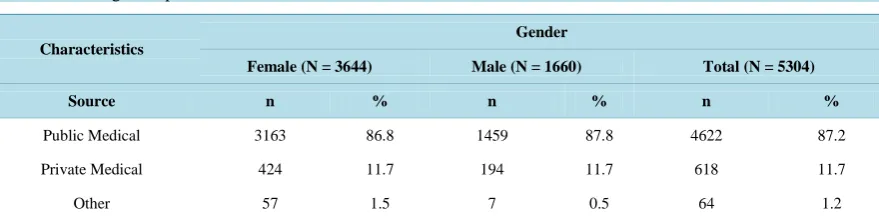
Three-fourths (73.9%) of respondents knew a place where they could obtain FP services and this did not vary much by gender (Table 5). Seven out of ten males (71.5%) knew where to obtain condoms, with a majority of them preferring the private sector (54.2%) over the public (44.9%). Over 85% of respondents (87% female and 88% male) knew of the public health sector, followed by the private sector (11.7%) and others sources (1.2%), as venues to obtain FP methods and services. The public health sector dominated the sources of FP methods; injec-tables, intrauterine device (IUD) implants and sterilization for example are usually administered at health facili-ties. A female participant’s concern raised in an FGD goes to confirm this assertion: “Something like the injec-tion (injectables); you need (a) qualified health personnel to attend to you”.
3.6. Current Contraceptive Use among Married and Sexually Active Unmarried Women
The contraceptive prevalence rate (CPR) for any method among married and unmarried sexually active women was 25.3% and 43.5% respectively. The injectables (32.4%) was the most frequently used contraceptive among married women, followed by the pill (26.2%); the reverse was however observed among unmarried sexually ac-tive women (i.e. 34.7% pills and 20.2% injectables) (Table 6). Current use of male condoms was higher (11.5%) among sexually active unmarried women compared to 1.5% in married women. Constituting less than one per-cent of current contraceptive use, the foam/jelly, diaphragm, IUDs, female condoms and emergency contracep-tion could be considered unpopular among the populacontracep-tion surveyed. The rhythm method was more popular among sexually active unmarried women (23.8%) as compared to the married (16.3%) (Table 6).3.7. Perceptions about FP and Contraception
Majority of respondents considered FP as a way of reducing the number of unwanted pregnancies and abortions (81.8%) and maternal deaths from complications of pregnancy and childbirth (72%) (Table 7). FP was also seen as improving overall health and wellbeing (79.5%) as well as health of mothers and children (79.2%). About half of all respondents (46.9% female and 55.6% males) perceived contraceptive use as ways of encouraging prom-iscuity among women. More females (46.3%) than males (37.5%) viewed contraception as the responsibility of women (Table 7). The FGDs endorsed such findings: “…I think it is the woman and the daughter who really need family planning…” (male respondent)… and “…What I know is that family planning is good for women and their daughters because they are closer to each other than the father so it is of more benefit to women and their daughters….” (male respondent)
Most (85.5%) respondents agreed that children born into smaller families were more likely to succeed in life (Table 7). This was demonstrated by the view of a female respondent: “…When I gave birth without spacing them, I really suffered but since I started using it (family planning) I have been able to space my children…I have (also) been able to save some money that I am hoping to use to support my child to continue her educa-tion.”
[image:7.595.95.535.574.684.2]Majority of males (78.9%) were aware that breastfeeding women could become pregnant; 73% knew of days within the menstrual cycle when women were more likely to become pregnant.
Table 5. Knowledge of a place where FP services could be or were obtained.
Characteristics
Gender
Female (N = 3644) Male (N = 1660) Total (N = 5304)
Source n % n % n %
Public Medical 3163 86.8 1459 87.8 4622 87.2
Private Medical 424 11.7 194 11.7 618 11.7
Other 57 1.5 7 0.5 64 1.2
Table 6. Current contraceptive use among currently married and sexually active unmarried women.
Characteristics
Gender
Married (N = 2327) Sexually Active Unmarriedb (N = 821) Total (N = 3148)
Method n % n % n %
Any Method 589 25.3 357 43.5 946 30.1
Any Modern Method 445 19.1 247 30.1 692 22.0
Any Traditional Method 144 6.2 110 13.4 254 8.1
Modern Methods
Injectables 191 32.4 72 20.2 278 27.8
Pills 154 26.2 124 34.7 263 29.4
Female Sterilization 73 12.4 6 1.7 79 8.4
Implant 12 2.0 3 0.8 15 1.6
Male Condom 9 1.5 a 41 11.5a 50 5.3
Foam 2 0.3 0 0.0 2 0.2
Jelly/diaphragm 2 0.3 0 0.0 2 0.2
IUD 1 0.2 0 0.0 1 0.1
Female Condom 1 0.2 1 0.9 2 0.2
Emergency Contraception 0 0.0 0 0.0 0 0.0
Male Sterilization 0 0.0 0 0.0 0 0.0
Natural/Traditional Methods
Rhythm 96 16.3 85 23.8 181 19.1
LAM 18 3.1 0 0.0 18 1.9
Withdrawal 13 2.2 7 2.0 20 2.1
Other Methods 17 2.9 18 5.0 35 3.7
a
Respondents whose partners had ever used a given method; bSexually active refers to sexual intercourse within the last 30 days.
Table 7. Perceptions about FP and contraception.
Characteristics
Gender
Female (N = 4946)
Male (N = 2225)
Total (N = 7171)
Statement about FP n % n % n %
Reduces number of unwanted pregnancies and abortions 3973 80.3 1891 85.0 5864 81.8
Improves overall health and wellbeing 3819 77.2 1882 84.6 5701 79.5
Improves the health of mothers and children 3811 77.1 1866 83.9 5677 79.2
Reduces the death of mothers from complications of pregnancy and childbirth 3399 68.7 1767 79.4 5166 72.0
Statement about contraception
It is better not to have more children than you can take care of 4538 91.8 2000 89.9 6538 91.2
Children in small families are more likely to succeed in life 4263 86.2 1865 83.8 6128 85.5
Having too many children may be dangerous for a woman 4091 82.7 1827 82.1 5918 82.5
Women who use contraception may become promiscuous 2322 46.9 1236 55.6 3558 49.6
4. Discussion
This study sought to describe characteristics influencing FP use in the Kintampo districts of Ghana. These were knowledge and use of FP, access to FP and perceptions about FP. The data comes from a representative sample of the population under study and would serve as a baseline for future updates. The KHDSS platform makes it feasible to follow the same cohort of study participants in future updates. Mixed-methods employed in the sur-vey places in context the findings and make them relevant to the needs of the study population.
4.1. Awareness and Use of FP Methods
In the surveyed population, awareness was higher compared to use of FP methods, similar to findings from other studies [5]-[7]. Awareness of modern methods was also significantly higher than that of traditional methods. The gap between knowledge and use may reflect the influence of a number of socio-cultural and economic factors that hinder access to and acceptance of FP methods. Some of these factors are poor female decision-making power [10], poor economic resources [11], low quality of care at FP services [12] and desire for large families [13]. For many sub-Saharan African countries, it is imperative to make contraceptive services more socially and economically accessible to women and their spouses; and this need is particularly pressing for couples in rural areas, where access to services is far below what is desired.
Contraceptive use among married women in the surveyed population was marginally higher than the Ghana national average of 23.5% [4]. Pills and injectables were the most currently used methods among married and sexually active unmarried women respectively, as per their own reports and those of their partners within the Kintampo districts. Respondents from a study in urban Ghana showed higher levels of use of pills among mar-ried women in contrast to the current study, where injectables were the most prevalent [14]. The reason for this situation may be largely due to their availability and publicity compared to other methods such as foam/jelly, di-aphragm, IUDs, female condoms and emergency contraception, which are not usually advertised [12]-[14]. For males however, the male condom was the most ever used method. The male condom was less popular in the fe-male study population, however the sexually active unmarried fefe-males’ current use was more than that of the married. Reasons such as lack of trust, wanting to become pregnant, stigma of associating condoms with HIV and STIs from prior prevention campaigns among others have been associated with community members avoid-ing condom use [15] [16].
It was observed that unmarried sexually active females used any, modern and traditional methods of contra-ception much more than married females in this surveyed population. The rhythm method was the most promi-nent of traditional methods used and non-married females “out-used” their married counterparts. The rhythm/ calendar method has been shown to be quite effective and satisfactory among relatively rural populations [17].
4.2. Sources of FP Information
Just like previous studies, radio (mass media) was identified as the most popular FP dissemination means [18], [19]. The current study identified other relevant and growing sources of FP message dissemination; this has been found to be social activities such as going to the market, fetching water, games, and visits to hairdresser’s sa-loons. This can serve as a cheap means for FP messaging.
4.3. Awareness of Sources of Contraceptives
Contraceptives in the surveyed population were accessed from diverse sources as documented in earlier studies. Among them are public medical facilities under the health ministry, non-governmental health institutions (pri-vate health facilities, pharmacy/chemical sellers) and other sources such as friends and religious bodies [4]. It was evident however that, FP services still reside within health institutions, possibly because the methods avail-able require expertise from within such facilities significantly determining the source of service [20] [21]. The private sector, mostly chemical shops serve as sources of non-clinical contraceptives such as condoms and pills [20] [21], as shown in the current survey results.
4.4. Perceptions about FP and Contraception
percep-tions of male attitudes towards FP are often a significant barrier for women [18] [19]. The perception by more males than females that FP leads to female promiscuity is worrying and requires attention and efforts to change. Another unfavorable perception is the view that contraception is women’s responsibility and that men should not have to worry about it. This perception does not encourage high contraceptive uptake [22] [23]. Joint deci-sion-making by couples about the use of FP is a key determinant of contraceptive use [22] [23]. Findings from other studies suggest that factual information on FP encourages contraceptive use, while myths and misinforma-tion discourages its use [24]-[27].
4.5. Limitations
These analyses were based on self-reported sexual behaviour, which could be affected by some biases of under-reporting or over under-reporting [28]. To minimise responder biases from answering personal questions such as FP use, interviewers were trained specifically with the skill of establishing rapport and questioning.
4.6. Conclusions and Recommendations
Findings from this study have depicted some essential shortfalls in the FP needs of the surveyed population that require action. It has also demonstrated some similarities and divergence from the FP picture within the country Ghana. Recommendations provided are mainly to policy makers, program implementers and healthcare providers.
Awareness of emergency contraception is low, so is its use. This calls for a proactive informational campaign by program implementers and healthcare providers to enhance knowledge and use by the populace. The promi-nence of the rhythm method among the traditional methods, more-so among the non-married makes it a potential for promotion among the population. Providing appropriate education to the population on its accurate utilization will enhance its effectiveness.
Radio was found to be an essential source of FP messages, as such program implementers should continue its use for dissemination of messages. Social activities have also shown a potential of enhancing message dissemi-nation and should be considered as additional or alternate to radio to enhance information spread.
As majority of the study population would go to health facilities to access FP methods, policy makers should ensure that health facilities have adequate staff strength and expertise to provide such services. Health care pro-viders should also make themselves accessible and provide satisfactory care to their clients. Methods however, that do not require specific clinical expertise should continue being made available in non-health institutions to increase access.
To address the perceptions of promiscuity associated with female FP use and FP use being the responsibility of women alone, program implementers and healthcare providers should devise and implement evidence-based educational messages and supplement them with role models to disabuse the minds of community members. Contraceptives in the surveyed population were accessed from diverse sources as documented in earlier studies.
Acknowledgements
The authors wish to thank the Municipal and District Assemblies, chiefs, elders, opinion leaders and community members in the Kintampo North Municipality and Kintampo South District for their goodwill and participation in the health and demographic surveillance system. We also wish to thank Mrs. Alice Vorleto and the entire Kintampo North Municipal Health Management Team for their assistance in training field staff on sensitive as-pects of the survey tool, all field and computer centre staff. This study was conducted with funds from the KHRC research fund.
References
[1] United Nations (2011) World Population Prospects, the 2010 Revision.
http://scholar.google.com/scholar?q=World+Population+Prospects:+The+2010+Revision&btnG=&hl=en&as_sdt=0,5#5
[2] Cleland, J., Bernstein, S., Ezeh, A., Faundes, A., Glasier, A. and Innis, J. (2006) Family Planning: The Unfinished Agenda. The Lancet, 368, 1810-1827. http://dx.doi.org/10.1016/S0140-6736(06)69480-4
[3] National Population Council (1994) National Population Policy of Ghana. Government of Ghana, Accra.
[5] Aryeetey, R., Kotoh, A.M. and Hindin, M.J. (2010) Knowledge, Perceptions and Ever Use of Modern Contraception among Women in the Ga East District, Ghana. African Journal of Reproductive Health, 14, 27-32.
[6] Bawah, A.A., Akweongo, P., Simmons, R. and Phillips, J.F. (1999) Women’s Fears and Men’s Anxieties: The Impact of Family Planning on Gender Relations in Northern Ghana. Studies in Family Planning, 30, 54-66.
http://dx.doi.org/10.1111/j.1728-4465.1999.00054.x
[7] Adanu, R.M.K., Seffah, J.D., Hill, A.G., Darko, R. and Rosemary, B. (2009) Contraceptive Use by Women in Accra, Ghana : Results from the 2003 Accra Women’s Health Survey. African Journal of Reproductive Health, 13, 123-134. [8] Parr, N.J. (2003) Discontinuation of Contraceptive Use in Ghana. Journal of Health, Population and Nutrition, 21,
150-157.
[9] Owusu-Agyei, S., Nettey, O.E.A., Zandoh, C., Sulemana, A., Adda, R., Amenga-Etego, S. and Mbacke, C. (2012) Demo- graphic Patterns and Trends in Central Ghana: Baseline Indicators from the Kintampo Health and Demographic Sur-veillance System. Global Health Action, 5, 1-11.
[10] Chapagain, M. (2005) Masculine Interest behind High Prevalence of Female Contraceptive Methods in Rural Nepal. Australian Journal of Rural Health, 13, 35-42 http://dx.doi.org/10.1111/j.1440-1854.2004.00643.x
[11] Stephenson, R. and Tsui, A.O. (2002) Contextual Influences on Reproductive Health Service Use in Uttar Pradesh, In-dia. Studies in Family Planning, 33, 309-320. http://dx.doi.org/10.1111/j.1728-4465.2002.00309.x
[12] Hamid, S. and Stephenson, R. (2006) Provider and Health Facility Influences on Contraceptive Adoption in Urban Pa-kistan. International Family Planning Perspectives, 32, 71-78. http://dx.doi.org/10.1363/3207106
[13] Bankole, A. and Singh, S. (1998) Couples’ Fertility and Contraceptive Decision-Making in Developing Countries: Hearing the Man’s Voice. International Family Planning Perspectives, 24, 15-24. http://dx.doi.org/10.2307/2991915
[14] Cox, C.M., Hindin, M.J., Otupiri, E. and Larsen-Reindorf, R. (2013) Understanding Couples’ Relationship Quality and Contraceptive Use in Kumasi, Ghana. International Perspectives on Sexual and Reproductive Health, 39, 185-194.
http://dx.doi.org/10.1363/3918513
[15] Chacko, S., Kipp, W., Laing, L. and Kabagambe, G. (2007) Knowledge of and Perceptions about Sexually Transmitted Diseases and Pregnancy: A Qualitative Study among Adolescent Students in Uganda. Journal of Health, Population and Nutrition, 25, 319-327.
[16] Baumgartner, J.N., Lugina, H., Johnson, L. and Nyamhanga, T. (2010) “Being Faithful” in a Sexual Relationship: Per-ceptions of Tanzanian Adolescents in the Context of HIV and Pregnancy Prevention. AIDS Care, 22, 1153-1158.
http://dx.doi.org/10.1080/09540121003615095
[17] Burkhart, M., de Mazariegos, L., Salazar, S. and Lamprecht, V.M. (2000) Effectiveness of a Standard-Rule Method of Calendar Rhythm among Mayan Couples in Guatemala. International Family Planning Perspectives, 26, 131-136.
http://dx.doi.org/10.2307/2648302
[18] Olenick, I. (2000) Women’s Exposure to Mass Media Is Linked to Attitudes toward Contraception in Pakistan, India and Bangladesh. International Family Planning Perspectives, 26, 48-50. http://dx.doi.org/10.2307/2648294
[19] Olaleye, D.O. and Bankole, A. (1994) The Impact of Mass Media Family Planning Promotion on Contraceptive Beha-vior of Women in Ghana. Population Research and Policy Review, 13, 161-177.
http://dx.doi.org/10.1007/BF01080201
[20] Agha, S. and Do, M. (2008) Does an Expansion in Private Sector Contraceptive Supply Increase Inequality in Modern Contraceptive Use? Health Policy and Planning, 23, 465-475. http://dx.doi.org/10.1093/heapol/czn035
[21] Hotchkiss, D.R., Godha, D. and Do, M. (2011) Effect of an Expansion in Private Sector Provision of Contraceptive Supplies on Horizontal Inequity in Modern Contraceptive Use: Evidence from Africa and Asia. International Journal for Equity in Health, 10, 33. http://dx.doi.org/10.1186/1475-9276-10-33
[22] Feyisetan, B.J. (2000) Spousal Communication and Contraceptive Use among the Yoruba of Nigeria. Population Re-search and Policy Review, 19, 29-45. http://dx.doi.org/10.1023/A:1006388011947
[23] Ogunjuyigbe, P.O., Ojofeitimi, E.O. and Liasu, A. (2009) Spousal Communication, Changes in Partner Attitude, and Contraceptive Use among the Yorubas of Southwest Nigeria. Indian Journal of Community Medicine: Official Publica-tion of Indian AssociaPublica-tion of Preventive & Social Medicine, 34, 112. http://dx.doi.org/10.4103/0970-0218.51232
[24] Ankomah, A., Anyanti, J. and Oladosu, M. (2011) Myths, Misinformation, and Communication about Family Planning and Contraceptive Use in Nigeria. Open Access Journal of Contraception, 2, 95-105.
http://dx.doi.org/10.2147/OAJC.S20921
[25] Otoide, V., Oronsaye, F. and Okonofua, F.E. (2001) Why Nigerian Adolescents Seek Abortion Rather than Contracep-tion: Evidence from Focus-Group Discussions. International Family Planning Perspectives, 27, 77-81.
http://dx.doi.org/10.2307/2673818
vince, Kenya. Studies in Family Planning, 28, 290-307. http://dx.doi.org/10.2307/2137860
[27] DeClerque, J., Tsui, A.O., Abul-Ata, M.F., Abul-Ata, M.F. and Barcelona, D. (1986) Rumor, Misinformation and Oral Contraceptive Use in Egypt. Social Science & Medicine, 23, 83-92. http://dx.doi.org/10.1016/0277-9536(86)90327-8