© 2016, IRJET ISO 9001:2008 Certified Journal Page 2880
SOLAR POWERED WATER LIFTER USING GIANT WHEEL METHOD
R.Abarna
1,Habis.k.Siddiqu
2, Jaginraj p.v
2,Jerin Jose
2,Jobin Mathew
21
Assistant Professor, Department of Mechanical Engineering, Gnanamani College of Technology, Namakkal,
Tamilnadu, India
2
UG scholar, Department of Mechanical Engineering, Gnanamani College of Technology, Namakkal, Tamilnadu,
India
---***---Abstract- By using this machine large amount of
water can be lifted from rivers easily and also
quickly. The power for the motor is given from a
solar panel. Solar panel consists of number of
silicon cells, when sun light falls on this panel it
generates the voltage signals, these voltage
signals are given to charging circuit. The motor
gets supply from the circuit .The motor is
connected to the scoops by means of worm gear.
When the motor starts rotating it leads to rotate the
scoops by means of gears .Thus the water from the
river surface can be collected in a tank.
Keywords- DC Motor, Worm Gear,Solar Panel,Giant Wheel.
1. INTRODUCTION
Water is a common chemical substance that
is essential for the survival of all known forms of life.
In typical usage, water refers only to its liquid form
or state, but the substance also has a solid state, ice,
and a gaseous state, water vapor or steam. About
1.460 petatonnes(Pt) (10
21kilograms) of water
covers 71% of the Earth's surface, mostly in oceans
and other large water bodies, with 1.6% of water
below ground in aquifers and 0.001% in the air as
vapor, clouds (formed of solid and liquid water
particles suspended in air), and precipitation.
Saltwater oceans hold 97% of surface water, glaciers
and polar ice caps 2.4%, and other land surface water
such as rivers, lakes and ponds 0.6%. A very small
amount of the Earth's water is contained within
water towers, biological bodies, manufactured
products, and food stores. Other water is trapped in
ice caps, glaciers, aquifers, or in lakes, sometimes
providing fresh water for life on land.
Water moves continually through a cycle of
evaporation or transpiration (evapotranspiration),
precipitation, and runoff, usually reaching the sea.
Winds carry water vapor over land at the same rate
as runoff into the sea, about 36 Tt (10
12kilograms)
per year. Over land, evaporation and transpiration
contribute another 71 Tt per year to the precipitation
of 107 Tt per year over land. Clean, fresh drinking
water is essential to human and other life. However,
in many parts of the world especially developing
countries there is a water crisis, and it is estimated
that by 2025 more than half of the world population
will be facing water-based vulnerability. Water plays
an important role in the world economy, as it
functions as a solvent for a wide variety of chemical
substances and facilitates industrial cooling and
transportation. Approximately 70% of freshwater is
consumed by agriculture.
Water can appear in three states; it is one of
the very few substances to be found naturally in all
three states on earth. Water takes many different
forms on Earth: water vapor and clouds in the sky;
seawater and rarely icebergs in the ocean; glaciers
and rivers in the mountains; and the liquid in
aquifers in the ground.
Water
can
dissolve
many
different
© 2016, IRJET ISO 9001:2008 Certified Journal Page 2881
it, as pure H
2O is tasteless. As such, purity in spring
and mineral water refers to purity from toxins,
pollutants, and microbes.
2. LITERATURE REVIEW
II. LITERATURE SURVEY
WATER:
Water covers more than two-thirds of the Earth's surface. But fresh water represents less than 0.5% of the total water on Earth. The rest is either in the form of seawater or locked up in icecaps or the soil, which is why one often hears of water scarcity in many areas.
Water is continuously moving around the earth and constantly changing its form. It evaporates from land and water bodies and is also produced by all forms of life on Earth. This water vapour moves through the atmosphere, condenses to form clouds and precipitates as rain and snow. In time, the water returns to where it came from, and the process begins all over again. Although water is constantly moving, its total quantity on Earth's surface is constant.
FORMS OF WATER:
Water is found in three different forms - liquid, solid or gas, depending on the temperature but it
constantly changes from one form to another. Changes in temperature will determine which of these forms predominates in a particular area.
Liquid:
Water is usually encountered in the liquid state, because this is its natural state when temperatures are between 0° C and 100° C. 'Fresh' or drinking water is found as groundwater in underground aquifers, and on the surface in ponds, lakes, and rivers. Seas and oceans account for 97% of all water on Earth; but their waters contain dissolved salts and are therefore unfit to drink. In regions of young volcanic activity, hot water emerges from the earth in hot springs (examples are Garampani in Assam and Badrinath in Uttaranchal). How does this phenomenon occur? Surface water percolates downward through the rocks below the Earth's surface to high-temperature regions surrounding a magma reservoir, either active, or recently solidified but still hot. There the
water is heated, becomes less dense, and rises back to the surface through fissures and cracks.
Solid:
Ice is the frozen form of water. It occurs when temperatures are below 0°C (32°F). For a given mass, ice occupies 9% more volume than water, which is why when water enters cracks in rocks and freezes it causes the rocks to crack and split. Being less dense than water, ice floats. This property of ice is vital to aquatic life in cold regions. As the temperature drops, ice forms a protective, insulating layer on the surfaces of streams, pools and other water bodies, allowing water to remain liquid in the layers beneath and life to survive. Glaciers, icebergs, and ice caps are all frozen water.
Gas:
Water is found in the atmosphere in its gaseous form, water vapour. Steam is nothing but vapourized water. In certain hot water springs called geysers, jets of steam and hot water rise one hundred feet or more from the ground. Geysers are found in Iceland, the North Island of New Zealand and in USA's Yellowstone National Park.
Worldwide, the consumption of water is doubling every 20 years - more than twice the rate of increase in population.
A large amount of water is wasted in agriculture, industry, and urban areas. It has been estimated that with available technologies and better operational practices, agricultural water demand could be cut by about 50% and that in urban areas by about 33% without affecting the quality or economics of life. But most governments do not have adequate laws or regulations to protect their water systems.
Due to the increase in population there has been a rise in the demand for food, space for housing, consumer products, etc., which has in turn resulted in increased industrialization, urbanization, and demands in agriculture thereby leading to both river and groundwater contamination.
Some interesting facts about water :
75% of the earth's surface is covered with water More than 97% of the earth's water is in its oceans About 2% of the available drinking water is frozen leaving only 1% for drinking
© 2016, IRJET ISO 9001:2008 Certified Journal Page 2882 regulates the temperature of the human body, carries
nutrients and oxygen to cells, cushions joints, protects organs and tissues, and removes waste
60% - 75% of the adult human body is water - 82% of blood is water; 70% of the brain and 90% of the lungs are made up of water
Blood in animals and sap in plants is composed mainly of water
To cook 1 cup of rice you need 2 cups of water but to wash the pan in which it has been cooked you need 4-5 litres of water
A dripping tap can waste up to 6 litres of water in a day More than half the creatures on the Earth are found under water
Life on earth probably originated in water
In the summer our bodies require about 2 litres of water daily. Here is the water content of some foods
(approximate) - 95% in tomato, 91% in spinach, 91% in milk, 85% in apples and 80% in potatoes
10% of the earth's surface is covered with ice
There are more than one billion people particularly in North Africa and Western and South Asia, who lack access to a steady supply of clean water.
Access to water and sanitation, so crucial to human well-being and development, has now become a priority for the international community. To underscore the need for immediate action, the United Nations has designated 2003 as the International Year of Freshwater.
B. Component Details
[image:3.595.344.559.505.654.2]1) DC Motor:
In any electric motor, operation is based on simple electromagnetism. A current-carrying conductor generates a magnetic field; when this is then placed in an external magnetic field, it will experience a force proportional to the current in the conductor, and to the strength of the external magnetic field. As you are well aware of from playing with magnets as a kid, opposite (North and South) polarities attract, while like polarities (North and North, South and South) repel. The internal configuration of a DC motor is designed to harness the magnetic interaction between a current-carrying conductor and an external magnetic field to generate rotational motion [1]. The dc motor show in Fig 1Fig. 1 DC motor
SOLAR PANEL
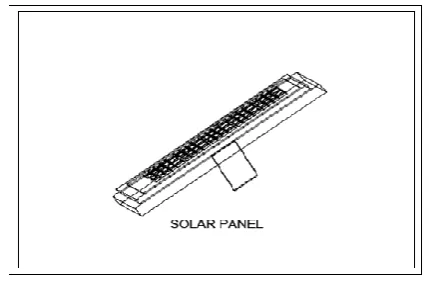
A solar panel is a device that collects and converts solar energy into electricity or heat. It known as Photovoltaic panels, used to generate electricity directly from sunlight Solar thermal energy collection systems, used to generate electricity through a system of mirrors and fluid-filled tubes solar thermal collector, used to generate heat solar hot water panel, used to heat water.
It is energy portal. A solar power technology that uses solar cells or solar photovoltaic arrays to convert light from the sun directly into electricity. Photovoltaic, is in which light is converted into electrical power. It is best known as a method for generating solar power by using solar cells packaged in photovoltaic modules, often electrically connected in multiples as solar photovoltaic arrays to convert energy from the sun into electricity. The photovoltaic solar panel is photons from sunlight knock electrons into a higher state of energy, creating electricity.
Fig no:2 solar panel
© 2016, IRJET ISO 9001:2008 Certified Journal Page 2883
BATTERY
In our project we are using secondary type battery. It is rechargeable type. A battery is one or more electrochemical cells, which store chemical energy and make it available as electric current. There are two types of batteries, primary (disposable) and secondary (rechargeable), both of which convert chemical energy to electrical energy. Primary batteries can only be used once because they use up their chemicals in an irreversible reaction.
Secondary batteries can be recharged because the chemical reactions they use are reversible; they are recharged by running a charging current through the battery, but in the opposite direction of the discharge current. Secondary, also called rechargeable batteries can be charged and discharged many times before wearing out. After wearing out some batteries can be recycled.
Batteries have gained popularity as they became portable and useful for many purposes. The use of batteries has created many environmental concerns, such as toxic metal pollution. A battery is a device that converts chemical energy directly to electrical energy it consists of one or more voltaic cells. Each voltaic cell consists of two half cells connected in series by a conductive electrolyte.
One half-cell is the positive electrode, and the other is the negative electrode. The electrodes do not touch each other but are electrically connected by the electrolyte, which can be either solid or liquid. A battery can be simply modeled as a perfect voltage source which has its own resistance, the resulting voltage across the load depends on the ratio of the battery's internal resistance to the resistance of the load.
When the battery is fresh, its internal resistance is low, so the voltage across the load is almost equal to that of the battery's internal voltage source. As the battery runs down and its internal resistance increases, the voltage drop across its internal resistance increases, so the voltage at its terminals decreases, and the battery's ability to deliver power to the load decreases
DRAWING FOR SOLAR POWERED WATER LIFTING
Fig.10Block Diagram
Fig no:3 solar powered water lifter system
B. SYSTEM WORKING Solar panel consists of number of silicon cells, when sun light falls on this panel it generates the voltage signals, these voltage signals given to charging circuit. Depends on the panel board size the generated voltage amount is increased. Here the worm gear and motor arrangement is used to control the rotation of the scoop. The motor gets supply from the solar panel. These scoops are arranged as it can touch the water surface. Below these scoops arrangement there is a tank which contains water. A tray and a collecting tray are arranged as shown in the diagram. When the motor rotates the scoops also starts rotating due the gear arrangement. So when the scoops rotate it reaches the water surface, when scoops leave the water surface it carries little amount of water in it. After scoop reaches the upper area the water spill in a tray due to gravitational force as the arrangement of the scoop is made so. The spilled water then reaches a collecting tray which is connected to the tank.
SOLAR PANEL CALCUALTION:
VOLT = 12 V
WATT = 5 W
W = V X I
5 = 12 X I
I = 5/12
I = 420ma
BATTERY CALCULATION:
BAH /CI = 8 ah/420ma
© 2016, IRJET ISO 9001:2008 Certified Journal Page 2884 To find the Current
Watt = 18 w
Volt = 12v
Current =?
P= V x I
18 =12 x I
I = 18/12
= 1.5 AMPS
BATTERY USAGE WITH 1.5 AMPS
BAH /I
8/1.5 = 5.3 hrs
30 RPM CALCAULTION DC MOTOR
SPEED = 30 RPM
VOLTAGE = 12 VOLT
WATTS = 18 WATT
Electrical (electric) power equation:
Power P = I × V
Where
V = 12
W = 18
I=18/12
=1.5 A
H.P = .02414
TORQUE OF THE MOTOR:
Torque = (P X 60) / (2 X 3.14 X N)
Torque = (18X 60) / (2 X 3.14 X 30)
Torque = 5.72 Nm
WORM GEAR CALCULATION [APPROXIMATE]
Number of teeth on worm wheel = 32
Outer diameter of worm wheel = 50.5 mm
Inner diameter of worm wheel = 12 mm
Number of starts on worm = 9
Axial Pitch of Worm or Circular Pitch of Gear P: 6.23 Pitch Circle Diameter of Worm D1: 16.07
Pitch Circle Diameter of Gear D2: 63.47
Centre to Centre Distance Between Worm and Gear C: 39.774
The value of "L1 = [C^(0.875)]/2" : 12.54 The value of "L2 = [C^(0.875)]/1.07" : 23.45
Motor speed = N = 30 rpm
Power of motor = p = 18 watts
Diameter of shaft = 15 mm
Mild steel shaft shear stress = fs = 210 N / mm^2
Torque of the motor = T = p x 60 / 2 x π x N
= 18 x 60 / 2 x π x 30
= 5.729 N - m
Gear ratio (i) = n1 / n2
(n1) worm shaft speed = 30 rpm
= 30 / 32
(n2) worm wheel speed = 0.937 rpm
Torque of the worm wheel (t2) = p2 x 60 / 2 x π x N2
= 18 x 60 /2 x π x 0.937
= 183.44 N m
Angular velocity of worm wheel = 2 x π x 0.937 / 60
= 0.098rad
Maximum torque rate of the worm wheel = π/16 x fs x d^3
© 2016, IRJET ISO 9001:2008 Certified Journal Page 2885 = 2226.6 N m
Worm wheel torque is limited to the maximum limit. So our design is safe.
Hence the worm wheel used here rotates at = 0.937 rpm
3.CONCLUSION
The project carried out by us made an impressing task in the field of water pumping area like agricultural etc..,
This project will reduce the cost involved in the concern. Project has been designed to perform the entire requirement task at the shortest time available.
REFERENCES
1.Halcrow, S.W. and Partners. 1981. Small-scale
solarpowered irrigation pumping systems: technical and
economic review. UNDP Project GLO/78/004.
Intermediate Technology Power, London, UK
2. Salameh, Z., A.K. Milpur, and F. Dagher. 1989. Controller gets last drop for photovoltaic system. Solar Today 14 (1):
26-27.