Copyright © 1997, American Society for Microbiology
Multicenter Evaluation of the Updated and Extended API
(RAPID) Coryne Database 2.0
GUIDO FUNKE,1* FRANC¸OIS N. R. RENAUD,2JEAN FRENEY,2ANDPHILIPPE RIEGEL3 Department of Medical Microbiology, University of Zu¨rich, 8028 Zu¨rich, Switzerland,1and
DERBA UPRES EA 1655, Faculte´ de Me´decine Rene´ Laennec, 69372 Lyon,2and Institut de Bacte´riologie, Universite´ Louis Pasteur, 67000 Strasbourg,3France Received 24 June 1997/Returned for modification 28 August 1997/Accepted 19 September 1997
In a multicenter study, 407 strains of coryneform bacteria were tested with the updated and extended API (RAPID) Coryne system with database 2.0 (bioMe´rieux, La-Balme-les-Grottes, France) in order to evaluate the system’s capability of identifying these bacteria. The design of the system was exactly the same as for the previous API (RAPID) Coryne strip with database 1.0, i.e., the 20 biochemical reactions covered were identical, but database 2.0 included both more taxa and additional differential tests. Three hundred ninety strains tested belonged to the 49 taxa covered by database 2.0, and 17 strains belonged to taxa not covered. Overall, the system correctly identified 90.5% of the strains belonging to taxa included, with additional tests needed for correct identification for 55.1% of all strains tested. Only 5.6% of all strains were not identified, and 3.8% were misidentified. Identification problems were observed in particular for Corynebacterium coyleae, Propionibacte-rium acnes, and AureobactePropionibacte-rium spp. The numerical profiles and corresponding identification results for the taxa not covered by the new database 2.0 were also given. In comparison to the results from published previous evaluations of the API (RAPID) Coryne database 1.0, more additional tests had to be performed with version 2.0 in order to completely identify the strains. This was the result of current changes in taxonomy and to provide for organisms described since the appearance of version 1.0. We conclude that the new API (RAPID) Coryne system 2.0 is a useful tool for identifying the diverse group of coryneform bacteria encountered in the routine clinical laboratory.
It is common knowledge that the identification of coryne-form bacteria is one of the most difficult tasks for clinical bacteriologists. This is mainly due to the enormous diversity of these organisms and the small number of readily available conventional tests that can be used to differentiate them. The API (RAPID) Coryne system (bioMe´rieux, La-Balme-les-Grottes, France), introduced in the early 1990s (1, 7, 11), was the first specific commercial identification system for coryne-form bacteria and has since proved itself invaluable to many clinical laboratories. Because our knowledge of the diversity of coryneform bacteria encountered in clinical specimens has dra-matically increased since the early 1990s (6), it has become appropriate to broaden and adopt the API Coryne (RAPID) database, considering both changes in taxonomy and newly described taxa. [The term API Coryne instead of API (RAP-ID) Coryne will be used from here on throughout the whole article.] Version 1.0 of the API Coryne database contained only 33 taxa, whereas the new version 2.0 covers 49 taxa. A multicenter study was created to evaluate this most recent database. The design of the study was such that numerical distribution of the strains tested did not reflect their frequency of isolation in clinical specimens but was rather directed to challenging the depth of the new database with a heteroge-neous group of organisms. It is finally important to note that the design of the API Coryne strip was not altered by the company (i.e., the same 20 biochemical reactions were still included) but that the new database contained many more
additional easy-to-perform tests useful in the differentiation of coryneform bacteria.
MATERIALS AND METHODS
Strains, media, and growth conditions.A total of 407 strains of mainly coryne-form bacteria (i.e., aerobically growing, asporogenous, non-partially acid-fast, irregularly shaped gram-positive rods) were included in this study. Noncoryne-form bacteria included were 18 Listeria strains, 3 strains of Erysipelothrix
rhusio-pathiae, 4 Rhodococcus strains, 5 Gordona strains, and 2 Dietzia maris strains.
About 20% of the strains were fresh clinical isolates, and 80% of the strains came from the culture collections of the three participating laboratories. All strains had been characterized in detail before applying phenotypic, chemotaxonomic, and molecular genetic methods, with many of the strains representing members of new taxa which had been recently defined by the authors of the present report. The type strains of each taxon tested were also included.
All strains were at least twice subcultured on Columbia agar supplemented with 5% sheep blood (SBA) before the cells were harvested after 24 h of incubation at 37°C in a 5% CO2-enriched atmosphere.
API Coryne system.The system was inoculated with a cell suspension as described previously by Freney et al. (1), and the urease reaction mixture and the nine carbohydrate acidification reaction mixtures (including one negative control reaction mixture) were covered with sterile paraffin oil. Special attention was given to the fact that the cell suspension had to be prepared to a turbidity greater than or equal to 6 on a McFarland scale. The strips were incubated for exactly 24 h at 37°C in ambient air. In parallel, an SBA plate was inoculated with 1 drop of the cell suspension in GP medium (bioMe´rieux) used and cultured at 37°C for 24 h in a 5% CO2-enriched atmosphere in order to check the purity of the inoculum. After application of reagents (1), strips were independently read by two different people. In the case of ambiguous results, a third person was asked to read the strips. However, this was necessary for less than 2% of the strains examined. The numerical identification profiles obtained (comprised of seven digits) were run against the API Coryne database 2.0 by using the API software on a personal computer.
Reporting of results.There were four different categories of results: (i) “cor-rect identification” meant that a strain was unambiguously cor“cor-rectly identified (i.e., only the correct identification was given); (ii) “correct identification with extra tests” meant that additional characteristics proposed by the database had to be examined in order to end up with a correct identification (i.e., the correct identification was initially given among others); (iii) “no identification” included profiles with doubtful or unacceptable identification; (iv) “misidentification” simply included incorrectly identified strains.
* Corresponding author. Mailing address: Department of Medical Microbiology, University of Zu¨rich, Gloriastrasse 32, CH-8028 Zu¨rich, Switzerland. Phone: 41-1-634-2701. Fax: 41-1-634-4906. E-mail: funke @immv.unizh.ch.
3122
on May 15, 2020 by guest
http://jcm.asm.org/
RESULTS
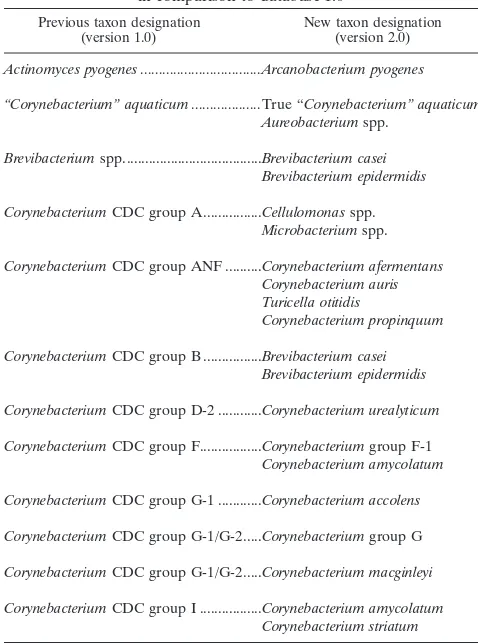
Although the new database had been expanded to include 13 new taxa (see footnote a of Table 1), 2 taxa that had appeared in version 1.0 were removed: Corynebacterium pilosum was included in the Corynebacterium renale group of organisms and Corynebacterium xerosis was not included any more, as it is very rarely encountered in clinical specimens (6). Taxonomic des-ignations were thoroughly updated, and certain taxa (e.g., Corynebacterium CDC group ANF and group F) were split into different taxa resulting in additional new taxa included (Table 1).
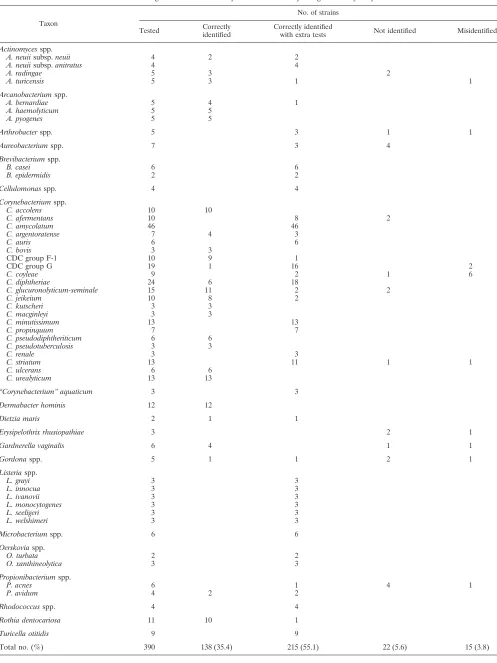
Four hundred seven strains (390 strains belonging to taxa included in the database and 17 strains not included) were tested in the API Coryne system. The 17 strains not included in the database were not taken into the calculations of the system’s performance. The system correctly identified 138 (35.4%) of the remaining 390 strains, and 215 (55.1%) of all strains were correctly identified with extra tests, resulting in a total of 90.5% correct identifications (Table 2). Twenty-two (5.6%) strains were not identified, and only 15 (3.8%) were misidentified. Moreover, 12 of the 22 strains not identified could be correctly identified by suggested extra tests. However, due to the definitions applied (see Materials and Methods)
these 12 remained in the not-identified category for further calculations. The most frequently encountered coryneform bacteria in clinical specimens, namely, Corynebacterium amy-colatum, Corynebacterium jeikeium, and Corynebacterium urea-lyticum, were, without exception, correctly identified (including the strains for which extra tests had to be performed).
The problems encountered with the API Coryne database 2.0 and the reasons for not identifying or for misidentifying some strains are listed in Table 3. Seven of nine Corynebacte-rium coyleae strains were misidentified due to all seven pro-ducing acid from glucose, in contrast to only 6% of strains in the 2.0 database found to have that characteristic. The reverse was encountered with Propionibacterium acnes, whereby five of six strains had a negative N-acetyl-b-glucosaminidase reaction and 100% of the database strains were positive. Finally, four of seven Aureobacterium strains in the study were reactive on carbohydrates, while Aureobacterium strains composing the da-tabase did not produce any acid from carbohydrates.
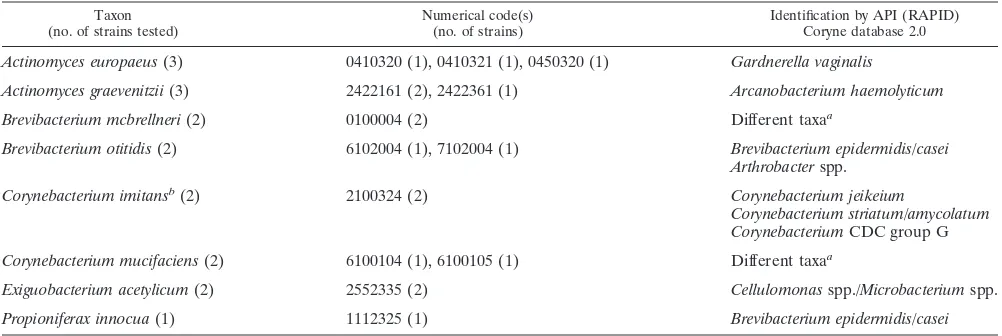
The 17 strains tested but not included in the API Coryne database 2.0 are listed in Table 4. The identification of some taxa, like Actinomyces europaeus (2) and Actinomyces graeve-nitzii (8), corresponded to a single taxon, whereas for other taxa (e.g., Corynebacterium mucifaciens [4]) multiple taxa ap-peared as identification. The taxa given in Table 4 were not included in database 2.0 because they had been only very recently described or because they are only rarely encountered in clinical specimens.
DISCUSSION
In our experience, the API Coryne system with the database 2.0 proved to be a handy and useful identification system for the majority of coryneform bacteria encountered in clinical specimens. We think that a performance with 90.5% correct identifications (including bacteria for which additional tests had to be performed) for the bacteria covered by the database makes the system recommendable for the routine clinical lab-oratory. If the 12 of 22 strains classified as “not identified” had been subjected to the suggested additional tests, the percent-age of correct identifications would have gone up to 93.6. This is a remarkable performance by the system, considering the enormous diversity of the organisms covered by the database. There are only very few medically relevant taxa of coryneform bacteria which were not included in the new database 2.0 (Table 4). Of note is that the most frequently encountered coryneform bacteria in clinical specimens (6, 10) were identi-fied very well. It is most unlikely that there will ever be a commercial identification system with a reliable database for the more rarely encountered coryneform organisms, such as yellow-pigmented bacteria (e.g., Aureobacterium and Mi-crobacterium spp.). Since these organisms are extremely heter-ogeneous (6) and the type strains are the only known repre-sentatives of particular species (13, 14), it is virtually impossible to build a complete database accurately differenti-ating all taxa.
[image:2.612.48.287.84.406.2]In general, the user of the API Coryne database 2.0 has to carry out more additional tests for correct identification than with the older database. This simply reflects the expansion of the new database, which leads to organisms from different taxa with similar metabolic profiles also having the same API pro-file number. Using database 1.0, Freney et al. (1) reported that extra testing for correct identification was required for 31.8% of their isolates and Soto et al. (11) reported additional tests for 21.8% of the strains tested, whereas Gavin et al. (7) had to carry out supplemental testing for only 4% of the isolates. In contrast, 55.1% of the isolates in the present study needed TABLE 1. Changes in the new API Coryne database 2.0
in comparison to database 1.0a
Previous taxon designation
(version 1.0) New taxon designation(version 2.0)
Actinomyces pyogenes ...Arcanobacterium pyogenes
“Corynebacterium” aquaticum ...True “Corynebacterium” aquaticum Aureobacterium spp.
Brevibacterium spp...Brevibacterium casei Brevibacterium epidermidis
Corynebacterium CDC group A...Cellulomonas spp. Microbacterium spp.
Corynebacterium CDC group ANF ...Corynebacterium afermentans Corynebacterium auris Turicella otitidis
Corynebacterium propinquum
Corynebacterium CDC group B ...Brevibacterium casei Brevibacterium epidermidis
Corynebacterium CDC group D-2 ...Corynebacterium urealyticum
Corynebacterium CDC group F...Corynebacterium group F-1 Corynebacterium amycolatum
Corynebacterium CDC group G-1 ...Corynebacterium accolens
Corynebacterium CDC group G-1/G-2...Corynebacterium group G
Corynebacterium CDC group G-1/G-2...Corynebacterium macginleyi
Corynebacterium CDC group I ...Corynebacterium amycolatum Corynebacterium striatum
aTaxa added to the new database (version 2.0) are as follows: Actinomyces
neuii subsp. anitratus, Actinomyces neuii subsp. neuii, Actinomyces radingae, Ac-tinomyces turicensis, Arcanobacterium bernardiae, Arthrobacter spp., Corynebacte-rium argentoratense, CorynebacteCorynebacte-rium coyleae, CorynebacteCorynebacte-rium glucuronolyticum-seminale, Dermabacter hominis, Propionibacterium acnes, Propionibacterium avidum, and Rothia dentocariosa. Taxa not included anymore in the new database
(version 2.0) are Corynebacterium pilosum and Corynebacterium xerosis.
on May 15, 2020 by guest
http://jcm.asm.org/
TABLE 2. Results of the testing of 390 strains of coryneform bacteria by using API Coryne system with database 2.0
Taxon
No. of strains
Tested Correctlyidentified Correctly identifiedwith extra tests Not identified Misidentified
Actinomyces spp.
A. neuii subsp. neuii 4 2 2
A. neuii subsp. anitratus 4 4
A. radingae 5 3 2
A. turicensis 5 3 1 1
Arcanobacterium spp.
A. bernardiae 5 4 1
A. haemolyticum 5 5
A. pyogenes 5 5
Arthrobacter spp. 5 3 1 1
Aureobacterium spp. 7 3 4
Brevibacterium spp.
B. casei 6 6
B. epidermidis 2 2
Cellulomonas spp. 4 4
Corynebacterium spp.
C. accolens 10 10
C. afermentans 10 8 2
C. amycolatum 46 46
C. argentoratense 7 4 3
C. auris 6 6
C. bovis 3 3
CDC group F-1 10 9 1
CDC group G 19 1 16 2
C. coyleae 9 2 1 6
C. diphtheriae 24 6 18
C. glucuronolyticum-seminale 15 11 2 2
C. jeikeium 10 8 2
C. kutscheri 3 3
C. macginleyi 3 3
C. minutissimum 13 13
C. propinquum 7 7
C. pseudodiphtheriticum 6 6
C. pseudotuberculosis 3 3
C. renale 3 3
C. striatum 13 11 1 1
C. ulcerans 6 6
C. urealyticum 13 13
“Corynebacterium” aquaticum 3 3
Dermabacter hominis 12 12
Dietzia maris 2 1 1
Erysipelothrix rhusiopathiae 3 2 1
Gardnerella vaginalis 6 4 1 1
Gordona spp. 5 1 1 2 1
Listeria spp.
L. grayi 3 3
L. innocua 3 3
L. ivanovii 3 3
L. monocytogenes 3 3
L. seeligeri 3 3
L. welshimeri 3 3
Microbacterium spp. 6 6
Oerskovia spp.
O. turbata 2 2
O. xanthineolytica 3 3
Propionibacterium spp.
P. acnes 6 1 4 1
P. avidum 4 2 2
Rhodococcus spp. 4 4
Rothia dentocariosa 11 10 1
Turicella otitidis 9 9
Total no. (%) 390 138 (35.4) 215 (55.1) 22 (5.6) 15 (3.8)
on May 15, 2020 by guest
http://jcm.asm.org/
additional testing. However, these included widely available and easy-to-perform tests, e.g., test for type of metabolism, motility test, and CAMP reaction, or a test for lipophilia (12), which are familiar to clinical bacteriologists. As a result, the suitability of the API Coryne system was not reduced by ex-pensive and time-consuming additional tests.
Difficulties observed in the identification of C. coyleae, P. acnes, and Aureobacterium spp. could be overcome by mod-ifying database 2.0 accordingly. For example, as has been re-ported before, C. coyleae strains acidified glucose and ribose at 48 h rather than the suggested 24 h (5). Difficulties in reading enzymatic reactions (in particular, alkaline phosphatase, N-acetyl-b-glucosaminidase, and esculin hydrolysis) might be avoided by reading of the strips by different persons. Esculin hydrolysis can be verified by exposing the API Coryne strip to UV light; since esculin is a fluorescent compound, fluorescence is observed when the substance is not hydrolyzed. It should be noted that for taxonomic investigations 24 h of incubation might not be sufficient, as some carbohydrate acidifications may become positive only after an extended incubation period (e.g., acid production from mannitol by Corynebacterium mac-ginleyi). Acid production might also be delayed in many other strains of lipophilic corynebacteria. In addition, we would like to stress the importance of basic microbiological tests (e.g., colony morphology, consistency of colonies, and Gram stain of cells) for the differentiation of coryneform bacteria (e.g., dif-ferentiation of the previous CDC coryneform group ANF
bac-teria) (6, 9). Unfortunately, the latter simple differentiation criteria were not explicitly mentioned in database 2.0 for the identification of bacteria with numerical code 2100004 (i.e., Corynebacterium afermentans, Corynebacterium auris, and Turi-cella otitidis). Furthermore, the database 2.0 did not include the simple morphologic differentiation between C. amycolatum (dry colonies with irregular edges) and Corynebacterium stria-tum or Corynebacterium minutissimum (both having creamy colonies with regular edges) (6).
It is obvious that chemotaxonomic methods are still indis-pensable for the identification of certain groups of bacteria (e.g., yellow-pigmented coryneforms and partially acid-fast bacteria). These isolates should be referred to a reference laboratory. Identification on the species level within these two groups of bacteria is very often possible by molecular genetic methods (16S ribosomal DNA sequencing and quantitative DNA-DNA hybridizations) only (6).
From the technical point of view, it is important to note that an inoculum greater than or equal to McFarland standard 6 in turbidity must be carefully prepared in order to avoid false-negative reactions. This may result in the need to initially culture more than one SBA plate in the case of lipophilic or catalase-negative bacteria in order to eventually harvest the number of cells necessary. Another disadvantage of the API Coryne system from the technical point of view is the relatively short times until expiration date of the needed reagents.
[image:4.612.51.549.81.209.2]We summarized all Corynebacterium diphtheriae strains tested TABLE 3. Difficulties encountered with the API Coryne database 2.0
Taxon (no. of strains) Problem
Actinomyces radingae (2) ...Alkaline phosphatase-positive strains not recognized; acid production from sucrose within 24 h not recognized
Actinomyces turicensis (1)...Acid production from glucose, ribose, and xylose within 24 h not recognized Arthrobacter spp. (2) ...Profiles 4000004 and 0100004 not covering Arthrobacter spp.
Aureobacterium spp. (4)...Acid production from carbohydrates not recognized C. afermentans (2) ...Alkaline phosphatase-negative strains not recognized Corynebacterium CDC group G (2) ...Sucrose-negative strains not well recognized
C. coyleae (7) ...Acid production from glucose and ribose within 24 h not recognized Corynebacterium glucuronolyticum-seminale (2)...Alkaline phosphatase-positive strains not recognized
C. striatum (1)...Difficulties in reading alkaline phosphatase reaction Gordona spp. (3) ...Acid production from carbohydrates not recognized P. acnes (5) ...N-Acetyl-b-glucosaminidase-negative strains not recognized
TABLE 4. Strains tested but not included in the API Coryne database 2.0
Taxon
(no. of strains tested) Numerical code(s)(no. of strains) Identification by API (RAPID)Coryne database 2.0
Actinomyces europaeus (3) 0410320 (1), 0410321 (1), 0450320 (1) Gardnerella vaginalis
Actinomyces graevenitzii (3) 2422161 (2), 2422361 (1) Arcanobacterium haemolyticum Brevibacterium mcbrellneri (2) 0100004 (2) Different taxaa
Brevibacterium otitidis (2) 6102004 (1), 7102004 (1) Brevibacterium epidermidis/casei Arthrobacter spp.
Corynebacterium imitansb(2) 2100324 (2) Corynebacterium jeikeium
Corynebacterium striatum/amycolatum Corynebacterium CDC group G Corynebacterium mucifaciens (2) 6100104 (1), 6100105 (1) Different taxaa
Exiguobacterium acetylicum (2) 2552335 (2) Cellulomonas spp./Microbacterium spp. Propioniferax innocua (1) 1112325 (1) Brevibacterium epidermidis/casei
aMore than three other taxa given as possible identifications according to the database.
bRecently defined (see reference 3).
on May 15, 2020 by guest
http://jcm.asm.org/
[image:4.612.49.550.541.709.2](6 of biotype gravis, 14 of biotype mitis, 3 of biotype belfanti, and 1 of biotype intermedius) in one taxon (Table 2), although the biotypes gravis and mitis-belfanti were listed as separate taxa in the database. In our view, there is no justification for separating the different biotypes of C. diphtheriae, since all can cause the same clinical picture (with the exception of biotype belfanti), they do not correlate with severity of disease, and their value in epidemiological typing is limited (6). All 6 bio-type gravis strains were correctly identified, and the remaining 18 other C. diphtheriae strains ended up in the category “cor-rectly identified with extra tests” because all 18 strains had to be examined for their colony size in order to differentiate the nonlipophilic biotypes mitis and belfanti from the small-colony-forming biotype intermedius.
Partially acid-fast bacteria (genera Rhodococcus, Dietzia, Gor-dona, and Tsukamurella and the aerial mycelium-producing ge-nus Nocardia) had been, in a pragmatic approach by the com-pany, summarized in the taxon Rhodococcus spp. As mentioned above, chemotaxonomic methods (e.g., analysis of mycolic acid structure) have to be applied in order to identify these bacteria at least on the genus level. It should be noted that all acidifi-cation reactions for the taxon Rhodococcus spp. are given as negative. However, Gordona strains were able to produce acid from some carbohydrates (Table 3), leading to misidentifica-tion of these partially acid-fast bacteria. In our experience, the API Coryne system is of only limited value for the species identification of partially acid-fast bacteria.
Another problem with the database was the lack of Coryne-bacterium afermentans subsp. lipophilum. However, this taxon could be easily included in the database by adding the test for significant stimulation of growth on Tween 80 medium to the differential criteria given for numerical code 2100004. Another minor mistake still included in the database was the negative alkaline phosphatase reaction for E. rhusiopathiae. In our ex-perience (with independent alkaline phosphatase tests), at least some of the E. rhusiopathiae strains express this enzyme.
In conclusion, the API Coryne system with database 2.0 is a useful identification system which, when combined with basic microbiological tests, should lead to satisfactory identification results for coryneform bacteria. At present, the API Coryne sys-tem with database 2.0 is the most advanced commercial iden-tification system, to which every other commercial identifica-tion system for coryneform bacteria will have to be compared in the future. Finally, we emphasize that clinically significant strains of coryneform bacteria with uncertain identifications should be referred to a reference laboratory.
ACKNOWLEDGMENTS
We thank D. Monget (bioMe´rieux) for kindly supplying API Coryne strips and reagents. M. Dutaur and V. Pu¨nter provided excellent tech-nical assistance. A. von Graevenitz is acknowledged for a careful re-view of the manuscript.
G.F. is a recipient of an ESCMID research fellowship.
REFERENCES
1. Freney, J., M. T. Duperron, C. Courtier, W. Hansen, F. Allard, J. M.
Boeuf-gras, D. Monget, and J. Fleurette.1991. Evaluation of API Coryne in com-parison with conventional methods for identifying coryneform bacteria. J. Clin. Microbiol. 29:38–41.
2. Funke, G., N. Alvarez, C. Pascual, E. Falsen, E. Akervall, L. Sabbe, L.
Schouls, N. Weiss, and M. D. Collins.1997. Actinomyces europaeus sp. nov., isolated from human clinical specimens. Int. J. Syst. Bacteriol. 47:687–692. 3. Funke, G., A. Efstratiou, D. Kuklinska, R. A. Hutson, A. de Zoysa, K. H.
Engler, and M. D. Collins.1997. Corynebacterium imitans sp. nov. isolated from patients with suspected diphtheria. J. Clin. Microbiol. 35:1978–1983. 4. Funke, G., P. A. Lawson, and M. D. Collins. 1997. Corynebacterium
mucifa-ciens sp. nov., an unusual species from human clinical material. Int. J. Syst.
Bacteriol. 47:952–957.
5. Funke, G., C. Pascual Ramos, and M. D. Collins. 1997. Corynebacterium
coyleae sp. nov., isolated from human clinical specimens. Int. J. Syst.
Bacte-riol. 47:92–96.
6. Funke, G., A. von Graevenitz, J. E. Clarridge III, and K. A. Bernard. 1997. Clinical microbiology of coryneform bacteria. Clin. Microbiol. Rev. 10:125– 159.
7. Gavin, S. E., R. B. Leonard, A. M. Briselden, and M. B. Coyle. 1992. Evaluation of the Rapid CORYNE identification system for
Corynebacte-rium species and other coryneforms. J. Clin. Microbiol. 30:1692–1695.
8. Pascual Ramos, C., E. Falsen, N. Alvarez, E. Akervall, B. Sjo¨de´n, and M. D.
Collins.1997. Actinomyces graevenitzii sp. nov., isolated from human clinical specimens. Int. J. Syst. Bacteriol. 47:885–888.
9. Renaud, F. N. R., A. Gre´gory, C. Barreau, D. Aubel, and J. Freney. 1996. Identification of Turicella otitidis isolated from a patient with otorrhea asso-ciated with surgery: differentiation from Corynebacterium afermentans and
Corynebacterium auris. J. Clin. Microbiol. 34:2625–2627.
10. Riegel, P., R. Ruimy, R. Christen, and H. Monteil. 1996. Species identities and antimicrobial susceptibilities of corynebacteria isolated from various clinical sources. Eur. J. Clin. Microbiol. Infect. Dis. 15:657–662.
11. Soto, A., J. Zapardiel, and F. Soriano. 1994. Evaluation of API Coryne system for identifying coryneform bacteria. J. Clin. Pathol. 47:756–759. 12. von Graevenitz, A., and G. Funke. 1996. An identification scheme for rapidly
and aerobically growing gram-positive rods. Zentralbl. Bakteriol. 284:246– 254.
13. Yokota, A., M. Takeuchi, T. Sakane, and N. Weiss. 1993. Proposal of six new species in the genus Aureobacterium and transfer of Flavobacterium
esteraro-maticum Omelianski to the genus Aureobacterium as Aureobacterium ester-aromaticum comb. nov. Int. J. Syst. Bacteriol. 43:555–564.
14. Yokota, A., M. Takeuchi, and N. Weiss. 1993. Proposal of two new species in the genus Microbacterium: Microbacterium dextranolyticum sp. nov. and
Mi-crobacterium aurum sp. nov. Int. J. Syst. Bacteriol. 43:549–554.