© 2016, IRJET | Impact Factor value: 4.45 | ISO 9001:2008 Certified Journal
| Page 1977
“AN EXPERIMENTAL INVESTIGATION OF SELF CURING CONCRETE
USING LIGHT EXPANDED CLAY AGGREGATES (LECA)
AND POLYETHYLENE GLYCOL (PEG)”
SHANKRAPPA HULLYAL
1, MANEETH P.D
2, BRIJBHUSHAN S
3, ROHAN S GURAV
4,
1
M.Tech. Student, Department of Construction Technology, VTU regional office, PG center, Kalaburagi, Karnataka
2 ,3,4,
Assistant Professor, Department of Construction Technology, VTU regional office, PG center, Kalaburagi,
Karnataka
---*******---
Abstract -In Today’s life concrete is important materialused in the construction because of its strength and durability properties. To attain better strength and durability curing is must. The scarcity of water, inaccessibility of structures in hilly areas, improper curing by human negligence’s demands alternate solution for curing. In the present study both LECA (Light Expanded Clay Aggregates) and Poly Ethylene Glycol PEG400 were used as potential materials for self-curing of concrete. The effect of both PEG400 and LECA on the mechanical properties of concrete can be done by changing the percentage of PEG400 by the equivalent weight of cement from 0%to 2% and coarse aggregates are replaced by LECA of about 10%were studied for M30 grade of concrete. In conventional concrete 0%PEG and also 10%of coarse aggregates are replaced by dry LECA aggregates. In self-curing concrete the PEG400 is varied from 0.5% to2% by weight of cement for each variation of PEG400 chemical 10%of coarse aggregates are replaced by LECA aggregates.
It was found that mechanical properties like compressive strength, spit tensile strength, flexural strength of self-curing concrete is more than the normal self-curing concrete.
Keywords: Self curing concrete, LECA, Polyethylene Glycol, Conventional curing.
1. SELF CURING CONCRETE
Self curing is also called by other name i.e,"Internal curing" and is defined as the phenomena in which the hydration of cement occurs by extra-internal water that is not included in mixing water. Internal curing concrete can be done by using self curing agents; the function of self curing agents is to reduction of the vaporization of water from the concrete, due to this the water folding capacity of concrete increases. Water soluble polymers are used in the curing of concrete, due to proper curing the microstructure and pore structure of concrete develops due to this durability and performance of concrete increases. the self curing in the concrete can be achieved by light weight aggregates also the water held in the pores of light weight aggregates will acts as a reservoir at the time of curing that water is used at time of curing, In day today life the scarcity of water is increasing day by day, some structures in the hilly areas are not reached so easy,
due to human negligence’s the proper curing is not achieved hence we have to think of alternate solution for curing.
1.1 Mechanism of Self Curing Concrete
After concreting the concrete surfaces are exposed to
external environment ,the environmental factors like pressure and temperature will affect curing by evaporation of water molecules, and hydration of cement will releases lot of heat this will also increase the rate of evaporation when the polymer based chemicals are added to the concrete the chemical will develops the hydrogen bond with the water molecules that reduces the free energy between the water molecules due to this vapour pressure is decreases and then rate of vaporization from the exposed surface of the concrete is decreases.1.2 Significance of Self Curing
Curing is important process in order to gain the strength, if the rate of evaporation of free water available in the concrete is high due to high temperature and hydration process of cement, when this free water is not easily available during
hydration process micro cracks are formed in the concrete that will creates the empty pores insides the cement paste, the hydration of cement is fast during early stage hence curing is necessary during early stage, if proper curing is not done in early stage leads to micro cracks.
1.3 Potential Materials for Self Curing
The following materials can provide internal water reservoirs:
1. Light Weight Aggregates(LWA) 2. Light Weight Sand(LWS)
3. Super Absorbent Polymers(SAP)
4. Shrinkage Reducing Admixtures; like polyethylene glycol (PEG)
5. Wood powder.
© 2016, IRJET | Impact Factor value: 4.45 | ISO 9001:2008 Certified Journal
| Page 1978
In India many areas have water problem, even it is difficultto get the water for drinking in such cases we have to go for self curing concrete using shrinkage reducing admixtures like Poly Ethylene Glycol (PEG) and along with this chemical use of light weight LECA aggregates which having higher water absorption rate the water held in the pores of LECA aggregates will acts as a reservoir which will provide the water at the time of curing. Some of the following objectives are listed below;
1. The main objective of our project is to solve the problems of improper curing.
2. To find the optimum dosage of shrinkage reducing admixture Polyethylene glycol PEG 400 for M30 grade concrete in which coarse aggregates is replaced by 10% LECA aggregates.
3. To study the workability properties of self curing concrete and the conventional curing concrete.
4. To find out the suitability of Polyethylene glycol PEG 400 and the light weight LECA aggregates as the potential materials of self curing concrete.
5. To examine the mechanical properties of self curing concrete and conventional curing concrete.
3. MATERIALS USED
Cement
[image:2.595.304.562.200.278.2]This project work has been carried out by using OPC 53 grade of (CCI cement) the properties of cement are given below in Table 1.
Table 1: Properties of Cement
SL.NO PROPERTIES VALUE
1 Specific Gravity 3.15 2 Normal Consistency 31.5%
3 Initial Setting Time 1Hr 30 Minutes 4 Final Setting Time 3Hr 45 Minutes
5 Soundness 1mm
Fine Aggregate (Sand):
In our present project work the locally available natural river sand is used. The sand is brought from the bed of the Bhīma River which is the major tributary of the Krishna River. The Properties of sand are shown in Table 2, Table 2: Properties of Fine Aggregates
SL.NO PROPERTIES VALUE
1 Size and Zone 4.75mm down(Zone II)
2 Specific Gravity 2.65 3 Water Absorption 1.4% 4 Moisture Adsorption 2% 5 Fineness modulus 3.95
Coarse aggregates:
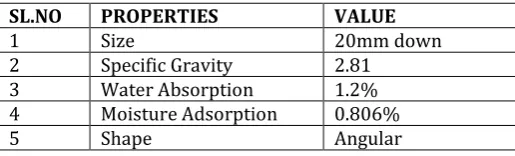
In our present project work the coarse aggregate basalt is used. The basalt was supplied from Prabhudev Stone Crushing Unit, Sedam road, Kalaburagi, Karnataka, India. The properties are shown below Table 3.
Table 3: Properties of Coarse Aggregates
SL.NO PROPERTIES VALUE
1 Size 20mm down
2 Specific Gravity 2.81 3 Water Absorption 1.2% 4 Moisture Adsorption 0.806%
5 Shape Angular
LECA (Light Expanded Clay Aggregates):
In our project LECA is used as the self curing agent along with the polyethylene glycol chemical, the LECA aggregates are produced in the kiln at a temperature of about 1200ºC to 1500ºC,the LECA aggregate has better sound insulation, thermal insulation and having higher water absorption capacity. In the present study LECA was obtained from RTEC Inc., ® India, Chennai, TamilNadu.
[image:2.595.303.566.423.513.2]Properties of LECA aggregates are listed below Table 4.
Table 4: Properties of LECA Aggregates
SL.NO PROPERTIES VALUE
1 Size 8 to 16mm
2 Specific Gravity 1 3 Water Absorption 24.9% 4 Saturated Density 550 kg/m3 5 Dry Density 292.3 kg/m3 6 Shape Rounded(Pink)
Water:
In the present project work portable water is used for both mixing and curing of conventional concrete. And it should not contain any salts.
Polyethylene Glycol:
[image:2.595.32.294.499.576.2]© 2016, IRJET | Impact Factor value: 4.45 | ISO 9001:2008 Certified Journal
| Page 1979
molecular weight 400).this chemical is exported orborrowed from the CHEMSOL CENTRE, #68, first main, fourth cross, sudham nagar, Bangalore, Karnataka, India.
4. METHODOLOGY AND CASTING OF SPECIMENS
:
In our project only mechanical properties of conventional curing(P0-0%PEG(weight of cement)) and 10% dry LECA aggregates).and in case of self curing both PEG 400 chemical is varied in the 0.5%,1%,1.5%,2%(by weight of cement) and 10% presoaked LECA aggregates are used for each variation of chemical. The properties of concrete are studied for M30 concrete using IS10262-2009.Mix proportion obtained from mix design is as follows
[image:3.595.313.585.183.600.2]MIX PROPORTION=1:1.48:2.68 AND W/C=0.45
Table 5: Mix Proportion
MATERIAL AMOUNT IN kg/m3
CEMENT 438.13
SAND 650.89
AGGREGATES 1175.19
WATER 197.16
[image:3.595.30.297.341.556.2]
Table 6: Mix Designations
SL.NO MIX DESIGNATION
1 P0=0%PEG and 10% dry LECA Aggregates.
2 P1=0.5%PEG and 10% presoaked LECA aggregates.
3 P2=1%PEG and10% presoaked LECA aggregates
4 P3=1.5%PEG and10%presoaked LECA aggregates
5 P4=2%PEG and 10%PEG presoaked LECA aggregates
Each of the above Mix Designations 3 Cubes,3 Cylinders,3 Prisms are casted, the fresh properties(workability) like slump test and compaction factor are tested before placing the concrete in the moulds as the concrete in the fresh state for all the mix designations, After testing the fresh properties of concrete, the fresh concrete is placed in the moulds and are de-moulded after 24 hours and then P0 mix designated specimens are normally water cured for the period of 7,14 & 28 days respectively, and other mix designated specimens like P1,P2,P3,P4 are kept at shaded dry place(self curing) for the period of 7,14 & 28 days respectively, and tested after the curing period.
5. RESULTS AND DISCUSSIONS
5.1 Fresh Concrete Results: The fresh properties
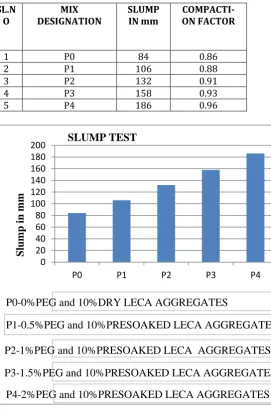
(workability) like slump and compaction factor test were conducted and the results are shown in the below table 7Table 7: Slump and Compaction Factor Values
SL.N
O DESIGNATION MIX SLUMP IN mm ON FACTOR
COMPACTI-1 P0 84 0.86
2 P1 106 0.88
3 P2 132 0.91
4 P3 158 0.93
5 P4 186 0.96
Graph-1 Slump Value for Different Designations
0 20 40 60 80 100 120 140 160 180 200
P0 P1 P2 P3 P4 Slump mm
SLUMP TEST
Slum
p
in
m
m
P0-0%PEG and 10%DRY LECA AGGREGATES
P1-0.5%PEG and 10%PRESOAKED LECA AGGREGATES
P2-1%PEG and 10%PRESOAKED LECA AGGREGATES
P3-1.5%PEG and 10%PRESOAKED LECA AGGREGATES
© 2016, IRJET | Impact Factor value: 4.45 | ISO 9001:2008 Certified Journal
| Page 1980
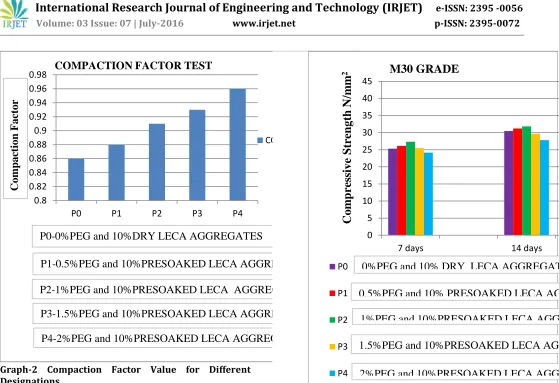
Graph-2 Compaction Factor Value for DifferentDesignations
5.2 Compressive Strength Test:
[image:4.595.36.596.48.431.2]The cubes compressive strength results are listed in the following table 8.
Table 8: Compressive Strength Results
SL.N
O DESIGNATION MIX STRENGTH IN N/mm2 COMPRESSIVE
7
Days Days 14 Days 28 1 P0 25.32 3.045 36.78 2 P1 26.13 31.19 37.62 3 P2 27.35 31.85 38.15 4 P3 25.48 29.69 36.31 5 P4 24.17 27.79 34.18
Graph 3- Compressive Strength for Different designation
[image:4.595.300.545.549.702.2]5.3 Split Tensile Strength Test: The spit tensile
strength test results are listed in table 9.Table 9: Split tensile Strength Results
SL.N
O DESIGNATION MIX STRENGTH IN N/mm2 SPIT TENSILE
7
Days Days 14 Days 28 1 P0 1.29 1.73 2.11 2 P1 1.42 1.84 2.23 3 P2 1.53 1.92 2.36 4 P3 1.31 1.76 2.13 5 P4 1.23 1.70 2.05
0.8 0.82 0.84 0.86 0.88 0.9 0.92 0.94 0.96 0.98
P0 P1 P2 P3 P4
COMPACTION FACTOR TEST
COMPACTION FACTOR
P0-0%PEG and 10%DRY LECA AGGREGATES
P1-0.5%PEG and 10%PRESOAKED LECA AGGREGATES
P2-1%PEG and 10%PRESOAKED LECA AGGREGATES
P3-1.5%PEG and 10%PRESOAKED LECA AGGREGATES
P4-2%PEG and 10%PRESOAKED LECA AGGREGATES
C
om
pac
ti
on
Fact
o
r
0 5 10 15 20 25 30 35 40 45
7 days 14 days 28 days
P0
P1
P2
P3
P4
Com
p
re
ss
ive
S
tr
en
gth
N/
m
m
2
M30 GRADE
0%PEG and 10% DRY LECA AGGREGATES
0.5%PEG and 10% PRESOAKED LECA AGGREGATES
1%PEG and 10%PRESOAKED LECA AGGREGATES
1.5%PEG and 10%PRESOAKED LECA AGGREGATES
© 2016, IRJET | Impact Factor value: 4.45 | ISO 9001:2008 Certified Journal
| Page 1981
Graph 4- Split Tensile Strength For Differentdesignation
5.4 Flexural Strength Test: The flexural strength test
results are listed in Table 10.Table 10: Split tensile Strength Results
SL.N
O DESIGNATION MIX STRENGTH IN N/mm2 SPIT TENSILE
7
Days Days 14 Days 28 1 P0 1.29 1.73 2.11 2 P1 1.42 1.84 2.23 3 P2 1.53 1.92 2.36 4 P3 1.31 1.76 2.13 5 P4 1.23 1.70 2.05
Graph 5-Flexural Strength for Different Designations.
6. CONCLUSIONS
1. The optimum dosage of PEG 400 was found out to be 1%for M30 grade concrete in which coarse aggregates are replaced by 10%LECA aggregates.
2. As the percentage of PEG 400 increases the workability properties like slump and compaction factor increases.
3. The compressive strength of self curing concrete using 1%PEG 400 chemical and 10% coarse aggregates are replaced by presoaked LECA aggregates is more than the conventional curing concrete using 0% PEG 400 and 10% coarse aggregates are replaced by dry LECA aggregates.
4. The spit tensile strength of self curing concrete using 1%PEG 400 chemical and 10% coarse aggregates are replaced by presoaked LECA aggregates is more than the conventional curing concrete using 0% PEG 400 and 10% coarse aggregates are replaced by dry LECA aggregates.
5. The flexural strength of self curing concrete using 1%PEG 400 chemical and 10% coarse aggregates are replaced by presoaked LECA aggregates is more than the conventional curing concrete using 0% PEG 400 and 10% coarse aggregates are replaced by dry LECA aggregates.
0 0.5 1 1.5 2 2.5
7 Days 14 Days 28 Days
P0
P1
P2
P3
P4
M30 GRADE
Sp
li
t
T
ensi
le
Str
engt
h
N
/m
m
2
0%PEG and 10%DRY LECA AGGREGATES
0.5%PEG and 10%PRESOAKED LECA AGGREGATES
1%PEG and 10%PRESOAKED LECA AGGREGATES
1.5%PEG and 10%PRESOAKED LECA AGGREGATES
2%PEG and 10%PRESOAKED LECA AGGREGATES
0 0.5 1 1.5 2 2.5 3 3.5 4 4.57 Days 14Days 28Days
P0
P1
P2
P3
P4
F
lex
ural
Str
engt
h
N
/m
m
2
M30 GRADE
0%PEG and 10%DRY LECA AGGREGATES
0.5%PEG and 10%PRESOAKED LECA
AGGREGATES
1%PEG and 10%PRESOAKED LECA AGGREGATES
1.5%PEGand 10%PRESOAKED LECA AGGREGATES
© 2016, IRJET | Impact Factor value: 4.45 | ISO 9001:2008 Certified Journal
| Page 1982
6. Self curing concrete will solve the many problems ofimproper-curing. and it is found to be beneficial in water scarcity areas or hot areas where the rate of evaporation of water is more.
REFERENCES
[
1]Vinayak Vijapur, Mohammed Noorulla”An experimental investigation on the behaviour of self curing concrete under acidic attack” (2013)[2] Magda I. Mousa a,*, Mohamed G. Mahdy a, Ahmed H. Abdel-Reheem a, Akram Z. Yehia b “Physical properties of self-curing concrete (SCUC)” (2015)
[3]Patel Manishkumar Dahyabhai* Prof. Jayeshkumar r. Pitroda**.”Self-Curing Concrete: New Technique For Concrete Curing – A Literature Review”(2013)
[4] Stella Evangeline “Self Curing Concrete and Its Inherent properties “(2014)
[5] Ankith MK “Self Curing Concrete with Light Weight Aggregate” (2014)
[6] M.V.Jagannadha Kumar1, M. Srikanth2, K. Jagannadha Rao “Strength Characteristics Of Self-Curing Concrete” (2012)
[7]Shikh Tyagi”An Experimental Investigation Of Self Curing Concrete Incorporated With Polyethylene Glycol As Self Curing Agent”
[8]IS10262-2009 [9]IS456-2000
[10] M.S.Shetty “Concrete Technology Theory and Practice”, S. Chand Publications, Fifth Revised Edition 2005, New Delhi