© 2016, IRJET | Impact Factor value: 4.45 | ISO 9001:2008 Certified Journal | Page 2759
Integrated Safety Management System In A Construction Organization -
A Feasibility Study
Nivin Chacko
1, P V Gopinadhan
21
Asst. Professor, Dept. of Mechanical Engineering, Caarmel Engineering College, Kerala, India
2
Professor , Dept. of Production Engineering, Govt. Engineering College Thrissur, Kerala, India
---***---Abstract -
For the last one decade construction industryin India achieved a booming growth in terms of work
volume and employability. Correspondence to
constructional a growth, the rate of accidents also increased. The standards and rules provided by OSHA, ISO and government agencies helps to reduce the rate and severity of accidents to some extent. This thesis work is concentrated on a study of various types, causes and elimination of accidents in construction industry in Kerala. The main frame of this thesis is based on a safety system namely Integrated Safety Management System (ISMS). Integrated Safety Management integrate safety into different levels of management and work practices so that missions are accomplished efficiently while protecting the workers and public. The project consist of safety analysis in construction industries to identify accidents and work time lost and provide a base and need for improvement. The safety data collecting from a post ISMS standard work in a construction site is analyzed for overall safety system improvement.
Key Words: Safety, Construction industry, Frequency
Rate, Severity Rate, Frequency Severity Indicator, Integrated Safety Management System, Cost & Productivity.
1.INTRODUCTION
Construction sector is the backbone of any country’s infrastructure development. For the last two decades construction industry in India showed rapid growth in construction expansion and employability. The number of workers in construction sector and related sub areas increased considerably. The Indian construction industry plays a vital role in the economy and is in constant growth due to industrialization, urbanization and economic development.
The construction industry is one of the most accident-prone sector in terms of serious injuries, loss of work time, hospitalization, disability, and mortality. The cost associated with safety management is negligible when compared to overall project cost in Construction industries in Kerala. Present management system and structure in construction industries located in Kerala doesn’t offer much attention towards safety system, and
hence the frequency and severity of accidents occurs in construction sector is increasing considerably.
This project consist of safety analysis in a construction firm situated in Kerala based on frequency rate, severity rate, man- hour lost and cost. The management system proposed in this project for improved safety performance in construction industry is ‘Integrated Safety Management System’, ISMS which deals with possible hazard analysis, develop and implementation of hazard control, performing the work within the controlled safety atmosphere, feedback and continuous improvement activities. The key step in Integrated Safety Management is the analysis and identification of possible hazard which can occur due to Environmental factors, improper equipment arrangement and maintenance, inefficient employee management, lack of supervision and unorganized management line activities.
2.SAFETY IN CONSTRUCTION SECTOR
2.1 Construction Industry in India
Construction industry is an integral part of Indian economy because of rapid urbanization and industrialization. The statistics shows there are approximately 31 million people involves in construction sector, contributing to 6-8% of GDP and, after agriculture, is the largest employment sector in the country. The statics about Indian construction industries shows a rapid growth in infrastructure development and employment rate and subsequently indicates increased accident rate due to efficient safety management programs.
2.2 Safety Standards & Regulations
© 2016, IRJET | Impact Factor value: 4.45 | ISO 9001:2008 Certified Journal | Page 2760
and Health at the state level that operate through thefactory inspectors and medical inspectors.
2.3 Safety in Construction Sector
The word safety is used widely in industry and has many definitions like, ‘absence of danger’, ‘a state of protection’, ‘a condition not involving risk’ etc. An Accident is an incident plus its consequences; the end product of a sequence of events or actions resulting in an undesired consequence (injury, property damage, interruption, delay). An accident can be defined more formally as ‘an undesired event, which results in physical harm and/ or property damage, usually resulting from contact with a source of energy above the ability of the body or structure to withstand it. An injury is a consequence of an incident – but not the only possible one. Accidents in construction sector may cause due to several reasons like Falls from a height Slips, trips and falls while handling, lifting or carrying. Struck by moving object, Struck by moving vehicle. Contact with electricity. Trapped by something collapsing or overturning, Strike against something fixed, stationary or moving machinery etc. Most of these accidents are caused by unsafe conditions in a work site. An unsafe condition is a condition in which the layout of the workplace or work location, condition of tools, equipment, or material are in violation of safety standards. Unsafe acts and unsafe conditions leads to several accidents in construction sector. Due to high random movement of equipment and workers the construction work sites are always prone. Only a proper safety management system can eliminate or reduce accidents in work sites. Identification of hazards and preplanning of safety is the only way to reduce accidents and injuries.
2.4 Accidents & Health Issues in Construction
sector
Construction Sites in India are prone to several types of accidents and health issues due to the absence of a proper safety management system. Most of the accidents are occurs due to negligence towards unsafe working conditions. The lack of safety education among workers causes unsafe acts, which in turn leads to minor and major accidents.
3.
CURRENT SAFETY SYSTEM STUDY
Existing safety management system in majority of construction oriented companies and industries in Kerala only consist of Site supervisors and a head safety engineer through them the safety reports and daily activity documents are forwarded to the top management. The safety related cost allocations in only limited to the purchasing and maintenance of Personal protective
equipment in many construction companies. Identification and rectification of accidents from the beginning of a work can reduce work related injuries and other hazards. The present safety management activity in construction industries only performs the following functions.
• Determine the types and quantity of personal protective equipment required.
• Prepare an approximate safety budget which doesn’t tolerate the overall profit.
• Provide the first aid kits for the work sites.
The management activities missing from current safety management systems are.
• Risk Assessment and Monitoring • Hazard Identification
• Hazard Controlling • Hazard Monitoring
• Safety Education and Training • Improving safety Communication
•Providing Promotional Activities and Follow up
• Ensuring Employee participation in safety management.
A well designed safety organization for contractors, sub-contractors and inter department are very essential. Implementation of Safety is a management function; therefore its responsibility lies with them.
4.
ACCIDENT DATA ANALYSIS
The data regarding safety performance can be analysed by certain parameters like frequency rate, and severity rate. Indian Standard IS: 3786 – 1983 (Reaffirmed 2002) gives the method for computation of frequency and severity rates for industrial injuries and classification of industrial accidents[2]. IS: 3786 – 1983 prescribes basic methods for recording and classifying industrial accidents. It also includes details of work injury and gives the methods for computation of frequency, severity and incidence rate of work injuries in industrial premises. This would enable adoption of a uniform system of recording events associated with injuries and the determination of corrective action. This standard gives the following definitions.
1. Frequency Rate
“How many Lost Time Injuries happened per 1000000hrs worked for one year “
FR – ( No: of Reportable lost time injury ×1000000)/(Man- hours worked)
2. Severity Rate
“No of days lost because of injuries per 1000000 man – hrs. Worked”
© 2016, IRJET | Impact Factor value: 4.45 | ISO 9001:2008 Certified Journal | Page 2761
3. Incidence Rate“A mathematical calculation that describes the number of recordable incident per 1000 full-time employees in any given time frame”
IR – (Number of reportable lost-time injuries × 1000)/(Average no: of persons employed)
4. Frequency Severity Indicator
“This is the square root of Disabling Injury Index. It gives combined effect of frequency and severity rate”
FSI = √((SR ×FR)/1000)
4.1 Significance of Parameters
• The Frequency Rate indicates how many injuries happened for every 1000000 hours worked over the past year which caused time lost.
• An increased Frequency Rate indicates that the company experienced a higher number of injuries which caused time lost.
• The Severity Rate indicates the number of working days lost per 1000000 hours of work due to accidents.
• Higher severity rate indicates that the loss of working days is higher due to accidents.
• Incident Rate gives the number of employees involved in a recordable injury or illness.
• As Incident Rate increases the number employees involved in accidents is also increases thus causing time and capital lass for the company.
• The Frequency Severity Index (FSI) gives a combined effect of injuries and accidents happened and corresponding working/man days lost.
• When the FSI in a company over a particular period is high it means that the company experienced a higher loss due to the accidents occurred and the man days loss associated with it.
5.
INTEGRATED SAFETY MANAGEMENT SYSTEM
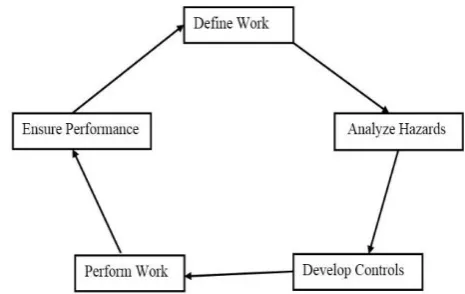
Integrated Safety Management System is a tool which systematically integrates safety into management and work practices at all levels to complete missions efficiently while protecting the workers and the public. This system describes the hierarchy of documentation, organization, and commitment for the implementation.
Below shown figure represents the five core functions of Integrated Safety Management System, which provide the necessary work control structure for all work that could potentially affect the public, the workers, and the environment. It is essential that the five ISM core functions be effectively integrated into work planning and
[image:3.595.316.549.133.280.2]work execution at the activity level to ensure the safety of workers.
Fig -1: Integrated Safety Management System
5.1 Work definition
The work requirement in the construction site is described in the first phase which include activities and equipment required to complete the task and. The number of workers required for each workers also determined in this process, it will ensures the adequate number of personal protective equipments required for all workers. The task is completed by the job analysis on the basis of several meetings conducted on the different levels of management. The main activities included in the first phase ‘Define Wok’ is given below.
• Identify the entire work activities required to complete the estimated project in the site.
• Gives a description for each activity in terms of technical and work force requirement.
• Describe the main equipment used for the given works so that precautionary measures can takes for equipment safety.
5.2 Hazards Analysis& control
This steps include the identification all the possible hazards that may arise during the work performance. Following are the control measures taken for eliminate or avoid possible hazards.
1. Hazard Controls (Engineering and Administrative). 2. Safety Controls (Personal Protective Equipment). 3. Emergency/Contingency Plans.
4. Environmental Equipment. 5. Certification Requirements.
© 2016, IRJET | Impact Factor value: 4.45 | ISO 9001:2008 Certified Journal | Page 2762
5.3 Performing Work
The required task are completed within controlled atmosphere where the safety risks are minimum. All the work activities are monitored for safety perfection which includes
1. Use of PPE by workers. 2. Safe work procedure.
3. Inspection before and after each works. 4. Placement of warning signs.
5 Equipment monitoring and maintenance.
6. Reporting the progress with higher management. By performing the work in a controlled and safe work place we were able to see reduced time for work performance by avoiding obstructions. Employee satisfaction for an ergonomic work condition, higher productivity and increased quality of work.
5.4 Feedback & Improvement
The feedback and improvement function generally may be categorized by three activities:
1. Generate and collect data,
2. Analyze data and develop information, and
3.Improve the process or activity and share the improvement.
The data collected in this project work is the safety indicators from the selected work site which showed a decrease in accident rates.
6.
DATA ANALYSIS
The accident measurements and activity data collected from the work site is used to analyze the efficiency of the Integrated Safety Management System. The accident data for a similar work is collected from the same company and it is compared with the ISMS integrated work to analyze the success of Integrated Safety Management System. The parameters used for data comparison are frequency rate, severity rate, incident rate and frequency – severity indicator.
6.1 Accident Data (Work without ISMS)
Sl.
No. Accidents Accidents No. of
1 Trapping of Hands/Legs while stacking 2
2 Electric Shocks 3
3 Fall of person in to trench 4 4 Fall from trailer, Truck, Tipper etc. 2
5 Accident due to improper swing of crane 1
6 Accident due to bursting of grinding wheel 2
7 Eye strain during welding operation 4
8 injury to eye from flying spatters during cutting operations 1 9 Bursting of Gas Cylinder 1 10 suffocation due to toxic fumes
inhalation during welding 1 11 Exposure to radiation during
radiography 1
12 Chance of strike person by excavator/JCB bucket during back filling
2
13 Stuck against objects 3
14 Struck by Object 3
15 Caught in object or equipment 1 16 Caught in collapsing materials 1 17 Contact with Temperature extremes 4
18 Sprain or Strain 3
19 Fracture 4
20 Cut Lacerations or punctures 5
21 Back pain 2
22 Muscular stress while lifting,
carrying, or putting down objects 3
23 Slip from platform 4
24 Contact with moving machinery 2 25 Fall from highway
vehicle/construction equipment 1 26 Fall from/with bucket (aerial
lift/basket) 1
27 Fall from/with structure (other than
roof) 1
28 Fall through opening (other than
roof) 2
TOTAL 64
No. of Accidents 64
No. of Workers involved 74 Average Man Days Lost/Person 107.5 Total Man- Days Lost 202.5
6.2 Accident Data (Work with ISMS)
No. of Accidents 34
No. of Workers involved 37 Average Man Days Lost/Person 105.5 Total Man- Days Lost 121.5
© 2016, IRJET | Impact Factor value: 4.45 | ISO 9001:2008 Certified Journal | Page 2763
data sheet we can obtain the accident reading in a workwith ordinary safety management and from the second data sheet we get the accident related data of a work with Integrated Safety Management System.
Safety Parameters for data1 Total No. workers : 330 Full time workers : 60 Contract workers : 270
Working hrs.
Full time workers : 40 hrs. /week × 35 weeks/Year Contract workers : 40 hrs. /week × 15 weeks/Year Man-hours worked : (60*40*35) + (270*40*15) =
246000 hrs.
1. Frequency Rate = (64*1000000)/246000 = 260 2. Severity Rate = (202.5 *1000000)/ 246000 =
823
3. Incident Rate = (64*1000)/330 = 194
4.Frequency Severity Index = √(((260*823))/1000) = 14.62
Safety Parameters for data2
1. Frequency Rate = (34*1000000)/246000 = 138 2. Severity Rate = (121.5 *1000000)/ 246000 =
494
3. Incident Rate = (34*1000)/330 = 103
4. Frequency Severity Index = √(((138*494))/1000) = 8.25
From the above calculations we can see that there is a significance decrease in accidents and work days loss in between the normal safety system and the new Integrated Safety Management System.
7.
DATA ANALYSIS SUMMARY
The summary of the safety data analysis is given in the following table, which differentiate the ordinary safety management system with Integrated Safety Management System.
Sl. N
o. Parameter
Safety System Normal
Safety System
Integrated Safety Management
System 1 Frequency Rate 260 138 2 Severity Rate 823 494 3 Incident Rate 194 103 4 Frequency
Severity Index 14.62 8.25
The above shown safety ratings in two safety management system conclude the efficiency of Integrated Safety Management Systems as follows.
Sl.
No. Parameter Decrease in values after implementing ISMS 1 Frequency Rate 47 %
2 Severity Rate 40% 3 Incident Rate 47% 4 Frequency Severity
Index 44%
When analyzing the data it is seen that there is approximately 40-50 % reduction in accident and its effects after implementing Integrated Safety Management System. This shows that the ISMS is feasible in Indian construction scenario. The studies in this project reveals that ISMS can be implemented in construction organizations located Kerala and India for generating better safe work atmosphere.
8.
CONCLUSION
The analysis of this project study reveals that the Integrated Safety Management System is feasible in construction industry in India. The results shows that there is a considerable reduction in accident rates after replacing the conventional safety management system with ISMS. The main findings arises from this project are,
• Safety & Health atmosphere in work site become improved.
• Control measures reduced obstacles for employee & equipment movement.
• A better understanding about work time loss due to accidents is developed.
• A better understanding about work time loss due to accidents is developed.
• A new safety culture associated with multi-level management system is developed and it helps to improve overall safety management.
• The integrated safety management systems is flexible enough to apply different types of construction activities.
REFERENCES
[1] Tarcisio Abreu Saurin, Carlos Torres Formoso,
Fabricio Borges Cambraia: ‘An analysis of construction safety best practices from a cognitive systems engineering perspective’ - Safety Science 46 (2008) 1169–1183.
[2] [2] OphirRozenfeld, Rafael Sacks, Yehiel Rosenfeld,
Hadassa Baum: ‘Construction Job Safety Analysis’ - Safety Science 48 (2010) 491–498.
[3] J. Hinze: ‘Construction safety’ - Safety Science 46
(2008) 565.
[4] [4] Indian Standards–‘method for computation of