R E S E A R C H A R T I C L E
Open Access
Physiotherapy movement based classification
approaches to low back pain: comparison of
subgroups through review and developer/
expert survey
Nicholas V Karayannis
*, Gwendolen A Jull and Paul W Hodges
Abstract
Background:Several classification schemes, each with its own philosophy and categorizing method, subgroup low back pain (LBP) patients with the intent to guide treatment. Physiotherapy derived schemes usually have a
movement impairment focus, but the extent to which other biological, psychological, and social factors of pain are encompassed requires exploration. Furthermore, within the prevailing‘biological’ domain, the overlap of
subgrouping strategies within the orthopaedic examination remains unexplored. The aim of this study was“to review and clarify through developer/expert survey, the theoretical basis and content of physical movement classification schemes, determine their relative reliability and similarities/differences, and to consider the extent of incorporation of the bio-psycho-social framework within the schemes”.
Methods:A database search for relevant articles related to LBP and subgrouping or classification was conducted. Five dominant movement-based schemes were identified: Mechanical Diagnosis and Treatment (MDT), Treatment Based Classification (TBC), Pathoanatomic Based Classification (PBC), Movement System Impairment Classification (MSI), and O’Sullivan Classification System (OCS) schemes. Data were extracted and a survey sent to the classification scheme developers/experts to clarify operational criteria, reliability, decision-making, and converging/diverging elements between schemes. Survey results were integrated into the review and approval obtained for accuracy.
Results:Considerable diversity exists between schemes in how movement informs subgrouping and in the consideration of broader neurosensory, cognitive, emotional, and behavioural dimensions of LBP. Despite differences in assessment philosophy, a common element lies in their objective to identify a movement pattern related to a pain reduction strategy. Two dominant movement paradigms emerge: (i) loading strategies (MDT, TBC, PBC) aimed at eliciting a phenomenon of centralisation of symptoms; and (ii) modified movement strategies (MSI, OCS) targeted towards documenting the movement impairments associated with the pain state.
Conclusions:Schemes vary on: the extent to which loading strategies are pursued; the assessment of movement dysfunction; and advocated treatment approaches. A biomechanical assessment predominates in the majority of schemes (MDT, PBC, MSI), certain psychosocial aspects (fear-avoidance) are considered in the TBC scheme, certain neurophysiologic (central versus peripherally mediated pain states) and psychosocial (cognitive and behavioural) aspects are considered in the OCS scheme.
* Correspondence: [email protected]
School of Health and Rehabilitation Sciences, NHMRC Centre of Clinical Research Excellence in Spinal Pain, Injury and Health, The University of Queensland, Brisbane, Qld 4072, Australia
Background
There is wide variability in the presentation of low back pain (LBP), yet if common characteristics emerge in the assessment that help to distinguish one pain profile from another, they may aid in initial decision-making by defining a dysfunction pattern towards which a targeted intervention is directed. A major goal over several years has been to divide people with LBP into homogeneous populations or ‘subgroups’ of similar characteristics in an effort to improve patient outcomes [1,2]. Subgroup-ing may also help reduce inefficient variability in treat-ment and provide a helpful communication tool [3]. Multiple disciplines have attempted to distinguish LBP subgroups with various classification schemes [4-6]. Per-spectives vary, with focus on improving multidisciplinary dialogue [7-9], examination of the musculoskeletal [10-14] or nervous system [15-17], assessment of psy-chosocial factors [18-25], or attempts to integrate assess-ment of multiple systems [14,26] to variable degrees. Within physiotherapy, a profession with strong back-ground in neuromusculoskeletal evaluation, classification schemes that focus on directing specific treatment have emerged [10-14] and most include evaluation of the relationship between movement and pain.
Surveys of practice of physiotherapists have revealed low use of classification schemes despite evidence that treatment of patients based on subgrouping results in better outcomes than treatment based on clinical guide-lines [27]. Usage rates of 7-70% [28-34] have been reported. The prevalence of relatively low use of these classification schemes could be explained by unfamiliar-ity with these approaches; low perceived value in classi-fication oriented assessment; inability to choose between classification schemes; or a preference for other assess-ment methods. An alternative reason for the modest implementation of the classification approach may be that assessment schemes do not adequately integrate the multiple dimensions that can contribute to, or per-petuate LBP. It has been argued that a limitation of schemes used in physiotherapy is the limited considera-tion of psychosocial aspects of LBP [35]. Given current evidence which suggests subgrouping results in better outcomes than non-subgrouping, and the diversity of schemes with varying ‘biological’ and ‘psycho-social’ perspectives, it is timely to compare and contrast the dominant schemes within physiotherapy in terms of their underlying philosophies, what they measure, how they overlap and what, if any, additional factors require consideration.
The aims of this review with developer/expert survey were: (1) To identify the classification schemes designed for use by physiotherapists that include a movement component; (2) To review the theoretical basis and key
elements for the schemes with clarification by develo-pers/experts; (3) To review reliability; (4) To identify areas of convergence or divergence between schemes; and (5) To determine how each scheme considers var-ious aspects of the bio-psycho-social framework.
Methods
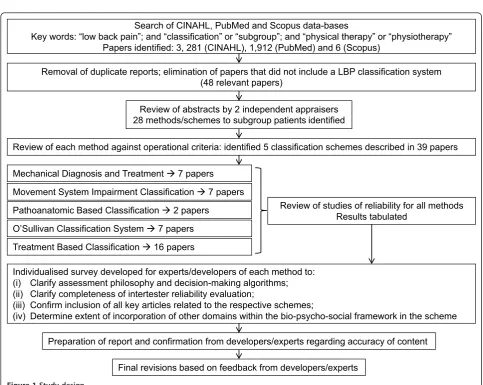
Literature was reviewed to address the study aims and a two-round survey of the schemes’ developers/experts was undertaken to verify accuracy of interpretation of the literature, and to gain their consideration of how their approach addresses broader aspects of a bio-psy-cho-social framework. Figure 1 depicts the study phases. The initial phase involved systematic search of CINAHL, PubMed and Scopus databases to identify studies per-taining to movement-based physiotherapy classification schemes for low back pain published between January 01, 1985 to June 01, 2011 using the key words: “low back pain"; and“classification”or “subgroup"; and “ phy-sical therapy” or“physiotherapy”. Articles were required to be written in English. The authors of the manuscript (NK, GJ, PH) developed the search strategy and it was implemented by NK.
The next phase of the review process involved identifi-cation of classifiidentifi-cation schemes that were aligned to operational criteria we developed for movement-based physiotherapy classification schemes for low back pain. We operationally defined a classification scheme as a clinical assessment method that: (i) was applicable to a
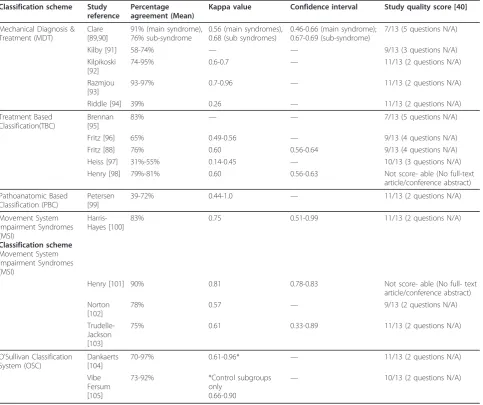
appraisers was resolved through discussion. As viability of subgrouping methods is diminished if it is not consis-tent between clinicians, additional data was sought for each of the final group of classification schemes regard-ing reliability and the results tabulated. This phase also involved analysis of the quality of reliability studies according to standardised criteria [40]. Additional file 1 lists the items used in the critical appraisal. Kappa values > 80% were considered to represent excellent agreement; > 60%, substantial agreement; 40-59% mod-erate agreement; and < 40% poor to fair agreement [41].
An individualised survey was sent to developers/ experts (n = 7) for the schemes that satisfied the opera-tional criteria in order to request clarification and further elaboration of any element of the scheme that was unclear from the available literature (i.e. assessment philosophy and decision-making algorithms,), to clarify whether any key articles from their respective schemes were omitted in the initial search strategy and to con-firm the completeness and accuracy of the assessment
of reliability of the scheme. Developers/experts were also asked to comment on similarities and differences with the other schemes, and to comment on the inclu-sion of broader bio-psycho-social dimeninclu-sions within their scheme.
After retrieval of all relevant information from the lit-erature and developer/expert survey responses, the next phase was to review the material for clear areas of con-vergence and dicon-vergence among the 5 classification schemes. Survey results and consideration of conver-gence and diverconver-gence were integrated into the manu-script and the final draft was sent to the developers/ experts for final approval of accuracy.
Results
Identification of classification schemes
Initial search of the CINAHL, PubMed and Scopus data-bases identified 3,281 (CINAHL), 1,912 (PubMed) and 6 (Scopus) articles that used the defined keywords, respec-tively (Figure 1). Removal of duplicate reports and
Search of CINAHL, PubMed and Scopus data-bases
Key words: “low back pain”; and “classification” or “subgroup”; and “physical therapy” or “physiotherapy” Papers identified: 3, 281 (CINAHL), 1,912 (PubMed) and 6 (Scopus)
Individualised survey developed for experts/developers of each method to: (i) Clarify assessment philosophy and decision-making algorithms; (ii) Clarify completeness of intertester reliability evaluation;
(iii) Confirm inclusion of all key articles related to the respective schemes;
(iv) Determine extent of incorporation of other domains within the bio-psycho-social framework in the scheme Preparation of report and confirmation from developers/experts regarding accuracy of content
Final revisions based on feedback from developers/experts
Removal of duplicate reports; elimination of papers that did not include a LBP classification system (48 relevant papers)
Review of abstracts by 2 independent appraisers 28 methods/schemes to subgroup patientsidentified
Review of each method against operational criteria: identified 5 classification schemes described in 39 papers
Review of studies of reliability for all methods Results tabulated
Mechanical Diagnosis and Treatment Æ7 papers
Treatment Based Classification Æ16 papers
Movement System Impairment Classification Æ7 papers
[image:3.595.56.540.77.462.2]O’Sullivan Classification System Æ7 papers Pathoanatomic Based Classification Æ2 papers
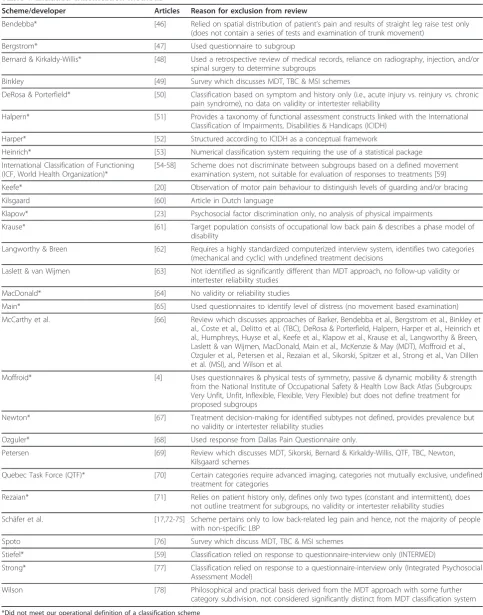
elimination of articles that obviously did not include a LBP classification system left 48 relevant articles. Review of the abstracts by 2 independent appraisers identified 28 methods/schemes to subgroup patients. Review of each of these methods against the operational criteria identified 5 classification schemes, described in 39 arti-cles. The schemes were: Mechanical Diagnosis and Treatment (MDT, McKenzie) [42,43] (7 articles), Treat-ment Based Classification (TBC, Delitto) [11] (16 arti-cles); Pathoanatomic Classification (PBC, Petersen) [12] (2 articles); Movement System Impairment Classification (MSI, Sahrmann) [44] (7 articles); and the O’Sullivan Classification System (OCS) [45] (7 articles). The 23 schemes/methods that were identified in the initial review, but not included in the final list and the reason for exclusion from the list are presented in Table 1.
Theoretical basis and key elements of schemes
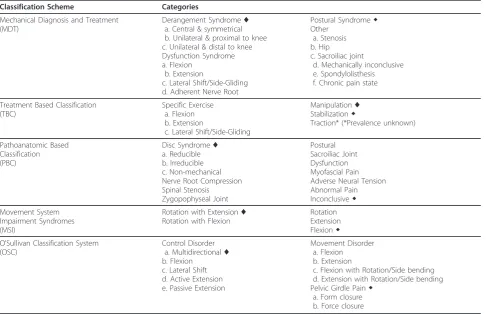
The conceptual model of each scheme is summarized below. Table 2 lists the subgroups defined in each scheme and the relative prevalence as reported by the developer/expert.
Mechanical Diagnosis and Treatment (MDT)
The primary objective of the MDT scheme is to deter-mine if LBP symptoms can be abolished or reduced through application of direction-specific, repeated lum-bar spine movements or sustained postures. Internal intervertebral disc displacement is a key component in the conceptual explanation of this model, particularly for the primary category,“derangement”. Less common categories are termed“dysfunction”and“postural”. With
“dysfunction syndromes” it is thought that tissue has undergone “contraction, scarring, adherence, adaptive shortening, or imperfect repair” [37]. Intervention is based on the tissue remodelling theory. “Postural syn-drome” is assumed to arise from joint capsule and liga-ment ischemia due to prolonged spinal end range positioning. Lifestyle factors believed to predispose indi-viduals to each syndrome include high frequency of sit-ting, flexion biased posture and activities.
A principal assessment is the use of direction-specific
“loading strategies”[79] to elicit a phenomenon termed
“centralisation”, i.e., movement of peripherally located pain to a more central location. Loading strategies involve repeated end range lumbar extension, flexion or side-gliding movements and are thought to relocate symptomatic displaced tissues in a “derangement syn-drome”, or stretch adhered or shortened tissue in a
“dysfunction syndrome”.
Treatment Based Classification (TBC)
The primary purpose of the TBC approach is to identify features at baseline that predict responsiveness to four different treatment strategies. Three levels of classifica-tion are implemented [11]. The first level determines
whether the patient can be managed by physical therapy alone, will require multidisciplinary management, or require referral to another health care practitioner. The second level stages the patient based on the severity of symptoms and degree of disability. Stage I is the acute phase where the goal is symptom relief. Stage II is the subacute phase when symptom relief and quick return to normal function are encouraged. Stage III is for those who must return to high physical demands but demonstrate poor physical conditioning. The third level of classification consists of assignment of the patient to one of four treatment syndromes [11]:“manipulation”,
“stabilization”, “specific exercise”or “traction”. Interpre-tation of a collection of signs, symptoms and observa-tions derives this decision. Signs from four primary orthopaedic tests include: (1) pain centralisation with two or more movements in the same direction, or pain peripheralisation in the opposite direction of centralisa-tion, (2) straight leg raise range of mocentralisa-tion, (3) “prone instability test” and (4) lumbar posterior-to-anterior mobility testing. Signs of nerve root compression are identified by a neurologic examination. Symptoms of relevance are: (1) pain duration, (2) pain location, (3) episode frequency and (4) fear avoidance behaviour [11]. Observation is used to detect presence or absence of aberrant motion or a lateral shift deformity. Age is considered a predictor for allocation to the “ stabilisa-tion” subgroup.
The “manipulation” subgroup treatment includes high velocity thrust manipulation directed towards the lumbo-pelvic region [11]. The “stabilisation” subgroup receives exercises aimed at“promoting stability by pro-ducing motor patterns of co-contraction among all spinal stabilising muscles” [11]. The“specific exercise” subgroup is treated primarily with repeated end range spinal movement in the direction found to elicit a cen-tralisation effect. The“traction”subgroup receives static mechanical traction in prone along with exercises to centralise symptoms [11]. Although initiated as an
‘expert panel consensus driven’ approach, the TBC scheme has developed into a ‘data driven’model, which incorporates evidence from ‘clinical prediction rules’ [80].
Pathoanatomic Based Classification (PBC)
Table 1 Excluded classification methods
Scheme/developer Articles Reason for exclusion from review
Bendebba* [46] Relied on spatial distribution of patient’s pain and results of straight leg raise test only (does not contain a series of tests and examination of trunk movement)
Bergstrom* [47] Used questionnaire to subgroup
Bernard & Kirkaldy-Willis* [48] Used a retrospective review of medical records, reliance on radiography, injection, and/or spinal surgery to determine subgroups
Binkley [49] Survey which discusses MDT, TBC & MSI schemes
DeRosa & Porterfield* [50] Classification based on symptom and history only (i.e., acute injury vs. reinjury vs. chronic pain syndrome), no data on validity or intertester reliability
Halpern* [51] Provides a taxonomy of functional assessment constructs linked with the International Classification of Impairments, Disabilities & Handicaps (ICIDH)
Harper* [52] Structured according to ICIDH as a conceptual framework
Heinrich* [53] Numerical classification system requiring the use of a statistical package
International Classification of Functioning (ICF, World Health Organization)*
[54-58] Scheme does not discriminate between subgroups based on a defined movement examination system, not suitable for evaluation of responses to treatments [59]
Keefe* [20] Observation of motor pain behaviour to distinguish levels of guarding and/or bracing
Kilsgaard [60] Article in Dutch language
Klapow* [23] Psychosocial factor discrimination only, no analysis of physical impairments
Krause* [61] Target population consists of occupational low back pain & describes a phase model of disability
Langworthy & Breen [62] Requires a highly standardized computerized interview system, identifies two categories (mechanical and cyclic) with undefined treatment decisions
Laslett & van Wijmen [63] Not identified as significantly different than MDT approach, no follow-up validity or intertester reliability studies
MacDonald* [64] No validity or reliability studies
Main* [65] Used questionnaires to identify level of distress (no movement based examination)
McCarthy et al. [66] Review which discusses approaches of Barker, Bendebba et al., Bergstrom et al., Binkley et al., Coste et al., Delitto et al. (TBC), DeRosa & Porterfield, Halpern, Harper et al., Heinrich et al., Humphreys, Huyse et al., Keefe et al., Klapow et al., Krause et al., Langworthy & Breen, Laslett & van Wijmen, MacDonald, Main et al., McKenzie & May (MDT), Moffroid et al., Ozguler et al., Petersen et al., Rezaian et al., Sikorski, Spitzer et al., Strong et al., Van Dillen et al. (MSI), and Wilson et al.
Moffroid* [4] Uses questionnaires & physical tests of symmetry, passive & dynamic mobility & strength from the National Institute of Occupational Safety & Health Low Back Atlas (Subgroups: Very Unfit, Unfit, Inflexible, Flexible, Very Flexible) but does not define treatment for proposed subgroups
Newton* [67] Treatment decision-making for identified subtypes not defined, provides prevalence but no validity or intertester reliability studies
Ozguler* [68] Used response from Dallas Pain Questionnaire only.
Petersen [69] Review which discusses MDT, Sikorski, Bernard & Kirkaldy-Willis, QTF, TBC, Newton, Kilsgaard schemes
Quebec Task Force (QTF)* [70] Certain categories require advanced imaging, categories not mutually exclusive, undefined treatment for categories
Rezaian* [71] Relies on patient history only, defines only two types (constant and intermittent), does not outline treatment for subgroups, no validity or intertester reliability studies
Schäfer et al. [17,72-75] Scheme pertains only to low back-related leg pain and hence, not the majority of people with non-specific LBP
Spoto [76] Survey which discuss MDT, TBC & MSI schemes
Stiefel* [59] Classification relied on response to questionnaire-interview only (INTERMED)
Strong* [77] Classification relied on response to a questionnaire-interview only (Integrated Psychosocial Assessment Model)
Wilson [78] Philosophical and practical basis derived from the MDT approach with some further category subdivision, not considered significantly distinct from MDT classification system
This scheme employs a hierarchy approach in which structures that more commonly cause LBP are consid-ered first [82,83], followed by systematic inclusion or exclusion of less prevalent structures and conditions. Other than response to loading strategies, additional cri-teria used for diagnosis include: (1) symptom duration; (2) standing, walking, sitting, and lying tolerance; (3) age > 65 years; (4) mechanical aggravating factors; (5) symp-tom provocation with examination; and (6) “ non-organic” signs. “Adherent nerve root” and “nerve root entrapment” categories have been excluded from the system due to low intertester reliability, and the criteria for“spinal stenosis syndrome” and“zygopophyseal joint problem”have been updated (Petersen, survey response). Movement System Impairment Syndromes (MSI)
The major objective in the MSI scheme is to identify the direction of alignment, stress or spinal movement that elicits or increases symptoms [13]. The development of these subgroups is theorized to occur due to alteration in the precision of joint movement as the result of repeated movements and prolonged postures associated with daily activities. This is enhanced by age-related fac-tors such as degenerative changes, habitual postures and
repetitive direction-specific activities (Sahrmann, survey response). Prolonged postures and repeated movements are proposed to cause tissue adaptations that eventually result in a joint developing a susceptibility to movement in a specific direction. Stress related to the alteration in precise motion is assumed to cause tissue micro-trauma and eventually, macrotrauma. Repeated movements and associated tissue adaptations are reasoned to contribute to generalization of movement patterns including the imprecise joint motion that is direction-specific. Of par-ticular interest is the concept of relative stiffness that is believed to contribute to and perpetuate a joint’s direc-tional movement susceptibility. The relative stiffness problem can pertain to intervertebral joints, as well as other joints such as the hip or shoulder. Studies of the MSI system have documented relative flexibility issues between the lumbar and hip region, where early or excess lumbar motion is observed with lower limb movement tests and with trunk sidebending [84,85].
[image:6.595.57.544.100.414.2]The MSI scheme focuses on modification of this altered alignment and motion to reduce spine symptoms and to redistribute movement to other joints [86]. This process involves correction and/or restriction of altered
Table 2 Classification categories
Classification Scheme Categories
Mechanical Diagnosis and Treatment (MDT)
Derangement Syndrome♦ a. Central & symmetrical b. Unilateral & proximal to knee c. Unilateral & distal to knee Dysfunction Syndrome a. Flexion
b. Extension
c. Lateral Shift/Side-Gliding d. Adherent Nerve Root
Postural Syndrome◆ Other
a. Stenosis b. Hip
c. Sacroiliac joint
d. Mechanically inconclusive e. Spondylolisthesis f. Chronic pain state
Treatment Based Classification (TBC)
Specific Exercise a. Flexion b. Extension
c. Lateral Shift/Side-Gliding
Manipulation♦ Stabilization◆
Traction* (*Prevalence unknown)
Pathoanatomic Based Classification (PBC)
Disc Syndrome♦ a. Reducible b. Irreducible c. Non-mechanical Nerve Root Compression Spinal Stenosis Zygopophyseal Joint
Postural Sacroiliac Joint Dysfunction Myofascial Pain Adverse Neural Tension Abnormal Pain Inconclusive◆
Movement System Impairment Syndromes (MSI)
Rotation with Extension♦ Rotation with Flexion
Rotation Extension Flexion◆
O’Sullivan Classification System (OSC)
Control Disorder a. Multidirectional♦ b. Flexion
c. Lateral Shift d. Active Extension e. Passive Extension
Movement Disorder a. Flexion b. Extension
c. Flexion with Rotation/Side bending d. Extension with Rotation/Side bending Pelvic Girdle Pain◆
a. Form closure b. Force closure
♦= Most prevalent*
lumbar motion in the direction associated with symp-toms and facilitation of movement of other joints. Sub-classification is confirmed by“modified movement and alignment tests”that correct the impaired spine move-ment, redistribute motion, or change alignment to reduce or eliminate symptoms. Examination includes tests that“identify tissue adaptations contributing to the identified relative stiffness and associated movement patterns” (Sahrmann, survey response). Tissue adapta-tions contributing to the patient’s altered movement and alignment impairments include motor control altera-tions in recruitment patterns and timing, de-recruit-ment, skeletal and muscular performance alterations, stiffness and length. Of critical importance is the biome-chanical consideration of muscle performance and recruitment patterns.
O’Sullivan Classification System (OCS)
The objective of the OCS is to identify the underlying mechanisms that are considered to drive pain. One of these is the identification of maladaptive (pain provoca-tive) spinal postures, movement patterns, and motor control behaviours associated with LBP, which are then used to target treatment. The development and persis-tence of these impairments is believed to occur due to a maladaptive response to pain (’movement’or ‘control’ alteration), resulting in a lack of variance in the way tasks are performed and further perpetuation of pain [14]. Impairments are characterized into either ‘pain avoidance’(movement category) or ‘pain provocation’ (control category) behaviour. Pain response is further categorized as either‘adaptive’or ‘maladaptive’. ‘ Adap-tive’pain is considered a protective response secondary to an underlying pathological process, whereas‘ mala-daptive’pain behaviour is viewed as a process in which movement and cognitive behaviours drive the pain, causing a compromise to the neuromusculoskeletal sys-tem. Assessment involves subjective and physical exami-nation of pain, cognitive and movement behaviours [14,36]. The OCS involves five levels [87]: In level one, LBP disorders are separated into‘specific’vs.‘ non-speci-fic’. Specific LBP is based on radiological evidence matching the clinical presentation. In level two, the pri-mary pain system is identified as either of a“peripheral” or “central” nervous system disorder. Central nervous system pain disorders (such as regional, neuropathic and fibromyalgia pain disorders) are defined as pain disor-ders that are constant and non-remitting in nature with no clear mechanical behaviour. Peripheral nervous sys-tem disorders refer to localized and anatomically defined pain influenced by mechanical factors, whereas central nervous system disorders refer to constant and wide-spread pain not clearly influenced by mechanical factors. If the disorder is peripheral, level three involves distin-guishing LBP from pelvic girdle pain. Where pain is
thought to arise from spinal structures, the fourth level identifies whether“control impairments” (no movement impairment in direction of pain but impaired control) or “movement impairments” (impairment of movement in the direction of pain provocation associated with fear avoidance behaviour) are drivers of the pain disorder. A directional or postural pattern is determined within each group [87]. The fifth level involves identification of psychosocial and/or lifestyle factors that may contribute to the disorder.
Management of non-specific chronic LBP disorders that are considered to be of the peripheral nervous sys-tem consist of changing movement and cognitive beha-viours based on the disorder classification. “Control impairment” disorders involve enhancing control by training movement patterns in order to functionally unload pain sensitive structures. In contrast, the approach to management of “movement impairment” disorders is to facilitate movement in the direction of pain provocation via graded exposure in order to reduce fear avoidance behaviours. The OCS assesses maladap-tive physical and cognimaladap-tive ‘drivers of pain’and imple-ments a behavioural intervention that focuses on the cognitive and behavioural change (termed ‘Cognitive Functional Therapy’[36]).
Review of classification scheme reliability
novice (Kappa 0.44-0.76) and expert clinicians (Kappa 0.52-0.87) [88]. The OCS [87] scheme intertester classi-fication reliability improves with training.
Convergence or divergence between schemes
Philosophies
All schemes share the objective to identify directions, movements or control patterns that decrease or increase pain in order to direct treatment. In this respect, we considered that the five schemes could be clustered into two groups. One group (MDT, TBC, and PBC) uses the centralisation phenomenon to guide categorization, but schemes vary in loading dosage, assessment strategies, and intervention options. The other group (MSI and OCS) shares a parallel theme of‘modified’movement and alignment strategies and a common philosophy of
promoting variety and precision of movement, although the proposed mechanism, movement observation focus, and emphasis on identification of concurrent psychoso-cial factors differ.
Assessment methods
[image:8.595.58.542.100.505.2]The MSI and OCS schemes rely on identification of the symptomatic region or segment during functional lumbo-pelvic and thoraco-lumbar movement tests and are alike in their use of a variety of test positions. MSI tests focus on the influence of hip and pelvic movements on the lumbar spine in both weight bear-ing and non-weight bearbear-ing positions, whereas OCS tests focus on abnormal thoraco-lumbar and lumbo-pelvic movement primarily in weight bearing posi-tions, determined by pain provocative activities reported by the patient.
Table 3 Intertester reliability of the whole classification system
Classification scheme Study reference
Percentage agreement (Mean)
Kappa value Confidence interval Study quality score [40]
Mechanical Diagnosis & Treatment (MDT)
Clare [89,90]
91% (main syndrome), 76% sub-syndrome
0.56 (main syndromes), 0.68 (sub syndromes)
0.46-0.66 (main syndrome); 0.67-0.69 (sub-syndrome)
7/13 (5 questions N/A)
Kilby [91] 58-74% — — 9/13 (3 questions N/A)
Kilpikoski [92]
74-95% 0.6-0.7 — 11/13 (2 questions N/A)
Razmjou [93]
93-97% 0.7-0.96 — 11/13 (2 questions N/A)
Riddle [94] 39% 0.26 — 11/13 (2 questions N/A)
Treatment Based Classification(TBC)
Brennan [95]
83% — — 7/13 (5 questions N/A)
Fritz [96] 65% 0.49-0.56 — 9/13 (4 questions N/A)
Fritz [88] 76% 0.60 0.56-0.64 9/13 (4 questions N/A)
Heiss [97] 31%-55% 0.14-0.45 — 10/13 (3 questions N/A)
Henry [98] 79%-81% 0.60 0.56-0.63 Not score- able (No full-text
article/conference abstract)
Pathoanatomic Based Classification (PBC)
Petersen [99]
39-72% 0.44-1.0 — 11/13 (2 questions N/A)
Movement System Impairment Syndromes (MSI)
Classification scheme
Movement System Impairment Syndromes (MSI)
Harris-Hayes [100]
83% 0.75 0.51-0.99 11/13 (2 questions N/A)
Henry [101] 90% 0.81 0.78-0.83 Not score- able (No full- text
article/conference abstract) Norton
[102]
78% 0.57 — 9/13 (2 questions N/A)
Trudelle-Jackson [103]
75% 0.61 0.33-0.89 11/13 (2 questions N/A)
O’Sullivan Classification System (OSC)
Dankaerts [104]
70-97% 0.61-0.96* — 11/13 (2 questions N/A)
Vibe Fersum [105]
73-92% *Control subgroups
only 0.66-0.90
— 10/13 (2 questions N/A)
Differences exist between the two clusters of schemes in frontal plane analysis, with an assessment preference for lumbar spine side gliding (i.e. lateral pelvic transla-tion) (MDT, PBC, and TBC) versus side bending (MSI and OCS). Lumbar rotation is a key MSI assessment component and part of the OCS multi-directional move-ment categories, but not referred to in other schemes. Patient appropriateness
The primary reason to implement a classification pro-cess for non-specific LBP is to facilitate the‘clustering’ of signs and symptoms in order to help better direct treatment and improve efficiency of care. However, the application of the subgrouping systems is also likely to apply to specific LBP diagnoses. The application to patients with specific diagnoses has not been tested, nor is it clear whether having a specific‘pathoanatomic’LBP diagnosis facilitates treatment decisions better than an assessment based on the patient’s presentation of move-ment, pain processing, and emotions, cognitions, and behaviours related to their LBP.
For development and reliability purposes, most studies of classification schemes exclude people with diagnoses such as severe kyphosis, scoliosis, ankylosing spondylitis, and rheumatoid arthritis. Spinal stenosis is integrated as a subgroup within some schemes (MDT and PBC)
whereas it is considered a specific diagnosis in the OCS and requires further classification. Spinal stenosis is most often classified in the MSI“extension” or “ exten-sion-rotation” subgroup, or TBC“specific exercise– flex-ion” subgroup (Sahrmann and Fritz, survey responses). The OCS scheme considers disc prolapse with radicular pain, spondylolisthesis, degenerative disc disease with positive Modic changes [106] and positive neural provo-cation tests as specific LBP diagnoses and are assessed and classified within the scheme. The MSI and OCS scheme developers clarified that principles of the classi-fication approach could be applied to the specific LBP population [39], but require a‘modified approach’ (Sahr-mann and O’Sullivan, survey responses), taking into account the known pathological influences on the con-dition. How this is operationalized is less defined. Distinguishing‘mechanical’LBP and‘stage’of disorder Most schemes are designed for those with‘mechanical’ LBP, determined from history, and confirmed with phy-sical examination. It is argued that if there is consistency in symptom provocation that can be related to, or altered by application of certain movements or postures, it is deemed a mechanical problem. Although TBC scheme reliability studies have generally targeted the
[image:9.595.60.539.99.403.2]‘acute’(< 3 months duration) LBP population, and MSI
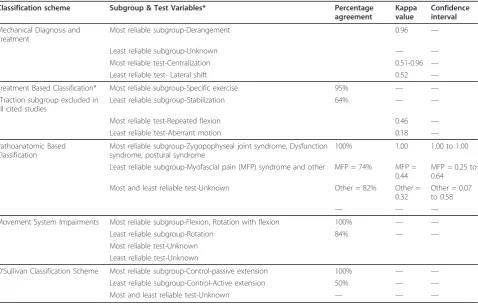
Table 4 Variability in intertester reliability between subgroups and tests
Classification scheme Subgroup & Test Variables* Percentage agreement
Kappa value
Confidence interval
Mechanical Diagnosis and Treatment
Most reliable subgroup-Derangement 0.96 —
Least reliable subgroup-Unknown — —
Most reliable test-Centralization 0.51-0.96 —
Least reliable test- Lateral shift 0.52 —
Treatment Based Classification* Most reliable subgroup-Specific exercise 95% — —
*Traction subgroup excluded in all cited studies
Least reliable subgroup-Stabilization 64% — —
Most reliable test-Repeated flexion 0.46 —
Least reliable test-Aberrant motion 0.18 —
Pathoanatomic Based Classification
Most reliable subgroup-Zygopophyseal joint syndrome, Dysfunction syndrome, postural syndrome
100% 1.00 1.00 to 1.00
Least reliable subgroup-Myofascial pain (MFP) syndrome and other MFP = 74% MFP = 0.44
MFP = 0.25 to 0.64
Most and least reliable test-Unknown Other = 82% Other =
0.32
Other = 0.07 to 0.58
— — —
Movement System Impairments Most reliable subgroup-Flexion, Rotation with flexion 100% — —
Least reliable subgroup-Rotation 84% — —
Most reliable test-Unknown Least reliable test-Unknown
O’Sullivan Classification Scheme Most reliable subgroup-Control-passive extension 100% — —
Least reliable subgroup-Control-Active extension 50% — —
Most and least reliable test-Unknown — — —
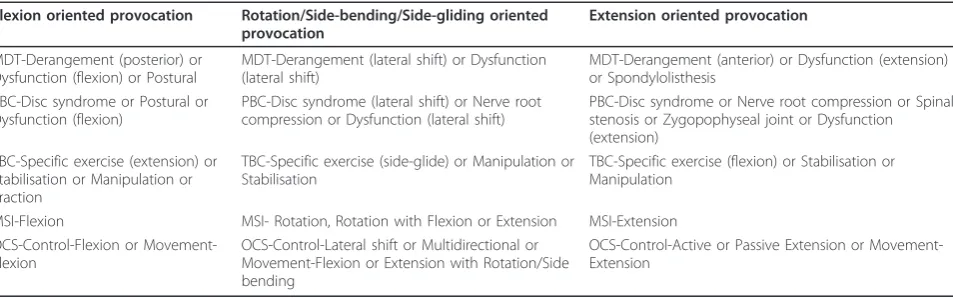
and OCS scheme studies have primarily used a ‘chronic’ (> 3 months) LBP population, scheme developers/ experts consider their scheme appropriate across the LBP stage continuum (all developers/experts, survey response). Table 5 summarises some of the key pro-posed overlap between subgroups identified within dif-ferent schemes.
Consideration of the bio-psycho-social framework within the classification schemes
In addition to the biomechanical system influences on LBP, psychosocial and neurophysiologic systems are equally important to consider in a multidimensional LBP assessment model [107-109]. Both psychosocial fac-tors (historical events/past experience with pain/percep-tion of the present injury seriousness, work/family/ practitioner environment, culture, personality, appraisals, self-efficacy, emotions/mood, educational and socioeco-nomic levels, sleep disturbance) and neurophysiologic factors [110] (e.g., pain physiology) potentially influence the movement presentation and frame the pain experi-ence [111-115] and are likely to be important to con-sider as moderators of the pain presentation and influence treatment selection. This section focuses on how current classification schemes integrate these aspects in assessment and attempt to distinguish psy-chosocial domains and neurophysiologic pain mechan-isms within the assessment strategy.
Incorporation of psychosocial factors
As psychosocial factors may contribute to or perpetuate LBP, it can be argued that they cannot be separated from a biomechanical view of LBP. All schemes consider psychological influences, particularly when psychological signs appear dominant in persistent LBP. However, there is disparity across schemes in identification of psy-chosocial aspects within movement-based categories.
MDT and PBC schemes identify subgroups with an
‘abnormal or chronic pain state’by testing for Waddell’s
‘abnormal illness behaviour’signs [81] but prioritize
treatment of the mechanical presentation first. “Chronic pain”is defined by the MDT and PBC schemes as symp-toms that are persistent (i.e., > 12 weeks), widespread and increase with all activity. Patients demonstrate
“exaggerated pain behaviour and mistaken beliefs and attitudes about pain and movement” [10]. The MDT rationale is that many psychological factors improve when the mechanical presentation and associated pain improves (Clare, survey response). PBC identifies depression as a key predictor of poor recovery and other psychosocial dimensions as poor prognostic indicators such as distress, job satisfaction, duration of sickness, unemployment and financial incentives (Petersen, survey response). How these variables are identified and inte-grated with the mechanical diagnosis categories is not specified.
Fear-avoidance is the key psychological feature addressed in the TBC scheme, as a low Fear Avoidance Beliefs Questionnaire (FABQ) score is a criterion for allocation to the “manipulation”subgroup. The classifi-cation approach can still be applied to those with a high FABQ, but with modification (Delitto, survey response). Likewise, the MSI scheme incorporates a measure for fear avoidance behaviour, but the developers/experts state this population subtype is atypical within their research and clinical setting (Sahrmann and Van Dillen, survey response). How the MSI scheme would address patients who present with high fear avoidance beha-viour, or other psychological features, is not clear. The OCS advocates multidisciplinary management and func-tional rehabilitation in the presence of dominant psy-chosocial factors [87]. In the presence of non-dominant psychosocial traits, the OCS also integrates the assess-ment of psychosocial factors into decision-making and pursues a behavioural intervention.
Incorporation of neurophysiologic factors
[image:10.595.61.538.582.731.2]The International Association for the Study of Pain has defined neuropathic pain as “pain initiated or caused by a primary lesion or dysfunction in the nervous system”.
Table 5 Proposed subgroup overlap
Flexion oriented provocation Rotation/Side-bending/Side-gliding oriented provocation
Extension oriented provocation
MDT-Derangement (posterior) or Dysfunction (flexion) or Postural
MDT-Derangement (lateral shift) or Dysfunction (lateral shift)
MDT-Derangement (anterior) or Dysfunction (extension) or Spondylolisthesis
PBC-Disc syndrome or Postural or Dysfunction (flexion)
PBC-Disc syndrome (lateral shift) or Nerve root compression or Dysfunction (lateral shift)
PBC-Disc syndrome or Nerve root compression or Spinal stenosis or Zygopophyseal joint or Dysfunction (extension)
TBC-Specific exercise (extension) or Stabilisation or Manipulation or Traction
TBC-Specific exercise (side-glide) or Manipulation or Stabilisation
TBC-Specific exercise (flexion) or Stabilisation or Manipulation
MSI-Flexion MSI- Rotation, Rotation with Flexion or Extension MSI-Extension OCS-Control-Flexion or
Movement-Flexion
OCS-Control-Lateral shift or Multidirectional or Movement-Flexion or Extension with Rotation/Side bending
In an effort to distinguish neuropathic pain from noci-ceptive system hyperexcitabiity (i.e., central sensitization) [116] a more precise definition of neuropathic pain has been proposed as “pain which arises as a direct conse-quence of a lesion or disease affecting the somatosen-sory system” [117]. Where the nociceptive system generates activity without adequate peripheral sensory ending activation, correlates of the neuroanatomic distri-bution, pain consistency, stimulus-response proportion, history of injury, and findings from a clinical neurologic examination may help to distinguish the likelihood of neuropathic versus nociceptive pain origin. Anatomic location of the lesion/disease can also help to divide neuropathic pain into peripheral and central nervous system subtypes. Recent studies suggest prevalence of neuropathic pain in patients with low back and leg pain is 37% [15] to 41% [118] and is characterised by certain signs, such as radicular pain, higher ratings of pain intensity, depression, panic, anxiety and sleep disorders [119]. LBP patients presenting with neuropathic features tend to have poorer outcomes, hence, consideration of LBP states beyond subcategories of nociceptive (mechanical) or inflammatory (chemical) pain in favour of considering LBP as a‘nervous system/neurodegenera-tive disease’ [120] may provide more comprehensive pain assessment and treatment. It should be acknowl-edged that neuropathic pain could co-exist with other pain types (i.e., mechanical or chemical), and central sensitization (amplification of transmission pathways within the central nervous system) is one mechanism that can contribute to neuropathic pain. Deciding which pain subtype is more important or dominant is based largely on clinical judgement.
Although most classification schemes provide a bio-mechanical or presumed pathoanatomic explanation for the presence of pain, few attempt to distinguish between various pain mechanisms. The OCS differentiates pain systems into either a centrally mediated or peripherally mediated pain category [39]. These features are distin-guished from one another within the classification pro-cess by clinical expert judgment based on a patient’s pain behaviour. The “abnormal pain state” subgroup proposed by the MDT and PBC schemes potentially capture some neuropathic characteristics and the PBC scheme provides an “adverse neural tension” category which may further highlight a particular neuropathic subset. However, these categories imply the pain states are separate and do not co-exist or interrelate with more mechanically based subgroups.
Discussion
Five movement based classification schemes were identi-fied and, from a broad perspective, the theoretical basis and key elements can be generalised into two main
approaches. One approach (MDT, TBC, and PBC) is initially guided by evaluation of the response to loading the spine in different directions, and the other (MSI and OCS) is guided by identification of strategies of modified movement along with a process of diagnostics. Inter-tes-ter reliability across schemes varies depending upon the subgroup and level of training, with ranges from‘poor to fair’ (PBC),‘moderate’(MDT, TBC, OCS),‘ substan-tial’(MSI), and‘excellent’(OCS).
Several areas of convergence and divergence were identified between schemes. Most share a common clin-ical reasoning strategy to classify patients into subgroups based on relevance of a specific movement direction to the symptoms in order to direct intervention and pre-dict outcomes. The MDT, TBC and PBC schemes also offer categories for patients who do not fit into a direc-tional preference. MDT, TBC, and PBC schemes con-verge in their use of repeated spinal movements to investigate the phenomenon of centralisation of pain, but diverge in their relative emphasis on this parameter, the inclusion of additional assessment options, and dif-ferences in the recommended treatments. The MSI and OCS schemes share the use of modification of painful movement to aid allocation to a subgroup, but they diverge in their emphasis on impairments, the specific clinical tests used, and the relative emphasis on neuro-physiologic and psychosocial factors. Differences between classification philosophies and strategies are greater than similarities. Disparity clearly exists between pursuit of a pathoanatomical source of pain (PBC) ver-sus the disengagement from this model (all other schemes). The MDT scheme places emphasis on ignor-ing known structural pathology and assesses initial pain response to movement in an effort to determine if the centralisation phenomenon can be elicited. The MSI scheme would consider this an inappropriate strategy for a spinal stenosis condition and the TBC scheme would more likely cease provocative movement testing to determine if manipulation or stabilisation exercises would be of benefit. MDT, TBC, MSI, and OCS schemes are designed around a preferred treatment strategy for each subgroup; however, the PBC scheme deliberately avoids selection of treatment.
Kinesiophobia [122], Örebro Musculoskeletal Pain Screening Questionnaire, Hopkins Symptoms Check List, and FABQ [87], in addition to the scheme’s empha-sis on incorporating a biopsychosocial model. There is currently a divergence in opinion on how to address psychosocial aspects of LBP. MDT and PBC schemes preferentially treat the mechanical dysfunction regard-less of psychological presentation, with the intention that improvement in symptoms may positively affect the psychological domain [123]. The TBC scheme focuses on one behavioural dimension of pain to guide assess-ment. The OCS scheme attempts to address the cogni-tive and behavioural aspects of LBP. Future research could explore which approach best reduces persistent or recurrent pain, or if additional psycho-social dimensions should be assessed (i.e., happiness [124], optimism [125], self-efficacy [126], stress hardiness [127], sense of coher-ence [128], treatment expectancy [129], life satisfaction [130], mindfulness [131]) from both patient and practi-tioner [132] perspectives.
Further diversity exists across schemes in the extent of their consideration of the neurophysiological aspects of pain within the biopsychosocial framework. Although the MDT scheme acknowledges a “chronic pain state” category, the definition of this subgroup pertains pri-marily to dominance of psychological factors and less on pain systems theory. For example, if a mechanical approach did not decrease fear avoidance, then a graded exercise intervention would be applied. The PBC scheme may hold a broader perspective of altered sen-sory features, by including “abnormal pain state” and
“adverse neural tension” categories. The OCS scheme separates pain systems into “centrally mediated” and
“peripherally mediated” subgroups, although operational criteria require development. How these subgroups relate to a proposed neuropathic pain grading system [117] remains unknown.
Clinical trials are required to validate the use of sub-grouping in low back pain. Although additional work is required to determine the optimal sequence of trials to be conducted, at minimum randomised controlled trials are required to determine whether classification of patients on the basis of these schemes leads to better outcomes for people with low back pain. Additional trials are necessary which investigate the relative impor-tance of different aspects of the schemes for treatment outcome (e.g. consideration of movement vs. psychologi-cal perspectives).
Conclusions
Perhaps one reason for the variety of subgrouping schemes lies in the rationale that one assessment method cannot be applicable to all types of patient char-acteristics, or adequately capture the diverse pool of
responses from a single assessment strategy. In contrast, the broad selection of schemes may symbolize a benefi-cial diversity in assessment viewpoints, or hold insight on proficient and deficient elements within classification systems. It would be of interest to examine which patient profiles respond more favourably to a ‘ repea-ted movement’ approach or a ‘modified movement approach’.
The question has been raised as to whether existing schemes adequately identify the presence of neuro-pathic pain, which may have implications in terms of seeking the appropriate intervention. Contemporary pain models suggest that different neurophysiologic pathways can distort the perception of pain. Although patients experiencing LBP can be focused on ‘what structure’is causing their pain and clinicians can feel compelled to provide patients with a structurally based answer, this often poses a diagnostic dilemma. Broad-ening the question to ‘what processes’ are causing the LBP, for example, through neuroscience pain based [133], contextual cognitive behavioural therapy [111,134], mindfulness based stress-reduction [131], or biomechanically but less pathoanatomically focused oriented education may provide additional benefit. Future studies could address whether early identifica-tion and targeted educaidentifica-tion and treatment of neuro-physiologically based pain subtypes, or matching a patient’s psychological characteristics with the various education styles improves outcomes.
Additional material
Additional file 1: Appendix A. Critical appraisal tool for validity and reliability studies of objective clinical tools, *Items related to reliability (adapted from Brink & Louw, 2011).
Acknowledgements
The authors would like to thank the following classification scheme developers and experts for their survey feedback and review of the final manuscript: Dr. Helen Clare (MDT), Prof. Anthony Delitto (TBC), Prof. Julie Fritz (TBC), Prof. Peter O’Sullivan (OCS), Dr. Tom Petersen (PBC), Prof. Shirley Sahrmann (MSI), and Prof. Linda Van Dillen (MSI). NK is supported by a PhD scholarship from the National Health and Medical Research Council (NHMRC) of Australia Centre for Clinical Research Excellence in Spine Pain, Injury, & Health, The University of Queensland International Research Tuition Award, and the American Academy of Orthopaedic Manual Physical Therapists– Cardon Grant Award. PH is supported by a Senior Principal Research Fellowship from the NHMRC of Australia.
Authors’contributions
NK, GJ, and PH have been involved in drafting, revision, and final approval of this manuscript.
Competing interests
The authors declare that they have no competing interests.
References
1. Borkan JM, Koes B, Reis S, Cherkin DC:A report from the second international forum for primary care research on low back pain. Reexamining priorities.Spine (Phila Pa 1976)1998,23:1992-1996. 2. Cherkin D, Kovacs FM, Croft P, Borkan J, Foster NE, Oberg B, Urrutia G,
Zamora J:The ninth international forum for primary care research on low back pain.Spine (Phila Pa 1976)2009,34:304-307.
3. Rose SJ:Physical therapy diagnosis: role and function.Phys Ther1989, 69:535-537.
4. Moffroid MT, Haugh LD, Henry SM, Short B:Distinguishable groups of musculoskeletal low back pain patients and asymptomatic control subjects based on physical measures of the NIOSH Low Back Atlas.Spine 1994,19:1350-1358.
5. Cieza A, Stucki G, Weigl M, Disler P, Jackel W, van der Linden S, Kostanjsek N, de Bie R:ICF core sets for low back pain.J Rehabil Med 2004,36:69-74.
6. Werneke MW, Hart DL:Categorizing patients with occupational low back pain by use of the Quebec Task Force Classification system versus pain pattern classification procedures: discriminant and predictive validity. Phys Ther2004,84:243-254.
7. Bautz-Holter E, Sveen U, Cieza A, Geyh S, Roe C:Does the international classification of functioning, disability and health (ICF) core set for low back pain cover the patients’problems? A cross-sectional content-validity study with a Norwegian population.Eur J Phys Rehabil Med2008, 44:387-397.
8. Cieza A, Stucki G, Weigl M, Disler P, Jäckel W, van der Linden S, Kostanjsek N, de Bie R:ICF Core Sets for low back pain.J of Rehabil Med,
Supplement2004, 69-74.
9. Paul B, Leitner C, Vacariu G, Wick F, Zehetmayer S, Matzner M,
Mittermaier C, Vanecek E, Ebenbichler G:Low-back pain assessment based on the brief ICF core sets diagnostic relevance of motor performance and psychological tests.American J of Phys Med and Rehabil2008, 87:452-460.
10. McKenzie R, May S:The lumbar spine, mechanical diagnosis and therapy.2 edition. Waikanae: Spinal Publications New Zealand Ltd; 2003.
11. Delitto A, Erhard RE, Bowling RW, DeRosa CP, Greathouse DG:A treatment-based classification approach to low back syndrome: identifying and staging patients for conservative treatment.Phys Ther1995,75:470-489. 12. Petersen T, Laslett M, Thorsen H, Manniche C, Ekdahl C, Jacobsen S:
Diagnostic classification of non-specific low back pain. A new system integrating patho-anatomic and clinical categories.Physiother Theory & Practice2003,19:213-237.
13. Sahrmann SA:Diagnosis and treatment of movement impairment syndromes St. Louis: Mosby, Inc; 2002.
14. O’Sullivan P:Diagnosis and classification of chronic low back pain disorders: maladaptive movement and motor control impairments as underlying mechanism.Man Ther2005,10:242-255.
15. Freynhagen R, Baron R, Gockel U, Tölle TR:painDETECT: a new screening questionnaire to identify neuropathic components in patients with back pain.Curr Med Res Opin2006,22:1911-1920.
16. Hall H, McIntosh G, Boyle C:Effectiveness of a low back pain classification system.Spine J2009,9:648-657.
17. Schäfer A, Hall T, Briffa K:Classification of low back-related leg pain-a proposed patho-mechanism-based approach.Man Ther2009,14:222-230. 18. Carmody TP:Psychosocial subgroups, coping, and chronic low-back pain.
J of Clin Psychol in Medical Settings2001,8:137-148.
19. Coste J, Paolaggi JB, Spira A:Classification of nonspecific low-back-pain .1. Psychological involvement in low-back-pain–a clinical, descriptive approach.Spine1992,17:1028-1037.
20. Keefe FJ, Bradley LA, Crisson JE:Behavioral assessment of low back pain: identification of pain behavior subgroups.Pain1990,40:153-160. 21. Hill JC, Dunn KM, Lewis M, Mullis R, Main CJ, Foster NE, Hay EM:A primary
care back pain screening tool: identifying patient subgroups for initial treatment.Arthritis Care Res2008,59:632-641.
22. Johansson E, Lindberg P:Low back pain patients in primary care: subgroups based on the multidimensional pain inventory.Internat J of
Behav Med2000,7:340-352.
23. Klapow JC, Slater MA, Patterson TL, Atkinson JH, Weickgenant AL, Grant I, Garfin SR:Psychosocial factors discriminate multidimensional clinical groups of chronic low back pain patients.Pain1995,62:349-355.
24. McNeill TW, Sinkora G, Leavitt F:Psychologic classification of low-back pain patients: a prognostic tool.Spine1986,11:955-959.
25. Talo S, Rytokoski U, Puukka P:1992 Volvo award in clinical sciences. Patient classification, a key to evaluate pain treatment: a psychological study in chronic low back pain patients.Spine1992,17:998-1010. 26. Fritz J:Sub-grouping patients with low back pain: evolution of a
classification approach to physical therapy (vol 37, pg 290, 2007).J Orthop Sports Phys Ther2007,37:769-769.
27. Fritz JM, Delitto A, Erhard RE:Comparison of classification-based physical therapy with therapy based on clinical practice guidelines for patients with acute low back pain: a randomized clinical trial.Spine (Phila Pa 1976)2003,28:1363-1371, discussion 1372.
28. Byrne K, Doody C, Hurley DA:Exercise therapy for low back pain: a small-scale exploratory survey of current physiotherapy practice in the Republic of Ireland acute hospital setting.Man Ther2006,11:272-278. 29. Poitras S, Blais R, Swaine B, Rossignol M:Management of work-related low
back pain: a population-based survey of physical therapists.Phys Ther 2005,85:1168-1181.
30. Hamm L, Mikkelsen B, Kuhr J, StØvring H, Munck A, Kragstrup J:Danish physiotherapists’management of low back pain.Advances in Physiother 2003,5:109-113.
31. Foster NE, Thompson KA, Baxter GD, Allen JM:Management of nonspecific low back pain by physiotherapists in Britain and Ireland. A descriptive questionnaire of current clinical practice.Spine (Phila Pa 1976)1999, 24:1332-1342.
32. Battie MC, Cherkin DC, Dunn R, Ciol MA, Wheeler KJ:Managing low back pain: attitudes and treatment preferences of physical therapists.Phys Ther1994,74:219-226.
33. Jackson DA:How is low back pain managed?: Retrospective study of the first 200 patients with low back pain referred to a newly established community-based physiotherapy department.Physiother2001,87. 34. Gracey JH, McDonough SM, Baxter GD:Physiotherapy management of
low back pain: a survey of current practice in northern Ireland.Spine (Phila Pa 1976)2002,27:406-411.
35. Ford J, Story I, O’Sullivan P, McMeeken J:Classification systems for low back pain: a review of the methodology for development and validation.Phys Ther Reviews2007,12:33-42.
36. O’Sullivan PB:’Clinical Instability’of the lumbar spine: its pathological basis, diagnosis and conservative management.InGrieve’s Modern
Manual Therapy, The Vertebral ColumnEdited by: Jull JDBaGA , 3 2004,
311-331, Churchill Livingstone.
37. McKenzie R:Part A: The Lumbar Spine Mechanical Diagnosis and Therapy.The Prince Charles Hospital, Brisbane, Qld Australia2009. 38. Sahrmann SA:Diagnosis & Treatment of Movement System Impairment
Syndromes: Introduction to Concepts & Application.Methodist Dallas Medical CenterDallas, TX, USA; 2009.
39. O’Sullivan PB:Management of Chronic Low Back Pain Disorders: From a mechanism based bio-psycho-social perspective.Royal Brisbane Hospital, Herston, Qld, AustraliaMusculoskeletal Physiotherapy Australia; 2009, 38. 40. Brink Y, Louw QA:Clinical instruments: reliability and validity critical
appraisal.J of Evaluation in Clinical Prac2011, 1-7.
41. Portney L, Watkins M:Statistical Measures of Reliability.Foundations of Clinical Research: Applications to PracticeNew Jersey: Appleton and Lange; 1993, 518.
42. Hefford C:McKenzie classification of mechanical spinal pain: profile of syndromes and directions of preference.Man Ther2008,13:75-81. 43. McKenzie R:Low back pain.N Z Med J1987,100:428-429.
44. Maluf KS, Sahrmann SA, Van Dillen LR:Use of a classification system to guide nonsurgical management of a patient with chronic low back pain. Phys Ther2000,80:1097-1111.
45. O’Sullivan PB:Lumbar segmental‘instability’: clinical presentation and specific stabilizing exercise management.Man Ther2000,5:2-12. 46. Bendebba M, Torgerson WS, Long DM:A validated, practical classification
procedure for many persistent low back pain patients.Pain2000, 87:89-97.
47. Bergstrom G, Bodin L, Jensen IB, Linton SJ, Nygren ÖL:Long-term, non-specific spinal pain: reliable and valid subgroups of patients.Behav Research & Ther2001,39:75-87.
49. Binkley J, Finch E, Hall J, Black T, Gowland C, DeRosa CP, Beattie P, Roy SH: Diagnostic classification of patients with low back pain: report on a survey of physical therapy experts.Phys Ther1993,73:138-155. 50. Derosa CP, Porterfield JA:A physical therapy model for the treatment of
low-back-pain.Phys Ther1992,72:261-269.
51. Halpern M:Functional assessment taxonomy relevant to low-back impairments.J of Occupat Rehabil2001,11:201-215.
52. Harper AC, Harper DA, Lambert LJ, Andrews HB, Lo SK, Ross FM, Straker LM: Symptoms of impairment, disability and handicap in low-back-pain–a taxonomy.Pain1992,50:189-195.
53. Heinrich I, O’HARE H, Sweetman B, Anderson JAD:Validation aspects of an empirically derived classification for non-specific low back pain. Statistician1985,34:215-230.
54. Hilfiker R, Obrist S, Christen G, Lorenz T, Cieza A:The use of the comprehensive international classification of functioning, disability and health core set for low back pain in clinical practice: a reliability study. Physiother Research Internat2009,14:147-166.
55. Rundell SD, Davenport TE, Wagner T:Physical therapist management of acute and chronic low back pain using the world health organization’s international classification of functioning, disability and health.Phys Ther 2009,89:82-90.
56. Paul B, Leitner C, Vacariu G, Wick F, Zehetmayer S, Matzner M,
Mittermaier C, Vanecek E, Ebenbichler G:Low-back pain assessment based on the brief ICF Core Sets–diagnostic relevance of motor performance and psychological tests.Am J Phys Med Rehabil2008,87:452-460. 57. Kuijer W, Brouwer S, Preuper HRS, Groothoff JW, Geertzen JHB, Dijkstra PU:
Work status and chronic low back pain: exploring the international classification of functioning, disability and health.Disabil Rehabil2006, 28:379-388.
58. Sigl T, Cieza A, Brockow T, Chatterji S, Kostanjsek N, Stucki G:Content comparison of low back pain-specific measures based on the international classification of functioning, disability and health (ICF).Clin J Pain2006,22:147-153.
59. Stiefel FC, De Jonge P, Huyse FJ, Slaets JPJ, Guex P, Lyons JS, Vannotti M, Fritsch C, Moeri R, Leyvraz PF,et al:INTERMED–an assessment and classification system for case complexity: results in patients with low back pain.Spine1999,24:378-385.
60. Kilsgaard JKBP:Inddeling af mekaniske lcenderyglidelser efter funktion (Danish). Classification of mechanical low back pain by function. Manedsskr Prakt Lcegegern1998,9:5-13.
61. Krause N, Ragland DR:Occupational disability due to low-back-pain–a new interdisciplinary classification based on a phase model of disability. Spine1994,19:1011-1020.
62. Langworthy JM, Phil M, Breen AC:Rationalizing back pain: the development of a classification system through cluster analysis.J Manip Physiol Ther1997,20:303-310.
63. Laslett M, van Wijmen P:Low back and referred pain: diagnosis and a proposed new system of classification.New Zealand J of Physiother1999, 27:5-14.
64. MacDonald D:An osteopathic view of back pain classification.InBack pain: classification of syndromes.Edited by: Fairbank JCT PP. Manchester: Manchester University Press; 1990:62-72.
65. Main CJ, Wood PLR, Hollis S, Spanswick CC, Waddell G:The distress and risk assessment method–a simple patient classification to identify distress and evaluate the risk of poor outcome.Spine1992,17:42-51. 66. McCarthy CJ, Arnall FA, Strimpakos N, Freemont A, Oldham JA:The
biopsychosocial classification of non-specific low back pain: a systematic review.Phys Ther Reviews2004,9:17-30.
67. Newton W, Curtis P, Witt P, Hobler K:Prevalence of subtypes of low back pain in a defined population.J of Family Pract1997,45:331-335. 68. Ozguler A, Guéguen A, Leclerc A, Landre M-F, Piciotti M, Le Gall S,
Morel-Fatio M, Boureau F:Using the Dallas pain questionnaire to classify individuals with low back pain in a working population.Spine2002, 27:1783-1789.
69. Petersen T, Thorsen H, Manniche C, Ekdahl C:Classification of non-specific low back pain: a review of the literature on classifications systems relevant to physiotherapy.Phys Ther Reviews1999,4:265-281. 70. Scientific approach to the assessment and management of
activity-related spinal disorders. A monograph for clinicians. Report of the Quebec Task Force on Spinal Disorders. Spine1987,12:S1-59.
71. Rezaian SM SI, Collins A:A new clinical classification of low back pain: a practical guide for diagnosing etiology by patient history.J Neurol
Orthop Med Surg1993,14:205-209.
72. Petersen SM, Scott DR:Application of a classification system and description of a combined manual therapy intervention: a case with low back related leg pain.J Man Manip Ther2010,18:89-96.
73. Schäfer A, Hall TM, Ludtke K, Mallwitz J, Briffa NK:Interrater reliability of a new classification system for patients with neural low back-related leg pain.J Man Manip Ther2009,17:109-117.
74. Walsh J, Hall T:Classification of low back-related leg pain: do subgroups differ in disability and psychosocial factors?J of Man Manip Ther2009, 17:118-123.
75. Cook C:Sub-group classification of low back related leg pain: is this the catalyst needed for other challenging conditions?J of Man Manip Ther 2009,17:70-72.
76. Spoto MM, Collins J:Physiotherapy diagnosis in clinical practice: a survey of orthopaedic certified specialists in the USA.Physiother Research Internat 2008,13:31-41.
77. Strong J, Large RG, Ashton R, Stewart A:A New Zealand replication of the IPAM clustering model for low back patients.Clin J Pain1995,11:296-306. 78. Wilson L, Hall H, McIntosh G, Melles T:Intertester reliability of a low back
pain classification system... including commentary by Marras WS.Spine 1999,24:248-254.
79. Donelson RG, Fritz JM, Delitto A:The reliability of centralized pain response [1] (multiple letters).Arch Phys Med Rehabil2000,81:999-1000. 80. Fritz JM, Cleland JA, Childs JD:Subgrouping patients with low back pain:
evolution of a classification approach to physical therapy.J Orthop Sports Phys Ther2007,37:290-302.
81. Waddell G, Pilowsky I, Bond MR:Clinical assessment and interpretation of abnormal illness behaviour in low back pain.Pain1989,39:41-53. 82. Donelson R, Aprill C, Medcalf R, Grant W:A prospective study of
centralization of lumbar and referred pain. A predictor of symptomatic discs and anular competence.Spine (Phila Pa 1976)1997,22:1115-1122. 83. Schwarzer AC, Aprill CN, Derby R, Fortin J, Kine G, Bogduk N:The
prevalence and clinical features of internal disc disruption in patients with chronic low back pain.Spine (Phila Pa 1976)1995,20:1878-1883. 84. Gombatto SP, Norton BJ, Scholtes SA, Van Dillen LR:Differences in
symmetry of lumbar region passive tissue characteristics between people with and people without low back pain.Clin Biomech (Bristol, Avon)2008,23:986-995.
85. Gombatto SP, Klaesner JW, Norton BJ, Minor SD, Van Dillen LR:Validity and reliability of a system to measure passive tissue characteristics of the lumbar region during trunk lateral bending in people with and people without low back pain.J Rehabil Res Dev2008,45:1415-1429.
86. Van Dillen LR, Maluf KS, Sahrmann SA:Further examination of modifying patient-preferred movement and alignment strategies in patients with low back pain during symptomatic tests.Man Ther2009,14:52-60. 87. Vibe Fersum K, O’Sullivan PB, Kvale A, Skouen JS:Inter-examiner reliability
of a classification system for patients with non-specific low back pain. Man Ther2009,14:555-561.
88. Fritz JM, Brennan GP, Clifford SN, Hunter SJ, Thackeray A:An examination of the reliability of a classification algorithm for subgrouping patients with low back pain.Spine2006,31:77-82.
89. Clare HA, Adams R, Maher CG:Reliability of the McKenzie spinal pain classification using patient assessment forms.Physiother2004,90:114-119. 90. Clare HA, Adams R, Maher CG:Reliability of McKenzie classification of
patients with cervical or lumbar pain.J Manip Physiol Ther2005, 28:122-127.
91. Kilby J, Stigant M, Roberts A:The reliability of back pain assessment by physiotherapists, using a“McKenzie algorithm”.Physiother1990, 76:579-583.
92. Kilpikoski S, Airaksinen O, Kankaanpaa M, Leminen P, Videman T, Alen M: Interexaminer reliability of low back pain assessment using the McKenzie method.Spine (Phila Pa 1976)2002,27:E207-E214.
93. Razmjou H, Kramer JF, Yamada R:Intertester reliability of the McKenzie evaluation in assessing patients with mechanical low-back pain.J Orthop Sports Phys Ther2000,30:368-389.