C A S E R E P O R T
Open Access
Severe Wear and multiple Pseudotumor
formation due to revision for ceramic head
breakage after ceramic-on-ceramic Total
hip arthroplasty: a case report
Dan Xing
1,2†, Chaolei Yang
1,2,3†, Rujun Li
1,2†, Yunfei Hou
1,2, Bolong Kou
1,2, Hu Li
1,2and Jianhao Lin
1,2*Abstract
Background:Head breakage is a serious complication following total hip arthroplasty when using Ceramic on Ceramic bearings surfaces. There is still in controversy about the selection of bearing surfaces when conducting revision surgery.
Case presentation:We describe the case of a fifty-year-old man who had undergone right total hip arthroplasty (THA) with ceramic-on-ceramic prostheses in 2011. After a fall 6 years after the primary procedures, radiographs suggested a ceramic head breakage for revision THA with exchange of metal-on-polyethylene bearing. However, 8 months later, severe metallosis and multiple pseudotumor was confirmed in pelvis and surrounding hip after re-revision THA with ceramic-on-polyethylene prostheses. Analysis of the serum metal ion indicated massive wear of the metal head and erosion of the stem neck and taper.
Conclusions:This case vividly demonstrates metal bearings should be avoided and revision with complete synovectomy and thorough debridement should be performed whenever possible for a fractured ceramic bearing.
Keywords:Total hip arthroplasty, Revision surgery, Bearing, Pseudotumor, Wear
Background
Young age and increased levels of activity have been regarded as independent risk factors for aseptic loosen-ing. Further revision total hip arthroplasty (THA) are required due to on-polyethylene (MoP) or
metal-on-metal (MoM) bearings [1]. In recent decades,
cer-amic-on-ceramic (CoC) bearings have shown superior wear resistance than MoP and MoM bearings. Subse-quently, there was a significant shift in usage to ceramic materials due to less wear problems [2–5]. Using CoC bearings has also become increasingly attractive in pa-tients with long life expectancy owing to their biocom-patibility properties and greatest wear resistance.
Unfortunately, in using CoC bearings surfaces, ceramic head breakage is a serious complication following THA
[6–8]. Furthermore, the revision THA can prove very
challenging, because the ceramic particles are embedded into the surrounding tissues which subsequently results in rapid implant wear or failure [7,9]. Although several studies recommended some interventions for revision THA, including limited patient’s physical activity, early surgery, removal of ceramic particles, complete syno-vectomy and replace or retain the well-fixed implants [7,
8, 10], there was still in controversy about the selection of bearing surfaces and femoral stem retention [11].
Here, we describe the case of a fifty-year-old man who
had undergone right THA with CoC prostheses
(Smith&nephew, Switzerland) in 2011. Six years later, he presented at our clinic with crunching noise after a fall on the right hip. Radiographic examination suggested a fracture of ceramic head of the right THA. Revision THA was conducted with MoP bearings prostheses
© The Author(s). 2019Open AccessThis article is distributed under the terms of the Creative Commons Attribution 4.0 International License (http://creativecommons.org/licenses/by/4.0/), which permits unrestricted use, distribution, and reproduction in any medium, provided you give appropriate credit to the original author(s) and the source, provide a link to the Creative Commons license, and indicate if changes were made. The Creative Commons Public Domain Dedication waiver (http://creativecommons.org/publicdomain/zero/1.0/) applies to the data made available in this article, unless otherwise stated. * Correspondence:[email protected]
†Dan Xing, Chaolei Yang and Rujun Li contributed equally to this work. 1Arthritis Clinic and Research Center, Peking University People’s Hospital, Peking University, Beijing 100044, China
2Arthritis Institute, Peking University, Beijing, China
(Smith&nephew, Switzerland) in 2017, but without revis-ing the stem. Eight months later, he was admitted to our hospital only with low fever. Catastrophic metallosis and non-infectious pseudotumor was confirmed after re-re-vision THA with CoP prostheses (Smith&nephew, Switzerland) in 2018.
The patient was informed that data concerning the case would be submitted for publication, and he pro-vided written consent.
Case report
In March 2011, a fifty-year-old man underwent a THA
with CoC bearings (BIOLOX, Smith & nephew,
Switzerland) on the right side at our clinic because of femoral head necrosis after internal fixation for femoral neck fracture for 4 years. In this surgery, a titanium alloy size-5Standard Stem (Smith & nephew) was used, along with a 28-mm fourth generation ceramic head (Smith & nephew). The acetabular side consisted of atitanium alloy Shell (Smith & nephew) with a ceramic liner that had a ceramic bearing interface (Fig.1).
In September 2017, he presented at our clinic after an accidental fall on the right hip complaining of crunching noise but without pain, swelling, and disability. Examin-ation of right hip showed normal range of motion. There was no pain during range of motion testing of right hip. He was diagnosed with ceramic head breakage by
radio-graphic examination (Fig. 2). Despite the surgeon’s
strong recommendation based on the fracture of the cer-amic head, the patient refused revision at that time.
Because of continuous crepitus in the right hip, a revi-sion of the right THA was performed in November 2017. During revision, intraoperative findings included wear of the taper and neck of stem, a multifragmented
head and intact ceramic liner. Considering the satisfied stability of stem and acetabular component, we per-formed revision of the head and liner with MoP with retaining the well-fixed stem and acetabular component (Fig. 3). After aggressive debridement and thorough lav-age, the incision was closed.
After 8 months, he was admitted to two hospitals con-secutively complaining of low fever, loss of appetite and weight loss. Clinical examination revealed painless nor-mal range of motion of the bilateral hips. No signs of in-fection were observed. X-ray showed huge soft tissue mass around right hip prosthesis. Computed tomo-graphic (CT) scan at admission showed a mass extend-ing to the pelvic without bone destruction. Laboratory
analysis of inflammatory markers showed slightly
elevated white cell count at 10.42 × 10⁹
/L (N: 87.6%), C-reactive protein at 46.92 mg/L, and erythrocyte sedimen-tation rate at 7 mm/h. Blood test for malignant tumors markers showed normal indicator. Based on his long his-tory of THA and radiographic findings, clinical diagnosis of implants-associated chronic inflammatory mass was made. Thus, the patient was admitted to our clinic for further treatments.
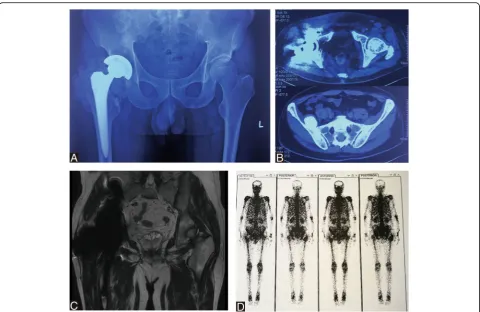
X-ray and CT scan confirmed extensive muscle and soft tissue mass around the right hip prosthesis and in pelvis. Coronal T2magnetic resonance image showed significant artifact in the region of right hip joint and in the pelvis abutting the medial wall of the right acetabu-lum. Surrounding the prosthesis was extensive soft tissue and muscle edema affecting the adductor bundle, gluteus muscles, rectus femoris muscle and obturator externus. 99mTc-MDP bone scan indicated benign tumor without distant metastases in pelvis (Fig.4). A provisional diag-nosis of necrotic pseudotumor was suggested. The
Fig. 1Anteroposterior radiograph of right cementless CoC total hip replacements
Fig. 2Radiograph showing fracture of the ceramic femoral head with marked fragmentation (a) Anteroposterior view.bLateral view
[image:2.595.306.538.86.288.2] [image:2.595.58.292.511.700.2]patient’s serum C-reactive protein was 33.42 mg/L and
erythrocyte sedimentation rate was 9 mm/h. His
complete white cell count was elevated at 14.10 × 10⁹/L (N: 81.0%). Serum ion analysis was conducted by induct-ively coupled plasma mass spectrometry (ICP-MS, Ther-moFisher, USA). Serum ion concentration was shown in
Table 1. Serum cobalt, chromium, titanium levels were
significantly elevated 5 days preoperatively (serum Co =
1065.39μg/L, serum Cr = 19.58μg/L, serum Ti =
106.27μg/L). Given the clinical and imaging findings
and serum analysis, combined with a history of CoC to
MoP revision THA, we deemed that this patient’s
symp-toms were likely due to severe metallos is caused by third particle wear when a fractured ceramic head and subsequent multiple pseudotumor formation.
Surgical exploration with re-revision THA for severe wear and multiple pseudotumor formation was dis-cussed with the patient and he underwent a re-revision THA by a lateral approach. During re-revision, extensive metallos is and dark gray tissue was visible around the joint, suggestive of multiple pseudotumor. The total vol-ume of dark gray drainage from surrounding synovial sacs was about 100 ml. The pseudotumors and sur-rounding synovial sacs around prosthesis were then ex-cised. The cystic soft tissue swelling herniated out under the inguinal ligament into the right pelvis. The dark gray fluid from pelvis was debrided aggressively and lavaged
thoroughly. The intraoperative frozen section of the ex-cised mass revealed less than 5 polymorphonuclear leu-kocytes per high-power field in all the three specimens. The patient’s hip was dislocated. The acetabular shell and femoral stem were well fixed, and therefore, these components were retained. A severe wear was noted
around the metal head and polyethylene liner (Fig. 5).
The taper exhibited wear without fracture. Thus, on the femoral side, a ceramic head (32/+ 3.5 mm) (Zimmer, Switzerland) was used, along with a titanium sleeve (Zimmer, Switzerland). On the acetabular side, the poly-ethylene liner (Smith & nephew, Switzerland) was ex-changed. The components were verified as being stable and synovectomy and extensive debridement were con-ducted before closing the wound. For excised mass, the histopathology analysis supported inflammatory re-sponse to metal particles, indicated by the presence of perivascular lymphocytes and necrotic tissue with fibro-sis, fibrin material (Fig.6).
Intraoperative metalion of periprosthetic tissue and dark gray fluid analysis was done, showing increased co-balt, chromium, molybdenum and titanium concentra-tion (Table 1). It indicated metal head and taper erosion and consequent metal toxicity. At 2 months, a repeat serum metal ion analysis revealed a decrease in Co and Cr ions levels with their values being 453.07 and 9.52μg/L, respectively (Table1). X-ray at immediate and
Fig. 3Revision MoP total hip arthroplasty for ceramic head breakage.a-bIntraoperative photograph demonstrating ceramic head breakage and (c) severe wear of the taper and neck of femoral stem.dPostoperative anteroposterior radiograph after revision with metal head and
[image:3.595.59.537.87.363.2]2 months postoperatively were unremarkable, while CT scan still showed cystic wall compares the solid pseudo-tumor preoperatively in pelvis (Fig.7).
Discussion and conclusions
The pseudotumor formation in the present case was caused by third particle wear on metal head after a frac-tured ceramic head breakage, which was indicated by in-creased metal ion release of cobalt and chromium. Furthermore, the increased amount of titanium was con-firmed by serum analysis. The metal ion release of titan-ium may be originated from tribocorrosion of the stem
neck and taper caused by cuts from sharper ceramic [12]. To the best of our knowledge, the present case is the first to describe rapid multi-pseudotumors formation and large pelvic mass due to severe wear after a revision MoP THA managed with re-revision arthroplasty.
Although CoC bearings are associated with low wear rates, breakage of head is still a concern. Breakage of ceramic head may associated with some intra- or post-operative factors, including excess hoop stress from impaction, component malposition, increased cup inclin-ation, taper design, taper mismatch and impingement
[13]. The use of 28-mm head and shorter neck during
Fig. 4Pseudotumor formation after revision MoP Total hip arthroplasty.aAnteroposterior radiograph showing extensive soft tissue mass around the right hip prosthesis and a mass in pelvis.bA transaxial view of the CT showed extensive right hip high density shadow and a high density mass in pelvis.cMRI T2image showed significant artifact in the region of the right hip MoM prosthesis. Surrounding the prosthesis was extensive soft tissue and muscle edema affecting the gluteus muscles, piriformis, rectus femoris, obturator externus, pectineus, and the adductor bundle.d
99mTc-MDP bone scintigraphy showed a photopenic area in the region of the right hip prosthesis that appears to extend into the surrounding
[image:4.595.58.539.86.398.2]soft tissues
Table 1Metal ion concentrations in the serum or in the periprosthetic tissue
Tissue (time point) Cobalt (ng/ml) Chromium (ng/ml) Molybdenum (ng/ml) Titanium (ng/ml)
Serum (5 days pre-operation) 1065.39 19.58 3.21 106.27
Surrounding tissue (intraoperation) 148.01 766.20 39.80 10.05
Dark gray fluid (intraoperation) 21389.71 89212.02 5431.69 279.83
Serum (2 months post-operation) 453.07 9.52 1.23 150.20
Norm values: Cobalt: < 2.5; Chromium < 2.03; Molybdenum 0.5–2; Titanium 2–10 (ng/ml)
[image:4.595.58.545.653.724.2]surgery are other potential risk factors for head breakage [9]. Lee et al. [14] reported that large-diameter heads were associated with a lower rate of fracture compared to smaller-diameter femoral heads in nearly 6 million hip implants. Moreover, revision THA conducted due to fractured ceramic implants is still to be complicated
[11]. The main puzzle is that complete removal of the
ceramic debris during revision is often impossible. Owing to no consensus on choice of implantation, metal head was used in the first revision in the present case. As demonstrated in the present study, the metal head was scraped by third particle from fractured ceramic head breakage. Therefore, wear of the revised articula-tion by retained ceramic debris is often catastrophic. As showed in the present case, a ceramic head with 28 mm diameter ceramic head was used in primary surgery
which may increase the risk of breakage. Furthermore, the presentation of symptoms occurred only 8 months after the revision MoP THA. The duration was shorter than that of average soft tissue reactions involving a MoP bearing (range from 3 to 26 years) [15]. The sever-ity of wear is attributed to the following factors, patient’s physical activity, kept non-weight bearing, postponed re-vision THA after ceramic breakage, complete synovect-omy, thorough lavage and choice of bearing surface. Although complete synovectomy and thorough lavage were conducted in revision arthroplasty in this case, small ceramic debris cannot be removed completely.
Currently, MoP or CoP/CoC bearings are all used in revision THA due to fracture of implants. Although there is no guideline on the best bearing for revision THA following fracture of the ceramic head, CoP or
[image:5.595.61.538.85.485.2]CoC bearings seem to reduce the risk of third-body wear [8]. Thus, as suggested by several studies, MoP bearing should be avoided because of the risk of head erosion and pseudotumor formation [8,11,16]. The present case clearly demonstrates that third-body wear and corres-pondingly increased release of metal ions (cobalt and chromium) are caused by MoP bearing in revision THA after ceramic head fracture. Thus, pseudotumor was formed rapidly in periprosthetic tissue and in pelvic.
In this case, the femoral stem was retained in revision THA and in re-revision surgery after intraoperative in-spection of the stability of the stem. However, titanium alloy sleeve was not used in revision MoP THA, which could lead to further erosion of the taper by unevenness. It was indicated by increased metal ion concentrations of titanium. In treating pseudotumour during re-revi-sion, non-metal bearing is required [17], thus, the pa-tient was revised with CoP with a titanium alloy sleeve. It is our preference to use a titanium alloy sleeve when a ceramic head is being placed on a previously used
femoral stem taper, because sleeve can create a smooth taper surface and prevent repeat fracture of the revised head. In spite of using titanium alloy sleeve in re-revi-sion THA, whether or not revise the femoral stem with scratches or corrosion on neck and taper was still un-clear [8,18]. Thus, femoral stem was always retained in this case. Furthermore, since a titanium alloy stem with
Fig. 6Postoperative histopathology.aPerivascular lymphocytes indicated inflammatory response to metal particles.b
Histopathology showed necrotic tissue with fibrosis, fibrin material and a few scattered lymphocytes
Fig. 7Two months following-up after re-revision surgery.a
Radiograph showing unremarkable pseudotumor surrounding hip and mass in pelvis.b-cA transaxial view of the CT showed a capsule wall in pelvis and lower density shadow surrounding the right hip
[image:6.595.308.539.84.604.2] [image:6.595.57.292.85.441.2]wear of the taper and neck was still present in crevice environment and erosion, the patient is still needed for serum metal ion analysis during follow-up, especially the concentration of titanium.
Diagnosing hip joint infection remains a major chal-lenge as there is no test with absolute accuracy [19]. The diagnosis is commonly based on a combination of clin-ical findings, laboratory test, microbiologclin-ical culture,
histological evaluation, and intraoperative findings.
Based on the preoperative test and intraoperative find-ings, the current case did not meet the new evidence-based criteria for diagnosing infection after joint
arthro-plasty [20]. Thus, we ruled out the possibility of
infection in differential diagnosis.
The case described herein clearly demonstrates that MoP bearings in revision THA for ceramic head break-age can cause severe wear and increased release of metal ions with correspondingly multiple pseudotumor forma-tion. Early immobilization and revision surgery as soon as possible are strongly recommended after breakage of ceramic head to prevent further formation of ceramic debris. Even small amounts of remaining debris with highest hardness could be deleterious for the outcomes after revision THA with metal components. Thus, revi-sion to CoC or CoP bearing with complete synovectomy and thorough debridement of the fractured ceramic frag-ments should be performed. The well-fixed femoral stem could be retained when the damage to the neck and taper is not beyond simple scratches or corrosion. A ti-tanium alloy sleeve should be placed on the retained femoral stem taper. The monitor for metal ions concen-tration in serum is still required during follow-up.
Abbreviations
CoC:Ceramic-on-ceramic; MoM: metal; MoP: metal-on-polyethylene; THA: total hip arthroplasty
Acknowledgements
N/A
Authors’contributions
DX: project conceptualization, data collection/validation, result interpretation, reporting & editing, and final approval of the version to be submitted. CY: data collection/validation. RL: result interpretation, reporting & editing, and final approval of the version to be submitted. BK: result interpretation. YH: reporting & editing. HL: result interpretation. JL: project conceptualization, result interpretation, final approval of the version to be submitted, and project guarantor. All authors have read and approved the manuscript.
Funding
This study was supported by grants from the National Natural Science Foundation of China (No. 81501919) and Peking University People’s Hospital Scientific Research Development Funds (No. RDH2017–05).These funding bodies had role in the collection and interpretation of data and in writing the manuscript.
Availability of data and materials
The final dataset will be available from the corresponding author.
Ethics approval and consent to participate
We have obtained written consent from patient and the case report was agreed by ethics committee of Peking University People’s Hospital.
Consent for publication
The patient was informed that data concerning the case would be submitted for publication, and he provided consent.
Competing interests
The authors declare that they have no competing interests.
Author details
1Arthritis Clinic and Research Center, Peking University People’s Hospital, Peking University, Beijing 100044, China.2Arthritis Institute, Peking University, Beijing, China.3Orthopedic Department, The First People’s Hospital of Pingdingshan, Henan, China.
Received: 4 March 2019 Accepted: 15 July 2019
References
1. Schulte KR, Callaghan JJ, Kelley SS, Johnston RC. The outcome of Charnley total hip arthroplasty with cement after a minimum twenty-year follow-up. The results of one surgeon. J Bone Joint Surg Am. 1993;75(7):961–75. 2. Chana R, Facek M, Tilley S, Walter WK, Zicat B, Walter WL.
Ceramic-on-ceramic bearings in young patients: outcomes and activity levels at minimum ten-year follow-up. Bone Joint J. 2013;95-B(12):1603–9. 3. Kang BJ, Ha YC, Ham DW, Hwang SC, Lee YK, Koo KH. Third-generation
alumina-on-alumina total hip arthroplasty: 14 to 16-year follow-up study. J Arthroplast. 2015;30(3):411–5.
4. Aoude AA, Antoniou J, Epure LM, Huk OL, Zukor DJ, Tanzer M. Midterm outcomes of the recently FDA approved ceramic on ceramic bearing in Total hip arthroplasty patients under 65 years of age. J Arthroplast. 2015; 30(8):1388–92.
5. Williams DH, Greidanus NV, Masri BA, Duncan CP, Garbuz DS. Prevalence of pseudotumor in asymptomatic patients after metal-on-metal hip arthroplasty. J Bone Joint Surg Am. 2011;93(23):2164–71.
6. Allain J, Goutallier D, Voisin MC, et al. Failure of a stainless-steel femoral head of a revision total hip arthroplasty performed after a fracture of a ceramic femoral head. A case report. J Bone Joint Surg Am. 1998;80: 1355–60.
7. Allain J, Roudot-Thoraval F, Delecrin J, et al. Revision total hip arthroplasty performed after fracture of a ceramic femoral head. A multicenter survivorship study. J Bone Joint Surg Am. 2003;85-A:825–30.
8. Traina F, Tassinari E, De Fine M, et al. Revision of ceramic hip replacements for fracture of a ceramic component: AAOS exhibit selection. J Bone Joint Surg Am. 2011;93:e147.
9. Traina F, De Fine M, Di MA, et al. Fracture of ceramic bearing surfaces following total hip replacement: a systematic review. Biomed Res Int. 2013; 2013:157247.
10. Sharma V, Ranawat AS, Rasquinha VJ, et al. Revision total hip arthroplasty for ceramic head fracture: a long-term follow-up. J Arthroplast. 2010;25:342–7. 11. Rambani R, Kepecs DM, Mäkinen TJ, et al. Revision Total hip arthroplasty for
fractured ceramic bearings: a review of best practices for revision cases. J Arthroplast. 2017;32:1959–64.
12. Cook RB, Bolland BJ, Wharton JA, et al. Pseudotumour formation due to tribocorrosion at the taper interface of large diameter metal on polymer modular total hip replacements. J Arthroplast. 2013;28:1430–6.
13. Kocadal O, Ozler T, AET B, Altintas F. Non-traumatic ceramic head fracture in Total hip arthroplasty with ceramic-on-ceramic articulation at postoperative 16th years. Hip Pelvis. 2019;31:124–7.
14. Lee GC, Kim RH. Incidence of modern alumina ceramic and alumina matrix composite femoral head failures in nearly 6 million hip implants. J Arthroplast. 2017;32:546–51.
15. Carli A, Reuven A, Zukor DJ, et al. Adverse soft-tissue reactions around non-metal-on-metal total hip arthroplasty - a systematic review of the literature. Bull NYU Hosp Jt Dis. 2011;69(Suppl 1):S47–51.
17. Campbell P, Shimmin A, Walter L, et al. Metal sensitivity as a cause of groin pain in metal-on-metal hip resurfacing. J Arthroplast. 2008;23:1080–5. 18. Pulliam IT, Trousdale RT. Fracture of a ceramic femoral head after a revision
operation. A case report. J Bone Joint Surg Am. 1997;79:118–21. 19. Fernández-Sampedro M, Fariñas-Alvarez C, Garces-Zarzalejo C,
Alonso-Aguirre MA, Salas-Venero C, Martínez-Martínez L, et al. Accuracy of different diagnostic tests for early, delayed and late prosthetic joint infection. BMC Infect Dis. 2017;17:592.
20. Parvizi J, Tan TL, Goswami K, Higuera C, Della VC, Chen AF, et al. The 2018 definition of Periprosthetic hip and knee infection: an evidence-based and validated criteria. J Arthroplast. 2018;33:1309–14.e2.
Publisher’s Note
Springer Nature remains neutral with regard to jurisdictional claims in published maps and institutional affiliations.