R E S E A R C H
Open Access
A new graph based on the semi-direct
product of some monoids
Eylem Guzel Karpuz
1*, Kinkar Chandra Das
2, Ismail Naci Cangul
3and Ahmet Sinan Çevik
4*Correspondence: [email protected]
1Department of Mathematics, Kamil
Özdag Science Faculty, Karamanoglu Mehmetbey University, Yunus Emre Campus, Karaman, 70100, Turkey Full list of author information is available at the end of the article
Abstract
In this paper, firstly, we define a new graph based on the semi-direct product of a free abelian monoid of ranknby a finite cyclic monoid, and then discuss some graph properties on this new graph, namely diameter, maximum and minimum degrees, girth, degree sequence and irregularity index, domination number, chromatic number, clique number of
(PM). Since graph theoretical studies (including such above graph parameters) consist of some fixed point techniques, they have been applied in fields such as chemistry (in the meaning of atoms, molecules, energyetc.) and engineering (in the meaning of signal processingetc.), game theory and physics.
MSC: 05C10; 05C12; 05C25; 20E22; 20M05
Keywords: graphs; semi-direct product; monoid presentation
1 Introduction and preliminaries
In this paper, we mainly investigate the interplay between the semi-direct product over monoids and the graph-theoretic properties of the semi-direct product in terms of its re-lations. In detailed, let us consider a free abelian monoidFnof ranknand also consider a finite cyclic monoidC. Then, by [], we can define the semi-direct product ofFnbyC. Moreover, one can also define a new graph associated with this semi-direct product (see Section . below). Thus the idea in here is to present the interplay between the alge-braic semigroup and theoretic properties of this new graph. In fact, by the graph-theoretic properties, we will be interested in the diameter, maximum and minimum de-grees, girth, chromatic number, clique number, domination number, degree sequence and irregularity index of the corresponding new graph. In the literature, there are some im-portant graph varieties and works that are related to algebraic and topological structures, namely, Cayley graphs [–] or zero-divisor graphs [–]. But the graph constructed in here is different from those in the previous studies and is also interesting in terms of using algebraic semi-direct products during the construction of the vertex and edge sets. So, this kind of graph not only provides the classification of algebras (monoids, semigroups), but also solves the problems of normal forms of elements, word problem, rewriting system, embedding theorems, extensions of groups and algebras, growth function, Hilbert series,
etc.As is well known, these problems are really important in fixed point results since they have a direct connection to nature sciences.
First of all, let us recall the semi-direct product of any two monoids and its presentation. Thus, let us take two arbitrary monoidsAandKwith associated presentationsPA= [X;r] andPK= [Y;s], respectively. Also, letM=KθAbe the corresponding semi-direct
uct of these two monoids, whereθis a monoid homomorphism fromAtoEnd(K). We note that the reader can find some examples of monoid endomorphisms in []. The elements of
Mcan be regarded as ordered pairs (a,k), wherea∈A,k∈Kwith multiplication given by (a,k)(a,k) = (aa, (kθa)k). The monoidsAandKare identified with the submonoids of
Mhaving elements (a, ) and (,k), respectively. Furthermore, one can define a standard presentation forMas follows: For everyx∈Xandy∈Y, choose a word, which we denote byyθx, onYsuch that [yθx] = [y]θ[x]as an element ofK. To establish notation, let us denote the relationyx=x(yθx) onX∪YbyTyxand writetfor the set of relationsTyx. Then
PM= [Y,X;s,r,t]
is a standard monoid presentation for the semi-direct productM. We may refer to [, ] for more detailed knowledge about the definition and a standard presentation for the semi-direct product of two monoids.
LetFnandCbe a free abelian monoid of ranknand a finite cyclic monoid with the
presentations
PFn=
y,y, . . . ,yn;yiyj=yjyi(≤i<j≤n)
and
PC=
x;xk=xl(≤l<k),
respectively. By [], if one considers the matrix
M=
⎡ ⎢ ⎢ ⎢ ⎢ ⎣
α α · · · αn α α · · · αn
..
. . .. ...
αn αn · · · αnn
⎤ ⎥ ⎥ ⎥ ⎥ ⎦
and assumesMk≡Ml(modd), whered|(k–l), then there exits a semi-direct product
M=FnθCwith the presentation
PM=
y,y, . . . ,yn,x;yiyj=yjyi(≤i<j≤n),xk=xl,
yx=xyαy
α
· · ·y
αn
n ,yx=xyαy
α
· · ·y
αn n , . . . ,
ynx=xyαny
αn
· · ·y
αnn n
. ()
1.1 A new graph based on semi-direct products
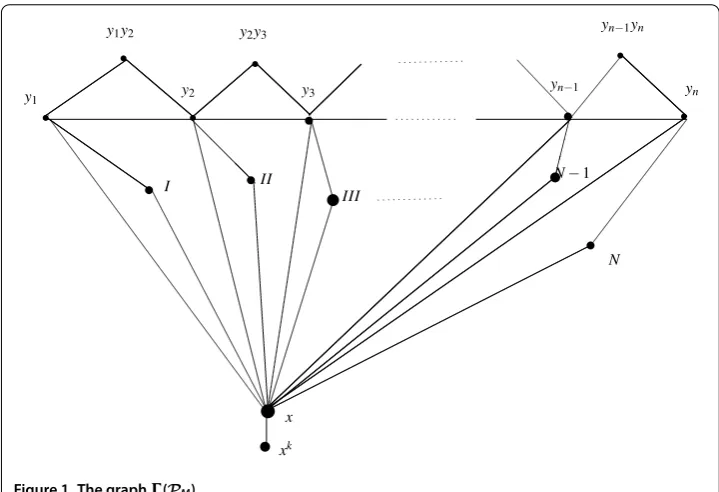
In the following, we define an undirected graph(PM) = (V,E) associated withPMgiven in (). Actually, all the results presented in this paper are based on this graph.
Thevertex set V consists of the following:
• all generatorsyi(≤i≤n) andxofPM,
• words of the formyαi
y
αi
· · ·y
αin
n (≤i≤n) in the presentation (),
• word of the formxkifl= in the presentation (). Otherwise,i.e., ifl= then we have
a relatorxk=x; in that case, sincexis in the vertex set, there is no need to takexkas a vertex.
Theedge Econsists of the following:
• connect each vertexyito singlexfor all≤i≤n,
• connect each of the adjacent verticesyiandyi+for all≤i≤n– , • connect each vertexyito the related verticesyαiy
αi
· · ·y
αin
n for all≤i≤n,
• connect each of the verticesyiandyi+to the vertexyiyi+from both sides for all ≤i≤n– ,
• connect the unique vertexxto each vertex of the formyαi
y
αi
· · ·y
αin
n for all≤i≤n.
Remark
(a) In the construction of the semi-direct product, we assume that all rows of the matrix
Mare different from each other. This affects our matching in the graph as all verticesyαi
y
αi
· · ·y
αin
n ’s are distinct.
(b) To simplify, let us label the vertex
yα
y
α
· · ·y
αn
n byI, y
α
y
α
· · ·y
αn
n byII, · · ·,
yαn
y
αn
· · ·y
αnn
n byN.
(c) As seen in Figure , the number of vertex and edge sets depends on the number of generators of the free abelian monoid of rankn. Thus we have
V(PM)= n+ and E
(PM)= n– ifl= in(),
V(PM)= n and E
(PM)= n– ifl= in().
[image:3.595.117.477.478.724.2]Thus we obtain the graph(PM) as drawn in Figure .
2 Graph theoretical results over
(PM)
In this section, by considering the graph(PM) drawn in Figure , we mainly deal with some graph properties, namely diameter, maximum and minimum degrees, girth, degree sequence, irregularity index, domination number, chromatic number and clique number of(PM).
We first recall that for any simple graph, thedistance(length of the shortest path) be-tween two verticesu,vofis denoted byd(u,v). If no such path exists, we setd(x,y) :=∞.
Actually, thediameterofis defined by
diam() =supd(x,y) :xandyare vertices of
.
We thus get the following result.
Theorem The diameter of the graph(PM)is.
Proof By Figure , it is clearly seen that the vertexxk(ifl= then it exists in the graph)
of(PM) is pendant and so the diameter can be figured out by considering the distance
d(PM)(xk,y), whereyis one of the other vertices. Ifl= in the presentation (), then the vertexxis pendant of the graph(PM). By Figure , we also see that the vertexxis con-nected with all the vertices except the vertices of the formyiyi+(≤i≤n– ) in the vertex set. Thus we can reach these vertices by only one edge from the verticesyi(≤i≤n). So,
we getdiam((PM)) = .
The degreedeg(v) of a vertexvofis the number of vertices adjacent tov. Among all
degrees, themaximum degree() (or theminimum degreeδ()) ofis the number of
the largest (or the smallest) degrees in(see []). In our graph, maximum and minimum
degrees are obtained as follows.
Theorem The maximum and minimum degrees of the graphs(PM)are
(PM)
=
⎧ ⎨ ⎩
n+ ; if l= in(),
n; if l= in() and
δ(PM)=
⎧ ⎨ ⎩
; if l= in(),
; if l= in(),
respectively.
Proof By Figure , it is seen that the vertexxis connected with all vertices of the formyi (≤i≤n),yαi
y
αi
· · ·y
αin
n (≤i≤n) and the vertexxkifl= in the presentation (). So, ((PM)) =n+n+ = n+ . In the casel= in the presentation (), since there is no vertex labeled byxk, we get((P
M)) =n+n= n.
On the other hand, ifl= in the presentation (), then there is only one edge from the vertexxkto the vertexx. Thusδ((P
M)) = . Otherwise, since the vertices which are of the formyiyi+(≤i≤n– ) are connected to the verticesyiandyi+, we getδ((PM)) = , as
required.
Theorem The girth of the graph(PM)is.
Proof By the edge definition of(PM), the vertexxis connected to the vertices of the form
yi(≤i≤n) andy
αi
y
αi
· · ·y
αin
n (≤i≤n). There also exists an edge between verticesyi andyαi
y
αi
· · ·y
αin
n . So, the length of the shortest cycle contained in the graph(PM) is .
There also exists the termdegree sequence DS(), which is a sequence of degrees of ver-tices of the graph. Recently, in [], a new parameter for graphs, namely theirregularity indexof, has been defined and denoted byMWB(). In factMWB() is the number of distinct terms in the setDS().
Theorem The degree sequence and irregularity index of(PM)are given by
DS(PM)=
⎧ ⎪ ⎪ ⎪ ⎨ ⎪ ⎪ ⎪ ⎩ (, , , . . . ,
n–times
, , , , , . . . ,
n–times
, n); if l= ,
(, , . . . ,
n–times
, , , , , . . . ,
n–times
, n); if l=
and
MWB(PM)
= ⎧ ⎪ ⎪ ⎪ ⎪ ⎪ ⎪ ⎪ ⎪ ⎨ ⎪ ⎪ ⎪ ⎪ ⎪ ⎪ ⎪ ⎪ ⎩
; if l= and n= ,
; if l= and n≥,
; if l= and n= ,
; if l= and n= ,
; if l= and n≥,
respectively.
Proof Let us consider the casel= in the presentation (). In this case, since the vertexxk is connected with only the vertexx, then we clearly obtain that the degree ofxkis . Now we consider the vertices of the formyiyi+(≤i≤n– ) andy
αj
y
αj
· · ·y
αjn
n (≤j≤n). Since these vertices are connected with the verticesyi,yi+ (≤i≤n– ) andyj(≤j≤n),x, the degree of them is . Thus we have n– vertices which have degree . By Figure , we see that the verticesyandynare connected toyy,y,yαy
α
· · ·y
αn
n ,xandyn–yn,yn–,
yαn
y
αn
· · ·yαnnn,x, respectively. So, the degree ofyandynis . The remaining verticesyi (≤i≤n– ) are connected to the verticesyi,yi–yi,yiyi+,yi+,yαiy
αi
· · ·y
αin
n andx. So, the degree of them is . Since the reminded vertexxis connected withyi,yαi
y
αi
· · ·y
αin n (≤i≤n) andxk the degree of it is n+ . Now, let us consider the casel= in the presentation (). In this case, since the vertexxkdoes not exist, we get the degree sequence
DS((PM)) as depicted in the theorem.
ForMWB((PM)), we need to consider the numbernin the presentation (). The num-ber of distinct terms in the setDS((PM)) depends on the numbern. By considering the
numbern, we can easily obtain the irregularity indexMWB((PM)), as required.
number γ() is the number of vertices in the smallest dominating set for the graph (see []).
Theorem The domination number of(PM)is given by
γ(PM)=
⎧ ⎨ ⎩
n+
; n is even, n+
; n is odd.
Proof By considering Figure , the vertexxis adjacent to all the vertices except the vertex of the formyiyi+(≤i≤n– ). Thus, in the domination set, there must be some vertices of the formyi adjacent to the vertices of the formyiyi+. These vertices depend on the number ofnin the presentation (). Ifnis even, then there aren
+ vertices (y,y, . . . ,yn,x) in the smallest dominating set for(PM). Otherwise, there aren–+ vertices. Hence the
result.
Basically, the coloring of a graphis to be an assignment of colors (elements of some set) to the vertices of, one color to each vertex, so that adjacent vertices are assigned distinct colors. Ifncolors are used, then the coloring is referred to asn-coloring. If there exists an
n-coloring of, thenis calledn-colorable. The minimum numbernfor whichisn -colorable is called thechromatic numberofand is denoted byχ(). There exists another graph parameter, namely thecliqueof a graph. In fact, depending on the vertices, each
of the maximal complete subgraphs ofis called aclique. Moreover, the largest number
of vertices in any clique ofis called theclique numberand is denoted byω(). In general, it is well known thatχ()≥ω() for any graph(for instance []).
Theorem The chromatic numberχ((PM))is equal to.
Proof Let us consider the vertexxin the graph(PM) drawn in Figure . It is easy to see thatxis adjacent to all the other vertices except the vertices of the formyiyi+(≤i≤n– ). That means the color used for the vertexxcan be used for the verticesyiyi+. Thus let us suppose that the color forxandyiyi+is labeled byC. Next, let us consider the vertices
yi(≤i≤n) in Figure . Since these vertices are connected with each other doubly, we have two different colors labeled byCandC. In other words, if we label the vertexyby
C, then we label the vertexybyC,ybyCand so on. Now we take account of vertices
I,II, . . . ,N. Since these vertices are adjacent to the verticesy,y, . . . ,yn, respectively, they can be labeled byCandC, respectively. Since the remaining vertexxkis just connected
with the vertexx, it can be labeled byC. Hence the result.
We note that the chromatic number of(PM) does not depend on the number of
gen-erators of the free abelian monoid of rankn.
Theorem The clique numberω((PM))is equal to.
Proof By Figure , we have three types of maximal complete subgraphs of(PM). These types consist of the following edges which have three vertices:yi–yi+–yiyi+–yi,yi–
yi+–x–yiandyi–yαiy
αi
· · ·y
αin
Figure 2 The graph defined in Example 1.
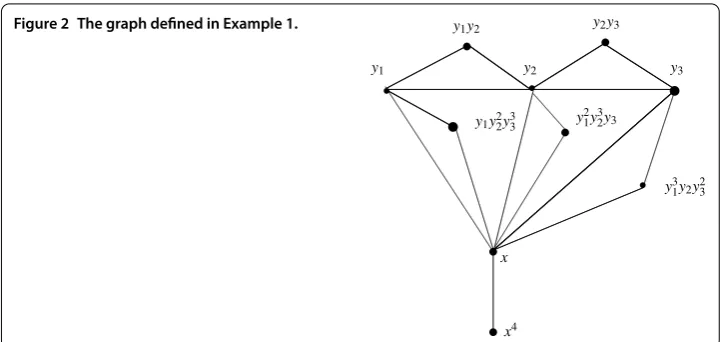
Example Let us consider a free abelian monoid of rank ,F, and a finite cyclic monoid
Cwith the presentations
PF=y,y,y;yy=yy,yy=yy,yy=yy
andPC=x;x=x, respectively. By taking the matrix
M=
⎡ ⎢ ⎣
⎤ ⎥ ⎦
and the homomorphismθ:C→End(F), we can get a semi-direct productFθCwith
the presentation
PFθC=
y,y,y,x;yy=yy,yy=yy,yy=yy,x=x,
yx=xyyy,yx=xyyy,yx=xyyy
. ()
By considering the presentation in () and Figure , we have the following:
• V((PFθC)) ={y,y,y,x,x
,y
y,yy,yyy,yyy,yyy}and so
|V((PFθC))|= . + = .
• E((PFθC)) ={ei(≤i≤), in Figure }and so|E((PFθC))|= . – = .
• diam((PFθC)) = .
• ((PFθC)) = . + = andδ((PFθC)) = .
• girth((PFθC)) = .
• DS((PFθC)) = (, , , , , , , , )and soMWB((PFθC)) = .
• γ((PFθC)) =
+ = .
• χ((PFθC)) =ω((PFθC)) = .
Competing interests
The authors declare that they have no competing interests.
Authors’ contributions
Author details
1Department of Mathematics, Kamil Özdag Science Faculty, Karamanoglu Mehmetbey University, Yunus Emre Campus,
Karaman, 70100, Turkey.2Department of Mathematics, Sungkyunkwan University, Suwon, 440-746, Republic of Korea. 3Department of Mathematics, Faculty of Arts and Science, Uludag University, Gorukle Campus, Bursa, 16059, Turkey. 4Department of Mathematics, Faculty of Science, Selçuk University, Campus, Konya, 42075, Turkey.
Acknowledgements
Dedicated to Professor Hari M Srivastava.
The third and fourth authors are partially supported by Research Project Offices (BAP) of Selcuk (with Project Number 13701071) and Uludag (with Project Numbers 2012-12 and 2012-19) Universities, respectively. The second author is supported by the Faculty Research Fund, Sungkyunkwan University, 2012 and Sungkyunkwan University BK21 Project, BK21 Math Modelling HRD Div. Sungkyunkwan University, Suwon, Republic of Korea.
Received: 28 January 2013 Accepted: 1 March 2013 Published: 20 March 2013 References
1. Cevik, AS, Das, KC, Cangul, IN, Maden, AD: Minimality over free monoid presentations. Hacet. J. Math. Stat. (accepted) 2. Kelarev, AV, Praeger, CE: On transitive Cayley graphs of groups and semigroups. Eur. J. Comb.24, 59-72 (2003) 3. Kelarev, AV: On Cayley graphs of inverse semigroups. Semigroup Forum72, 411-418 (2006)
4. Luo, Y, Hao, Y, Clarke, GT: On the Cayley graphs of completely simple semigroups. Semigroup Forum82, 288-295 (2011)
5. Anderson, DF, Livingston, PS: The zero-divisor graph of commutative ring. J. Algebra217, 434-447 (1999) 6. Anderson, DF, Badawi, A: The zero-divisor graph of a ring. Commun. Algebra36(8), 3073-3092 (2008) 7. DeMeyer, FR, DeMeyer, L: Zero-divisor graphs of semigroups. J. Algebra283, 190-198 (2005) 8. Dlab, V, Neumann, BH: Semigroups with few endomorphisms. J. Aust. Math. Soc. A10, 162-168 (1969)
9. Cevik, AS: Thep-Cockcroft property of the semi-direct products of monoids. Int. J. Algebra Comput.13(1), 1-16 (2003) 10. Wang, J: Finite derivation type for semi-direct products of monoids. Theor. Comput. Sci.191(1-2), 219-228 (1998) 11. Gross, JL: Handbook of Graph Theory. Chapman & Hall/CRC, London (2004)
12. Mukwembi, S: A note on diameter and the degree sequence of a graph. Appl. Math. Lett.25, 175-178 (2012)
doi:10.1186/1029-242X-2013-118