ECONOMIC (IN)SECURITY AND GENDER
DIFFERENCES IN TRADE POLICY ATTITUDES
By:
Jeffrey Drope and Abdur Chowdhury
ECONOMIC (IN)SECURITY AND GENDER DIFFERENCES IN TRADE POLICY ATTITUDES
Jeffrey Drope
Department of Political Science Marquette University
and
American Cancer Society, Atlanta, GA [email protected]
Abdur Chowdhury Department of Economics
Marquette University [email protected]
ECONOMIC (IN)SECURITY AND GENDER DIFFERENCES IN TRADE POLICY ATTITUDES
Abstract
Over time and across countries, researchers have noted frequent and mostly unexplained gender differences in the levels of support for policies of free or freer trade: women tend to be less favorable toward policies of liberalizing trade than men. Using an economic security explanation based principally on a mobile factors approach, we find that it is not women generally who are more negative toward trade but particularly economically vulnerable women – i.e. women from the scarce labor factor. We utilize recent survey data on individuals’ attitudes toward different facets of trade and its effects across three disparate regions to examine this phenomenon empirically. An economic security approach helps to explain the marked differences in attitudes toward trade among lower- and higher-skilled females in developing and developed countries.
Key words: trade policy, gender difference, labor mobility, Latin America, Muslim
countries
JEL Classification
:
F14, F20, O57I. Introduction
Over time and across countries, researchers have noted frequent and mostly unexplained
gender differences in the levels of support for policies of free or freer trade: women tend to be
less favorable toward policies of liberalizing trade than men (e.g. Baker 2005, 2009; Graham and
Pettinato 2001; O’Rourke and Sinnott 2001; Mayda and Rodrik 2005; Seligson 1999; Scheve
and Slaughter 2001). Because the economic importance of trade is growing worldwide, citizens
can and often influence macroeconomic policymaking, and women comprise greater than 50% of
the population in most countries, women’s distinct preferences in this major policy area are an
important phenomenon to consider.
While earlier studies have posited multiple explanations for general attitudes toward trade
policy, no well substantiated account of the gender component of trade attitudes has emerged.
The few studies focusing specifically on the gender-trade attitudes nexus underscore exposure to
economic ideas (Burgoon and Hiscox 2004) and consumption decisions (Hall, Kao and Nelson
1998), while those examining general attitudes toward trade have employed not only these two
approaches (e.g. Baker 2009; Hainmuller and Hiscox 2006), but have also emphasized more
traditional mobile factors (Scheve and Slaughter 2001) and specific factors (Mayda and Rodrik
2005) approaches, in addition to considering education as human capital (Gabel 1998) and
sociotropic concerns (Mansfield and Mutz 2009).
While this research seeks to address all of the above approaches in order to explain
gender differences in trade attitudes, it emphasizes the concept of labor mobility as the most
useful theoretical starting point. We posit that it is not women in general who tend to be
negative toward trade but particularly women in the less abundant labor factor – higher or
lower-skilled depending on the country context – who have heightened concerns about open trade’s
negative effects on them. In particular, these individuals tend to be more concerned about the
potentially disruptive economic effects that such policies might have on them or their families.
One of the central obstacles to testing theoretical propositions related to explaining trade
policy attitudes has been the limitations of the available data. Most public opinion surveys ask
respondents to provide only a general opinion about free trade and researchers are left to
conjecture as to which particular aspect(s) of trade policy and/or its effects the respondent is
reacting.1 Trade is complex and few surveys bother to ask questions about its meaningful
components, a shortcoming that poses serious problems for direct testing of many key
hypotheses. Trade, and more importantly, changes in trade policy, can have a number of major
implications for individuals and societies, and respondents are likely to be more concerned about
the particular aspects that most affect them or their household, including, for example, trade’s
effects on consumption, jobs (theirs and/or employment more broadly) and economic growth.
These specific concerns are the components shaping the “general” attitudes on which most
researchers focus. Specific to this inquiry, the existing literature suggests that there may be a
gendered component to many of these aspects, including those related to economic security and
consumption.
Ideally, in order to determine more effectively why women are generally less receptive to
trade liberalization, survey questions need to ask directly about the specific aspects and/or effects
1
The following surveys include general questions about attitudes toward trade or trade policy: the American National Election Study or NES 1992 (Blonigen 2009; Scheve and Slaughter 2001); Globescan International Survey 2003 (Baker 2009); International Social Survey Program or ISSP 1995 (Mayda and Rodrik 2005; O’Rourke and Sinnott 2001); Knowledge Networks 2007 (Mansfield and Mutz 2009); Latinobarometro 1996 (Beaulieu, Yatawara and Wang 2005), 1997 (Baker 2009); the National Annenberg Election Study 2004 (Mansfield and Mutz 2009); Pew Global Attitudes Project 2002, 2007 (Baker 2009); Time-Sharing Experiments for the Social Sciences or TESS 2003 (Burgoon and Hiscox 2004); the Wall Street Journal Americas 1998 (Baker 2009); the World Values Survey 1990-92, 1995-97, 1999-2001 (Baker 2005, 2009; Kaltenthaler, Gelleny and Ceccoli 2004 use 1995-97 only). Baker (2009, Chapter 8) utilizes some questions from his 4-City Survey (Brazil – 2005) about particular aspects of trade but uses them to create an index and explore a different theoretical inquiry.
of trade policy that might be affecting women differently. Such data are even better if they are
collected across space and time. Researchers can then employ these more nuanced responses as
dependent variables in order to test competing or complementary theoretical propositions more
meaningfully. Exploring gender differences in individuals’ wide-ranging concerns about trade’s
effects on different facets of economic security helps to ensure that the findings are robust. The
breadth of question also can help to disentangle the effects of major causal and/or other
important variables that are otherwise lumped together in the general questions.
Several recent major public opinion surveys across three disparate countries or sets of countries –
the U.S., six major Latin American countries and five countries with predominant or large
Muslim populations – offer excellent opportunities to explore some of these complexities
because they probe deeply and widely into individuals’ perceptions of and attitudes toward trade
and its effects. Survey themes include economic security concerns – e.g. jobs, overall economic
growth, markets for exports, pocketbook economic concerns, etc – and consumption, while also
collecting other crucial individual-level data such as educational attainment. A multi-country and
region research design serves to identify any divergence in gender’s effects on trade attitudes
between developed and developing countries, thereby helping to test a mobile factors theory
more effectively.
The empirical findings of this research suggest that a mobile factors approach is a useful
theoretical starting point in an explanation of gender differences in trade attitudes across a wide
sample of countries. In the U.S., less educated women are more likely to have negative attitudes
toward international trade and many things that it affects including consumption, workers and
business. On the other hand, women with higher levels of formal education in the U.S. are more
likely to report that trade has positive effects on the country’s workers and consumption. In
contrast, in developing countries, it is educated women who are more likely to view aspects of
trade more negatively, including its effects on jobs, markets and consumption in Latin America,
and trade overall and domestic business in the Muslim-country survey, while less educated
women in the Muslim-country survey view trade’s effects on domestic business positively. As
we develop below, women who are more likely to feel economically less secure because they are
part of the scarce factor are more skeptical toward freer trade and its many facets, which include
women with less education in developed economies and with more education in many emerging
economies. In many of these developing countries, educated women are relatively new to their
more skilled jobs in the labor marketplace and in times of major economic change – such as
changes caused and/or exacerbated by trade policy reform – they may feel more vulnerable to the
disruptions that often occur.
The paper is organized as follows. Section II discusses the literature and develops the
theoretical framework. Data and the methodology are given in Section III; while Section IV
presents the empirical results. Alternative explanations are discussed in Section V. The paper
ends with concluding remarks in Section VI.
II. Literature and Theoretical Framework
The existing literature on trade policy attitudes has established empirically that a number
of theoretical approaches offer explanatory utility. Recognizing this utility and because there are
no compelling reasons that these explanations need to be theoretically or empirically exclusive of
each other, we employ a framework that seeks to integrate them. However, because the literature
on trade attitudes has grown somewhat vast, we will focus in this section on the approaches that
have been most directly associated with gender and/or are most germane to our broader
argument, including economic security, consumption, education/knowledge and risk.
II.a A Mobile Factors Approach and Economic Security
A major component of economic security is personal labor mobility. In a mobile factors
approach to explaining trade attitudes, individuals in the abundant labor factor – higher-skilled in
developed countries and lower-skilled in developing countries – are more likely to prefer policies
of freer trade because they are theoretically better positioned to thrive in a more liberalized
economy.2 Researchers argue that the goods or services generated by the abundant labor factor
are comparatively more competitive in the global marketplace, which garners those workers
higher wages. The corollary suggests that individuals in the scarce factor – lower-skilled in
developed countries and higher-skilled in developing countries – will be more wary of
liberalized trade because their industry will not do as well thereby mitigating demand for their
skills and driving down their wages.3
We suggest that the scarce-factor dynamic is particularly heightened for women because
they potentially face even greater economic and workforce constraints than men and stand
potentially to lose more from policies that may cause economic distortion or dislocation. Many
researchers have noted and some have demonstrated empirically that women often bear a
disproportionate economic burden after liberalization (e.g. SIPA 2001, Tickner 2001).
Therefore, women in the scarce labor factor face a veritable double burden: both their gender and
their skill set appear to limit their economic opportunities. It is reasonable therefore to expect
2 In an analysis of the relationship between trade policy and inequality, Dutt and Mitra (2002) also employ a
framework consistent with a mobile factors approach. Though gender and inequality are of course distinct concepts, the multi-purpose nature of the general framework illustrates its broad utility.
3 For in-depth general discussions of these approaches, see Baker 2009; and Mansfield and Mutz 2009.
that these women will tend to be more skeptical of economic policy changes that present greater
potential danger to their more precarious economic status, including trade liberalization.
Accordingly, we should be able to observe clear evidence of predictable differences
among more and less educated women in both developed and less developed economies. In
developed economies, women with more formal education, by virtue of being the abundant labor
factor, should enjoy greater labor market flexibility and opportunity and be more positive toward
different facets of trade. Also, in developed economies such as the U.S., less educated women
are generally more economically vulnerable and should demonstrate wide-ranging and deeper
concerns about liberalizing trade. Kucera and Milberg (2000) demonstrate empirically that in the
higher-skilled Organization of Economic Cooperation and Development (OECD) countries, trade
with countries with abundant lower-skilled labor has had a disproportionate negative effect on
lower-skilled female workers in these more developed economies.
In developing countries, higher-skilled skilled workers are not only the scarce labor
factor, but higher-skilled women in particular in many circumstances are newer to and a minority
in the workforce, and are frequently the first to feel negative effects as labor demands change.
Empirically, the ILO (2010) finds precisely this negative dynamic across a wide range of
developing countries and regions: educated women are consistently facing lower wages, losing
their jobs and not finding work disproportionate to educated men.4 Thus, policies such as free
trade that can generate significant economic change are more likely to be viewed with skepticism
and even negativity by these women. Finally, theory also suggests that less educated women in
developing countries will be more likely to endorse freer trade. Recent empirical studies
demonstrate that in the post-liberalization environment, wage gains for women have accrued
4
It is important to note that mobile factors approaches assume full employment, which in strict terms, limits the theory to anticipating only wage decreases.
disproportionately to the lower-skilled (Kabeer 2000; Mathew 2006; Saavedra 2001). Therefore,
it is reasonable to expect that they might look at trade more positively than their better educated
compatriots. However, this expectation should also be tempered with the complex economic
reality that while lower-skilled women might be doing better than before economic opening,
many studies show that trade liberalization generates winners and losers as labor is reallocated
according to factor endowments and some groups of low-skilled women have also fared poorly
(see Artecona and Cunningham 2002).5
Another component of the mobile factors approach is individuals’ direct economic
pocketbook concerns (e.g. Kaltenthaler et al 2004; Seligson 1999), because these concerns are
closely associated with wages and consumption, and thus economic security of the individual
and their household. Though studies have found only occasional evidence that these concerns
drive individual-level attitudes toward trade, women may feel these microeconomic pressures
more acutely than men. In recent decades, women have been taking an increasingly direct
household management role in both developed and developing countries and pocketbook
concerns may now be more important to many women because of these significant role changes
(see Varley 1996).
Changes in trade policy might affect individual-level consumption and thus their broader
economic situation. Recent research (see especially Baker 2003, 2009) argues that perceptions
of improved consumption opportunities as a result of more open trade help to drive more positive
5 A competing theoretical view posits a specific factors approach wherein the individual’s industry strongly
influences trade policy preferences. In brief, individuals in export-oriented sectors are more likely to support open trade while those in import-competing sectors prefer more closed trade policies (see Mayda and Rodrik 2005). In a recent working paper, Beaulieu and Napier (2008) test a specific factors hypothesis and a related tradables versus non-tradables hypothesis, and find that neither sectoral differences in employment nor employment in a tradable versus a non-tradable sector helps to explain gender differences in attitudes toward trade. They do find that the gender gap is more pronounced in developed economies than in developing ones, but do not offer an explanation. They conclude in part that the lack of a clear explanation of the gender gap in attitudes may be due to immeasurable differences between the attributes of males and females.
attitudes toward liberalized trade. It is reasonable to expect that women – generally highly
active in household-level purchasing – will strongly consider policies that potentially affect
consumption. A recent survey of 12,000 women in 21 countries estimates that women are
responsible for nearly two-thirds of purchasing worldwide (BCG 2008). With an increasing
number of women heading households, perhaps especially so in developing nations, this
proportion of purchasing will likely continue to increase.6 Accordingly, it is reasonable to
anticipate that women’s perceptions of the effects of trade policy on consumption – including the
price, quality and variety of consumer goods – may directly affect their policy attitudes.
Hall, Kao and Nelson (1998) examine the historical relationship between female political
influence and trade policy utilizing a logic that suggests that women have more of a
consumption-based perception of trade policy and are going to be more in favor of liberalized
trade because tariffs increase prices. Comparing U.S. tariff levels before and after women’s
enfranchisement, they find a gender gap wherein policy became more open – at least in terms of
tariff levels – after this systemic change in voter eligibility, though they note the large number of
possible conflicting or complementary explanations. In essence, the researchers are suggesting
that women are more likely to condition their votes on changes in prices, while men tend to
emphasize wages. The research, however, does not explicitly consider the interaction of gender
and education.
Women’s central interest in consumption presents at least two related theoretical
possibilities. First, because women across education and income groups are generally active in
household purchasing, the perceived consumptive benefits from trade might cause all women to
look more favorably on this aspect of open trade (or even tilt general attitudes of women more
6
Varley (1996) argues that women-led households are in fact dramatically undercounted because the convention has been to count only single-female-parent with dependents as “woman-led.”
positively toward open and/or international trade). Or second, women with more limited means
– indicated best by lower levels of education and/or income – will be particularly attracted to the
notion of getting more for their money (e.g. Booth et al 1993). Thus, women with lower levels
of education and/or income will be more supportive of open trade because of its positive effects
on consumption. Since all three surveys query respondents directly about how they think trade
and/or trade policy is affecting their consumption, it is possible to examine this relationship
directly.
II.b Sociotropic
Somewhat outside of the mobile factors framework, some scholars suggest that
perceptions of the macroeconomic or “sociotropic” environment, including overall economic
growth and/or broader employment opportunities in the general economy, have an effect on
attitudes toward trade. For example, Mansfield and Mutz (2009) find that in the U.S., regardless
of gender, respondents’ sociotropic concerns have a resounding impact on their attitudes toward
trade: people who view the economy positively are more supportive of open trade. In developing
countries, where there is ample evidence that trade can disproportionately affect vulnerable
segments of the population under certain circumstances, it is reasonable to expect individuals to
demonstrate concern about trade’s macroeconomic effects. But the theoretical expectations are
complex and not well developed. For example, it is challenging to disentangle individuals’
perceptions of their pocketbook concerns from sociotropic ones because it is not clear that people
can make these distinctions clearly. Is it reasonable to expect that an individual would support
free trade if it is working well for the broader economy but not for them individually? Finally,
there are no clear expectations for specific gender implications.
II.c Ideas and Education
Scholars have also focused on exposure to ideas and information about the economic
principles of trade, as well as on education more generally, in order to explain trade attitudes.
Hiscox and Hainmueller (2006) argue that the actual ideas that people learn are important in
terms of shaping their attitudes toward trade. They posit that the fairly consistent positive
relationship between education and support for free trade in developed countries that scholars
have found is more a function of educated people’s exposure to specific economic ideas.
Burgoon and Hiscox’s (2004) version of this basic argument includes a gender twist by
suggesting that the gap between men and women is mainly a difference in their exposure to
economic ideas. The authors argue that men are more likely to be exposed to ideas that support
freer trade such as comparative advantage – for example, by being more likely to take a college
economics class – and therefore will be more likely to prefer policies that correspond to these
ideas. They test their hypothesis using data from the U.S. and find that incorporating knowledge
of trade issues (or suitable proxies) considerably closes the gender gap even after controlling for
alternative explanations including those more focused on mobility and consumption.
The logic of the “ideas” hypothesis is extremely challenging to test because it is
necessary to know the actual ideas to which individuals have been exposed. One crude
possibility is that college-educated women have generally been exposed to more economic ideas
than women without a college education because of the relative sophistication of the subject
material compared to other educational experiences (e.g. high school or vocational institutions),
and they will therefore be more positive toward trade. Some important shortcomings of this
claim are discussed in greater detail below.
The human capital explanation interprets the role of education differently than the “ideas”
approach. Scholars (e.g. Gabel 1998) who privilege the importance of human capital argue that
no matter the context, people with more education are better poised to be more mobile in the
labor market and will be more supportive of general social welfare-maximizing policies such as
liberalized trade. Thus, regardless of their status in terms of factor abundance and/or the
economic ideas to which they have been exposed, more educated people – including women –
should be more supportive of liberalizing trade.
In the cases of both the ideas and human capital, a clear pattern should emerge across the
data and corresponding analyses below. If either or both are helping to explain some of the
variation – and we will not be able to discern which with these data – we should observe
consistently that better educated women support open trade.
II.d Risk Preferences
A strand of the economics literature examining why men and women often make
different economic decisions privileges the role of risk. In particular, studies cite the possible
gender effects of emotions; overconfidence; and interpretations of risk as threat or a challenge
(see Crosson and Gneezy 2009 for a review), and some have argued that women tend to be more
emotional and less “overconfident” than men, and more likely to interpret risk as a threat.
Because economic liberalization by nature entails some, if not significant, risk, this logic could
be used as a theoretical starting point to understand preferences toward changes in trade policy.
While we cannot test these propositions directly – in fact, most of this literature is based
on controlled laboratory experiments – we can predict the general results that we should observe
if this logic is suitable to helping to explain trade preferences. If women by “nature” are simply
more emotional, less overconfident and see risk as a threat, there should be systematic evidence
of women, ceteris paribus, being more likely to reject the riskiness of a potentially changed
economic context – i.e. liberalized trade – no matter their status in terms of factor endowments.
To further complicate this proposition, however, some researchers (e.g. Atkinson et al 2003)
have found that education and knowledge can attenuate gender differences in economic
decisions. If this is the case then we should see clear evidence of educated and/or
trade-knowledgeable women more likely to support trade liberalization.
III. Data and Methodology
III.a Data
The data are drawn from three recent public opinion surveys. The surveys were
administered in the U.S., the six countries in Latin America with the largest economies
(Argentina, Brazil, Chile, Colombia, Mexico and Venezuela); and five countries with
predominant or large Muslim populations (Azerbaijan, Egypt, Indonesia, Nigeria, and Turkey).7
This collection of surveys provides considerable variation in terms of the average income, the
type of political system and the structure of the national economies, among other country-level
variables.
The U.S. survey is “Fortune Magazine Poll # 2008-4311: Economy,” which was fielded
in 2008 by Abt – Schulman, Ronca & Bucuvalas, Incorporated (SRBI). The survey sought to
examine the attitudes of 1000 randomly-selected individuals toward the U.S. economy and
related issues in the first year of the worldwide economic crisis.
7 The broader Muslim-country survey also included Great Britain, Iran, and Palestine, but questions about trade were
excluded entirely for Great Britain and Iran, and basic demographic variables were excluded for Palestine. Where possible, we run alternative analyses in order to include Palestine, and consistently; these results are similar to those presented in this research.
The survey from Latin America was executed in six countries in late 2005 by Zogby
International and the University of Miami. The surveyors specifically targeted 500 people that
the pollsters identified as “leaders” or “opinion-makers” – people with high-level government
jobs, management positions in private industry, a salaried position in a media company (e.g.
television, print, radio, etc) or holding some type of elected public office. In other words, all of
the respondents were either well educated formally or at least informally through their work
experience. While the lack of variation in educational level makes the data less ideal for the
purposes of this inquiry, the range of questions that permit a variety of relevant dependent
variables justifies the survey’s inclusion. Moreover, though the bias in the data generates
obvious limitations in terms of educational group comparisons, it makes the implicit tests for
both the ideas and human capital hypotheses even stiffer. In other words, because most of these
respondents demonstrate greater than average levels of both education and human capital, we
should observe continuity in (the positive) responses if the education and/or human capital
propositions are correct. Finally, the notion that elites wield considerable policy influence has
been theoretically well developed (e.g. Zaller 1992) and tested empirically in many contexts,
including Latin America (e.g. Baker 2009; Bishin, Lebo and Barr 2006).
The third survey was administered in countries with predominantly or large Muslim
populations in early 2008 by www.worldpublicopinion.org, which is a collaborative project
involving research centers from around the world and managed by the Program on International
Policy Attitudes (PIPA) at the University of Maryland. The original survey sought the opinions
of a random sample of more than 5,000 individuals in eight countries about globalization and
related issues including international trade. Four of the five survey countries are among the top
ten countries in the world with the largest Muslim populations (all but Azerbaijan).
Note that we are not attempting to integrate the findings from the analyses of the three
surveys. We fully recognize that they are not readily comparable in such a direct fashion
because of the different contexts of survey implementation and the different questions.
However, we argue that there is inherent value in looking at the broader pattern of findings to
determine if the effects are broadly consistent with theoretical constructs.
III.b Dependent variables
As the survey data permit, we seek to use dependent variables that examine both trade
policy attitudes generally and individuals’ attitudes toward trade’s major effects, including on
jobs, mobility, economic pocketbook issues, macroeconomic performance and consumption.
While the precise questions vary, there is sufficient continuity across the three surveys to
generate a meaningful discussion comparing the results (see Data Appendix A for the wording of
each question).
In the U.S. survey, the dependent variables are direct queries about attitudes on trade
generally, and its effects on the respondent personally, workers, business and consumption. The
respondents have three options: “worse” (coded as -1), “neutral” (0) or “better” (1).
In the Latin America survey, questions ask about general free trade and specifically about
freer trade’s effects on jobs, economic growth, demand for a country’s goods, and demand for
exports. The general question utilizes a four-point ascending scale, where “very bad” is set to 1
and “very good” is set to 4. The menu of possible answers for the trade effects questions is a
five-point, ascending scale (1-5): very negative, negative, neutral, positive and very positive.
The last dependent variable from the Latin America survey is based on three
consumer-oriented questions. The survey asks respondents three separate questions about the effects of
trade on the price, quality and variety of goods – giving the respondent the choice of negative
1), neutral (0) or positive (1). Using the three responses, we create a simple additive seven-point
consumer scale variable index (range=-3 to 3). In separate specifications, we also use the
three-point scale for each component of consumption to determine if there is a gender effect on these
specific parts of the broader consumer issue (See Appendix B).
The questions in the survey of Muslim countries tap into the same conceptual issues as
the other two surveys, including trade generally and trade’s effects on consumption, job security,
job creation, standard of living and domestic business. There is one additional question about
trade’s effects on the environment that is difficult to place directly in this research’s broader
theoretical discussion but which we include as a robustness and stability check for the significance
and direction of the coefficients of the variables included in the other analyses. The possible answers
to all of these questions are dichotomous: “good” (1) or “bad” (0).
III.c Independent Variables
Considering the theoretical inquiry of this research, the first independent variable is
gender. Following most research, it is a dummy variable where “female” is set to 1. Drawing
from the general literature on trade attitudes, other key variables include: education; age; income;
prospective economic outlook; and ideology and/or political party. Where data permit and there
is compelling theoretical logic and/or strong precedent in the literature, we include several other
controls in some analyses.
The second major independent variable most relevant to this theoretical inquiry,
education, is a very complex variable in the trade attitudes literature and as discussed above is
often poorly developed theoretically. Scholars use it to represent mobility by identifying if an
individual is part of the abundant factor, the level of individual human capital, and “knowledge”
about trade and related economic issues.
In this research, it is particularly important theoretically to determine how more and less
educated women react to trade liberalization, and if there are distinct patterns across different
types of countries. Accordingly, in order to generate a meaningful interaction of education and
gender in the U.S. and Muslim-country surveys, we first dichotomize education into college
graduate and those who are not college graduates. Hainmueller and Hiscox (2006) present
empirical data supporting the contention that college education – more than any other type of
education – has a measurable and significant effect on support for free trade. We then create an
interaction between the two dummy variables: college graduate and female. In addition, in
contrast to using the ordered education variable in the interaction term, generating an interaction
of gender and the dichotomous education variable permits more meaningful interpretations of the
constituent terms. The female constituent term represents women who are not college graduates,
while the college graduate constituent term represents males with college degrees. In the Latin
America dataset, the sample is comprised of elites so there is little variation on the education
variable as most respondents have a college education while many more hold additional graduate
or professional degrees. We do not create an interaction variable initially but do include an
education variable in order to examine the effects of higher education more generally as the data
permit. In the Latin America survey, education is a six-point scale where 1 represents no high
school, 2 is some high school, 3 is a high school graduate, 4 is some college, 5 is college
graduate, and 6 is a graduate or professional degree.
Age is generally linked by scholars to mobility. People who are older are thought to be
less able or perhaps less willing to relocate, so policies such as liberalizing trade that can have
implications for dislocating workers are often less popular with them. In each dataset, age is a
continuous measure by year.
Like education, income is also often poorly developed theoretically. High incomes can
indicate some level of mobility. High incomes can also indicate more consumptive power.
Income is also usually highly correlated (and/or causally related) to education, so it is not easy to
disentangle these complexities. In any event, it is positively related to attitudes toward open
trade and statistically significant in most research. In terms of measurement across the surveys,
though the actual increments are different, the measures are conceptually similar. The U.S.
survey uses a seven-point scale: 1 represents respondents reporting income less than $20,000;
2=$20,000 to just under $35,000; 3=$35,000 to just under $50,000; 4=$50,000 to just under
$75,000; 5=$75,000 to just under $100,000; 6=$100,000 to just under $150,000; and 7=$150,000
or more. In the Latin American survey, income is a five-point scale where 1 is respondents
reporting annual income less than $15,000 (USD); a 2 represents $15-30,000; 3=$30-45,000;
4=$45-60,000; and 5=greater than $60,000. In the Muslim-country survey, using specific scales
for each country relative to cost of living, the surveyors use a three-point income scale of low,
medium and high, which we code from 1 to 3 respectively.
Studies have found a consistent positive relationship between broader macroeconomic
outlook and attitudes toward open trade (see particularly Mansfield and Mutz 2009). Though
theoretically it is challenging to disentangle this notion from mobility and/or economic security
distinctly (and from several of the dependent variables, too), it appears likely that many citizens
consider the broader economy and link those perceptions to the policies that may be affecting it,
including trade policy. In the U.S. and Latin America surveys, there are questions about
prospective economic outlook. In the U.S. survey, the question is a short-term prospective one
where the survey asks if the economy is “getting better” (coded 1), staying the same (0), or
getting worse (-1).” In the Latin America survey, the question asks: Within the next two years,
do you expect the economy in your country to… decline greatly (coded as 1), decline somewhat
(2), improve somewhat (3), or improve greatly (4). There are no sociotropic questions asked in
the Muslim-country data, nor any questions that could serve as a reasonable proxy.
Though it has been much less consistently demonstrated in the empirical research, some
scholars posit that attitudes toward trade policy are shaped by more of a personal economic
interest or “pocketbook” concerns (e.g. Kaltenthaler et al 2004). Only the U.S. survey asks a
pocketbook economic question: Just thinking about your own personal economic situation, do
you feel that over the past twelve months things have gotten better (coded as 1), worse (-1), or
stayed about the same (0)?
Some researchers have posited a strong link between ideology and attitudes toward trade.
But once again, the theoretical logic is far from clear. On one hand, from the viewpoint of a
mobile factors approach, political parties that are supported largely by the abundant labor factor
should have supporters that are in favor of more open trade. In developed countries, these parties
should be right-leaning and supported by capital and higher-skilled citizens, and in developing
countries, these parties should be left-leaning and supported by lower-skilled labor. While this
dynamic seems to hold well in developed countries, scholars have found more support for
openness in some developing countries from right-leaning parties (e.g. Magaloni and Romero
2008) or a near convergence in support for more open policies between the left and right (e.g.
Armijo and Faucher 2002; Kingstone and Young 2009). The U.S. and Latin America surveys
offer data on political party affiliation and ideology. For the U.S. data, we code the political
party variable on a five-point scale with strong Democrat coded to 1, a leans-Democrat coded as
2, an independent that reports no leaning to either party as 3, a leans-Republican as 4 and a
strong Republican coded as 5.8 In the Latin America data, we use a simple dichotomous
measure if the respondent indicates that they self-identify as supporting a left-leaning political
party.
In Latin America particularly, some research has emphasized the strong support from the
business sector for policies of trade openness in the post-reform era (e.g. Armijo and Faucher
2002). Considering that business tends to lean right ideologically, this hypothesis is in some
tension with a narrow interpretation of the mobile-factors approach and its predictions for how
the less abundant factor should be negatively-oriented toward open trade. To include this
dynamic in the analysis of the Latin America survey, we generate a dummy variable for those
respondents who self-identify as working in the business sector.
In order to examine preliminarily the trade knowledge hypothesis (see Burgoon and
Hiscox 2004) using the U.S. survey data, we include a measure of self-identified trade
knowledge. Of course, whether the respondent is qualified to assess their own actual
knowledge of trade is a separate but important issue; in effect, in many cases, it is more
likely a measure of issue salience than actual knowledge. In either event, we argue that it is
a useful control. The question asks: On another topic, compared to most other issues in the
news, how closely do you follow news about United States trade with foreign countries –
very closely (3), somewhat closely (2), not very closely (1), or not at all (0)?
III.d Methodology
The nature of the ordered responses in the U.S. (three-point) and Latin American datasets
(four- and five-point) suggests the use of ordered probit. For the Muslim country dataset,
8
A separate question in the survey asks respondents if they self-identify as liberals or conservatives. We use this measure as an alternative, and it produces substantively similar results to the political party variable.
because the questions ask only if the respondents think that trade is good or bad in relation to
specific issues, we code the answers dichotomously (1 and 0 respectively) and utilize an
appropriate multivariate method for binary outcomes, probit analysis.9 As a general check on the
robustness of the results from the analyses using ordered dependent variables, we try
dichotomizing these ordered dependent variables so that “1” indicates any positive response, and
re-run the analyses using regular probit analysis. The results do not change substantively from
the ordered probit analyses using the more nuanced responses (presented in the tables).10
Because country-level traits might affect the results, we include country dummies. It is
likely that specific characteristics of certain countries affect the results, but without more
countries to establish a sample at this higher level of analysis, it is not possible to control
meaningfully for these possibilities. In an ideal scenario, a hierarchical model would be utilized
(see Baker 2005, 2009), but under the constraints of the data – particularly too few countries in
each survey – the best alternative is the use of a set of country dummies. For the Latin America
surveys, we use Mexico as the baseline country because we expect that its exceptionally close
trading relationship with the U.S. makes it distinct from its Latin American neighbors. For the
Muslim-country survey, we use Nigeria as the baseline because of its huge petroleum-based
economy, unique among the five countries. For the sake of simplicity of presentation and
because the country variables are not directly germane to the theoretical discussion, we do not
include them in the results in the tables.
9 We run the ordered-dependent variable models for the U.S. and Latin America using ordered logistic regression
and these models produce substantively similar results to the ordered probit models in terms of direction, size and strength of the coefficients. Similarly, we run the analyses for the Muslim-country data using logistic regression and the results are almost identical.
10 We also run these analyses using logistic regression and the results are substantively similar.
IV.Results and discussion
The results from the empirical analyses of the three different surveys reveal convincing
preliminary evidence supporting a mobile factors/economic security-focused theoretical
argument to explain gender differences in the perceptions of trade policy, as well as an inherent
complexity to trade attitudes. Consistent with the predictions of this research’s theoretical
framework and Beaulieu and Napier’s (2008) finding, the results demonstrate that there are
marked differences in how gender affects attitudes toward trade among those respondents from
the developed country and the developing countries in these analyses. In brief, in the U.S., the
interaction between gender and education demonstrates a mostly positive effect on trade
attitudes: college-educated women tend to see the effects of international trade more positively.
The even stronger corollary suggests that women without a college education tend to be more
negative toward open trade in general and many of its effects. In contrast, in developing
countries, the results of the multivariate analyses suggest that educated women tend to be more
negative toward freer trade or international trade more generally and many of its effects.
Overall, these results for gender undoubtedly have affirming implications for the utility
of a mobile factors hypothesis. Note particularly that women in the abundant factor in the
developed country – i.e. those who are higher-skilled – are more supportive of free trade, while
educated women in the developing countries, who comprise part of the scarce labor factor, are
more negative about open or international trade. These findings essentially support what a
mobile-factors-based theory would predict. Moreover, the totality of the evidence – negative
attitudes toward multiple, wide-ranging aspects of international trade and its effects – suggests
that the findings are pretty robust. The results for both the developed and developing countries
are robust across a number of dependent variables representing general trade and its various
major effects, which suggests that women are conceptualizing multiple aspects of trade policies
and corresponding effects relatively consistently.
On a related note, a mobile factors approach assumes full employment. While it is
reasonable to argue that women are concerned about wage levels, it is likely that they also have
grave direct concerns about their employment status – i.e. job or no job – and concerns well
beyond the individual level. The results from these analyses clearly bear out women’s broad
concerns about trade liberalization. These more comprehensive interpretations, however, are not
well accounted for theoretically in a strict mobile factors approach, so it seems reasonable to
consider relaxing this assumption to allow for these concerns.
IV.a U.S. Survey
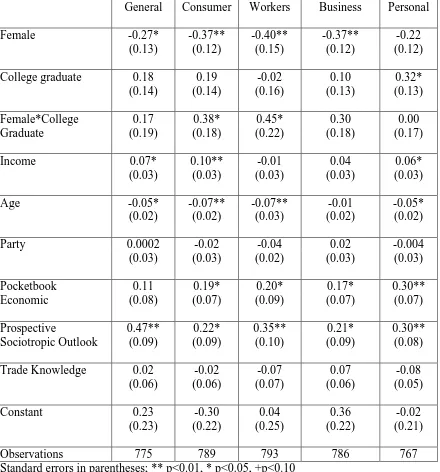
The results from the U.S. survey (Table 1) point to a marked divergence between
college-educated and less college-educated women. Moreover, these results are robust across most of the
different dependent variables – the particular focus of the question about trade and/or its effects
simply does not seem to matter much. These findings also suggest strongly that the consistent
negative general finding for gender may be driven in considerable part by women with less
education in developed countries. The results demonstrate that the coefficients of the constituent
female variable – which represents women without a college education – is negative and
significant not only in the analyses utilizing the consumer and workers dependent variables, but
also the macro-economy and business dependent variables. Women without college degrees are
more likely to have a negative attitude toward most of the major components and/or effects of
international trade. In contrast, the coefficients of the interaction between college-educated and
female are positive and significant in the analyses with the consumer and effects on workers
dependent variables. College-educated women are more likely to report that international trade
is good for consumption and U.S. workers.
IV.b Latin America Survey
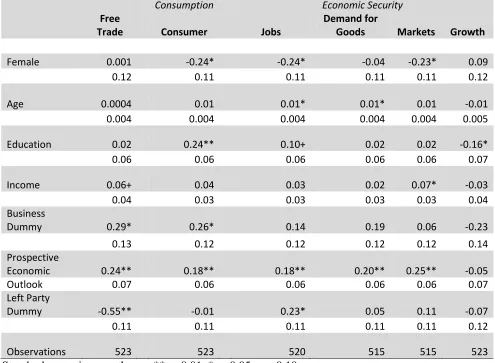
In the Latin America analyses (Table 2), the results are in significant contrast to the U.S.
analyses, suggesting that female respondents, all of whom have been identified by the surveyors
as “elites,” are less likely to believe that more open trade is good for jobs, consumer benefits and
new markets for their country’s goods.11 In these three analyses, the coefficients of the female
variable are negative and statistically significant at the 5% level. Elite women are more likely to
believe that trade is not good for creating jobs, which speaks to concerns about their economic
security. The results suggest that elite female respondents are also less likely to believe that
policies of open trade improve consumer conditions. Where Baker (2003 and 2009)
hypothesizes that people’s perceptions of the relationship between trade and consumption are
mainly positive, and Hall et al (1998) suggest that women in particular hold this viewpoint, this
finding suggests that we should examine the relationship a little more closely from a gender
perspective (and given the appropriate data – particularly wider variation on the education
variable – perhaps, a gender and education interactive perspective). It is possible that women
and men have different expectations for trade’s positive or negative effects on consumption. In
the three analyses that examine several macroeconomic components of trade, the results are
somewhat mixed. In the analysis that examines the effects of more open trade on markets for a
country’s goods, the coefficient of the female variable is negative and significant at the
five-11
As stated above, there is little variation on education (more than 90% of respondents are college-educated) so an interaction between education and gender in the Latin America analysis is not comparable to the other surveys.
percent level. In the effects of freer trade on economic growth analysis, the gender coefficient is
positive, and in the demand for exports analysis, the coefficient is negative, but neither
coefficient is statistically significant. Finally, in contrast to much of the more general literature
on attitudes toward open trade, in the analysis that examines general attitudes toward free trade,
the gender coefficient is actually positive, though not statistically significant.
IV.c Muslim-country Survey
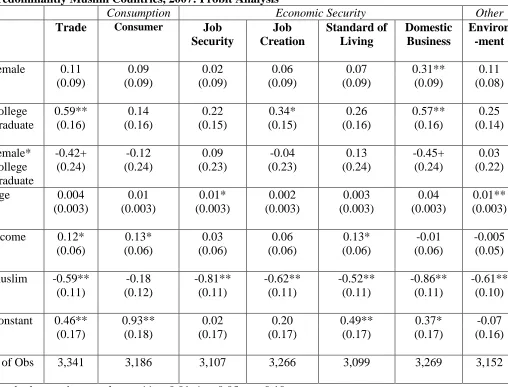
In the analyses using the Muslim-country survey data (Table 3), two of the results
suggest a finding similar to the Latin American analyses that more educated women are less
supportive of open trade, though the results are weaker – significant only at the less demanding
10% level. The negative finding is for both the general trade question and the question about
international trade’s effects on the respondent’s country’s domestic businesses. Notably, the
results also suggest that less educated women believe that open trade is good for domestic
business.12 The implication of this finding is not entirely clear but may have to do with the
nature of business in which less educated women are more likely to participate in these
countries: service industries. If for example, women help to run small retail businesses, it is
possible that the prospect of more and cheaper imported goods to sell is attractive. Finally, in the
other five analyses that examine effects of international trade on consumption, job creation, job
security, standard of living and environment, neither gender nor the interaction between gender
and education is significant. This important finding of little or no effect across most of these
12
In an otherwise identical analysis but without the interaction of female and education, the coefficient for gender is positive and significant only in the domestic business analysis. It is important to note that the inclusion of the interaction of the college graduate and female variables suggests strongly that less educated and more educated women diverge in their perception of trade’s effect on domestic business. Such results raise the possibility that gender variables that are not statistically significant in analyses of individual attitudes toward trade policy may be instances where two or more groups of women with differing viewpoints are dulling the overall gender effects precisely because meaningful interactions are not adequately incorporated.
analyses suggests that there is a less strong gendered component to trade attitudes in these five
developing countries with large or predominant Muslim populations. It is possible that women
are less engaged economically in societies that tend to privilege the roles of males, but more
research is necessary to explain meaningfully why there are more limited effects of gender,
especially compared to Latin America and the U.S.
IV.d Consumption
The consumption findings suggest a notable contrast between the U.S. and Latin
America. The results from the U.S. survey strongly indicate that educated women in the U.S. are
far more likely to believe that international trade has positive effects on consumption, while less
educated women are much more likely to be negative. The first finding may be consistent with
Hall et al’s (1998) theoretical supposition about perceptions of the link between tariffs and price.
But, in terms of their attitudes toward trade, at the time of this survey (2008), concerns about
jobs appear to trump the benefits to consumption for U.S. women with lower levels of education,
which is quite a reasonable finding in light of the scope and magnitude of the worldwide
economic crisis. It is clearly difficult to parse out if individuals are more focused on changes in
price or wages stemming from globalization,
The finding that female elites in Latin America do not generally have a positive outlook
toward trade’s effects on consumption runs counter to the U.S. finding and is an interesting
addendum to some previous research. Baker (2003, 2009) finds in a number of rigorous models
using multiple public opinion surveys that people in Latin America are generally supportive of
free trade in some part because of its benefits for consumption. The findings in this research
suggest that previous positive results may be driven largely by certain discrete groups – e.g. men
and/or less-educated women. More research needs to be done in order to identify and explain
better patterns of attitudes across different types of groups of respondents, and to examine more
rigorously what individuals believe is positive or negative about how open trade affects their
consumption. Building on the latter goal, we seek to disentangle preliminarily the components
of consumption by running separate analyses for the three components that comprise the
seven-point consumption index used as the principal dependent variable: price, quality and variety of
goods. We find statistically significant gender differences on trade’s effects on price and quality
(both negative), but not on the variety of goods (see Appendix B).13
IV.e Education and/or Knowledge
The divergent results between the U.S. and the emerging or developing countries in these
surveys suggest that scholars need to pay closer attention to issues of education and knowledge.
While this research finds generally what many other scholars find in terms of educated people in
the U.S., and perhaps especially educated women, having more positive viewpoints toward open
trade (e.g. Burgoon and Hiscox 2004; Hainmueller and Hiscox 2006), the preliminary finding of
skepticism toward freer trade of more educated women in low- and middle-income countries is
enormously important. While we argue for an economic security-focused explanation, it is
possible that the hypothesis that the curriculum of the countries’ universities deeply shapes
people’s opinion toward economic policy is also correct: in developed countries, higher
education is perhaps more likely to extol the virtues of open trade, at least more than institutions
of higher education in other countries. An alternative explanation is that educated women in
developing societies recognize better some of the fundamental – often economic security-related
13
The logic of a consumption-based approach might suggest that lower and higher income women will have differing views on the effects of trade on their consumption power. Because basic goods comprise a larger proportion of income for someone that makes less money, it is reasonable to expect that lower income women will have statistically significant positive views of trade’s effects on consumption. Accordingly, in separate specifications, I include a multiplicative term of the income and gender variables. The coefficients of the interactive term are negative but not statistically significant in the consumption analyses across the three surveys, a finding that is consistent across all of the analyses using other dependent variables, also.
– challenges faced by individuals and specific groups as states liberalize their economies because
these changes are more proximate to them. It is worth examining this possibility more as
appropriate data – for example, university curricula in an appropriate broad sample of countries –
are generated by researchers, an enormous task well beyond the purview of this study.
This research does examine very preliminarily the closely-related issue of trade
knowledge using the U.S. survey. The coefficients of the trade knowledge variable are mixed in
direction and are never statistically significant across the five analyses.14 When we generate an
interaction of trade knowledge and gender, it does not produce results that are statistically
significant. Women who follow trade closely do not have views statistically different from
women who do not follow the topic closely. It is possible that respondents do not really
understand trade, and the survey question that this research utilizes is an unreliable measure.
However, it is also possible that an individual’s actual knowledge of trade does not affect their
views of it in any discernible pattern – in other words, the distribution of those who are negative
or positive toward trade openness is comparable no matter the level of knowledge, which is
similar to the issues discussed directly above. Future surveys need to develop better questions
that actually test people’s economic and trade knowledge more objectively.
It is also possible that particularly high levels of education have a different or heightened
effect on trade attitudes. Gleason and van Scyoc (1995) have found that even after controlling
for economics classes, those with graduate and professional degrees are markedly better
informed about and better prepared to contemplate complex economic issues such as open trade.
It is therefore reasonable to hypothesize that those with a graduate or professional degree are
more “educated” about the ideas of freer trade (and perhaps have more mobility and/or human
capital generally), and will therefore be even more supportive of freer trade policies than their
14 Removing the knowledge variable from the analysis does not change any other result substantively.
four-year degree counterparts. Also, Green et al (2001) argue that in Latin America, workers
with intermediate skills have been particularly hard hit by trade liberalization while those with
the highest skill levels have done comparatively well. We utilize the Latin America survey to
examine these arguments and do not find that respondents (men or women) with graduate or
professional degrees have different views than those with some college or a bachelor’s degree.
More generally, the results of the education variable (not interacted with gender) in the Latin
America survey seem to buttress the contention that “knowledge” or “education” could cut either
way. The coefficients for education are significant at the 5% level in two of the six analyses, but
notably, the direction of the coefficient changes between the two analyses. In the growth
analysis, education is negative and significant suggesting that the most formally educated
respondents are actually more likely to think that freer trade is not good for overall economic
growth. However, in the consumer analysis, the coefficient is positive and significant suggesting
that the most educated respondents are more likely to report that trade is good for consumer
issues. The coefficient for education is also positive in the jobs analysis, though statistically
significant at the less demanding 10% level.
IV.f Risk
As acknowledged above, we cannot effectively test risk-based hypotheses directly with
these data, but the general trends suggest that risk might be a situation-specific explanation. If
women are more risk-averse naturally then we should observe systematic negative trends in
women’s attitudes toward trade across these surveys. These results do not bear out such a
consistency. Furthermore, if knowledge attenuates risk, it remains a puzzle why educated
women in developing countries are more risk-averse than their less-educated counterparts.
Considering the complexity of the relationship between risk and trade attitudes, a next logical
step in terms of testing these potential explanations might include more work out of the
experimental laboratory.
V. Alternative Explanations
While the results for many of the control variables vary among the analyses depending on
the survey and the particular dependent variable, there are some consistent findings of theoretical
note. One of the most stable findings using the U.S. and Latin America surveys is the direction
and significance of the coefficients for prospective economic outlook variable: in nearly every
analysis, the coefficients of this variable are positive and statistically significant. This finding is
consistent with Mansfield and Mutz’s (2009) finding across two national surveys in the U.S. If a
respondent is optimistic about the nation’s economic prospects, they are much likelier to support
trade generally, or to think that it has positive effects on specific facets of the economy (e.g.
consumption, mobility, macroeconomic, etc.).
There are, however, potential problematic issues with sociotropic variables that scholars
sometimes do not acknowledge sufficiently. Undoubtedly, there is genuine potential for
tautology because the crude logic suggests that (dis)satisfaction with the economy leads to
(dis)satisfaction with a major component of the economy – i.e. trade. On a closely related note,
it is difficult to know whether sociotropic issues belong on the left- or the right-hand side of the
empirical equations. There is a reasonable case for both and scholars have to consider these
issues carefully.
In the Muslim-country survey, the coefficients of the Muslim dummy variable are
negative and statistically significant in seven of the eight analyses (not the consumer dependent
variable), suggesting that Muslim respondents are much less likely to support trade generally or
to think that it has positive impacts on any major aspect such as jobs or the macro-economy.
There could be myriad explanations for this finding and it deserves considerably more
investigation in future research, particularly considering the general conclusion of the surveyors
that Muslims are generally supportive of globalization, which was based on aggregated
responses not on multivariate analysis with appropriate controls (World Public Opinion 2008).
Age demonstrates an unanticipated divergence between the U.S. and the two developing
country surveys in terms of the direction and consistency of the statistical significances of the
coefficients. As with many other empirical studies, the findings for age in the U.S. survey
suggest a negative relationship: older people are less likely to be supportive of free trade or to
believe that it has widespread positive effects. In all analyses for the U.S., the coefficients for
age are negative, and in four of the five analyses, they are statistically significant. Age is
statistically significant in only two of the six Latin American analyses, but in contrast to the U.S.
analyses, in both the demand for goods and jobs analyses, the coefficients are positive and
statistically significant. Apparently, older people in Latin America are more likely to believe
that trade is good for the demand for a country’s goods and for the availability of jobs.
Similarly, in the Muslim-country survey, age is positive in all analyses, though only significant
with the job security and environment dependent variables. It is possible that in many
developing countries, older people recall the long-term economic challenges associated with
closed economies, though new survey data would be necessary to address this issue effectively.
As discussed above, across the analyses, income is fairly consistently positive and
significant at the 5% level in nearly half the analyses. Respondents with higher incomes are
more likely to deem trade as good generally, or positive for specific aspects of their lives or for
their country.
Ideology and political party are not strong predictors of attitudes toward trade policies.
In the U.S. results, the coefficients of the political party variables are never statistically
significant and are inconsistent in terms of direction. Similarly, with the Latin America survey,
the signs flip in the two analyses where the coefficients of the ideology measure are significant:
the coefficient in the general trade analysis is negative while it is positive in the analysis utilizing
the jobs dependent variable. Perhaps oddly, respondents who self-identify as left-leaning are less
likely to be positive toward policies of freer trade, while being more likely to believe that freer
trade is good for jobs. But this inconsistency may be partly explained by wide changes in the
workforces in many emerging economies, while also fitting into the theoretical model employed
in this research. In many developing countries experiencing more robust growth, the labor
market is no longer obviously bifurcated between low- and high-skilled workers. In fact, many
countries, such as Brazil and Mexico, have an increasingly higher skilled workforce. These
changes certainly make the application of a simple mobile-factors model more problematic.
More importantly to the theoretical inquiry of this research, these changes in workforce
composition also appear to be generating more uncertainty – at least temporarily – for particular
groups, including educated women.
In the Latin America results, the coefficients for the business dummy are positive and
significant only in the analyses using the general free trade and consumer dependent variables.
Those who self-identify as working in business are more likely to be positive toward free trade
and to believe that freer trade is good for consumption-based issues. Though scholars suggest an
iron-clad link, support for free trade from those in the business sector is not universal across all
aspects/effects of trade. Again, an explanation for the inconsistency may lie in the economic
changes in many of these countries. “Business” is far from a monolithic group: the re-structuring