i
Analysis of Driver Knee Contours for Vehicle Interior Design
Matthew P. Reed
University of Michigan Transportation Research Institute
Final Report
UMTRI-2018-1
Technical Report Documentation Page
1. Report No.
UMTRI-2018-1 2. Government Accession No. 3. Recipient's Catalog No.
Analysis of Driver Knee Contours for Vehicle Interior Design 5. Report Date
6. Performing Organization Code
7. Author(s) Reed, M.P.
8. Performing Organization Report No.
9. Performing Organization Name and Address
University of Michigan Transportation Research Institute 2901 Baxter Rd.
Ann Arbor MI 48109
10. Work Unit No. (TRAIS)
11. Contract or Grant No.
12. Sponsoring Agency Name and Address
General Motors 13. Type of Report and Period Covered
14. Sponsoring Agency Code
15. Supplementary Notes
16. Abstract
An analysis of knee contours was conducted to provide design guidelines to prevent inadvertent actuation of switches located in the lower part of the driver compartment. A programmatic analysis of 3D laser scan data from 181 men and women was conducted. The results quantified the maximum level of penetration into a circular opening that could be expected. The maximum penetration was generally observed in the lateral patella area. A statistical model of the data was used to generate plots of the distributions of penetrations that would be observed for circular holes of various size. A verification study was conducted using manual measurements on a convenience sample of 42 people. The results of the manual measurements were generally consistent with the programmatic measurements from 3D scans, with discrepancies typically less than 3 mm for holes up to 50 mm.
17. Key Words
Crash safety, vehicle maneuvers, occupant motions 18. Distribution Statement
19. Security Classif. (of this report) 20. Security Classif. (of this page) 21. No. of Pages
21 22. Price
2
Metric Conversion Chart
APPROXIMATE CONVERSIONS TO SI UNITS
SYMBOL WHEN YOU KNOW MULTIPLY
BY
TO FIND SYMBOL
LENGTH
In inches 25.4 millimeters mm
Ft feet 0.305 meters m
Yd yards 0.914 meters m
Mi miles 1.61 kilometers km
AREA
in2 squareinches 645.2 square millimeters mm2
ft2 squarefeet 0.093 square meters m2
yd2 square yard 0.836 square meters m2
Ac acres 0.405 hectares ha
mi2 square miles 2.59 square kilometers km2
VOLUME
fl oz fluid
ounces 29.57 milliliters mL
gal gallons 3.785 liters L
ft3 cubic
feet
0.028 cubic meters m3
yd3 cubic
yards
0.765 cubic meters m3
NOTE: volumes greater than 1000 L shall be shown in m3
MASS
oz ounces 28.35 grams g
lb pounds 0.454 kilograms kg
T short
tons (2000 lb)
0.907 megagrams
(or "metric ton")
Mg (or "t")
TEMPERATURE (exact degrees)
oF Fahrenheit 5 (F-32)/9
or (F-32)/1.8
Celsius oC
FORCE and PRESSURE or STRESS
lbf/in2 poundforce
per square inch
6.89 kilopascals kPa
LENGTH
mm millimeters 0.039 inches in
m meters 3.28 feet ft
m meters 1.09 yards yd
km kilometers 0.621 miles mi
AREA
mm2 square
millimeters 0.0016 square inches in
2
m2 square meters 10.764 square
feet
ft2
m2 square meters 1.195 square
yards yd2
ha hectares 2.47 acres ac
km2 square
kilometers
0.386 square
miles mi2
VOLUME
mL milliliters 0.034 fluid ounces fl oz
L liters 0.264 gallons gal
m3 cubic meters 35.314 cubic feet ft3
m3 cubic meters 1.307 cubic yards yd3
MASS
g grams 0.035 ounces oz
kg kilograms 2.202 pounds lb
Mg (or "t") megagrams (or "metric ton")
1.103 short tons
(2000 lb) T
TEMPERATURE (exact degrees)
oC Celsius 1.8C+32 Fahrenheit oF
FORCE and PRESSURE or STRESS
N Newtons 0.225 poundforce lbf
kPa Kilopascals 0.145 poundforce per
square inch
lbf/in2
*SI is the symbol for the International System of Units. Appropriate rounding should be made to comply with Section 4 of ASTM E380.
4
ACKNOWLEDGMENTS
CONTENTS
6 ABSTRACT
INTRODUCTION
The design and placement of switches in vehicle interiors must include consideration of the potential for inadvertent activation. For switches located in the lower part of the driver area, contact with the driver’s knee is a possibility. The current project considered the situation of push-button switch recessed within a circular opening. The goal of the research was to estimate the depth of switch placement that would be sufficient to greatly reduce or eliminate the possibility of activation by a driver’s knee. The research was conducted in two phases. First, a large set of three-dimensional (3D) body surface scan data was queried to estimate the maximum penetration possible with a range of hole sizes. Second, hole penetrations were manually measured for a convenience sample of knees to verify the findings from the 3D scan study.
METHODS –– SCAN-BASED MEASUREMENTS
[image:8.612.99.443.368.578.2]Surface scan data for right knees were extracted from scan data obtained in a large study of driver postures and body shapes. Figure 1 shows the two postures from which the data were extracted. The included knee angle was either 90 or 115 degrees (approximately typical driving posture). Knees were extracted from scans of 181 men and women in the automotive posture and 83 in the 90-degree posture.
Figure 1. Scan poses used: automotive (left) and 90-degree (right).
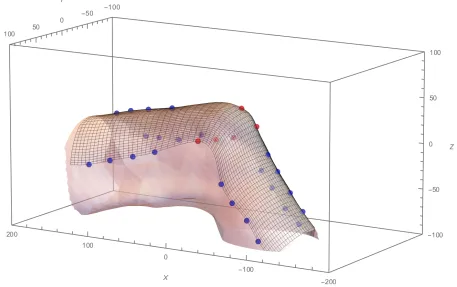
For each extracted scan, the locations of four landmarks were available: medial femoral condyle (MFC), lateral femoral condyle (LFC), suprapatella, and infrapatella. These landmark locations are shown in Figure 2. To facilitate programmatic analysis, a
rectangular grid was fit to the anterior surface of each scan, using the landmarks to ensure that the grid placement was homologous for each knee.
8 were generated on the thigh and 12 on the leg to guide the fitting. The suprapatellar landmark was also used to ensure its position would be homologous across fitted scans.
Figure 2. Example of quadrangle mesh (black lines) fit to knee scan. Digitized landmarks are shown in red. Synthetic landmarks used to align the mesh are shown in blue.
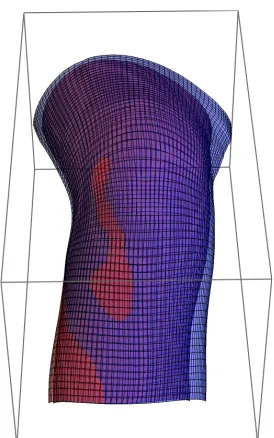
Figure 3. Small female (blue) and large male (red) predicted knee shape holding BMI=27.5 and SHS=0.52. Statures are 1511 and 1870 mm, respectively.
[image:10.612.239.376.338.557.2]10
Figure 5. Mid-stature male with BMI=20 (red) and BMI=35 kg/m2 (blue).
Simulating Hole Penetration – Automotive Posture
Figure 6. Estimating penetration at 5, 10, 15, 20, and 25-mm increments along the normal for one sample point on the knee (large dot). All sample points are shown with small blue dots.
[image:12.612.97.505.417.634.2]Figure 7 shows the results from automotive posture scans. The cumulative distributions of across 181 subjects are plotted. The distributions are approximately log-normal. The interpretation of the curves is as follows, for example: approximately a 65-mm-diameter hole is needed to allow 50% of the knees to penetrate at least 10 mm. For that same 65-mm-diameter hole, essentially all knees would be able to penetrate 5 mm, but almost none would penetrate 15 mm or more.
Figure 7. Distributions of the minimum widths for penetrations of 5, 10, 15, 20, and 25-mm (left to right) for 181 men and women.
12 exemplar knee. This participant had the smallest max section widths at 10, 15, and 20 mm, effectively showing the highest penetrations (Figure 9).
[image:13.612.93.476.407.635.2]Figure 8. Locations of 10 sample points with the highest penetrations across subjects (smallest diameters at each penetration level) on an exemplar knee. (These are not necessarily the points of highest penetration on this knee.) The lateral aspect is at the bottom of the figure.
Figure 9. “Pointiest knee”, demonstrating the greatest penetrations (subject T098, male, 1699 mm tall, 80 years old, BMI 30.4 kg/m2).
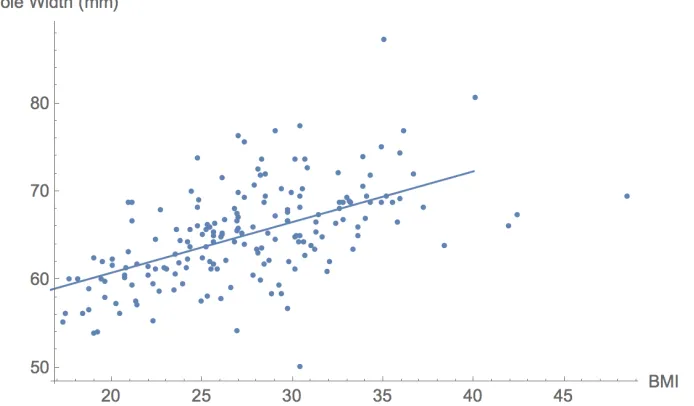
The most useful predictor of knee penetration depth is body mass index (BMI).
This is consistent with the earlier finding that lower BMI is associated with narrower knees, but small stature is not. A consequence of this finding is that further investigation of knee penetrations should focus on low BMI populations, regardless of stature, gender, or age.
Figure 10. Hole width for 10-mm penetration (smaller indicates greater pointiness) as a function of BMI (kg/m2). The pointiest-knee subject from Figure 9 is seen here as a low outlier at BMI 30.4.
Simulating Hole Penetration – 90-Degree Posture
The same method used previously was implemented to measure hole penetration with the 90-degree scans. Figure 11 shows the contours on the sample planes for sample point on one knee.
As with the automotive-posture data, the largest width of the plane contour was obtained for each sample point, corresponding to the minimum diameter hole that the knee could penetrate to the prescribed depth at that point. For each penetration depth, the smallest value across the knee was extracted; this corresponds to the smallest hole into which that subject’s knee could penetrate by the prescribed amount.
14
Figure 11. Estimating penetration at 5, 10, 15, 20, and 25-mm increments along the normal for one sample point on the knee (large dot). All sample points are shown with small blue dots.
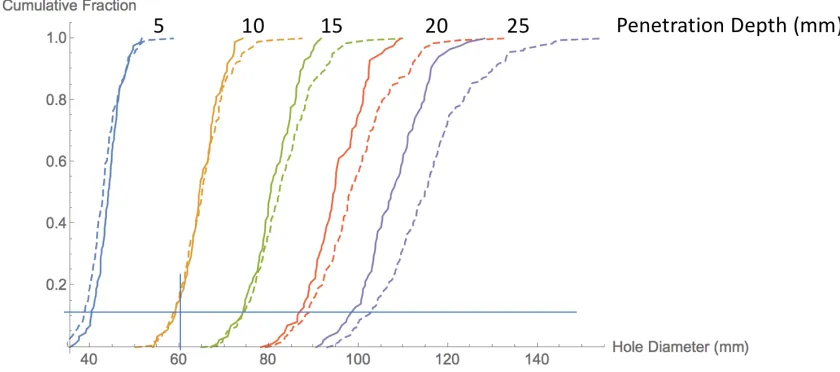
Figure 12. Distributions of the minimum widths for penetrations of 5, 10, 15, 20, and 25-mm (left to right) for 83 men and women with 90-degree included knee angle (dashed lines) and 181 men and women with 115-degree included knee angle (solid lines). Example Interpretation: only about 10% of knees can penetrate more than 10 mm into a 60-mm-diameter hole
[image:15.612.96.516.406.592.2]is body mass index (BMI). Age and overall body size (stature) had much weaker relationships.
Figure 13. “Pointiest knee” in 90-deg scans, demonstrating the greatest penetrations. (subject T098, male, 1699 mm tall, 80 years old, BMI 30.4 kg/m2)
16
Figure 14. Cumulative log-normal distribution approximations (solid lines) for empirical distributions of hole diameter across penetration depths from Figure 12.
[image:17.612.96.500.319.521.2]RESULTS – VERIFICATION STUDY
The scan-based analysis provided inexpensive analysis to a large dataset, but the scanning and data processing steps may have tended to smooth the surface, resulting in smaller penetration estimates. Moreover, any effect of soft-tissue deformation would not be captured by the scan-based analysis. Consequently, a small verification study was conducted to compare manual measurements with the scan-based results.
A series of holes were cut in a sheet of 2.25-mm-thick aluminum. As shown in Figure 16, the hole fixture was manipulated to obtain the greatest penetration at each hole diameter from 30 to 70 mm. The penetration was measured to 0.1 mm using a manual depth gage. The fixture thickness was added to each measurement. Data were gathered from a convenience sample of 42 young men and women with a wide range of body size.
[image:18.612.168.446.316.616.2]Figure 18 shows an overview of the participants’ characteristics. Data were gathered with people wearing their normal clothing, which included jeans, tights, and no clothing over the knee.
18
Figure 18 shows a boxplot of the data across hole diameter. The distributions within each hole size are approximately symmetrical and the median penetration is an approximately linear function of hole diameter. As in the previous analysis, slightly smaller penetrations were observed for individuals with higher BMI (Figure 19).
[image:20.612.94.507.426.640.2]Figure 18. Boxplot of measured penetration for a range of hole diameters (N=42 for each diameter).
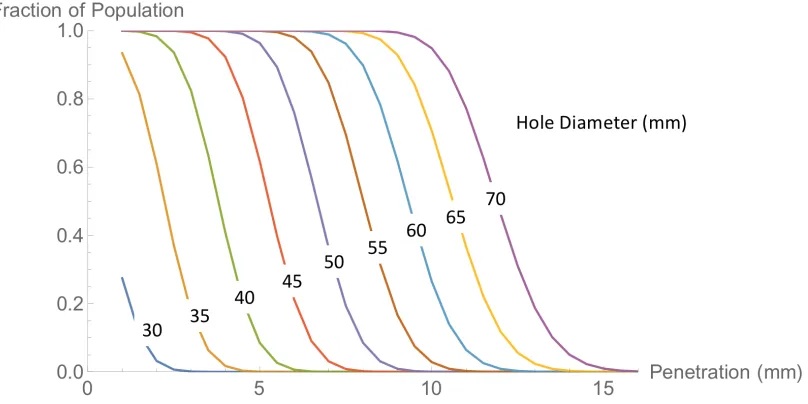
20 The distributions of penetration depths can be compared to the estimates from obtained from the scan-based analysis. Figure 20 shows cumulative plots of the manual data (inverted to show fraction exceeding the penetration depth on the horizontal axis). Predictions from the scan-based model (90-deg posture) are also shown. The manual-measurement data show greater penetration than the scan-based model for all hole diameters, but the differences are small in absolute terms. For example, the prediction model shows essentially zero penetrations more than 10 mm for a 40-mm-dimeter hole. The maximum value in the verification data was about 12 mm.
DISCUSSION
The scan-based analysis was largely verified by the manually measured sample. Both methods have some limitations that should be considered. The knees were scanned nude, but as noted above the scanning and analysis process may have smoothed the surface somewhat and flesh deformation is not taken into account. Moreover, the penetration simulation method was based on the local normal. In some circumstances, greater penetration could be obtained using a surface that is not orthogonal to the normal at the center of the simulated hole. The manually measured sample included a range of normal clothing; 16 of the 42 participants wore jeans and 8 had nude knees. Greater penetrations might have been measured if all participants were measured directly on the skin.
Although a weak effect of BMI was observed, no attempt was made to normalize the results to a particular population BMI distribution. The effort is not warranted given that the adjustment is small relative to uncertainties in the BMI distribution.