5th International Scientific and Business Conference—Future Engineering 2019 ISBN: 978-1-60595-632-9
Technical Support of Practical Education in
the Construction and Operation of
Hydrostatic Drive Systems
Adam Bartnicki
1, Agnieszka Klimek
1and Szymon Nadolski
2ABSTRACT
The continuous development of drive systems of modern machines and devices results in an increase in the demand for qualified engineers in the operation and maintenance of these drives. The article presents a range of hydraulic, didactic workstations dedicated to practical education in the field of hydrostatic drive systems.
Keywords: hydrostatic drives, didactic workstations, practical education
INTRODUCTION
In the last few years, the industry share in Gross Domestic Product has increased very significantly [15], which led to the dynamic development of working equipment. Most of these machines are powered by hydrostatic drive systems. Because of sophisticated devices, machine construction and advanced technologies of steering systems, high qualifications of staff and knowledge in the area of utilization are required.
Connecting knowledge with practical skills is one of the most important principles of effective teaching. The already operating and emerging training and professional development centres are trying to meet these requirements by offering an increasingly wider range of trainings and courses. The biggest problem for these facilities is the financial limitations, which result in minimal compliance with the legal requirements of technical support. At the same time, this is a field of growing interest among scientific institutions and companies [1,4,6,8,13,14]. In effect, the availability of tech-didactic workstations is expanding.
_______________
1
Military University of Technology, Faculty of Mechanical Engineering, 2 Sylwestra Kaliskiego Street, Warsaw 00-908, Poland
In the age of e-learning, educational establishments reach out beyond conventional teaching and increasingly offer remote access to laboratory workstations. This kind of teaching known as “blended learning” [3,5,7,9,10] is very useful in the professional development of technical staff, trainees, and teachers.
This paper presents selected hydraulic drive and control didactic workstations available on the Polish market.
BOSCH REXROTH DS4 TRAINING STATION
Bosch Rexroth DS4 training stations are one of the available high-tech training systems (Fig. 1). There are two versions of this stand [12]: double-sided hydraulic and double sided hydraulic-pneumatic.
The main components of the double-sided, mobile workstation are the frame, the hydraulic unit, and double-sided grids and boards for holding electrical components. The station requires a 230 or 400 V power supply. A hydraulic scheme of the station is presented on Figure 2.
The hydraulic unit is equipped with a three-phase motor with a power of 2.2 kW, a 40 dm3 hydraulic oil reservoir, and two variable displacement vane pumps with a pressure controller. The hydraulic unit is equipped with pressure relief valves set at 7 MPa. Bosch Rexroth Company offers a wide range of hydraulic components for creating practical and demanding tasks in the field of on/off and proportional hydraulics. The components include actuators (hydraulic motors, cylinders, and cylinders with loads), pressure valves (relief and reduction), and flow valves (throttle, directional and check valves). All valves are offered in on/off and proportional technology. The user has the possibility of choosing hydraulic valves that are produced with manual or electric steering. For proportional valves, there is a possibility of control with electronic modules or different kinds of controllers like joysticks, steering wheels, or pedals. All elements are equipped with self-couplings, which provide easy assembly of the hydraulic system. The company offers a wide range of measuring devices (like flowmeters, and pressure sensors) adapted for use with the training station. A valuable part of the didactic stand is the cylinders with load (Fig. 3), which enable the observation of the system working with external loads.
The range of training station accessories, proposed by the producer, allows one to realize the full spectrum of the didactic process in the field of construction and the utilization of hydraulic systems from simple, on/off industry systems, to sophisticated processes with the use of Load Sensing or LUDV.
Figure 1. Bosch Rexroth DS4 training station.
[image:3.612.152.512.331.608.2]Figure 3. The part of Bosch Rexroth DS4 training station—cylinders with external load.
RDL TRAINING STATION
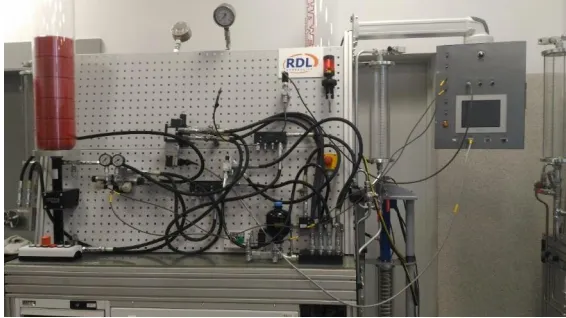
The RDL didactic stations (Fig. 4) are universal laboratory stands that enable the configuration of sophisticated hydraulic systems. The basic version is a double sided construction for up to six students. The station is made of a frame with a hydraulic power-pack, an assembly board, and a control panel. This version is not equipped with electronic control units. The station requires a 400 V power supply.
A 3kW motor powers two pumps (fixed – 11 cm3/rev or variable displacement). The hydraulic power-pack is equipped with a pressure relief valve set at 6 MPa, which makes training safer. A scheme of a hydraulic system with Load Sensing is presented in Figure 5. The working station is equipped with hydraulic valves, such as pressure, flow, and directional valves. The actuator is a hydraulic cylinder with external changeable value load. An interesting element of this station is a hydraulic accumulator which allows one to learn the principles of the use of such elements.
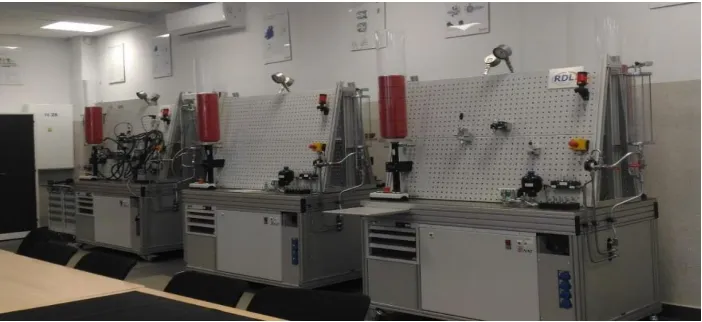
Four RDL training stations configured to user requirements (Fig. 6) are used for the didactic process at the Institute of Mechanical Engineering.
[image:4.612.169.520.489.650.2]Figure 6. The personalized RDL training station placed in MUT.
IVENTEC DMSD-01 DIDACTIC STATION
The domestic answer for practical training in the field of hydraulics is the IVENTEC double-sided training station (Fig. 7). The main station components are a frame with a hydraulic power pack, an assembly board, and an electric modules plate.
The station is equipped with a 230 V motor with 1.1 kW of power that runs a fix displacement pump (with 8 dm3/min flow) with a reduced noise level (Fig. 8). The power-pack is equipped with a pressure relief valve with a 6 MPa pressure limit. The basic version is equipped with a hydraulic element set containing a hydraulic motor, hydraulic cylinders (double and single acting), on/off directional valves—manually and electrically controlled, relief and pressure reduction valves, and flow valves, such as throttle valve or flow dividers. All hydraulic components are fit with self-couplings, which makes system configuration easier and quicker. What is more, the stand is equipped with inductive switches for training in working cycle automation.
The basic version of the didactic stations allows the realization of essential courses in the field of hydraulic systems utilization. On request, there is the possibility of an extended hydraulic set with proportional hydraulic, variable displacement pump with a controller and programmable control unit. What is more, the producer offers trainings and courses for technical staff with different levels of knowledge and practical skills.
Figure 7. IVENTEC DMSD-01 didactic station [14].
[image:7.612.104.561.319.620.2]KRET HP 201 DIDACTIC STATION
The HP 201 (Fig. 9) didactic station is another native solution. This stand is dedicated to pupils and students and allows training in the field of on/off and proportional hydraulics. The station is equipped with three valve blocks, which consist of a directional valve, a throttle valve, check valve, a reduction valve, and flow dividers with different configurations. The actuators are double-acting cylinders and a hydraulic motor. Contrary to previously described stations, the KRET station has permanently fixed hydraulic valves, so there is no possibility to assemble the station with specific user requirements.
[image:8.612.227.436.306.539.2]The stand requires a 400 V power supply and is equipped with two motors. The first of them, with the power of 2.2 kW, supplies two gear pumps (flow 6 dm3/min), the second, with the power of 1.5 kW, supplies the variable displacement pump. The pressure in the system is limited by a pressure relief valve set at 6.3 MPa. A hydraulic scheme of a HP 201 station is presented in Figure 10.
Figure 10. HP 201 hydraulic system [6].
STUDENTS-MADE DIDACTIC STATION
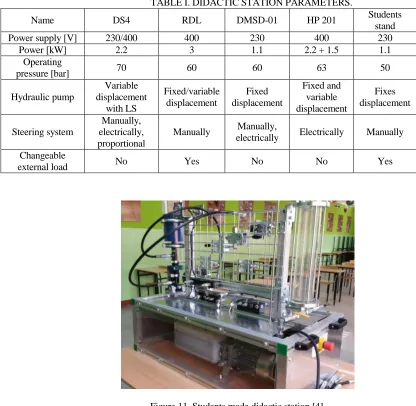
An interesting solution was proposed by MUT students who created a didactic station (Fig. 11). The idea of the station is to use it in secondary schools to teach primary principles of hydraulic systems.
The stand requires a 230 V power supply. The main component is a hydraulic power-pack (consisting of a 1.1 kW motor, gear pump with displacement 1.3 cm3/rev and a hydraulic oil reservoir). The pressure in the system is limited to 5 MPa by a pressure relief valve. The actuators are hydraulic cylinders (one of them with changeable external load) and a hydraulic motor. The didactic station is equipped with manually controlled on/off valves (directional, flow, and pressure valves). All components are fitted with self-couplings. What is more, the station is equipped with a measuring glass so it is easy to draw the characteristic curves of the valves. Up till now, three stations have been built for use in secondary schools.
CONCLUSIONS
TABLE I. DIDACTIC STATION PARAMETERS.
Name DS4 RDL DMSD-01 HP 201 Students
stand
Power supply [V] 230/400 400 230 400 230
Power [kW] 2.2 3 1.1 2.2 + 1.5 1.1
Operating
pressure [bar] 70 60 60 63 50
Hydraulic pump Variable displacement with LS Fixed/variable displacement Fixed displacement Fixed and variable displacement Fixes displacement Steering system Manually, electrically, proportional
Manually Manually,
electrically Electrically Manually
Changeable
[image:10.612.214.455.283.482.2]external load No Yes No No Yes
Figure 11. Students made didactic station [4].
REFERENCES
1. Bartnicki, A. and T. Muszyński. 2016. “Nowoczesne laboratorium hydrotroniki i automatyki napędów
robotów mobilnych”, Autobusy: technika, eksploatacja, systemy transportowe, 12:804–806.
2. Bartnicki, A. and A. Klimek. 2018. “Adult education in hydrotronics laboratories of mobile robots’ drives”,
Polish Journal of Continuing Education, 2(101):110–117.
3. Bartnicki, A. and J. Kras. 2018. “Remote Controlled Laboratory Station”, Intelligent Technologies in Logistics
and Mechatronics Systems, 135–142.
4. Kończalski, K. 2016. “Projekt stanowiska laboratoryjnego do badania hydrostatycznych układów
napędowych”.Master’s Thesis, MUT.
5. Kowalik, D., J. Wojutyński, and M. Siczek. 2014. „E-learning didactic stands in innovative vocational
education”, Polish Journal of Continuing Education, 4(87):489–498.
6. Kret, T. and I. Madejski. “Mechatroniczne stanowisko badawczo-dydaktyczne hydrauliczne z elektronicznym
7. Łabędzka, J. 2014. “Sharing of digital resources in education—computer platforms”, Polish Journal of Continuing Education, 3(86):132–141.
8. Łomotowski, G. 2015. “Uniwersalne elektrohydrauliczne stanowisko dydaktyczno-badawcze”, Zeszyty
Naukowe DWSPiT. Studia z Nauk Technicznych, 4:75–84.
9. Wojutyński, J., J. Dobrodziej, M. Siczek, and J. Kaczyński. 2011. “Opracowanie modelowego stanowiska
programowania systemów pomiarowo-sterujących w konwencji wirtualnego laboratorium”, ITeE-PIB Works.
10. Wojutyński, J. and M. Siczek. 2015. “Virtual Laboratory for vocational education”, Polish Journal of
Continuing Education, 2(89):148–156.
11. Technical documents: Stanowisko laboratoryjne hydrauliki mobilnej i napędów robotów, HCS Sp. z o.o.
12. Catalouge: Drive&Control Academy DS4 Hydraulic Training System, Bosch Rexroth Group.
13. RDL Hydraulics: Hydrauliczne stanowiska badawcze do celów dydaktycznych. Available from:
https://www.rdl-hydraulics.com/pl/oferta/hawe/dydaktyczne-stanowiska-badawcze [Accessed 23 April 2019].
14. IVENTEC: Hydrauliczne stanowiska dydaktyczne. Available from: http://www.iventec.com/ dydaktyka
[Accessed 23 April 2019].
![Figure 2. Bosch Rexroth DS4 training station hydraulic system [12].](https://thumb-us.123doks.com/thumbv2/123dok_us/245719.1024430/3.612.160.502.84.280/figure-bosch-rexroth-ds-training-station-hydraulic.webp)
![Figure 5. The hydraulic system with Load Sensing of RDL training station [11].](https://thumb-us.123doks.com/thumbv2/123dok_us/245719.1024430/5.612.102.432.82.649/figure-hydraulic-load-sensing-rdl-training-station.webp)
![Figure 7. IVENTEC DMSD-01 didactic station [14].](https://thumb-us.123doks.com/thumbv2/123dok_us/245719.1024430/7.612.104.561.319.620/figure-iventec-dmsd-didactic-station.webp)
![Figure 9. HP 201 didactic station [6].](https://thumb-us.123doks.com/thumbv2/123dok_us/245719.1024430/8.612.227.436.306.539/figure-hp-didactic-station.webp)
![Figure 10. HP 201 hydraulic system [6].](https://thumb-us.123doks.com/thumbv2/123dok_us/245719.1024430/9.612.119.550.87.300/figure-hp-hydraulic-system.webp)