2018 3rd International Conference on Information Technology and Industrial Automation (ICITIA 2018)
ISBN: 978-1-60595-607-7
Simulation Calculation of Reducing Ammonia
Escape Rate by Optimizing the Nozzle and
Controlling the Unit of Ammonia Grille
Changfu Ding and Xuyang Li
ABSTRACT
This article through the introduction of the principle of SCR denitration technology and characteristics of the work, the denitration process generating mechanism and harm of ammonium hydrogen sulfate an overview on the denitration technology. Then built based on a real power plant using Gambit software, the simulation model, the initial simulation for by fluent software. After explaining the nozzle structure and layout of the ammonia injection grid structure type, classify and compare, choose the optimal model of innovation, modified by dividing four grid as a set of control unit to adjust the volume of different spraying ammonia, obtains the relatively optimal value, according to the different results for further model transformation. Finally, further optimize the structure of guide plate, guide plate can be external regulation is adopted to improve the optimization, through the monitoring of export spraying ammonia adjust inertia, achieve the goal of control export rate of ammonia escape finally reform. Will eventually model for simulation calculation, get the results compared with the original model calculation results, get conclusion through reform to reduce the rate of ammonia escape, in order to achieve the goal of more energy conservation and environmental protection.1
KEYWORDS
Selective Catalytic Reduction Of Out Of Stock;Ammonia Escape Rate; Ammonium Hydrogen Sulfate; Unitized Control; Simulation Calculation
1
INTRODUCTION
Sulfur dioxide and soot produced by thermal power plants have been strictly controlled in China for a long time. Because of the wide application of desulphurization technology and dust removal technology, NOx has replaced SOx as the most harmful atmospheric pollutant in China [1]. At the beginning of the 12th Five-Year Plan, the Chinese government attached great importance to the control of NOX pollution. In September 2011, the Ministry of Environmental Protection issued the "Standard for Atmospheric pollution Emission from Thermal Power plants", which stipulates that the existing boilers will begin to implement new emission standards for pollutants in July 2014. The maximum emission limit for NOx is 100 mg/N m3, which clearly states that Five "nitrogen oxide emission reduction 10% binding target , it can be seen that the latest NOX control standards have been more stringent than the SOX standards, nitrogen oxides have become one of the focus of national environmental pollution control. The control of nitrogen oxides is imperative.
SCR DENITRIFICATION PROCESS
NOx Generation and Emission Reduction Technology
The NOx emission reduction control measures of coal-fired power plant boiler can be divided into low NOx burner (LNB), SOFA staged combustion (SOFA) and tail-end secondary flue gas purification (DeNOx flue gas denitrification device).It is necessary to install flue gas denitrification device at the back of the boiler because the NOx emission cannot meet the environmental protection standard only depending on the furnace. At present, the more mature technology of flue gas denitrification is selective catalytic reduction (SCR),) denitrification rate of more than 90%, which is the most mature technology used at home and abroad[2].
SCR Technical Principle of Flue Gas Denitrification
In SCR flue gas denitrification system, ammonia (NH3) is used as the main component of the reduction medium, SCR DeNOx unit, which includes a reactor with catalyst, an ammonia storage tank and a reductant injection system, and anhydrous liquid ammonia is used more frequently in foreign countries. The basic principle is to inject the required ammonia gas into the flue gas, mix it fully with the original flue gas and enter the reaction tower. Under the action of the catalyst and under the condition of oxygen, selectively with the NOx (mainly NO,) in the flue gas. NO2) to produce harmless nitrogen (N2) and water (H2O), the main reaction The chemical equations are:
O H N O NH
NO 4 3 2 4 2 6 2
O H N O NH
NO2 4 3 2 3 2 6 2
2 (2)
AMMONIA ESCAPE AND CONTROL MEASURES
Formation Mechanism of Ammonium Hydrogen Sulfate
As a side reaction of SCR denitrification by selective catalytic reduction, the formation of ammonia hydrogen sulfate is directly related to the complete escape of coal sulfur and SCR into flue gas without reaction. Usually, the dew point of ammonia hydrogen sulfate is 147 ℃. , the physical properties of ammonia hydrogen sulphate and its determination are that the flue gas temperature decreases greatly in the air preheater and deposits in the low temperature area of the air preheater, and the undeposited ammonia hydrogen sulfate adsorbs in the flue gas and converts the smoke dust into solid state. To remove in an electric precipitator . The reaction formula is as follows:
4 4 2
3
3+SO +HO NHHSO
NH (3)
4 2 4 2
3
3+SO +HO NH)SO
2NH ( (4)
Harm Caused by Ammonium Hydrogen Sulfate
Ammonium bisulfate can cause blockage in the air preheater. The main hazards are as follows:
(1) because the resistance of two air preheater is different, it causes low load and low smoke volume, which results in large fluctuation of negative pressure in furnace and the safe operation of unit.
(2) because of the non-uniform clogging of air preheater, periodic fluctuation of primary and secondary air pressure and negative pressure in furnace is caused;
(3) when the air preheater resistance increases, the power consumption of the air-smoke system increases;
(4) the resistance increases after the air preheater is blocked, the local flue gas velocity becomes faster, and the air preheater heat storage element wear is aggravated, which will cause damage to the heat storage element when serious;
(5) the air preheater blockage causes the smoke system resistance to increase, the induced fan output force cannot satisfy the unit full load operation, causes the unit to limit the output force;
(6) it is likely that the air preheater will eventually be shut down and overhauled.
Ammonia Escape Cause
(1) the flow field of denitrification flue gas is not uniform, which results in excessive amount of ammonia injection and escape;
(2) there is blockage in denitrification nozzle, which also leads to excessive amount of ammonia injection and escape;
(3) the monitoring method of ammonia escape rate is limited;
(4) after the air preheater is blocked, the amount of flue gas decreases and the exhaust temperature decreases, which expands the deposition area of hydrogen ammonia sulfate;
(5) the exhaust gas temperature of the unit has been low in low load operation, and the deposit area of hydrogen ammonia sulfate has also been enlarged;
(6) the load fluctuates frequently, the NOX production changes with the load change, and the ammonia injection regulation has some lag, which results in the phenomenon of over injection.
(7) Operation adjustment and monitoring means are not perfect, so we need to sum up experience further.
CALCULATION RESULT AND ANALYSIS
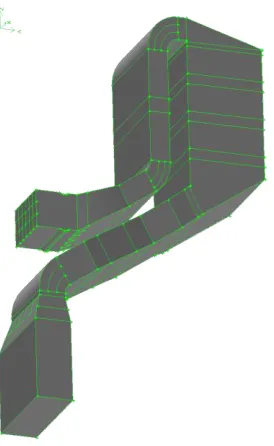
[image:4.612.166.490.385.629.2] [image:4.612.149.286.404.627.2]Physical Modeling and Mesh Generation of Denitrification System
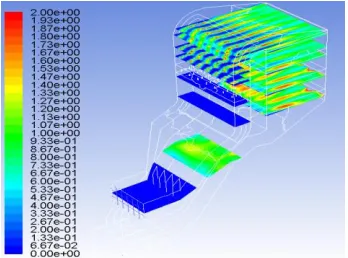
Section Ammonia Nitrogen Concentration Ratio
[image:5.612.131.465.303.447.2]Figure 3. Y Section ammonia nitrogen concentration ratio distribution.
Figure 4. Ammonia-nitrogen molar ratio after uniform grid.
[image:5.612.131.467.493.637.2]Figure 6. The molar ratio of ammonia to nitrogen in the second layer catalyst.
Figure 7. The molar ratio of ammonia to nitrogen in the third layer catalyst.
Comparison of Results before and after Optimization
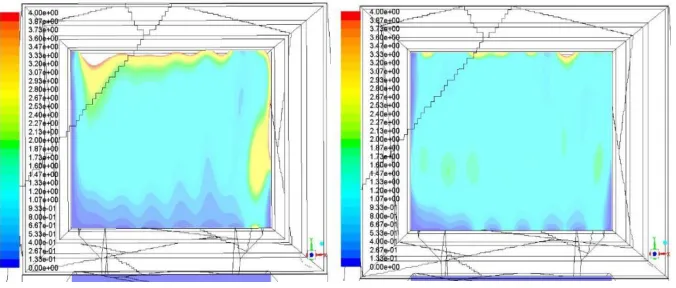
After the analysis of the original and optimization, the left picture of the original state, right after the optimization.
Optimized Result Analysis
[image:6.612.132.470.277.421.2]CONCLUSION AND PROSPECT
By comparing before and after optimization, it can be concluded that nozzle optimization and unit control of ammonia spray grille can reduce ammonia escape rate, and after ammonia escape, we can solve some problems existing in some thermal power plants. To further improve production efficiency.
REFERENCES
1. Per Morsing, Torben Slabiak. Selective Catalytic Reduction Desorption from Topso, Denmark SCR DeNOx Basic Process Planning Instructions,2004.