2018 3rd International Conference on Information Technology and Industrial Automation (ICITIA 2018)
ISBN: 978-1-60595-607-7
Research and Application of an Underwater
Detection Robot with Three Level Control
Mode of ROV/ARV/AUV
Hongkun Zhou, Fan Yang, Wenhui Wang, Tianwei Wang
and Chao Yan
ABSTRACT
In this paper, an underwater detection robot with the three-level control mode of ROV/ARV/AUV is proposed, aiming at the safety measurement of complex hydraulic structures such as long-distance water conveyance tunnel of pumped storage power station. In normal operation, the power supply and control of the underwater robot body is completed by the surface equipment through the umbilical cable (ROV mode).When the cable is wound, the robot releases the cable box, which is powered by a battery. The surface operator controls the robot through the built-in fiber optics of robot (ARV mode). Extremely, the optical fiber connection is interrupted, the robot will automatically return to initial position according to the guidance sonar (AUV mode). Finally, the control function tests and the independent return-to-navigation reliability verification are carried out in the real hydropower plant environment.1
KEY WORDS
Underwater Robots; Autonomous Return; Pumped Storage Power Station; Guided Sonar; The Water Conveyance Tunnel.
1
Hongkun Zhou, Fan Yang, Tianwei Wang, Chao Yan, the 750 Test Range of CSIC, Kunming, China
INTRODUCTION
At present, underwater robots are widely used to complete various underwater tasks in the field of underwater detection engineering of hydropower station. Traditionally, underwater robots are generally divided into two types of ROV (Remote Power Vehicle) and AUV (Autonomous Underwater Vehicle). ROV is powered and functionally controlled by the surface equipment via the umbilical cable with the advantages of long operation time, reliable control and flexible movement, and is suitable for carrying out complex underwater tasks. However, the underwater robot is easy to be wound under water, which is not suitable for the complex underwater environment and restricted operating space, especially for the environment with high drop and long distance diversion tunnel, such as the pumped storage power station, which has the risk of losing control of the cable, seriously threatening the normal operation of the power plant unit. AUV is powered by its own battery pack and can independently complete underwater operations, which is no risk out of control. However, due to the limitation of the battery pack capacity, its endurance capacity and operation capacity are limited and the activity space is small, which is only suitable for relatively simple operation tasks.
In this paper, an underwater robot with the three-level control mode of ROV/ARV/AUV is presented. The power supply and function control of the underwater robot body can be completed by the water surface controller through the umbilical cable, and the complex underwater tasks such as long-distance water tunnel inspection can be performed. In the case that the cable breaks out of control, the underwater robot can be powered by its own battery, and complete the autonomous course return task. At the same time, it can realize the surface control of the robot when the power is disconnected and the communication is connected. This greatly reduces the risk of the robot breaking the cable in the long-distance water conveyance tunnel, effectively ensures the safe and reliable operation of the hydropower station generating set, and is especially suitable for the detection of the high drop of the pumped storage hydropower station and the long-distance water diversion tunnel.
COMPOSITION AND FUNCTIONS
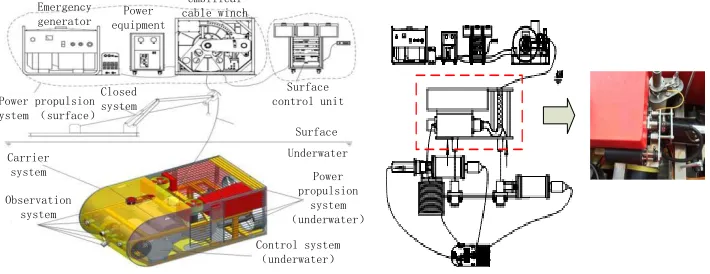
The underwater robot system is composed of a carrier system (main body), an observation system, a control system, a dynamic propulsion system and a retracting and releasing system, as figure 1.
Aiming at the complex operating environment of long-distance water conveyance tunnel of hydropower station, the robot is equipped with underwater camera and floodlight, image sonar, ranging sonar, guidance positioning sonar, fiber optic gyroscope and electronic compass, etc., which have the following functions:
3) The functions of front, rear, left, right, upper and lower six-way ranging collision avoidance;
4) The function of manual/automatic release of umbilical cord cable; 5) Capable of real-time measurement of objects;
6) Seamless switch of emergency power and autonomous course return.
Emergency
generator equipmentPower
Umbilical cable winch
Surface control unit Closed
system Power propulsion system (surface)
Surface Underwater Carrier
system
Observation system
Power propulsion
[image:3.612.125.480.183.320.2]system (underwater) Control system (underwater)
Figure 1. System composition. Figure 2. The uncabling mechanism.
WORK PRINCIPLE
Design of The Cable Stripping Mechanism
A controllable uncabling mechanism is adop tin the connection between umbilical cord cable and underwater robot. In the case that the cord cable is entangled by foreign body and cannot be released, the untethered mechanism can detach the cord cable from the underwater robot and release the cable guiding fiber inside the robot, so that the underwater robot can continue to move or return to the surface of the water. The uncabling structure is shown in FIG. 2.
ROV Work Mode
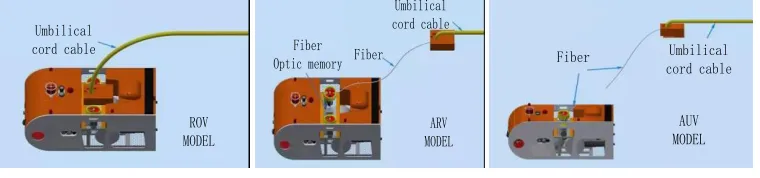
During normal operation, the robot connects with the control end of the water surface through the umbilical cord cable to obtain power supply and control signals, which are controlled by the water surface operator to complete the underwater task. Meanwhile, the detection data of the robot is received through the umbilical cord cable. The working principle is shown in FIG. 3.
ARV Work Mode
on its own battery pack for power. At this point, the robot releases the fiber optic cable from the fiber storage box on the body, and obtains the control signal, so that it can continue the operation or sail back, working principle as shown in FIG. 4.
Umbilical cord cable
ROV MODEL
Fiber Optic memory Fiber
Umbilical cord cable
ARV MODEL
Fiber Umbilical
cord cable
[image:4.612.103.483.157.246.2]AUV MODEL
Figure 3. ROV mode. Figure 4. ARV mode . Figure 5. AUV mode.
AUV Work Mode
In extreme cases, the optical fiber is also wound and data communication is interrupted. Underwater robot can cut off the optical fiber autonomously and achieve autonomous course reversal according to the guidance sonar, ranging sonar and other information, the working principle is shown in FIG.5.
PRACTICAL APPLICATION OF HYDROPOWER STATION
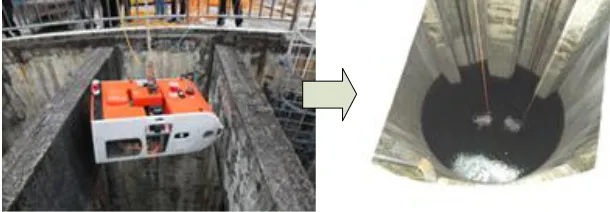
On January 15, 2018, the long distance water conveyance inspection of 1867m and the autonomous reentry test simulated cable fault were carried out at Tian Sheng Qiao secondary power station. The robot is put into the tunnel by the no.2 pressure regulating well of Tian Sheng Qiao power plant. After passing down through the impedance hole, it is inspected along the upstream of the diversion tunnel. The test environment of no.2 pressure regulating well is shown in figure 6.
Figure 6. No. 2 pressure regulating well of Tian Sheng Qiao. Time H e a d i n g
The heading of robot
Start End
Impedance
hole Stop MAX
D i s s t a n c e o f g u i d a n c e s o n a r Time Gate slot Stop
MAX
[image:5.612.105.489.245.386.2]Return End
Figure 7. Heading value curve. Figure 8. Distance value curve.
The course value curve and the distance value curve of the sonar end of guidance during the autonomous reentry test of the robot are respectively shown in FIG. 7 and FIG. 8.
FIG. 7 and FIG. 8 show that, after the robot starts autonomous course reversal, the course value rapidly decreases by 180 degrees under the condition of no intervention. The robot approaches the guidance sonar independently, and the movement process is close to constant speed.
CONCLUSIONS
REFERENCES
1. Allen. R. Remotely operated vehicles of the world, 8th Edition[M]. UK; Oilfield Publications, 2008.
2. Tiantian Liu, Feng Qin, Xiaoyong Zhu, et al. Underwater autonomous navigation robot system[J]. Military automation, 2012 (11).
3. Wang Zhenlong, Hang Guangrong. Swimming Mechanism of Squid and Its Application to Biomimetic Underwater Robots[M].Journal of Mechanical Engineering Vol. 44 No. 13, 13 Jul. 2008.