2018 3rd International Conference on Information Technology and Industrial Automation (ICITIA 2018) ISBN: 978-1-60595-607-7
Simulation and Analysis of Tablet Pressing
Process Based on Discrete Element Method
Xinyan Li, Juechan Lu, Boijian Qi, Xueyao Wang*
and Wenbiao Zhang
ABSTRACT
The process of the single-punch tablet pressing was simulated based on the discrete element method, and the simulation results were analyzed. The relationship between the stamping speed and the pressing force of the upper die, the particle size and the pressing force were obtained respectively through analyzing the results of dynamic simulation experiments on two sites of pressing process. According to the experimental results, the pressing force increased as the pressing speed increased with other conditions being the same, and at the same time, the pressing force also increased as the particle size increased.1
INTRODUCTION
Tablet is one of the most popular forms of pharmaceuticals in daily life and has a long history of application. The common production equipment for tablets is the tablet press, in which particles or powdery materials are placed in the die hole and pressed into tablets by punch. There are many types of tablet presses, which can be divided into single-punch tablet presses and rotary tablet presses according to the structural principle [1]. The single-punch tablet press used in this paper is the earliest tablet press, with only one die, including upper punch, middle die and undershoot.
The discrete element method [2] is a particle discrete material analysis method based on molecular dynamics principle proposed by Professor Cundall P. A. The discrete element method has great advantages in the analysis of bulk materials. It considers the medium as a series of discrete independent moving particles. It builds a mathematical model based on the discrete properties of the discrete matter itself,
1
and considers the object to be analyzed as discrete. The collection of particles can directly obtain a large amount of complex behavior information of discrete substances and particle size information that is difficult to measure. With the development of computer technology, software based on the discrete element method has also developed greatly, such as UDEC, 3DEC, PFC2D/PFC3D and EDEM. In this paper, based on the discrete element method, the single-press tablet press process was simulated and analyzed under different pressing speeds and different particle sizes.
DISCRETE ELEMENT METHOD CALCULATION MODEL
The basic motion equation used in the discrete element method is as follows [3]:
2
2
d s(t) ds(t)
m +c + ks(t)= f(t)
dt dt (1)
Where: mis the particle mass; sis the particle displacement; tis the particle motion time; cis the interparticle viscosity coefficient, kis the particle stiffness; f is the load attached to the unit.
Assume that f t( ), the amount of change between tandt t,s t( ),s t( t),
( ) /
ds t t dt and d s t2 ( t) /dt2is known. t is the calculation time step, the
central difference method can be applied to equation (1):
2
[ ( ) 2 ( ) ( )] ( )
[ ( ) ( )]
( ) ( )
2
s t t s t s t t
m
t
s t t s t t
c ks t f t
t
(2)
The solution formula (2) can be obtained:
2
2
( )
( ) {( ) ( ) ( 2 ) 2 [2 ( ) ] ( )} / ( / 2)
s t t
s t t t f t c t m
m k t s t m c t
(3)
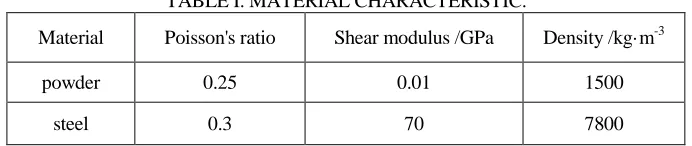
TABLE I. MATERIAL CHARACTERISTIC.
Material Poisson's ratio Shear modulus /GPa Density /kg·m-3
powder 0.25 0.01 1500
steel 0.3 70 7800
TABLE II. MATERIAL INTERACTION CHARACTERISTICS. Material Coefficient of
restitution
Coefficient of static friction
Coefficient of rolling friction
powder-powder 0.2 0.3 0.1
powder-steel 0.2 0.01 0.01
MODELING AND SIMULATION ANALYSIS OF TABLET PRESSING PROCESS
Parameter Settings
Create two new materials, named powder and steel [4]. The material of the geometry is defined as steel, and the material of the particles is powder.
The ECM (Elasto-Plastic Cohesion) contact model, which is a general-purpose nonlinear model, is used to calculate the interaction between particles and particles. The contact mechanics equation contains hysteresis, cohesion and van der Waals force, which can reflect the particles involved in this paper by elastic-plastic deformation accompanied with an increase in cohesion. The setting of material properties is shown in table 1, and the interaction parameters between materials are shown in table 2.
Simulation
Set the Rayleigh time step to 10% and the simulation time to 0.25s. Run the simulation, the process is shown in Fig.1.
DISCUSSION OF SIMULATION RESULTS
Figure 1. Simulation process.
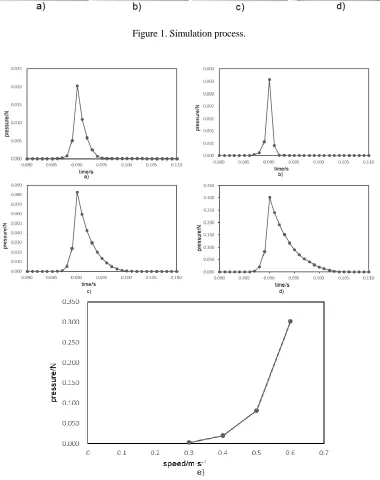
Figure 2. a)-d). The relationship between the pressing force and the time.
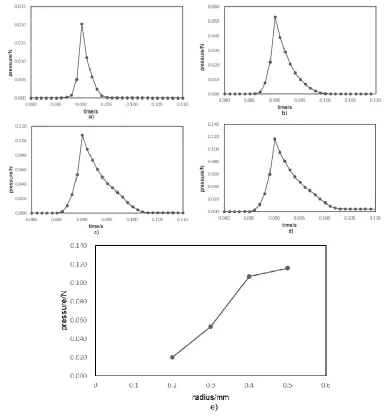
[image:4.612.108.488.167.647.2]Figure 3. a)-d). The relationship between the pressing force and the time. Figure 3. e). The relationship between the pressing force and the particle size.
According to the results of the above four experiments, the relationship between the stamping speed of the upper die and the pressing force can be obtained as shown in Fig. 2e). It can be seen that as the stamping speed of the upper die increases, the pressing force it receives increases [6].
Under the condition of pressing speed of 0.4m/s, the relationship between the pressing force and the time of the upper die punching under different particle sizes can be obtained as shown in Fig. 3a)-d).
[image:5.612.103.493.85.505.2]Fig. 3e). It can be seen that as the particle size continues to increase, the pressing force of the upper die also increases.
CONCLUSIONS
The single-punch tablet press has the advantages of simple structure, convenient operation and low price. It is widely used in production occasions with less batches. Based on the discrete element method, this paper simulated the pressing process of the single-impulse tablet press, obtained the specific pressing process, and discussed the simulation results.
1) The pressing speed of the upper die is changed for several times with other conditions being the same. The experimental results show that the pressing force of the upper die increases with the increasing pressing speed.
2) In this paper, the influence of the change of particle size on the stamping force of the upper die is studied. According to the results of several experiments, the pressing force increases with the increase of the particle radius.
ACKNOWLEDGEMENTS
This work was supported by the National Natural Science Foundation of China (No. 51576196), the Fundamental Research Funds for the Central Universities (2018MS029).
REFERENCES
1. Da-an Yang, et al. 2011. “The Development Status and Direction of Single Punch Tablet Press.” Journal of Netshape Forming Engineering.
2. Guoqiang Wang, et al. 2010. “Discrete Element Method and its Practice on EDEM.” Journal of Northwestern Polytechnical University.
3. Y. H. Ou, Y. X. Zhao, et al. 2015. "Simulation and Analysis of Powder Compaction Process Based on EDEM Software." Chinese Powder Technology 6(2015):76-81.
4. Y. Yu, L. Chen, and H. Shi. 2010. “Progress of the Influencing Factors on Die Filling Process of Tablet Press.” Chinese Journal of Pharmaceuticals (2010).
5. Y. Guo, et al. 2010. “Numerical Analysis of Density-induced Segregation during Die Filling.” Powder Technology 197.1(2010):111-119.