2018 3rd International Conference on Information Technology and Industrial Automation (ICITIA 2018) ISBN: 978-1-60595-607-7
Estimation of Global Sizes of Cylinder Based on
the Neural Network Regression
Zexiang Zhao, Dongxu Ren, Xinyu Zhao, Bin Li,
Mengjiao Shang, Wuyang Dou and Ruyi Liu
ABSTRACT
In ISO 14405-1, the global sizes are defined, which include the least-squares, minimum circumscribed, maximum inscribed and minimax diameters for cylinder. The evaluation models of the global sizes were built based on the cylindrical coordinate measuring principle. The pseudo global sizes of cylinder can be obtained on the basis of the extracted data in the cylindricity measurement and a given value. The global sizes of cylinder can be precisely estimated by using the trained models of neural network regression between pseudo global sizes and global sizes, and the evaluation results showed that the estimated global sizes can meet their measurement accuracy requirements.1
INTRODUCTION
The global sizes of cylinder include least-squares diameter (LSD), minimum circumscribed diameter (MCD), maximum inscribed diameter (MID) and minimax diameter (MZD). According to the definitions of the global sizes of cylinder in ISO 14405-1[1], the precision cylindrical coordinate measuring machine(C2M2) is an instrument suitable for measurement of the global sizes of cylinder with the capability of measuring the absolute sizes between the sampling points in the cylinder’s profile and the rotary axis of the worktable, but most cylindricity measuring instruments are only able to measure the radial variations of the sampling points relative to a point, the principle of which is actually a like-C2M2. For the
1
Zexiang Zhao, Dongxu Ren, Bin Li, Mengjiao Shang, Wuyang Dou, Ruyi Liu. School of Mechatronics Engineering, Zhongyuan University of Technology, 41 Zhongyuan Middle Rd., Zhengzhou 450007, China
evaluation of cylindricity errors, the sum values of the radial variations and a value (such as half of the nominal size of the measured cylinder or other value) are as the radial sampling values of the extracted profiles. Based on the processed values above and the evaluation models, four kinds of evaluation methods, such as the least-squares, minimum circumscribed, maximum inscribed and minimum zoon methods[2,3], can be usually used to evaluate cylindricity errors according to user’s purpose, respectively. Except for the least-squares method, the optimization methods, such as steepest decent algorithm, BFGS-0.618 algorithm, genetic algorithm, geometry optimization and particle swarm optimization, were used for the other three evaluation methods by researchers[4-7]. For the evaluation of cylindricity error, the diameter of the reference cylinder corresponding one of four evaluation methods should first be obtained. Owing to that the radial values of the sampling points in the extracted profiles are not the actual radial sizes between the sampling points and the rotary axis of the worktable in the evaluation of cylindricity error, the diameters of four reference cylinders are called as pseudo LSD, pseudo MCD, pseudo MID and pseudo MZD for the four evaluation methods, respectively, in this paper, which are collectively known as pseudo global sizes. The global sizes of cylinder may be estimated through the regression between pseudo global sizes and global sizes by using the training models of the neural network regression. In this paper, some regression models were trained based on 49 cylindrical specimens with a nominal size of 40mm, and the models were checked by using 14 cylindrical specimens with a nominal size of 25mm. The checked results showed that the estimated global sizes of the checked cylindrical specimens can meet their measurement accuracy requirements, which can be an indirect way to solve the measurement issue of the global sizes for promoting the implementation of ISO 14405-1 in the manufacturing industry as soon as possible.
EVALUATION MODELS OF GLOBAL SIZES OF CYLINDER
Figure1. Schematic of extraction of cylinder profiles.
The axis of reference cylinder can be determined by the parameters x0, y0,z0, p, q and t, where p, q and t are equal to cosα, cosβ and cos, respectively, where α, β and are the angles between the axis of reference cylinder and x, y and z axes, respectively. Suppose that one end of the axis of the reference cylinder and the 1st roundness profile are in the xoy plane, that is, z0 is equal to 0, and according to that p2+q2+t2=1, let p’=p/t and q’=q/t, therefore, the axis of the reference cylinder can be determined by the parameters x0, y0, p’ and q’. For simplified expression, dPij and dGij are collectively expressed as dXij, and ρPij and ρGij are collectively called as ρXij, so dXij can be determinedby Eq. (1), where φij is the angle between the jth sampling point in the ith roundness profile and x axis, which is equal to (j-1)△φ, where △φ is the angle of two adjacent sampling points in the same roundness profile, and zi is the distance between the ith roundness profile and the xoy plane along z axis, which is equal to (i-1)△z, where △z is the distance between two adjacent roundness profiles.
2 1 2 2 2 0 X 0 X 2 2 0 X 2 0 X X 1 ) sin ( ) cos ( ) sin ( ) cos ( q p z y q x p z y x d i ij ij ij ij i ij ij ij ijij
(1)
For the evaluation of cylindricity error by using the least square method and the LSD of cylinder, the reference cylinder is a least-squares cylinder, and the parameters x0, y0, p’ and q’ of its axis and its radius RXL can be determined as follows, min ) ( 1 2 XL 1 X
XL
WhererXij is the distance between the jth sampling point and the axis of the least-squares cylinder in the ith roundness profile plane, m is the number of the extracted roundness profiles of a cylinder, and n is the sampling point number of one roundness profile.
Considering that before extracting the roundness profiles, the cylinder should be centered and leveled, and x0, y0 and are small, therefore, non-linear least-squares issue in Eq. (2) was simplified as a linear least-squares one.
Based on Eq. (2), the parameters x0, y0, p’, q’ and RXL of the least-squares cylinder can be obtained, and DXL of the LSD can be calculated as follows,
m i n j ij mn R D 1 1 X XL XL 2 2 (3)For the evaluation of cylindricity errors by using the other evaluation methods and the other three global sizes of cylinder, the axis parameters of their reference cylinder should meet the following conditions, that is,
Xij m i n j q p y x d F 1 1 , , ,
XC min max
0 0
(4)
Xij
11 , , ,
XI min max
0 0 d F m i n j q p y x (5) ij m i n j ij m i n j q p y
x d d
F X 1 1 X 1 1 , , ,
XZ min max min
0 0
(6)
Eqs.(4)-(6) correspond to the least-squares, minimum circumscribed and minimum zoon methods, respectively, which can be classified as a ‘minimax’ issue and solved by using the optimization methods. When the axis parameters x0,y0, p’ and q’ of reference cylinder satisfy the optimization objective functions corresponding to Eqs. (4)-(6), DXC of the MCD, DXI of the MID and DXZ of the MZD can be obtained as follows,
ij m ij n ij
m i
n
j d d
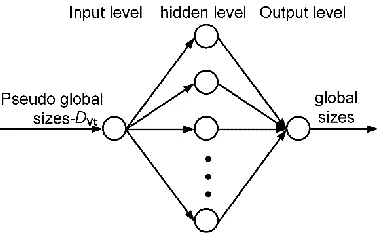
Figure 2. Schematic of neural network regression model.
NEURAL NETWORK REGRESSION BETWEEN PSEUDO GLOBAL SIZES OF CYLINDERS
As mentioned above, owing to lack of C2M2, the actual roundness profiles of cylinder for the evaluation of global sizes can’t be extracted, while the pseudo roundness profiles of cylinder can be extracted by using Like-C2M2, therefore, the pseudo global sizes of cylinder can be obtained based on Eqs. (3) and (7). The global sizes of cylinder can be indirectly determined by using the trained models based on the neural network regression in Figure 2, where Pseudo global sizes are obtained based on the pseudo radial distance values.
For the training of the neural networks, three training functions, such as ‘trainlm’, ‘trainbr’ and ‘trainscg’ in Matlab, are often used. Both ‘trainlm’ and ‘trainbr’ functions update weight and bias values based on Levenberg-Marquardt optimization and are backpropagation algorithm. The ‘trainscg’ function updates weight and bias values based on the scaled conjugate gradient method. The principles of the three training functions’ algorithms can be seen in Refs. [9,10].
EXPERIMENTS AND RESULTS
Experiment Design
For the neural network in Figure2, the training parameters were set as follows: the maximum epochs were 1000, the ratios among train, validation and test numbers were 0.7, 0.15 and 0.15, respectively, the maximum number of the fail epochs was 6, the train goal of MSE (Mean square error) was 1.0e-12, and the ‘trainlm’, ‘trainbr’ and ‘trainscg’ training functions were used for the evaluation models of the global sizes. For the hidden level’s nodes from 3 to 15, the neural network non-linear regression of the global sizes were carried out for 100 times, respectively, and the neural network optimal nonlinear regression models of the global sizes were selected based on the MSE values of outputs and targets for simplification, respectively.
Experiment Results
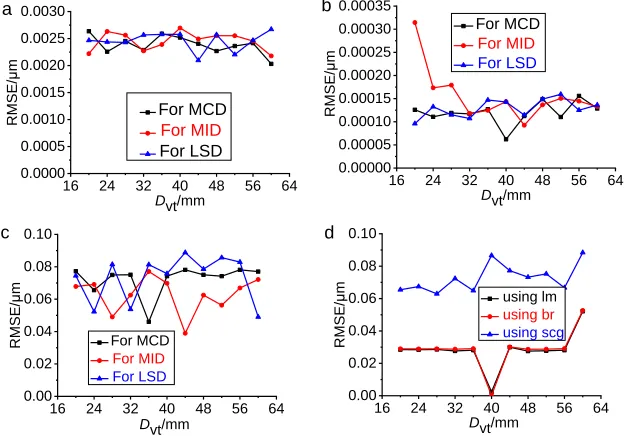
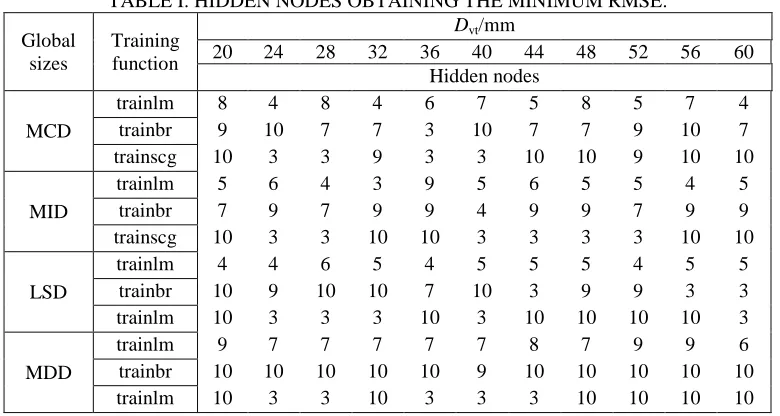
The minimum values of RMSE(Root Mean Square Error) of the outputs and their targets of the global sizes for the above values of Dvtunderthree training functions were shown in Figure 3. The minimum value of RMSE refers to the minimum value among the 1300 RMSE values obtained under 1300 training times from 3 to 15 hidden level’s nodes for each Dvt. The hidden nodes obtaining the minimum RMSE values under the diameters Dvt of the virtual cylinders can be seen in Table 1. In Figure 3(d), ‘lm’, ‘br’ and ‘scg’ represent ‘trainlm’, ‘trainbr’ and ‘trainscg’ training functions, respectively.
Figure 3. (a) Minimum RMSE obtained based on ‘trainlm’ function for virtual cylinders; (b) minimumRMSE obtained based on ‘trainbr’ function for virtual cylinders; (c) minimum RMSE obtained based on ‘trainscg’ function for virtual cylinders; (d) minimum RMSE of
MZD based on three training functions for virtual cylinders. 16 24 32 40 48 56 64
0.0000 0.0005 0.0010 0.0015 0.0020 0.0025 0.0030
RMSE/
μ
m
Dvt/mm For MCD For MID
For LSD
a
16 24 32 40 48 56 64 0.00000
0.00005 0.00010 0.00015 0.00020 0.00025 0.00030 0.00035
RMSE/
μ
m
Dvt/mm
For MCD
For MID
For LSD
b
16 24 32 40 48 56 64 0.00
0.02 0.04 0.06 0.08 0.10
For MCD
For MID
For LSD
RMSE/
μ
m
Dvt/mm
c
16 24 32 40 48 56 64 0.00
0.02 0.04 0.06 0.08 0.10
RMSE/
μ
m
Dvt/mm using lm
using br
[image:6.612.133.447.398.617.2]TABLE I. HIDDEN NODES OBTAINING THE MINIMUM RMSE.
Global sizes
Training function
Dvt/mm
20 24 28 32 36 40 44 48 52 56 60
Hidden nodes
MCD
trainlm 8 4 8 4 6 7 5 8 5 7 4
trainbr 9 10 7 7 3 10 7 7 9 10 7
trainscg 10 3 3 9 3 3 10 10 9 10 10
MID
trainlm 5 6 4 3 9 5 6 5 5 4 5
trainbr 7 9 7 9 9 4 9 9 7 9 9
trainscg 10 3 3 10 10 3 3 3 3 10 10
LSD
trainlm 4 4 6 5 4 5 5 5 4 5 5
trainbr 10 9 10 10 7 10 3 9 9 3 3
trainlm 10 3 3 3 10 3 10 10 10 10 3
MDD
trainlm 9 7 7 7 7 7 8 7 9 9 6
trainbr 10 10 10 10 10 9 10 10 10 10 10
trainlm 10 3 3 10 3 3 3 10 10 10 10
From Figure 3 and Table 1, we can know that all the minimum RMSE between the outputs of the trained models by using three training functions for the global sizes can meet their measuring accuracy requirement(less than 0.1m) for all the virtual cylinders with the diameters from 20mm to 60 mm, but comparing the RMSE values trained by the three training functions, the RMSE results trained by ‘trainbr‘‘ function are best, which are much more suitable as the evaluation models of the global sizes.
For further verifying the feasibility estimating the global sizes by using the trained models above, the roundness profiles of the 14 cylinders with a nominal size of 25mm were extracted. For the corresponding relationship to Dvt in Table 1, a series of the checked virtual cylinders with diameters Dvtc from 12.5mm to 37.5mm, where the difference between two adjacent checked virtual cylinders is 2.5mm. the pseudo MCD, pseudo MID, pseudo LSD and pseudo MZD for each Dvtc and their corresponding actual global sizes(targets) with a nominal sizes of 25mm were evaluated based on Eqs. (3)and (7).
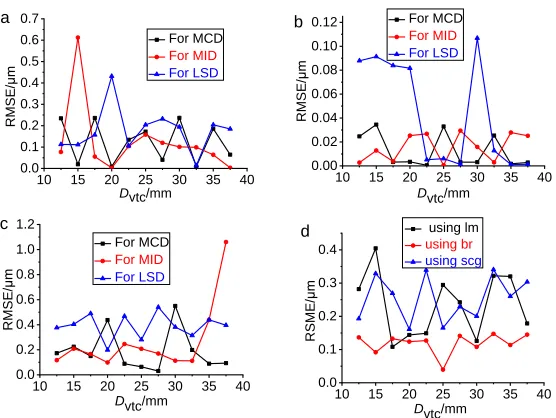
Their corresponding global sizes (outputs) based on the trained models used in Figure 3 for all checked virtual cylinders, and their corresponding RMES values between the outputs and the targets for the cylinders with a nominal size of 25mm were obtained, as shown in Figure 4.
Figure 4. (a) Minimum RMSE obtained based on ‘trainlm’ function for checked virtual cylinders; (b) minimum RMSE obtained based on ‘trainbr’ functionfor checked virtual cylinders; (c)
minimum RMSE obtained based on ‘trainscg’ function for checked virtual cylinders; (d) minimum RMSE of MZD based on three training functions for checked virtual cylinders.
In summary, for four kinds of global sizes, their neural network regression models trained by using ‘trainbr’ function are suitable for their evaluation with higher accuracy.
Results Analysis
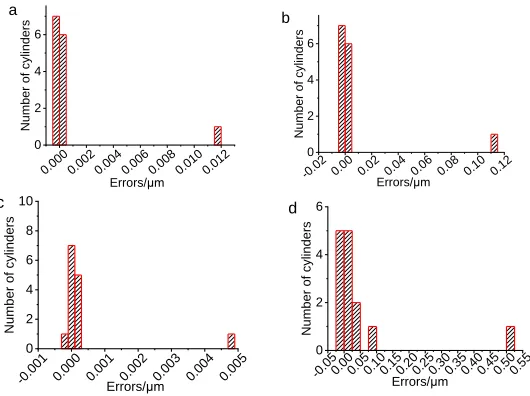
For further verifying the results above, the neural network regression curves of the global sizes of the virtual cylinder with the diameter Dvt of 44mm and the checked virtual cylinder with the diameter Dvtc of 27.5mm were taken as an example, which were obtained based on the neural network regression models trained by using ‘trainbr‘ function. The curves of the regression between the outputs trained by the difference of pseudo global sizes and the Dvt above and their corresponding targets were obtained, which have good linearity, and the distribution histograms of their errors are shown in Figure 5(a), (b), (c) and (d) for MCD, MID, LSD and MZD, respectively. The curves of the regression between the outputs by using the trained models above for the Dvtc above and their corresponding targets were also obtained, which have samilar good linearity, and the distribution histograms of their errors are shown in Figure 6(a), (b), (c) and (d).
From Figs. 5, we can know that the absolute errors between the outputs and targets of MCD, MID and LSD are less than 0.005m for 49 cylinders with very high evaluation accuracy, except for one cylinder, the absolute errors between the outputs and targets of MZD are less than 0.07m. From Figure 6, we can know that
10 15 20 25 30 35 40 0.0
0.1 0.2 0.3 0.4 0.5 0.6 0.7
RMSE/
μm
Dvtc/mm For MCD
For MID
For LSD
a
10 15 20 25 30 35 40 0.00
0.02 0.04 0.06 0.08 0.10
0.12 For MCD
For MID
For LSD
RMSE/
μm
Dvtc/mm
b
10 15 20 25 30 35 40 0.0
0.2 0.4 0.6 0.8 1.0 1.2
For MCD
For MID
For LSD
RMSE/
μm
Dvtc/mm c
10 15 20 25 30 35 40 0.0
0.1 0.2 0.3 0.4
RSME/
μm
Dvtc/mm using lm
using br
using scg
[image:8.612.172.450.84.293.2]for 14 checked virtual cylinders, the absolute errors between the outputs and targets of MCD and LSD are less than 0.035m, one of 14 MID absolute errors is greater than 0.1m, and two of 14 MZD absolute errors is greater than 0.1m. On the whole, the evaluation of global sizes of cylinder based on the neural network regression has higher accuracy, which has application value in the measurement of global sizes.
Figure 5. (a) Histogram of errors distribution of MCD for 49 cylinders; (b) histogram of errors distribution of MID for 49 cylinders; (c) histogram of errors distribution of LSD for 49 cylinders;
(d) histogram of errors distribution of MZD for 49 cylinders.
Figure 6. (a) Histogram of errors distribution of MCD for 14 checked cylinders; (b) histogram of errors distribution of MID for 14 checked cylinders; (c) histogram of errors distribution of LSD for 14 checked cylinders; (d) histogram of errors distribution of MZD for 14 checked cylinders.
-0.0004-0.0003-0.0002-0.00010.00000.00010.00020.00030.0004 0
4 8 12 16 20 24 28
Number of cylinde
rs
Errors/μm
a
-0.0004-0.0003-0.0002-0.00010.00000.00010.00020.0003 0
2 4 6 8 10 12 14 16
Number of cylinde
rs
Errors/μm
b
-0.0002-0.00010.00000.00010.00020.00030.00040.0005
0 2 4 6 8 10
Number of cylinde
rs
Errors/μm
c
-0.20 -0.16 -0.12 -0.08 -0.04 0.00 0.04 0.08
0 4 8 12 16 20
Number of cylinde
rs
Errors/μm
d
0.000 0.002 0.004 0.006 0.008 0.010 0.012
0 2 4 6
Number of cylinde
rs
Errors/μm
a
-0.02 0.00 0.02 0.04 0.06 0.08 0.10 0.12
0 2 4 6
Number of cylinde
rs
Errors/μm
b
-0.001 0.000 0.001 0.002 0.003 0.004 0.005
0 2 4 6 8 10
Number of cylinde
rs
Errors/μm
c
-0.050.000.050.100.150.200.250.300.350.400.450.500.55
0 2 4 6
Number of cylinde
rs
Errors/μm
[image:9.612.170.426.182.369.2] [image:9.612.166.431.430.628.2]CONCLUSIONS
Based on the cylindrical coordinate measuring principle, the evaluation models of the global sizes and the regression models between the pseudo global sizes of the virtual cylinder and their corresponding actual global sizes were trained by using three training functions, and the regression models were checked by using the pseudo global sizes of the checked virtual cylinders. The trained experiments for the training models showed that the global sizes evaluated based on the models trained by using ‘trainbr’ function are best among the three training functions and the RMES of the errors between the outputs and the targets were less than 0.2m for all virtual cylinders. The checked experiments indicated that the errors of MCD and LSD of 14 checked virtual cylinders are less 0.015m, and for 14 checked virtual cylinders, 13 errors of MID or MZD are less than or equal to 0.1m. In a word, the evaluation of global sizes based on the neural network regression models is feasible and has higher evaluation accuracy.
ACKNOWLEDGEMENTS
The work was supported by the projects of the Natural Science Foundation of China (Contract No.:51475485, 51405523).
REFERENCES
1. International Organization for Standardization, ISO 14405-1:2016 Geometrical Product Specifications (GPS) - Dimensional Tolerancing - Part 1: Linear, Geneva, 2016.
2. Miroslav, Alexander Végh. 2013. “Comparison of the Cylindricity Deviation Using Different Evaluation Methods,” American Journal of Mechanical Engineering,1(7):339-342.
3. S. Hossein Cheraghi, Guohua Jiang, Jamal Sheikh Ahmad. 2003. “Evaluating the Geometric Characteritics of Cylindrical Features,” Precision Engineering, 27(2):195-204.
4. Zexiang Zhao, Bin Li, Guoqing Zhang, Hechun Yu and et al. 2017. “Study on the Evaluation of Cylinder’s Global Sizes. Precision Engineering,” 49:189-199.
5. Hsinyi Lai, Wen Yuh Jywe, Cháokuang Chen, Chienhong Liu. 2000. “Precision Modeling of Form Errors for Cylindricity Evaluation Using Genetic Algorithms,” Precision Engineering, 24(4):310-319.
6. Xianqing Lei, Hongwei Song, Yujun Xue and et al. 2011. “Method for Cylindricity Evaluation Using Geometry Optimization Searching Algorithm,” Measurement, 44(9):1556-1563.
7. Xiulan Wen, Jiacai Huang, Dinghong Sheng, Fenglin Wang. 2010. “Conicity and Cylindricity Error Evaluation Using Particle Swarm Optimization,” Precision Engineering, 34(2):338-344. 8. International Organization for Standardization, “ISO/TS 12180-2:2007 Geometrical Product
Specifications (GPS) -Cylindricity-Part 2: Specification Operators”, Geneva, 2007
9. L.V. Kamble, D.R. Pangavhane, T.P. Singh. 2015. “Neural Network Optimization by Comparing the Performances of the Training Functions-Prediction of Heat Transfer from Horizontal Tube Immersed in Gas-Solid Fluidized Bed,” International Journal of Heat and Mass Transfer, 83:337-244.