2018 International Conference on Computer Science and Software Engineering (CSSE 2018) ISBN: 978-1-60595-555-1
Global Load Balancing Strategy Based on
Origin-based Algorithm
Ji-jun Wang, Jun Mu, Rong-shui Shi and Jiang Fan
1
ABSTRACT
At present, most of the global load balancing products which undertake the resource access scheduling tasks for multiple data centers are mostly based on the single user optimal policy, they can’t reach global optimization, and in theory, algorithms like genetic and BP are mostly used, but they have slow convergence rate. The origin-based algorithm which is used for optimal planning of the transportation network is valued. To apply this algorithm, the model of resource access for multiple data centers which has corresponding attributes to the transportation network has been structured. It is proved that the model can be used in the actual global load scheduling scenario as under the same accuracy, the simulation result shows it can achieve a faster convergence, which is very important to meet the real-time scheduling requirements of multi data centers.
INTRODUCTION
Application systems are usually deployed in a single data center, nowadays, they can be deployed in multiple data centers by cloud computing technologies.
Global load balancing is a technology which is used to balance access requirement to each service site. It makes users with only one IP address or
WANG Ji-jun, State Grid Jiangsu Electric Power Co., Ltd. No. 215, Shanghai Road, Gulou District, Nanjing, China.
domain name can access to the nearest or the fastest server site, so as to obtain the optimal access strategy[1], at the same time, it also eases the access pressure by multiple links[2].
However, the service capabilities of data centers are usually different. It is quite difficult to find a strategy which can reach global optimization for users in global environment of several data centers. In recent years, Most scholars have tried their best to find the optimal SDN controller (or sevice site)[3,4]. some scholars have also proposed strategies based on kinds of algorithms like genetic algorithm, simulated annealing algorithm, and BP algorithm, these strategies with parallel search ability can achieved certain results. For example, the BP algorithm can be used to achieve approximate solutions in a certain scenario, but the rate of convergence is extremely slow. For actual use, we need to approximate the approximate solutions in advance as training tools to improve the scheduling efficiency[5]. The another solution is using genetic algorithm to plan the global optimal migration scheme (essentially the same as the global load scheduling). The result is obviously better than the user's optimal rotation scheduling algorithm[6], but its efficiency is still unable to meet the real-time scheduling requirements of multiple data centers.
In the traffic network flow theory, global load balancing assigns the optimal policy to every user is actually the idea of user equilibrium(UE), while the global user optimal access policy is the idea of system optimal(SO). User equilibrium considers that each user's behavior is independent of each other, they each want to choose the best strategy for themselves, and eventually reach the equilibrium state. In other words, the travel time of all used routes between the same OD
pair(origin point and destination point)is equal and minimal. System optimization considers that all travelers follow the strategy which can minimize the total travel time of the network, and in this condition, the network resources are optimally utilized[7].
In this paper, a model of global load scheduling for multiple data centers is established based on the Origin-based Algorithm (OBA), which is used to solve the system optimal problem in the filed of traffic network flow with a faster convergence speed. The effectiveness of the model is demonstrated through simulation results.
ORIGIN-BASED ALGORITHM (OBA)
Algorithm Introduction
divides the undifferentiated traffic flow on the traffic network into different levels according to the origin points. That is, traffic flow from different origin points belongs to different levels. The algorithm updates traffic flow from each origin point independently in an orderly manner. At the same time, the superposition of different layers will affect each other, and the last equilibrium state will be achieved by repeatedly updating the traffic volume of each layer[8].
Calculation Process
The traffic allocation problem is split into two sub-problems: which road sections should be selected for different origin points and how to determine how much traffic flow should be allocated to these road sections. Its process is divided into two parts, namely initialization and main loop.
The purpose of initialization is allocating traffic flow to the traffic network roughly in preparation for the main loop. The process is as follows:
1) Origin from any point O in the network, the shortest path tree is searched
by the labeling method according to the free travel time of road sections. The shortest path tree is the restricted sub network in initialization phase;
2) Traffic flow from the origin point O is allocated to the shortest path tree
according to the law of "all-nothing", then the flow of road sections of origin point O is obtained;
3) Initializes the origin point's original paths ratio. The original paths ratio of all the road sections in the shortest path tree are 1, and the original paths ration of the road sections that are not in the shortest path tree are 0;
4) Repeat 1 to 3 steps from a new origin point in the network until all origin points have been initialized;
5) The initial traffic flow of each road section is an initial feasible solution, and then the cost of road section and the derivative value of the road section cost will be updated.
For reaching the optimal result, the main loop mainly uses the quasi-Newton type flow transfer method to transfer the traffic flow on each road section of the initialized state to other road sections gradually, as the convergence speed of the quasi-Newton type flow transfer method is very fast.
To perform the calculation, data as traffic network topology G, capacity of
each road section C, free travel time t0 of each road section, the value α and β in the impedance function of each road section, point pairs ODand traffic flow
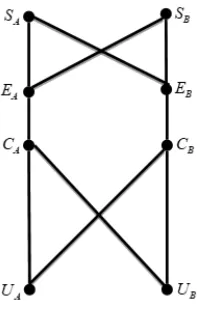
Figure 1. User access to multiple data center system node model diagram.
MODEL OF MULTI-DATA CENTER GLOBAL LOAD BALANCING
Model Construction
It can be seen from the description of the OBA algorithm that an ideal result can be converged in a very short time as long as the model suitable for the operation of the algorithm is constructed. Therefore, this paper combines multiple data center service sites with communication networks, and maps them together to build a model on the road network.
The access mode of multiple data center is that users in various places visit several systems, and the nodes of the system are deployed in multiple data centers. When users access the business system, in addition to its own factors, the delay mainly comes from three places. One is the delay of communication network, the other is the delay of various network devices at the outlet of the data center, and the third is the node delay of the business system. For the first two factors, the entities can be directly mapped into the network topology; for business system server nodes, the point must be converted to line, and logically matched with the actual access process.
A feasible access model is presented below as shown in Figure 1:
Where, UA and UB represent two user access points, SAandSB represent
two business systems, CA and CB represent two data
centers.UA-CA,UA-CB,UB-CAandUB-CBindicate the physical communication network from users to the data center,CA-EAandCB-EBare exit lines in the data center,EA-SAandEB-SAare nodes which deployed by the business system A in two data centers, EA-SBandEB-SB are nodes which deployed by the business system B in two data centers.
on the line segmentEA-SA.If you want to separately access nodes of SAin data
centers CA and CB from UA , there are only two ways of
A
U -CA-EA-SAandUA-CB-EB-SA. These two ways pass through two different
communication networks, and access the same service system located at different data centers, which is consistent with reality. If UAwants to access theSAsystem
at CA , and UB wants to access the SB system at CA ,there two ways
ofUA-CA-EA-SAandUB-CA-EA-SB. Before reaching the data centerCA, the two access demand points pass through different communication networks. When entering the data center, after passing through the same line, and then accessing their respective system nodes separately, if there are many access demand points, traffic congestion will only occur at the outlet of the data center, which is also consistent with the actual situation. Therefore, the model is feasible.
Property Mapping
According to the data required by the OBA algorithm, the entire network topology attributes in the model are described one by one:
The network bandwidth of the physical communication network, such as
A
U -CA etc, corresponds to the capacity of the link C. The idle network delay
corresponds to the free flow travel time t0of the link. The delay impedance characteristic of the network access number corresponds to the link cost function.
The data center exit line attribute represented by CA-EA and others is similar to the entity communication network. It involves multiple network devices at the outlet of the data center, which needs comprehensive consideration.
performs the local distribution policy delivered by global load balancing, which is not discussed in detail here.
Finally, point pairs OD and OD data can be obtained by collecting the
access requirements in the network through the global load balancing device core controller.
At this point, all the data needed by the OBA algorithm have been completed, and we can use algorithm to do iterative computation.
Iterative Simplification
In the OBA algorithm, the iterative process needs to use Quasi-Newton flow transfer method. The essence is to calculate the ratio of the first derivative and the second derivative of the objective function. Although the convergence speed is fast, the calculation is complicated. Therefore, the second derivative is approximated with little effect on the accuracy.
The first derivative of the objective function is:
(
)
NB
o o o
n a b
o a
t
f µ µ α
∂
= ⋅ −
∂
(1)
The approximate second derivative of the objective function is:
(
)
2 2 2 2 NBo o o o
n a b n
o a
t
f υ υ ρ
α
∂
≈ ⋅ + − ⋅
∂
(2)
Approximate processing brings a problem, that is, the second derivative of the objective function is strictly positive, and the approximate form may lead to a negative number, but the error is very small. In this case, you can use a positive
number that is the smallest enough, where ευ 107
−
= is used instead of the
calculation result. The Newtonian transfer flow (ratio) from segment a to segment b can be calculated from the following formula:
2 2
NB NB
a b o o
a a t t z α α → ∂ ∂ = ∂ ∂ (3)
(
0)
1
max , 2
o o
a b
a b o b o
n a a n
z
f υ
µ µ
ε υ υ ρ
→
−
≈ ⋅
+ −
(4)
Iterative Convergence Control
In the actual distribution process, the convergence accuracy of the algorithm needs to be controlled. This paper uses the difference between the maximum cost and the minimum cost in all used road sections in each iteration resultε∆as an
accuracy index. In the calculation process, each process of updating the restricted sub-network of the origin point is to calculate the maximum contribution cost of the node, and the maximum path cost between the point pairs OD is also the
maximum contribution cost of the node. In addition, the search for the shortest path tree is performed every time. The process can calculate the minimum path cost, so the calculated value ε∆does not require additional calculation process,
which can save the algorithm overhead.
There is a certain degree of blindness in the definition of the value of ε∆
before the allocation of the solution, or ε∆ is set too harsh, resulting in a large
number of iterative calculation processes that take a long time. It is not frequent to use the OBA algorithm to make the global optimal planning in traffic planning. The amount of ODis also obtained through observation of a period of time.
Therefore, the calculation process can be tolerated for a long time to achieve accuracy. The global load balancing planning guide is frequent and requires high timeliness. Therefore, in addition to ε∆, it is necessary to control the number of
iterations of the algorithm. If the iterations are full 100 times, the output will be stopped even if the accuracy is not reached. From the point of view of the road segment flow during the iterative process of the OBA algorithm, the convergence rate is very fast. By reasonably setting the iteration upper limit times, satisfactory accuracy can be obtained in a short time.
SIMULATION EXPERIMENT
Simulation Assumptions
In order to verify the application effect of the algorithm, we use C++ to write a simulation program. To obtain intuitive results, simplify the conditions as follows:
1) Simplify access points to 1;
2) Simplify the business system to 1 set;
3) Ignore the influence of the data center outlet lines; 4) Ignore communication network congestion delays.
The segment cost function is applied to the form of traffic network flow:
0(1 )
Q t t
C
= + b
a( )
Its derivative form is:
1 '
0*
Q t t
C β
β β α
−
=
(6)
Among them, αandβ are uniformly adopted by the United States Highway Authority designated values 0.15 and 4.
In the simulation experiment, a total of three data centers were set up, and the six nodes of a business system were deployed separately, as shown in Table I.
There is one access demand point U in the network, and the access
requirement will take different values in the test.
Assume that the attributes of the entity communication network are shown in Table II (without considering the congestion of the communication network, that is, if the link capacity is infinite, α and β are meaningless. To simplify the editing of the network topology attributes, the unified assumption is 0.15, 4).
[image:8.612.91.502.378.444.2]According to the foregoing discussion, no matter how many nodes are deployed in the data center, the idle access delay should be constant, but the capacity is proportional to the node. According to the deployment of nodes, the attributes of the business system nodes are set out in Table III.
TABLE I. DATA CENTER SERVICE NODE DISTRIBUTION TABLE.
Data center number Business node number
A
C S1,S2
B
C S3
C
[image:8.612.96.503.486.553.2]C S4 , S5 , S6
TABLE II. ENTITY COMMUNICATION NETWORK ATTRIBUTE TABLE.
Link number Link capacity Link idle access delay α β
A
U -CA 1000000 10ms 0.15 4
A
U -CB 1000000 30ms 0.15 4
A
[image:8.612.94.502.601.680.2]U -CC 1000000 100ms 0.15 4
TABLE III. SERVICE NODE ATTRIBUTE TABLE.
Data center number Business capacity
Business idle access
delay
α β
A
C 1000 5ms 0.15 4
B
C 500 5ms 0.15 4
C
The network model constructed according to the algorithm theory is shown in Figure 2.
The convergence accuracy of the algorithm is 0.1, and the iteration limit 100 times.
[image:9.612.115.479.357.675.2]Figure 2. Experimental topology properties.
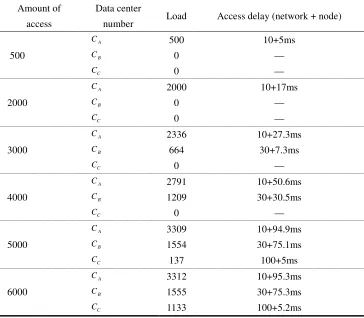
TABLE IV. SIMULATION RESULTS TABLE.
Amount of
access
Data center
number Load Access delay (network + node)
500
A
C 500 10+5ms
B
C 0 —
C
C 0 —
2000
A
C 2000 10+17ms
B
C 0 —
C
C 0 —
3000
A
C 2336 10+27.3ms
B
C 664 30+7.3ms
C
C 0 —
4000
A
C 2791 10+50.6ms
B
C 1209 30+30.5ms
C
C 0 —
5000
A
C 3309 10+94.9ms
B
C 1554 30+75.1ms
C
C 137 100+5ms
6000
A
C 3312 10+95.3ms
B
C 1555 30+75.3ms
C
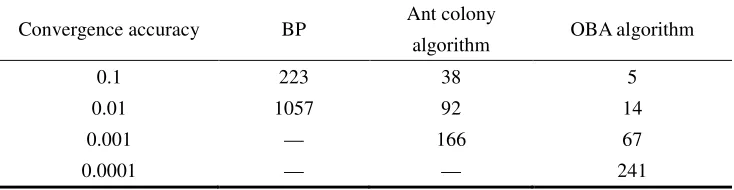
TABLE V. CONVERGENCE EFFICIENCY COMPARISON TABLE.
Convergence accuracy BP Ant colony
algorithm OBA algorithm
0.1 223 38 5
0.01 1057 92 14
0.001 — 166 67
0.0001 — — 241
Simulation Results
The test selected several representative visits. The results of distribution are shown in Table IV.
It can be seen that no matter how many access is tested, the system guarantees the consistency of access delay, and in this allocation mode, any access amount cannot obtain a better access speed by changing the access method.
Comparison Test
From the previous section, we can see that the optimization results are very satisfactory, so this section only compares the convergence efficiency.
The iterative upper limit of the model algorithm is canceled, the number of set access is 6000, and the convergence efficiency of BP and ant colony algorithm is compared under different accuracy requirements. The results are shown in Table V (unit: ms):
CONCLUSION
By constructing a multi-data center business access model, the traffic network flow OBA algorithm is successfully applied to the global business load, and the optimal target of the system is achieved. The algorithm is very time-consuming and has the conditions to guide the production environment.
In practical application, it is necessary to determine the value of α and β in the actual meaning of each section of the topology model through extensive experience and repeated testing, so as to ensure the rationality of the results. Even by testing the way to change the cost function of the road section and formulating a cost function which is more consistent with the production environment, the global load balancing product truly has a globally optimized dispatching command capability.
ACKNOWLEDGEMENT
This work was supported by a grant from the Project of Science and Technology of State Grid (No. SG[2017]179).
This paper is funded by Research and Application of Key Technologies for Integrated State Grid Cloud Platform.
REFERENCES
1. Wang Junfei. The implementation of global load balancing technology in the Internet[J]. Guangdong Science & Technology, 2007, 16(5):47-48. (In Chinese)
2. Yang Xiaofei. Current Technology and Applications of GSLB Strategy[J]. China Science and Technology Information, 2004, 16(22):18-20. (In Chinese)
3. Kanagavelu R, Mingjie L N, Mi K M, et al. OpenFlow based control for re-routing with differentiated flows in data center networks[C]// Proceedings of the 18th IEEE International Conference. New York: IEEE Press, 2012:228-333.
4. Wang Chunzhi, Luo Chen, Chen Hongwei. Optimal path allocation algorithm based on load balancing for SDN[J]. Application Research of Computers, 2016, 33(8):2462-2466. (In Chinese)
5. Man Lixin. The Load Balancing research based on BP Neural Network[D]. Jilin University, 2017. (In Chinese)
6. Luan Zhikun, Niu Chao. A Load-balanced Virtual Machine Scheduling Approach in Cloud Data Center[J]. Computer and Modernization, 2017, (05):24-36. (In Chinese)
7. Huang Haijun. Urban Transportation Network Eguilibrium Analysis: Theory and Practice[M].Beijing: China Communications Press,1994:12-30. (In Chinese)