2018 International Conference on Physics, Computing and Mathematical Modeling (PCMM 2018) ISBN: 978-1-60595-549-0
The Evaluation Research of Undergraduates Employment
Ability Based on Analysis Network Process
Na WANG*, Yin-zhen LI and Gang DUAN
School of Traffic and Transportation, Lanzhou Jiaotong University, Lanzhou, Gansu Province 730070, China
*Corresponding author
Keywords: Analytic network process, Decision science, Undergraduate employment ability index, Evaluation mode.
Abstract. This thesis researches the undergraduate employment abilities index system, which has 4 first level indicators, i.e. interpersonal skills, professional development abilities, general skills and working abilities, and 17 second level indicators based on the previous studies of the employment ability evaluation system. Because of the interrelationship of each indicator on undergraduate employment, this thesis constructed the model of undergraduate employment ability by using the analytic network process and overcome the shortcoming that analytic hierarchy process is not able to reflect the interrelationship of each indicator on undergraduate employment. At the end of the thesis, it verified the effectiveness and scientificalness of the evaluation model, with the help of Super Decisions software.
Introduction
With the development of China's higher education reform, the number and the growth rate of Chinese college graduates has reached an unprecedented level, and the college graduates are precisely the current job of the main staff. In the job market, the college students who want to find their favorite jobs must constantly improve their employability. The employability means that a college student should have any kind of job that can be employed by any organization and retain any office. Colleges and universities as the main position of education and teaching, its primary goal is to improve the level of professional knowledge of students, science and technology innovation and other aspects of the comprehensive ability. On the other hand the employer value is that our college students should have practical, solidarity and cooperation, adaptation, innovation and other aspects of the comprehensive ability, so that our college students can better for the development of innovation and production and management to make greater contribution. University graduates, as the main force of the current job force, who have to achieve the self-worth of this desire, requires students must have a certain degree of social development, that is, after the entry of new knowledge, accumulated new experience, the way to achieve self-value and ability.
The weight of each factor influencing the evaluation of employment ability is very important in the whole evaluation system, which is directly related to the rationality and authenticity of the evaluation result. Liu [3] put forward the constituent dimension of college students' employability, and investigated and analyzed the employment ability of college graduates in Fuzhou, and finally put forward the relevant countermeasures and suggestions to improve the employability of college graduates. Long etc. [2] and Sheng [5] established the evaluation system of college students' employability based on the analytic hierarchy process (AHP), and calculate the total score of employment ability. Niu etc. [4] puts forward the fuzzy comprehensive evaluation method based on improved analytic hierarchy process and Gaussian membership function to evaluate the employability and reduce the subjectivity of evaluation.
Most of the existing studies have adopted AHP. AHP adopts hierarchical hierarchy. It is easy to deal with system problems, but it is difficult to apply in complex decision problems. There are many indexes to evaluate the employability of college students. These indexes are interrelated and
difficult to be measured and defined by traditional AHP. Therefore, this paper uses the analytic network process (ANP) to study the comprehensive evaluation of college students' employability ability, determines the index system of mutual influence in the multi-index hierarchy system, and calculates the preference order of the college students.
ANP Introduction
The analytic network process is a systematic decision-making method proposed by the American operations scientist Satty in 1996. It is in the AHP on the basis of the development and the formation of a new practical decision-making method. In many practical problems, there is feedback between the internal elements of each hierarchy, where the structure of the system is more similar to the network structure. So it could solve more complex decision problems.
ANP first divides the system elements into two parts: the control hierarchy and the network layer. The control hierarchy contains at least one goal, and it may contain decision criteria that are independent of each other and dominated by the target element. The weight of each criterion in the control layer can be obtained using the AHP method. The network layer consists of all element groups of the control layer control. The internal structure of the network is the mutual influence, interdependence and mutual control. Each criterion in the hierarchical structure dominates a network structure that is interdependent and feedback.
There are elements B B1, 2,...,Bm in the control layer of the ANP and the network layer has element
groups C C1, 2,...,CN. The elements in Ci are e ei1, i2,...,eini
i1, 2,...,N
. Taking the control factor layerelement B ss 1, 2,...,m as the criterion and taking the ejl
l1, 2,..., nj
in Cj as the secondarycriterion, the judgment matrix is constructed under the criterion Bs, that is, the elements in Ci are
compared indirectly ejl by their influence on ejl
l1, 2,..., nj
. Then the ordered vector
1 , 2 ,..., i
T
jt jt jt
i i in
w w w
is obtained by the characteristic root method. If the characteristic vector is checked by consistency check, it could be written in matrix form. Then the local weight vector matrix can be obtained as follows.
( ) ( 1) ( 2)
1 1 1
( ) ( 1) ( 2)
2 2 2
( ) ( 1) ( 2)
... ... ... j j j
i i i
jn
j j
i i i
jn
j j
i i i
ij
jn
j j
in in in
w w w
w w w
W
w w w
(1)
The column vector in Wij is the ordered vector in what degree the element e ei1, i2,...,eini in Ci affects
the element e ei1, i2,...,eini in Cj. If the elements in Cj are not affected by the elements in Ci, Wij0.
Thus, the super matrix Wij can be obtained under Bs as follows.
11 12 1
21 22 2
1 2
N
N
N N NN
W W W
W W W
W
W W W
(2)
There are total m nonnegative super matrices. Every Wij is column normalized but not row
normalized. Using Bs as a criterion, the importance of each element group under Bs to the criterion
j C
is compared. Under Bs, the ordered vector of element group independent of the Cj is zero. So the
weight matrix is obtained as follows.
11 12 1
21 22 2
1 2
N
N
N N NN
a a a
a a a
A
a a a
(3)
By weighting the elements of the super matrix W, the weighted hyper matrix W
Wijis obtained. The entry in the matrix is the weight of each element of the network system.
In order to reflect the dependency between elements, the super matrix is needed to be handled stably, i.e. computing the relative order vector of each matrix.
1
lim (1 )
N k N
k
W N W
(4) If the limit is convergent and unique, the value of the corresponding row of the original matrix is the stable weight of each evaluation index.
Construction of ANP Model for College Student Employability
Zeng [8] pointed out that the top 5 indicators in the quality of college student are professional knowledge, professional dedication, willingness to learn, plasticity and communication and coordination ability and basic problem-solving skills. The United States Department of Education referred to [7] puts forward a framework of employability through a lot of social investigation which mainly includes 8 kinds of employment ability: learning ability, innovation and entrepreneurial ability, teamwork ability, communication skills, problem solving ability and self-management ability, planning and organization ability and technology ability. Reference [6] points out that enterprises are very important to students' learning ability, thinking ability, communication ability and the ability to find and solve problems. Li [1] divides employability into 3 dimensions: inner quality, ability to work, and social leadership.
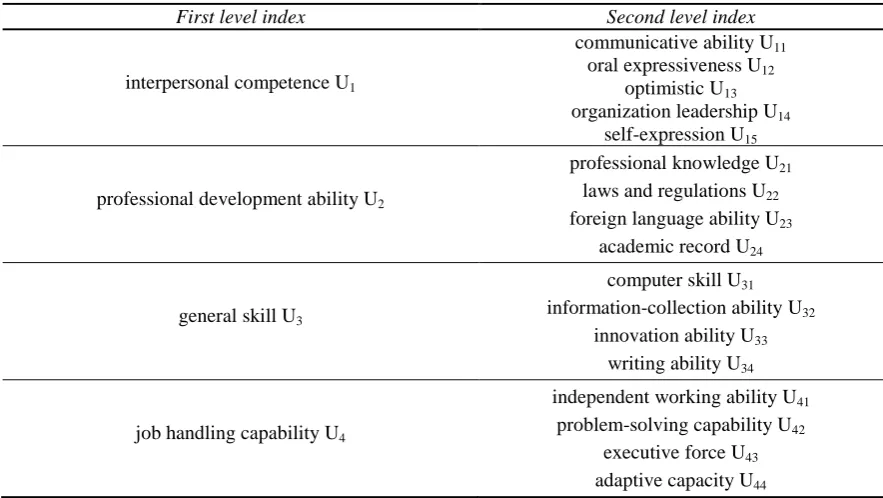
[image:3.595.133.462.584.754.2]According to the previous research on the evaluation system of employment ability, combining with the current employment situation of college students, a preliminary evaluation system of employability is formed. There are four first level indicators in our evaluation system, that is interpersonal skills, professional development ability, general skills and ability to handle work, which contain seventeen second level indicators, i.e. oral expression, cheerful optimism, interpersonal communication, writing ability, professional knowledge, innovation ability, laws and regulations, learning achievement, language ability, computer ability, information collection, self-expression, independent work, organization and leadership, execution, problem solving and ability to adaptation, as shown in table 1. The ANP structure model of the evaluation index of college student employment ability is set up as shown in figure 1.
Figure 1. ANP model of undergraduate employment capability evaluation.
interpersonal competence U11, U12, U13, U14, U15
professional development ability U31, U32, U33, U34
general skill U21, U22, U23, U24
job handling capability U41, U42, U43, U44
u4、
undergraduate 1,….,undergraduate N
Table 1. The evaluation index of undergraduate employment capability.
Firstlevelindex Secondlevelindex
interpersonal competence U1
communicative ability U11
oral expressiveness U12
optimistic U13
organization leadership U14
self-expression U15
professional development ability U2
professional knowledge U21
laws and regulations U22
foreign language ability U23
academic record U24
general skill U3
computer skill U31
information-collection ability U32
innovation ability U33
writing ability U34
job handling capability U4
independent working ability U41
problem-solving capability U42
executive force U43
adaptive capacity U44
Numerical Example
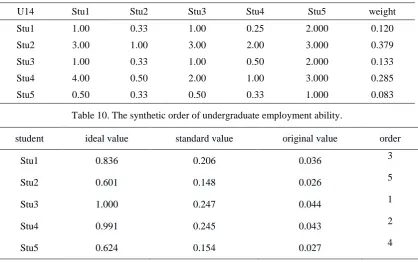
[image:4.595.79.523.527.800.2]In this paper, we take an enterprise recruitment of a university student among five college students as an example. And 1~9 scales were used to evaluate the relationship between the indexes of the employability of college students. Super Decisions software is applied to construct the ANP model of college student employment. We first establish a judgment matrix through pairwise comparison between indices of elements group. Then consistency check of the judgment matrix is performed in order to decide accept it whether or not. Finally, the weights of each first level index and second level index are determined by weighted super matrix and limit matrix. We list the pairwise comparison matrixes partly from Table 2 to Table 9. And every consistency check of pairwise comparison matrix, that is C.R., is less than 0.1. Table 10 indicates limited super matrix W after computing by Super Decisions software.
Table 2. Pairwise comparison under interpersonal competence (C.R. = 0.0074).
U1 U11 U12 U13 U14 U15 weight
U11 1.00 0.50 0.50 0.33 2.00 0.121
U12 2.00 1.00 1.00 0.50 3.00 0.215
U13 2.00 1.00 1.00 0.50 3.00 0.215
U14 3.00 2.00 2.00 1.00 4.00 0.376
U15 0.50 0.33 0.33 0.25 1.00 0.074
Table 3. Pairwise comparison under professional development ability (C.R. = 0.0227).
U2 U21 U22 U23 U24 weight
U21 1.00 2.00 0.50 2.00 0.278
U22 0.50 1.00 0.50 1.00 0.163
U23 2.00 2.00 1.00 2.00 0.395
U24 0.50 1.00 0.50 1.00 0.163
Table 4. Pairwise comparison under general skill ability (C.R. = 0.0172).
U3 U31 U32 U33 U34 weight
U31 1.00 3.00 2.00 1.00 0.366
U32 0.33 1.00 0.50 0.50 0.124
U33 0.50 2.00 1.00 1.00 0.233
U34 1.00 2.00 1.00 1.00 0.278
[image:4.595.78.522.731.800.2]Table 5. Pairwise comparison under job handling capability (C.R. = 0.0172).
U4 U41 U42 U43 U44 weight
U41 1.00 0.50 2.00 1.00 0.231
U42 2.00 1.00 3.00 2.00 0.426
U43 0.50 0.33 1.00 1.00 0.148
[image:5.595.97.507.159.387.2]U44 1.00 0.50 1.00 1.00 0.195
Table 6. Pairwise comparison between five college students under professional knowledge.(C.R. = 0.0297)
U21 Stu1 Stu2 Stu3 Stu4 Stu5 weight
Stu1 1.00 4.00 3.00 1.00 2.000 0.322
Stu2 0.25 1.00 0.50 0.25 0.500 0.073
Stu3 0.33 2.00 1.00 0.33 2.000 0.151
Stu4 1.00 4.00 3.00 1.00 2.000 0.322
Stu5 0.50 2.00 0.50 0.40 1.000 0.132
Table 7. Pairwise comparison between five college students under computer skill (C.R. = 0).
U31 Stu1 Stu2 Stu3 Stu4 Stu5 weight
Stu1 1.00 2.00 2.00 2.00 2.00 0.333
Stu2 0.50 1.00 1.00 1.00 1.00 0.167
Stu3 0.50 1.00 1.00 1.00 1.00 0.167
Stu4 0.50 1.00 1.00 1.00 1.00 0.167
Stu5 0.50 1.00 1.00 1.00 1.00 0.167
Table 8. Pairwise comparison between five college students under foreign language ability. (C.R. = 0.0504)
U23 Stu1 Stu2 Stu3 Stu4 Stu5 weight
Stu1 1.00 0.50 0.33 1.00 0.250 0.087
Stu2 2.00 1.00 0.50 2.00 0.333 0.153
Stu3 3.00 2.00 1.00 3.00 0.333 0.242
Stu4 1.00 0.50 0.33 1.00 0.500 0.106
Stu5 4.00 3.00 3.00 2.00 1.000 0.412
Table 9. Pairwise comparison between five college students under organization leadership. (C.R. = 0.0366)
U14 Stu1 Stu2 Stu3 Stu4 Stu5 weight
Stu1 1.00 0.33 1.00 0.25 2.000 0.120
Stu2 3.00 1.00 3.00 2.00 3.000 0.379
Stu3 1.00 0.33 1.00 0.50 2.000 0.133
Stu4 4.00 0.50 2.00 1.00 3.000 0.285
Stu5 0.50 0.33 0.50 0.33 1.000 0.083
Table 10. The synthetic order of undergraduate employment ability.
student ideal value standard value original value order
Stu1 0.836 0.206 0.036 3
Stu2 0.601 0.148 0.026 5
Stu3 1.000 0.247 0.044 1
Stu4 0.991 0.245 0.043 2
Stu5 0.624 0.154 0.027 4
[image:5.595.81.511.407.500.2] [image:5.595.90.509.522.784.2]Table 11. Limited super matrix.
In the evaluation system of college student employment ability, we could conclude that the total weights of 4 first level indexes of interpersonal ability, professional development ability, general skills and processing ability are 0.188, 0.204, 0.211 and 0.22 respectively from Table 10. Therefore,
students U1 U2 U3 U4
stu1 stu2 stu3 stu4 stu5 U11 U12 U13 U14 U15 U21 U22 U23 U24 U31 U32 U33 U34 U41 U42 U43 U44
st
ude
n
ts
stu1 0.036 0.026 0.044 0.043 0.027 0.038 0.037 0.026 0.063 0.024 0.062 0.036 0.036 0.070 0.025 0.062 0.081 0.043 0.042 0.083 0.026 0.069
stu2 0.036 0.026 0.044 0.043 0.027 0.038 0.037 0.026 0.063 0.024 0.062 0.036 0.036 0.070 0.025 0.062 0.081 0.043 0.042 0.083 0.026 0.069
stu3 0.036 0.026 0.044 0.043 0.027 0.038 0.037 0.026 0.063 0.024 0.062 0.036 0.036 0.070 0.025 0.062 0.081 0.043 0.042 0.083 0.026 0.069
stu4 0.036 0.026 0.044 0.043 0.027 0.038 0.037 0.026 0.063 0.024 0.062 0.036 0.036 0.070 0.025 0.062 0.081 0.043 0.042 0.083 0.026 0.069
stu5 0.036 0.026 0.044 0.043 0.027 0.038 0.037 0.026 0.063 0.024 0.062 0.036 0.036 0.070 0.025 0.062 0.081 0.043 0.042 0.083 0.026 0.069
U1
U11 0.036 0.026 0.044 0.043 0.027 0.038 0.037 0.026 0.063 0.024 0.062 0.036 0.036 0.070 0.025 0.062 0.081 0.043 0.042 0.083 0.026 0.069
U12 0.036 0.026 0.044 0.043 0.027 0.038 0.037 0.026 0.063 0.024 0.062 0.036 0.036 0.070 0.025 0.062 0.081 0.043 0.042 0.083 0.026 0.069
U13 0.036 0.026 0.044 0.043 0.027 0.038 0.037 0.026 0.063 0.024 0.062 0.036 0.036 0.070 0.025 0.062 0.081 0.043 0.042 0.083 0.026 0.069
U14 0.036 0.026 0.044 0.043 0.027 0.038 0.037 0.026 0.063 0.024 0.062 0.036 0.036 0.070 0.025 0.062 0.081 0.043 0.042 0.083 0.026 0.069
U15 0.036 0.026 0.044 0.043 0.027 0.038 0.037 0.026 0.063 0.024 0.062 0.036 0.036 0.070 0.025 0.062 0.081 0.043 0.042 0.083 0.026 0.069
U2
U21 0.036 0.026 0.044 0.043 0.027 0.038 0.037 0.026 0.063 0.024 0.062 0.036 0.036 0.070 0.025 0.062 0.081 0.043 0.042 0.083 0.026 0.069
U22 0.036 0.026 0.044 0.043 0.027 0.038 0.037 0.026 0.063 0.024 0.062 0.036 0.036 0.070 0.025 0.062 0.081 0.043 0.042 0.083 0.026 0.069
U23 0.036 0.026 0.044 0.043 0.027 0.038 0.037 0.026 0.063 0.024 0.062 0.036 0.036 0.070 0.025 0.062 0.081 0.043 0.042 0.083 0.026 0.069
U24 0.036 0.026 0.044 0.043 0.027 0.038 0.037 0.026 0.063 0.024 0.062 0.036 0.036 0.070 0.025 0.062 0.081 0.043 0.042 0.083 0.026 0.069
U3
U31 0.036 0.026 0.044 0.043 0.027 0.038 0.037 0.026 0.063 0.024 0.062 0.036 0.036 0.070 0.025 0.062 0.081 0.043 0.042 0.083 0.026 0.069
U32 0.036 0.026 0.044 0.043 0.027 0.038 0.037 0.026 0.063 0.024 0.062 0.036 0.036 0.070 0.025 0.062 0.081 0.043 0.042 0.083 0.026 0.069
U33 0.036 0.026 0.044 0.043 0.027 0.038 0.037 0.026 0.063 0.024 0.062 0.036 0.036 0.070 0.025 0.062 0.081 0.043 0.042 0.083 0.026 0.069
U34 0.036 0.026 0.044 0.043 0.027 0.038 0.037 0.026 0.063 0.024 0.062 0.036 0.036 0.070 0.025 0.062 0.081 0.043 0.042 0.083 0.026 0.069
U4
U41 0.036 0.026 0.044 0.043 0.027 0.038 0.037 0.026 0.063 0.024 0.062 0.036 0.036 0.070 0.025 0.062 0.081 0.043 0.042 0.083 0.026 0.069
U42 0.036 0.026 0.044 0.043 0.027 0.038 0.037 0.026 0.063 0.024 0.062 0.036 0.036 0.070 0.025 0.062 0.081 0.043 0.042 0.083 0.026 0.069
U43 0.036 0.026 0.044 0.043 0.027 0.038 0.037 0.026 0.063 0.024 0.062 0.036 0.036 0.070 0.025 0.062 0.081 0.043 0.042 0.083 0.026 0.069
U44 0.036 0.026 0.044 0.043 0.027 0.038 0.037 0.026 0.063 0.024 0.062 0.036 0.036 0.070 0.025 0.062 0.081 0.043 0.042 0.083 0.026 0.069
w
e
igh
t 0.036 0.026 0.044 0.043 0.027 0.038 0.037 0.026 0.063 0.024 0.062 0.036 0.036 0.070 0.025 0.062 0.081 0.043 0.042 0.083 0.026 0.069
job handling capability and general skills are the key indicators. In the all second level indices the following indices have larger weights including organization leadership, professional knowledge, academic record, information-collection ability, innovation ability, problem-solving capability and adaptive capacity, whose weights are 0.063, 0.062, 0.070, 0.062, 0.081, 0.083 and 0.069 respectively. So students should improve their employment abilities by improving the above second level indices. The results of the synthetic order are shown in Table 10. It shows that for recruitment enterprise Stu3 (student 3) will be the best choice. The column of ideal value in Table 10 displays Stu3 has a weight of 1. The column of standard value in Table 11 presents the results in the form of weights. The column of original value in Table 11 is obtained directly from the limit super matrix. From the column of the ideal value, we get the results that Stu1 (student 1) is 83.6% less than that of Stu3 (student 3), Stu2 (student 2) 60.1% less than that of Stu3 (student 3), Stu4 (student 4) 99.1% less than that of Stu3 (student 3), and Stu5 (student 5) 62.4% less than that of Stu3 (students 3), respectively.
Conclusion
According to the interdependence and feedback relationship between the evaluation indexes of college student employment, this paper proposes an evaluation method of college student employability based on ANP, which could effectively solve the defects of the AHP method. With the help of Super Decisions software, the calculation process is simple and scientific. It provides a scientific basis for the employment guidance of college student.
Acknowledgement
The authors greatly acknowledge the support from Lanzhou Jiaotong University Young Scientific Research Fund Project (2015021).
References
[1]Liu, T. Y. (2012): College graduates’ employability: status, causes and countermeasures – based on the investigation of some college graduates in Fuzhou. Journal of Fujian Agriculture and Forestry University (Philosophy and Social Sciences), 15(1), pp. 92-97.
[2]Long, Y. H.; Chen, M. R. (2011): Graduate employment research based on AHP evaluation system[J]. Natural Science Journal of Hainan University, 29(3), pp. 231-236.
[3]Sheng, D. (2012): Evaluation on the employability of college students based on AHP[J]. Journal of Xi’an Shiyou University: Social Science Edition, 21(1), pp. 57-62.
[4]Niu, L.; Chen, K.; Chen, Y. (2011): Application of improved AHP in employment comprehensive evaluation[J]. Computer Simulation, 28(5), pp. 376-379.
[5]Zeng, X. Q. (2004): Job seeking of college graduates in employment environment under ttransition[J]. Economic Research Journal, (6), pp. 87-95.
[6]Yang, J. T. (2011): American college students’ employment ability training mechanism and the enlightenment[J]. Research in Educational Development, (19), pp. 63-68.
[7]Wang, T.; Zeng, X. Q.; Yang, Y. M. (2011): Improving employability for resolving the problem of the structural unemployment of university graduates. Population & Economics, (03), pp. 49-56.
[8]Li, Y.; Liu, S. S.; Wen, S. Z. (2005): The influence of the employment ability of college students on the quality of employment. Higher Education Exploration, (2), pp. 91-93.