2019 International Conference on Computer Intelligent Systems and Network Remote Control (CISNRC 2019) ISBN: 978-1-60595-651-0
Research on Optimization of Conference Room
Using Method Based on Data Mining Algorithm
Wei Wang and Donlin Wang
ABSTRACT
Most of the meeting rooms are chosen randomly. In particular, there are many places in the conference room, such as the conference building, hotel conference area, etc. Because of the lack of corresponding optimization methods when the conference room is used, the energy consumption of the conference room cannot be controlled. An association rule analysis method based on data mining and Apriori algorithm is proposed. The use of four conference rooms in an office building is analyzed with the help of this method. The result shows that compared with the disordered room allocation method, this rule can reduce the energy consumption by 55.1% at most.
KEYWORDS
A conference Room, Association Rules, Apriori, Energy Saving.
INTRODUCTION
Public intelligent building has been widely used. With the construction operation, a large number of data are generated. How to achieve the goal of energy saving and consumption reduction with the help of big data analysis will gradually become the focus of everyone's research. At present, for the current situation of conference room energy conservation, most of the optimized algorithms are used to control the single electrical equipment in the conference room, such as air conditioning, lighting, etc., to achieve the energy conservation goals[1],[2]. It focuses on energy-saving equipment, not management and control. In the future, someone will control the conference room in an intelligent way to achieve the purpose of energy saving. This ignores the technical level of the meeting service personnel. This paper will analyze big data according to real operation data, obtain corresponding strategies, guide the scheduling of conference room, and achieve the purpose of reducing energy consumption.
It is proposed that it is about the data algorithm based on Apriori algorithm, which analyzes and optimizes the occupancy of conference room. The data algorithm based on Apriori algorithm is proposed, which is to analyze and optimize the occupancy of conference room. First of all, data information such as the occupancy of conference rooms, number of participants, energy consumption data, __________________________________________
Wei Wang, Donlin Wang
Tianjin Architectural Design Institute, Tianjin 300074, China
and indoor environment data were obtained in 2018, with the help of data mining of sample buildings. Secondly, after the existing data is preprocessed, the effective data is obtained. Then, with the help of the analysis of heterogeneity and coupling, the data association between systems is found. These data include the data between the overall operation energy consumption and operation and maintenance cost of the building. Finally, by analyzing the association rules, the data-driven energy-saving method is realized. And the goal of energy energy-saving and emission reduction to improve comfort has also been achieved. The results show that the optimal solution can be provided according to the time period of the meeting and the factors of season and orientation.
DATA MINING
Research Example of Office Building Meeting Room
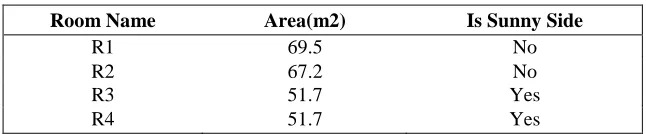
[image:2.612.136.459.436.503.2]This paper is based on a green intelligent building in Tianjin, which is designed by three stars, operated by three stars and won LEED Star Award. Although the building has done a good job in energy saving, there is still a waste of energy consumption and conference room scheduling random situation. In this paper, four conference rooms in the building are selected as the research object and numbered as R1, R2, R3 and R4. The curtains of each conference room are closed for a long time, so the lighting has no effect on the conference room. Each conference table has 16 seats, with 20 free seats around. See basic information Table I for R1, R2, R3 and R4 as male.
TABLE I. BASIC INFORMATION OF CONFERENCE ROOM.
Room Name Area(m2) Is Sunny Side
R1 69.5 No
R2 67.2 No
R3 51.7 Yes
R4 51.7 Yes
Apriori Algorithm
Data mining is to mine and search the repeated relationships in a given data set, aiming to find interesting associations or correlations between items in a large transaction or relational data set. Data association mining is a kind of supervised method, which is used to find the association between a group of variables, and effectively applied to medical big data research, education classroom scheduling, power research and so on.
The strength of association rules can be measured by support degree and confidence degree, which respectively reflect the usefulness and certainty of association rules. Support degree is the probability that project set a project set B appear at the same time in the transaction database. It is pointed out that the degree determination rule can be used to determine the frequency of a given data set.
Data mining is a kind of analysis tool based on big data. It is not clear about the actual relationship between the data, which requires human analysis. Apriori, charm and FP growth are commonly used algorithms for association and correlation mining. Based on the conference room of office building, the amount of data after dimension reduction is small and the number of combination of project sets considered is reduced. Because the choice of algorithm has no fundamental influence on the result or running time, Apriori algorithm is used to optimize and study the occupancy of conference room.
DATA MINING AND ANALYSIS
Data Collection
The use time of the meeting room is working day, and the time period is from 08:30 to 17:30. According to data analysis, the average duration of each meeting is 2.2 hours, and the average number of meetings per day is 3.4, namely 3-4. Because the electrical equipment in each meeting room is basically the same (projector, air purifier, computer), and because the service personnel in the meeting room shut down the energy consumption equipment after the meeting, the socket power in each meeting room is considered the same, and there is no decisive factor for the selection of the meeting room. Compare and analyze all CO2 values with the number of participants and get the result that the fresh air system can be started when there are 6 participants per capita. The power consumption of fresh air system in each room is 0.19kw/h. When the air conditioner is on, the corresponding power is 0.89kw/h.
Data Preprocessing
maintenance platform data, when the room reaches the set value, the difference between the wall temperature and the indoor temperature is about 3 ℃. Therefore, the wall temperature can be used as a standard to measure the energy level of air conditioning refrigeration or heating. Next, the data processing of each dimension will be described in detail. There are many ways to divide seasons, such as astronomy, lunar calendar, climate and so on. In order to ensure that they are more suitable for the body temperature, this paper will divide them according to the climate. According to the national meteorological industry standard "climate season division" and relevant meteorological information of Tianjin, the division of four seasons in 2018 is determined. The time period is divided into four periods. To ensure a certain amount of data in each period, a time point is selected for recording in each period. Because the meeting room is divided into the shade and the sun and the wall temperature is different in different seasons, the heating state of the air conditioner is heat, code, null. Waste level: high, mid, low. The above evaluation dimensions are disordered, so deep integration and treatment are needed.
A N
S T K
T
T
1 ( ) (i)
A S
N T K
T
T
2 ( ) (ii)
TS is the temperature of the wall on the outside, TN is the temperature of the
wall on the outside, Ka is the air conditioning on state when heating, 1 when
heating, 1 when cooling, no operation in spring and autumn, 0; because according to the national standard GB /T18883-2002, the indoor temperature is 22 ℃ ~ 28 ℃ in summer and 16 ℃ ~ 24 ℃ in winter. The air conditioning setting range of the building is 16 ℃ ~ 28 ℃, so when the same setting range is reached, T1 is used as
the energy consumption standard for evaluating the energy consumption between the sunny side and the shady side, and T2 is used as the energy consumption standard for evaluating the energy consumption between the shady side and the sunny side.
TABLE II. MEETING ROOM EVALUATION DIMENSION TABLE.
Variable Values
Season Spring(03.22~05.09),Summer(05.10~09.15), Autumn(09.16~10.29),Winter(01.01~03.21、10.30~12.31) TimeValue T1(08:30~10:00),T2(10:00~12:00),T3(13:30~15:30),T4(15:30~17:30) WasteLevel High(>2),Mid(0.3~2),Low(0~0.3)
Aircondition Heat, Code, Null
Research and Analysis of Association Rules
Figure 1. Energy consumption in summer on the sunny side.
[image:5.612.174.436.64.116.2]When heated, the results are shown in Figure 2. Take association rule 1 for example. When the predecessor's TimeValue is T1 and the season is winter, the successor's waste level is low. The detailed results are shown in Figure 2.
Figure 2. Energy consumption in summer on the shade side.
According to the results of R and the actual situation, some rules can be obtained:
1) there are no corresponding association rules in spring and autumn when heating or cooling, because there will be some data in the air conditioning heating mode in the early spring of the example building, most of the time in spring, the air conditioning is in the state of non-heating and non-cooling, so the heating data volume of air conditioning in spring is small, and then there are no relevant rules, which has little impact on energy consumption. In the same way, in the early autumn, there are certain data in the air conditioning and refrigeration mode, and in the later autumn, there will be certain data in the air conditioning and heating mode, but the amount of data is still small, so there is no relevant rules, which has little impact on energy consumption;
2) when cooling, the energy consumption on the sunny side is higher than that on the shady side in summer. In the first time of summer morning, because the cooling in the building stops at night, the temperature of the building gradually approaches the outdoor temperature, and there is no sunshine at night, so the energy consumption on the shady side is lower than that on the sunny side, so the difference between the shady side and the sunny side is not big; with the rising of the sun, the temperature gradually rises, so the temperature on the sunny side rises faster than that on the shady side, and then the association rules 2, 3 and 4 are obtained. That is to say, in the second, third and fourth time periods in summer, the energy consumption degree of the shade is higher than that of the sun, and the shade is preferred; and the probability of energy consumption in the fourth time period is higher than that in the second time period.
shady side to the sunny side is medium, and the sunny side is preferred. In the fourth time period of winter, The energy consumption of the shade is higher than that of the sun, and the sun is preferred.
There are about 3.4 meeting rooms every day, so it is recommended that the meeting staff arrange the meeting in one meeting room on the same day and in different time periods according to the actual needs of the day, so as to reduce the energy consumption waste caused by heating / cooling. When combining the energy consumption of each meeting room, more accurate suggestions can be obtained:
1) the priority of spring and autumn is R3, R4, R2 and R1.
2) from 08:30 to 10:00 in summer, the priority order is R3, R4, R2 and R1. 3) from 12:00 to 17:30 in summer, the priority order is R2, R1, R4 and R3. 4) priority in winter: R3, R4, R2, R1
According to the rules, depth calculation is carried out to get the maximum energy saving ratio, and the formula is as follows.
2.2397 . 1 87 . 0 11 . 1 * 97 . 1 4 * 06 . 1 * 87 . 0 * a E
E 1t 2 3 3
New Old b a x b x x (iii)
Eold is the energy consumption corresponding to the original disordered
dispatching conference room principle; Enew is the energy consumption
corresponding to the new rules; X1 is the energy consumption multiple ratio
increased for each 1 ℃ rise. According to the literature, X1 is 1.06 when the heating
temperature of air conditioner is increased by 1 ℃ or the cooling temperature is reduced by 1 ℃, and the energy consumption is increased by 6%; t is the temperature to be increased or decreased, and the temperature difference between night and day is calculated as 3 ℃, that is, t is 3; X2 is the number of meeting
rooms, which may be 4 meeting rooms in the original disordered state, but now 1 meeting room can meet the requirements, so X2 is 4; a is the average lighting power
of 4 meeting rooms, 0.87kw; b is the air conditioning power, 1.97 KW; X3 is the
power ratio of a to R4, i.e. 1.11. Therefore, the energy consumption ratio of the original disordered dispatching conference room principle mode and the new rule is 2.23 times, that is, if the new rule is adopted, the current energy consumption can be saved up to 55.1%.
CONCLUSION
four seasons are provided. Finally, according to the Association rules and the actual power consumption of the four conference rooms, the in-depth analysis is carried out, and the rules proposed in this paper are adopted. It can save up to 55.1% energy, and provide strong theoretical and practical support for the management of the conference room.
ACKNOWLEDGMENTS
Corresponding author: Wei Wang.
This work was financially supported by Ministry of housing and urban rural development science and technology plan project, Project No., 2018-r1-013, project name, research on Key Technologies of green building operation performance dynamic evaluation system based on intelligent integrated platform and Tianjin Science and technology support key project, Project No., 17yfzcsf01280, project name, research and demonstration of key technologies for intelligent building heterogeneous data coupling analysis and optimized operation.
REFERENCES
1. J. Xiao and J. Xie, “Energy cost reduction robust optimization for meeting scheduling in smart commercial buildings, 2017 IEEE Conference on Energy Internet and Energy System Integration (EI2), Beijing, 2017, pp. 1-5.
2. A. Majumdar and Z. Zhang, Characterizing the Benefits and Limitations of Smart Building
Meeting Room Scheduling, 2016 ACM/IEEE 7th International Conference on Cyber-Physical Systems (ICCPS), Vienna, 2016, pp. 1-10.
3. D. Tao and P. Wei, Adaptive energy saving monitoring technology for air condition in telecommunication equipment room, INTELEC 07—29th International Telecommunications Energy Conference, Rome, 2007, pp. 155-160.
4. T. Hayashi and T. Tominaga, Minimum data set for controlling data center equipment for