Vacancy Overview 2012
Vacancy Overview 2012
A report produced by the Skills and Labour Market Research Unit (SLMRU) in FÁS for
the Expert Group on Future Skills Needs
February 2013
Authors
Foreword
The Vacancy Overview 2012 is the third in a series of annual reports prepared by the Skills and Labour Market Research Unit (SLMRU) in FÁS on behalf of the Expert Group on Future Skills Needs. The report examines the demand for labour in Ireland as measured by trends in advertised job vacancies, thereby
contributing to the EGFSN’s on-going monitoring of the labour market. While the study does not cover the entire vacancy market in Ireland, the sources used here amounted to almost 100,000 vacancies in 2012.
The Overview shows that despite the challenging economic
climate, vacancies continue to arise in all occupational groups. The Department of Social Protection/FÁS Jobs Ireland vacancies were most prevalent in sales, personal services and
elementary occupations while for IrishJobs.ie (private agency) vacancies occurred most frequently for IT professionals, sales and administrative roles. Foreign languages, particularly European languages, continued to be in demand for a number of roles (primarily sales and customer service positions) and a third level qualification was a prerequisite for many advertised jobs, particularly for professional positions.
The contraction in employment levels combined with a continuous inflow of newly registered vacancies suggest that, for many occupations, vacancies are occurring due to turnover and/or replacement, rather than expansion demand. In addition, the analysis in this report points to a number of occupations for which vacancies are proving difficult to fill, mostly professional posts (in IT, engineering, science, health and business) as well as multilingual sales and customer care roles.
The Vacancy Overview 2012 can contribute to the success of active labour market measures by highlighting skills which are required by the Irish labour market due to replacement or expansion demand or because they are currently in short supply. The Overview is also valuable in assisting the education and training providers to better align their programmes to the labour market needs. It provides a useful guide to job seekers, graduates and career guidance professionals as it identifies the areas where employment opportunities exist.
Una Halligan
Table of Contents
Key Findings ... 7
1. Introduction ... 9
2. Data ... 10
3. Overview of Vacancies ... 13
4. Managerial Occupations ... 22
5. Professionals ... 26
6.
Associate Professionals & Technical Occupations ... 32
7. Administrative and Secretarial Occupations ... 36
8. Skilled Trades Occupations ... 40
9. Caring, Leisure and Other Services Occupations ... 43
10. Sales and Customer Services Occupations ... 46
11. Operatives ... 49
12. Elementary Occupations ... 52
13. Policy Implications ... 55
Appendix A
Job Search Analysis ... 56
Appendix B
Vacancy Trends by Occupation ... 58
Members of the Expert Group on Future Skills Needs ... 63
Key Findings
While the number of vacancies advertised through the Department of Social Protection
(DSP)/FÁS Jobs Ireland in 2012 remained steady when compared to 2011, IrishJobs.ie saw a slow but steady rise over the year
Employment contracted between 2011 and 2012 (based on Quarter 3, CSO data) for all occupations except for managers, professionals and associate professionals; given that there was little expansion demand this suggests that most of the vacancies arising were due to turnover and/or replacement
An analysis of the Central Statistics Office’s (CSO) questions in their Quarterly National Household Survey (QNHS) relating to job search methods for those unemployed revealed that the incidence of contacting either a private or public employment agency varied depending on the sector the person was previously employed in, age and duration unemployed; those previously employed in all occupational groups excluding professionals were more likely to contact a public rather than a private employment agency
In 2012, the IT sector accounted for over 20% of all vacancies advertised through IrishJobs.ie; the sales sector and science, pharmaceutical and food sector each accounted for a further 9%
In 2012, DSP/FÁS Jobs Ireland vacancies were primarily in associate professional, elementary and personal service occupations. The occupations which appeared most frequently were:
Care workers and home carers (accounting for 10% of all DSP/FÁS Jobs Ireland vacancies in 2012)
Business sales executives (e.g. sales representatives/agents; 8% of vacancies)
Kitchen and catering assistants (5% of vacancies)
Chefs (5% of vacancies)
Collector salespersons and credit agents (e.g. field/door to door sales agents; 5% of vacancies)
IrishJobs.ie vacancies in 2012 were focused in the areas of professionals and associate
professionals (these accounted for 45% of all IrishJobs.ie vacancies in 2012). When examined by occupation title the following appeared most frequently:
Programmers and software development professionals (accounting for 6% of all IrishJobs.ie vacancies in 2012)
Sales accounts and business development managers (5% of vacancies)
Book-keepers, payroll managers and wages clerks (3% of vacancies)
Business sales executives (3% of vacancies)
Business and related associate professionals (e.g. data analysts, QA/compliance administrators, logistics analysts; 3% of vacancies)
Vacancies for professional occupations were by far the most likely to require a third level degree qualification and also in the main required 2-6 years’ experience. In contrast,
managerial vacancies had the highest share that had no minimum education requirements but also over a quarter of managerial vacancies (advertised through IrishJobs.ie) required at least 6 years’ experience
Employment permits provide an indication of which vacancies are difficult to fill within the Irish labour market and the European Economic Area (EEA). The number of permits issued to persons in the IT sector continues to grow, accounting for 46% of all new permits issued in 2012. In terms of occupations, professionals accounted for almost 60% of all new permits and of these the majority were for IT roles
The Recruitment Agency Survey conducted by the SLMRU in October 2012 points towards an increase in the aggregate number of mentions of vacancies which have been difficult to fill compared to both six months and a year ago; the highest share of mentions of difficult to fill vacancies was for professional posts (in IT, engineering, science, health and business) as well as multilingual sales and customer care roles.
Despite significant job losses occurring since the recession began, job announcements
1. Introduction
The Vacancy Overview 2012 report was prepared by the Skills and Labour Market Research Unit (SLMRU) in FÁS on behalf of the Expert Group on Future Skills Needs (EGFSN). Drawing on the various datasets held in the National Skills Database (NSD), this report aims to provide an overview of the demand for labour as measured by trends identified in advertised job vacancies.
While vacancy data has its limitations, as detailed in Section 2 of this report, when interpreted with caution, it can provide a useful insight into the developments in Ireland's labour market.
The vacancy data presented in this report refers to new vacant posts advertised through1:
Jobs Ireland (DSP/FÁS)2: public employment offices
IrishJobs.ie: a private recruitment agency
The analysis focuses on the occupations and job titles of vacancies advertised in 2012 with the objective of identifying skills for which there is currently a demand in the Irish labour market.
Following an overview of vacancy data, the report focuses on the nine broad occupational groups as per the Standard Occupational Classification (SOC 2010). An analysis of trends and the composition of vacancies advertised in 2012 are set out for each occupation according to:
sector
occupation and job title
skills
education
experience.
For each occupational group there is an analysis of:
The Recruitment Agency Survey conducted by the SLMRU in October 2012 which identifies any difficult to fill vacancies that are occurring.
Employment permit data, provided by the Department of Jobs, Enterprise and Innovation (DJEI), indicates where employers were unable to find suitable candidates within the Irish labour market and the broader European Economic Area (EEA).
Job Announcements which provides an analysis of job announcements through the media in 2012 along with job announcements confirmed by IDA client companies indicating possible future demand in the short-medium term.
1The Irish Times vacancy data utilised in previous reports is not currently available.
2 In October 2012, the Government launched Intreo, a new employment and support service for jobseekers, to be rolled out
2. Data
Vacancy Data
The vacancy data presented in this report is drawn from the newly advertised job vacancies in the following sources:
DSP/FÁS Jobs Ireland: the public employment service, providing a collection of all vacancies advertised by employers through the National Contact Centre in the DSP (formerly in FÁS) FÁS; the DSP/FÁS vacancy data excludes vacancies advertised as part of Work Placement and JobBridge schemes
IrishJobs.ie vacancy data: which is gathered from the Irishjobs.ie online vacancy advertising service; the analysis includes only IrishJobs.ie vacancies advertised by an employer and excludes vacancies advertised by agencies.
For the most part, the focus of this report is on vacancies that have occurred in 2012. In order to deliver an overview of trends, a five year analysis is provided where possible.
An analysis of the sectors in which vacancies occur utilises data from IrishJobs.ie (data on sectors is not available from DSP/FÁS Jobs Ireland at present).
A further analysis on sectors utilises DJEI employment permit data to indicate in which sectors employers are required to source persons from outside of the EEA for positions.
The level of experience required for positions advertised is available from both IrishJobs.ie and DSP/FÁS Jobs Ireland. For each occupational group, the source which has the most vacancies is utilised to report on this variable. The level of education required is only available for positions advertised through IrishJobs.ie.
Several issues, general and source specific, arise with the interpretation and analysis of advertised job vacancy data.
General vacancy data limitations
Vacancies may be advertised through channels not captured in the analysis (e.g. social media, recruitment agencies, employer websites), leading to an underestimation of the true demand.
Vacancies may be advertised simultaneously through several channels, leading to multiple counting and an overestimation of the true demand.
There is a danger of an occupational bias in any given advertising channel. For instance, despite a gain in the market share for managerial and higher skilled job advertisements in recent years in the DSP/FÁS Jobs Ireland data, the distribution of vacancies advertised through DSP/FÁS Jobs Ireland is skewed towards skilled trades, caring/leisure services and sales occupations. On the other hand, job vacancies advertised through IrishJobs.ie are skewed towards managerial, professional and associate professional occupations.
While it was possible to identify and exclude work placement and JobBridge vacancies from the DSP/FÁS Jobs Ireland data, it was not possible to do so from the IrishJobs.ie vacancy data; however, as the work placement and JobBridge schemes are administered and advertised through DSP/FÁS Jobs Ireland, their occurrence in other data sets is likely to be low and therefore unlikely to skew the data unduly.
The profile of vacancies advertised through other channels (e.g. an individual company’s website, community of practice websites, international media) may differ from the profile of those outlined in this report; this may be particularly true in the case of certain foreign
languages (e.g. Mandarin) where employers may prefer to advertise the vacancy in the language being sought or in countries where fluency in that language is commonplace.
Source specific data limitations
The vacancy refreshing facility available to employers on the IrishJobs.ie website makes it possible for a previously advertised vacancy to occur as a new vacancy in the same or following month, which may lead to an overestimation of the true number of new vacancies.
While not an issue with DSP/FÁS Jobs Ireland vacancies (given the vacancy validation procedures in place), difficulties in distinguishing between true vacancies and non-substantiated
advertisements in the IrishJobs.ie data can lead to an overestimation of the true demand.
IrishJobs.ie vacancies have been assigned an occupational code using Cascot software which automatically assigns a code based on key words or word segments found in the job description. In some cases the match may be erroneous (e.g. anti-money laundering may be mistaken for laundering services), and as such this has the potential to reduce the accuracy of the data.
Despite having unique reference codes in the IrishJobs.ie data set, the same job can appear in the data more than once, thus skewing the perceived demand for a job.
The DSP/FÁS Jobs Ireland vacancies are assigned codes manually (using a MANCO occupational coding system) which are then mapped by the SLMRU to SOC codes. It is possible for translation errors to occur during this process.
Seasonality
The issue of seasonality was examined for the overall vacancy time series as well as individual occupational groups. Only DSP/FÁS Jobs Ireland data was examined in this context given that it provides the longest time series without breaks. Seasonality was found to be present in the overall vacancy time series and in the vacancies data for skilled trades, sales and customer service, and elementary occupations. As the analyses are primarily qualitative, the presence of seasonality does not impact on the findings presented in this report.
SLMRU Recruitment Agency Survey
The Skills and Labour Market Research Unit (SLMRU) in FÁS has conducted a recruitment agency survey every six months since January 2008. It is designed to gather the views of recruitment agencies in respect of the occupations for which vacancies, in their experience, are proving difficult to fill. Almost 70 recruitment agencies were contacted and asked to participate in a telephone interview. The findings of the most recent survey (based on approximately 40 responses), which took place in October 2012, are presented for each occupational group.
Employment Permit Data
Employers where necessary employ workers from non-EEA countries through employment permit schemes. While the data on newly issued employment permits, provided by the DJEI may be used to highlight occupations for which employers experience difficulty in sourcing staff domestically, it should be interpreted with caution:
new employment permits may be issued to persons already residing in Ireland but who have changed employer
new employment permits may be issued to spouses/dependants of existing employment permit holders3
new employment permits may be issued to EU citizens (i.e. Romanian and Bulgarian nationals).4
Job Announcements
Announcements in the media (national newspapers) indicating the creation or loss of jobs have been documented by the SLMRU since 2010. Jobs created over the period January to December 2012 are summarised and presented for each occupational group, thereby highlighting areas in which job opportunities are arising as well as those where expansion activities may occur in the short-medium term. Job creation expected to arise from foreign direct investment in Ireland, supported by the IDA, is also considered here.
3 Only spouses/dependants of persons who attained their employment permit before 1 June 2009 are eligible for an
employment permit under the spousal/dependant scheme.
3. Overview of Vacancies
This section examines the overall findings from the analysis of vacancy data to ascertain the sectors and occupations where vacancies are most commonly reported. As previously mentioned, this analysis utilises data from two vacancy sources, IrishJobs.ie and DSP/FÁS Jobs Ireland, along with supplementary information from the employment permit data to indicate where there have been difficulties in sourcing persons from the Irish labour market and the EEA.
As IrishJobs.ie and DSP/FÁS Jobs Ireland do not capture the total pool of vacancy data available it is of value to get an understanding of the share of persons who utilise the services of both public and private employment agencies and how preferences differ according to sectors and occupations. For this reason this section includes an analysis of the Job Search questions undertaken by the CSO in their Quarterly National Household Survey (QNHS). While this analysis is based on the responses of the job seeker rather than the employer who is advertising positions, it gives an indication of the market share each agency holds.
Job Search Analysis
In the CSO’s QNHS those persons classified as unemployed are asked a series of questions in relation to methods used in searching for a job. There are thirteen questions including whether they have been in contact with public employment offices and/or private employment agencies and if they contacted employers directly. Each question is stand alone and it is therefore possible to get a “YES” response to any number of job search questions. DSP/FÁS Jobs Ireland is the only public employment agency in Ireland, while IrishJobs.ie is one of many private employment agencies.
Figure 3.1: Job Search for Unemployed Persons, 2004-2012
Source: SLMRU Analysis of CSO QNHS data
A third of those previously employed in a professional occupation contacted a public employment office, while for all other occupations the rate was over 50% (Figure 3.2). Persons previously employed as managers had the highest rate of contacting both public and private agencies in searching for a job, while the proportion of those contacting a private employment agency only was particularly high for those from professional occupations at 31%.
Approximately 35%5 of those persons previously employed in caring or sales related occupations did not contact either a public or private employment agency when searching for a job, instead choosing other methods such as contacting employers directly, asking friends or relatives or responding to advertisements.
Figure 3.2: Job Search by Broad Occupation of Previous Employment, q1 2012
Source: SLMRU Analysis of CSO QNHS data
5
A further 5% did not state whether they contacted either a private/public employment agency
0% 10% 20% 30% 40% 50% 60% 70% 80% 90% 100% Q1 2004
Q1 2006 Q1 2008 Q1 2010 Q1 2012
Both PES only Private agency only Neither/Not stated
0% 20% 40% 60% 80% 100% Managers, Directors & Senior Officials
Professionals Associate Professionals & Technical Administrative/Secretarial Skilled Trades Caring, Leisure & Other Services Sales/Customer Services Process, Plant & Machine Operatives Elementary Occupations No Previous occupation given
[image:15.729.79.501.534.703.2]A further analysis of the Job Search data is detailed in Appendix A showing that the incidence of contacting either a private or public employment agency varied depending on the sector the person was previously employed in, age and duration unemployed.
Overall Vacancies
Table 3.1 examines the share of employment by occupation in quarter 3 2012 and compares it to the share of vacancies for both DSP/FÁS Jobs Ireland and IrishJobs.ie. An analysis of this table raises the following questions in relation to the data sources utilised in this report:
Are the sources representative? The distribution of vacancies in both DSP/FÁS Jobs Ireland and IrishJobs.ie differs from the employment distribution across occupations and moreover differs from each other. While there is an overrepresentation of professional vacancies in IrishJobs.ie, there is an underrepresentation in these occupations in DSP/FÁS Jobs Ireland. Conversely there is a greater share of DSP/FÁS Jobs Ireland vacancies in lower skilled occupations; however, these two sources combined give a valuable insight in to the types of skills in demand across all occupational groups.
To what extent do the vacancies indicate employment growth? Given that employment contracted between 2011 and 2012 (quarter 3) for all occupations except managers,
[image:16.729.69.524.456.720.2]professionals and associate professionals, there was little expansion demand suggesting that most of the vacancies arising were due to turnover and/or replacement.
Table 3.1: Occupational Distributions of Employment, Employment Growth and Vacancies, 2012 Employment IrishJobs.ie
Vacancies 2012 DSP/FÁS Jobs Ireland Vacancies 2012 Total Employme nt Q3 20 12 % Share of Employme nt
% Change, Q3 20
11 -Q3 20 12 Share o f Total Employme nt Share o f Total Vaca ncies Share o f Total Employme nt Share o f Total Vaca ncies
Managers 147,000 8% 7.5% 1% 7% 1% 2% Professionals 346,000 19% 3.6% 3% 30% 1% 6% Associate Professionals 209,000 11% 2.4% 5% 33% 6% 21% Admin/Secretarial 209,000 11% -1.5% 2% 11% 2% 6% Skilled Trades 265,000 14% -2.5% 1% 5% 3% 11% Personal Services 145,000 8% -1.6% 0% 2% 7% 16% Sales 163,000 9% -0.5% 1% 6% 5% 12% Operatives 141,000 8% -8.5% 1% 4% 3% 6% Elementary Occupations 206,000 11% -2.6% 0% 2% 6% 20% Other/Not Stated 10,000 1% 5.4% 0% 0% 0% 0%
Total 1,841,000 100% -0.2% 2% 100% 3% 100%
While the numbers of vacancies notified to DSP/FÁS Jobs Ireland were in decline up to the start of 2009, the numbers have remained relatively steady since (see Figure 3.3); the peak that occurred in mid-2011 relates to the advertisement for a considerable number of Census enumerators and a change in recruitment practices of care workers at this time. On average approximately 5,500 vacancies are notified to DSP/FÁS Jobs Ireland each month. Notifications to IrishJobs.ie have seen a slow but steady increase in the same time period with an average of approximately 2,500 vacancies notified by employers each month. A trend analysis by occupation is detailed in Appendix B.
Figure 3.3 New Notified Job Vacancies (three-month moving average), 2008-2012
Note: A break occurred in the IrishJobs.ie data between June 2008 and July 2008 and it is therefore excluded from the trend analysis reported in this paper
Source: IrishJobs.ie and DSP/FÁS Jobs Ireland
Vacancies by Sector
Sectoral data is available for IrishJobs.ie but not for DSP/FÁS Jobs Ireland vacancy data. This analysis is supplemented by the inclusion of sectoral data available for employment permits issued (provided by the Department of Jobs, Enterprise and Innovation (DJEI)). The sectors listed in Figure 3.4 and Figure 3.5 are assigned by IrishJobs.ie and DJEI respectively. As the number of sectors examined are too extensive to report, this section examines those sectors most frequently mentioned.
The sectors shown in Figure 3.4 represent approximately 70% of all vacancies notified to IrishJobs.ie in the period 2008 to 2012. IT remains the sector with the highest proportion of vacancies with 21% of vacancies in 2012. There was a significant jump in the proportion of vacancies notified for the
2,000 4,000 6,000 8,000 10,000 12,000 Jan-08 Ma y-0 8 Sep -08 Jan-09 Ma y-0 9 Sep -09 Jan-10 Ma y-1 0 Sep -10 Jan-11 Ma y-1 1 Sep -11 Jan-12 Ma y-1 2 Sep -12
science, pharmaceutical and food sector from 3% in 2010 to 9% in 2012; this is primarily related to vacancies notified by one company with over 1,000 vacancy notifications in 2012. The 4 percentage point decline that occurred in the banking sector between 2010 and 2011 showed a slight recovery in 2012 with a 9% share.
Figure 3.4: IrishJobs.ie Vacancies by Sector for Top 8 Sectors, 2010-2012
Source: IrishJobs.ie
Figure 3.5 refers to employment permits issued by sector between 2010 and 2012. While the number of employment permits issued to most sectors has declined in the period examined, the IT sector has seen a significant increase, with the number of new permits doubling between 2010 and 2012; the IT sector accounted for over 40% of all new permits issued in 2012. In contrast the number of employment permits issued for positions in the healthcare sector in 2012 dropped by
approximately 400, or nine percentage points, since 20106.
6 Since 2010 doctors can enter the Irish labour market through channels other than the employment permit scheme thus
reducing the number of permits issued for the healthcare sector.
1,000 2,000 3,000 4,000 5,000 6,000 7,000
2008
2009
2010
2011
Figure 3.5: Employment Permits by Sector, 2010-2012
Source: DJEI
Vacancies by Broad Occupation
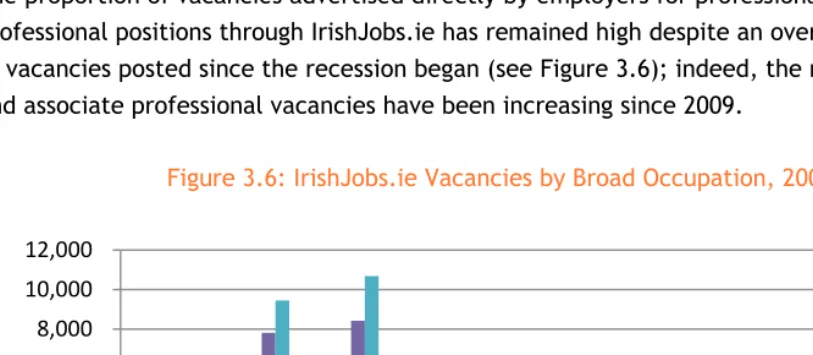
The proportion of vacancies advertised directly by employers for professionals and associate professional positions through IrishJobs.ie has remained high despite an overall drop in the number of vacancies posted since the recession began (see Figure 3.6); indeed, the numbers of professional and associate professional vacancies have been increasing since 2009.
Figure 3.6: IrishJobs.ie Vacancies by Broad Occupation, 2008-2012
Source: IrishJobs.ie
200 400 600 800 1,000 1,200 1,400
2010 2011 2012
2,000 4,000 6,000 8,000 10,000 12,000
[image:19.729.96.503.540.717.2]DSP/FÁS Jobs Ireland has a large share of vacancies for associate professionals (primarily sales related) and elementary occupations (Figure 3.7). The peak observed in admin/secretarial vacancies in 2010 is related to positions for Census enumerators, while the peak in vacancies for personal services in 2011 was due to a surge in notifications for care workers primarily by one company.
Figure 3.7: DSP/FÁS Jobs Ireland Vacancies by Broad Occupation, 2009-2012
Source: DSP/FÁS Jobs Ireland
While the overall number of employment permits has been in decline, the number of employment permits for professionals has increased significantly since 2010, reaching over 1,700 permits in 2012 (Figure 3.8); their share has also increased in this time period from 36% in 2010 to 59% in 2012. Over the same period the share of employment permits for elementary occupations fell by twelve percentage points, accounting for just a 5% share in 2012.
Figure 3.8: Employment Permits by Broad Occupation, 2010-2012
2,000 4,000 6,000 8,000 10,000 12,000 14,000 16,000
2009 2010 2011 2012
200 400 600 800 1,000 1,200 1,400 1,600 1,800
[image:20.729.87.503.521.744.2]Source: DJEI
Occupations and job titles
Vacancies notified to IrishJobs.ie and DSP/FÁS Jobs Ireland combined were most frequent for
Sales and related occupations
business associate professionals (e.g. sales accounts and business development managers, business sales executives, marketing associate professionals)
sales occupations (e.g. field sales agents, retail sales assistants)
customer service occupations
Science and engineering professionals
IT professionals (e.g. programmers and software developers, IT business analysts, web designers, IT specialist managers)
design and development engineers
process engineers
Business professionals (e.g. financial project management professionals, chartered
accountants, management consultants and business analysts, regulatory professionals, quality control professionals)
Administrative occupations (e.g. book-keepers, payroll clerks, financial clerks)
Caring personal services
care workers
nursing assistants
Catering occupations
chefs
waiters
kitchen/catering assistants
Science and engineering associate professionals
IT associate professionals (e.g. IT operation technicians, IT user support technicians)
engineering technicians
laboratory technicians
Corporate managers and directors (e.g. production managers in manufacturing, managers in warehousing, HR managers, financial managers, retail managers, purchasing managers).
A requirement for language skills was also frequently cited, particularly for associate professional positions. German was the most frequently mentioned language required, followed by French, Italian, Spanish and Dutch.
4 Managerial
Occupations
Managerial occupations accounted for 2% of all notified vacancies to DSP/FÁS Jobs Ireland and 7% of vacancies notified to IrishJobs.ie in 2012
The number of notifications for
managerial occupations to both DSP/FÁS Jobs Ireland and IrishJobs.ie saw a slight increase between 2011 and 2012
Vacancies were most common in the IT sector, retail and sales; combined these sectors accounted for almost a third of all notified managerial vacancies to
IrishJobs.ie
The Job Search analysis of the CSO’s QNHS data indicates that in the first quarter of 2012, unemployed managers were marginally more likely to contact a public employment office (56%) than a private employment agency (48%) when searching for a job
[image:23.729.71.524.131.461.2]Figure 4.1 DSP/FÁS Jobs Ireland Vacancies 2012
Figure 4.2 IrishJobs.ie Vacancies 2012
.
Job Titles:
Vacancies for managerial positions were most frequent for the following job titles:
Operations managers across all sectors
Services managers in banking, retail and hotel and catering
HR managers
Financial managers
Sales and marketing managers
Skills
Language skills were required for a number of managerial positions including German, French, Dutch, Swedish and Norwegian, while a high level of experience was a key requirement for many posts advertised.
2%
Managers
Others
7%
Managers
Education
Of those who stated an education requirement7, 49% stated no minimum level was required (the highest share of all occupational groups); a further 27% of vacancies required a third level degree qualification. This significant variation in levels of education required is due to the large disparity between managerial occupations from chief executives of large companies to managers of a coffee shop.
Figure 4.3 Level of Education Required
Source: IrishJobs.ie
Experience
Although a high level of education was not always a requirement for managerial positions, of those vacancies which specified a level of experience8, 61% required 2-6 years’ experience and a further 22% required at least six years of experience.
Figure 4.4 Level of Experience Required
Source: IrishJobs.ie
Difficult to Fill Vacancies
While relatively limited, some difficult to fill vacancies were reported for managers in the Recruitment Agency Survey conducted in October 2012 in the following specific niche areas:
Financial managers and directors (for roles in financial services e.g. business takeover and M&A, client relationship, etc.)
7 61% of managerial vacancies stated a level of education required 8 43% of managerial vacancies stated a level of experience required
49%
6% 6% 27%
3% 9%
No min required
Junior/Leaving Cert/ Trade
3rd Level Cert/Diploma
3rd Level Degree
Postgraduate qualification
Part/Professional Qualification
5%
12%
61%
22% No minimum required
0-2 Years
2-6 Years
Purchasing managers and directors (procurement and global supply chain roles)
Marketing and sales directors (for senior roles in business-to-business sales in IT and biopharma)
Managers and directors in retail and wholesale (agri-food related activities)
Vacancies filled with non EEA workers
In 2012 approximately 200 new permits were issued for managerial occupations accounting for 7% of all employment permits issued (a similar share to that of 2011)
Almost a half of permits issued to managers were for intra-company transfers (accounting for a quarter of all intra-company transfer permits issued in 2012) in sectors including manufacturing, IT and services; a further third were green cards, primarily in services and financial services
USA nationals accounted for almost 42% of all new managerial permits issued
Occupations most often cited include:
Chief executives/vice presidents
Financial managers/directors
Marketing and sales directors.
Figure 4.5 Employment Permits 2012
Source: DJEI
Figure 4.6 Employment Permits by Type 2012
Job Announcements
There were few specific job announcements for managers in 2012; those mentioned were mainly in manufacturing (medical devices), finance (senior management roles, project management) and ICT (non-technical management roles). Typical roles announced were for senior managers with some also specifying supply chain management or multilingual skills. Positions for manager occupations are also implicit in other job creation announcements, particularly where large numbers were involved, e.g. contact centres (customer service, sales and marketing).
7%
Managers
Others
31%
46% 18%
5%
Green cards
Intra-company transfers
Employment Permits
5 Professionals
Professional occupations accounted for 6% of all notified vacancies to DSP/FÁS Jobs Ireland and 30% of vacancies notified to IrishJobs.ie in 2012
While the number of professional vacancies notified to DSP/FÁS Jobs Ireland remained steady in 2012, notifications to IrishJobs.ie saw an increase in 2012, peaking in the second quarter at almost 900 professional vacancies notified each month
IrishJobs.ie vacancies were primarily in the IT sector with over a 40% share, followed by business and financial services along with science and engineering occupations
Unemployed persons previously employed in professional occupations were the only group who were more likely to contact a private employment agency than a public employment office as shown in the Job Search analysis of the CSO’s QNHS data
[image:27.729.85.431.136.492.2]Figure 5.1 DSP/FÁS Jobs Ireland Vacancies 2012
Figure 5.2 IrishJobs.ie Vacancies 2012
.
Job Titles:
IT professionals: with over 40% of all vacancies for professionals, IT occupations advertised included: Programmers and software developers in client/application development (C#, C++, Java, PHP,
ASP, VB, Python), database/enterprise development (Oracle, SQL Server, DB2, SAP, Informatica) and operating systems (UNIX, Windows Servers)
IT business analysts, architects and systems designers (in areas such as cloud computing, platform and user operations, Agile Focus)
Network engineers (e.g. Cisco) and test engineers
IT project managers (e.g. for desktop/helpdesk support, business systems, service delivery)
Engineers and Scientists
Process engineers were one of the most cited engineering professional vacancies in areas including chemical, manufacturing, food, mechanical and validation
Product development and design engineers (electrical, electronics, mechanical, process automation, R&D)
6%
Professionals
Others
30%
Professionals
Technologists (food, process, product development, technical solutions)
Scientists: chemical scientists (e.g. analytical, nutritional, process, regulatory, validation); biological scientists (e.g. microbiology, biostatisticians); R&D scientist
Business and Finance professionals
Chartered accountants (e.g. corporate finance, financial accountant, management accountants)
Management consultants and business analysts (e.g. funds industry, banking, SAP), including risk (mostly operational) analysts and actuaries
Business professionals (project management, compliance and risk management)
Health professionals: these accounted for 5% of all professional vacancies advertised on IrishJobs.ie. Job titles include:
Nurses (e.g. clinical, theatre and staff nurses), doctors, clinical psychologists, pharmacists,
radiographers, therapists (occupational, speech and language), other healthcare professionals
(e.g. dietician).
Skills
Many vacancies, including those for occupations such as business analysts, account managers and technical support engineers positions, required language skills in German, French, Italian, Spanish and to a lesser extent Dutch, Danish and Russian.
Education
Of those who stated an education requirement9, 61% of vacancies stated a minimum of a third level degree qualification, the highest share for any of the occupational groups. A further 20% of
vacancies required postgraduate qualifications while 9% required part- or professional qualifications (including for accountancy roles).
Figure 5.3 Level of Education Required
Source: IrishJobs.ie
9 63% of vacancies for professional occupations stated a level of education required. 20%
1% 5%
61% 4%
9%
No Minimum required
Junior/Leaving Cert/ Trade
3rd Level Cert/Diploma
3rd Level Degree
Postgraduate qualification
Experience
Of those who stated a minimum level of experience required10, 84% stated at least 2 years’ experience was required, the highest levels alongside managers.
Figure 5.4 Level of Experience Required
Source: IrishJobs.ie
Difficult to Fill Vacancies
The October 2012 Recruitment Agency Survey found that professionals accounted for the largest segment of difficult to fill vacancies. Within this occupational grouping, the following occupations were identified as difficult to source:
Information technology and telecommunication professionals:
programmers and software developers (accounting for a quarter of all difficult to fill mentions) with specific skill sets such as Java, C++, Summit, .NET, C Sharp, PHP, CSS, VBS, Interactive visual applications (e.g. 3D imaging for gaming industry), those proficient in open source software/operating systems (e.g. Linux) and applications (e.g. Ruby on Rails and Flex); IT skills associated with cloud computing (e.g. expertise in Java related applications and the migration of CRS / CRM application to web based or cloud computing architecture) and financial/business application skills (e.g. SAP analysts)
IT business analysts, architects and system designers (e.g. Oracle and SQL developers)
web development professionals (including Webpress programmers)
Engineering professionals – these skills accounted for approximately 16% of difficult to fill mentions; particularly in demand were:
process and production engineers (lean production, process automation and system control and associated skills e.g. Six Sigma); quality assurance, validation, and regulatory (standard) compliance
design and development engineers including R&D engineers (e.g. for the medical devices industry)
10 52% of professional vacancies stated a level of experience required. 2%
14%
69%
15% No minimum required
0-2 Years
2-6 Years
electronic engineers - mobile telephony developers (e.g. android mobile telephone technology, engineers with PCB (printed circuit boards) skills, HTML5 mark-up language, Smartphone Mobile Apps such as Objective-C 2.0, Objective C J2ME /Java ME -Java platform designed for embedded systems such as mobile devices, etc.)
electrical engineers (wind energy engineers and power generation and transformation/high tension and substation power engineers with experience)
Scientists (natural and social science professionals): demand mostly stemmed from biopharma offering opportunities for chemists (e.g. product formulation, analytical development, and chemical process engineering and production process planning)
Healthcare professionals:
medical doctors (e.g. non-consultant hospital doctors - registrars, Senior House Officers)
radiographers (e.g. MRI radiographers, CT radiographers, and sonographers)
nurses: nursing clinical managers, advanced nursing practitioners in specialised areas such as intensive care and theatre nursing; demand also exists for geriatric/older people care nursing posts in private nursing homes
Speech and language therapists
Business Professionals:
chartered and certified accountants and taxation experts, i.e. accountants with experience in financial services, solvency, auditing, regulatory compliance (e.g. financial regulation skills such as Dodd-Frank compliance, etc.)
management accountants and auditors
actuarial specialist, risk and credit risk analysts
business and financial project management professionals – demand persists for those possessing a set of specialised skills such as SAP business analysts with relevant industry knowledge, business analysts with in-depth knowledge of financial investment markets, data analysts with business intelligence related skills, etc.
Vacancies filled with non EEA workers
In 2012 professional occupations accounted for 59% of all new permits issued; this is an increase of 12 percentage points on 2011
While the share of new permits issued for occupations in the healthcare11 and manufacturing sectors declined year on year, increases occurred for occupations in the services and IT sectors; the IT sector accounted for 59% of all new permits issued for professional occupations
Of all new permits issued for professional occupations in 2012, 49% were for green cards, primarily in the IT sector; indeed professional occupations accounted for over four fifths of all green cards issued
Those from India accounted for over half of new permits issued in 2012 (up nine percentage points on 2011)
11Since 2010 doctors can enter the Irish labour market through channels other than the employment permit scheme thus
Occupations most often cited include:
Programmers and software developers (e.g. analyst, application developer, software/systems engineer)
IT computer systems analysts/architects
Network engineer
Medical interns and nurses.
Figure 5.5 Employment Permits 2012
Source: DJEI
Figure 5.6 Employment Permits by Type 2012
Job Announcements
A significant share of the job creation announcements in the media during 2012 were for professional positions. Most of the job announcements were in the IT, medical devices,
pharmaceutical sectors, and to a lesser extent, green technology. The demand for professionals was particularly strong for
Software engineers and developers, test engineers, database architects, systems engineers, support engineers and network engineers; the positions were in research and development centres, cloud computing, e-commerce and electronic payments, online sales, marketing and advertising, mobile (e.g. tablet computers), internet and social media technologies and, to a lesser extent, IT for specialised sectors (e.g. healthcare or manufacturing management solutions).
Research & development engineers and scientists (especially medical devices, food processing)
Regulatory and quality assurance professionals (pharmaceuticals and IT)
Electrical/electronic engineers (green energy and smart power generation; semiconductors)
Production/industrial engineers (pharmaceuticals, medical devices, food processing)
Life scientists, chemical/biochemical scientists and operation research scientists
59% Professionals
Others
49%
11% 36%
4%
Green cards
Intra-company transfers
Employment Permits
Some temporary jobs will be created for construction professionals (civil engineers, quantity surveyors, construction project managers) in projects associated with the expansion of plants and building of new premises
Business analysts/ enterprise risk analysts
Finance, accounting and tax experts (IT, consulting, financial and manufacturing)
Supply chain, programme and change management consultants.
Many of the positions specified high skilled, senior roles, although there were also some job creation announcements for graduate position recruitment. The majority of announcements were for 50 positions or less.
Job creation for professional occupations is also confirmed by the jobs announced by IDA client companies in 2012; these roles are predominantly in the IT, pharmaceuticals and medical devices sectors and mainly for roles in IT (software/R&D developers, IT managers), followed by
engineers/scientists (including R&D), business professionals (e.g. accountants), and quality and regulatory professionals.
6. Associate Professionals & Technical Occupations
Associate professional/technical occupations accounted for 21% of all notified vacancies to DSP/FÁS Jobs Ireland and 33% of vacancies notified to IrishJobs.ie in 2012
While associate professional/technical vacancies notified to DSP/FÁS Jobs Ireland saw a slight increase in 2012, notifications to IrishJobs.ie for this occupational grouping increased by 25%
Vacancies were primarily in sales, IT, science, pharmaceuticals and food, marketing and financial services
[image:33.729.67.281.143.453.2] The Job Search analysis of the CSO’s QNHS data indicates that in the first quarter of 2012, unemployed associate professionals were more likely to contact a public employment office (52%) than a private employment agency (43%) when searching for a job
Figure 6.1 DSP/FÁS Jobs Ireland Vacancies 2012
Figure 6.2 IrishJobs.ie Vacancies 2012
Job Titles:
Vacancies for associate professionals were most frequent for
Business associate professionals accounted for the largest number of vacancies in this occupational group with the majority of jobs requiring language skills. Job titles include:
multilingual inside12/advertising sales representatives (Danish, Finnish, German, Swedish, French) in IT, pharmaceuticals, and medical devices
multilingual customer account managers including on line sales accounts (Dutch, German, French, Spanish, Danish, Hebrew, Russian, Norwegian etc.)
marketing managers (e.g. brand, product)
multilingual business development executives (sales development), claims officers, collection agents, fraud analysts
financial analysts, credit, pricing, transfer agency
human resources specialists
buyers and procurement officers (supply chain specialist)
compliance officers
12 Inside sales representatives work in-house, often in contact centres.
21%
Associate Professionals
Others
33%
Associate Professionals
Science, engineering and technology technicians:
IT technical support for clients, compliance, applications and databases primarily with language skills (German, Danish, Finnish, Norwegian, Swedish, French, Spanish etc.), systems/network administration
laboratory technicians (microbiology, metrology, medical, chemistry, quality control, pharmaceutical)
engineering technicians (electrical, electronic, manufacturing, mechanical, process, quality control)
Vocational trainers (healthcare, social science, career guidance, health and safety, IT etc.)
Interpreters.
There were also a number of vacancies for performing artists (actors/directors) associated with activity in the domestic and foreign film industry in Ireland.
Skills
Language skill requirements were predominant in vacancies for associate professionals. Foreign language skills, particularly German, Nordic languages and French were required for roles in IT technical support, business analysts, risk management, claims and collections; the languages most in demand were German and French, but other European languages were also required. Other skills in demand included:
e-business, business-to-business (B2B) sales and marketing skills, often combined with languages
a driving licence (B licence) for sales roles across a variety of sectors (e.g. energy, security, IT installation, etc.).
Education
Of those who stated an education requirement13, 39% stated a minimum of a third level degree qualification while an almost equal share (37%) stated no minimum education level was required.
Figure 6.3 Level of Education Required
Source: IrishJobs.ie
13 60% of associate professional vacancies stated a level of education required. 39%
6% 9% 37%
1% 8%
No Minimum required
Junior/Leaving Cert/ Trade
3rd Level Cert/Diploma
3rd Level Degree
Postgraduate qualification
Experience
Of those who stated a level of experience required14, 28% stated either no minimum level or 0-2 years was required while almost two thirds required 2-6 years’ experience.
Figure 6.4 Level of Experience Required
Source: IrishJobs.ie
Difficult to Fill Vacancies
Associate professional skills stated as being difficult to source in the October 2012 Recruitment Agency Survey were mainly for:
science, engineering and production technicians (quality assurance and validation)
information technology technicians (IT operations and IT user support technicians)
sales, marketing and related associate professionals (business sales executives, technical sales representatives for the medical device industry)
health associate professionals (cardiac technicians)
Vacancies filled with non EEA workers
In 2012 approximately 400 new permits were issued for associate professional/technical occupations, accounting for 14% of all employment permits issued (a decline of 20% on the previous year)
Permits issued to the IT sector accounted for over a third of associate professional permits issued; services, financial services and the sports sector accounted for a further 46% combined
Of all associate professional new permits issued in 2012, 22% were for green cards, while 51% were employment permits
Those issued with employment permits for associate professional positions were most likely to come from the USA and India (combined accounting for 42% of all permits issued in this category)
Occupations most often cited include:
IT technicians
14 42% of associate professional vacancies stated a level of experience required. 4%
24%
65% 7%
No minimum required
0-2 Years
2-6 Years
Business/finance associate professionals (e.g. account strategist, finance/tax analysts)
Sales and marketing (e.g. business development, online sales/media)
Figure 6.5 Employment Permits 2012
Source: DJEI
Figure 6.6 Employment Permits by Type 2012
Job Announcements
At associate professional level, job creation announcements were chiefly for roles in
IT technical support, including multilingual (across a range of sectors, including business and financial software support and gaming)
business associate professionals (financial services, asset management, investment management)
business sales and marketing (sales accounts and business development, and buyers and procurement officers)
A minority of job announcements related to the creation of graduate positions.
Job creation for associate professional occupations is also confirmed by the jobs announced by IDA client companies in 2012; sectors in which these roles are expected to occur include IT (especially for IT support technicians), finance and insurance (e.g. financial advisors, fund accountants), and high-tech manufacturing (engineering/science technicians).
14%
Associate Professionals
Others
22%
18% 51%
9% Green cards
Intra-company transfers
Employment Permits
7. Administrative and Secretarial Occupations
Administrative/secretarial occupations accounted for 6% of all notified vacancies to DSP/FÁS Jobs Ireland and 11% of vacancies notified to IrishJobs.ie in 2012
Vacancies for administrative/secretarial occupations through DSP/FÁS Jobs Ireland have remained steady in recent years apart from a significant jump in 2010 related to Census enumerators; vacancies advertised through IrishJobs.ie have seen an increase on 2011 in line with an overall increase in vacancy notifications
Vacancies were primarily in the finance, banking, accountancy, and
secretarial/admin sectors
[image:37.729.68.281.178.531.2] The Job Search analysis of the CSO’s QNHS data indicates that in the first quarter of 2012, those previously employed in administrative/secretarial jobs were more likely to contact a public employment office (52%) than a private employment agency (45%) when searching for a job.
Figure 7.1 DSP/FÁS Jobs Ireland Vacancies 2012
Figure 7.2 IrishJobs.ie Vacancies 2012
.
Job Titles:
Administrative and secretarial vacancies were most frequent for
administrative positions in finance:
accounts payable/receivable clerks
financial administration clerks
payroll clerks
multilingual credit controllers (e.g. French, Spanish, Italian)
cost/fund accountants
claims administrators (e.g. in motor industry, pensions and personal injury)
receptionists
property management admin/holiday home inspectors
6%
Clerical
Others
11%
Clerical
personal assistants
administrative positions in logistics and distribution:
freight clerks (air, ship and road; freight forwarding)
purchasing administration, stock controllers, warehouse operatives
logistics co-ordinators
Skills
Language skills including German, French, Spanish and Dutch were frequently cited as a requirement for accounts payable, credit analysts, payroll, credit control, financial accounts assistants and sales support roles. Part professional or professional qualifications were required for a significant number of jobs in the areas of accountancy and finance. A driving licence was required for holiday home inspectors.
Education
Of those who stated an education requirement15, 43% stated a minimum of a third level qualification (as compared to 70% for professional vacancies). This occupational group had the highest share of vacancies requiring a part/professional qualification at 13% (for accounting related positions).
Figure 7.3 Level of Education Required
Source: IrishJobs.ie
Experience
Of those who stated a minimum level of experience required16, 39% stated either no minimum level was required or 0-2 years of experience. The majority of positions (58%) required 2-6 years’ experience. Only a very small share required over six years’ experience.
15 59% of vacancies for administrative occupations stated a level of education required. 16 52% of administrative vacancies stated a level of experience required.
30%
14% 12% 30% 1%
13%
No Minimum required
Junior/Leaving Cert/ Trade
3rd Level Cert/Diploma
3rd Level Degree
Postgraduate qualification
Figure 7.4 Level of Experience Required
Source: IrishJobs.ie
Difficult to Fill Vacancies
Administrative occupations that were reported as being difficult to fill in the Recruitment Agency Survey in October 2012 were limited to the following:
administrative roles in finance (e.g. accounts clerks with languages, including multilingual candidates for positions in areas such as accounts payable, credit control and payroll)
other administrative occupations: niche administrative roles such as specialist roles in logistics/supply chain operations and sales administration.
Vacancies filled with non EEA workers
Administrative occupations did not feature strongly in the employment permit statistics in 2012, accounting for 2% of all permits issued
Job titles included:
Accounting and valuation administration staff
General accountant/administrator
Finance assistant
Almost a half of all permits issued were for spousal/dependent permits or intra-company transfers.
Figure 7.5 Employment Permits 2012
Source: DJEI
5%
34%
58% 3%
No minimum required
0-2 Years
2-6 Years
6+ Years
2%
Clerical
Job
Announcements
Job creation announcements for administrative occupations included those associated with office support for a range of sectors (e.g. retail, ICT, transport) as well as administrative roles in supply chain management, order management, finance, HR and accounts payable/receivable. While there were some job loss announcements for administrative roles, the losses were mainly related to retail bank clerks and insurance clerks.
8. Skilled Trades Occupations
Skilled trades accounted for 11% of all notified vacancies to DSP/FÁS Jobs Ireland and 5% of vacancies notified to IrishJobs.ie in 2012
While the number of vacancies for skilled tradespersons through the DSP/FÁS declined (6,100 compared to 7,300 in 2011), the share of vacancies notified to Irishjobs.ie rose by one percentage point year on year
In terms of sectors, vacancies most often occurred in the following sectors:
engineering, IT, hotel and catering, science, pharmaceutical and food
[image:41.729.80.327.139.472.2] The Job Search analysis of the CSO’s QNHS data indicates that in the first quarter of 2012, unemployed skilled tradespersons were more likely to contact a public employment office (56%) than a private employment agency (31%) when searching for a job.
Figure 8.1 DSP/FÁS Jobs Ireland Vacancies 2012
Figure 8.2 IrishJobs.ie Vacancies 2012
.
Job Titles:
Vacancies for skilled trades were most frequent for:
Chefs (over 40% of DSP/FÁS Jobs Ireland vacancies were for this occupational group)
Mechanics (NCT testers, HGV, motor)
Fitters (maintenance, construction plant, mechanical, mobile service)
Butchers/Deboners
Welders (stainless steel, Tig17, fabricator, pipe fitter, butt fusion18)
Electrical and electronic trades (electricians, engineers (Commissioning & Qualification(C&Q), computerised system validation (CSV), network, IT, security))
Skills
Vacancies for mechanics stipulated a variety of driving licences required, while electricians and welders were often required to have a B licence.
17Tungsten Inert Gas welding
18 Butt fusion is a type of hot plate welding which is used to make pipe end to end joints
11%
Skilled Trades
Others
5%
Skilled Trades
Education
As vacancies for skilled trades occupations are typically advertised through DSP/FÁS Jobs Ireland, Irishjobs.ie data is unlikely to capture a representative share of vacancies in this occupational group. Nonetheless, as education data is not available for DSP/FÁS Jobs Ireland vacancies, a tentative analysis on the education level required for skilled trades vacancies advertised through Irishjobs.ie is presented in Figure 8.3. As 37% of IrishJobs.ie vacancies did not state a level of education required the data refers to approximately 10% of the overall skilled trades vacancies analysed in this report.
Almost 40% of these vacancies required at least a third level degree, indicating that demand for skilled trade persons may be encroaching on what has been traditionally regarded as technician level work, particularly as the majority of those vacancies which required a third level degree were in the area of engineering.
Figure 8.3 Level of Education Required
Source: IrishJobs.ie
Experience
As DSP/FÁS Jobs Ireland accounted for approximately 80% of the skilled trades’ vacancies examined, the level of experience required is based on the data available from this source. Over half of all vacancies required fully experienced individuals; along with managers this occupation had the highest share of vacancies with a requirement for fully experienced staff.
Figure 8.4 Level of Experience Required
Source: DSP/FÁS Jobs Ireland
25%
19%
7% 39% 1%
9%
No Minimum required
Junior/Leaving Cert/ Trade
3rd Level Cert/Diploma
3rd Level Degree
Postgraduate qualification
Part/Professional Qualification
3% 5%
37% 55%
Not Stated
No Minimum
Some Experience
Difficult to Fill Vacancies
While in general there remains an oversupply of skilled tradespersons, the Recruitment Agency Survey in October 2012 reported difficulties in filling certain posts in, namely for:
Food preparation and hospitality trades (limited to butcher/deboners and chefs), and
Skilled metal, electrical and electronic trades (limited to welding trades).
Vacancies filled with non EEA workers
In 2012 over 150 employment permits were issued for skilled trades occupations; this is a decline of almost 80 on 2011
The significant decline in the number of employment permits issued for skilled trades
occupations was primarily related to a fall-off in the number of permits issued in the catering sector
Despite this, the catering sector still accounted for almost two thirds of the permits issued for this occupational group; a further fifth were in agriculture and fisheries
Chefs accounted for over 60% of permits issued for this occupational group in 2012; while the share increased the overall number of permits issued for chefs declined slightly since 2011
Occupations include:
Chefs
Butchers.
Figure 8.5 Employment Permits 2012
Source: DJEI
Figure 8.6 Employment Permits by Type 2012
Job Announcements
There were a number of job creation announcements for the skilled trades in construction. Almost all the posts were temporary positions and associated with the new building or expansion of
manufacturing facilities in sectors such as pharmaceuticals, food/beverages and retail. Other skilled trades include butchers/fish mongers for job creation announcements in the food processing field and a small number of chefs and cooks for a limited number of new restaurants.
6%
Skilled Trades
Others
13%
83% 4%
Spousal/Dependant
Employment Permits
9. Caring, Leisure and Other Services Occupations
Vacancies for caring, leisure and other services occupations were most likely to be notified through DSP/FÁS Jobs Ireland, accounting for 16% of all DSP/FÁS Jobs Ireland vacancies
A 35% drop in the number of caring, leisure and other services vacancies occurred between 2011 and 2012 for DSP/FÁS Jobs Ireland
In terms of sectors, vacancies most often occurred in the healthcare sector
[image:44.729.61.543.126.463.2] The Job Search analysis of the CSO’s QNHS data indicates that in the first quarter of 2012, public employment offices were the most likely route through which unemployed caring, leisure and other service persons would search for a job.
[image:44.729.68.285.139.426.2]Figure 9.1 DSP/FÁS Jobs Ireland Vacancies 2012
Figure 9.2 IrishJobs.ie Vacancies 2012
.
Job Titles:
Vacancies for caring, leisure and other service occupations were most frequent for:
Care workers and home carers (accounting for over 55% of DSP/FÁS Jobs Ireland vacancies for this occupational group and almost 10% of total DSP/FÁS Jobs Ireland vacancies); three quarters of these vacancies were for part time positions
Healthcare assistants
Barbers/hairdressers
Childcare workers
Beautician/nail technician/spa therapists
Housekeepers/accommodation assistants.
Education
There is insufficient data available through IrishJobs.ie vacancies to provide a meaningful analysis of the levels of education required for this occupational group.
16%
Caring, leisure and other services
Others
2%
Experience
Vacancies advertised for caring occupations through DSP/FÁS Jobs Ireland accounted for 95% of the overall vacancies analysed for this occupational group and is therefore used to examine the level of experience required. Almost two thirds of vacancies advertised by DSP/FÁS Jobs Ireland for caring occupations required some experience with a further 22% requiring candidates to be fully
experienced.
Figure 9.3 Level of Education Required
Source: DSP/FÁS Jobs Ireland
Difficult to Fill Vacancies
Difficult to fill mentions in the Recruitment Agency Survey in October 2012 were limited to caring workers mostly in the area of older persons’ care (health care assistants/home carers).
Vacancies filled with non EEA workers
In 2012 130 employment permits were issued for caring, leisure and other services occupations; this is a decline of approximately 60% on 2011
This decline is primarily due to a drop in the number of permits issued to the healthcare sector for this occupational group; this sector accounts for over two thirds of all new caring, leisure and other services permits issued
Permits issued to spousal/dependants accounted for 72% of all caring, leisure and other services permits issued in 2012
Permits were most often issued to persons from India and the Philippines
Occupations include:
Care assistants
Childcare workers.
8% 9%
61% 22%
Not Stated
No Minimum
Some Experience
Figure 9.5 Employment Permits 2012
Source: DJEI
Figure 9.6 Employment Permits by Type 2012
Job Announcements
There were few job creation announcements for caring, leisure and other services occupations, with the exception of home carers and care assistant positions for appropriately qualified personnel (FETAC level 5 or equivalent).
4%
Caring, leisure and other services
Others
72% 28%
Spousal/Dependant