115
Chapter 16
Designing Direct Current Electric Circuit for Foster Creative Thinking
Eko Hari Tiarto1,a
1
Magister of Physics Education Department, University of Lampung, Lampung, Indonesia
a
Abstract. This paper aim to produce a design of direct current electric circuit teaching aid for foster creative
thinking. The indicator of Creative thinking skill that measured is solving problem with different way. This study is research and development with instructional development model Four-D, but report in this study only until stage design direct current electric circuit. Consider from literature study identified that direct current electric circuit teaching aid from materials that are available in electronic store was needed for foster student’s creative thinking. And then, produced a design of direct current electric circuit teaching aid with instruction to foster creative thinking.
Keywords: Teaching Aid, Electric Circuit, Creative thinking
I. Introduction
Physics is a part of science. Science is a problem solving activity conducted by humans who are motivated by a curiosity about the world around them and a desire to understand that world, or by a desire to manipulate the world in order to satisfy other wants or needs, or by both of these[2]. Based on this definition, science is a activity to solve a problem. In this case, the problem is everything that relates to daily nature phenomena.
Physics gives knowledge to students, and then the purpose of physics learning in school is a place to grow thinking skill and for solving problem in daily life. Physics learning in school need teach students for more specific purpose to give supply of knowledge, comprehension, and several skills to students that required for entering the more high level education along with developing science and technology. Physics learning was thought with scientific inquiry to grow thinking skill, work, scientific attitude, and communicate as one of life skill[6].
Creativity is the ability of someone to bring up something new, including idea and real work, produce a new thing or combined with things which already exist to produce a new thing that different from the previous. Creative thinking skill is required in making an innovation .Of course, to make students have creative thinking skill, students need to be familiar in solving the problems by creative way.
Someone can solve a problem with unusual way and easier to solve if he or her is creative. Creativity is the greatest gift of human intelligence. If the world becomes more complex, more creative we need to be to meet its challenges
[10]
116
Creative thinking provides looking into to events from different perspectives, suggesting multi choice solutions to problems. Creative thinking has four dimensions: Fluency (generating a large number of ideas), flexibility (generating ideas of different categories or approaches), novelty (generating unusual or rare ideas) and elaboration (generating ideas in detail)[10]. Teacher need to be creative in developing lab course as effort to develop student’s creative thinking skill[15].Teacher has task to develop student’s creative thinking skill, of course, there are many ways to develop student’s creative thinking skill, one of it is doing lab course, with a certain way/procedure to foster creative thinking.
Problems appear when going to do Physics lab course in the school is unavailability of adequate facilities and infrastructure. Based on the observations that made by the researchers, note that the physics teaching aid is very inadequate. These condition has an impact on the activities of the Physics lab course is done very rarely. The second factor is that teachers who are less skilled in making a good practical guide. Teachers only use existing practical guidance from the book or from the internet. Results from other studies, it also shows that teachers are not optimal in designing and conducting physics lab course[14].
Physics course about direct current electric circuits commonly done with lectures methods and teacher center, and then electric current concepts are abstract and have high complexity, so it require a media in imparting these concepts in students[4]. Physics course about direct current electric circuits need to be taught with a media and also the practical lab course to make it more meaningful. Students only arrange electrical circuit according with the existing instruction on the practical guide or student’s work sheets when arrange electric circuit activities. the electrical circuit that required to arrange was an usual series or parallel circuit.
The aim of this research is to produce a design of direct current electric circuit teaching aid to foster student’s creative thinking skill. Creative thinking skill has some indicators, but in this study the indicators that will measured is the ability to solve unusual problems. Ability to solve unusual problems revealed by student’s practice in constructing direct current electric circuits with complex problems and can be solved in several ways.
II. Method
This research is a research and development with instructional development model Four-D developed by Thiagarajan et al[13]with the stages are Define, Design, Develop, and Disseminate. However, this research only until the stage Design teaching aid of direct current electric circuit. Teaching aid that developed with materials that are available in electronic stores. Direct current electric circuits teaching aid also carried an instruction to practical lab course.
III. Results and Discussions
A. Define
117
Based on analysis that conducted to identify the problems in direct current electrical circuit physics course material is material is highly abstract and complex[8][12]. Concepts in electricity are invisible or cannot be seen, and it’s difficult to learn and implemented in real life. A lot of students difficult in understanding electricity concepts, mainly on electric circuit. Because it required analogy and appropriate learning model[9]. In addition, students difficult to understanding the image of direct current electric circuit[3]. The purpose of the image and image of direct current electrical circuit made students difficult to interpret it[5]. Student’s misconception on electric circuit are also becoming a problem in study of learning material in direct current electric circuit[16].
Learn by exploring, questioning, experimenting, manipulating, arrange things, testing, and modify the idea or solution tends to be preferred by many people. Students will be motivated to learn if they are allowed to use their creative thinking skills and their creative ways in processing information for acquiring knowledge and skills[7].
After the researcher analyze on existing standard teaching aid at school revealed that students difficult to associate electric current image with it. Students difficult to arrange circuit with using 216 holes construct circuit board. Because in electric circuit image of using wires, while if using 216 holes construct circuit board need connector to connected the holes. The principle is same, but it takes lot of time for students to get accustomed to using it.
Creative thinking skill can be supported by doing some activity like moving in different way, unusual solutions to problems, exploring alternative and unusual solutions to problems ,and improvising with common objects in the Environment[11]. These activities are added to practical lab course to foster student’s creative thinking.
B. Design
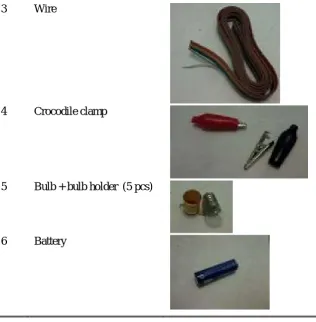
Based on analyze that held, and then researcher designing DC electric current with materials are:
TABLE I
MATERIALS No Material Picture 1 Battery holder AA
118
3 Wire
4 Crocodile clamp
5 Bulb + bulb holder (5 pcs)
6 Battery
Tools and materials are available at an electronics store. Tools and materials were selected because of the tools and materials are easier to associate with electric circuit image. The advantages of these teahing aid are the material is cheap and easy to associate with electric circuit image. Then these materials can be done the following practical lab activities:
1. OHM's law and Kirchhoff’s law practical lab course
[image:4.595.147.464.45.368.2]Students make a small group with 5 or 6 member. Teacher give a worksheet that outlines the purpose and the table only to write down the observations. Then students need to think and write down the procedure with accompanied by a teacher. And then, students done the practical lab activities and discussion the conclusions based on results of practical lab course.
2. Problem that students must solved
Teachers give the problems of parallel and series circuit which need to be completed by students. Student and the members of his/her group must solve the problem. Here the following example of the problem:
a) Make a circuit with four bulbs, with the condition are one bulb lit brighter than the two bulbs that lit with the same brightness and one bulb not lit.
b) Make a circuit with five bulbs, with the condition are three bulbs on the same brightness and two bulb not lit up.
119
3. Make electric circuit based on image that drawn by teacher
Teacher can make a problem that students must make series and parallel according the condition that given by teacher. Students will make several type of circuit, and then teacher need to made performance assessment and instrument of creative thinking skill for asses circuit which made by students.
IV. Conclusions
Based on literature study was identified problem that direct current electric circuit teaching aid was needed direct current electric circuit teaching aid from materials that are available in electronic store was needed for foster creative thinking students. And then, produced a design of direct current electric circuit teaching aid with instruction to foster creative thinking. The benefit of this teaching aid are (1) the material is cheap, (2) foster creative thinking skill (3) easy to associate with electric circuit image.
References
[1]. M. Csikszentmihalyi, Creativity: flow and the psychology of discovery and invention. New York: Harper Collins, 1996, pp
[2]. Chris Dawson, Beginning Science Teaching. Longman Cheshire Pty Limited, 1994, pp 5
[3]. Paula Vetter Engelhardt and Robert J. Beichner, “Students’understanding of direct current resistive electrical circuits,”American Journal of Physics, vol 72, pp 98-115, January 2004. [DOI:
10.1119/1.1614813]
[4]. Muhammad A. Hasbi, Kosim, dan Gunawan, “Pengembangan Alat Peraga Listrik Dinamis (APLD) Berbasis Inkuiri Untuk Meningkatkan Penguasaan Konsep Siswa.”Jurnal Penelitian Pendidikan IPA (JPPIPA), vol 1, pp 57-67, 2015.
[5]. Samuel Johsua,‘‘Students’interpretation of simple electrical diagrams,’’Eur. J. Sci. Educ. 6, pp 271–
275, 1984.
[6]. Kemendikbud. Lampiran Permendikbud No. 59 Tahun 2014. Jakarta: Kemendikbud, 2014, pp 901. [7]. Anton E. Lawson, 1980 AETS Yearbook: The Psychology of Teaching for Thinking and Creativity.
Colombus: Clearinghouse for Science, Mathematics, and Environmental Education, 1979,pp [8]. P. Mulhall, B. MCKittrick, & R. Gunstone,“A perspective on the resolution of confusion in the
teaching of electricity,”Research in Science Education, vol 31, pp 575-587, 2001.
[doi:/10.1023/A:101315412537]
[9]. Mursalin.. MODEL REMEDIASI MISKONSEPSI MATERI RANGKAIAN LISTRIK DENGAN PENDEKATAN SIMULASI PhET, Jurnal Pendidikan Fisika Indonesia, vol 9, pp 1-7, 2013.
[10]. Ken Robinson, Out of Our Minds: Learning to be Creative (revised edition), UK: Capstone Publishing, 2011.
[11]. Canan L . Simsek & F. C. Kiyici, “Howmuch do science and technology lesson student studying books support creative thinking?”Procedia Social and Behaviour. Science , vol 2 pp 2105–2114, 2010. [DOI:10.1016/j.sbspro.2010.03.289]
[12]. S. K. Taber, T. Trafford, & Teresa Quail,“Conceptual resources for constructing the concepts of electricity: The role of models, analogies and imagination,”Physics Education, vol 41, pp 155-160,
2006. [doi:/10.1088/0031-9120/41/2/006]
[13]. S. Thiagarajan, D. S. Semmel, & M. I. Semmel, Instructional Development for Training Teachers of
Exceptional Children, Minneapolis, Minnesota: Leadership Training Institute/Special Education,
University of Minnesota, 1974.
120
[15]. H. S. Wattimena, A. Suhandi, & A. Setiawan, “Pengembangan Perangkat Perkuliahan Eksperimen Fisika Untuk Meningkatkan Kreativitas Mahasiswa Calon Guru Dalam Mendesain Kegiatan Praktikum Fisika di SMA,”Jurnal Pendidikan Fisika Indonesia, vol 10, pp 128-139, 2014. [DOI:
10.15294/jpfi.v10i2.3349]
[16]. Erdal Taşlıdere, “Effect of Conceptual Change Oriented Instruction on Students’Conceptual
Understanding and Decreasing Their Misconceptions in DC Electric Circuits,”Creative Education, vol