Sustainability Assessment (SA)
Table of contents
Executive Summary………..4
1 Introducing Sustainability Assessment (SA) ...6
1.1 Introduction...6
1.2 Background ...6
1.3 What is SA?...7
1.4 Benefits of SA...8
1.5 Links to Sustainable Development Policy Framework...8
1.6 Learning from Experience...9
1.7 Principles of Sustainability Assessment...11
2 Procedures for SA...12
2.1 Integrating with existing instruments ...12
2.2 Who will oversee the implementation of SA? ...12
2.3 Who will carry out individual SA?...12
2.4 When should an SA be required? ...13
2.5 When does the SA process begin?...13
3 Sustainability Criteria...14
3.1 Core Sustainability Criteria ...14
3.2 Additional Sustainability Criteria ...22
3.3 Policy Specific Criteria...22
3.4 Rules for selecting additional sustainability or policy specific criteria ...22
4 Conducting an SA: Pre Analysis...23
4.1 Description of Policy Context and Objectives...23
4.1.1 Policy Context...23
4.1.2 Statement of Objectives...23
4.2 Identification and Description of Options ...24
5 Impact Analysis of Options...26
5.1 Costs and Benefits ...26
5.1.1 Costs and Benefits...26
5.1.2 Risks and Uncertainty ...27
5.2 Impact Identification and Evaluation ...27
5.2.1 Impact Identification...27
5.2.2 Impact Evaluation ...30
5.3 Summarise key statements about impacts and determine sustainability...31
6 Comparison of Options ...34
7 Consultation...36
8 Publication……….37
9 Review ...38
Tables
Table 1 Comhar SDC Principles for Sustainable Development ...8
Table 2 Description of Sustainability Criteria……….16
Table 3 Identification of Impacts………..……….…...29
Table 4 SA Results (Policy Option 1) ...33
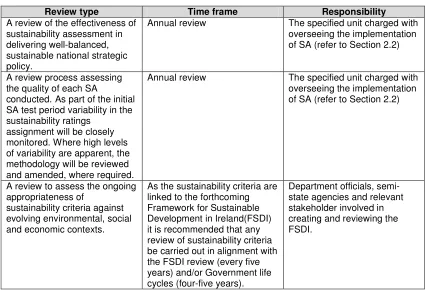
Table 5 SA Review Procedures ...38
Figures
Figure 1 SA Methodological Steps ...7Figure 2 Impact Assessment in Ireland ... …...10
Executive Summary
The establishment of a more sustainable pattern of development for Ireland is one of the key challenges for government and ultimately for society. It is widely accepted that economic growth, social cohesion and environmental protection are not mutually exclusive and so an integrated management approach based on sustainable development principles must be adopted. Sustainable Development: A Strategy for Ireland (1997), currently being revised, establishes the overarching framework for Ireland’s sustainable development. In addition, it is intended that the revised Framework for Sustainable Development in Ireland will make provision for Sustainable Development Indicator sets which will provide information on Ireland’s progress in achieving sustainable development. Within this policy context, the introduction of Sustainability Assessment (SA) would act as an additional supportive mechanism in progressing towards a more sustainable Ireland. SA is a comprehensive, methodical and targeted analysis of impacts for sustainable development of proposed initiatives. These guidelines present a methodological approach to carrying out SA in Ireland.
SA allows the identification of the short and long term impacts that policy proposals may have on sustainable development as well as a method by which to compare the impacts of different policy options. The assessment is carried out using sustainability criteria representing the three pillars of sustainable development; Environmental, Social and Economic. The framework for SA presented in this document has been designed for compatibility with existing impact assessment instruments in Ireland, principally the Regulatory Impact Assessment (RIA) system. It is envisaged that SA would develop over time to function as an integrated impact assessment instrument, embracing RIA and other impact assessment instruments. Comhar SDC recommends that SA should initially be carried out for proposals relating to national strategies and policies. For instance, it is anticipated that SA would be carried out for strategies and economic development policies such as a National Development Plan, a National Education Strategy and a National Spatial Planning Strategy.
In order that SAs are carried out in a transparent, regulated manner that informs policy decisions, the SA should be set out in an SA Report. The purpose of these guidelines is to provide clear, user-friendly assistance to officials conducting SAs1. The proposals outlined
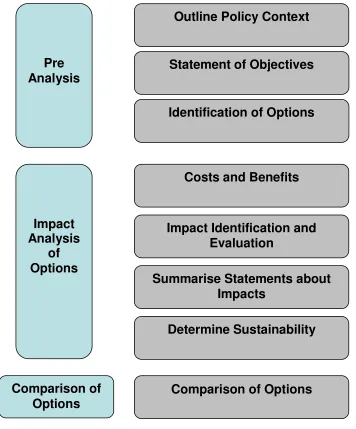
herein form the basis of Comhar SDC recommendations to Government on the development of a Sustainability Assessment methodology for Ireland. The following three step methodological process is proposed for production of SA reports:
1
Pre Analysis
Outline Policy Context •Concise general overview •Individual measures involved •Mechanisms proposed •Stakeholders involved
Statement of Objectives •Explicitly state objectives
Identification of Options •Identify all available options
•Provide a “no action” option for bench marking
Costs and Benefits
•Identify all costs associated with policy option •Identify and value all associated benefits •Outline risks and uncertainty
Impact Identification and Evaluation •Identify potential impacts of each option
•Evaluate impacts based on minimum requirements, trends, irreversibility and burden shifting
Summarise Statements about Impacts •Summarise results of impact identification in a results table •Summarise results of impact evaluation in a results table
Determine Sustainability
•Use impacts and evaluation to determine sustainability •Enter sustainability ratings into results table
Comparison of Options
•Compare sustainability scores for criterion for each option
Comparison of
Options
Impact
Analysis of
Introducing Sustainability Assessment (SA)
1.1 Introduction
This section establishes the background to Sustainable Assessment (SA) in a European context, with a brief overview of sustainable development in Ireland. An overview of the SA methodology is also presented, with key benefits and principles highlighted. The role of SA in the sustainable development policy framework is then outlined. Finally, the relationship of SA to existing assessment tools in Ireland is discussed.
1.2 Background
The general framework for integrated impact assessment of policies within the EU is the European Commission’s Impact Assessment (IA) system, which was launched in 2002, with the latest EC IA Guidelines published in 20092. The IA Guidelines were initially based on the ‘better regulation’ objective, and the follow up to this, the ‘Better Regulation Action Plan’. In addition, the EU Sustainable Development Strategy is also a key driver of IA at EC level3.
While IA focuses primarily at impacts within the EU, DG Trade has used a Sustainable Impact Assessment (SIA)4 framework that focuses on the external impacts of EU trade internationally. The EU has not yet considered extending the SA method to include fields other than trade. Although there is no legal requirement for member states to carry out sustainability assessment, the development of similar approaches is encouraged. Belgium5 and Switzerland6 have both implemented IA through a sustainability assessment framework. Austria and the Netherlands have also carried out work on developing a sustainability assessment methodology. In addition, the Finnish National Commission on Sustainable Development began work on formulating an impact assessment of its National Sustainable Development Strategy in 2009.
Comhar SDC has made previous recommendations to Government on the case for the Sustainability Assessment of proposals contained in the An Bord Snip Nua (McCarthy) report (2009). Following on from this, a request to carry out further research on developing appropriate methodology for Sustainable Impact Assessment in Ireland was made by the then Minister for the Environment, Heritage and Local Government. This methodological proposal presents the outcomes of the SA research project.
The adoption of SA in Ireland would build on and facilitate the delivery of Comhar SDC Principles for Sustainable Development, which were initially designed as a first step towards the sustainability benchmarking of policies and would also provide an opportunity to systematically evaluate how policies will assist in meeting commitments under the forthcoming Framework for Sustainable Development in Ireland.
2
European Commission (2009) Impact Assessment Guidelines, Sec (2009) 92. 3
IEEP (Institute for European Environmental Policy) (2004) Sustainable Development in the European Commission’s Integrated
Impact Assessment for 2004, Final Report, IEEP, London. 4
European Commission (2006) Handbook for Trade Sustainability Impact Assessment, EC, External Trade. 5
Paredis, E. et al. (2006) Methodology and Feasibility of Sustainability Impact Assessment. Case: Federal Policy-making Processes, Belgian Science Policy, Brussels,
(http://www.belspo.be/belspo/home/publ/pub_ostc/CPgen/rappCP46_en.pdf) 6
1.3 Whatis SA?
Sustainability Assessment (SA) is a comprehensive, methodical and targeted analysis of the short and long-term impacts for sustainable development of proposed initiatives. As such it evaluates the social, economic and environmental impacts of policy options, providing an evidence base that informs decision-making. SA is an ex-ante appraisal tool carried out in tandem with policy formulation and can be applied to a range of legislative proposals, policy proposals, plans, programmes and projects.
[image:7.612.103.459.250.679.2]There is no single accepted model for carrying out SA; however most models used to date tend to follow a series of steps including a clear identification of objectives, structured consultation with stakeholders, detailed examination of impacts and consideration of options. The results of the process are typically detailed in a report, which is intended as an aid to decision-making. A three step methodological process is proposed, with each step breaking down into a number of sub-steps, as illustrated in Figure 1 below.
Figure 1: SA Methodological Steps
Pre
Analysis
Outline Policy Context
Statement of Objectives
Identification of Options
Costs and Benefits
Impact Identification and
Evaluation
Summarise Statements about
Impacts
Determine Sustainability
Comparison of Options
Impact
Analysis
of
Options
1.4 Benefits of SA
Sustainable Assessment (SA) is gaining momentum internationally and offers huge potential in ensuring regulation and policies deliver successful, sustainable outcomes that deliver positive change in Ireland.
Previous unsuccessful policies strengthen the case for a balanced ex-ante appraisal of regulation and policy prior to its adoption by Government. The basic rationale for SA is to ensure that policies adopted by Government have been based on an integrated assessment, which has considered the associated benefits and costs for the economy, society and the environment. In this way more informed decision-making could be made, with the potential effects of decisions carefully evaluated before they are taken.
In Ireland, Impact Assessment (IA) methodologies developed to date have tended to focus on specific policy sectors or on working towards achieving certain elements of sustainable development, without due consideration for all three dimensions. It is now evident that consistency is needed across Government policy so that potential conflicts or tradeoffs between different policy areas are avoided and synergies are identified and these opportunities are realised. The SA methodology allows for the assessment of the impacts of proposed policy options on a number of core sustainable development objectives, which will remain constant across sectors, facilitating policy integration.
SA is designed to ensure that the development of policy is transparent, involving multi-sectoral stakeholder engagement. At a time when public finances are under severe pressure, SA will be useful in ensuring public finances are spent appropriately, that initiatives have the support of stakeholders and resources are invested in policies that will deliver long-term benefits for society, the environment and the economy.
1.5 Links to Sustainable Development Policy Framework
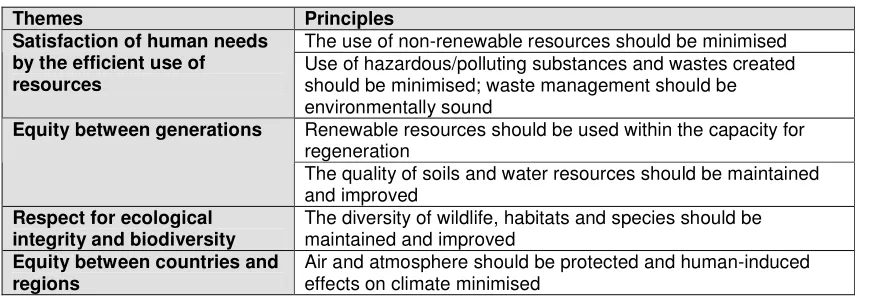
[image:8.612.79.518.510.660.2]Creating links with existing policy frameworks for sustainable development lends credibility to the SA process. SA has the potential to act as a valuable supporting tool for the forthcoming Framework for Sustainable Development in Ireland (FSDI). The overarching principles for sustainable development identified by Comhar SDC7, as shown in Table 1 below, have informed the selection of the sustainability criteria against which the policy options are assessed (see Section 3). In this way, SA is useful in helping to embed sustainable development principles in the policy formation process.
Table 1: Comhar SDC Principles for Sustainable Development
Themes Principles
The use of non-renewable resources should be minimised
Satisfaction of human needs by the efficient use of resources
Use of hazardous/polluting substances and wastes created should be minimised; waste management should be environmentally sound
Renewable resources should be used within the capacity for regeneration
Equity between generations
The quality of soils and water resources should be maintained and improved
Respect for ecological integrity and biodiversity
The diversity of wildlife, habitats and species should be maintained and improved
Equity between countries and regions
Air and atmosphere should be protected and human-induced effects on climate minimised
7
Themes Principles
The development of resource potential in one region should not compromise the ability of other regions to achieve their own potential
Social inclusion should be promoted to ensure an improved quality of life for all
Social equity
Sustainable development depends on co-operation and agreement between states
Respect for cultural heritage /diversity
The quality of landscapes, the heritage of the man-made environment and historic and cultural resources should be maintained and improved
Decision-making should be devolved to the appropriate level
Good decision-making
Stakeholder participation should be promoted at all levels of decision-making
1.6 Learning from Experience
SA is not intended to be additional to existing impact assessment instruments. Rather it is intended to complement and extend the scope of existing impact assessment instruments. Incorporation with a similar, though well-established impact assessment instrument offers the most promising way to implement SA, particularly in light of the economic difficulties facing Ireland. Consequently, a key question that emerged in developing the SA methodology was to what extent are these tools complementary to SA.
There are two main instruments that drive environmental appraisal in Ireland: Environmental Impact Assessment (EIA) and Strategic Environmental Assessment (SEA). EIA assesses the environmental impacts of projects i.e. development proposals and SEA involves assessment of the likely significant environmental effects of plans and programmes prior to their adoption. Therefore, a mechanism already exists for environmental appraisal of projects and plans. The plans that are used to guide development activity in Ireland are often formulated with regard to higher-level strategies. Therefore, Government strategy and policy should lead by example to ensure efficient progress is made in delivering sustainable development.
Regulatory Impact Assessment (RIA) is the existing impact assessment tool for legislation. RIA is used for the structured exploration of different options to address particular policy issues. RIA applies to proposed primary legislation, significant statutory instruments and proposals for EU Directives. RIA assesses significant impacts on national competitiveness, the socially excluded or vulnerable groups and on the environment, amongst others. Interestingly, the Belgium SA model was developed on the basis of the Flemish regions experience of RIA.
Poverty Impact Assessment (PIA) is carried out by Government Departments, local authorities and State Agencies to assess policies and programmes at design, implementation and review stages, so that the likely impacts on poverty and on inequalities likely to lead to poverty may be identified, with a view to poverty reduction. There are established linkages between Regulatory Impact Assessment and Poverty Impact Assessment. The Poverty Impact Assessment Guidelines8 state, “the RIA process is
clearly complementary to Poverty Impact Assessment since it includes a specific requirement to examine the impacts of regulatory proposals on the socially excluded and
8
vulnerable groups”. However, the PIA Guidelines note that not all policy proposals will be required to carry out RIA and, for these, Poverty Impact Assessment will be carried out according to the PIA guidelines.
Health Impact Assessment (HIA) is a multi-sectoral process that may be carried out by a wide group of organisations. HIA is commonly described as ‘the assessment of policy, programmes or projects in terms of the effects on the health of a population and the distribution of those effects within the population’.
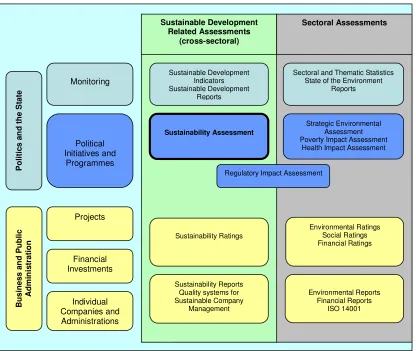
As the SA process evolves, the above impact assessment processes could possibly be integrated into an SA by offering a sector specific evaluation from an environmental or economic or social viewpoint. However, as a starting point, RIA appears to be the most compatible with SA, particularly in terms of its function i.e. the evaluation of policy options at an early stage of the decision process and the fact that it considers environmental and social aspects, alongside economic aspects. With this in mind and to avoid duplication of processes, the proposed SA procedures and methodological steps are designed to closely align with those already in place for RIA.
SA is envisaged as an important stepping-stone towards a single integrated assessment tool, which can be built upon and adapted to encompass the overall affects of policy on society, the economy and the environment, similar to the EC Integrated Assessment tool.
[image:10.612.88.504.352.703.2]Figure 2 presents a schematic of the impact assessment system in Ireland, highlighting the position of sustainability assessment relative to existing instruments.
Figure 2: Impact Assessment in Ireland
Sustainable Development Related Assessments (cross-sectoral) P o li ti c s a n d t h e S ta te B u s in e s s a n d P u b li c A d m in is tr a ti o n Monitoring Political Initiatives and Programmes Sustainable Development Indicators Sustainable Development Reports
Sectoral and Thematic Statistics State of the Environment
Reports
Strategic Environmental Assessment Poverty Impact Assessment
Health Impact Assessment
Sustainability Assessment
Regulatory Impact Assessment
Principles of Sustainability Assessment SA is based on the following principles:
Transparency: The entire SA process must be as transparent and open as possible.
Flexibility: Although each SA must follow a step-by-step methodological process and criteria must be selected according to minimum standards, flexibility is allowed in the selection of analysis methods to be used for each SA and the impact identification stage allows flexibility in the selection of criteria used as part of each SA.
Compatibility: Compatibility is an important principle for SA in two respects: - SA is not intended as a replacement for existing assessment instruments.
Rather, its aim is to build on existing instruments to create more compatible outcomes across multi sectoral instruments.
- A key objective of SA is to assist in the formulation of policy that delivers goals across multiple sectors that fall within environmental, economic and social arenas.
The purpose of SA is not to substitute decision-making, but to help inform policy decisions.
2 Procedures for SA
This section discusses the integration of SA with existing assessment methods and also sets out proposed procedures for implementation of SA in terms of overall responsibility, frame of reference, timing and consultation.
2.1 Integrating with existing instruments
As SA is not intended as a replacement for any existing impact assessment model, the proposed SA model has been designed with flexibility, so that it is compatible with RIA and other impact assessment instruments such as SEA, EIA, PIA and HIA.
For instance, procedures could potentially be established whereby a RIA would trigger an SA in certain cases or vice versa. However, for this to happen, commonality in the issues under consideration would be required.
To facilitate progress towards streamlined and integrated impact assessment instruments, it is suggested that Strategic Environmental Assessments could ensure that all three sustainability criteria are reflected. Similarly, with statutory underpinning, there is potential for the current Environmental Impact Assessment (EIA) model to be modified to better consider sustainability, e.g. by requiring the provision of information on viability, durability, decommissioning and site reusability for all projects.
2.2 Who will oversee the implementation of SA?
Rather than proposing the establishment of a new agency to oversee SA, Comhar SDC proposes that the remit of an existing agency is extended to encompass SA. Proposed options include:
• Expansion of the remit of the Better Regulation Unit (BRU), formerly at the
Department of the Taoiseach and recently transferred to the Department of Jobs, Enterprise and Innovation. This unit has oversight of RIA and also functions as an RIA helpdesk, providing information and advice on all aspects of RIA and other better regulation. An RIA Network consisting of representatives from relevant Government Departments also meet regularly to share learning and experience in the area of RIA in an aim to develop best practice. The Departmental Network representative is also the initial point of contact in Departments for anybody requiring further assistance on RIA. A similar network with representatives from various Government Departments could be established for SA.
• Alternatively, a unit within a relevant Government Department may be appropriate.
It is interesting to note that the Environmental Assessment Agency plays a role in the SA process in the Netherlands.
2.3 Who will carry out individual SA?
would be required to undertake SA training as part of their performance management and development.
As the use of integrated impact assessment instruments is the key long-term goal, the most practical and cost efficient solution is to maintain the existing arrangements in place for carrying out RIA, with an extension of the scope and basic requirements.
2.4 When should an SA be required?
Comhar SDC recommends that SA should initially be carried out for proposals relating to national strategies and policies. For instance, it is anticipated that SA would be carried out for strategies such as the National Spatial Strategy (NSS), the National Development Plan (NDP), the National Strategy for Higher Education, and other key national policies.
Therefore a screening phase will not initially be required because national strategies and policies are by nature ‘significant’ and therefore there should be no question as to whether or not the policy proposal is of sufficient importance to merit SA. However, if SA was to extend to legislation or other plans/programmes it is recommended that a screening process to determine applicability be carried out.
As SA establishes itself as a key impact assessment instrument in Ireland, it may evolve to cover a similar frame of reference as RIA, targeting proposals for primary legislation, significant statutory instruments, proposals for EU Directives and significant EU Regulations etc. In that context, there may be scope for the integration of the two mechanisms.
2.5 When does the SA process begin?
SA is intended as an iterative process to be carried out alongside the policy formation process. It is important to carry out the SA process as early as possible, before the options have been narrowed down and choices made so that it can inform decision-making.
3 Sustainability criteria
SA evaluates policy options against a set of predefined criteria and corresponding objectives. To ensure that the criteria used have legitimacy, it is essential that the SA criteria are accepted by policy makers and linked to sustainable development policy objectives.
The criteria proposed are closely linked to the Sustainable Development Indicator (SDI) set developed by Comhar as well as sustainable development policy objectives. The SDI set provide an overview of the main aspects of sustainable development in Ireland, embracing human, physical, social, natural and financial assets. The SDI set relates to the forthcoming Framework for Sustainable Development in Ireland (FSDI), the EU SDS and Comhar SDC principles for sustainable development. By linking the SA criteria to the SDIs, the effect of different policy options can be explored in a systematic and more quantitative way.
As SA is intended as a stepping-stone towards an integrated assessment system for Ireland, consideration has also been given as to the best way to incorporate elements from RIA and the criteria selected have an equal number of environmental, economic and social components.
3.1 Core Sustainability Criteria
Environment
Economy
Society Env 1: Energy
The use of non renewable energy resources is to be minimised
Env 2: Climate
Promote a low carbon society to mitigate climate change and maximise capacity and flexibility to adapt to climate change
Env 3: Transport
Encourage smarter travel choices (walking, cycling and use of public transport)
Env 4: Biodiversity and Ecosystem Services
Protect and enhance biodiversity and ecological functioning systems essential for life
Env 5: Resource Efficiency
Maximise natural resource efficiency and support sustainable consumption and production processes
Soc 1: Health
The health and well being of all people is to be protected and enhanced
Soc 2: Equality and Poverty
Foster and support an open and tolerant society with equal rights and opportunities for all citizens and reduce inequalities, including income inequalities
Soc 3: Social & Physical Infrastructure
Promote viable and sustainable communities and improve integration between the provision of housing and essential supporting social and community infrastructure
Soc 5: Education
Promote personal development through education
Soc 4: Culture
Promote and enhance culture, social heritage and the arts
Econ 2:
Competitiveness
Reinvigorate the enterprise economy and restore national competitiveness, while minimising costs incurred by publicservices, businesses and citizens
Econ 3: Innovation and Job Creation
Stimulate sustainable growth, job creation and capacity for innovation
Econ 4: Decoupling & Efficiency
Support the decoupling of economic growth from environmental
degradation
Econ 5: Investment
Promote investment in public goods for well being
Econ 1: Sustainability
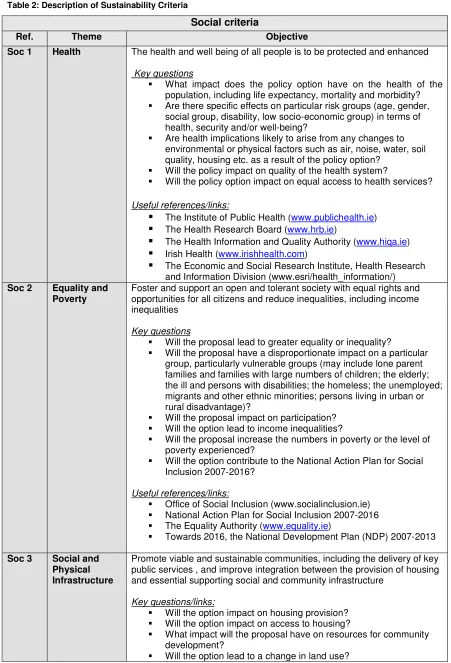
Table 2: Description of Sustainability Criteria
Social criteria
Ref. Theme Objective
Soc 1 Health The health and well being of all people is to be protected and enhanced
Key questions
What impact does the policy option have on the health of the population, including life expectancy, mortality and morbidity? Are there specific effects on particular risk groups (age, gender,
social group, disability, low socio-economic group) in terms of health, security and/or well-being?
Are health implications likely to arise from any changes to environmental or physical factors such as air, noise, water, soil quality, housing etc. as a result of the policy option?
Will the policy impact on quality of the health system?
Will the policy option impact on equal access to health services?
Useful references/links:
The Institute of Public Health (www.publichealth.ie)
The Health Research Board (www.hrb.ie)
The Health Information and Quality Authority (www.hiqa.ie)
Irish Health (www.irishhealth.com)
The Economic and Social Research Institute, Health Research and Information Division (www.esri/health_information/)
Soc 2 Equality and Poverty
Foster and support an open and tolerant society with equal rights and opportunities for all citizens and reduce inequalities, including income inequalities
Key questions
Will the proposal lead to greater equality or inequality?
Will the proposal have a disproportionate impact on a particular group, particularly vulnerable groups (may include lone parent families and families with large numbers of children; the elderly; the ill and persons with disabilities; the homeless; the unemployed; migrants and other ethnic minorities; persons living in urban or rural disadvantage)?
Will the proposal impact on participation? Will the option lead to income inequalities?
Will the proposal increase the numbers in poverty or the level of poverty experienced?
Will the option contribute to the National Action Plan for Social Inclusion 2007-2016?
Useful references/links:
Office of Social Inclusion (www.socialinclusion.ie) National Action Plan for Social Inclusion 2007-2016 The Equality Authority (www.equality.ie)
Towards 2016, the National Development Plan (NDP) 2007-2013
Soc 3 Social and Physical Infrastructure
Promote viable and sustainable communities, including the delivery of key public services , and improve integration between the provision of housing and essential supporting social and community infrastructure
Key questions/links:
Will the option impact on housing provision? Will the option impact on access to housing?
What impact will the proposal have on resources for community development?
Will the option require supporting social or community infrastructure?
Will the option impact on public transport provision and accessibility?
Will the option impact on other transport initiatives? Is the option likely to lead to spatially dispersed effects? Will the option impact on crime and security?
Will the option impact on the delivery of public services?
Useful references/links:
Department of Environment, Heritage and Local Government (2002) National Spatial Strategy (2002-2020), Government of Ireland
Department of Environment, Heritage and Local Government (2010) Implementing the National Spatial Strategy 2010 Update and Outlook, Harnessing Potential, Delivering Competitiveness, Achieving Sustainability
Department of Environment, Heritage and Local Government (2007) Delivering Homes, Sustaining Communities
Department of Environment, Community and Local Government (2011) Housing Policy Statement
Soc 4 Culture Promote and enhance culture, social heritage and the arts Key questions
Will the option impact on cultural diversity, cultural heritage, available resources etc?
Will the option have positive or negative implications for preservation of natural heritage?
Will the option have positive or negative implications for preservation of architectural heritage?
Will the option affect access to cultural activities and resources? Will the option affect cultural diversity?
Useful references/links:
Department of Tourism, Culture and Sport (2008), Arts and Culture Plan, Government of Ireland.
Culture Ireland (www.cultureireland.gov.ie) The Heritage Council (www.heritage.ie) The Arts Council (www.artscouncil.ie) National Inventory of architectural heritage
Soc 5 Education Promote personal development through education
Key questions
Will the option impact on education provision, access to education, educational attainment etc?
Will the option affect resources (financial, personnel etc.) for education?
Will the option affect resources or provisioning of environmental education/awareness?
Useful references/links:
Department of Education and Skills (www.education.ie)
Department of Education and Science (2005) Delivering Equality of Opportunity in Schools (DEIS): An action plan for educational inclusion
Department of the Taoiseach (2011) National Reform Programme for Ireland under the Europe 2020 Strategy
Environment Protection Agency
(www.epa.ie/researchandeducation/education/)
Environmental criteria
Ref. Theme Objective
Env 1 Energy The use of non renewable energy resources is to be minimised
Key questions
Will the option increase or decrease the use of non-renewable energy resources?
Will the option increase or decrease the use of renewable energy sources?
Will the option impact on energy security in a positive or negative way?
Will the option increase reliance on imported fossil fuels (oil, coal and gas)?
Useful references/links:
Sustainable Energy Authority of Ireland (www.seai.ie) Environmental Protection Agency (www.epa.ie) The National Renewable Energy Action Plan (NREAP) The National Climate Change Strategy
Env 2 Climate Promote a low carbon society to mitigate climate change and maximise capacity and flexibility to adapt to climate change
Key questions
Will the option increase greenhouse gas emissions (carbon dioxide, methane, ozone, nitrous oxide etc.) arising from
agricultural, energy, transport, industrial, commercial, residential or waste activities?
Will it affect the ability to adapt to the impacts of climate change (for example sea level rise, flooding, freezing, drought and water shortages, changes in distribution of species and possible extinction of vulnerable species, pest infestation, effects on fisheries due to temperature changes etc.?
Useful references/links:
The National Renewable Energy Action Plan The National Climate Change Strategy
(http://www.epa.ie/whatwedo/climate/)
Department of the Taoiseach (2011) National Reform Programme for Ireland under the Europe 2020 Strategy
Env 3 Transport Encourage smarter travel choices (walking, cycling and use of public transport)
Key questions
Will it increase private car use etc?
Will the option increase/decrease fossil fuel consumption? Will the option increase/decrease demand for public transport? Will the option improve/hinder accessibility to public transport for
all?
Is the option likely to influence on the transport modal choices of the general public?
Will the option affect pedestrians/cyclists?
Useful references/links:
National Transport Authority (www.nationaltransport.ie)
Department of Transport (2009), Smarter Travel, A Sustainable Transport Future 2009-2020, Government of Ireland.
Env 4 Biodiversity and Ecosystem Services
Protect and enhance biodiversity and ecological functioning systems essential for life
Key questions
Will the option impact on Natura 2000 network (Special Areas of Conservation (SACS) or Special Protection Areas (SPAs)? or other designated/protected sites such as National Heritage Areas Will the option increase/decrease biological diversity?
Will the option affect the scenic value of landscapes?
Will the option impact on ecosystem services (soils, water and air)?
Will the option increase/decrease emissions to air?
Will the option impact upon the quality or quantity of ground and/or surface waters?
Will the option affect drinking water supplies? Will the option affect soil quality in any way?
Will the option enhance or develop green infrastructure?
Useful references/links:
Environmental Protection Agency (www.epa.ie) National Parks and Wildlife Service (www.npws.ie)
Department of Arts, Heritage, Gaeltacht and the Islands (2002) National Biodiversity Plan, Government of Ireland
Env 5 Resource Use Maximise natural resource efficiency and support sustainable consumption and production processes
Key questions
Will the option increase or decrease natural resource use (natural minerals, fisheries, oil, gas etc.) for production purposes?
Is the option likely to lead to increased consumption of natural resources?
Will the option improve resource efficiency?
Will the option increase or decrease water consumption? Will the option increase or decrease energy consumption? Will the option lead either directly or indirectly to increased
volumes of waste?
Will the option contribute to improving environmental and social performance of products and processes and encourage their uptake by business and consumers?
Is the option in line with green public procurement initiatives? Does the option promote eco innovation in industry?
Useful references/links:
Environmental Protection Agency (www.epa.ie)
Economic Criteria
Ref. Theme Objective
Econ 1
Sustainability Restore economic resilience and sustainability of public finances
Key questions
What impact will the proposal have on public debt? Will the option have budgetary consequences for public
authorities?
Will the option assist in the reduction of our national debt? Will compliance with or implementation of the option entail
significant costs to the Exchequer?
Useful references/links:
The National Recovery Plan 2011-2014
Building Ireland’s Smart Economy – a Framework for Sustainable Economic Renewal9
Department of the Taoiseach (2011) National Reform Programme for Ireland under the Europe 2020 Strategy
Econ 2
Competitiveness Reinvigorate the enterprise economy and restore national
competitiveness, while minimising costs incurred by public service, business and citizens.
Key questions
Will the proposal increase the regulatory burden? Will the option encourage exports growth?
Will the option promote recovery of domestic demand? Will the option impose significant compliance, administrative or
implementation costs on businesses and/or citizens?
Will the option support/hinder entrepreneurship and enterprise development?
Will the option lead to anti-competitive conditions or the emergence of monopolies?
Will the option place Irish companies at a competitive disadvantage compared to their international rivals?
9
Useful references/links:
National Competitiveness Council (www.competitiveness.ie)
Econ 3
Innovation Stimulate sustainable growth, job creation and capacity for innovation
Key questions
Will the proposal create sustainable jobs etc?
Will the option directly or indirectly lead to job losses? Will the option support education, skills and training for high
quality human capital?
Does the option promote or hinder research and development? Will the option increase/decrease capacity for innovation and
creativity?
Useful references/links: Europe 2020 strategy
Building Ireland’s Smart Economy Report of the Innovation Taskforce Forfas (www.forfas.ie)
Department of the Taoiseach (2011) National Reform Programme for Ireland under the Europe 2020 Strategy
Econ 4
Decoupling and Efficiency
Support the decoupling of economic growth from environmental degradation
Key questions
Does the option support relative decoupling of economic growth from consumption of resources and environmental impacts? Will the option increase awareness of the economic benefits for
business in improving environmental performance?
Useful references/links:
Department of the Environment, Community and Local Government, Sustainable Development Unit
(www.environ.ie/en/Environment/Sustainable Development)
Department of the Environment,: National Action Plan on Green Public Procurement (to be finalised)
(www.environ.ie/en/Environment/SustainableDevelopment/Consul tationGreenPublicProcurement)
Econ 5
Investment Promote investment in public goods for well being
Key questions
Will the option promote/hinder a stable investment climate? Will the option prioritise investments that support our competitive
position?
Will the option support/limit investment that will deliver long term benefits such as critical infrastructure, research and development and renewable energies and clean technologies?
Will it increase levels of investment in key public goods e.g. water infrastructure, environmental protection, education etc?
Will the option lead to more efficient infrastructure and services that will support inward investment?
Will the option affect equal access to goods and services?
Useful references/links:
Industrial Development Agency (www.idaireland.com)
Department of the Taoiseach (2011) National Reform Programme for Ireland under the Europe 2020 Strategy
3.2 Additional Sustainability Criteria
The sustainability criteria described above may be supplemented with more specific sustainability criteria depending on the policy option being evaluated. The decision as to whether or not to include additional criteria must be decided on a case-by-case basis by the Departmental team designated responsibility for conducting the SA.
Some examples of additional criteria that might be useful to include are:
Promote Social Inclusion: Combat social exclusion to ensure an improved quality of life for all, in particular for the poor and vulnerable
All Ireland co-operation: Promote mutually beneficial north-south and east-west relations
Food security: Support sustainable domestic food production and food security by minimising reliance on imports as well as the carbon footprint of our food and support food security measures in developing countries so that the world’s poorest people have access to food.
Population: Promote sustainable population distribution patterns 3.3 Policy Specific Criteria
Policy specific criteria that are of particular relevance to the policy area in question may be included in the SA, if considered appropriate to do so. For instance, in addition to providing information on the advantages and disadvantages of a proposal in terms of sustainability, it may also be useful for the SA to examine whether or not the proposal will achieve its primary objectives. To this end, the primary objectives of the proposal may be incorporated in the SA as objectives based criteria. Alternatively, it is possible to evaluate the objectives of the policy independently of the SA. The decision on whether or not to include policy specific criteria is at the discretion of the policy formation team conducting each particular SA.
3.4 Rules for selecting additional sustainability or policy specific criteria10
In choosing additional sustainability or policy specific criteria, the following factors should be considered:
Relevance: Does the criteria represent an issue that is of particular importance to the policy area or is the criteria representative of an issue that is likely to be impacted upon by the policy area?
Precision and operability: The criteria should be as precisely defined as possible; vague criteria will create difficulties in the impact identification stage.
Uniqueness: Criteria should be unique in terms of addressing an identifiable separate impact of the policy. Two criteria should not reflect similar impacts of a policy. This could lead to double counting and may distort the decision making process.
Number: The number of criteria used in any one SA should not be excessive. Ideally, the number of criteria used should be as small as reasonably conducive to a comprehensive SA. Large numbers of criteria will create a complicated assessment process and will create difficulties in assigning sustainability ratings.
10
4 Conducting an SA: Pre Analysis
4.1 Description of Policy Context and Objectives
4.1.1 Policy Context
The first step in the SA process is to describe the policy context. The background to the topic should be clearly outlined in an SA report, with the particular policy issue or challenges described. The conditions/imperatives that provide justification for why a policy is required to address it at this particular time should be outlined. Include only the most relevant information to provide the reader with a concise background to the issue. Additional background material may be provided as an Appendix if necessary.
A minimum of the following information should be presented in the SA report:
A general overview of the subject matter the policy proposal is intended to address, including a description of spatial boundaries to which it relates and the likely duration of the policy.
The individual measures that might be associated with the policy proposal.
The mechanisms through which the policy will be implemented.
The key stakeholders likely to be involved.
Example 1: Policy Context
Extract from RIA on Planning and Development (Amendment) Bill 2009
“Building Ireland’s Smart Economy highlights the need to optimise the resources available to the Government by ensuring a clear and co-ordinated prioritisation of investment in those locations that have the potential to drive regional and national competitiveness and which have the capacity to grow. The National Economic and Social Council (NESC), Forfás, and the National Competitiveness Council (NCC) indicate that the National Spatial Strategy (NSS) must continue to play a central role in this prioritisation process. …”
Source: www.environ.ie
4.1.2 Statement of Objectives
A statement of objectives should explicitly state what the proposed policy aims to achieve as this may be useful in focusing the assessment process and will assist in the formulation of policy options that meet these objectives. It is important to differentiate between the ultimate objective and immediate outcomes. Policy objectives should be linked clearly to the policy context already described and should be:
• Specific • Measurable • Achievable • Realistic
Guiding Questions11
1 What are the main objectives and what would constitute successful outcomes?
2 Could existing objectives set in other contexts be adapted here?
3 Are the objectives consistent with strategic aims and objectives set out in, for example, the Department of the Environment’s forthcoming Framework for
Sustainable Development in Ireland?
4 How would objectives and outcomes be measured?
5 How could progress towards meeting objectives be monitored?
6 What factors determine success of objectives?
Example 2: Statement of Policy Objectives
Extract from RIA on Health (Long-term Residential Care Services) Bill 2009
Ultimate objective: To put in place an infrastructure of high quality and sustainable long-term residential care services for older people
Immediate outcomes: To equalise State support for public and private long-term residential care recipients;
To render private long-term residential care affordable and anxiety-free, and ensure that no-one has to sell their home during their lifetime to pay for their care;
To remove the incentive to avail of public rather than private long-term residential care, thereby helping to alleviate the problem of delayed discharges from the acute hospital sector.
Source: www.dohc.ie
4.2 Identification and Description of Options
Having clearly outlined the policy context and objectives, different policy options or alternative ways to achieve the objectives should now be identified and described. This is a key step in SA as it is the policy options that will be subject to impact analysis and evaluation. In the initial stages, the SA should include all genuine options under consideration. As the policy develops a shortlist of options can be created but all options included in the shortlist should be justified12. For bench marking purposes it is preferable
to include a ‘do nothing’ or ‘no action’ option. This highlights the changes that will occur with or without the policy initiative.13
11
HM Treasury (2003), Green Book: Appraisal and Evaluation in Central Government 12
HM Treasury (2003), Green Book: Appraisal and Evaluation in Central Government 13
Example 3: Identification of options
Extract from RIA on Biofuel Obligation Scheme 2009
Option 1: Do Nothing
Scheme II of the Mineral Oil Tax Relief (MOTR) will terminate at the end of 2010. It has succeeded in creating some market penetration for biodiesel and ethanol in diesel and petrol markets since being introduced in 2005, and a number of production facilities have been constructed. If no further policy action is taken in the biofuels sector, it is a practical certainty that the nascent biofuels market would disappear…
Option 2: Continuation of Mineral Oil Tax Relief
Another option would be to either hold another MOTR type competition, or to extend the relief already granted to certain companies. However, while relief from excise obviously confers an immediate commercial benefit on biofuels, it does not encourage investment in second generation biofuels, and does not compel suppliers to use the fuels. In other words, as has been seen already with regard to MOTR, relief schemes are not effective in terms of meeting national targets. This type of instrument generally gives no long-term guarantee, which is a disincentive for investments and innovation. An additional and obvious disadvantage to this approach is the fact that costs to the state in terms of revenue foregone are high.
Option 3: Subsidy for Biofuel Industry: Crops/Producers
Another option would be to introduce a direct subsidy for the biofuels industry to increase competitiveness with petrol and diesel. However, just like the previous example this would not necessarily generate market interest in purchasing biofuels, or in investing in more sustainable technologies. The cost to government of introducing such a subsidy is again high.
Option 4: VRT Relief for Flexi-Fuel Vehicles and/or conversion kits
There was a VRT relief scheme for flexi-fuel vehicles in place until June 2008. From 1 July 2008, relief for series production hybrid electric and flexible fuel cars has been adjusted to provide a relief of up to €2,500 on the VRT payable, in addition to any benefits accrued under the new VRT carbonemission related system. This policy of VRT relief does reward more fuel efficient cars but does not encourage the use of biofuels in cars per se.
Therefore to meet the 2020 goals for renewable energy in transport some support for the industry itself is required.
Option 5: Biofuel Obligation
A market-based obligation mechanism would provide a tool to ensure that the
Government’s policy objectives are attained, in a manner that ensures that the consumer is not adversely affected. A Biofuels Obligation Scheme (BOS) would require transport fuel suppliers to ensure that a specified percentage of their fuel was from a renewable source. This would provide market stability, both to existing road transport fuel suppliers and to those in the biofuels sector.
5 Impact Analysis of Options
There are several key stages involved in the impact analysis of options:
Description and valuation of all costs and benefits associated with each policy option
Identification of all potential impacts associated with each policy option, followed by evaluation of each impact
Summary of results of impact identification stage into Results Table 3 then summary of results of impact evaluation into Results Table 4
Use impacts and evaluating factors to determine sustainability then enter sustainability rating into results table
5.1 Costs and Benefits
5.1.1 Costs and Benefits
The costs and benefits of all identified options should be outlined to aid comparisons between options. Costs and benefits should be allocated a monetary or quantitative value where possible. This may have been completed already as part of a corresponding RIA, in which case provide details. Costs can be divided into two main categories, Administrative Burdens and Policy Costs14. Administrative Burdens constitute the costs associated with the administrative activities carried out as a direct result of policy requirements. Policy Costs are all remaining costs associated with meeting or complying with the policy objectives. Benefits must also be valued to determine whether the policy option can be justified. Benefits may be valued using market prices. For example, equipment upgrades that make staff more efficient can be valued in terms of hours saved multiplied by average wage. Costing can be complicated and may require consultation with specialists, for example, accountants or economists, so it is important that they are given all of the relevant information required to calculate costs accurately. Some costs and benefits can not be easily allocated a market value, for example, environmental impacts. In this instance, ‘willingness to pay’, ‘stated preference’ or ‘willingness to accept’ can be used to elicit values15.
Example 4: Example of Administrative Burdens and Policy Costs
Example Administrative Burdens:
Record keeping
Preparation of management accounts
Critical examination of training/education schemes to ensure appropriate practical/technical content
Example Policy Costs:
Upgrading production processes
Training in best-practice approach, business and project management skills
Investment into product marketing and development
Research into GHG mitigation, genetic improvements, technologies
14
Department for Business Innovation and Skills (2011), Impact Assessment Toolkit: A guide to undertaking an Impact Assessment (IA) and completing the IA Template
15
5.1.2 Risks and Uncertainty
Actual outcomes of policy options may not always reflect expected outcomes as policy makers cannot control for external events that contribute to the impacts of policy options. Therefore, there is always a certain degree of risk and uncertainty. A risk is the probability of the policy option having a significant, hazardous or irreversible impact or leading to an irreplaceable loss. It is good practice to identify potential risks and explicitly state when and where these may occur.
No matter how thoroughly risks are identified and prepared for, there will always remain a certain degree of uncertainty. Uncertainty results from the lack of knowledge or understanding of possible impacts or responses of the environment to them. There are three main methods of assessing uncertainty16:
1 Sensitivity analysis may be carried out to calculate the effect of policy options for a variety of future values. This technique involves changing the value of one variable or factor in order to anticipate the likely impact of future changes that may occur.
2 Where high levels of uncertainty or risks are apparent, it may be useful to carry out scenario analysis. This involves changing the value of a number of variables or factors simultaneously rather than just one, as is the case with sensitivity analysis.
3 An alternative method is to present values as ranges when estimating costs and benefits. Ranges would be broader where there is a greater level of uncertainty and become narrower as the policy develops and specific costs and benefits become clear.
The level of uncertainty attached to an impact statement should be included using the following scale: none, low, medium or high and included in Table 3. It is important that this is backed up with explanatory text, particularly where assumptions relating to any impact are made.
5.2
Impact Identification and Evaluation
5.2.1 Impact Identification
Using the key questions and reference material supplied in Table 2, and any other resources relevant to the proposed policy options, identify areas where impacts may occur and record in a summary table (Table 3). A combination of impact analysis techniques may be used to determine the potential impacts of each option on each criterion selected for inclusion in the SA. Information acquired at the earlier policy description stage may assist in identifying criteria that are particularly significant in terms of the policy proposal. Significance should be scored on a scale of 1–5, 1 representing very low significance and 5 representing very high significance. Criteria of high significance should be subject to the most rigorous analysis. A basic analysis may be carried out for criteria of very low significance. Alternatively, where it is apparent that there is no impact whatsoever on a criterion, this may be deleted as long as a clear justification is provided. All analyses and references should be included in an Appendix (with page reference cited in Table 3), outlining:
Policy option
Identified Impacts
Analytical approach used
References/evidence base consulted
For criterion of low significance, impacts may be evaluated using methods such as interviews, desktop review, surveys etc. Where impacts are assessed using these methods this should be clearly stated, as the evaluation may not be supported by scientific
16
and/or empirical analyses. Criterion identified as significant should be subject to more rigorous analysis using methods such cost benefit analysis, multi-criteria analysis, surveys, case studies, material flow analysis, life cycle analysis, and equilibrium models.
Comhar SDC has developed an excel tool that will assist in an efficient impact analysis process.
Choosing analytical techniques
Two main analytical techniques may be used to analyse the impacts in relation to sustainable development criteria; Cost Benefit Analysis and Multi-Criteria Analysis.17
Cost Benefit Analysis is used when costs and benefits can be monetised. If value of benefits exceeds the costs, the proposal would be considered worthwhile.
Multi-criteria Analysis is used when it is not possible to monetise benefits. In this case, the policy objectives are used to create a set of weighted criteria from which preferred options can be determined.
The type of assessment, objectives, depth of analysis and the impacts examined informs the appropriate selection of impact analysis techniques. Selection of appropriate methods should be the responsibility of the department to which the individual SA relates. It is important to remember that no single assessment method will be capable of carrying out a thorough evaluation of all the impacts of a policy option in relation to the sustainability criteria. A combination of several methods may be used as appropriate.
17
Table 3: Example Identification of Impacts
Will the proposed policy have an impact on the following?
Yes/No Positive/Negative (+/-)
Level of Uncertainty
Analytical Approach SA report page reference for details of impacts and analyses
Health
Equality and Poverty
Social and Physical Infrastructure
Culture
Social
Education
Energy
Climate
Transport
Biodiversity and Ecosystem
Services
Environmental
Resource Use
Sustainability
Competitiveness
Innovation and job creation
Decoupling and Efficiency
Economic
5.2.2 Impact Evaluation
Each criterion theme is then evaluated in terms of a number of additional evaluating factors. The purpose of the evaluating factors is to ensure the SA considers not only the positive and/or negative impacts on sustainability criteria, but also the wider contextual conditions relating to each criterion theme, such as baseline and predicted future conditions and any minimum requirements that must be respected. In establishing the effect of each policy option on the evaluating factors it is useful to present these factors as a series of questions, as outlined below.
Information previously obtained as part of the impact identification process may be useful in considering each factor. Information may also be obtained from the following recommended sources:
CSO might be referred to for economic criteria data
EPA Environment in Focus website may provide baseline information on environmental criteria.
The Economic and Social Research Institute (ESRI)
Comhar Sustainable Development Indicator website (see www.comharsdc.ie )
Additional Evaluation Factors - Guiding Questions
1. Minimum requirements: These are the threshold values at which the desired impacts will only just be achieved. Will impacts negatively affect minimum requirements relating to the criteria themes (e.g. standards, legislation, thresholds, limits)?
2. Trend lines: All criteria will have an existing trend line, either positive, constant or negative, regardless of the project proposed. Will the policy option exacerbate, reverse or have no effect on existing trends relating to the criteria theme? Particular emphasis should be placed on negative trends.
3. Irreversibility of negative impacts: Impacts are deemed irreversible if they rule out future investment opportunities or utilisation of resources18. Will the option exert a negative irreversible impact on the criteria theme?
4. Burden shifting onto future: This occurs when the impacts of a policy option are not felt by the current generation but passed on to future generations. Are negative impacts likely to affect future generations as a result of the policy option?
18
5.3 Summarise findings into key statements about the impacts and determine
sustainability
The results of the impact identification and evaluation stage are presented alongside each other in the SA Results Table (Table 4). The results of the evaluation stage may be directly transferred to the results table. However, the results of the impact identification stage are likely to be more complex and as such it is necessary to summarise the findings into key statements about the impacts using an ordinal scoring system, as outlined below. A summary statement of impacts should be included.
Impact scale
Highly positive; (+3)
Moderately positive; (+2)
Slightly positive; (+1)
Neutral impact; (0)
Slightly negative; (-1)
Moderate negative; (-2)
Highly negative: (-3)
On full consideration of impacts and evaluating factors, each criterion must then be assigned a sustainability rating. The sustainability rating should be calculated using the total score for each criterion as follows:
Total between 11 and 15 is highly positive: (+++)
Total between 6 and 10 is moderately positive: (++)
Total between 1 and 5 is slightly positive: (+)
Total of 0 is neutral: (0)
Total between -1 and -5 is slightly negative: (-)
Total between -6 and -10 is moderately negative: (- -)
Total between -11 and -15: is highly negative (- - -)
This rating should also be entered onto the SA results table. By adding the total scores of each criterion, an overall sustainability rating may be assigned as follows:
Overall total between 151 and 225 is highly positive: (+++)
Overall total between 76 and 150 is moderately positive: (++)
Overall total between 1 and 75 is slightly positive: (+)
Overall total of 0 is neutral: (0)
Overall total between -1 and -75 is slightly negative: (-)
Overall total between -76 and -150 is moderately negative: (- -)
Overall total between -151 and -225: is highly negative (- - -)
Example 5: Scoring Evaluating factors
Minimum requirements: Each policy option will have upper and lower limits that must be adhered to in order to achieve positive impacts. For example, Teagasc set out minimum requirements for ‘Good Agriculture and Environmental Condition (GAEC)’:
Agricultural policy options that work within these limits would score (0)
A policy option that makes it easier to meet or goes above and beyond minimum requirements would score (+1), (+2) or (+3), depending on the scale of the positive impacts
A policy option that fails to meet or makes it more difficult to meet minimum requirements would score (-1), (-2) or (-3)
Trend: If a trend is negative prior to introduction of the policy, for example: habitat loss, scores would be allocated as follows:
A policy option that halts the trend would score (0)
A policy option that has no effect on the trend, e.g. the ‘no action’ option, will score (-1) as the trend remains negative but does not get worse
A policy option that exacerbates the trend will score (-2) or (-3)
A policy option that reverses the trend would score (+1), (+2) or (+3).
Irreversibility of impacts: Irreversible damage may arise from a policy proposal, for example, species extinctions, loss of natural habitats or loss of genetic diversity. Scores for irreversibility of impacts would be allocated as follows:
If impacts are reversible, for example through adequate afforestation, scores would be (+1), (+2) or (+3)
If impacts can be counteracted, for example balancing CO2 emissions with carbon
offsetting, the score would be (0)
If impacts are in any way irreversible or there is uncertainty as to the irreversibility, the score will always be negative, even if there is a lack of scientific knowledge available on possible impacts
Burden shifting onto future generations: Impacts of policy options may not be felt immediately but may increase the environmental burden of future generations. For example, if current targets to stabilise CO2 emissions are not met, the cost of doing so for
future generations will be much greater. Regarding CO2 emissions, scores would be
allocated as follows:
A policy option that stabilises CO2 emissions would score (0) as future burdens
would be no greater than currently predicted
A policy option that has no effect on current CO2 emissions would score (-1) as
doing nothing will result in burden shifting
A policy option that increases CO2 emissions will score (-2) or (-3) as the future
burden will be greater than currently predicted
A policy that reduces CO2 emissions would score (+1), (+2) or (+3) as it may ease