Terms and Conditions of Use of Digitised Theses from Trinity College Library Dublin
Copyright statement
All material supplied by Trinity College Library is protected by copyright (under the Copyright and Related Rights Act, 2000 as amended) and other relevant Intellectual Property Rights. By accessing and using a Digitised Thesis from Trinity College Library you acknowledge that all Intellectual Property Rights in any Works supplied are the sole and exclusive property of the copyright and/or other I PR holder. Specific copyright holders may not be explicitly identified. Use of materials from other sources within a thesis should not be construed as a claim over them.
A non-exclusive, non-transferable licence is hereby granted to those using or reproducing, in whole or in part, the material for valid purposes, providing the copyright owners are acknowledged using the normal conventions. Where specific permission to use material is required, this is identified and such permission must be sought from the copyright holder or agency cited.
Liability statement
By using a Digitised Thesis, I accept that Trinity College Dublin bears no legal responsibility for the accuracy, legality or comprehensiveness of materials contained within the thesis, and that Trinity College Dublin accepts no liability for indirect, consequential, or incidental, damages or losses arising from use of the thesis for whatever reason. Information located in a thesis may be subject to specific use constraints, details of which may not be explicitly described. It is the responsibility of potential and actual users to be aware of such constraints and to abide by them. By making use of material from a digitised thesis, you accept these copyright and disclaimer provisions. Where it is brought to the attention of Trinity College Library that there may be a breach of copyright or other restraint, it is the policy to withdraw or take down access to a thesis while the issue is being resolved.
Access Agreement
By using a Digitised Thesis from Trinity College Library you are bound by the following Terms & Conditions. Please read them carefully.
sequester carbon in soil:
a study of carbon dynamics in soil
aggregates
PhD thesis
2010
Marta Dondini
School o f Natural Sciences
Trinity College
a) I declare that this thesis has not been subm itted as an exercise for a degree at this or any other U niversity,
b) That it is entirely my ow n w ork, and
c) I agree that the Library m ay lend or copy the thesis upon request. This perm ission covers only single copies made for study purposes, subject to normal
conditions o f acknow ledgem ent.
Dublin, March 2010
The author
Marta Dondini
The grow ing o f bioenergy crops has been w idely suggested as a key strategy in
m itigating anthropogenic CO2 em issions. H ow ever, the full m itigation potential o f these crops cannot be assessed w ithout taking into account their effect on soil
carbon (C ) dynam ics. Here I analyzed the potential o f M iscanthus, a bioenergy crop, to sequester C in the soil. 1 studied the effect o f land use change from
M iscanthus to arable and grassland on the total SOC content, as well as on the C associated w ith the soil fractions. Finally, in order to predict the potential o f
M iscanthus to sequester C in the soil, I com pared direct m easurem ents o f soil organic carbon fractions to soil C model predictions m ade by RothC and a cohort
model.
The soil organic m atter (SO M ) w as studied using tw o different soil
physical fractionation m ethods com bined w ith the application o f stable C isotopic
m ethodologies. The com bination o f these tw o techniques allow s to trace the
Miscanthus-AQx'wtd C in various physically protected soil fractions.
Integrated through the w hole soil profile, the total am ount o f soil organic carbon
(SOC) w as higher under M iscanthus than under an arable crop and this difference was largely due to the input o f new C. The C stock o f the m acroaggregates (M)
under M iscanthus was significantly higher than those in the arable land. A dditionally, the C content o f the m icro-w ithin m acroaggregates (m M ) were
higher in the M iscanthus soil as com pared w ith the arable soil. A nalysis o f the intra-m icroaggregates particulate organic m atter (PO M ) suggested that the
Futhermore this research sh ow s that the conversion from grassland to a one-year-old M iscan th u s plantation leads to accum ulate Miscanthus-AQv'w/td C in the intra-m acroaggregate fractions. In the upper 30 cm soil depth, land use has a significant effect on the total SOC content, as w ell as on the C associated with the soil fractions. In particular, 14 years o f M iscan thu s plantation increased C sequestration in stable and protected soil fractions com pared to the other land use system s (e. g. arable land and grassland).
Finally, the results from the com parison o f the direct m easurements o f SOC fractions to m odel predictions sh ow that w hen M iscan thu s is grown on land previously under arable agriculture, the SOC w ill increase as M iscanthus organic material is show n to have a slo w decom position rate. In addition I demonstrated that for m easured organic carbon, fractions o f different lability are sim ilar to the carbon p o o ls used in the RothC m odel. The m odel predictions from RothC and M iscan thu s y ie ld s from M ISC A N FO R sh ow that, in Ireland, changing the land use from arable to M iscan thu s plantations has the potential to store between 2 to 3 M g C ha"' y"' depending on the crop yield and the initial soil organic carbon level.
I would like to express my special gratitude to Prof. M ike Jones, w ho supported and supervised me during this research.
1 would also thank Dr. K ees-Jan Van G roenigen, for his suggestions, advice and constructive conversations.
M any thanks are due to research groups that hosted me during these three years: in particular, 1 would like to thank P ro f M aria Francesca C otrufo and Dr. llaria Del Galdo, who first introduced me to this kind o f soil research by teaching me the main m ethodological techniques.
1 would also like to thank Dr. G ustavo Saiz w ho personally helped m e and offered the opportunity to use the equipm ent at St. A ndrew s University.
M any thanks are due also to Prof. Pete Sm ith and Dr. Astley H astings, for the fruitful collaboration on soil carbon m odelling.
1 thank Dr. John Finnan at Teagasc C rop R esearch Centre, C arlow for granting access to the field site. M any thanks are also due to Teagasc staff for site m aintenance.
M any thanks are due to our research group, especially to Fabrizio and N uala, for all the nice m om ents jo in ed together.
Finally, my special gratitude goes to my fam ily and my ‘Italian friends’, who alw ays sustained and supported me.
Chapter 1 - GENERAL INTRODUCTION
1
1.1 Kyoto protocol
2
1.2 Land use change and carbon sequestration
3
1.3 Bioenergy crops
6
1.4 Soil organic M atter
9
1.5 SOM separation methods
12
1.6 Stable isotopes and soil carbon sequestration
15
1.7 M odelling soil organic matter
18
1.8 Objectives and outline o f this thesis
21
Chapter 2 - CARBON SEQUESTRATION UNDER
MISCANTHUS: A STUDY OF ‘^C DISTRIBUTION
IN SOIL AGGREGATES
24
2.1 Abstract
25
2.2 Introduction
26
2.3 Materials and Methods
39
2.4 Results
35
SOIL AGGREGATES UNDER DIFFERENT LAND
USE SYSTEMS
47
3.1 Abstract
48
3.2 Introduction
49
3.3 Materials and Methods
52
3.4 Resuhs
56
3.5 Discussion
63
Chapter 4 - THE POTENTIAL OF M ISCANTHUS TO
SEQUESTER CARBON IN SOILS: COMPARING
FIELD MEASUREMENTS IN CARLOW, IRELAND
TO MODEL PREDICTIONS
67
4.1 Abstract
68
4.2 Introduction
68
4.3 Materials and Methods
75
4.4 Results
83
4.5 Discussion
88
Chapter 5 - CONCLUSIONS AND PERSPECTIVES
94
5.1 Soil carbon sequestration under
Miscanthns
95
5.2 Soil organic carbon stocks in soil aggregates under
5.4 Comparing soil fractionation techniques
103
5.5 Future perspectives
104
TABLE OF ACRONYM S
106
1.1. K yoto Protocol
C lim ate change and global w arm ing have been the subject o f increased debate in an agricultural policy context in recent years. In 1997, the U nited N ations Fram ew ork C onvention on Clim ate C hange (U N FC C C ) adopted the Kyoto Protocol (see U N FC C C (1997) for details). The Protocol outlines targets and tim etables for the reduction o f hum an induced sources o f global w arm ing. It was agreed that by 2012, global em issions o f greenhouse gases (G H G s), expressed in carbon dioxide (C O2) equivalents, should be five percent less than em ission levels recorded in 1990. Ireland’s com m itm ent under the protocol is to limit its em issions o f greenhouse gases to not m ore than 13 percent above 1990 levels. In order to achieve this target, the Irish D epartm ent o f the Environm ent, Heritage and Local G overnm ent has published the N ational Strategy on C lim ate Change (2007), w hich proposes m easures for the m itigation o f greenhouse gas em issions across different sectors o f the econom y. The strategy em phasises that the contribution o f agriculture tow ards reaching the target should com e from both a reduction in em issions and an increase in sequestration.
Heritage and L ocal G overnm ent, 2 0 0 7 ) from a 'b usiness as u sual’ projected level o f 18.7 M t C O2 equivalents (B ehan et a l , 2002).
The K yoto Protocol estab lish es the possib ility for crediting greenhouse gas em ission reductions com in g from forestry and agriculture activities (nam ed LU L UC F; W atson et al., 2 0 0 0 ). Under the Marrakesh accords, elig ib le L U L U C F activities in clu d e afforestation, reforestation, and deforestation (under A rticle 3.3 o f K yoto p rotocol), forest m anagem ent, crop m anagem ent, grassland m anagem ent and revegetation (under A rticle 3 .4 o f K yoto protocol). Three broad typ es o f LU L U C F projects have been identified: avoid in g em ission s via conservation o f existin g carbon (C ) stocks, increasing C storage by sequestration and substituting C for fo ssil fuel and energy in tensive products.
S p ecific ch allenges related to C sequestration include: com p lex responses o f soil C stock s to L U L U C F activities, the need to m onitor sm all incremental changes in soil C content relative to large C p ools, long-term periods to accrue the full C ben efits, high local variability o f soil C content and relatively costly soil C m easurem ent procedures (Garci'a-Oliva et a l , 2004).
D esp ite the im portance o f the soil C m itigation potential, only in the recent years projects on soil C m anagem ent exp licitly directed to the m itigation o f greenhouse ga ses em ission s have been proposed (Sam pson et al., 2000; Follett 2 0 1 0).
1.2 Land use change and carbon sequestration
land-use change and management on soil organic carbon (SOC) stocks has
implications for soil quality improvement and sustainability, as well as a role in
the mitigation o f C emission from agricultural land. The commonly recommended
land-use changes that lead to SOC sequestration are afforestation and the
replacement o f arable land with pasture or biomass crops. The SOC sequestration
is caused by those management systems that add high amounts o f biomass to the
soil, cause minimal soil disturbance, conserve and improve soil structure, enhance
activity and species diversity o f soil fauna and strengthen mechanisms of
elemental cycling (Saurerbeck, 2001; West et al., 2002). Maintaining or enhancing carbon storage requires consistent input o f carbon, for example from
crop residues, compost, cattle slurry or sewage sludge in cultivated soils.
However, in cultivated soils where crop residues are incorporated in large
quantities, SOM content varies slowly. In the same way, the removal o f crop
residues does not necessarily induce a rapid decrease o f SOM content. It has been
shown that the incorporation o f fresh organic matter such as green manure or
straw in a soil may intensify SOM mineralization. The stimulation o f SOM
mineralization, named the ‘priming effect’ by Bingeman et al. (1953) has been
clearly observed at the rhizosphere scale. The mechanisms leading to the priming
effect remain poorly understood (Kuzyakov et al., 2000). It is commonly believed
that the low quality of SOM limits the amount o f available energy for soil
microorganisms, and in turn the rate o f SOM mineralization. Thus, the priming
effect is often supposed to result from an increase in overall microbial activity due
to the higher availability o f energy and nutrients released from fresh organic
When natural vegetation is converted to cultivated crops, a rapid decline in soil organic matter (SOM) has been observed (Post & Kwon, 2000). It has been estimated that already within the first few decades of cultivation, soils loose typically 20-30% of the C pool, partly through erosion, but mostly through oxidation o f organic matter into CO2, thus contributing to the CO2 emissions to the atmosphere (Schlesinger, 1995). Agricultural practices also affect soil structure and, after few years o f conversion from grasslands to pastures or cultivated lands, soils experience a substantial reduction in aggregate stability (Elliott, 1996). The breakdown o f stable macroaggregates could cause the decomposition o f previously physically-protected organic matter through greater exposure to soil organisms and improved aeration (Beare et a l , 1994). The magnitude o f this mechanism is a function of the soil texture; in coarse-soils, for example, the soil stability mainly depends on roots and fungal hyphae, which are disrupted and rapidly decomposed upon soil disturbance (Tisdall & Oades, 1982). On the other hand, higher clay contents promote organic-mineral complexes which may allow smaller aggregates to persist, protecting the physically stabilized SOM from decomposing following disturbance (Parfitt et a l , 1997).
1.3 Bioenergy crops
dry-down in the winter, when the available solar radiation is small and decreased
water content will be o f least importance (Long 1994).
Bioenergy crops can be used as a good option to sequester atmospheric
CO2 by increasing biomass productivity which can be incorporated into existing energy alternatives to improve energy use efficiency. In fact, bioenergy crops are
defined as any plant material used to produce biofuel, but those grown specifically
for the purpose are characterized by the capacity to produce large volume o f
biomass, have high energy potential and are adapted to marginal soils (Lemus &
Lai, 2005).
First-generation biofuels can be produced from food crops containing
starch/sugar/oil, where the conversion technologies and markets are well
established, and where it has been possible to quickly take advantage o f the
commercial opportunity provided by the increase in petroleum prices (Hettinga et
a l , 2009; Van den Wall Bake et a i , 2008). Particularly, where these technologies
are applied to annual temperate-climate food crops (cereals, sugar beet, oil seeds),
the overall process has relatively low energy output compared to energy inputs
(Wu et a i , 2008; Farrell et a l , 2006). A major attraction o f second-generation
feedstocks is their abundance, low cost, and high ratio o f energy output to input.
They are composed mainly o f lignocellulosic materials that make up the fibrous
and woody structural components o f plants. These materials are available as
primary (in the field) or secondary (processing) residues from agriculture and
forestry; as well as tertiary waste (from urban/industrial activity). Primary sources
also include herbaceous (grasses) and woody species grown as crops. The
crops are robust perennial species that can resprout from rootstocks after harvest.
Woody crops in particular have the potential to provide ecosystem services and
therefore to complement rather than compete with conventional agriculture. There
is considerable current investment in developing second-generation conversion
technologies and biomass sources (Bartle & Abadi, 2009). O f the second-
generation bioenergy crops, Miscanthns x giganteus (G ref and Deu.) has generated a lot o f interest for several different reasons.
Miscanthus is a perennial rhizomatous grass native to East Asian tropic and subtropic region and with a considerable biomass production potential, even
under cool temperate climatic condition (Lewandowski et a l, 2000). In Europe, Miscanthus is used as bioenergy crop with high aboveground biomass-yield potential (Beuch, 2000). Research over the past two decades suggests Miscanthus as a potentially important bioenergy crop (Jorgensen et al., 2000). In fact, previous researches have focused on management and economics in relation to
productivity and combustion ability. It can be cultivated for 15 up to 25 years
without replanting and is harvested yearly, often in the following spring to reduce
ash contents. Particularly interesting is that the replacement o f conventional
cropping systems by this bioenergy crop, may introduce an increase in SOC
(4) a high input o f aboveground harvest residues, because harvesting in late winter or early spring leads to an accumulation o f stubbles and leaves on the soil surface as pre-harvest losses (Beuch, 1999) and (5) slower decomposition of plant residues (stubbles, leaves and roots) because the absence or reduction o f nitrogen (N) fertilization leads to a larger C : N ratio (Schneckenberger & Kuzyakov, 2007). These features o f M iscanthus' physiology and cultivation lead us to expect that this bioenergy crop has a potential to increase C stores in the soil (Fisher et a i, 1994) at least when established on arable land (Foereid et a l, 2004).
1.4 Soil organic matter
In soil, plant residues, microbial and animal biomass are bound to mineral constituents to form what is defined as soil organic matter (SOM). The constituents o f SOM can be divided into non-humic substances, which are discrete identifiable compounds such as sugars, amino acids and lipids, and humic substances, which are complex largely unidentifiable organic compounds. As organic compounds, both humic and non-humic substances contain C, oxygen (O) and hydrogen (H) and can also contain nitrogen (N), phosphorus (P) and sulfur
( 5 ) .
many o f these same soil properties (Bot & Benites, 2005). An increase in the organic matter content has a lot o f advantages for the soil such as: 1) increase in cation exchange capacity (CEC) which in turn increases the ability to attract and retain nutrients, 2) improvement o f soil structure (more stable soil aggregates), 3) better water holding capacity, 4) enhancement o f growing conditions for soil fauna and flora and 5) construction o f a nutrient buffer (Hassink et al., 1993).
Organic matter releases nutrients in a plant-available form upon decomposition. Decomposition o f organic matter is largely a biochemical process that occurs naturally; three parallel processes go on during decomposition: (1) degradation o f plant and animal remains by cellulases and other microbial enzymes, (2) the increase in the biomass o f microorganisms which comprises polysaccharides and proteins and (3) the accumulation or liberation o f end products. In the decomposition process, different products are released: CO2, energy, water, plant nutrients and re-synthesized organic C compounds. The speed o f this process is determined by three major factors: soil organisms, the physical environment and the quality o f the organic matter (Brussaard, 1994).
The SOM is often split up in distinct com pounds (or pools), w ith residence tim es ranging betw een a few m onths for the m ost labile, to over thousand years for the m ost recalcitrant and com plex pools. This com partm entalization is strictly correlated to the different physical and chem ical properties o f the SO M , as well as to its m icrobial degradability (Paul & Clark, 1996). Traditionally, soil aggregation has been linked with either total C (M atson et al., 1997) or organic C levels (Dalai & M ayer, 1986a, 1986b). M ore recently, techniques have developed to fractionate C on the basis o f lability (ease o f oxidation), recognizing that these sub-pools o f C may have greater effect on soil physical stability and be more sensitive indicators than total C values o f C dynam ics in agricultural system s (B lair & Crocker, 2000). In their conceptual m odel, Six et al. (2002) distinguish the SOM that is protected either physically or biochem ically against decom position from that w hich is unprotected. They identified four m easurable pools: (i) an unprotected C pool, (ii) a biochem ically protected C pool, (iii) a silt and clay-protected C pool, and (iv) a m icroaggregate-protected C pool. The unprotected SOM pool consists o f both the light fraction and the particulate organic m atter (PO M ) fraction, although they are conceptually considered to be identical pools by Six et al. (2002). The origin o f both light and POM fractions is m ainly plant residues, but they m ay also contain m icrobial debris. These fractions are highly labile organic m atter pools and Six et al. (2000) have shown that variation in the light fraction pool is the best indicator o f m anagem ent-induced changes in SOM .
compounds. Second, biochemical stabilization is caused by the chemical- complexing processes between substrates such as lignins and polyphenols and soil particles, forming recalcitrant SOM compounds. Finally, physical protection occurs through encapsulation of SOM fragments by clay particles or soil aggregates, thereby forming physical barriers between microbes and enzymes and their substrates (Marinissen & Hiienaar, 1997; Jones & Donelly, 2004).
Even if the heterogeneity o f soil structure and nature is well recognized, only in the last decades, the importance to assess soil dynamics in terms of aggregate distribution and stability has been revealed (DeGryze et al., 2004). In fact, previous researches showed that considering and analyzing SOM dynamics in its different pool distribution is one o f the best approaches to detect and comprehend the processes involved in soil C, as well as its composition, properties and turnover time.
1.5 SOM separation methods
A wide range of separation methods have been developed to identify the various SOM constituents. Depending on the procedure o f separation, distinction can be made between chemical, physical or biological SOM fraction.
or methods, like gel permeation chromatography or ultrafiltration, allow the extraction o f soluble SOM compounds as water soluble organic matter (WSOM), dissolved organic matter (DOC), carbohydrates, sugars, lignin and humic or fulvic acids. However, the separation of SOM in such compounds, does not always separate fraction with different turnover rate (Balesdent, 1996), while this can be often achieved through physical separation techniques, which are also less destructive than chemical extractions. Physical fractionation can help to provide information concerning the architecture o f SOM, determining the extent to which residues have been biologically processed and the degree o f physical occlusion or organo-mineral complexation (Ellert & Gregorich, 1995).
Conglomerations o f primary particles with organic matter, called macroaggregates (0.25-2 mm), are separated by sieving or flotation. Macroaggregates are formed by microaggregates, bound with fresh plant or animals residues (i.e., plant polysaccharides, fungal hyphae or roots) and with silt and clay (Tisdall & Oades, 1982). In this hierarchical division, it is assumed that most o f the turnover o f SOM is in the light or large fractions, while heavier or smaller compounds are complexed with clay minerals to form very stable and protected C pools (Tisdall & Oades, 1982). The formation o f big aggregates promotes the encapsulation of organic matter into the smaller compounds, thus inducing C stabilization in the long term (Six et a l , 2000).
during d ecom position. The light fraction (LF) is considered to be labile w hereas the heavy fraction is assum ed to be stabilized onto surfaces o f clay particles, m aking it m ore resistant to m icrobial degradation. S iev in g soil into different size cla sses separates sm all aggregates or particles from larger particles (K em per & C hepil, 1965; S ix et al., 1998), w hich contain SO C that is partially p hysically protected from m icrobial degradation, although not ch em ically recalcitrant. D ispersion and sievin g o f the sand-sized organic matter can be used to isolate the particulate organic matter (PO M ) fraction that is considered labile (Cam bardella & Elliott, 1992). W ithin the separation agents used to ach ieve this fractionation, sodium iodide and sodium polytungstate are the m ost com m on, usually in a range o f density from 1.6 to 2.2 g cm'^ (S ollin s et al., 1984; C am bardella & Elliot,
1992).
microbial biomass, can be quantified with either chloroform fumigation incubation or chloroform fumigation extraction (Beck et al., 1997; Paul et a l,
1999). Other frequent biomass determinations are based on the microscopic counting o f fungi and bacteria, or by the measurements and determination of cellular compounds, nucleic acids, chitin or glucosoamines.
1.6 Stable isotopes and soil carbon sequestration
In recent years a lot o f emphasis has been placed on better understanding the C cycle across different ecological scales, ranging from patch, stand, and landscape to global scales. In particular, stable analyses o f C (5'^C) had been applied to help meet the challenge of closing gaps in our understanding o f soil C turnover and belowground processes (Balesden & Mariotti, 1996; Boutton, 1996; Amundson et al., 1998; Allen et al., 2000; Jackson et a l, 2000).
'^C represents approximately 1.11 atom% o f the earth’s C (Craig, 1957), but biological material varies around this average value as a result o f isotopic discrimination during biological, physical and chemical processes (Blair et a l, 1985; Galimov, 1985). Stable isotope abundances are expressed using the 5 notation in per mil (%o), as the deviation of the isotopic ratio o f the sample from that o f an internationally accepted standard, where:
5 ’^ C = [ ( Rs a m p l e- Rs t a n d a r d) / Rs t a n d a r d] X 1 0 0 0
The utility o f '^C isotopic tracers for SOM studies derives from the fact that all plants discrim inate against during photosynthesis but to different degrees depending on their photosynthetic pathw ay (Farquat et a l , 1989; B em oux et al., 1998). Plants are “depleted” o f '^C relative to the atm osphere and this depletion is caused by enzym atic and physical processes that discrim inate against '^C in favour o f '^C. D iscrim ination varies am ong plants using different photosynthetic pathw ays: the C alvin cycle ( C 3 ) , H atch-Slack cycle ( C 4 ) and C rassulacean acid m etabolism (C A M ) (O ’Leary 1981, 1988).
The C3 pathw ay begins w ith the diffusion o f C O2 from the atm osphere into the air-filled spaces w ithin the le a f T his diffusion occurs through the still air occupying stom atal pores. Such diffusion has an apparent fractionation (A5) o f ~4.4%o due to the slow er m otion o f the heavier '^C -containing C O2 m olecules. W ithin the leaf, the carboxylating enzym e ribulose bisphosphate carboxylase / oxygenase (rubisco) discrim inates further against the '^C, w ith a A5 o f about 29%o. I f the atm ospheric diffusion w ere the sole lim itation for C O2 uptake, than we would expect to see only the fractionation o f 4.4%o. This 4.4%o would be subtracted from the 5'^C value for C O2 in the atm osphere, w hich is about -8%o,
13
In conclusion, the isotopic composition o f SOM closely resembles the isotopic composition o f the vegetation from which it was derived because o f the fractionation during C fixation (Peterson & Fry, 1987; Nadelhoffer & Fry, 1988). When one type o f vegetation is replaced with another, S'^C values can be used to identify SOM derived from residues from the original vegetation and from the new vegetation (Cerri et a l, 1985; Balesdent et ai, 1987; Bernoux, 1998).
1.7 M odelling soil organic carbon
The dynamic changes of SOC have a strong effect on atmospheric composition and the rate o f climate changes. Where direct measurements are not available, GHG fluxes are often estimated using numerical soil / ecosystem models. Models are not substitutes for direct measurements, but they do allow integration o f the various factors controlling decomposition processes and SOM dynamics. Most importantly, they can be used to predict changes in SOM under the different management and climatic conditions that may occur in the future (Jones and Donnelly, 2004). The applications o f simulation models range across scales from field or plot level (Jenkinson et a l, 1987) to regional (Parton et a i, 1987) and global scale (King et a l, 1996; Cao & Woodward, 1998). Many soil C models have been relatively successful in simulating C dynamics at the field and regional scale, but they generally need some site-specific calibration to provide reliable predictions (Paustian et a l, 1997).
compartment, which is difficult to obtain from field studies (Yang et al., 2003). In fact, classical descriptions o f SOM have normally combined chemical extractions with the identification o f specific chemical compounds, but this approach has contributed little to a functional understanding o f soil processes (Collins et a l,
2000). As an alternative, researchers studying ecosystem functioning have tended to adopt a model where organic C is located in more-or-less discrete “pools” in the soil. There is at present little agreement on the precise definition o f most of these pools and they can mean different things to different researchers (Jenkinson
order rate transfer coefficient. This results in a linear system o f model equations. These compartmental models are mechanistic since they arise from making assumptions about the kinetics involved (e.g. first-order kinetics), writing down differential equations that represent these assumptions and solving these equations to obtain a model with parameters that can be physically interpreted. A mechanistic model often also has a level o f empiricism. For example, the rate coefficients o f the resulting differential equation systems may vary empirically with abiotic conditions such as soil moisture content and soil temperature. These empirical relationships could be any arbitrary functions which may only have the desired shape In order to fit the available data points. Parameters in such empirical models often do not have any theoretical and physical interpretation, and any connections between this family o f curves and the underlying physical processes are often tenuous (Parshotam, 1996). To date, the Century model (Parton et al., 1988) and the Rothamsted soil-C turnover model (Jenkinson & Rayner, 1977; Jenkinson, 1990) have undergone the most field testing and validation. These models and other soil-C turnover models are increasingly being used in climate- change and land-use studies.
d evelopm ents by Falloon e t al. (1 9 9 8 ) have used RothC on a scale closer to the m acro-scale m odels to estim ate C sequestration at the regional level u sin g the
sim ulation m odel linked to spatially exp licit data. B y linking geographical
information system s that contain detailed inform ation on so ils, land use and
clim ate to dynam ic sim ulation m odels such as RothC for the turnover o f organic
C, it is p o ssib le to estim ate the im pacts o f land use and clim atic ch an ges on C
stocks in soil at the m acro-scale (Jenkinson e t a l., 1991).
1.8 Objectives and outlines of this thesis
B ased on further literature research w hich is presented in Chapter 2
through 5, the m ain ob jectives o f this dissertation are:
• T o m easure the total C sequestered in a M iscan th u s soil and its distribution in different soil aggregates.
• T o quantify the amount o f C4- and C3- derived C under a 14-years-old
M iscan thu s plantation, established on previous arable land, and under a 1-year-old M iscan th u s plantation, previously under grassland.
• T o com pare SO C stocks betw een different land-use system s and quantify
the relative distribution o f SOC in different aggregate siz e fractions.
• T o com pare field m easurem ents in Ireland to soil m odel predictions in
In particular, with this dissertation I w ill study the fo llo w in g hypothesis:
H I: The land use change from arable to M iscan th u s cultivation increases C storage in physically protected SO M fractions and, con sequ en tly, the soil C
stocks under M iscan th u s contribute considerably to its C O2 m itigation potential.
H2: Land use has a sign ifican t effect on the total SOC content, as w ell as on the C
associated with the soil fractions. In particular, 14 years o f M iscan th u s plantation
increase C sequestration in stable and protected soil fractions com pared to other
land use system s.
H3: M easured soil fractions can be related to RothC pools.
Chapters 2 through 4 focu s on experim ental sites located at the T eagasc Research
Center, Oak Park, C arlow , Ireland. In particular. Chapter 2 reports on SOM
dynam ics through four soil depths after 14 years o f land use change from arable
land to M iscan thu s plantation. In order to understand the cause o f the differen ce in
soil C content betw een these tw o land use system s, I also analyze the C content o f
various soil fractions com b ining soil physical fractionation technique w ith the '^C
isotop ic analysis.
Chapter 3 has the aim o f quantifying the am ount and distribution o f SOC
under different land use system s. In this experim ent I use the sam e m ethod as the
previous research to analyze the C content o f various so il fractions under a 1 year
old M iscan th u s plantation, established on grassland. H ence, I com pare soil C stock s and the relative distribution o f SOC in the aggregate siz e fractions betw een
Chapter 4 focuses on the comparison between direct measurements o f SOC fractions and model predictions made by RothC and a cohort model. The targets o f this experiment are to predict C sequestration resulting from changing the land use from arable to Miscanthus plantations and to demonstrate that measured organic C fractions o f different lability are similar to the C pools used in RothC. To achieve this last objective, 1 applied a soil fractionation technique that is different to that used for the previous experiments.
Chapter 2
Carbon sequestration under
Miscanthus:
a study of
1' X
C
distribution in soil aggregates'
Biology-2.1 Abstract
The growing o f bioenergy crops has been widely suggested as a key strategy in
mitigating anthropogenic CO2 emissions. However, the full mitigation potential o f
these crops cannot be assessed without taking into account their effect on soil C
dynamics. Therefore, we analyzed the C dynamics through four soil depths under
a 14 year old Miscanthus plantation, established on former arable land. An adjacent arable field was used as a reference site. Combining SOM fractionation
with '^C natural abundance analyses, we were able to trace the fate of
Miscanthns-Atx'weA C in various physically protected soil fractions. Integrated through the whole soil profile, the total amount of SOC was higher under
Miscanthus than under arable crop, this difference was largely due to the input o f new C. The C stock o f the macroaggregates (M) under Miscanthus was significantly higher than those in the arable land. Additionally, the C content of
the micro-within macroaggregates (mM) were higher in the Miscanthus soil as compared with the arable soil. Analysis of the intra-microaggregates particulate
organic matter (POM) suggested that the increase C storage in mM under
Miscanthus was caused by a decrease in disturbance o f M. Thus, the difference in C content between the two land use systems is largely caused by soil C storage in
physically protected SOM fractions. We conclude that when Miscanthus is planted on former arable land, the resulting increase in soil C storage contributes
2.2 Introduction
In recent years, clim ate change im pacts and G H G em ission s from different form s
o f land use have em erged as key factors shaping agricultural p o licies w orld w ide.
W hereas agriculture is one o f the largest sources o f anthropogenic GHG
em ission s, it also provides several p ossib ilities for GHG m itigation (IPCC 2 001).
S p ecifically, the con version o f surplus agricultural land to bioenergy crops
provides great potential for C O2 m itigation across Europe (Sm ith et al. 2 000). B iom ass energy is clo se to ‘carbon neutral’, that is to say, it produces energy
w h ile only releasin g C to the atm osphere that has been captured during the
grow in g cy c le o f the plant, rather than em itting C that has been locked aw ay from
the atm osphere in fossil reserves for m illion s o f years. B ioenergy crops can take
m any form s and can be converted to a number o f different products. M any crop
sp ecies are m ultipurpose in that they can be used to produce m ore than one type
o f energy product (S im s et a l., 2 006).
In recent years, M iscan th u s {M iscan th us x gig a n teu s G reef and D eu .) has
received m uch attention as a potential bioenergy crop (S tyles e t al., 2 0 0 7 ). This
perennial rhizom atous grass, w hich is native to East A sian tropical and
subtropical regions, has a considerable biom ass production potential even under
tem perate clim atic con d itions (L ew an dow sk i e t al., 2 000). C lifton -B row n e t al.
(2 0 0 4 ) estim ated peak annual y ie ld s across Europe ranging from 13 t ha'' in
Finland and S w ed en to 2 5 .8 t ha'' in B elgiu m . By both d isplacin g C released
electricity production cou ld m itigate 9% o f the total European C em issions in
1990 (C lifton -B row n e t a l., 2004).
Previous research on M iscan thu s primarily focu sed on m anagem ent and
eco n o m ics in relation to establishm ent and productivity, harvest and storage, and
com bustion feasib ility (Jorgensen e t a l , 2000). Even though soil C represents the
largest C p ool in m ost agro-ecosystem s (IPCC, 2 0 0 1 ), research on SOC dynam ics
under M iscan th u s plantation remains scarce (H ansen e t a l., 2004). In particular,
little is know n about C dynam ics b elow the top soil layer. A sse ssin g the effect o f
agricultural practices on C stocks in top soil alone m ay lead to erroneous
co n clu sion s regarding so il C storage potential (Baker et al., 2007). T o determine
the C O2 m itigation potential o f M iscanthus, w e therefore need to m easure its effect on soil C dynam ics through the w hole soil profile.
Several features o f M iscan thu s ’ p h ysiology and the agricultural practices
associated w ith its cultivation su ggest a large potential for soil C sequestration.
Firstly, perennial plants such as M iscan thu s allocate high proportions o f the
assim ilated C below ground as a C reservoir for growth in spring (K uzyakov &
D om anski, 2 0 0 0 ). S econ d ly, w hen M iscan thu s is planted on former arable land,
the ab sen ce o f soil tillage results in less aeration, low er d ecom p osition rates and
increased soil C stabilization (B eu ch , 1999; C lifton-B row n e t ah, 2 007). Thirdly,
as M iscan th u s system s are typically harvested after aboveground biom ass has
sen esced , stem s and leaves accum ulate on the soil surface as pre-harvest lo sses,
cau sin g high soil C input rates o f aboveground biom ass (B eu ch , 1999). Finally,
soil C : N ratios and a slower decomposition o f plant residue (Schneckenberger &
Kuzyakov, 2007).
To accurately determine the potential for soil C sequestration following
land use changes, we need to know the fate o f new soil C input. Most organic
matter enters the soil as readily recognizable plant litter and is mineralized within
months (Christensen, 2001). A small portion, however, may be stabilized through
interactions with mineral surfaces for periods up to thousands o f years (Six et aL, 2004; Lehmann et a l , 2007). In many soils, such as Mollisols and Alfisols, strong feedbacks exist between SOM stabilization and aggregate turnover (Jastrow &
Miller, 1998; Six et al., 2004). In these soils, the deposition and transformation of SOM is a dominant aggregate stabilizing mechanism. Soil aggregate structure is
usually hierarchical (Tisdall & Oades, 1982; Oades & Waters, 1991) with primary
particles and silt-sized aggregates (<50 [xm diameter) bound together to form
microaggregates (50-250 |xm diameter). These primary and secondary structures,
in turn, are bound into macroaggregates (>250 |im diameter).
Current evidence suggests that microaggregates are formed inside
macroaggregates, and that factors increasing macroaggregate turnover decrease
the formation and stabilization o f microaggregates (Angers et a l , 1997; Gale et a l , 2000; Six et a l , 2000, 2004). However, microaggregates, and smaller
aggregated units, are generally more stable and less susceptible to disturbance
than macroaggregates (Tisdall & Oades, 1982; Dexter, 1988; McCarthy et a l,
2008). Soil C storage following land use change has previously been attributed to
2 0 0 4 ). For these reasons, soil physical fractionation forms a u seful tool to
evaluate changes in soil C and SOM dynam ics.
Isotopic lab elling o f C allow s the tracing o f n ew ly sequestered C into
SOM p ools (B alesdent e t al., 1987). U sin g a sim p le isotopic dilution m odel, differen ces in ’^C-signature betw een C3 and C4 plants have been used to trace
n ew ly sequestered C (e.g. Jastrow e t a l., 1996; C ollin s e t a l., 1999). This is particularly the case w hen C4 plantation are grow n on so ils w hich have retained a
predom inantly C3 sign al, associated w ith a C3 vegetation history. The
com bination o f SO M fractionation techn iqu es with '^C natural abundance
analyses offers an elegan t approach to in vestigate sm all shifts on soil C stores that
w ould be sign ifican t in the lon g term, but that m ight not be detected by
conventional m eth od ologies in the short term (D el Galdo e t a l , 2 003).
In this study, w e report on soil C sequestration beneath a 14 years old Irish
M iscan th u s plantation established on form er arable land. M easurem ents o f the '^C/'^C ratios in the so il dow n to 60 cm depths in M iscan th u s plots and in nearby references plots with a C3 plant history allow ed us to estim ate the fraction o f SOC
derived from M iscan th u s as w ell as ch an ges in overall SOC storage.
2.3 M aterials and methods
2.3.1 Study site a n d so il sam pling
The experim ental site w as located at the T eagasc Research Centre, Oak Park,
sand texture, with a pH o f 6.9. Mean annual precipitation and annual temperature are 830 mm and 9.3 °C, respectively. At the experimental site, we established three sampling plots (15x30 m) in a Miscanthus plantation and three plots on adjacent arable land. The Miscanthus field (30x120 m) was established in 1994. Although a detailed historical record o f past land use is not available, the entire experimental site had been under cultivation for at least 15 years before the Miscanthus plantation was established, and has been cropped exclusively with C3
crops. Aboveground standing biomass o f the Miscanthus was harvested annually in March - April.
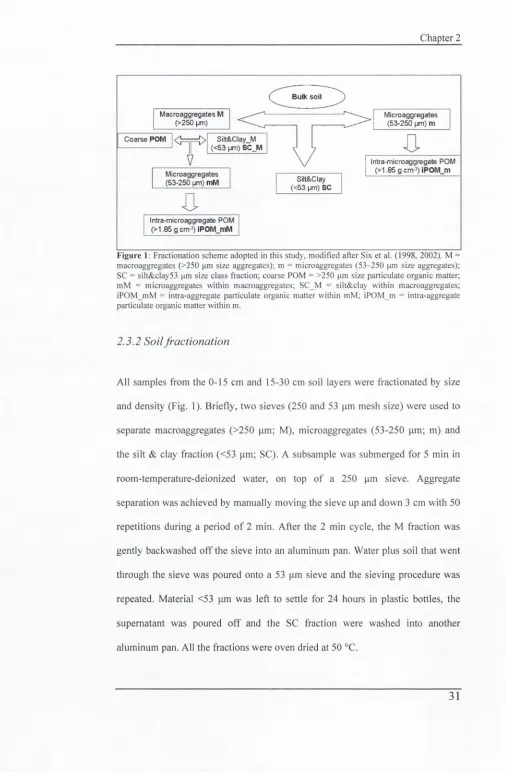
Bulk soil M acroaggregates M
(>250 (jm)
M icroaggregates (53-250 |jm) Itl C o a rse POM
Intra-microaggregate POM (>1.85 g cm IPOIVI_m M icroaggregates
(53-250 ^im) mlVI
Intra-microaggregate POM (>1.85 g cm 3) IPOM_mM
F ig u r e 1: Fractionation sch em e adopted in this study, m o d ified after S ix et al. (1 9 9 8 , 2 0 0 2 ). M = m acroaggregates (> 2 5 0 |im siz e aggregates); m = m icroaggregates (5 3 -2 5 0 |im siz e aggregates);
SC = silt& clay53 |j.m siz e cla ss fraction; coarse POM = > 2 5 0 jim siz e particulate organic matter; m M = m icroaggregates w ithin m acroaggregates; SC _M = silt& clay w ithin m acroaggregates; iPO M _m M = intra-aggregate particulate organic matter w ithin mM ; iPO M _m = intra-aggregate
particulate organic matter w ithin m.
2.3.2 Soil fractionation
All sam ples from the 0-15 cm and 15-30 cm soil layers were fractionated by size
and density (Fig. 1). Briefly, tw o sieves (250 and 53 [im mesh size) were used to
separate m acroaggregates (>250 |im; M), m icroaggregates (53-250 |im ; m) and
the silt & clay fraction (<53 p-m; SC). A subsam ple was subm erged for 5 m in in
room -tem perature-deionized water, on top o f a 250 |j,m sieve. A ggregate
separation was achieved by m anually m oving the sieve up and dow n 3 cm w ith 50
repetitions during a period o f 2 m in. A fter the 2 m in cycle, the M fraction was
gently backw ashed o ff the sieve into an alum inum pan. W ater plus soil that w ent
through the sieve w as poured onto a 53 |xm sieve and the sieving procedure w as
repeated. M aterial <53 |im w as left to settle for 24 hours in plastic bottles, the
supernatant w as poured o ff and the SC fraction were w ashed into another
[image:41.525.6.512.48.820.2]In the second step, the M fraction w as separated into coarse particulate
organic m atter (>250 jj.m; coarse PO M ), m icroaggregates (53-250 [im; m M ) and
silt and clay (<53 |im ; SC_M ) by using the m ethodology described in Six et al.
(2000). Subsam ples o f fraction M w ere im m ersed in deionized w ater on top o f a
250 |j,m m esh screen and gently shaken w ith 50 glass beads ( 0 5.4 m m ) for 10
min. The coarse POM w as retained on the 250 (xm screen, w hile a continuous and
steady w ater flow ensured that the m M were flushed onto a 53 |im sieve. O nce the
M fraction was broken up entirely, the m aterial on the 53 |im sieve w as wet-
sieved. The fraction retained on the 53 (j.m sieve (i.e. w ater-stable m M ) and the
fraction that passed through the 53 |j,m sieve (i.e. SC_M ) w ere collected and dried
at 50 °C.
Density fractionation was carried out by follow ing the m ethod described
in Six et al. (1998). Subsam ples (5 g) o f the oven-dried m and mM fractions w ere
suspended in 35 mL o f a 1.85 g cm'^ o f sodium polytungstate (SPT) solution and
slow ly shaken by hand. M aterial rem aining on the cap and sides o f the centrifuge
tube w as w ashed into suspension w ith 10 mL o f the SPT solution. A fter 20 min o f
vacuum (138 kPa), the sam ple w as centrifuged (1250 g) at 20 °C for 60 m in. The
floating m aterial was aspirated onto a 20 mm nylon filter, thereby rem oving all
undecom posed litter and root fragm ents from the soil sam ples. The heavy fraction
w as rinsed tw ice w ith 50 mL o f deionized w ater and dispersed by shaking it w ith
30 mL o f 0.5% sodium hexam etaphosphate for 18 h. The dispersed heavy fraction
w as passed through a 53 |i.m sieve and the m aterial rem aining on the sieve, i.e. the
intra-aggregate particulate organic m atter (iPO M ), w as dried (50 °C) and
2. S. 3 Total C and ‘^C analysis
The C contents and 5'^C signature were m easured for all soil and plant samples.
Sam ple preparation prior to isotopic analyses was sim ilar for all sam ples. Three
gram s o f each sam ple w as ball m illed and sub-sam ples o f 30 m g w ere w eighed
into A g capsules. Soil carbonates were rem oved using HCI fum igation as
described by H arris et at. (2001). Total C and 5'^C were determ ined at the UC Davis Stable Isotope Facility using a continuous flow, isotope ratio mass
spectrom eter (CF-IRM S, P D Z -E uropa Scientific, Sandbach, UK) interfaced with
a CN sam ple converter.
2.3.4 Data analysis
By convention, the '^C abundance in a sam ple is expressed in delta-units (5'^C%o)
according to the follow ing equation:
5'^C%0 = [ ( R s a m p l e ^ s t a n d a r d ) ~ 1] X 1000,
1 3 1 2 1 3 1 2
w here Rsampie is the isotope ratio C / C o f the sam ple and Rstandard is the C/ C
ratio o f the international Pee Dee form ation belem nite carbonate standard (PD B).
The fraction o f the soil C pool that is C4-derived (fjvi) is calculated by using the
isotope m ass balance equation (B alesdent et a l , 1987):
where 8 2 is the 5'^C o f the soil under Miscanthus, 5o is the 5’^C o f the soil before
introduction o f Miscanthus and 5i is the 5'^C of the Miscanthus plant material
entering the soil. As 8 0 was not known, the value from relevant depths o f the
reference field was used instead. The 5i represents an average o f S'^C values
determined for litter, rhizomes and roots from Miscanthus. Carbon concentrations
were expressed on an aggregate basis while the C contents o f SOM fractions were
calculated on an area basis, correcting for soil depth and bulk density.
We estimated the retention coefficient o f M i s c a n t h u s -C at our site
as the ratio o f the annual quantity o f C retained in the soil over the total annual
input o f Miscanthus C derived from above- and below- ground biomass (Hansen
et a i, 2004). In our calculations, we assumed that the yield data o f 2007 were
representative for the last 14 years. This approach assumes a full grown crop after
1 year, which overestimates the actual soil C input rate in the first years after the
establishment o f the Miscanthus field. On the other hand, the approach also
assumes that yield did not decline over time, which underestimates the actual rate
o f soil C input (Clifton-Brown et al., 2007).
2.3.5 Statistical analysis
. The results o f the experiment were tested for normal distribution using the
Shapiro-W ilk Test and the Sig. value was > 0.05 (i.e., the data have a normal
distribution) The results o f the experiment were then analysed as a split-plot
design, with land use as the main plot treatment. An ANOVA was conducted for
each soil depth using the SPSS 16.0 software package, with blocks as random
conducted with blocics as random effects and depth as fixed effect. The separation
o f means was tested using Tukey’s honestly significant difference with a
significance level o f P < 0.05.
2.4 Results
2.4.1 S oil profile
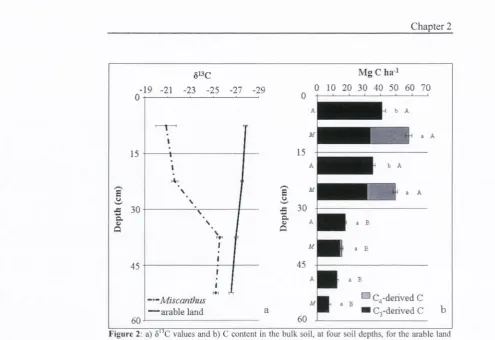
Integrated through the whole soil profile, the total SOC content under Miscanthus
is significantly (P < 0.01) higher than under arable crops (131.3 V5. 105.8 Mg C
ha '). Within soil layers, significant differences between the two land use systems
were found at the 0-15 and 15-30 cm depth (Fig. 2b). Top soil under both land use
systems contained significantly more C than lower soil layers.
The distribution o f soil C with depth differed between land use systems.
Under Miscanthus, 82.1% o f the total C stock was found in the upper 30 cm. In
the arable soil, on the other hand, the upper 30 cm contained only 61.9% of the
total C stock. Soil C content in both the 0-15 cm and the 15-30 cm layers were
significantly higher under Miscanthus (58.0 and 49.7 Mg C ha’') than in the
arable soil (42.1 and 34.7 Mg C ha"'). At lower soil depths, C contents did not
differ between land uses.
The input o f C4-derived C increased 5'^C values at all depths under
Miscanthus relative to the arable soil (Fig 2a). In the 0-15 cm soil layer, 42.6% o f
the total C pool in the 0-15 cm layer was Miscanthus derived. This value declined
cm layers (Fig. 2b). Integrated through the whole soil profile, 45.1 Mg C ha''
under Miscanthus was C4-derived.
After 14 years o f Miscanthus plantation, the estimated total biomass recycled to the soil was 170 Mg DM ha'', which is equivalent to a C input to the
soil o f 77 Mg C ha'' (Table 1). This estimate resulted in a retention coefficient of
JS Q. u
Q
— Misccmthus
— ai a b le la n d
M g C h a 1
0 10 2 0 3 0 4 0 50 6 0 7 0
1:1. u Q
^ C ^ -d e riv e d C
■ C j- d e r iv e d C
F igure 2: a) 8 C values and b) C content in the bulk soil, at four soil depths, for the arable land
(A) and the M iscanthus (M) system s. W ithin each depth, values follow ed by a different low ercase letter are significantly different (P<0.05) betw een land use system s (A and M). W ithin each land use system , values follow ed by different capitals are significantly different (P<0.05) betw een depths. For M iscanthus soils, the C 3 - and C4-derived C are indicated.
T able 1: Peak yield, estim ated C balance and coefficient o f retention for the
M iscanthus plantation. DM = dry m atter_____________________________________
P e a k y i e l d ( M g D M h a ' ' y r ‘')^ 1 6 .0
R e c y c l e d a b o v e g r o u n d b i o m a s s ( M g D M h a ' - y r ' ' ) ” 6 .9
R e c y c l e d b e l o w g r o u n d b i o m a s s ( M g D M h a ' 'y r - ') ^ 6 .5
S u m o f b i o m a s s r e c y c l e d t o s o i l ( M g D M h a ' ' y r ' ' ) 1 3 .4
T o ta l s o il i n p u t o f c a r b o n ( M g C h a '' yr'')"^ 6 .0
C a r b o n d e r i v e d f r o m M i s c a n t h u s ( M g C h a '' y r - ') ' 3 .2
C o e f f i c i e n t o f retention*^ 0 .5
“ D ata based on m ean peak yields in 2007.
D ata based on difference betw een peak yields and harvested biom ass in 2007, w e assum ed a 30% harvest loss o f above ground biom ass (C lifton-B row n et al.,
2007)
B elow ground biom ass estim ated as proportion o f the above ground biomass, allow ing a turnover tim e o f 4 years (H ansen et al., 2004). R atio above/below ground biom ass from C lifton-B row n et al. (2007).
45% o f the total biom ass recycled to the soil. ' D ata from Fig. 2.
[image:47.525.7.523.54.798.2] [image:47.525.13.509.60.400.2]□
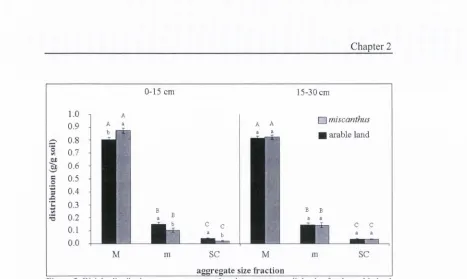
miscanthus ■ arable land [image:48.525.39.506.41.320.2]aggregate size fraction
Figure 3: Weight distribution among aggregate size classes, at two soil depths, for the arable land and the Miscanthus systems. Within each depth, values followed by a different lowercase letter are significantly different (P<0.05) within aggregate size and among land use systems. Within depth and land use system, values followed by a different capital are significantly different (P<0.05) between soil fractions. M = macroaggregates; m = microaggregates; SC = silt&clay.
2.4.2 A ggregate size fraction s
Aggregate size distributions followed the same pattern across both land use
systems and with soil depths, with the highest percentage o f soil being present as
M, followed by m and SC (Fig. 3). In the 0-15 cm layer, Miscanthus soil has a higher percentage of M compared to the arable land, while the arable soil
contained a higher proportion o f m and SC fractions. Here, the difference in the
weight distribution of the aggregate size classes between land uses was consistent
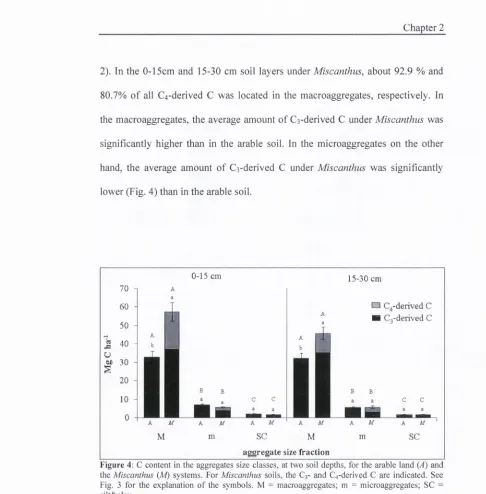
with their respective C content. Macroaggregates under Miscanthus contained 57.4 Mg C ha"' in the 0-15 cm layer, and 45.4 Mg C ha"' in the 15-30 cm layer.
These values are significantly higher than the C content o f the same fraction in the
arable soil.
Both in the 0-15 cm and 15-30 cm soil layers, the 5'^C values o f all aggregate size
2). In the 0-15cm and 15-30 cm soil layers under Miscanthus, about 92.9 % and
80.7% o f all C4-derived C was located in the macroaggregates, respectively. In
the macroaggregates, the average amount of Cs-derived C under Miscanthus was
significantly higher than in the arable soil. In the microaggregates on the other
hand, the average amount o f Cs-derived C under Miscanthus was significantly
lower (Fig. 4) than in the arable soil.
0-15 cm 15-30 cm
□ C^-derived C ■ C ,-derived C
SC M
a g g r eg a te size fra ctio n
SC m
m
[image:49.525.22.508.57.551.2]T able 2: 5'^C values for soil aggregate fractions.
6'^C
Depth (cm) Land use Soil aggregates
M m SC
0-15 Miscanthus -21.45 -23.24 -26.20
(1.19) (1.14) (0.55)
Arable land -26.43* ■-27.50* -27.11
(0.57) (0.03) (0.04)
15-30 Miscanthus -23.80 -22.50 -25.20
(1.10) (1.89) (0.94)
Arable land -27.12* -26.92* ■-27.01*
(0.06) (0.20) (0.08)
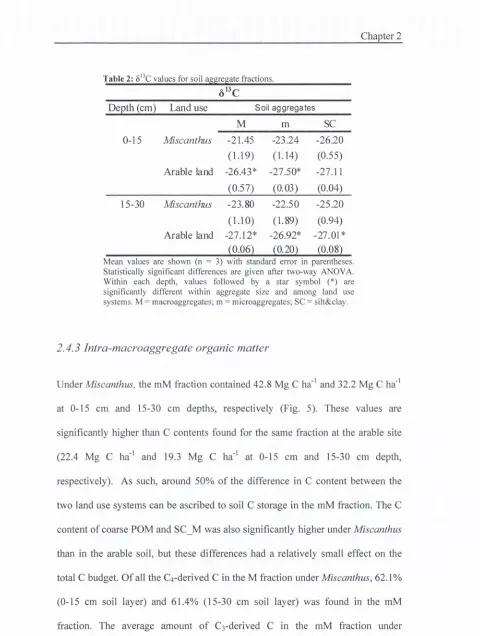
M ean values are show n (n = 3) w ith standard error in parentheses. Statistically significant differences are given after tw o-w ay AN OVA . W ithin each depth, values follow ed by a star sym bol (*) are significantly different w ithin aggregate size and am ong land use system s. M = m acroaggregates; m = m icroaggregates; SC = silt& clay.
2.4.3 Intra-macroaggregate organic matter
Under Miscanthus, the mM fraction contained 42.8 Mg C ha’’ and 32.2 Mg C ha’'
at 0-15 cm and 15-30 cm depths, respectively (Fig. 5). These values are
significantly higher than C contents found for the same fraction at the arable site
(22.4 Mg C ha'' and 19.3 M g C h a'' at 0-15 cm and 15-30 cm depth,
respectively). As such, around 50% o f the difference in C content between the
two land use systems can be ascribed to soil C storage in the mM fraction. The C
content of coarse POM and SC_M was also significantly higher under Miscanthus
than in the arable soil, but these differences had a relatively small effect on the
total C budget. O f all the C4-derived C in the M fraction under 62.1%
(0-15 cm soil layer) and 61.4% (15-30 cm soil layer) was found in the mM
[image:50.525.29.509.51.687.2]Miscanthus was higher than in the arable soil; however, this difference was not
statistically significant (Fig. 5).
0 -1 5 cm 1 5 -3 0 cm
□ C^-derived C
■ C j-d eriv ed C
SC M SC M
in tr a -m a c r o a g g r e g a te o r g a n ic m a tte r
F ig u r e 5: C content in the intra-m acroaggregate organic matter, at tw o so il depths, for the arable land (A) and the M iscan th u s (M ) system s. S e e Fig. 3 for the explanation o f the sym b ols. For M isca n th u s so ils, the C 3 - and C4-derived C are indicated.. C oarse POM = > 2 5 0 |jm siz e particulate organic matter; m M = m icroaggregates w ithin m acroaggregates; S C _M = silt& clay w ithin m acroaggregates.
2.4.4 Intra-microaggregates POM
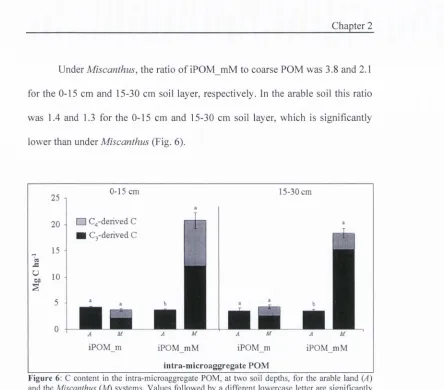
Under Miscanthus, iPOM_mM contained 20.8 Mg C ha’’ at 0-15 cm depth, 8.6
Mg o f which was C4-derived. At the 15-30 cm depth iPOM_mM contained 18.2
Mg C ha"', 3.1 Mg o f which was C4-derived. In the arable soil, iPOM_mM
contained 3.4 Mg C ha’’ at both 0-15 and 15-30 cm soil depth, significantly less
than under Miscanthus. In the iPOM_mM, the amount o f Cs-derived C under
Miscanthus was significantly higher compared to the arable soil. The iPOM mM
fraction accounted for 30% of all the Cs-derived C in the M fraction under
[image:51.525.0.486.64.819.2]