Journal of Criminal Law and Criminology
Volume 54
Issue 4
December
Article 13
Winter 1963
Handwriting Standard Forms
David J. Purtell
Follow this and additional works at:
https://scholarlycommons.law.northwestern.edu/jclc
Part of the
Criminal Law Commons
,
Criminology Commons
, and the
Criminology and Criminal
Justice Commons
This Criminology is brought to you for free and open access by Northwestern University School of Law Scholarly Commons. It has been accepted for inclusion in Journal of Criminal Law and Criminology by an authorized editor of Northwestern University School of Law Scholarly Commons.
Recommended Citation
DAVID J. PURTELL
Capt. David J. Purtell is the Senior Document Examiner with the Chicago Police Scientific Crime Detection Laboratory. Capt. Purtell is a member of the Executive Committee of the American Acad-emy of Forensic Sciences, a member of the American Society of Questioned Document Examiners, and an author of a number of articles on various phases of questioned document examination. This paper was presented at the First International Meeting in Questioned Documents, London 1963.-EDToP.
With the investigator lies the source for the accumulation of handwriting standards. If the quality of the standards that they submit are poor, it is because they are uncertain as to how to attack the problem of procuring them. Time is of the essence when a prisoner is being held and in the investigator's confusion to obtain standards, he may overlook many opportunities to obtain the necessary material. If insufficient or poor quality standards are obtained, the opportunity may never present itself again. So aiding the investigator in selecting the right material is vital and more in-telligent than allowing him to wander around aimlessly on his own as he collects standards in a hit or miss fashion.
To overcome these shortcomings, some in-vestigators and departments have tried to develop a form upon which the suspect would write, but the form gave the appearance of fingerprint identifi-cation cards and unusable printing papers. The material requested to be written appears to have been extracted from Greek mythology rather than being extracted from common everyday names and words. Can you imagine expecting a person of meager intelligence, of which we have an abundance in criminal cases, to write such names as Yolo, Zamora, Irmig, Unthank, Xerxes, and Liza Squid?
The materials that have been suggested for dictation are passages, such as; the London Letter' which also falls into this mediocre category. These words are in no way practical. How many times have you encountered any of these words in an examination? Moreover, have you ever tried to dictate the London Letter or similar suggested passages to a person in the low intelligence bracket? It is so utterly unfamiliar to the person that it scares him. If you insist, he will go through the I A. S. Osborn, Questioned Documents, second edi-tion, Boyd Printing Company, Albany, 1929, page 34.
motions by scribbling on the paper in an effort to disguise his misspelling.
It is apparent that the people who instigated these forms bearing such ridiculous names and unusable passages concerned themselves with only upper and lower case letters but failed to take into consideration commonly used names and words and the combination of letters that is always so valuable in a comparison.
Chicagoland area, being the great metropolis that it is, embraces approximately five million people of many types. We have our share of illiter-ate people, white and colored southern migrants, Puerto Ricans, Mexicans, and displaced persons. These people for the most part are foreign to the language and to our way of life. Even our own so-called school "drop-outs", whose knowledge of writing and spelling is limited, could be added to the above list. From these groups come the majority of those who are involved in criminal cases and with whom we must work in extracting handwriting samples. Those aids which were in use proved unsatisfactory. Consequently, it be-came imperative that forms had to be developed
if any headway was to be made in obtaining proper
standards.
HANDWRITING STANDARD FORMS
this form will aid other departments and agencies in evaluating their own methods of obtaining handwriting standards or in developing forms.
Structurally, the upper section of Form 1 has the appearance of an employment application
(figure 1). Having been confronted with such forms in many of their school and business transactions, most people are oriented in filling them out so that poses no problem. The requested background information consists of the person's name, address, date, telephone number, and the place and date of birth. From here we progress into references on relatives and employments. The request for the writing of social security numbers and the salaries received is not unexpected while presenting addi-tional numerals and dollar signs. The completeness, simplicity, and familiarity of this form are the qualities that produce valuable comparative ma-terial.
It may seem comical, but the only instances where we have encountered any difficulty with this form is our request for the listing of the names of the suspect's relatives. Most suspects are reluctant to have their relatives know that they are being questioned by the police, and once they are as-sured that their relatives will not be contacted, they complete the form without any hesitation. Whereas the upper portion of Form 1 resembles an application blank, the lower section of the front page contains a list of common everyday first names and surnames. The great majority of first names are those in frequent use while the source from which the surnames were chosen was the telephone books that service the Chicagoland area. Extending over approximately 3800 pages, the telephone books expose over two million sur-names which presented a good cross section of the populace. Of these, the most common names were chosen, and they, in turn, were studied as to their value in the way of comparable material. Consider-ation was given to all letters of the alphabet, their position in the word as well as the combination of letters that they exhibited. Some common names were combined with some common endings resulting in such names being used as "Young-berg".
To exemplify the method applied in the selection of surnames, let us consider the names which start with the capital letter "H". Using the telephone books as our guide, we found the following names and the number of times that each was listed therein: Hanson and Hansen-2400; Harris-3500;
Harrison-1000; Hill-2000; Hall-2000; Howard
-1600; Hughes-1700. Weighing the above
sur-names against such first sur-names as Henry, Harold, and Howard, we determined to use the name "Harrison" since our survey revealed that approxi-mately 9000 names began with the "Ha" letter combination. Moreover, the name "Harrison", besides satisfying names like "Harry" and "Harris" discloses the "son" and "on" combina-tions of letters that are so numerous and common-place in our language.
The surnames, "Novak" and "Kowalski" are very prevalent in Chicago, and for that reason each of them appears on the form. "Novak" was also chosen in preference to "Norman" because it would be more likely to be encountered, and this has proven to be true. To the right on the very last line, the writer signs his name just as he did when he started to fill out the form. Factually, then, the first, last, and all the writings in between is the suspect's writing. We have had instances wherein the suspect rather than writing his signa-ture, writes the printed words, "Your Signature". We have tried to combat this by using different phraseology, but it still occurs occasionally. A person of meager intelligence is inclined to write the printed words without giving any thought as to what is actually requested. They appear to be concentrating on the writing of what has to be written rather than ways to disguise their writing. The material that is requested to be written on the reverse side follows the same format as the front side, and the one we have just discussed (figure 2). The suspect writes his name and the date, followed by the writings of the street ad-dresses and the names of the cities and states. Names of streets, cities, and states are requested for the value that they might give toward writings in endorsements or on envelopes. Many times these names could also double as a common name of a surname as in Lake, Parker, Black, Woods, Ander-son and Hill. To delve still further into the realm of names, the state names of Virginia and Georgia are also girls' names whereas the name Washington could be a person's first or last name, the name of a city or a state, or it could be the name of a very prominent street in Chicago. Washington is also a word of convenience primarily because it exhibits three combinations of letters, "Wash", "ing", and "ton", and it has the advantage of being a word that everyone can spell without any assist-ance.
-
~~~~~~
0 0 0 r P t P t ' 0 -t~ 0 E= 00W 203 P at
- P t P r 0 >t 0 O0 -n -C>
o r -c P 00 0 E 0 Y- .20* SE Pa 0t 0 Pt P 0 Ot
Pt
~
r Pt KM P 04 4 04~ Ptt 0 PPt r
*4
~
Pt . P Ptr0 P 0 - P
-c t Pt Pt Pt t r P
Pt PtPt
~
r PLAB NO. _ CHICAGO POLICE DEPARTMENT
CRIME LABORATORY
NAME
RA CS CDNAN S H D R L Y MS L
Figure 1
HAT
S
-s
'-I
HANDWRITING STANDARD FORMS 525
M.
C. ob'
40 m
< M - *
CF
rr,
° I " 0I, o ._.. , -J - .
C, o
-X',/
00 O
4E Mn in
0: M
..- _- '0 xx....,
-(
t
-+
..
~
> r" ,- '
>
1
3 r I3
_ -P a 00 Z ._/
mmI 07 t
'b -f .1.
0 or z) >
z
7->~ M n 'a E In -M .0 Ma
MI 40 rr
re F >~ > >
Cr 01 5
C', 2 .4E 5
z r : =
r
>
-1
0
:E
IF-r All * 8
_.x
o
x4
.o,
>z]
."J
INSTRUCTIONS TO INVESTIGATOR IN OBTAINING REPRESENTATIVE WRITING SPECIMENS: I. To complete this form, -it the
writer at a deak provided with a normal nib fountaid pen. Instruct him to answer every question in handwriting or handprinting using no abbrevistions. 2. ADDITIONAL STANDARDS should be obtained by duplicating the original paper and writing instrument and dictating'
at least 3 timos, selected portions of the questioned document without aiding in spelling or punctuation. In check cases use voIded checks. 3. Also obtain driver's license, identification cards, applications, personal letters, etc. 4. Officer obtaining standards will
sa that every line Is completed and then sign as witness.
The space allowed for the writing of amounts is exactly the same as that which is recommended by the American Bankers Association for business sized checks. We choose these particular amounts to be written because these combinations of figures are prevalent on fraudulent checks which are received in our laboratory, and they allow the writing of words that represent numerals. Besides all the writing of figures that is requested on the front side of the form, the reverse side gives the writing of each figure two or three times.
The message to be 'handprinted is made up of words selected for their frequency of use in letters appearing in the Anonymous Letter File main-tained by the Chicago Police Crime Laboratory. The message concocted may seem very innocent and meaningless, but it should be obvious what we are attempting to do here. The words, "The money in dollars" are found in almost every extortion, robbery, and burglary note. While the words, "trouble", "auto", "never to be found", "killed", and "received" are in letters of violence. To ob-tain material for comparison in obscene letters, we combine the last part of Virginia McLong's last name with the first name of Dick Zass. Dropping the last two letters in "Virginia" and the capital letter"Z" in Zass exposes words that show up on obscene letters. The more obvious words such as, "pussy", "jump" and "trick" have no hidden connotations. All of the words in this message give material that can be used in comparison and, in no instance, have we requested the subject to write a vulgar word. Having this quality, the form can be offered to all sexes and classes of people without fear of offending them. At the same time the ma-terial that we are striving to obtain is obscure. The space in which the suspect writes is slightly under 8 x 10 inches and can be photographed easily with 8 x 10 inch film. It is recommended that the inner lines be printed in a colored ink, preferably light blue, which can be deleted when photographed with filters. These lines are very important for if they are too thick they will interfere with a com-parison and may, when photographed, cover up a very important point. If the form must be printed in black ink, the lines upon which the writing is to be executed should be very thin. A thin line is superior to either a dotted or a broken line. In order to avoid overlapping of writing, allow enough space between requested words.
The printed form is so arranged on a 8Y2 x 11 inch sheet of paper that we have an empty block on the right hand side which is useful for filing
information and for giving instructions to the investigator on how to obtain representative hand-writing specimens. These instructions are really reminders so they are kept short and to the point and are in no way confusing.
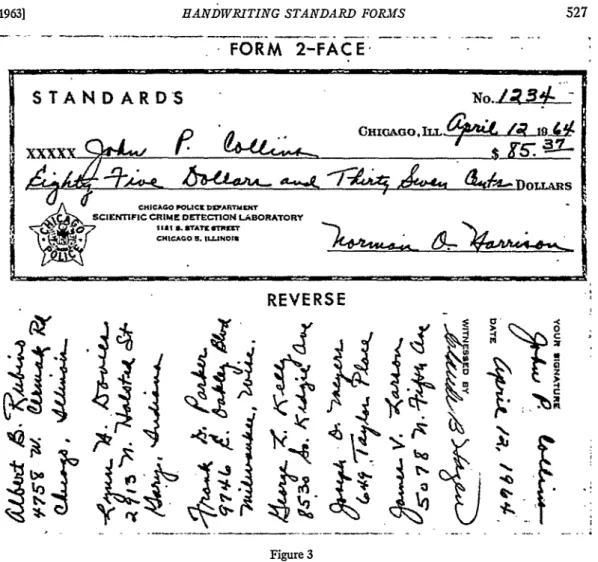
To complement Form 1, we have developed two others which make a set. From experience we have learned that some people will refuse to fill out a cancelled or voided check for fear of exposing themselves to some kind of trickery (figure 3). Therefore, we eliminated the bank name, its code numbers and the words, "Pay to the order of" and inserted "Standards", five "X"s and the
Chicago Police insignia. This form is in accord with the comparable material rule for it has been printed according to the specifications set forth by the American Bankers Association. Using safety paper on which to take writing standards facilitates photographing with the questioned check and eliminates any misconception among jurors. If the questioned document is a check and all the requested writing is taken on white paper and a photographic chart is made, it is possible that some juror might mistakenly take the background of the two for differences which would make it difficult to focus his attention on the similarities present in the handwriting. This very thing actually occurred when a defense attorney, seeing different backgrounds, believed or tried to convince the court that something was wrong. On the reverse-side of Form 2, space is provided for dictation of endorsements and signatures of the suspect and the witness.
OHANDWRMTING STANDARD FORMS
FORM
2-FACE-REVERSE
Figure 3
The paper used for the taking of standards should be sturdy enough, and of good quality and sufficient weight to withstand a fair amount of handling.
On many handwriting standard forms, there appears a printed notation that the handwriting contained therein was given freely and voluntarily. Some forms exhibit long, lengthy statements to this effect giving them the appearance of being designed by a lawyer rather than a document examiner. Judging from the amount of space allotted for the statement and the obtaining of handwriting, these forms appear to be more con-cerned with publicizing the statement than the obtaining of comparable handwriting. The writer of this article feels that there is no intrinsic value in publicizing such a statement because any stand-ards which are obtained through force or violence would be worthless for comparison. Handwriting must be given freely and voluntarily to be of value. If the law requires that such a statement must
appear on a handwriting standard form, the word-ing should be kept to a minimum, and it should be pre-printed using a small readable sized type and placed at the bottom of the form. In regards to the forms under discussion, a portion of the right hand box on the face of Form 1, could be utilized for this purpose or a statement could appear at the bottom of Form 3.
These forms, in themselves, represent the equip-ment usable in procuring standards. The manner in which the investigator interprets the instructions and carries them out as well as his overall use of the forms complete the picture. The obtaining of proper requested handwriting standards is not a simple task because it requires careful preparation for desirable results which takes time, skill, pa-tience, persuasion, and perseverance.
SUAUTARY
The forms discussed in this article have bene found to be extremely useful in the work of the
NAME
f
&&XQW
FORM
3
DATE
NAME DATE
/ 63
Figure 4
Chicago Police Department. It is the author's use in other localities, but reasonable consideration
belief that intelligent adaptation of these forms in of how the material was developed and duplication
other metropolitan police departments and in fed- of these techniques by other law enforcement
eral and state law enforcement agencies can be agencies will lead to handwriting standard forms
made. Of course, it would be illadvised to adapt, for use in their agency of far greater utility than
for example, all of Form 1 in its present form for many which are now being used.