International Journal of Emerging Technology and Advanced Engineering
Website: www.ijetae.com (ISSN 2250-2459,ISO 9001:2008 Certified Journal, Volume 2, Issue 12, December 2012)
626
Performance, Problems and Remedial Measures for the
Structures Constructed on Expansive Soil in Malwa Region,
India
Kartikey Tiwari
1, Sahil Khandelwal
2, Aman Jatale
31Department of Civil Engineering, Sanghvi Institute of Management & Science Behind IIM-Indore, Pigdambar, 453331,
Indore, India
2Department of Civil Engineering, Sanghvi Institute of Management & Science Behind IIM-Indore, Pigdambar, 453331,
Indore, India
3Department of Civil Engineering, Sanghvi Institute of Management & Science Behind IIM-Indore, Pigdambar, 453331,
Indore, India
Abstract—The Present paper deals with the properties of expansive soil in Indore (Malwa region), Madhya Pradesh, India. The expansive soil here especially posses a problem to many Structures and National Highways constructed which is caused due to presence of mineral Montmorillionite. This paper presents the case study about the Performance, Problems, and Remedial measures for the Structures Constructed on expansive Soil. The swelling characteristics of expansive soil and its effects on the structures are being revealed.
Expansive soil popularly known as Black Cotton Soil presents a very challenging task for construction work in Malwa region. The effect of adding Gypsum, Crude oil and Laying CNS (Cohesive Non-swelling) layer on expansive soil is studied. In areas with very less probability of seismic activities, vibratory ground improvement can reduce the potential for liquefaction and ground deformation due to lateral spreading. Various tests are performed on the expansive soil to determine its Swelling Pressure test, Tri-axial Compression Test, Optimum Moisture Content, Conducting Field Density, Liquid Limit, Plastic Limit, Shrinkage Limit, Specific Gravity etc.
The experimental results of this paper seeks to explore and explain the phenomena causing swelling and the attendant damage based on a local setting, and on the basis of this study various multiple remedial measures are given to overcome the swelling of expansive soils by different means and it is found that swelling pressure decreases with increase in bearing capacity of soil by addition of Gypsum, Crude oil, Laying CNS layer and use of Under-reamed piles (single bulb) under economical consideration.
Keywords: CNS layer, Crude oil, Expansive Soil, Gypsum, Swelling characteristics, Under-reamed piles.
I. INTRODUCTION
Large scale distress, due to expansive shrinking nature of expansive soil, can be prevented by either obstructing the soil movement and reducing the swelling pressure of soil or making the structure sufficiently resistant to damage from soil movement.
In Malwa region, India previously it seems that only Black Cotton Soil up to greater depth. However, during construction of Indore By-pass ( Presently RAU-MANGLIYA BY-PASS ) project, it was observed that
Montmorillionite (60-70 %), Illite (5-10 %), Kaolinite (5-10%) is present.
Essentially expansive soil is one that changes in volume in relation to changes in water content, Expansive soils are found in humid environments where expansive problems occur with soils of high Plasticity Index (Ip) or in Malwa soils where soils of even moderate expansiveness causes significant damage. Expansive soils contain minerals such as
Montmorillionite, Illite, Kaolinite clays that are capable of absorbing water. When they absorb water they increase in volume, The more water they absorb the more their volume increases. This change in volume can exert enough force on a structure to cause damage. These volume changes are either in the form of swell or in the form shrinkage and this is why they are sometime known as swell/shrink soils.
Shrink-swell soils which expand due to high ground moisture experience a loss of soil strength or “capacity” and the resulting instability results in various forms of Sub-grade problems and slope failure.
Expansive soils will also shrink when they dry out. This shrinkage removes support from structures and result in damaging subsidence. Fissures in the soil also develop. These fissures facilitate the deep penetration of water when moist conditions or runoff occurs. This produces a cycle of shrinkage and swelling that places repetitive stress on structure.
International Journal of Emerging Technology and Advanced Engineering
Website: www.ijetae.com (ISSN 2250-2459,ISO 9001:2008 Certified Journal, Volume 2, Issue 12, December 2012)
627
Soils are composed of a variety of materials, most of which do not expand in the presence of moisture. However, a number of clay minerals are expansive. These include: montmorillionite. There are also some sulphate salts that will expand with changes in temperature. When a soil contains a large amount of expansive minerals it has the potential of significant expansion. When the soil contains very little expansive minerals it has little expansive potential.The structures commonly affected by expansive soil are residential structures, roads, irrigation canals & spillways. This report deals exclusively with variations of Swelling Pressure, Tri-axial Compression Test, Optimum Moisture Content, Conducting Field Density, Liquid Limit , Plastic Limit, Shrinkage Limit, Specific Gravity etc. through expansive soil in context of slab-on-grade performance in Malwa region, India.
II. PROBLEMS FOR THE STRUCTURES CONSTRUCTED ON
EXPANSIVE SOIL
[image:2.595.330.556.120.300.2]The problem is more in case of light structures; those cannot counteract the upward thrust posed by expansive soils. The damage will be apparent, usually, several years after construction. The soil below will exert swelling pressure both upwards and laterally. As a result, the Sub-grade of road & floor slab is lifted up, leading to cracking roads & floor. Cracking is normally evident at the Surface texture of roads & corners of window and door openings.
Fig 1.Cracks in interior walls, as a result of upward soil pressure
The ensuing leakage further aggravates the situation. Roads that pass through expansive soil sub-grade are subjected to heaving and shrinkage settlement of these treacherous soils. Both the lined and unlined canals are subjected to the vagaries of expansive soils. The unlined canal slopes erode and become soft. Canal beds heave up obstructing the functioning of the canal. The concrete linings splinter like glass pieces on account of deleterious cyclic movement of background swelling clay. This heavy results in seepage losses.
Fig.2. Cracks develop at Indore-bypass
III.RESULT A. Experiments Performed
1. Specific Gravity 2. Soil Classification 3. Liquid Limit 4. Plastic Limit 5. Plasticity Index 6. Shrinkage Limit
[image:2.595.316.535.452.743.2]7. Optimum Moisture Content 8. Conducting Field Density
[image:2.595.58.278.468.631.2]International Journal of Emerging Technology and Advanced Engineering
Website: www.ijetae.com (ISSN 2250-2459,ISO 9001:2008 Certified Journal, Volume 2, Issue 12, December 2012)
[image:3.595.322.560.117.413.2]628
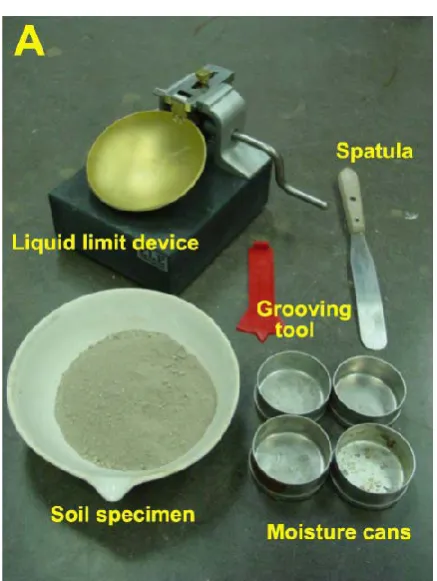
Fig. 4. Soil sample filled in bowl of cassegrande Apparatus. [image:3.595.60.291.130.414.2]
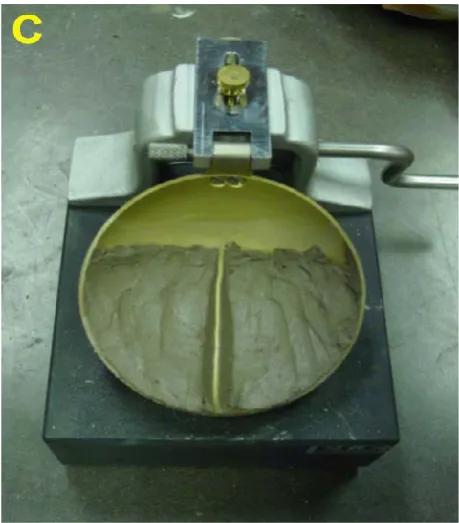
Fig. 5. Cut made in soil sample
Fig. 6. Soil sample after performing test.
[image:3.595.319.545.468.734.2] [image:3.595.49.279.475.737.2]
International Journal of Emerging Technology and Advanced Engineering
Website: www.ijetae.com (ISSN 2250-2459,ISO 9001:2008 Certified Journal, Volume 2, Issue 12, December 2012)
[image:4.595.66.286.129.444.2]629
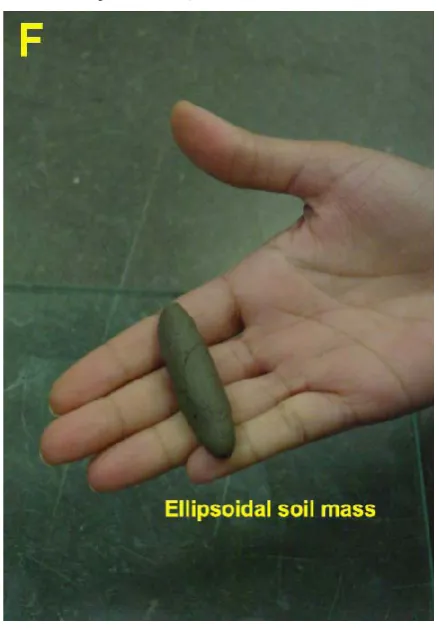
Fig. 8 Ellipsoidal soil mass during test.TABLE I RESULTS OF EXPERIMENTS
Sr.No. Particulars Observations
1. Specific Gravity 2.65
2. IS Soil Classification MH-OH
3. Liquid Limit (WL) 58.73 %
4. Plastic Limit (WP) 32.18 5. Plasticity Index (IP) 26.55 6. Shrinkage Limit (WS) 17.19 7. Optimum Moisture Content
(%) 18.63 %
8. Conducting Field Density (KN/M3)
16.89 %
9. Degree of expansion Very High
Fig. 9. Graph Between Plastic Index and liquid Properties
IV.SUGGESTED REMEDIAL MEASURES FOR EXPANSIVE
SOIL
A. Providing Foundation surrounded with Granular Fill:-
1. Excavation carried out upto depth greater than the depth of foundation by about 20-30 cm. 2. Free drainage material such as mixture of sand
& gravel is filled & compacted upto the bottom level of foundation.
3. R.C.C footing foundation is constructed at this level, over which the brick wall may be raised. 4. A R.C.C apron with light reinforcement and of
about 2m width is provided all along the building to prevent the moisture from directly entering the foundation.
5. The cushion of granular soil below the foundation will absorb the effect of swelling, thereby reducing its detrimental effects on R.C.C foundation.
6. Provide slotted footing so that this may reduce the swelling pressure.
International Journal of Emerging Technology and Advanced Engineering
Website: www.ijetae.com (ISSN 2250-2459,ISO 9001:2008 Certified Journal, Volume 2, Issue 12, December 2012)
[image:5.595.50.546.88.604.2]630
Fig. 10. Wall without Footing and Wall with Footing and Void [image:5.595.326.546.290.621.2]Ratio
Fig. 11. Typical Shallow Foundation in Expansive Soil
B. Using CNS layer technology:-
1. This method consists of laying a layer of Cohesive-Non swelling soil (CNS), over the expansive soil to a depth to counter react the detrimental effect of having caused due to Expansive soil.
2. The larger the thickness of CNS layer over the expansive soil lesser the swelling and Deformation.
3. Evidently the thickness of CNS layer is thicker for more expansive soil & thinner for less Expansive soil.
4. Some percentage of clay, sand and the existing swelling soil may be used as CNS material.
The use of CNS layer has found to be very effective in construction of road pavement and also water resources project particularly in Lining of Canals constructed in expansive soil in Indore. The CNS layer is placed over & before placing of side slopes for roads and lining of water resource projects.
TABLE II
FOR THICKNESS OF CNS LAYER FOR SLOPING & LINING OVER EXPANSIVE SOIL
Swelling Pressure of Soil in KN/M2
Thickness of CNS Material in cm.
50 – 150 75 – 85
200 – 300 90 – 100
350 – 500 105 – 125
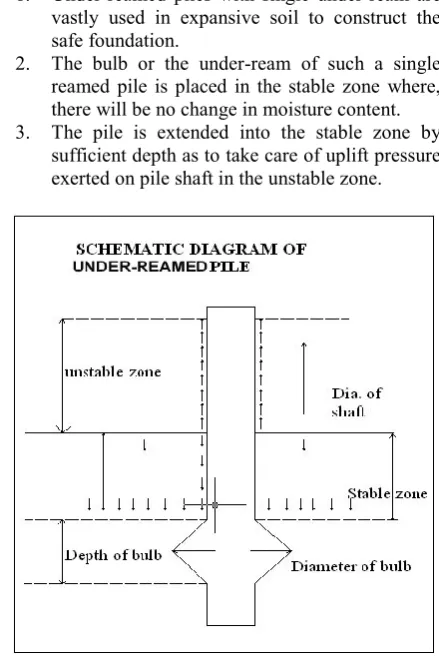
C. Using of Under-reamed Piles to Carry Load up to Stable Zone:-
1. Under-reamed piles with single under-ream are vastly used in expansive soil to construct the safe foundation.
2. The bulb or the under-ream of such a single reamed pile is placed in the stable zone where, there will be no change in moisture content. 3. The pile is extended into the stable zone by
sufficient depth as to take care of uplift pressure exerted on pile shaft in the unstable zone.
Fig. 12. Schematic Diagram of Under-Reamed Pile (Single-bulb in-cast situ Pile)
D. Addition of Gypsum:-
1. Gypsum, in addition to prevention and correction of sodicity, include greater stability of soil organic matter, more stable soil aggregates, improved water penetration into soil, and more rapid seed emergence.
[image:5.595.60.282.322.497.2]International Journal of Emerging Technology and Advanced Engineering
Website: www.ijetae.com (ISSN 2250-2459,ISO 9001:2008 Certified Journal, Volume 2, Issue 12, December 2012)
631
3. Gypsum improves the ability of soil to drain andnot become waterlogged due to a combination of high sodium, swelling clay, and excess water. 4. Soils that have been treated with gypsum have a
wider range of soil moisture levels where it is safe to till without danger of compaction or de-flocculation.
5. Gypsum can decrease the swelling and cracking associated with high levels of sodium on the montmorillionite type clays. As sodium is replaced by calcium on these clays they swell less and therefore do not easily clog the pore spaces through which air, water and roots move.
Addition of gypsum will reduce the swelling pressure. Limit the foundation depth if swelling soil is at some depth so that distance between foundation and swelling soil will be more and as the distance is more there are less chances of cracks in building. Take effective measures to maintain moisture equilibrium in foundation soil, add Narmada sand in the existing swelling soil.
E. Crude Oil:-
1. It should be sprayed on top surface of the roads as it helps in lubrication of surface layer with the aggregates.
2. It should be preferred over water as its density is much higher than that of water.
V. CONCLUSION
Expansive soils are one of the most significant ground related hazards found in central region, Expansive soils are found throughout and are commonly found in arid/semi-arid regions where their high suctions and potential for large water content changes on exposure/deficient with water can cause significant volume changes. In humid regions such as Indore problematical expansive behaviour is generally occurs in clays of high IP. Either way, expansive soils have the potential to demonstrate significant volume change in direct response to changes in water content. This can be induced through water ingress, through modification to water conditions or via the action of external influence such as trees.
To understand and hence engineer expansive soils in an effective way it is necessary to Understand soil properties, suction/water conditions, water content variations temporal and Spatial and the geometry/stiffness of foundations and associated structures. This paper Provides an overview of these features and includes methods to investigate expansive Behaviour both in the field and in the laboratory together with associated empirical and Analytical tools to evaluate expansive behaviour. Following this remedial measures for pre and Post constructions are highlighted for both foundations and pavements together with methods to ameliorate potentially damaging expansive behaviour
REFERENCES
[1] Snethen, D.R. et al. (1979), “An evaluation methodology for prediction and minimization of Detrimental volume change of expansive soils in highway sub grades”, research report, Vol.
prepared for federal highway administration, Washington [2] Soil Mechanics and Foundations By - Dr. B.C. Punmia,
Ashok Kumar Jain, Arun Kr. Jain
[3] Expansive Soil and Expansive Clay : geology.com [4] Moisture Movement Through Expansive Soil and Impact on
Performance of Residential Structures By Heather Beata Dye.
[5] Expansive Soils: Recent Advances in Characterization and Treatment edited by Amer Ali
Al-Rawas, Mattheus F. A. Goosen.
[6] John D. Nelson and Debora J. Miller. Expansive Soils – Problems and Practice in Foundations and Pavement Engineering. Department of Civil Engineering, Colorado State University.
[7] Chen, F.H. (1988). “Foundations on Expansive Soils”, Elsevier publications Co., Amsterdam.
[8] Leonards, G.A. (1962). “Foundation Engineering”, Mc-Graw Hill Book Co., New Delhi.
[9] Hausmann, M.R. (1990). “Engg . Principles of Ground Modification”, Mc Graw Hill Book Co., New Delhi. [10] Mohan Rai and jaisingh, M.P. (1985). “Advances in
Building materials and construction”, CBRI Publication, Roorkee, India.
[11] Prof. Binod Kumar - National Workshop on Soil and Highway Material Testing (2012).
[12] Mathur, A.K. (1995) “Study of Gypsum on the Swelling Pressure Characteristics” M.E.Thesis, J. N.V. University, Jodhpur.
[13] Prasada Raju, G.V.R. (2001). “Evaluation of flexible pavement performance with reinforced and chemical stabilization of expansive soil sub grades”. A Ph.D Thesis submitted to Kakatiya University, Warangal, (A.P.) [14] Srinivas, M. (2008), Test track studies on chemically