t o ol s s uffici e n tly a d d r e s s t h e
s o ci al is s u e s in l e a r ni n g ?
Ke r a m i niy a g e , KP, I n gi ri g e , MJB a n d Am a r a t u n g a , RDG
T i t l e D o t h e m o d e r n d i s t a n c e l e a r n i n g t o ol s s uffici e n tly a d d r e s s t h e s o ci al is s u e s i n l e a r n i n g ?
A u t h o r s Ke r a m i niy a g e , KP, I n gi ri g e , MJB a n d Am a r a t u n g a , RDG
Typ e C o nf e r e n c e o r Wo r k s h o p I t e m
U RL T hi s v e r si o n is a v ail a bl e a t :
h t t p :// u sir. s alfo r d . a c . u k /i d/ e p ri n t/ 2 0 0 9 /
P u b l i s h e d D a t e 2 0 0 6
U S IR is a d i gi t al c oll e c ti o n of t h e r e s e a r c h o u t p u t of t h e U n iv e r si ty of S alfo r d . W h e r e c o p y ri g h t p e r m i t s , f ull t e x t m a t e r i al h el d i n t h e r e p o si t o r y is m a d e f r e ely a v ail a bl e o nli n e a n d c a n b e r e a d , d o w nl o a d e d a n d c o pi e d fo r n o
n-c o m m e r n-ci al p r iv a t e s t u d y o r r e s e a r n-c h p u r p o s e s . Pl e a s e n-c h e n-c k t h e m a n u s n-c ri p t fo r a n y f u r t h e r c o p y ri g h t r e s t r i c ti o n s .
Do the Modern Distance Learning Tools Sufficiently Address
the Social Issues in Learning?
Kaushal Keraminiyage, [email protected] Bingunath Ingirige, [email protected] Dilanthi Amaratunga, [email protected]
Abstract
Modern Computer Mediated Communication (CMC) tools have been identified as one of the primary enablers of delivering modern Distance Learning courses. However, it is increasingly becoming apparent that these CMC tools are often developed to cater to structural and management needs of courses (e.g. number of students who can log in at one time, downloadable lecture content, downloadable speeds etc.,). The social aspects of a classroom setting (e.g. guidance and support, body language, feedback, interactions with other learners etc.,), which are highly valued in face-to-face classroom settings often tend to be ignored. This is evidenced through the feel of isolation expressed by the distance learning communities in some of the satisfaction surveys conducted. This is the main focus of this ongoing research under the Teaching Learning Quality Improvement Scheme (TLQIS) of Salford University. This paper details how perspectives of facilitators in DL, experts in DL provision and learners are compared in identifying the social dimension, which becomes the basis for proposing guidelines for improvement. First, the paper reviews literature in the area and sets out the overall research methodology of the paper. Then, through a survey of DL courses within the UK, the paper will discuss how some of the tools deal with different distance learning settings (e.g. synchronous / asynchronous, time zone problems, etc,). The paper will also discuss some of the preliminary interview results addressing the social dimension, current capacities and capabilities of DL tools and the degree of facilitator intervention in conducting DL programmes in the UK. The results presented in this paper will inform the process of preparing guidelines for improvement of DL education considering the various settings, hence benefiting HE institutions, FE institutions and HE policy makers mainly in the UK.
Introduction
As the modern knowledge based economy requires its stakeholders to capture new knowledge in a timely and effective manner, innovative ways of disseminating knowledge have been experimented in the recent past, with the help of modern technological advances (Zhang et al, 2004). While distance learning is not a complete discovery of the knowledge economy, with the advent of the world wide web (www) the distance learning was repositioned as a major tool for course delivery so that knowledge can be disseminated within a setting of the learner’s choice aligned with a pace that they can easily cope with. The advancement of web related technologies facilitated modern distance learning to overcome traditional distance learning barriers such as one way communication and minimal teacher learner interaction (Terzi and Celik, 2003). This advancement has largely made possible through the introduction of Virtual Learning Environments for distance learning initiatives.
ISBN: 1905732074
Copyright for all the contributions in this publication remains with the authors 1
Virtual Learning Environments (VLEs) are predominantly used within modern Distance Learning programmes and are based on Computer Mediated Communication (CMC)
tools to achieve its desired functionalities. Even though these CMC tools are developed largely to address the functionality and administrative requirements of Distance Learning environments, the actual social issues related to teaching and learning have not received adequate attention (Sherry, 1995). The social issues within this context refer to the visible limitations the learner and the teacher go through during the learning and teaching process, within a distance learning environment created or largely influenced by social and human parameters.
As an example, most of the CMC based DL tools currently in use are attempting to provide various communication channels between the student and the tutor. These methods vary from simple text based methods to more complex voice and video based interactions. But so far the majority of these tools have overlooked the importance of social issues such as how a tutor could address the different levels of learning capabilities between various student groups within a virtual learning environment. Despite the level of infrastructure and the logistical support provided, the success of the learning process still largely depends on these social issues. Thus it is important to explore how and to what extend the current CMC based distance learning tools are capable of addressing social issues of distance learning. This paper explores this requirement further by analysing the views of the users of two modern computer based distance learning tools.
This paper is based on an ongoing Teaching and Learning Quality Improvement Scheme (TLQIS) research project, namely “Guidelines for improving social outcomes gained through distance learning (DL) tools”. The overall aim of this project is to improve social outcomes within SCPM DL settings pertaining to existing DL Masters and PhD programmes and to share results with other schools and faculties. In order to achieve this aim, the project is guided through the following objectives. The objectives are:
To identify the currently available tools for DL, both synchronous and asynchronous;
To formulate a methodology for eliciting the social dimensions of the collaborative tools in practice;
To identify gaps within the available tools for effective and efficient knowledge transfer and;
To recommend appropriate guidelines for improvement both in terms of collaborative tools as well as facilitator interventions.
The next section discusses about methodological perspective of the overall research followed by the focus of this research paper.
ISBN: 1905732074
Copyright for all the contributions in this publication remains with the authors 2
Methodology
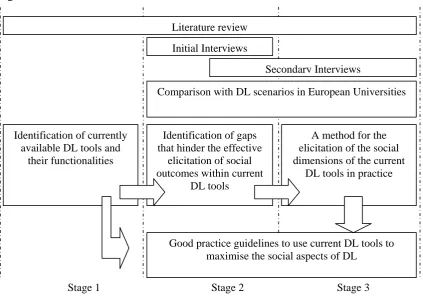
This overall research project is planned to be delivered through three stages. Figure 1 below shows the methodological approach to the overall research through the three stages.
Good practice guidelines to use current DL tools to maximise the social aspects of DL
Literature review
Initial Interviews
Secondary Interviews
Identification of currently available DL tools and
their functionalities
A method for the elicitation of the social dimensions of the current
DL tools in practice Identification of gaps
that hinder the effective elicitation of social outcomes within current
DL tools
Comparison with DL scenarios in European Universities
Stage 3 Stage 2
[image:4.595.105.529.132.430.2]Stage 1
Figure 1 - The research model
As indicated within the above model, the initial literature review is employed with the intention of identifying the current available DL tools and their functionalities. This is shown as stage 1. However, the literature review is intended to be continued throughout as a means of keeping this research up to date with the developments in the field. At the second stage, the initial interviews were used to identify the gaps within existing DL tools that either promote or hinder the social dimension of learning. At the third stage it is intended to evaluate these tools in terms of their functionalities to elicit their potential social dimensions using the secondary interviews. Further to this major function, it is expected from secondary interviews will identify further gaps of current DL tools in terms of addressing social issues of learning. The gap identification and elicitation of social dimensions from the current DL tools are expected to be compared against DL scenarios in selected European universities. With the outcomes of these, it is expected to compile good practice guidelines to use the current DL tools to maximise social aspects of learning within DL settings. Further, it is expected to disseminate these findings through various channels.
ISBN: 1905732074
Copyright for all the contributions in this publication remains with the authors 3
This paper is based on a detailed review of literature in the field of distance learning and on the outcomes of the preliminary interviews conducted. The literature review aims at establishing the theoretical background of the distance learning, to evaluate the importance of social issues in a distance learning environment, while the information
gathered through the preliminary interviews brings in a perspective of the level of the social issues addressed within current distance learning environments. This provides the infrastructure for a comparison to identify any mismatches. Furthermore, the enablers and the barriers to address social issues within modern distance learning environments are also explored through the preliminary interview data, which provided the basis for the suggested improvements.
The Evolution of Distance Learning
The terms “distance education” or “distance learning” have been applied interchangeably by many different researchers to a great variety of programs, providers, audiences, and media (Sherry, 1995). Jonassen (1992) defines distance learning as the volitional control of learning by the student rather than the distant instructor, while Perraton(1988) defines it as the separation of the teacher and the learner, in space and / or time. These two definitions reveal two important characteristics of distance learning, the distance between the tutor and the learner (either geographically or timely) and the learner centred learning mechanisms as opposed to the teacher centred learning in a traditional classroom based learning environment.
The concept of Distance Learning was originated with the establishment of the Open University in UK in 1969 (Hellman, 2003). The rapid growth of internet related technologies and increased information technology proficiency has also contributed to the continued expansion of Distance Learning. (Lindner, 1999).
The Theoretical Base of the Modern Distance Learning
Garrison (2000) conducted a detail literature review of the historical perspective of distance learning. According to this review, in the early 70’s the focus of distance learning shifted from a ‘correspondent study’ focus towards an ‘independent study’ focus. This shift reflects two contrasting schools of thoughts in instructional models, the symbol processing view and the situated cognition view (Sherry, 1995). Within the symbol processing view, the key concept is that the teacher can transmit a fixed body of information to students via an external representation. This closely related to the correspondent study view. Within this, the tutor represents an abstract idea as a concrete image and then presents the image to the learner via a medium. The learner, in turn, perceives, decodes, and stores it (Sherry, 1995). This is a tutor centred static approach, where the assumption is that the learner will be able to acquire desired knowledge externally, by processing the information or the symbols provided by the tutor. Within this setting, the required tutor – student interaction is minimal, and may have provided the basis for the radio and television based distance learning programmes.
Later, this view has been further developed by adding two other dimensions to the equation, the learner’s setting (environment, current situation, other sensory input) and mind (memories, associations, emotions, inference and reasoning, curiosity and interest) (Sherry, 1995). This enhancement argues that knowledge is not externally transferred, but internally created using tutor inputs and previous knowledge gathered about the subject through various means.
The situated cognition approach is based on constructivist principles, in which a learner actively constructs an internal representation of knowledge by interacting with the material to be learned. The same is the basis for the problem based learning approach
ISBN: 1905732074
Copyright for all the contributions in this publication remains with the authors 4
(Sherry, 1995). This approach closely maps with the independent study focus, where the learner is the centre of the learning arrangement and the tutor – student interaction is the key for the desired knowledge creation.
Considering its origination and this focus shift, it is arguable that initially distance learning might have been considered as external and peripheral to the traditional classroom based learning settings from the functional point of view. Due to this the importance of social aspects within distance learning environments might have been overlooked at early stages. However, with advent of the web based and computer mediated communication (CMC) based distance learning tools, the tutor – learner interaction became easily achievable, thus reinforced the focus shift of the distance learning from correspondent study view to the independent study view. It is worth noting that it is this focus shift which determines the level of desired social aspects to be addressed within the distance learning setting. It is clear from the above that, if the distance learning setting carries the correspondent study view, the level of consideration of social aspects of the distance learning environment may not necessarily be as much as within a distance learning setting which supports the independent study view.
Irrespective of the theoretical base of the distance learning environment, it is visible that the studies about the modern CMC tools for distance learning environments are highly focused on structural and administrative requirements of the DL setting, while only minimal consideration has been given to the transactional aspects (Ingirige et al, 2005). As an example, Valenta et al (2001) points out that out of the 4059 articles turned up from the ERIC database after a search on “distance learning”, only 5% of articles have dealt with students’ attitudes towards computer mediated distance learning. Thus, the next section investigates various distance learning settings with the aim of identifying their integrated level of support for social issues within distance learning.
CMC Tools within Distance Learning and their Integrated Support for Social Issues in DL
As emphasised within the previous section, the transactional aspect of distance learning is one of the biggest current challenges for modern CMC based DL tools. It may be due to the fact that CMC based DL tools developers may not have paid adequate consideration to the theoretical underpinnings of distance learning. Or it may be down to the simple fact that the modern CMC based tools are not in use at its maximum potential. This section presents the preliminary findings of a case study conducted within a UK based higher education institute (hereafter, “the institute”) to identify the actual scenario within its CMC based DL settings, specifically to understand up to which extent it supports the transactional aspects of distance learning. The discussion here is twofold. The first part discusses CMC based tools in use within the school and their functionalities with relation to transactional and social aspects of DL. Secondly, the discussion reveals the initial findings of the preliminary interviews conducted with the DL tutors of the school to understand how they use the functionalities of the CMC based tools to address the transactional issues of their DL settings at their maximum potential.
The modes of CMC tools for DL can be classified as synchronous (using same time communications), asynchronous (communications that do not require participants to exchange information at the same time), one way (information delivered from one point
ISBN: 1905732074
Copyright for all the contributions in this publication remains with the authors 5
to one or many other points), two-way (any communication in which the flow is bi-directional but not limited to synchronous), multi-point (information delivered simultaneously from one place to many other places) and multi-cast (usually consisting of transmission of a video or audio clip to the computers of many users) Carty (1999). The case study data uses this classification and the terminology when analysing the CMC based DL used within the Institute from the transactional support perspective.
The DL Setting Within the Institute
The institute primarily uses two CMC based DL tools, “Blackboard” and “Horizonwimba”.
Blackboard
‘Blackboard’ is a commercially available tool used as a content management system as well as an online course delivery platform. Thus, it is considered as a Virtual Learning Environment (VLE) for DL. It is worthwhile assessing its functionalities in order to understand how it addresses the administrative (structural) and transactional (social) issues within a DL setting.
Major functionalities of Blackboard can be classified in to four major sections. Those are;
Information services
Communication services
Assessment services
Content management services.
The information services provide a tools set to support administrative work. This mainly includes an online announcement service where tutors can post announcements to be viewed by students. This facilitates the basic infrastructure desired to ensure smooth implementation of DL courses.
The communication services provide the infrastructure to create two way communication between the learner and the tutor. Within this category, tools such as forums, text based chat services, collaborative tools (such as virtual class rooms) and email facilities exist. Compared with traditional classroom based face to face communication options, this environment lacks desirable elements as far as the social aspects of learning is concerned. For example, the informal private exchange of ideas between learners is important from the constructivist learning view point . But during the initial interviews with academic staff members who deliver DL courses, it has been revealed that even though this private exchange of ideas can be accomplished by arranging a simple private discussion board for students within Blackboard, the is not being practiced widely within the institute . As this shows, the technological capability of modern CMC tools may not be the sole case as not to address social aspects of learning within distance learning environments, but mere unawareness or ignorance may degrade the usability of these tools.
Assessment services within Blackboard perform two major functions. Firstly it provides an important administrative tool within a DL environment. Within this setting, the tools such as “grade book” and “performance dashboard” minimise the administrative burden
ISBN: 1905732074
Copyright for all the contributions in this publication remains with the authors 6
of student grading records. Secondly, it provides a technological infrastructure to the student assessments. However, this CMC based assessment infrastructure does not fully support the traditional assessment protocols. Traditionally the close book examinations are the major mode of student assessment. However, the major difference resides within the monitoring aspects of the students during the examination time as students cannot be monitored closely during the assessment time. A solution to this problem would be to make assessments accessible only within specific time periods within dedicated examination centres as much as practically possible. However within this institute, this is not in practice yet.
Content Management services within Blackboard are basically file repositories where tutors can upload handouts and other course related documents to be downloaded by students. This again is very much an administrative tool from the tutor’s point of view. On the other hand, this is a useful tool for students as they have an automatic archive of all the lecture handouts in a single place. Compared this with a traditional classroom based system, this may hinder the student interaction with each other up to some extend as it eliminates the necessity of collecting missing lecture handouts from colleagues, which is a common initiative for building social interactions (Ingirige et al, 2005).
Horizonwimba
In a traditional learning environment, the tutor and the learner communicates in different modes. Generally verbal, visual (body language, visual presentations such as posters or computer based presentations) and text based (traditional blackboard or whiteboard based) are the major modes of communication. Within the case of the institute, Blackboard is being used as a mode for text based communication most of the times. “Horizonwimba” is being used within the institute to accommodate for the need of using audio and visual modes of communication between the tutor and the learner. The visual and audio communication is accomplished through a web conferencing based system capable of establishing video and audio based communications between the tutor and the learner. It uses the voice transfer, application transfer and chatting facilities to deliver synchronous lectures. One of the problems both tutors and learners encounter in utilising web conferencing is the time that it takes to learn the various functionalities of the tool. Particularly at the school with blackboard and horizonwimba, the students are invited to participate at free tutorial sessions before their actual online lectures commence to overcome their fears of using the technology (Ingirige et al, 2005). Among the problems of this software it is often pointed out various connectivity problems due to the nature of local internet connectivity. For example, applications such as Microsoft PowerPoint slides are transferred at a relatively slower pace than voice, so that some students complain that the commentary does not run concurrently with the particular slide in question thereby highlighting problems relating to synchronicity (Ingirige et al, 2005). Therefore it is important to look at this issue from a social aspect perspective, to safeguard the equal opportunities of learning available to all the students in question. As Ingirige et al (2005) pointed out it may be down to the application developers to look at these technological limitations at the user end when developing such applications.
As discussed above, it is visible that modern CMC tools has enabled the DL to be technologically sound more than ever before, especially with minimal administrative burdens to the DL institutions and more conveniently to the students. However, the
ISBN: 1905732074
Copyright for all the contributions in this publication remains with the authors 7
question still persists whether the essential social aspects of learning have attracted adequate attention within modern DL settings. Especially within this case study it has been revealed that this needs further attention. The next section discusses this requirement in detail as a research question for further investigation.
While investigating the case of the institute in concern, several preliminary interviews were conducted to collect the DL tutor’s perspectives about the issues discussed above. It is expected to address four specific perspectives of Distance Learning through these interviews. The perspectives are:
Focus on DL setting – e.g. synchronous, asynchronous, time zone problems, cultural barriers, etc.
Focus on DL tools – e.g. how various functionalities of DL tools cater for learning needs, etc.
Focus on DL tutors – e.g. Degree of tutor intervention, desirable Vs available functionalities, etc.
Focus of DL learners- e.g. Degree of lecture personalisation, “sense of isolation”, etc.
Related to the first perspective, it became visible that there are social, cultural and technical barriers to implement synchronous DL courses. The major barriers are the time zone problems and bandwidth problems. The interviewees within the institute show a wide variety of knowledge and awareness of various functionalities available within CMC based DL tools in use. The usage of some tools was interpreted differently by some tutors, out of which some practices can closely be mapped to address identified social gaps within DL settings. However, this shows possible increased concern about social issues within a DL setting may increase the productivity of DL tools from the social aspects of learning view point, provided that there is a plan to share good practice for the use of CMC based DL tools effectively. When viewing from the tutor’s and learner’s (user’s) perspectives, the current tools show a clear gap between desirable and available functions from the social interactions point of view (Ingirige, 2005).
Conclusion and the Way Forward
This paper identifies a research gap visible within the domain of the social aspects of learning specifically within Distance learning environments. An in depth literature review along with the findings of an initial case study on the social aspects of modern CMC based DL tools within a UK higher education institute provided the methodological basis for this paper.
The modern communication technologies including world wide web enabled the ability of the Distance Learning to regain its value as a major mode of course delivery. While structural and organisational issues related to DL have received adequate recognition through the modern CMC based communication tools the transactional issues of learning have often been overlooked. This triggered the necessity to evaluate the modern CMC based distance learning tools from a social aspects of learning point of view. The case of the institute’s DL setting highlighted the fact that DL tools may have the capability of addressing some social needs of distance learning, but an extensive awareness and sharing of good practices may be required from the tutor’s point of view
ISBN: 1905732074
Copyright for all the contributions in this publication remains with the authors 8
to make the process productive. As the next step it is expected to address the above need by producing good practice guidelines for CMC based DL users (tutors, students and other stake holders) to improve the social aspects of modern CMC based DL settings. Towards this end, it is expected to extend the case study to assess other CMC based DL tools used within European Higher Education Institutes.
ISBN: 1905732074
Copyright for all the contributions in this publication remains with the authors 9
Acknowledgement
The authors wish to acknowledge that this work is a part of a Teaching and Learning Quality Improvement Scheme (TLQIS) research project, and funded by the TLQIS scheme.
References
Barrett, E. (2003) Spirit, Trust, Interaction and Learning: A Case Study of an Online Community of Doctoral Students, British Educational Research Association Annual Conference, Heriot-Watt University, Edinburgh, 11-13 September 2003
Carty, W. (1999) Distance education in the developing world, The advising quarterly for professionals in international education, Summer 1999.
Dede, C. Emerging Technologies in Distance Education for Business. Journal Of Education For Business, Volume 71.4, pp197-204.
Diaz, D.P. and Cartnal, R.B. (1999) Students’ learning styles in two classes: online distance learning and equivalent on-campus, College teaching, Volume 47 (4), pp 130 – 135.
Dunn, S. & Ridgway, J. (1991) Computer use during primary school teaching practice: a survey. Journal of Computer Assisted Learning, Volume 7, pp 7–17.
Garrison, G. (2000) Theoretical challenges for distance education in the 21st century: A shift from structural to transactional issues, International review of research in open and distance learning, Volume 1.1, pp 1 -17
Hellman, J.A. (2003) The riddle of distance education: promise, problems and applications for development, Technology, business and society programme paper series, No. 9, United Nations Research Institute for Social Development.
Henri, F. (1992) Computer conferencing and content analysis, In A. R. Kaye (ed.) Collaborative learning through computer conferencing: The Najaden papers, Berlin: Springer - Verlag
Holmberg, B. (1989) Theory and practice of distance education, London: Routledge
Http://www.horizonwimba.com (accessed on 3/04/2005)
Http://www.moodle.com (accessed on 25/05/05)
Http://www.bodington.org (accessed on 25/05/05)
Ingirige, M.J.B. (2004), A study of knowledge sharing in construction alliances, Unpublished PhD thesis, University of Salford (November 2004)
Ingirige, M.J.B., Amaratunga, R.D.G., Keraminiyage, K.P. and Baldry, D (2005) Leveraging distance learning tools for broadbasing education in construction industry disciplines: The importance of a continuous social aspect, proceedings of 3rd CIB international symposium, Brisbane.
Jonassen, D.H. (1992) Applications and limitations of hypertext technology for distance learning. Paper presented at the Distance Learning Workshop, Armstrong Laboratory, San Antonio, TX.
ISBN: 1905732074
Copyright for all the contributions in this publication remains with the authors 10
Katz, Y.J. (2000) Attitudes affecting college students’ preferences for distance learning, Journal of computer assisted learning, Vol. 18, pp 2-9.
Kolb, D. (1984) Experiential learning, London: Prentice Hall.
Lee, J.S, Cho, H., Gay, G., Davidson, B. and Ingraffea, A. (2003) Technology acceptance and social networking in distance learning, Educational technology and society, Vol. 6.2, pp 50-61.
Lewis, T., Gould, M. et al (1997) Computer conferencing and the continuing professional development of teachers in the post – 16 sector, in Field, J. (Ed.) Electronic pathways: adult learning and the new communication technologies, England: NIACE.
Lindner, J.R. (1999) Usage and impact of the Internet for Appalachian chambers of commerce, Journal of applied communications, Vol. 83.1, pp 42-52.
Lockee, B. B., Moore, D. M., & Burton, J. K. (2001) Old concerns with new distance education research. Educause Quarterly, 24(2), 60–62.
Mason, R. (1994) Using communications media in open and flexible learning, London: Kogan page.
Mathews, D. (1999) The origins of distance education and its use in the United States, T.H.E Journal, September 1999.
Moore, M. (1990) Recent contributions to the theory of distance education, Open learning, Volume 5.3, pp 10 - 15
Perraton, H. (1988) A theory for distance education. In D. Sewart, D. Keegan, & B. Holmberg (Ed.), Distance education: International perspectives (pp. 34-45). New York: Routledge.
Peters, O. (2000) The transformation of the university into an institution of independent learning. In T. Evans and D. nation (Eds.), Changing University teaching: Reflections on creating educational technologies, PP 10 – 23.
Rahm, D. and Reid, B. J. (2004) Tangled webs in public administration: organizational issues in distance learning, PAMIJ
Sherry, L. (1996) Issues in distance learning. International Journal of Distance Education, 1(4), 337-365.
Terzi, S., Celik, A (2003) Teacher-Student Interactions In Distance Learning, International Education Technology Conference and Fair, North Cyprus
Valenta, A., Therriault, D., Dieter, M., and Mrtek, R (2001) Identifying Student Attitudes and Learning Styles in Distance Education. Journal of Asynchronous Learning Networks, 5 (2), 111- 127
Vince, H and Ronnie, D. (2005) Our first time: two higher education tutors reflect on becoming a ‘virtual teacher’ Innovations in Education and Teaching International Vol. 42, No. 3, pp. 257–264
Wedmeyer, C. A. (1971) Independent study. In R. Deighton (Ed.), Encyclopedia of Education IV, New York, McMillan, pp 7 - 22
ISBN: 1905732074
Copyright for all the contributions in this publication remains with the authors 11
ISBN: 1905732074
Copyright for all the contributions in this publication remains with the authors Published by the University of Salford
http://www.edu.salford.ac.uk/her/
12
Whatley, J. (2004) An agent system to support student teams working online, Journal of information technology education, Vol. 3, pp 53 – 63.
Whatley, J. and Bell, F. (2003) Discussion across borders: benefits for collaborative learning, Education media international, Vol 40.1, pp 139-152.
Wilson, T. and Whitelock, D. (1997) Monitoring a CMC environment created for distance learning, Journal of Computer Assisted Learning, Vol. 13.4, pp 253 – 260.
Wilson, T. and Whitelock, D. (1998) Monitoring the online behaviour of online learning students, Journal of computer assisted learning, volume 14, pp 91-99.