International Journal of Emerging Technology and Advanced Engineering
Website: www.ijetae.com (ISSN 2250-2459, Volume 2, Issue 1, January 2012)124
Motion Detection based on Multi Frame Video under
Surveillance System
Neelam Patel
ME, Computer Science, Sri Ram Institute of Technology JABALPUR (M.P.)
Abstract- In this paper a series of algorithm has been formed to track the feature of motion detection under surveillance system. In this paper a pixel variant plays a vital role in detection of moving frame of a particular clip. If there is a little bit motion in a file then it is detected very easily by tracking pixel variance. This algorithm detects the zero variation only when there is no motion in a frame clip. It is simple and easier for motion detection in the fames of moving object having Avi file. In this paper we enhanced the efficiency of tracking the moving object by implementing pixel base displacement algorithm in the frame of object as the current and previous.
There are different levels at which tracking can be performed. At the highest level, the whole body is tracked without paying attention to the details of the posture and limbs. At a lower level, the posture and limbs are tracked. At an even lower level, one or two parts of the body (such as hands) are tracked. The finest level would be tracking the fingers of a hand or facial features. Scope of this paper is deals with the highest level of tracking (tracking the Whole body as one unit).
This paper answered the crucial question regarding the tracking of an object and suggests the requirement of surveillances in the terms of security and in high tech world. Our selection criteria are directly based on the definition of Motion detection and tracking algorithms which explains the experimental performance of motion detection in a frame generated by clip. This is usually analyzing the difference of two successive frames with the help pixel variant.
The purpose of surveillance is to provide more information of moving object by tracking its motion in multi frames at any work places as banking, cinema hall, shopping mall, offices and structural work. From the experimental data we explain that the change in the pixel variant means that changes had occurred from the current frame to previous frame.
Index Terms- Pixel Variant, Segmentation of frame, Moving Object Detection, surveillance system.
I. INTRODUCTION
Motion detection under surveillances with tracking is an artificial intelligence that aims at giving vision to machines, which means to develop mathematical models, algorithms and technologies to build a machine with vision capabilities as advanced at least as human eyesight.
A frequent task in the visual analysis of natural scenes is the tracking of moving objects. Trying to recognize a real-world object in a non-artificial surrounding will usually be a quite complex task and will probably need more computing time than is available from one single frame to the next. To overcome this problem one solution is to follow the target with the camera and hence to keep it in the center of the image. This approach is equivalent to determining the trajectory of a moving object in a large image. Such issues include the distinction and relative merits of pixel-based versus object based metrics; the motivation of appropriate metrics with impact of defining the end application; making explicit evaluation parameters and selecting appropriate values. This is usually analyzing the difference of two successive frames. With this we also described moving edges (Frames) by using a gradient-based optical flow technique and pixel base technique in the multi frames clip. Motion detection is the action of sensing the physical movement in a given area. It is also the process of determining the movement of an object from two or more successive images. Once the movement detection occurs, calculations are made from two images to determine the type of movement made. This can be achieved either by mechanical devices that physically interact with the field or by electronic devices that quantifies and measures changes in the given environment.
Mechanical form of Motion Detection
A tripwire is a simple form of motion detection. If a moving object steps into the tripwire's field of view (i.e. trips the wire), then a simple sound device (e.g. bells) may alert the user. A glass filled to the brim so that surface tension causes convex menus can be placed on top of an object to detect if the object has moved.
Electronic form of Motion Detection
International Journal of Emerging Technology and Advanced Engineering
Website: www.ijetae.com (ISSN 2250-2459, Volume 2, Issue 1, January 2012)125
Here we are proceeding with electronic form for image change detection based on multi frame video. The main idea is to identify the set of pixels that have undergone under some significant change between the current and previous images. These groups of pixels create what is often known as the change mask. Detecting and
representing this change mask provides valuable
information for the applications. This area is known as image understanding, which includes the object detection, object tracking, object classification, object Structure Analysis & identification and video encoding.
II. METHOD
Thresholding is the simplest method of image segmentation from a grayscale image. The existing algorithm is to threshold the average estimated pixel variance for some successive pair of frames and this average threshold determines the presence of moving object. For example to track the motion between two successive frames, we will need at least three to four pairs of successive frames: frames, i-3 and i-2, i-2 and i-1 and i-1 and i, where i is the current frame. Thus, we obtain three pixel variances for three successive pair of frames and corresponding.
σ
2mean
= (σ
2i-2
+ σ
2i-1
+ σ
2i
) /
3After that, the mean value is to be subtracted from the pixel variance of the current and previous frame:
σ
2= σ
2 i- σ
2mean
σ
2 ≥ T (Threshold)(A suitable threshold), the center of sliding mask Ai is marked as changing region, i.e. as a moving object. however we observed this method has one major drawback. In case, If body is moving and pixel variant value of current pair of frame is less than mean value of pixel variant, subtracted value will be negative (-ve). Results that there is no movement in the object as per above algorithm, whereas in actual, body is in moving condition.
The choice of our threshold highly depends on the sequence, its noise, its motion. It works simply on the basis of pixel variant for current frame to previous frame. We can say it require only 2 frames to track the motion at a time. Furthermore there is no reason for this value to be depended on the some previous frames i.e 3 to 4 frames to detect the motion between any two successive frames.
σ
2i > 0 (T Threshold)
Hence this method will enhance the efficiency & occur less error to track the motion. Many methods have been developed to decide whether or not a pixel has moved.
The decision can be made independently on each pixel or on small blocks of pixels. With independent pixel-wise detections, detection maps are usually corrupted by holes in the mask of moving objects and false detections due to noise.
The thresholding is classified into three types. They are
Hard thresholding.
Soft thresholding
Qian thresholding
a) Hard thesholding: it can be defined as follow
D(Y,λ) = Y if || Y || > λ
= 0 otherwise
Where Y = W(x) denote the forward wavelet transform operator, D(Y,λ) denote the thresholding operator with threshold λ.
Hard threshold is a "keep or kill" procedure and is more intuitively appealing. The transfer function of the hard
thresholding may seem to be natural. Sometimespure noise
coefficients may pass the hard threshold and appear as annoying „blips‟ in the output.
b) Soft Thersolding or Wavelet shrinkage : It can be
defined as follow
D(Y,λ) = sign (Y )( || Y || - λ ) if || Y || > λ = 0 otherwise
Soft threshold shrinks coefficients above the threshold in absolute value.
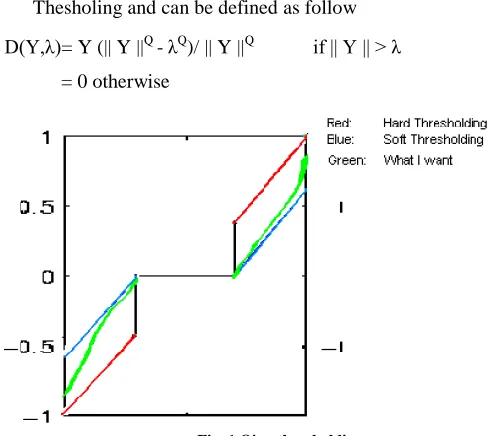
c) Qian thresholding : It incorporate the both hard and soft
Thesholing and can be defined as follow
D(Y,λ)= Y (|| Y ||Q -λQ)/ || Y ||Q if || Y || > λ
[image:2.612.321.566.505.723.2]= 0 otherwise
International Journal of Emerging Technology and Advanced Engineering
Website: www.ijetae.com (ISSN 2250-2459, Volume 2, Issue 1, January 2012)126
Soft thresholding is best in reducing noise but worst in preserving edges, and hard thresholding is best in preserving edges but worst in denoising. Qian thresholding achieves a compromise between the two extremes. It significantly reduces noise and well preserves edges at the same time. This can be clearly seen in above Figure, which shows the effectiveness between the three methods.
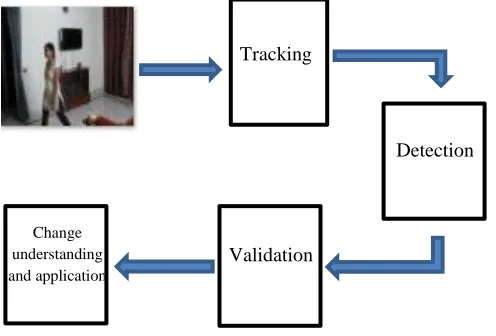
In our proposed method, three stage approaches is taken for each video frame:
Tracking step
Detection step
Validation step
Firstly, the objects, which have been previously identified, are tracked to find their position and shape within the current video frame. At the same time, the motion of these objects is estimated. We call this the Tracking step.
The second step involves the creation of new hypotheses regarding new moving objects. That is, possible new objects are detected and their shape and motion are estimated. We call this the Detection step.
[image:3.612.48.296.463.631.2]The final step decides on which, if any, of the hypotheses were correct. If any of the hypotheses are deemed valid, then we have identified a new moving object at this frame and this will now be tracked through subsequent frames. We call this the Validation step.
Fig. 2 Segmentation frame work
III. TECHNIQUE (ALGORITHM DISCRIPTION)
The effectiveness and feasibility of the proposed concept is proven through experimental results on a real-life video sequence.
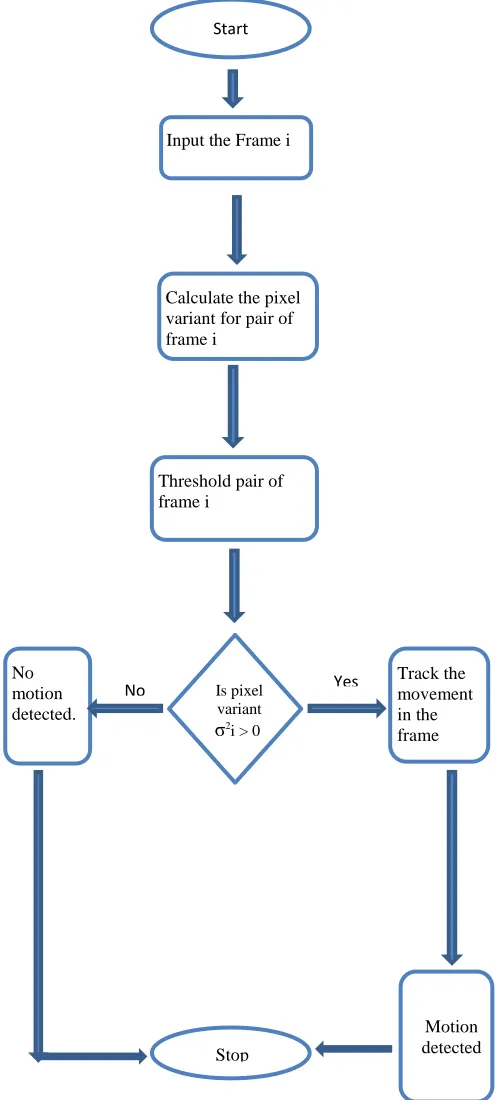
The proposed work is depicted in the flow chart of fig.3. as can be seen whole algorithm is comprised of 3 steps i.e. Tracking step, Detection step, Validation step for each video frame. In tracking step, a object is tracked to find their position and shape within the current video frame. In Detection step, a new hypotheses object is created with their estimated shape and motion in new current frame. In validation step, if any of the hypotheses are correct, then we have identified a new moving object at this frame and this will now be tracked through subsequent frames. In this methodology a pixel variant plays a vital role in detection of moving frame of a particular clip. If there is a little bit motion in a file then it is detected very easily by tracking pixel variance.
Pixel – Based Detection:
Consider image sequence I consisting of N video frames. The sliding mask Ai is applied on every frame. We calculate the pixel variance in order to estimate the potential movement in the observed area, as follows:
1 Bm
σ
i2 = Σ [ Ki – median{Ai}]2Card {Ai} mεAi Cm
Where pixel intensities within mask Ai are denoted with
Bm
For a reference background frame that does not contain
changing regions and with Cm for a current frame (where
we are identifying moving objects). The estimated mean of
the pixel intensity ratio within Ai is denoted with
µ
Ai.The illumination compensation coefficient is defined
ΣmεAi Cm µi
Ki = =
ΣmεAi C1m µ1
Where C1m is pixel intensity for the first frame in the
sequence. The algorithm performs the analysis in time and space domains simultaneously, contributing to its resistance to the illumination changes and reducing the false detection, i.e. artifacts. We calculate the pixel variance in order to estimate the potential observation for current pair of frame i and threshold this value to determine the presence of moving objects. This represents temporal
aspect of analysis. The ratio of pixel intensities in Ai
between two frames is used to estimate the pixel variant of the current pair of frame (i & i-1). If the pixel variant value of current pair of frame (i & i-1) is greater than zero (0) then the motion is detected in the frame of moving clip.
σ
2i > 0 (T Threshold)
Tracking
Detection
Validation
International Journal of Emerging Technology and Advanced Engineering
Website: www.ijetae.com (ISSN 2250-2459, Volume 2, Issue 1, January 2012)127
Thus this algorithm detects the zero variation only when there is no motion in a pair of frame. Furthermore we can also compare the intensity of motion in successive pair of
frames. If (
σ
2i-
σ
2
i-1) > 0, intensity of motion on current
pair of frames will be more than previous pair of frame.
Key words which are used as a command in MATLAB.
Video input: Video in input command is used to setup
the video source for the rest of the program to be run.
Aviobj: The Avi object command is used to create an
object file of the type Avi. The Avi file is standard video format with a predefined method with a predefined method of encryption.
Get: The function get is used to interface with the GUI
file.
Start Vid: The Start Function is used to start video
acquisition devices to get start the frame from the device object
Stop Vid: The Stop function stop the input video, if the
user will try to use it again, at lab will not be able to start it again as the path will be busy.
Play: The function starts and run the audio signal object
created in the audio player function. It plays each audio sample as provided in the audio files as it enters in the audio players.
Mdhelp: The Mdhelp is a complete new GUI file which
acts as a popup when called as a function .It contains a static text box that acts as a frame in which there is instruction stored about how to use the given software.
[image:4.612.322.570.155.705.2]Fig. 3
Fig. 3: Flow Chart of Proposed Algorithm
Start
Stop
No Is pixel
variant
σ2i > 0
Track the movement in the frame No
motion detected.
Motion detected Input the Frame i
Calculate the pixel variant for pair of frame i
Threshold pair of frame i
International Journal of Emerging Technology and Advanced Engineering
Website: www.ijetae.com (ISSN 2250-2459, Volume 2, Issue 1, January 2012)128
Following are the steps and its working Methodology
a) Start
b) Input a frame i sequence of N video frames, like the
slide mask is applied on every frame.
c) Calculate the pixel variant in order to estimate the
potential observation for pair of frame i.
d) Threshold the frame i to determine the presence of
moving object.
e) If the pixel variant value of current pair of frame (i &
i-1) is greater than zero (0) then the motion is detected in the frame of moving clip. Otherwise detects the zero variation only when there is no motion in a pair of frame.
f) Track the movement in the current frame i.
g) Hence the motion is detected.
h) Stop
IV. EXPERIMENTAL RESULT
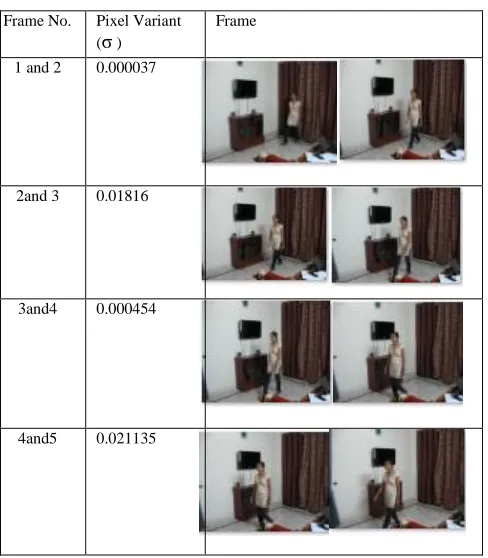
From the experimental data, we clearly explain that the change in the pixel Variant means motion had occurred from the current frame to previous frame. We also inferred if the pixel variant zero from the current to previous frame then no motion had occurred.
Here we have taken seven frame of sliding clip.
Frame No. Pixel Variant (σ )
Frame
1 and 2 0.000037
2and 3 0.01816
3and4 0.000454
4and5 0.021135
5and 6 0.354027
[image:5.612.322.565.129.258.2]6and 7 0.346167
Fig. 4.1 Pixel variant value for six pair of frames
0.1 0.2 0.3 0.4 0.5 0.6
-0.05 0.00 0.05 0.10 0.15 0.20 0.25 0.30 0.35 0.40
M
O
T
IO
N
[image:5.612.48.292.412.691.2]FRAME Motion Detection
Fig. 4.2 Graph of Motion Detection
V. CONCLUSION
International Journal of Emerging Technology and Advanced Engineering
Website: www.ijetae.com (ISSN 2250-2459, Volume 2, Issue 1, January 2012)129
This method is better than the previous method because slight motion in the pair of frames not recognize due to threshold the average estimated pixel variance for some successive frames (at least 3 to 4 pair of frames). Whereas proposed algorithm detects the zero variation only when there is no motion in current pair of frames. If there is a little bit motion in a file then it is detected very easily by tracking pixel variance for a pair of frames.
Reference
[1] Zeljkovic, V.; Pokrajac, D, “Motion Detection Based Multimedia Supported Intelligent Video Surveillance System”, Multimedia Signal Processing and Communications, 48th International Symposium ELMAR-June 2006, pp. 49 – 52.
[2] Foresti, G.L., Regazzoni, C.S., “A Change Detection Method for Multiple Object Localizations in Real Scenes”, IEEE, March 1994, pp.984-987.
[3] Fathy, M., M. Y. Siyal, “An Image Detection Technique Based on Morphological Edge Detection and Background Differencing for Real-time Traffic Analysis”, Pattern Recognition Letters, Vol. 16, 1995, pp. 1321-1330.
[4] Eric Foxlin. Handbook of Virtual Environment Technology, chapter 8, Motion Tracking Requirements and Technologies. 2002.
[5] IEEE explore „Multi-Frame Motion Detection for Active/Unstable Cameras‟-This paper appears in: Computer Graphics and Image Processing (SIBGRAPI), 2009 XXII Brazilian Symposium on Date of Current Version: 22 January 2010 Location: Rio de Janiero.
[6] Multi-frame motion detection for active/unstable cameras In Proc. of 22-nd Brazilian Symposium on Computer Graphics and Image Processing, SIBGRAPI-2009.
[7] A J2ME-Based Wireless Automated Video Surveillance System Using Motion Detection Method Ashwin S, Sathiya Sethuram A, Varun A, Vasanth PAMRITA School of Engineering, AMRITA VISHWA VIDAPEETHAM, Conference Proceedings RTCSP‟09.
[8] An Improved Motion Detection Method for Real-Time Surveillance Nan Lu, Jihong Wang, Q.H. Wu and Li Yang (Advance online publication: 19 February 2008).
[9] Ismail Haritaoglu, David Harwood and Larry S. Davis, “W4: Real-Time Surveillance of people and their Activities”, Proceedings of the IEEE Transactions on Pattern Analysis and Machine Intelligence, Volume 22, No. 8, pp 809-830, August 2000.
[10] Ross Cutler and Larry S. Davis, “Robust Real-Time Periodic Motion Detection, Analysis, and Applications”, Proceedings of the IEEE Transactions on Pattern Analysis and Machine Intelligence, Volume
22, No. 8, pp 781-796, August 2000.
[11] M. Bramberger, A. Doblander, A. Meier, B. Rinner, and A. Schwabach, “Distributed embedded smart cameras for surveillance applications,”IEEE Computer, vol. 39, no. 2, pp. 68–75, Feb. 2006.
[12] R. J. Radke, S. Andra, O. Al-Kofahi, and B. Roysam “Image Change Detection Algorithms: A Systematic Survey,” IEEE Trans. Image Processing, vol. 14, no. 3, pp.294–303, March. 2005.
[13] M. Bosc, F. Heitz, J. P. Armspach, I. Namer Automatic change detection in multimodal serial MRI: Application to multiple sclerosis lesion evolution,” Neuroimage, vol. 20, pp. 643–656, 2003.
[14] Inigo, R.M., “Application of Machine Vision to Traffic monitoring and Control”, IEEE Transactions on Vehicular Technology, vol. 38, no. 3, Aug. 1989, pp.112-122.
[15] Rong Yan, MATLAB Arsenal- A Matlab Package for Classification