International Journal of Emerging Technology and Advanced Engineering
Website: www.ijetae.com (ISSN 2250-2459,ISO 9001:2008 Certified Journal, Volume 3, Issue 5, May 2013)
731
Analysis Of Exhaust Emission Of Internal Combustion Engine
Using Biodiesel Blend
Suvendu Mohanty
1, Dr. Om prakash
2 1Reasearch Scholar, 2Associate Professor, Department of Mechanical Engineering. NIT Patna, Bihar 800004.india
Abstract-The main purpose of this research is to study the effect of various blends of an environmental friendly alternative fuel such as biodiesel on the performance of diesel engine. In the Present investigation experimental work has been carried out to analyze the performance and exhaust emission characteristics of a single cylinder internal combustion engine fuelled with biodiesel blend at the different load. In this experiment the biodiesel which is use as a waste cooking oil (WCO) biodiesel .To investigation of the emission characteristics of the engine loads, which is supplied from the alternator. The experiment was carried out different load i.e. (NO LOAD, 100W 200W, 500W, 1000W, 1500W, 2000W, 2500W & 3000Watt) at engine speed 1500 rpm/min. A test was applied in which an engine was fuel with diesel and seven different blends of diesel. Biodiesel (B5, B10, B20, B40, B60, B80, B100) made from waste cooking oil and the results were analyzed .The emission of were measured carbon monoxide (CO), hydrocarbon carbon(HC), Oxides of nitrogen (NOX) and oxygen ( ).The experimental results will be compared with biodiesel blends and diesel. The biodiesel results of (WCO) in lower emission of hydro carbon (HC) and (CO) and increase emission of (NO2). This study showed that the results of exhaust emission of biodiesel blends were lower than the diesel fuel.
Keyword- Biodiesel (WCO), diesel engine, gas analyzer, Exhaust emission.
I. INTRODUCTION
Biodiesel can be produced by various methods, such as: alkali catalysis, acid catalysis, lipase catalysis etc. Considering various limitations of these methods, there is a strong quest to develop an efficient, time-saving, and economically functional and environment friendly biodiesel production processes suitable to large scale industrial biodiesel production. Keeping this aspect into consideration, some of the recently developed biodiesel production technologies are power ultrasound, hydrodynamic cavitation and super critical methanol etc. All these methods have future potential for biodiesel production at large industrial scale [1]. Due to the depletion of the world‟s petroleum reserves and the increasing environmental concerns, there is a great demand for alternative sources of fossil fuels.
Biodiesel, a clean renewable and environment friendly fuel, has recently been considered as the best substitute for the diesel fuel because it can be used in any diesel engine without any modification .Since the cost of feedstock for biodiesel raw materials accounts about 75-90% of the total cost of production, choosing a right feedstock is very important. Biodiesel can be produced from straight vegetable oil, animal oil/fats, and tallow and waste oils. There are three basic routes to biodiesel production from oils and fats:
Base catalyzed trans-esterification of the oil. Direct acid catalyzed trans-esterification of the oil. Conversion of the oil to its fatty acids and then to
biodiesel.
The Trans-esterification process is the reaction of a triglyceride (fat/oil) with an alcohol to form esters and glycerol. A triglyceride has a glycerin molecule as its base with three long chain fatty acids attached. The characteristics of the fat are determined by the nature of the fatty acids attached to the glycerin. The nature of the fatty acids can in turn affect the characteristics of the biodiesel. During the esterification process, the triglyceride is reacted with alcohol in the presence of a catalyst, usually a strong alkaline like sodium hydroxide. The alcohol reacts with the fatty acids to form the mono-alkyl ester, or biodiesel and crude glycerol [2].
In most production methanol or ethanol is the alcohol used (methanol produces methyl esters, ethanol produces ethyl esters) and is base catalyzed by either potassium or sodium hydroxide. Potassium hydroxide has been found to be more suitable for the ethyl ester biodiesel production; either base can be used for the methyl ester. A common product of the trans-esterification process is Rape Methyl Ester (RME) produced from raw rapeseed oil reacted with methanol.
International Journal of Emerging Technology and Advanced Engineering
Website: www.ijetae.com (ISSN 2250-2459,ISO 9001:2008 Certified Journal, Volume 3, Issue 5, May 2013)
[image:2.612.71.275.141.299.2]732
Fig 1. Process of Production of biodiesel
1.1 Blending of Biodiesel
Blends of biodiesel and conventional hydrocarbon-based diesel are products most commonly distributed for use in the retail diesel fuel marketplace. Much of the world uses a system known as the "B" factor to state the amount of biodiesel in any fuel mix:
100% biodiesel is referred to as B100, while
20% biodiesel, 80% petro-diesel is labeled B20
5% biodiesel, 95% petro-diesel is labeled B5
2% biodiesel, 98% petro-diesel is labeled B2. Blends of 20% biodiesel and lower can be used in diesel equipment with no, or only minor modifications, although certain manufacturers do not extend warranty coverage if equipment is damaged by these blends [3].
1.2 Biodiesel use in IC engine
Biodiesel has been increasingly used in diesel engines as a neat or partial substitute with diesel within the past few decades. It is mainly due to its comparable properties to those of diesel, environmental concerns, and energy security. This chapter describes impacts of the use of biodiesel as a fuel for diesel engines, collected from previous research work recently published in journals, proceedings, or other references involved. Promotions to use alternative bio-fuels in transportation and environmental concerns on carbon dioxide (CO2) emissions are the main reasons for instigating the use of biodiesel as an alternative fuel for compression ignition (CI) engines (usually known as diesel engines). Presently, vehicles currently circulated in Europe and other countries are fuelling with low percentage of biodiesel without problem, due to a consequence of technological advances.
In Europe, there is a European Union (EU) Directive to promote the use of bio-fuels for transportation (Directive 2003/30/EC, 2003) with an objective of increasing use of bio-fuels towards CO2 emission reduction in transportation. As one among other bio-fuels, biodiesel is considered to be CO2 neutral in terms of the global carbon cycle [4]. In the production aspect, the cost for bio-fuel for transportation is normally higher than those of conventional fossil fuels. However, there are benefits of biodiesel in the view of environment, not just conserving fossil fuel resources. Other distinctive advantages comprise near-zero Sulpher content in the fuel and its combustion emissions, superior capability of biological degradation in aquatic environment, and a reduction in greenhouse effect gas due to a more favorable energy and CO2 balance over the full life. The latter revealed that overall energy used with soybean-based biodiesel production (feedstock production, feedstock transportation, conversion, fuel transportation) and use (combustion in a diesel engine) will drop by 74% compared to fossil diesel. Though, this report makes no account between CO2 fixation by the soybean crop and the use of land for farming. In addition, the Commission Green Paper described an ambitious EU program that has set a target of 20% alternative fuel substitution in conventional fuel in the road transport sector by the year 2020. However, for compliance to the relevant legislation on emission standards, the EU Directive suggests that high proportion blends (>5% v/v) of biodiesel used in non-adapted vehicles should be monitored [5]
1.3 Objective
International Journal of Emerging Technology and Advanced Engineering
Website: www.ijetae.com (ISSN 2250-2459,ISO 9001:2008 Certified Journal, Volume 3, Issue 5, May 2013)
733 The fuel blends investigated for performance analysis are 100% diesel (B00), blend of 5% biodiesel and 95% diesel (B5), blend of 10% biodiesel and 90% diesel (B10), blend of 20% biodiesel and 80% diesel (B20), blend of 40% biodiesel and 60% diesel (B40), blend of 60% biodiesel and 40% diesel (B60), blend of 80% biodiesel and 20% diesel (B80), 100% biodiesel (B100) for both of the biodiesels of Waste Cooking Oil . The experimentation further extended to fulfillment values for the relevant working parameters and their optimal combination based on the results. The performance parameters, the resistive type load panel, and exhaust emissions are considered for the discussions.
II. BACKGROUND
Now-a-days, the idea of using vegetable oil and its derivatives as fuel is becoming increasingly interesting, due to variations in the oil market prices and the growing concern about the environment, mainly the effects of greenhouse gases on the world‟s climate. As vegetable oils and their derivatives do not have sulfur in their composition, they have the advantage of being renewable and “green” as far as the environment is concerned. For this reason, several investigations have been carried out in order to determine the feasibility of using them as substitutes for Diesel, mainly in internal combustion engines. [6] .The depletion of world petroleum sources and increased environmental concerns has stimulated recent interest in alternative sources for petroleum based fuels .One of the advantages of these fuels is reduced exhaust gas emissions. Experience has shown that vegetable oil based fuels can significantly reduce exhaust gas emissions, including carbon monoxide (CO),nitrogen oxides (NOX), and
hydrocarbon (HC) Because of their less concentration of sulfur, the sulfur dioxide greases cannot only reduce the burden of the government in disposing the waste, maintaining public sewers and treating the oily wastewater, but also helps in lowering the production cost of biodiesel significantly. In recent times, the world is confronted with the twin crisis of fossil fuel depletion and environmental degradations. The situations have led to the search for an alternative fuel which should be not only sustainable but also environment friendly without sacrificing the performance. The different sources for alternative fuels are edible- and non-edible vegetable oils, animal fats and waste oil (triglycerides). Vegetable oils, being renewable, are widely available from variety of sources have low sulfur contents close to zero and hence cause less environmental damage (lower greenhouse effect) than diesel.
In the context of India, non-edible vegetable oil can be the most viable alternative for petroleum fuels since there is shortage of edible oils to meet the domestic requirements. It has been found that neat vegetable oil can be used as a fuel in conventional diesel engines [7]. However, unmodified vegetable oils are glycerol esters, and when used in diesel engines the glycerol poses engine wear and performance problems due to higher viscosity and lower volatility. India is a developing country and its energy demand is also increasing day by day. Presently most of the country‟s oil demands are fulfilled by import from the foreign countries which is a major expense for the country. Therefore, there is a dire need of searching a viable alternative source of energy for long term energy security of the nation. Bio-diesel is an alternative to petroleum-based fuels derived from vegetable oils or animal fats. It is named biodiesel because it is derived from biological products and matches petro-diesel in properties and performance. The glycerides present in vegetable oils can be separated in the trans-esterification reaction and may be used as a by-product. Bio-diesel production is a very modern and challenging area for researchers because of its relevance due to increase in the petroleum price and the environmental advantages. Vegetable oils have good heating power and provide negligible sulphur and aromatic polycyclic compounds in the engine exhaust gases. It possesses high biodegradability and lubricating property which makes it even better fuel. In recent years, the demands for energy have grown very quickly due to the rapid development of certain growing economies, especially in Asia and the Middle East. Biofuels such as alcohols and biodiesel have been proposed as alternatives for diesel engines. Biodiesel is known as a carbon neutral fuel because the carbon present in the exhaust was originally fixed from the atmosphere. This supply deficit will have serious implications for many nonoil producing countries which are dependent on oil imports [8]. Especially, the environmental issues concerned with the exhaust gases emission by the usage of fossil fuels also encourage the usage of biodiesel, which has proved to be eco-friendly far more than fossil fuels.
III. DEVELOPMENT OF EXPERIMENTAL SET- UP
3.1 System development
International Journal of Emerging Technology and Advanced Engineering
Website: www.ijetae.com (ISSN 2250-2459,ISO 9001:2008 Certified Journal, Volume 3, Issue 5, May 2013)
[image:4.612.46.291.139.355.2]734
Table 1
List of structural and instrumental panels
SI. No.
Items Requirements
1 Foundation 1
2 Kirloskar TV-1 diesel engine 1
3 Alternator 1
4 Load Panel 1
5 Steel Frame 1
6 Air box 1
7 Orifice Plate 1
8 Exhaust gas analyzer 1
9 Waste Cooking Oil Biodiesel (WCO)
7ltr
3.2 Construction
3.2.1 Foundation
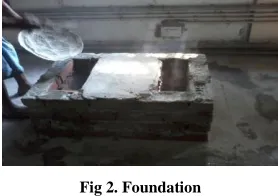
[image:4.612.315.573.268.709.2]For conducting experiment, the proportion of foundation (3ft43”),(1ft16”),(2ft29”) is taken for cement, Brick, Concrete, Sand ,Cements, The mixing is done by using concrete mixture. As we know that for every set up foundation is the primary part of the experimental setup shown in fig 2.
Fig 2. Foundation
List of the material amount used in this foundation i.e.
Brick-62(10*5*3* INCH)
Cements-2 bags(100kg)
Sand-6 bags
Concrit-2 bags
Ordinary tap water is used for concrete mixing in all the mix.
Length (3ft43”), Width (1ft16”), Brath (2ft29”)
3.2.2 Test Engine
The present research work was carried out on a 5kV, single cylinder, vertical, naturally aspirated, four stroke, water cooled, direct injection, Kirloskar TV-1 diesel engine having the main technical features presented in fig 2. This engine has been widely used in agricultural lands irrigation applications. The main objective has been to study the performance and emission characteristics of biodiesel as fuel in diesel engine. For conducting the desired set of experiments and to gather required data from the engine, it is essential to get the various instruments mounted at the appropriate location on the experimental setup. Engine specification shown table 2.
Fig 3. Test Engine
Table 2 Test engine specifications
Particulars Specifications
Make Kirloskar Oil Engines,india
Type TV-1 stationary diesel engine
Eng.no. 18.1176/1204252 No. of Cylinder 1
Cubic capacity 0.66 Power rating 7hp Compression ratio 17.5:1
Wet of flay wheel 39kg
Weight 129kg
Rate speed(rpm) 1500 Fuel Oil Diesel
SFC 251h/kwh
Governing Class”A2/B1”
[image:4.612.98.237.449.547.2]International Journal of Emerging Technology and Advanced Engineering
Website: www.ijetae.com (ISSN 2250-2459,ISO 9001:2008 Certified Journal, Volume 3, Issue 5, May 2013)
735 3.2.3 Alternator
[image:5.612.318.565.101.694.2]Engine loading is through electrical alternator shown fig 4. A DC shunt generator with electrical load bank of bulbs is used. A rheostat is connected in series the circuit to control the load precisely by controlling voltage. The specifications of Alternator are shown in table 3.
Fig 4. Alternator
Table 3 Alternator specifications
Particulars Specifications
Type AC generator
S.N W12WRDCH017
Model KBE-150M
Out put 5.0kvA
Volt 230
FREQ 50HZ
RPM 1500
AMP 21.7
BHP 7
Type of Cooling Fan Cooled
3.2.4 Load Panel
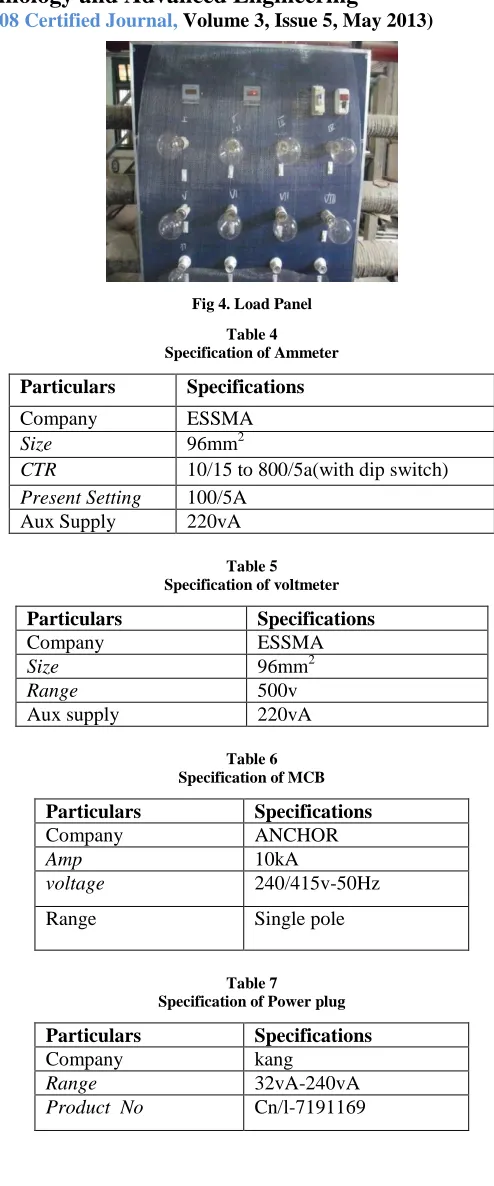
The load panel made of plywood which has 3ft width and 4ft height. This load panel consists of eight 500w bulbs, three 200w bulbs and one 100w bulbs, with individual‟s switches. One ammeter and one voltmeter are also set in this load panel because to measure current and voltage, the specification of ammeter and voltmeter is show on table 4 and 5. TO control the voltage I use one miniature circuit breaker (MCQ) AND one Power plug. The specification of Power plug is show on table 6 and 7.
Fig 4. Load Panel
Table 4 Specification of Ammeter
Particulars Specifications
Company ESSMA
Size 96mm2
CTR 10/15 to 800/5a(with dip switch) Present Setting 100/5A
Aux Supply 220vA
Table 5 Specification of voltmeter
Particulars Specifications
Company ESSMA
Size 96mm2
Range 500v
Aux supply 220vA
Table 6 Specification of MCB
Particulars Specifications
Company ANCHOR
Amp 10kA
voltage 240/415v-50Hz
Range Single pole
Table 7 Specification of Power plug
Particulars Specifications
Company kang
Range 32vA-240vA
[image:5.612.44.294.195.533.2]International Journal of Emerging Technology and Advanced Engineering
Website: www.ijetae.com (ISSN 2250-2459,ISO 9001:2008 Certified Journal, Volume 3, Issue 5, May 2013)
736 3.2.5 Steel Frame Mounting
[image:6.612.326.561.160.304.2]Various measuring instruments are mounted on a piece of plywood which is attached on the steel frame (90cm*90cm*150cm). All the devices such as U Tube (25.5cm L), burette (57.5cm L), one-way cock, two-way cock and three-way cock, which is attached on the piece of plywood which is fixed in steel clamps. Cocks are connected with Polyvinylchloride pipe to supply diesel and biodiesel to engine. The top end of the burette was open and bottom end was fitted with stopcock. The outlet of stopcock was connected to the filter unit of the diesel engine by a Polyvinylchloride pipe Shown in fig 5.
Fig 5. Steel frame
3.2.6 Air box
A cubic steel box (60cm*60cm*60cm) which thickness (20gauge), Size of pipe hole diameter on two faces of box is also attached in the frame which is used as flow measuring device for inlet air. Steel box is made air tight through gas welding around it, to insure proper air circulation. Shown in fig 6.
Fig 6. Air box
3.2.7 Orifice Plate
A Carrier Ring orifice plate which diameter 8cm (outer), 5cm (inner), 2.5cm (interior) is a device used for measuring flow rate.
[image:6.612.103.234.267.377.2]Either a volumetric or mass flow rate may be determined, depending on the calculation associated with the orifice plate. Shown in Fig 7.
Fig 7. Orifice Plate
3.2.8 Exhaust gas analyzer
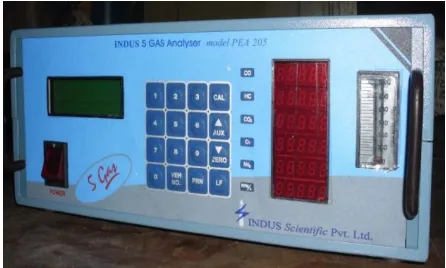
Exhaust gas composition was measured using exhaust gas analyzer [INDUS 5 GAS analyzer MODEL PEA 205 India and ISO 3930: 2000]. The analyzer measures CO, HC, O2 and NOx in the exhaust. The range and accuracy of the INDUS 5 GAS analyzer.
INDUS Model PEA205 is a class I Gas Analyzer designed and manufactured for testing the emissions from automotive engines, which run on Diesel, petrol as well as CNG and LPG. The instrument can measure carbon monoxide (CO) and Oxygen in percentage, and Hydrocarbons [Hexane equivalent (HC)] and Nitric Oxide (NOx) in ppm. It is generally supplied as a three gas analyzer without the NOx Sensor. When NOx sensor is added PEA205 becomes a 5 Gas analyzer. Shown in Fig8.
[image:6.612.85.249.474.599.2] [image:6.612.332.555.494.628.2]International Journal of Emerging Technology and Advanced Engineering
Website: www.ijetae.com (ISSN 2250-2459,ISO 9001:2008 Certified Journal, Volume 3, Issue 5, May 2013)
[image:7.612.338.547.108.352.2]737
Table 8
Specifications of INDUS 5 GAS analyzer
Exhaust Gas
Range Resolution Accuracy
0-15% volume .01% volume ±.06% Vol.
0-30000 ppm(propane) 0-15000 approx.
(hexane)
1ppm ±12ppm Vol.
0-25.00% volume
.01%volume ±.1% Vol.
0-5000 ppm 1 ppm
volume
±50ppm Vol.
3.2.9 Waste Cooking Oil Biodiesel (WCO)
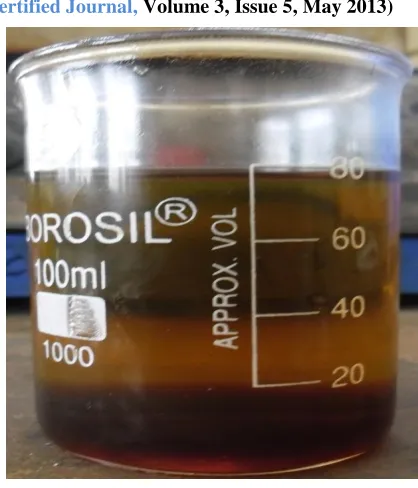
Currently the cost of biodiesel is high as compared to petro diesel because most of the biodiesel is produced from refined edible oils. One way of reducing the biodiesel cost is to use less expensive feedstock such as waste vegetable oils shown fig 9.
fig 9. Waste Cooking Oil Biodiesel
[image:7.612.43.303.147.458.2]International Journal of Emerging Technology and Advanced Engineering
Website: www.ijetae.com (ISSN 2250-2459,ISO 9001:2008 Certified Journal, Volume 3, Issue 5, May 2013)
738
[image:8.612.64.564.180.398.2]Fig 10. Process Flow For WCO Biodiesel Process
Table 9
International Journal of Emerging Technology and Advanced Engineering
Website: www.ijetae.com (ISSN 2250-2459,ISO 9001:2008 Certified Journal, Volume 3, Issue 5, May 2013)
739 IV. EXPERIMENTATION
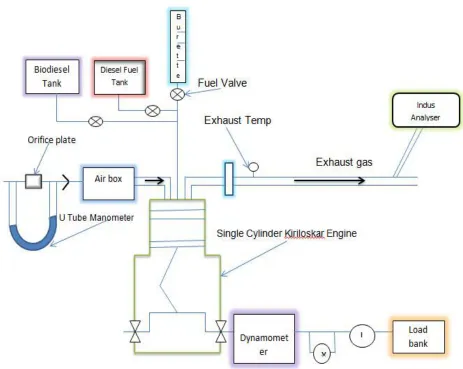
The experimental set up will consists of a single cylinder diesel engine, air metering unit, fuel measuring equipment, exhaust gas analyzer and thermocouples with temperature indicator. All the tests with different blend like B5, B10, B20, B40, B60, B80 and B100 will conduct for varying engine speed and with varying load on engine.
[image:9.612.77.540.217.586.2]Tests will be carried out for 2000 bar original fuel injection pressure. The engine is coupled with a single phase, 245 V AC alternator. The alternator is used for loading the engine through a resistive load bank the Schematic diagram of experimental setup Shown in Fig 11.
Fig 11. Schematic diagram of experimental setup
The load bank consists of eight bulbs of 500W each, three bulbs with 200w, one bulb with 100w. The load will vary from 0.5 kW to 4 kW in step of 0.5kw at rated speed of 1500 rpm. The specifications of engine and generator shown fig 1 and 2. The engine will first tested with diesel fuel for no load for 20 min at fixed speed until lubricating oil temperature rose to around 800C. The same conditions will maintain throughout the experiment for different fuels.
International Journal of Emerging Technology and Advanced Engineering
Website: www.ijetae.com (ISSN 2250-2459,ISO 9001:2008 Certified Journal, Volume 3, Issue 5, May 2013)
740 The specific fuel consumption will calculated by measuring the time taken for a fixed volume of fuel to flow into the engine. The engine speed (rpm) will measured by electronic digital tachometer. The engine was loaded with an eddy current dynamometer. The mass flow rate of intake air was measured with an orifice meter connected to a manometer. A surge tank was used to damp out the pulsations produced by the engine, for ensuring a steady flow of air through the intake manifold. The fuel consumption rate was determined using the glass burette and stop watch. An INDUS gas analyzer instrument can measure carbon monoxide (CO) and Oxygen in percentage , and Hydrocarbons [Hexane equivalent (HC)] and Nitric Oxide (NOx) in ppm. The exhaust gas temperature was measured with k-type thermocouple.
V. DATA ANALYSIS
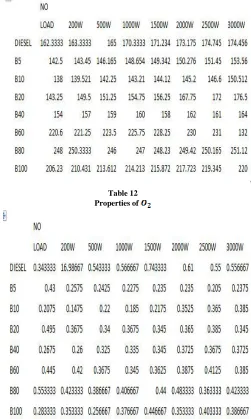
Table 10. Properties of CO
[image:10.612.321.572.151.570.2]Table 11 Properties of HC
International Journal of Emerging Technology and Advanced Engineering
Website: www.ijetae.com (ISSN 2250-2459,ISO 9001:2008 Certified Journal, Volume 3, Issue 5, May 2013)
741
Table 13 Properties of NOX
VI. RESULTS AND DISCUSSION
6.1 Exhaust emission of Carbon Monoxide (CO)
[image:11.612.330.565.253.429.2]Figure shows the variation of CO emission with engine loading. It was observed that CO emissions are increased with increase in engine load. The lower CO emission of biodiesel compared to diesel is likely due to oxygen content inherently present in the biodiesel which helps in the more complete oxidation of fuel. Further it can be seen that volume of CO initially decrease but increase at full load indicating better burning conditions at higher temperature assisted by improved spraying qualities with uniform charge preparations of biodiesel.
Fig 12. Effect of biodiesel and engine load on CO
6.2 Exhaust gas emission of Hydrocarbon (HC)
The variations of HC emission for diesel and biodiesel are shown in the figure. The emissions of unburnt hydrocarbon for biodiesel exhaust due to lower than that of diesel fuel the increased gas temperature and higher cetane number of biodiesel could be responsible for this decrease. Higher temperature of burnt gases in biodiesel fuel helps in preventing condensation of higher hydrocarbon reducing unburnt HC. The higher cetane number of biodiesel results decrease in HC emission due to shorter ignition delay.
Fig 13. Effect of biodiesel and engine load on HC
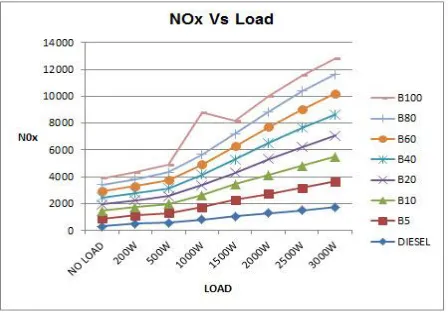
[image:11.612.55.283.488.654.2]6.3 Exhaust gas Emissions of Nitrogen Oxides (NOx) The NOx values as parts per million for different blends of diesel and biodiesel in exhaust emission are plotted as function of load. From these figures it can be seen that the fueling biodiesel or its blends NOx emission increase.
[image:11.612.332.556.518.677.2]International Journal of Emerging Technology and Advanced Engineering
Website: www.ijetae.com (ISSN 2250-2459,ISO 9001:2008 Certified Journal, Volume 3, Issue 5, May 2013)
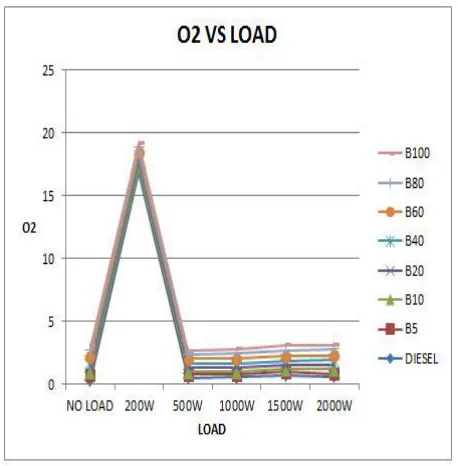
742 6.4 Exhaust gas Emissions of Oxygen ( )
The variations of HC emission for diesel and biodiesel are shown in the figure. The O2 value for different blends
of diesel and biodiesel in exhaust emission are plotted as function of load. At the time of 200w the value of O2
[image:12.612.55.284.203.436.2]increase and then decrease in other load.
Fig 15. Effect of biodiesel and engine load on oxygen
VII. CONCLUSION
Performance and emissions of diesel engine fueled with blends of biodiesels of using Waste Cooking Oil with diesel fuel are experimentally investigated. The results of study may be summarized as follows:
The performance is slightly reduced while brake specific fuel consumption is increased when using biodiesels.
Compared with conventional diesel, exhaust emissions of CO and HC are reduced while NOx emissions are increased with biodiesel and its blends with diesel.
However further investigations to explore the knowledge of dynamics combustion with biodiesel as fuel is needed for the better optimization.
REFERENCES
[1 ] Ramdhas A.S., Jayaraj S., Murleedharan C., "Use of vegetable oil asI.C. engine fuels – a review", Renewable Energy, 29 (2004), 727- 742.
[2 ] Allen C.A.W., et al, "Predicting Viscosity of Biodiesel Fuel from fatty acid ester Composition", Fuel 78, (1999), 1319-1326. [3 ] Masjuki H. H. et al, "Experimental Evaluation of an Unmodified
Diesel Engine using Bio Diesel with Fuel Additive", IEEE (2006), 96-99.
[4 ] Lang X. et al, "Preparation and characterization of biodiesel from various Bio oils", Bioresource Technology, 80 (2001), 53-62. [5 ] Barnwal B.K., Sharma M.P., "Prospects of biodiesel production
from vegetable oils in India."Renewable and Sustainable Energy Reviews, 9 (2005), 363-378.
[6 ] Naidu B.S.K., "Indian scenario of renewable energy for sustainable development", Energy Policy, 24 (1996), 575-581.
[7 ] N. Stalinand H. J. Prabhu OCTOBER 2007 A Journal of Engineering and Applied Sciences„ Performance test of IC engine using Karanja Biodiesel and blending with Diesel‟ ISSN 1819-6608 VOL. 2, NO. 5