THE UTILITY OF KNOWLEDGE
MAPPING AS AN APPROACH TO
IMPROVING CORPORATE AND
PROJECT PERFORMANCE: A CASE
STUDY OF A LARGE SOUTH
KOREAN CONSULTING FIRM
GANG CHEOL YUN
THE UTILITY OF KNOWLEDGE
MAPPING AS AN APPROACH TO
IMPROVING CORPORATE AND
PROJECT PERFORMANCE: A CASE
STUDY OF A LARGE SOUTH
KOREAN CONSULTING FIRM
GANG CHEOL YUN
Research Institute for the Built and Human Environment
School of the Built Environment
The University of Salford
Submitted in Partial Fulfilment of the Requirements of
the Degree of Doctor of Philosophy
i
Table of Contents
List of Tables
List of Figures
Acknowledgements
Declaration
Abbreviations
Abstract
Chapter 1 Introduction... 1
1.1 Introduction ... 2
1.2 Background to the research ... 2
1.3 Research problem ... 4
1.4 Research objectives and articulated research questions and hypotheses ... 6
1.5 Research methodology ... 9
1.6 Synopsis of the thesis ... 9
1.7 Summary and link ... 11
Chapter 2 Literature Review and Synthesis... 12
2.1 Introduction ... 13
2.2 Key Key characteristics of construction project organisations ... 13
2.2.1 Introduction ... 13
2.2.2 Knowledge-based view ... 13
2.2.3 Learning organisation-based view... 16
2.2.4 Construction actor-based view ... 17
2.2.5 Construction process-based view ... 19
2.2.6 Knowledge transfer technology-based view ... 20
2.2.7 Summary and link ... 22
2.3 Knowledge maps ... 22
2.3.1 Introduction ... 22
2.3.2 Definition and potential benefits of knowledge maps... 22
2.3.3 Characteristics of knowledge mapping: key purposes, principles and functions ... 23
2.3.4 Types of knowledge map ... 25
2.3.5 Summary and link ... 27
ii
2.4.1 Knowledge and its effective transfer... 27
2.4.2 Organisational networks within construction project organisations ... 29
2.5 Finding an appropriate focus for knowledge mapping in construction project organisations... 30
2.5.1 Selecting the appropriate components in knowledge mapping ... 31
2.6 Research questions ... 34
2.7 Summary and link ... 35
Chapter 3 A Knowledge Map Concept Model and Hypotheses... 36
3.1 Introduction ... 37
3.2 Knowledge map concept model ... 37
3.2.1 Interaction environment ... 38
3.2.2 Construction actors... 38
3.2.3 Construction processes ... 39
3.2.4 Knowledge transfer technologies ... 39
3.3 Gap analysis ... 39
3.4 Research hypotheses... 40
3.5 Summary and link ... 42
Chapter 4 Research Methodology ... 43
4.1 Introduction ... 44
4.2 Methodology: a nested research methodology... 44
4.3 Research philosophy... 45
4.4 Research approach: case study ... 49
4.5 Case study design ... 51
4.5.1 Case study: a single-holistic case study ... 51
4.5.2 Unit of analysis... 53
4.5.3 Selection of the case study ... 54
4.5.4 Interviewee ... 55
4.6 Research techniques ... 56
4.6.1 Data collection techniques... 56
4.6.1.1 Literature review and synthesis... 56
4.6.1.2 Interviews ... 57
4.6.1.3 Company documentation... 61
4.6.2 Data analysis techniques ... 62
4.6.2.1 Content analysis ... 62
4.6.2.2 Cognitive mapping ... 66
4.7 Validation ... 70
4.7.1 Generalisability ... 70
4.7.2 Validity... 71
4.7.3 Reliability ... 73
4.8 Overall research methodology model process in the research ... 74
iii
Chapter 5 Research Findings... 77
5.1 Introduction ... 78
5.2 Background of the case study company ... 78
5.2.1 Description of the case study company... 78
5.2.2 Description of interviewees... 81
5.3 Key findings in the case study data ... 87
5.3.1 Introduction ... 87
5.3.2 The general perception on the role and nature of knowledge mapping ... 87
5.3.2.1 The generic perception of the definition of the knowledge mapping ... 87
5.3.2.2 Perception on the knowledge map model components ... 99
5.3.3 Key benefits of adoption an integrated approach to knowledge mapping ... 121
5.3.4 Major constraints to effective knowledge mapping ... 126
5.3.5 Factors about unsuccessful knowledge mapping ... 130
5.4 Testing of the research hypotheses... 133
5.4.1 Introduction ... 133
5.4.2 Project-based resources ... 133
5.4.2.1 Hypothesis 1-1: construction actors ... 133
5.4.2.2 Hypothesis 1-2: knowledge transfer technologies... 135
5.4.2.3 Hypothesis 1-3: construction processes ... 136
5.4.3 The interaction between the knowledge map model components... 138
5.4.3.1 Hypothesis 2-1: The interaction between construction actors and knowledge transfer technologies ... 138
5.4.3.2 Hypothesis 2-2: The interaction between construction actors and construction processes ... 140
5.4.3.3 Hypothesis 2-3: The interaction between knowledge transfer technologies and construction processes... 141
5.4.4 Testing of meta-hypothesis ... 143
5.5 Summary and link ... 146
Chapter 6 Conclusions... 147
6.1 Introduction ... 148
6.2 Summary of key results... 148
6.2.1 Definition of knowledge mapping within construction project organisations... 148
6.2.2 Summary of the research findings on the key knowledge map model components... 148
6.2.3 Implications between the key knowledge map model components within the knowledge map model ... 153
iv
6.4 Implications for knowledge mapping theory... 160
6.4.1 Differentiated knowledge mapping approaches ... 161
6.4.2 Contingency approach to knowledge map types... 165
6.5 Implications for practice... 175
6.6 Limitations of research... 177
6.7 Future research issues... 177
6.8 End note... 178
References ... 180
Appendices... 200
Appendix A: Interview Co-operation Proposal... 200
Appendix B: Interview Protocol... 202
Appendix C: Interview Agreement ... 211
Appendix D: Basic information of the interviewees ... 212
Appendix E: A representative sample of verbatim interview transcript (Knowledge Manager)... 216
Appendix F: A representative sample of verbatim interview transcript (Project Manager) ... 229
Appendix G: A representative sample of verbatim interview transcript (Project Member) ... 242
v
List of Tables
Table 2.1 Key purposes and principles of knowledge mapping... 24
Table 3.1 Indicated gap analysis questions generated between the knowledge map concept model components ... 40
Table 4.1 Relevant situations for different research strategies ... 49
Table 4.2 A list of interviewees and duration of interviews ... 59
Table 4.3 The interview schedule and corresponding research questions ... 60
Table 4.4 A list of company documents used during the study ... 61
Table 4.5 An example of the final synthesised table... 69
Table 5.1 Summary of HanmiParsons Co., Ltd. (July, 2006) ... 79
Table 5.2 Basic information of the interview participants (July, 2006)... 81
Table 5.3 The perception of project managers on the definition of knowledge mapping within construction project organisations... 92
Table 5.4 A synthesis of the general perception of project members on the definition of knowledge mapping... 95
Table 5.5 Key concepts captured on the general perception of knowledge managers concerning the knowledge mapping within construction project organisations... 98
Table 5.6 A summary of the insights of the interviewees on the project-based knowledge within construction project organisations ... 105
Table 5.7 A summary of the key insights of the interviewees on the construction actors proposed as a knowledge map model component ... 110
Table 5.8 A summary of the key insights of the interviewees on the construction processes proposed as a key knowledge map model component... 114
Table 5.9 A summary of the key insights of the interviewees on the knowledge transfer technologies within construction project organisations ... 120
Table 5.10 A summary of the insights of the interviewees on the benefits of integrating the key knowledge map model components within construction project organisation ... 125
Table 5.11 A synthesis of the insights of interviewees on the constraints of knowledge mapping within construction project organisations ... 130
vi
Table 6.1 A summary of the key variables within the knowledge map concept model ... 150 Table 6.2 Testing of the indicated gap analysis questions between the knowledge map model components... 154 Table 6.3 Types of construction actors in the knowledge mapping... 163 Table 6.4 Attributes, context, components and examples of each component for four types of knowledge map model within construction project organisation .. 170 Table 6.5 A summary of the key benefits of knowledge mapping within
construction project organisations... 174 Table 6.6 A summary of the constraints of knowledge mapping within
vii
List of Figures
Figure 1.1 The nested research methodology approach ... 9
Figure 2.1 Spiral of organisational knowledge creation... 15
Figure 2.2 Knowledge transfer in construction organisations after learning ... 33
Figure 3.1 Knowledge map concept model... 38
Figure 3.2 Gap analysis framework of knowledge map concept model ... 40
Figure 4.1 The nested research methodology... 45
Figure 4.2 Research philosophies on the various dimensions... 46
Figure 4.3 Basic types of design for case studies... 51
Figure 4.4 Main areas explored by a literature review and synthesis ... 57
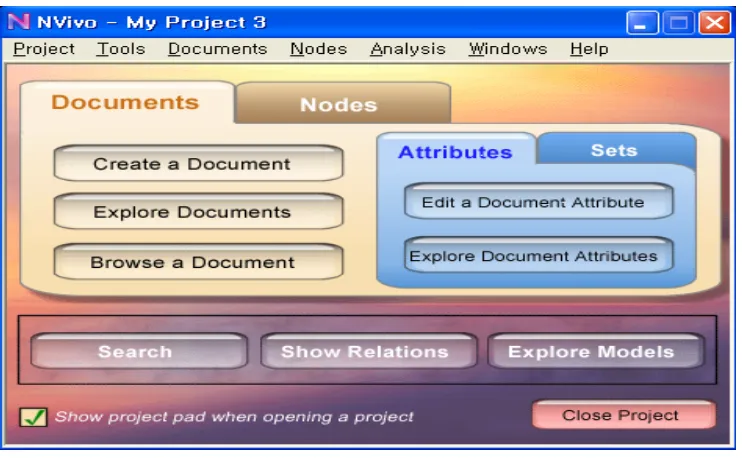
Figure 4.5 The default main screen in NVivo ... 63
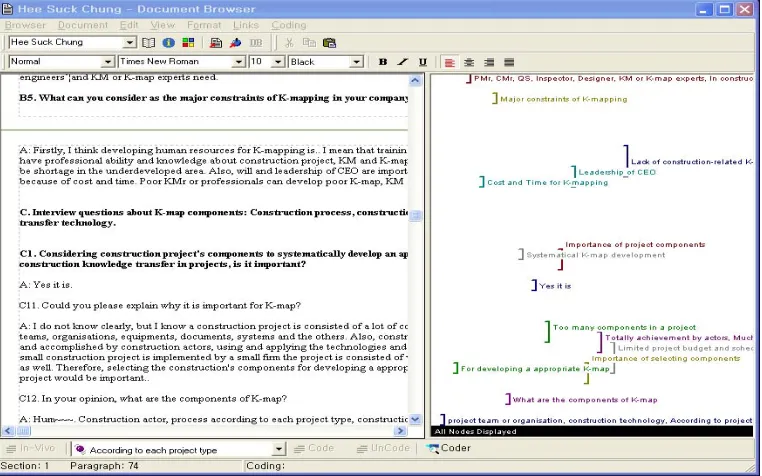
Figure 4.6 The passages of the primary document and specific quotations and codes assigned in NVivo ... 64
Figure 4.7 The types of nodes in NVivo ... 65
Figure 4.8 The final sets of nodes coordinated in NVivo ... 66
Figure 4.9 An example of linking nodes and concepts in Decision Explorer ... 67
Figure 4.10 An example showing a key concept linking to sub-concepts and ideas ... 68
Figure 4.11 An example of a laddering of concepts... 69
Figure 4.12 Research Methodology process used in this study ... 75
Figure 5.1 The homepage of the case study company ... 79
Figure 5.2 The organisational structure of the HanmiParsons Co., Ltd... 81
Figure 5.3 A cognitive map of project manager SSK on the definition of knowledge mapping within construction project organisations ... 89
Figure 5.4 A cognitive map of project manager KIK on the definition of knowledge mapping within construction project organisations ... 89
Figure 5.5 A cognitive map of project manager OGK on the definition of knowledge mapping within construction project organisations ... 91
Figure 5.6 A cognitive map of project member WKC on the definition of knowledge mapping within construction project organisations ... 93
viii
Figure 5.8 A cognitive map of project member JHO on the definition of
knowledge mapping within construction project organisations ... 95 Figure 5.9 A cognitive map of project member TWK on the definition of
knowledge mapping within construction project organisations ... 97 Figure 5.10 A cognitive map of project member EJP on the definition of
knowledge mapping within construction project organisations ... 98 Figure 5.11 A cognitive map of project manager KNK on the project-based
knowledge ... 102 Figure 5.12 A cognitive map of the interviewee knowledge manager TWK on the project-based knowledge within construction project organisations ... 103 Figure 5.13 A cognitive map of the interviewee project manager OGK on the project-based knowledge within construction project organisations ... 104 Figure 5.14 A cognitive map of the interviewee project member WKC on the construction actors within the knowledge mapping ... 107 Figure 5.15 A cognitive map of the interviewee project manager OGK and
knowledge TWK on the construction actors ... 109 Figure 5.16 A cognitive map on the value of construction processes as a key project component ... 111 Figure 5.17 A cognitive map on the value of construction processes as a key project component ... 112 Figure 5.18 A cognitive map on the value of construction processes as a key project component ... 113 Figure 5.19 A cognitive map on the value of knowledge transfer technologies as a key knowledge transfer supporting tool within construction project organisations
... 115 Figure 5.20 A cognitive map on the value of knowledge transfer technologies as a key knowledge transfer supporting tool within construction project organisation
... 116 Figure 5.21 A cognitive map of project member HSC on the value of knowledge transfer technologies within construction project organisation... 118 Figure 5.22 A cognitive map of the perception and insights of the interviewees on the knowledge transfer technologies used and available within construction
project organisation ... 119 Figure 5.23 A cognitive map of the benefits on the application and integration of the key components to the knowledge mapping within construction project area
... 122 Figure 5.24 A cognitive map of the insights of the interviewee knowledge
manager TWK on the benefits of integrating the key components to the
ix
Figure 5.25 A cognitive map of the insights of the interviewee project manager OGK on the constraints of the knowledge mapping within construction project
organisation ... 127
Figure 5.26 A cognitive map of the insights of the interviewee knowledge manager JEP on the constraints of knowledge mapping within construction project organisation ... 128
Figure 5.27 A cognitive map of the insights of the interviewee project member HSC on the constraints of the knowledge mapping within construction project organisation ... 129
Figure 5.28 A cognitive map of the insights of knowledge manager TWK on the unsuccessful factors to knowledge mapping in company ... 131
Figure 5.29 A cognitive map of the insists of project manager KIK on the unsuccessful factors to knowledge mapping in company ... 132
Figure 6.1 Knowledge map concept model... 149
Figure 6.2 Gap analysis framework of knowledge map concept model ... 154
Figure 6.3 The original knowledge map concept model for this study... 161
Figure 6.4 Types of construction processes in the knowledge mapping... 164
Figure 6.5 Types of knowledge transfer technologies in knowledge mapping... 165
x
Acknowledgements
I sincerely acknowledge the support of many people at the University of Salford during this study. I would like to express my gratitude to all of them.
First, I would like to express my gratitude to my supervisor Professor Martin Sexton who guided and directed me with his enthusiasm, attention and excellent knowledge. It was very lucky for me to have him as my supervisor. During the study, the things which I have learnt from him will be good for my future work.
I would like to express my gratitude to Professor Han-Su Kim and Dr Shu-Ling Lu who has encouraged and advised me.
I also gratefully acknowledge to the staff of HanmiParsons co., Ltd., particularly to Senior Director O-kyung Kwon and Associate Researcher Tae-wan Kim who helped and encouraged me as adviser and supporter.
I am grateful to my dear friends and colleagues who have helped me with their support.
xi
Declaration
xii
Abbreviations
HRD HRM IBT ICT IT KM KMS MBT PDA PMIS Q&A System RFID SNW Wibro
Human resource development Human resource management Internet-based technologies
Information and communication technologies Information technologies
Knowledge management
Knowledge management system Mobile-based technologies Personal digital assistant
Project management information system Question and answer system
Radio frequency identification Social networks
xiii
Abstract
Knowledge, and its appropriate management, has been increasingly recognised as a critical source of sustainable competitive advantage for companies. Within this context, many companies are developing their strategies and capabilities to effectively create, share and exploit knowledge. This issue has been seen to be particularly important in project-based industries, such as the construction industry.
xiv
1
2
1.1 Introduction
This chapter introduces the overall focus of this research. The chapter is organised as follows:
(1) the background for this study is set out; (2) the research problem is articulated; (3) a summary of the methodology is given; (4) a synopsis of the thesis is laid out; and,
(5) finally, a summary of the chapter is provided with a link to Chapter 2.
1.2 Background to the research
Knowledge, and its appropriate management, has been increasingly recognised as a key strategic resource for successful project-based companies and for individual projects and a critical resource of sustainable competitive advantage (Armistead, 1999, Desouza and Evaristo, 2003, Astrid and Peter, 2005, Halawi et al., 2006).
Indeed, it is argued that knowledge has become the core resource of the modern economy for companies, rather than the traditional resources of money, land and materials (Bell, 1973, Drucker, 1992, Drucker, 1993, Nonaka and Takeuchi, 1995). This shift in the importance of knowledge has been captured by many academics and practitioners in the term “knowledge economy” (Hoffman et al.,
2005, Halawi et al., 2006, Meroño-Cerdan et al., 2007).
Within this perspective, many companies are increasingly interested in the potential benefits of knowledge management and developing their strategies and capabilities to effectively create, codify, share and use knowledge in a purposeful fashion (Hansen et al., 1999, Nonaka et al., 2000, Bhatt, 2001, Maier, 2002).
Davenport et al. (1996), Syed-Ikhsan and Rowland (2004) and Egbu et al. (2005),
3
approaches which provide project members the right knowledge and knowledge owners at the right time.
This issue is seen as being particularly important in project-based industries, such as the construction industry, where the effective management of project-based knowledge can lead to improve project performance. Project-based knowledge is embedded within project components and resources and its effective management can provide the specific capabilities and competencies for improved project performance and, as a consequence, successful delivery of products or services to customers (Eldin, 1999, Poell and Van-der-Krogt, 2003, Law and Chuah, 2004, Maqsood et al., 2006).
In the construction industry, projects are delivered by temporary project teams or organisations made up different functional groupings, such as design actors and construction action (Levy, 2000, Walker, 2002, Cooke and Williams, 2004, Loosemore et al., 2006). This means that the specific project-based knowledge
and skills are owned and used by each individual organisation. The critical challenge in temporary project organisations is to successfully transfer specific project-based knowledge to other parts of temporary project organisation. When this transfer does occur successfully, the capacity and skills of the constituent individual construction actors is enhanced (Santos and Powell, 2001, Love et al.,
2004, Maqsood et al., 2006, Raidén and Dainty, 2006).
In summary, knowledge and its effective management is recognised as a key strategic resource and capability to enable construction project organisations to capture and transfer project-based knowledge, to build their knowledge assets (Robinson et al., 2001, Kamara et al., 2002, Kazi, 2005, Egbu, 2006).
4
1.3 Research problem
The potential benefits of knowledge management have been championed by a number of researchers, as a key capability which can generate sustainable competitive advantage (McCampbell et al., 1999, Soliman and Spooner, 2000,
Hoffman et al., 2005, Meroño-Cerdan et al., 2007).
However, in spite of the claimed value of knowledge management, a number of problems and barriers have been identified in practice, which erode the actual benefits of knowledge management in projects and companies. The problems include: knowledge and knowledge management strategy-based problems (Zack, 1999, Desouza and Evaristo, 2003, Smith, 2004, Meroño-Cerdan et al., 2007);
human resource-based problems (Egbu, 2001, Thite, 2004, Chua and Lam, 2005, Stuckenschmidt et al., 2005); knowledge management technology-based problems
(Koch, 2003, Hustad, 2004, Bennet and Tomblin, 2006, Foos et al., 2006); and,
process-based problems (Davenport et al., 1996, Maier and Remus, 2002, Kang et al., 2003, Plumley, 2003). A number of key prescriptions have been offered to
overcome these problems. The key research problems are discussed as follows.
First, knowledge and knowledge management strategy has been recognised as a vital success factor (Smith, 2004, Astrid and Peter, 2005, Chua and Lam, 2005, Gammelgaard and Ritter, 2005). Hansen et al. (1999), for example, have argued
that there are two principal knowledge management strategies: codification and personalisation.
Second, a number of technologies have been offered to effectively and successfully manage knowledge in projects and companies (Minsky, 1975, O'leary, 1998, Gomez et al., 2000, Rollet, 2003). However, it has been argued that
5
increasingly recognised that item is a lack of theories and techniques, such as knowledge visualisation tools, knowledge transfer systems and knowledge search systems (Fernandes and Raja, 2002, Albino et al., 2004, Malik, 2004, Sun and
Scott, 2005).
Third, it has been stressed that human resources are a key variable in successful knowledge management, because people make the key decisions for knowledge management in projects and companies (Dougherty, 1999, Scarbrough, 2003, Thite, 2004, Bennet and Tomblin, 2006). Within this context, empirical studies have demonstrated that staff are the key knowledge owners and users (Li and Gao, 2003, Scarbrough, 2003, Thite, 2004, Stuckenschmidt et al., 2005). Nevertheless,
majority of knowledge management studies adopt a technology-centred approachm rather than a human-centred one. Bhatt (2001), Kautz and Thaysen (2001) and Robinson et al. (2005), for example, emphasised that the interactions
between technologies and people are critical for successful knowledge management.
Finally, Mier and Remus (2002) argued that project processes must be used as a critical component for successful knowledge management because projects are commonly delivered through various numbers of phases and sub-processes. Furthermore, projects are always completed by the construction actors, performing the processes and sub-processes (Peurifoy et al., 1996, Levy, 2000,
6
Plumley, 2003, Liu and Hsu, 2004).
It has been established that there are individual barriers – inadequate strategies, technologies, and so on – to successfully knowledge management. The system barrier, however, is the lack of effective integration of key project resources and technologies. The argument here is that the key project resources and technologies must be treated as the vital variables for appropriate knowledge mapping in projects and companies (Dougherty, 1999, Anon, 2003, Astrid and Peter, 2005).
Nevertheless, the importance and need of integrating the project resources and technologies do not appear strongly in the majority of the literature or in practice. Within this context, knowledge mapping has been promoted as a key solution for effectively integrating the key project components and technologies in projects and companies (Grey, 1999, Gomez et al., 2000, Wang, 2002, Plumley, 2003).
There is a dearth of empirical studies which have investigated the utility of knowledge mapping within a construction context (Egbu, 2004). Robinson (2005), for example, stressed that people and project processes must be integrated for successful knowledge management in projects and organisations. In addition, Kamara (2002) and Maqsood (2006) emphasised that construction workers, project processes and technologies must be considered and integrated for successful knowledge management within projects and organisations.
1.4 Research objectives and articulated research
questions and hypotheses
7
are as follows.
■ Research questions
Q1. Is knowledge management an appropriate aspiration for effective project performance and project-based learning in projects and organisations?
Q11. Is knowledge mapping an appropriate tool to improve performance and enhance learning within and across construction project organisations?
Q2. In construction project organisations, how can an appropriate knowledge map be developed for effective project performance and learning?
Q21. What types of construction project components and knowledge transfer technologies should be part of an effective knowledge mapping approach?
Q22. How should the knowledge map components be integrated?
■ Research hypotheses
Meta-hypothesis:
Knowledge mapping is more likely to promote effective project performance and learning within temporary construction project organisations when the construction actors, construction processes and knowledge transfer technologies are effectively integrated - compared to knowledge maps developed without the appropriate development and integration of construction actors, construction processes and knowledge transfer technologies.
8
Hypothesis 1-1: Construction actors
Knowledge mapping is more likely to be successful when construction actors who are critical and necessary to successfully perform construction projects are effectively integrated into the knowledge mapping approach.
Hypothesis 1-2: Knowledge transfer technologies
Knowledge mapping is more likely to be successful when the knowledge transfer technologies integrated as a key knowledge mapping component.
Hypothesis 1-3: Construction processes
Knowledge mapping is more likely to be successful when construction processes are integrated into the knowledge mapping approach.
■ The interaction between the knowledge map model components
Hypothesis 2-1: Construction actors and knowledge transfer technologies
Knowledge mapping which integrates construction actors and knowledge transfer technologies will improve project performance and learning within temporary construction project organisations - compared to knowledge mapping approach which does not integrate these components.
Hypothesis 2-2: Construction processes and construction actors
Knowledge mapping which integrates construction processes and construction actors will improve project performance and learning within temporary construction project organisations - compared to knowledge mapping approach which does not integrate these components.
Hypothesis 2-3: Knowledge transfer technologies and construction processes
9
temporary construction project organisations - compared to knowledge mapping approach which does not integrate these components.
1.5 Research methodology
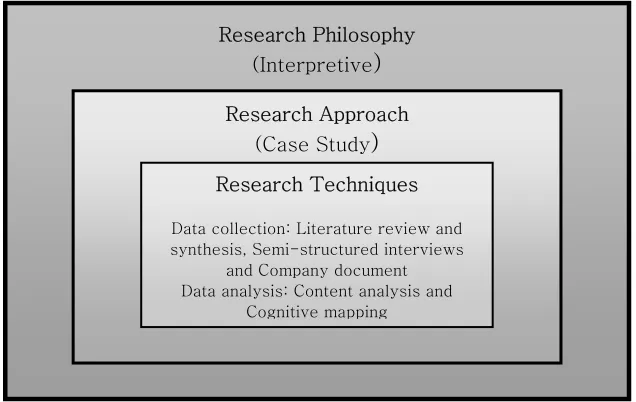
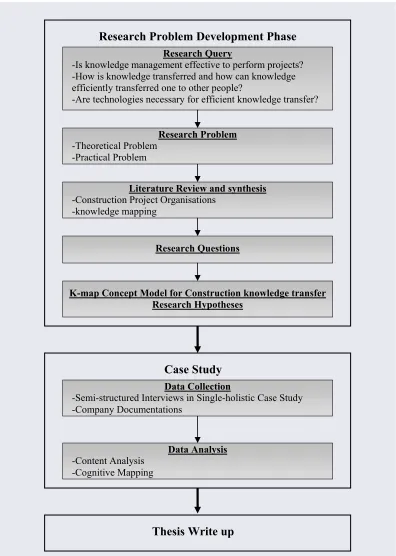
An interpretative research philosophy is adopted for this study. A single case study approach which is aligned with the interpretative research philosophy is selected as an appropriate research access strategy. Research data collection techniques involved literature review and synthesis, semi-structure interviews and company document review are adopted to collect, analyse and apply the research data in the case study. The content analysis and cognitive mapping techniques are employed as the key data analysis tools in this study.
Figure 1.1 The nested research methodology approach [Source: Adapted from Kagioglou et al. (1998)]
1.6 Synopsis of the thesis
This thesis is structured into seven chapters. Each chapter is summarised below.
Chapter 1: Introduction
Chapter 1 introduces the research background and the research problem for this
Research Philosophy
(Interpretative)
Research Approach
(Case Study)
Research Techniques
Literature review and synthesis, semi-structured interviews, company
10
study. Then, a summary of the research methodology and a synopsis of the thesis are presented.
Chapter 2: Literature review and synthesis
Chapter 2 presents a literature review and synthesis which is used to develop the research questions and the concept model. First, the characteristics of construction organisations and knowledge maps are reviewed. Then, an appropriate knowledge map in construction organisations is conceptualised. Next, the research questions are presented. The focus of an appropriate knowledge map model in construction organisations is discussed based on the selection of key project components and knowledge transfer technologies.
Chapter 3: Knowledge map concept model and hypotheses
Chapter 3 presents a knowledge map concept model for this study. Within the concept model, the key components are described and the gap analysis questions are articulated. Then, the research hypotheses are formulated based on the concept model and gap analysis questions.
Chapter 4: Research methodology
Chapter 4 presents and justifies the research methodology adopted and used for this study. Within the research methodology, selected research philosophy, approach and techniques are presented. Finally, the validation aspects of this study are discussed.
Chapter 5: Research findings and testing of research hypotheses
This chapter presents the key research findings and testing research hypotheses within the context of the case study.
Chapter 6: Conclusions
11
of the research are stated.
1.7 Summary and link
12
13
2.1 Introduction
This chapter reviews the relevant literature to develop and substantiate the research questions proposed in Chapter 1. This chapter is structured as follows:
(1) the key characteristics of construction project organisations are investigated; (2) the specific principles and features of knowledge mapping are explored;
(3) an appropriate knowledge mapping approach within construction project organisations is discussed and represented; and,
(4) a summary of this chapter is provided with a link to Chapter 3.
2.2 Key Key characteristics of construction project
organisations
2.2.1 Introduction
The construction industry has been argued to be a project-based industry, where different construction companies form temporary project organisations to develop, plan, perform and deliver projects (Bresnen, 1990, Dubois and Gadde, 2002, Loosemore et al., 2006, Raidén and Dainty, 2006).
In the next subsections, Tthe project-based nature of construction projects and unique characteristics of project organisations are explored in the following sub-sections through a number of perspectives: knowledge-based view; learning organisation-based view; human resource-based view; project process-based view; and, knowledge transfer technology-based view.
2.2.2 Knowledge-based view
14
in order to effectively implement and successfully complete projects in companies (Maier, 2002, White, 2002, Scarbrough, 2003, Halawi et al., 2006). Rollet (2003)
and Heng (2001), for example, emphasised the value of knowledge as an intellectual capital because knowledge can be (should be)has been recognized as a real asset of enterprise as it is successfully identified, captured, codified, classified, transferred and used by its users within projects and organisations. From this perspective, a variety of knowledge types have been articulated, for example: explicit (tangible) knowledge and tacit (intangible) knowledge; individual knowledge and organisational knowledge; and, external knowledge and internal knowledge.
First, knowledge can be conceptualised as tacit knowledge and explicit knowledge. Takeuchi (1995) and Li and Gao (2003), for example, distinguished between tacit and explicit knowledge. According to Takeuchi (1995), tacit knowledge is difficult to codify, classify and transfer and is usually in the domain of subjective, cognitive and experiential learning, whereas explicit knowledge can be effectively codified, classified and transferred between people within and across organisations and furthermore, explicit knowledge deals with more objective, rational, and technical knowledge like data, policies, procedures, documents.
15
(Bhatt, 2001).
Finally, a number of academics and practitioners have suggested a variety of classification and codification approach, including: process-based knowledge (Maier and Remus, 2002, Maier and Remus, 2003); workflow-based knowledge (Kang et al., 2003); human resource-based knowledge (Thite, 2004, Astrid and
Peter, 2005, Foos et al., 2006); and, project-based knowledge (Poell and
Van-der-Krogt, 2003, Leseure and Brookes, 2004, Liu and Hsu, 2004).
From these perspectives, a variety knowledge management processes have been stressed in order to effectively manage knowledge, such as knowledge creation process, knowledge conversion process, knowledge transfer process, knowledge use process and knowledge store process (Maier, 2002, Tiwana, 2002, Rollet, 2003, Robinson et al., 2005). Nonaka and Takeuchi (1995), for example,
proposed a knowledge creating model which is composed of four key variables: socialisation; externalisation; internalisation; and, combination because it needs to understand the dynamic nature of knowledge creation and to effectively manage such as process. Figure 2.1 is the spiral of knowledge creation.
16
As can be seen in Figure 2.1, knowledge is created and converted in the dynamic and complex contexts. Construction project has been also argued and recognised as a dynamic and complicated project-based context where project-based knowledge is created, used, stored and transferred by construction actors within construction project organisations (Kamara et al., 2002, Hari et al., 2005,
Robinson et al., 2005, Egbu, 2006). However, construction industry has recently
focused on the fact that the efficient management of knowledge leads to the creation of competitiveness and value within construction project organisations, improving project performance through skills and knowledge of organisation members (Robinson et al., 2001, Kazi, 2005, Robinson et al., 2005, Maqsood et al., 2006). Therefore, it can be said that construction project-based knowledge
must be managed for effective project performance and successful project completion (Lu and Sexton, 2006).
2.2.3 Learning organisation-based view
Successful learning organisations facilitate learning and innovation of their all organisation members and continuously transform and nurture itself to generate sustainable competitive advantage (Garratt, 1987, Senge, 1990, Pedler, 1995, Garavan, 1997). From this perspective, it has been argued that learning organisations can more effectively respond and adapt to changing internal and external context (Jashapara, 2003, Dymock and McCarthy, 2006, Thomas and Allen, 2006). One of the critical issues of learning organisations is the ability and skills of staff to learn and use knowledge (McHugh et al., 1995, Sambrook and
Stewart, 2000, Kim et al., 2003, Law and Chuah, 2004).
It has been emphasised that learning organisations are a project-based organisation in which projects are performed by skilled and functioned workers. As a result of, it has been suggested that construction organisations are a type of learning organisation (Santos and Powell, 2001, Love et al., 2004, Maqsood et al.,
17
Project organisations are commonly divided into several specialised parts where construction actors are grouped (Levy, 2000, Walker, 2002, Cooke and Williams, 2004, Loosemore et al., 2006). Maqsood et al. (2006) argue that a construction
project organisation which, as a learning organisation, comes together with its construction workers and professionals to successfully accomplish the construction project has its own capacity and knowledge in a form of people, processes and technologies. In the construction project-based environment, Love (2004), for example, proposed a blueprint for a successful learning organisation which considers the relationships and interactions between total quality management and customer value strategies.
In summary, construction organisations are structured around project and project teams. This means that the success of construction projects is dependent upon the ability of project members.
2.2.4 Construction actor-based view
All construction project organisations tend to be different in that they produce different buildings, but organisations share similar fundamental resources, such as actors, materials, processes, methods, equipments and sites (Cooke and Williams, 2004). From this perspective, it has been stressed that construction actors are a critical resource for successful projects because they are concerned with the use and management of the resources to effectively perform their roles within construction project organisations (Hore et al., 1997).
As has been connected in the previous section, the construction industry is project-based, and that project team members are perceived to be a valuable asset and resource for successful construction projects (Morton and Jaggar, 1995, Harrison, 1996, Shirazi et al., 1996, Wong et al., 2006).
18
a number of practitioners and researchers have argued that construction actors have and use their own specific knowledge and basic abilities, such as know-how, insights, skills, experiences and qualifications and often share and transfer to the others within/across construction project organisations (Harrison, 1996, Shirazi et al., 1996, Griffith and Watson, 2004, Loosemore et al., 2006). Therefore, it can be
seen that construction project organisations are a vehicle for combining the knowledge and ability of construction actors toward successful project performance. However, it has been argued that combining the specific knowledge of construction actors is difficult because a various number of construction actors (such as designers, quantity surveyors, inspectors, project managers, contractors) have their own specific and different knowledge, skills and language in the different construction parts, such as construction part, management system part, design part, structural engineering part and quantity surveying part (Bresnen, 1990, Morton and Jaggar, 1995, Gidado, 1996, Loosemore et al., 2006).
In order to successfully accomplish construction projects, it has been argued that organisational structure must be necessarily used to appropriately engage and deploy construction actors in the each construction project organisation (Walker, 2002, Maqsood et al., 2006). Johes et al. (1998), for example, stressed that
organisational structure is the systematic and formal system of task and management reporting relationships that coordinates and motivates organisational members so that they work together to achieve organisational design goals. In addition, Anumba at el. (2002) noted that organisational structures are classified
by grouping of roles, tasks and functions. Therefore, it can be said that building an appropriate organisational structure needs to effectively transfer knowledge between construction actors and their organisations for project performance and successful project completion within construction project organisations.
19
(2004), for example, note that construction project organisations must have effective communication between construction actors and their organisations to successfully perform construction projects because poor communication can be a key obstacle to transfer project-based knowledge. From this perspective, Bresnen (1990) and Fryer (2004), for example, notice that having good communication between actors enable the transfer and use of knowledge.
In brief, construction actors have different abilities, specific knowledge bases and professional languages. In this regard, knowledge transfer has been emphasised as a critical method for effective project performance (Kautz and Thaysen, 2001, Fernandes and Raja, 2002, Sun and Scott, 2005, Foos et al., 2006). However, it
has been noted that poor communication between actors is a critical barrier to effectively transfer project-based knowledge (Senge, 1990, Rowley, 1999, Daghfous, 2004, Gorelick, 2005).
2.2.5 Construction process-based view
Processes can be defined as a designed sequence of operations, possibly taking up time, space, expertise and other resource, which produces some outcomes (Feynman et al., 1963, Lindsay et al., 2003). This sequence has been seen as a value chain or supply chain where each step adds value to the proceeding steps (Czuchry and Yasin, 2003). It has been agreed that projects consist of several phases and many types of processes (Kamara et al., 2000, Lindsay et al., 2003,
Plumley, 2003, Jugdev and Mathur, 2006). Projects which are commonly carried out and accomplished with performing phases and sub-processes can be improved by improving processes (Sarshar et al., 2004, Tzortzopoulos et al., 2005).
In the construction industry, it has been agued that construction is process-based (Kagioglou et al., 1998, Kamara et al., 2000, Levy, 2000, Sarshar et al., 2004).
According to Tzortzopoulos et al. (2005), different project process models have
20
requirements for improving project performance. Within this regard, it has been argued that almost all the process models are a designed sequence of building, dealing with actors, materials, technologies, time, cost, quality and the other resources (Bresnen, 1990, Gidado, 1996, Chan et al., 1999, Tzortzopoulos et al.,
2005).
Griffith and Watson (2004), for example, insiste that construction projects have a basic sequence: market demand or perceived needs; conceptual planning and feasibility study; design and engineering, procurement and construction; start-up for occupancy, operation and maintenance; and, disposal of facility (Walker, 2002, Koskela, 2003, Griffith and Watson, 2004). Furthermore, in order to effectively implement construction projects, several management systems, such as cost management, time management, risk management, value management and quality management, are used and applied, which basically have its sub-processes for its successful performance (Day, 1994, Mcgeorge and Palmer, 2002, Fisk, 2003, Griffith and Watson, 2004). According to Walker (2002), management systems provide construction actors a sense of project direction in projects.
In many cases, construction projects are divided into several major phases and many sub-processes for effective project performance.
Projects, however, often do not have any integrated or standardised process models because almost all the construction organisations have their own different or unique construction process models which have sometimes been developed according to project types (Levy, 2000, Fisk, 2003, Bouchlaghem et al., 2004,
Tzortzopoulos et al., 2005). Therefore, it is argued that construction processes
need to be integrated in the knowledge approach in order to effectively transfer project process-based knowledge.
2.2.6 Knowledge transfer technology-based view
21
1982, Nystrom, 1990, Bye, 1995, Abecker et al., 1998). Nystrom (1985), for
example, agreed that technology is a key strategy factor in projects and organisations. Sexton and Barrett (2004) noted that the term “technology” is widely used as the machines, tools, procedures and systems, work routines used to transform material and information inputs: for example, people, capital, land and raw materials, into outputs: products and services. By Skinner (1982), technology has been defined as knowledge that is useful and necessary for product and service development, rather than as physical methods or techniques for producing products or services.
Within this broad context, technologies are argued to be necessary for effective knowledge management in projects and organisations. For effective project performance improvement and knowledge acquirement, it has been argued that knowledge transfer technologies are essential (Wright, 1993, Kautz and Thaysen, 2001, Turban et al., 2002, Foos et al., 2006).
In the construction industry, it is increasingly recognised that knowledge managements are essential technologies for effective project performance (Peurifoy et al., 1996, Shirazi et al., 1996, Walker, 2002, Fisk, 2003). Syed-lkhsan
and Rowland (2004), for example, have noted that building knowledge transfer devices and systems is critical to sustainable competitive advantage and project performance. Furthermore, it has been argued that knowledge transfer technologies (like information and communication technology) can be effectively used for nurturing a learning organisation in construction (Love et al., 2004,
Robinson et al., 2005, Raidén and Dainty, 2006). Within this context, many
22
In brief, a number of technologies are used to effectively transfer project-based knowledge. However, the major problem is that technologies for effective knowledge transfer in projects and organisations have not been fully sought or developed in the construction industry.
2.2.7 Summary and link
This section has presented the unique characteristics of construction project organisations. The following section discusses key characteristics of knowledge maps and their potential utility and application in the construction sector.
2.3 Knowledge maps
2.3.1 Introduction
Knowledge management has been recognised as an innovative process to improve supply chain processes and as a driving force to enhance competence and competitive advantage of enterprises through efficiently managing knowledge assets (Storey and Barnett, 2000, Kim et al., 2003, Moffett et al., 2003, Lu and
Sexton, 2006).
However, it has been asserted that knowledge management is still at an immature phase and furthermore, its resultant benefits and advantages have not been clearly identified or substantiated (Long and Fahey, 2000, Caldwell, 2002, Sun and Scott,
2005, Meroño-Cerdan et al., 2007). In the underdeveloped knowledge
management area, knowledge maps have been proposed as a key fundamental resource for successful knowledge management (Grey, 1999, Eppler, 2001, Liu and Hsu, 2004, Henao-Cálad and Arango-Fonnegra, 2007).
2.3.2 Definition and potential benefits of knowledge maps
23
disseminate, use, evaluate and update to leverage managing knowledge to maximise productivity and competitive advantage of enterprises (Rollet, 2003, Sun and Scott, 2005, Halawi et al., 2006, Mohamed and J.Anumba, 2006) and to
enhance exploitation, creation and use of intellectual assets of enterprise (Rowley, 1999, Marr et al., 2002, Hellström and Husted, 2004, Hoffman et al., 2005).
However, it has been noted that knowledge management has many barriers and problems with respect to its development and operation, especially codifying and transferring knowledge and integrating and applying the key components of projects and businesses (Liu and Hsu, 2004, Driessen et al., 2007).
In the knowledge management area, knowledge maps are defined as a critical process, method and tool to effectively visualise the sources, flows, constraints and terminations of tacit and explicit knowledge and also, knowledge mapping helps to understand the relationships between knowledge stores within projects and organisations (Grey, 1999, Speel et al., 2000, White, 2002, Driessen et al.,
2007). White (2002) and Tiwana (2002), for example, argue that knowledge maps are used to develop conceptual maps as hierarchies or nets and support knowledge scripting and profiling and provide highly developed procedures to elicit and document conceptual maps from knowledge workers. Furthermore, it has been emphasised that knowledge maps are an interactive and open system for dialogue that defines, organises and builds on the intuitive, structured and procedural knowledge used to explore and solve problems (Wright, 1993). Kautz and Thaysen (2004) and Speel et al. (2000) for example, argue that knowledge maps
are key prerequisite for effective knowledge management.
In summary, it has been agued that knowledge maps can be used as a means of visualising where knowledge is located and how the knowledge is related.
2.3.3 Characteristics of knowledge mapping: key purposes,
principles and functions
24
capitalising knowledge for projects and organisations. The approach is a set of tools and processes which identify and visualise knowledge resources and knowledge flows in projects or organisations (Gomez et al., 2000, White, 2002,
Kang et al., 2003, Plumley, 2003). Therefore, knowledge mapping must be
explicitly based on the needs of project and business for successful knowledge management in companies. Table 2.1 organises the key purposes and principles of knowledge mapping proposed in the knowledge mapping area (Grey, 1999, Meso and Smith, 2000, White, 2002, Liu and Hsu, 2004).
Table 2.1 Key purposes and principles of knowledge mapping
[Source: Organised from Grey (1999), Meso and Smith (2000), White (2002), Liu and Hsu (2004)]
Content
Key purposes of knowledge mapping
■ To generate knowledge and ideas.
■ To visualise complex structure (long text, hypermedia, large web sites).
■ To communicate complex knowledge and ideas.
■ To aid individual and organisational learning by explicitly integrating new and old knowledge.
■ To assess understanding or diagnose misunderstanding.
■ To easily access to relevant knowledge.
Key principles of knowledge mapping
■ Understand that knowledge is transient.
■ Explain the sanction, establish boundaries and respect personal disclosures.
■ Recognise and locate knowledge in a wide variety of forms; tacit and explicit, formal and informal, codified and personalised, internal and external and short life cycle and permanent.
■ Locate knowledge in processes, relationships, policies, people, documents, conversations, links, context, suppliers, competitors and customers.
■ Be aware of organisational level and aggregation, cultural issues and reward systems, timeliness, sharing and value, legal process and protection.
25
1998). Above all, as has been mentioned in Section 2.2.1, it has been emphasised that knowledge maps can be effectively used to aid individual and organisational learning.
On the one hand, it has been argued that knowledge maps can help enterprises successfully build their knowledge management, project performance and project-based learning: technology-oriented knowledge management (Maier and Remus, 2003); decision supporting-based knowledge management (Klein and Cooper, 1982); web-based knowledge management (Wang, 2002); human resource-based knowledge management (Bish, 1999); project process-based knowledge management (Plumley, 2003, Liu and Hsu, 2004); and workflow-based knowledge management (Kang et al., 2003). In addition, White (2002) proposed a
number of key functions of knowledge maps: knowledge maps can be used to develop knowledge management; knowledge maps may support knowledge scripting and profiling, basic knowledge analysis; and knowledge maps may provide a solution against problems and troubles.
In this section, the key characteristics of knowledge map have been described. The next section presents the types of knowledge maps.
2.3.4 Types of knowledge map
Knowledge mapping is defined as a visual architecture of knowledge which enables and facilitates knowledge users more easily and quickly access to relevant knowledge and knowledge owners at the right time (Gomez et al., 2000).
26
First, procedural knowledge maps which are commonly called “process-based knowledge maps” are used to visualise knowledge and knowledge resources in the project or business processes in organisations (Kang et al., 2003, Liu and Hsu,
2004). Process-based knowledge maps can be used for process-based projects, especially construction projects. These types of knowledge maps are more useful and effective for planning and implementing effective knowledge management.
Second, conceptual knowledge maps are for content management of knowledge which are used as a method of hierarchically organizing and classifying contents of knowledge (Caldwell, 2002). These types of map can be used for content management of knowledge, for example for web-based systems with taxonomy.
Third, competency knowledge maps which are employed to document the skills, techniques, positions, job experience and even career path of individuals, such as architects, engineering designers, quantity surveyors, project managers, construction managers, construction planners and construction operatives, to list and manage competency profile (Gorseline, 1996, Bish, 1999). Competency maps can be used for human resource management, human resource development and job placement and displacement. Furthermore, the knowledge maps can support knowledge users to find right knowledge owners and experts at the right time in projects and organisations.
27
In summary, a various number of knowledge maps have been developed in accordance with their purpose and characteristics of the industrial sectors in which they are used.
2.3.5 Summary and link
In this section, the unique characteristics of knowledge map have been reviewed as a critical resource and component for successful knowledge management. The next section deals with finding an appropriate focus for successful knowledge map model development in construction project organisations.
2.4 Conceptualisation of knowledge mapping within
construction project organisations
2.4.1 Knowledge and its effective transfer
Knowledge is a complex and multifaceted concept. Polanyi (1958) and Nonaka and Takeuchi (1995), for example, argued that knowledge can be classified into tacit knowledge and explicit knowledge.
In essence, explicit knowledge can be typically well-documented and visualised, while tacit knowledge is usually difficult to be codified and visualised. Gupta (2000), for example, argued that tacit knowledge is in the domain subjective, cognitive and experiential learning, whereas explicit knowledge is objective, rational and technical knowledge like data, policies, procedures, manuals, documents and lists.
28
not a simple sum of individual knowledge and also, organisational knowledge can be shaped through interactions between techniques, technologies and people, which can not be easily imitated and used by other organisations because the interactions are formed by their unique history and culture in organisations. Therefore, it can be said that knowledge must be mapped according to the differences of individual knowledge and organisational knowledge for successful knowledge management in projects and organisations, but it has been argued that it is in fact difficult to be classified and transferred (Nonaka and Takeuchi, 1995, Herschel et al., 2001, Daghfous, 2004, Foos et al., 2006).
In the construction industry, it has been argued that knowledge must be managed according to the nature, type and shape of knowledge (Robinson et al., 2001,
Kamara et al., 2002, Egbu et al., 2005, Pathirage et al., 2007). For example, the
term “project-based knowledge” has been used as a type of knowledge in the construction industry because construction is project-based. In this regard, it has been argued that project-based knowledge must be managed for construction projects and organisations (Kamara et al., 2002, Egbu, 2004, Maqsood et al.,
2006). Furthermore, it has been argued that knowledge must be classified into tacit and explicit knowledge and individual and organisational knowledge according to its nature for effective knowledge management in the construction industry (Carrillo et al., 2002, Kazi, 2005, Egbu, 2006). As has been mentioned in
Section 2.2 and 2.3, construction project-based knowledge enables to improve project performance, to form core competencies and to continuously sustain competitive advantage of construction organisations.
29
Arguing further, it has been emphasised that in order to gain its benefits with managing knowledge, systems and mechanisms for effective knowledge transfer are necessary (Shariq, 1999, Albino et al., 2004, Hustad, 2004, Sun and Scott,
2005). According to Dougherty (1999) and Maier (2002), knowledge transfer is an increasingly popular phrase in the literature as practitioners attempt to stress importance of human resource in the knowledge management area. In the construction industry, it has been argued that knowledge transfer is a key process to effectively achieve project performance improvement on innovation (Wright, 1993, Koch, 2003, Sexton and Barrett, 2004, Egbu et al., 2005).
Based on effectiveness and efficiency of knowledge transfer, technologies and systems have been argued as being key supporting tools in industries (Skinner, 1982, Abecker et al., 1998, Fernandes and Raja, 2002, Foos et al., 2006). In this
regard, information and communication technologies (ICT) have been emphasised as key knowledge transfer technologies (Kautz and Thaysen, 2001, Koch, 2003, Hustad, 2004, Barber et al., 2006), which is an umbrella term that includes any
communication devices and applications, such as radios, televisions, telephones, mobile phones, computer and network hardware and software and satellite systems, as well as the various services and applications associated with information and communication technologies (ICT), such as video conferencing and distance learning. It has been argued that knowledge transfer technologies are critical tools to effectively enhance learning and to improve project performance (Santos and Powell, 2001, Love et al., 2004, Maqsood et al., 2006, Raidén and
Dainty, 2006). Therefore, it can be said that technologies for effective knowledge transfer must be researched and developed to improve project performance through effective knowledge management.
2.4.2 Organisational networks within construction project
organisations
30
functioned departments for effective project performance. In each construction project organisation, it has been stressed that its organisational network is composed of all the departments required by the company in order to effectively produce its products or services (Jones et al., 1998, Levy, 2000, Fryer, 2004,
Jabnoun, 2005).
Anumba et al. (2002), for example, defined an organisational network as being a
formal and structural system of task and management reporting relationships between actors and departments that coordinates and motivates organisation members so that they work together to achieve requirement of clients and objectives of projects. It has been agreed that structuring a organisational network is necessary for good communication between construction actors (Day, 1994, Morton and Jaggar, 1995, Griffith and Watson, 2004). Harrison (1996), for example, argued that organisational networks can be structured by grouping of roles, tasks and functions. Furthermore, it has been emphasised that organisational networks facilitate the transfer of project-based knowledge between construction actors and their organisations (Harrison, 1996, Shirazi et al., 1996, Croucher and
Druker, 2001, Loosemore et al., 2006).
As a result of, it can be said that an effectively structured organisational network can improve project performance and knowledge transfer. However, the major problem is that organisational networks have not been fully considered in the knowledge management literature. Loosemore (2006) and Harris and McCaffer (1996), for example, argued that well-developed organisational networks are particularly useful for effective access to relevant knowledge and knowledge owners at the right time. Therefore, organisational networks must be deliberately integrated into an appropriate knowledge mapping approach.
2.5 Finding an appropriate focus for knowledge
31
2.5.1 Selecting the appropriate components in knowledge
mapping
As has been argued by a number of researchers and practitioners, knowledge maps are an effective tool and means to visualise and codify knowledge in construction project organisations (Wexler, 2001, Tiwana, 2002, Plumley, 2003, Liu and Hsu, 2004), but it has been emphasised that the key characteristics and components of construction projects, businesses or organisations must be integrated in knowledge mapping (Grey, 1999, White, 2002, Kim et al., 2003, Liu
and Hsu, 2004).
The selection of appropriate knowledge map model components for successful knowledge mapping in construction project organisations is thus essential. In this study, each rational for selecting each of the appropriate knowledge map components is given below.
First, construction actors are adopted as a key component for an appropriate knowledge mapping in this study because construction project-based knowledge is created, owned and used by construction actors in construction projects and construction organisations. In the knowledge management area, it has been agreed that people are at the heart of knowledge and knowledge management, as knowledge owners and knowledge users (Wiig, 1999, Egbu, 2001, Scarbrough, 2003, Thite, 2004).
Second, construction processes are adopted as a key component for the knowledge map model in this study. It has been mentioned that construction projects commonly consist of a various number of phases and sub-processes which have been recognised and agreed a key fundamental unit for construction management and project performance by many researchers and practitioners (Gould, 2004, Al-Reshaid et al., 2005, Tzortzopoulos et al., 2005, Lindahl and Ryd, 2007). In other
32
and classified for effective construction project performance by specific construction actors who have their own specific knowledge and techniques to systematically plan and use management systems and technologies. Therefore, it can be argued that construction processes are a necessary component for an appropriate knowledge mapping in this study.
Finally, knowledge transfer technologies are considered as a key component of the knowledge map model in this study because it has been stressed that technologies like information and communication technology (ICT) are effective in the transfer of knowledge in projects and organisations (Kautz and Thaysen, 2001, Koch, 2003, Daghfous, 2004, Hustad, 2004). Furthermore, it has been argued that knowledge transfer technologies are useful to organisationally improve communications with people in projects and organisations (Carrillo et al.,
2002, Koch, 2003, Koskela, 2003, Egbu, 2004).
In order to successfully develop an appropriate knowledge map in construction project organisations, the following key three knowledge mapping components are identified: construction actors; construction processes; and knowledge transfer technologies.
33
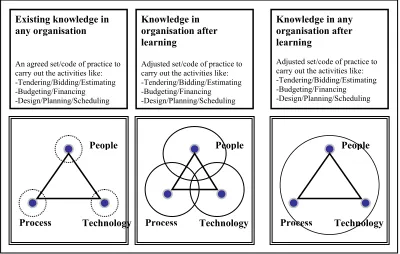
Figure 2.2 Knowledge transfer in construction organisations after learning [Source: Kazi (2005)]
As has been seen in Figure 2.2, organisational learning can be enhanced through knowledge transfer, integrating people, processes and technology in order to overcome or remove the imperious and impervious thick boundaries and obstacles isolating the construction organisations. Therefore, it can be insisted that project-based learning can be effectively enhanced through systematic knowledge transfer systems which can improve the ability and skills of construction actors in construction project organisations. Ultimately, construction project performance is improved.
However, integrating the key construction project components is difficult in the knowledge management area. In this regard, it has been agreed that knowledge maps can more effectively integrate the key components of project or business, such as knowledge, processes, human resources, technologies and techniques.
Existing knowledge in any organisation
An agreed set/code of practice to carry out the activities like: -Tendering/Bidding/Estimating -Budgeting/Financing -Design/Planning/Scheduling
Process Technology People
Knowledge in organisation after learning
Adjusted set/code of practice to carry out the activities like: -Tendering/Bidding/Estimating -Budgeting/Financing -Design/Planning/Scheduling
Process Technology People
Knowledge in any organisation after learning
Adjusted set/code of practice to carry out the activities like: -Tendering/Bidding/Estimating -Budgeting/Financing -Design/Planning/Scheduling
People
34
2.6 Research questions
As a result of the literature review and synthesis, it has been confirmed that knowledge mapping offers the potential to be a principal component of knowledge management. Tiwana (2002), White (2002) and Hellstrom (2004), for example, agreed that knowledge maps can be used to effectively foster generating, capturing, transferring, codifying, storing and using knowledge in projects and organisations.
A number of types of knowledge map are discussed (Lawless and Smee, 1998, Oughton and Reed, 2000, Koh and Tan, 2006, Driessen et al., 2007), but the maps
may be difficult to be used and applied to construction project organisations directly because key characteristics of construction project organisations have not been considered and deliberated. Therefore, a various number of the natures of construction project organisations must be explored and considered in order to successfully develop an appropriate knowledge map for construction project organisations. The following research questions which are interrelated each other are proposed for by the researcher.
■ Research questions
Q1. Is knowledge management an appropriate aspiration for effective project performance and project-based learning in projects and organisations?
Q11. Is knowledge mapping an appropriate tool to improve performance and enhance learning within and across construction project organisations?
Q2. In construction project organisations, how can an appropriate knowledge map be developed for effective project performance and learning?
35
transfer technologies should be part of an effective knowledge mapping approach?
Q22. How should the knowledge map components be integrated?
In order to support and address the above research questions, a systematic and graphic concept model for effective construction project performance and project-based learning in construction project organisations is offered in Section 3.1. The model is utilised to more effectively understand and improve practice, particularly for implementing case study and establishing and demonstrating hypotheses in this study.
2.7 Summary and link
36