Journal of Chemical and Pharmaceutical Research, 2015, 7(8):578-584
Research Article
CODEN(USA) : JCPRC5
ISSN : 0975-7384
Effect of drying method on anti-microbial, anti-oxidant activities and isolation
of bioactive compounds from Peperomia pellucida (L) Hbk
Habsah Mohamad
1, Yosie Andriani
1*, Kamariah Bakar
1,
Chow Chee Siang
1, Desy Fitrya
Syamsumir
1, Asmah Alias
2and Siti Aisha Mohd Radzi
11
Institute of Marine Biotechnology, Universiti Malaysia Terengganu, Kuala Terengganu, Terengganu, Malaysia 2
Department of Chemistry, Faculty of Applied Sciences, Universiti Teknologi Mara (UiTM), Shah Alam, Selangor, Malaysia
_____________________________________________________________________________________________
ABSTRACT
In this study, Peperomia pellucida was subjected to the determination of biological activity and isolation of chemical constituents. Two samples of this plant were used, which were the air-dried and freeze-dried. The sequential maceration of the plant utilized three different solvents with increasing polarities, namely dichloromethane, ethyl acetate and methanol. The Thin Layer Chromatography (TLC) profile showed there was no significant different in the chemical constituents in both samples. All six crude extracts displayed in vitro antimicrobial activity on Pseudomonas aeruginosa, with minimum inhibition zone 9.0±1.7 mm and no activity on 7 other type of bacteria (Escherichia coli, Klebsiella pneumonia, Salmonella sp., Bacillus subtilis, Micrococcus sp., Staphylococcus aureus and Streptococcus uberis). In addition, antioxidant activity of all of the crude extracts was determined using DPPH (2,2-diphenyl-picryhdrazyl) radical scavenging assay. Among the extracts methanol extract of freeze dried sample showed the highest antioxidant activity with IC50 value of 2.45±0.20 mg/ml. The result also showed that the free radical scavenging activity was proportional to the concentrations of samples. The isolation of compound from dichloromethane extracts was performed by using various chromatographic techniques such as dry column vacuum chromatography, chromatotron and preparative thin layer chromatography techniques and produce six single compounds, with three of them were successfully characterized as dillapiole, caryophyllene oxide and stigmasterol. The structures of the compounds were determined using IR, UV, EIMS and NMR spectroscopies.
Key words: Peperomia pellucida, dillapiol, caryophylene oxide, DPPH, antibacterial
_____________________________________________________________________________________________
INTRODUCTION
Peperomia pellucida is an annual herb from the Piperacea family which comprises of 14 genera and 1,950 species
widely distributed in many Asia countries and South of America. It is popularly known in northeast Brazil as
“coraҫӑozinho” (little heart), “lingua de sapo” (toad’s tongue), “erva-de-vidro” (glass grass), “erva-de-jaboti”
Indians in Bolivia consumes the whole plant to stop haemorrhages [3, 9]. Moreover, the plant was recognized as one of the ten herbal medicines in the Philipines Approved by the Department of Health (DOH) of the country due to its medical properties [10].
Chemical studies carried out on Piperaceae species have revealed the occurrence of a variety of compounds including pyrones, lignoids, polyphenols, unsaturated amide, essential oil and alkaloid [11]. vious phytochemical investigation on P. pellucida have shown the presence of flavanoids, phytosterols, apiols, substituted styrenes,
pellucidin A, a dimeric (ArC2), secolignans [12] terpenes, arylpropanoids and phenolic compounds [13-16].
These species have been extensively investigated as a sources of new natural products with potential antimicrobial, anticancer, cytotoxicity, anti-inflammatory, analgesic, antitumor and antiedematogenic activity [5, 8, 17-19]. Some of the compounds isolated from this plant were evaluated for their biological activity. Patuloside A, a xanthone glycoside displayed weak antifungal and antibacterial. Patuloside A also cytotoxic to brine shrimp naupli [2]. 2-Methylene-3-[(3’,4’,5’-trimethoxyphenyl) (5”-methoxy-3”,4”-methylenedioxyphenyl) methyl] butyrolactone and peperomine E exhibited cytotoxic activity against HL-60, MCF-7 and HeLa cell lines. The 7,8-trans-8,8’-trans-8,8’-trans-7’,8’-cis-7,7’-bis(5-methoxy-3,4-methylenedioxyphenyl)-8-acetoxymethyl-8’-hydroxymethyltetrahydrofuran showed cytotoxic activity against MCF-7 cell line, and displayed an estrogen-like activity [14].
Peperomia pellucida is a succulent plant, thus the drying method is important to avoid any decay of the plant prior
to extraction. Thus two drying method were applied which were air dried and freeze dried. Air dried methods was preferred by the small medium industry because the freeze dried method is expensive. In order to determine the better technique for drying the P. pellucida, we have performed a phytochemical examination of P. Pellucida, compare the TLC profiling and biological activity of the P. Pellucida crude extract obtained from different drying method and also from different type of solvent for extraction. The isolation and characterization of the bioactive compounds from local P. Pellucida is also reported.
EXPERIMENTAL SECTION
2.1 Collection and Preparation of Plant Samples
Approximately 30kg of mature P. pellucida plant samples were collected from an oil palm farm in Segari, Lumut, Perak, Malaysia on June 2010. Plant samples which contained cuts and infection due to insect invasion were discarded. Plant samples were washed with running water and separated into two batches. The first batch of plant samples was air-dried under the shade (5 days) and further freeze-dried under -40°C (1 day) to remove any extra moisture that might caused problem in purification method. The second batch, the fresh sample was lyophilised directly in freeze dryer under -40°C (5 days). The plant wet weight and dry weights were recorded. Then the samples were ground using a blender into powder form.
2.2 Extraction
Ground samples in powder form were extracted with dichloromethane (DCM) at room temperature for 48 hours at a time. The soaked plant materials were then filtered to collect the soluble extract, and this process was repeated until almost clean filtrate was obtained. The samples were filtered using Buchner vacuum filter set with whatman filter
paper no.2 (100 Ø). Filtrates, or the DCM extracts were then evaporated under a reduced pressure at 40oC using a
rotary evaporator. The remaining solvent was further removed by drying the sample in a laminar flow hood for a few days. The residues were then extracted by ethyl acetate (EtOAc) for 6 times and then followed by methanol (MeOH) for 6 times in same procedure. The crude extracts were used in the isolation of chemical compounds and determination of biological activity.
2.3 Antibacterial Activity Assay
The microbial growth inhibitory potential of the crude extracts and pure compounds was determined by the disc diffusion method [20] cited by [21]. Samples of crude extracts in series concentrations, i.e. 2000 µg/disc, 1000
µg/disc, 500 µg/disc, 240 µg/disc and 125 µg/disc were be loaded onto each Whatman No. 1 filter paper discs (Ø,
6mm) and dried in laminar flow to remove the solvent of stock solution. Then, the discs were located on the surface of the previous inoculated agar. The plates were inverted and incubated for 24 hours at 37 °C. Clear inhibition zones around the discs indicated the presence of antimicrobial activity. The zones around the disc were measured after the incubation period. The experiments were performed in triplicates to determine the inhibition zone.
2.4 Determination of DPPH Scavenging Activity
The free radical scavenging activity of P. pellucida extracts was measured in terms of radical scavenging ability or
Subsequently, 200 µlof DPPH (2.37g in 100 ml) was added to this mixture. After 30 minutes of incubation at room temperature, absorbance was measured at 517 nm using UV/visible light readers (Multiskan ascent, Thermo electron
corporation), against DMSO as a blank. The control contained 20 µl DMSO and 200 µl of DPPH. Free radical
scavenging activity was determined according to the equation:
where, As is the absorbance of sample. Ac is the absorbance of control.
2.5 Isolation and characterization of dillapiol (1) and caryophyllene oxide (2)
About 36.83g of DCM extract was subjected to dry column vacuum chromatography (10 cm x 6 cm) packed with
preparative TLC silica (Merck, Kieselgel 60 PF254 Art No. 7747). The column was eluted with hexane followed by
gradiently increased the polarity of the solvents by adding chloroform, ethyl acetate, acetone and methanol to give fraction of A1-A8. Fraction A2 (5.7918g) was subjected to further isolation by column chromatography (CC) on silica gel (Merck 7738) to produce fraction D3 and D4. Fraction D4 was subjected to preparative column
chromatography (PTLC, 1 mm thickness, silica gel Merck 7749) with solvent system hexane: Et2O 8 : 2. Dillapiol
(1) appeared as light yellow liquid (8.2 mg) and was successfully isolated. Whereas fraction D3 was subjected to medium pressure liquid chromatography (MPLC, silica gel: 11 x 300 mm, solvent hexane:acetone (9.5:0.5), flow rate 2.5 ml/min) and followed by PTLC (1 mm thickness, silica gel Merck 7749, solvent system: hexane : acetone
8.5 : 1.5). A blue green band was observed under UV254 nm light were scraped and extracted with chloroform to give
caryophyllene oxide (2) (99.3 mg). The structures of the compounds were determined using IR, UV, EIMS and NMR spectroscopy.
RESULTS AND DISCUSSION
3.1 Percentage yield of P. pellucida extracts based on drying method
Since Peperomia pellucida is a succulent plant, thus method of drying is important to avoid any decay of plant material prior to extraction. Freeze dry method is good in preserving the chemical constituents and the biological activity of plant extract [23-24]. However, some small medium industry choose air dry in grafted oven rather than freeze dry because the later was an expensive method for drying the sample. In this study, two batches of P.
pellucida were dried in two ways which are air dried for 5 days followed by freeze dried for 1 day, and freeze dried
for 5 days. A total of six crudes were obtained, and the percentage yield of extract is displayed in Table 1. Table 1 shows that the extracts obtained from the fresh–freeze dried plants (DF, EF, MF) had a higher extraction efficiency than the air dried–freeze dried samples (DD, ED, MD). This is because freeze-drying leads to the development of ice crystals within the plant matrix. Ice crystals can results in a greater rupturing of plant cell structure, which allows better solvent penetration and extraction [25].
Table 1 Percentage yield of P. pellucida extracts based on drying method
Extract Weight (g)
Percentage Yield (%wt/dry wt)
Extract Weight (g)
Percentage Yield (%wt/dry wt) DD 26.9039 5.01 DF 26.0126 6.19 ED 7.2788 1.36 EF 11.3891 2.71 MD 50.9260 9.49 MF 57.5246 g 13.68
DD: air dried-freeze dried Dichloromethane crude extract, ED: air dried-freeze dried Ethyl acetate crude extract, MD for air dried-freeze dried Methanol crude extract, DF for fresh-freeze dried dicholoromethane crude extract, EF for fresh-freeze dried Ethy acetate crude extract and a
MF for fresh-freeze Methanol crude extract.
Dry weight of air dried-freeze dried sample = 536.5 g, Dry weight of air dried-freeze dried sample = 420.4 g
3.2 TLC Profiling
TLC profiling of extracts demonstrated the presence of numerous phytochemicals. Various phytochemicals
produced different Retention factor (Rf)values in different solvent systems. Compounds that show high Rf value in
less polar solvent system have low polarity, while lower Rf value have high polarity. TLC profiling on 6 extracts were developed by different solvent polarities and were visualized under UV254nm, UV366nm, stained with iodine vapors and sprayed with anisaldehyde reagent (Figure 1).
The TLC profiling of the extracts that extracted with the same type of solvent shows no significant differences between two batches of samples with different drying methods (fresh-freeze dried and air dried-freeze dried). However, the TLC profiles between crude extracts which extracted with different solvents were significantly different.
A B C D E
Figure 1 TLC profiling of Peperomia pellucida crude extracts
DD: air dried-freeze dried Dichloromethane crude extract, ED: air dried-freeze dried Ethyl acetate crude extract, MD for air dried-freeze dried Methanol crude extract, DF for fresh-freeze dried Dichloromethane crude extract, EF for fresh-freeze dried Ethyl acetate crude extract and a
MF for fresh-freeze Methanol crude extract. Visualised under: A=ambient light, B= UV254nm, C=UV366nm, D=stained with iodine vapors, E=
sprayed with anisaldehyde reagent. Solvent system used = Hexane : Acetone (7 : 3). TLC sheets=Merck silica gel 60F254 1.05735.001
3.3 Antimicrobial activity of crude extract
A total of eight microorganisms, Escherichia coli (gram - negative), Klebsiella pneumoniae (gram - negative),
Pseudomonas aeruginosa (gram - negative), Salmonella sp. (gram - negative), Bacillus subtilis (gram - positive), Micrococcus sp. (gram - positive), Staphylococcus aureus (gram - positive), Streptococcus uberis (gram - positive)
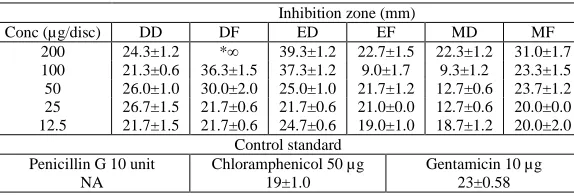
were used to be screened by all the crude extracts. The extracts only displayed antimicrobial activity against
P.aeruginosa and did not show any antimicrobial activity against the rest of other bacteria tested. All the crude
extracts had different level of inhibition against P.aeruginosa at all concentrations (Table 2).
Table 2 Antimicrobial activity of Peperomia pellucida crude extract against P. aeruginosa
Inhibition zone (mm)
Conc (µg/disc) DD DF ED EF MD MF 200 24.3±1.2 *∞ 39.3±1.2 22.7±1.5 22.3±1.2 31.0±1.7 100 21.3±0.6 36.3±1.5 37.3±1.2 9.0±1.7 9.3±1.2 23.3±1.5 50 26.0±1.0 30.0±2.0 25.0±1.0 21.7±1.2 12.7±0.6 23.7±1.2 25 26.7±1.5 21.7±0.6 21.7±0.6 21.0±0.0 12.7±0.6 20.0±0.0 12.5 21.7±1.5 21.7±0.6 24.7±0.6 19.0±1.0 18.7±1.2 20.0±2.0
Control standard Penicillin G 10 unit
NA
Chloramphenicol 50 µg Gentamicin 10 µg 19±1.0 23±0.58
*∞ : the zone was too big and overlap between others.
DD: air dried-freeze dried Dihloromethane crude extract, ED: air dried-freeze dried Ethy acetate crude extract, MD for air dried-freeze dried Methanol crude extract, DF for fresh-freeze dried Dichloromethane crude extract, EF for fresh-freeze dried Ethyl acetate crude extract and a
MF for fresh-freeze Methanol crude extract.
The results obtained in this study show contradictory with those of Khan and coworkers [26]. It was reported dichloromethane, ethyl acetate and methanol crude extracts of P. pellucida produced anti-microbial activity against
Escherichia coli, Klebsiella pneumoniae, Salmonella sp., Bacillus subtilis, Micrococcus sp. at 4 mg/dics. This may
be due to the difference in sample locality which might affect their biological activity [27-28]. However, that study also demonstrated the ability of the extracts to kill P. aeruginosa which is in agreement with our study. Dillapiol may be one of the chemical constituents that are responsible for its antimicrobial activity [29-30].
3.4 Free Radical Scavenging Activity
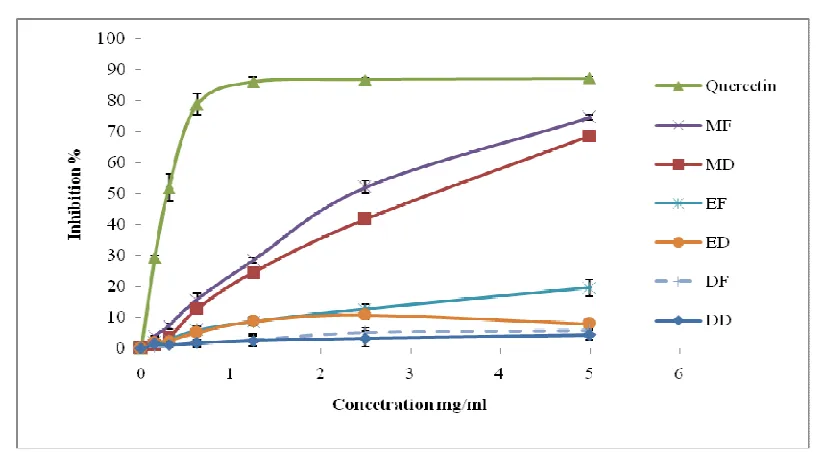
The concentration of Quercetin and the extracts used in this study was 1mg/mL and 5mg/mL, respectively. The IC50
of any extract that over 50% inhibition is considered to have antioxidant activity. The results in Figure 2 show that
only MF (IC50=3.24±0.13) and MD (IC502.45±0.20) had antioxidant activity over 50% with the fresh-freeze dried
extracts showed highest activities than to that of the air dry-freeze dried. This difference indicates that freeze-drying may lead to higher extraction efficiency on extraction of antioxidant compounds.
[image:4.595.162.449.395.493.2]Figure 2 Free radical scavenging activity of P. pellucida extracts
DD: air dried-freeze dried Dichloromethane crude extract, ED: air dried-freeze dried Ethy acetate crude extract, MD: air dried-freeze dried Methanol crude extract, DF:freeze dried Dichloromethane crude extract, EF: freeze dried Ethyl acetate crude extract, MF:
fresh-freeze Methanol crude extract. MF (IC50=3.24±0.13) and MD (IC50=2.45±0.20)
3.5 Characterization and biological activities of dillapiol (1) and caryophyllene oxide (2)
Dillapiol (1) and caryophyllene oxide (2) (Figure 3) in addition to stigmasterol, sitosterol and campesterol were successfully isolated from Peperomia pellucida dichloromethane extract.
Figure 3 Structure of Isolated Compounds Dillapiol (1) and caryophyllene oxide (2)
The 1H-NMR and 13C-NMR data of dillapiol (1) (Table 3) were consistent with literature values for dillapiole [31].
[image:5.595.101.465.399.530.2]This compound was previous isolated by Bayma and co-workers [6] from P. Pellucida.
Table 3 1D-NMR (1H and 13C NMR) and 2D-NMR assignments for dillapiole (1)
Dill apiol
C# δ
13C δ1H mult. (J HH),
HMBC
COSY
2J 3J 4J
1 126.1(C) H-6,H-7 H-8
2 144.3(C) H-7 H-10
3 137.6(C) H-11
4 136.0(C) H-6,H-12
5 144.6(C) H-6 H-12 6 102.8(CH) 6.38 s, 1H H-7
7 33.9(CH2) 3.33 d (6.4), 2H H-8 H-6, H-9 H-8,H-9
8 137.4(CH) 5.95 m, 1H H-7,H-9 H-7,H-9 9 115.5(CH2) 5.07 m, 2H H-7 H-7,H-8
10 61.3(CH3) 3.78 s, 3H
11 60.0(CH3) 4.04 s, 3H
12 101.1(CH2) 5.90 s, 2H
Silva and coworker [32] published that dillapole is the major volatile compound in the essential oil of P. pellucida with 39.7%. Since P. pellucida was used to treat epilepsy in Africa, we continue to study the enhancement effect of dillapiol on GABA (A) receptors as a preliminary evaluation for its antiepileptic activity. In addition, one of dillapiol derivatives, myristicin did show promising enhancement effect of dillapiol on GABA (A) receptors [33]. Various biological activities of dillapiol were reported. Dillapiol can act as a cytochrome P450 inhibitor and used in binary treatment with gedunin demonstrated the potential efficacy of antimalarial drugs [4], show insecticidal activity against European Corn Borer (ECB) Ostrinia nubilalis [34], fungicidal, antimicrobial activities and have genotoxic effect on dengue mosquitoes, Aedes aegypti [29].
The 1H NMR, 13C NMR data and HMBC correlation of caryophyllene oxide (2) were given in Table 4. From
previous literature, 3.8% of caryophyllene oxide was found in the essential oil of P.pellucida [30]. An MTT assay was conducted against several cancer cell lines to resolve an ongoing controversy regarding the cytotoxic effects of
β-caryophyllene oxide. β-caryophyllene oxide produced potent cytotoxic activity against HepG2, AGS, HeLa,
SNU-1, and SNU-16 cells, with IC50 values of 3.95, 12.6, 13.55, 16.79, and 27.39 µM, respectively. The results also
showed that β-caryophyllene oxide exhibited cytotoxicity activity in both a dose-dependent and time-dependent
[image:6.595.113.505.281.484.2]manner [35].
Table 4 1D-NMR (1H and 13C NMR) and 2D-NMR assignments for caryophyllene oxide (2)
Caryophyllene oxide
C# δ13C (DEPT) δ1H mult. (J HH),
HMBC COSY
2J 3J
1 50.8 (CH) 1.79 t, 1H H-9,H-2,H-2’ H-3,H-3’,H-14,H-15 H-2,H-9 2 27.2 (CH2) 1.45 m, 1H,1.66 m, 1H H-3,H-3’ H-9 H-1,H-3
3 39.2 (CH2) 0.99 m, 1H,2.10 m, 1H H-2 H-5,H-12 H-2
4 59.8 (C) H-3,H-3’,H-5, H-12 H-2’,H-6,H-6’
5 63.8 (CH) 2.90 dd, 1H H-6 H-3’,H-7,H-7’, H-12 H-6 6 30.2 (CH2) 1.36 m, 1H,2.27 ddd, 1H H-5 H-7,H-7’ H-5,H-7
7 29.8 (CH2) 2.14 m, 1H,2.37 ddd, 1H H-6,H-6’ H-9,H-13,H-13’ H-6
8 151.9 (C) H-7,H-7’,H-9 H-6,H-6’, H-10, H-10’
9 48.7(CH) 2.64 q, 1H H-1,H-10,H-10’ H-2’,H-7,H-7’ H-1,H-10 10 39.8 (CH2) 1.61 m, 1H,1.70 m, 1H H-9 H-13,H-13’H-14,
H-15
H-9
11 34.0 (C) H-1,H-10,H-10’, H-14,H-15
12 17.0 (CH3) 1.23 s, 3H H-3’,H-3
13 112.8 (CH2) 4.89 s, 1H,5.00 s, 1H H-7,H-7’,H-9
14 21.6 (CH3) 1.03 s, 3H H-1,H-10,H-10’,
H-15
15 29.9 (CH3) 1.01 s, 3H H-14,H-10,H-10’
CONCLUSION
Fresh – freeze dried samples produced higher percentage in the yield of extracts; dichloromethane extract (6.19 %), ethyl acetate extract (2.71 %) and methanol extract (13.68 %) compared to air dried – freeze dried sample have lower percentage yield; dichloromethane extract (5.01 %), ethyl acetate extract (1.36 %) and methanol extract (9.49 %). The extracts P. pellucida demonstrated antimicrobial against P.aeruginosa. Fresh-freeze dried MeOH and air
dried – freeze dried methanol extracts exhibited DPPH free radical scavenging activity, with IC50 value of
2.45±0.20 mg/mL and 3.24±0.13 mg/mL, respectively. Dillapiole, and caryophyllene oxide were successfully isolated from P. pellucida dichloromethane extract. Our finding showed different drying method used in this study did not affect the antioxidant and antimicrobial activity and chemical constituents of Peperomia pellucida. This may be good because it benefit people in small medium industry as they do not need to use an expensive machine such as freeze drier to dry the Peperomia pellucida. They just can used air dried, which is cheaper and also can preserved their chemical constituent and their biological activity comparable to freeze dry method.
Acknowledgements
The author acknowledge the support from Ministry of Higher Education for the fund provided Fundamental Research Grant Scheme (FRGS vote: 59261) for this project.
REFERENCES
[1]. ABM De Fatima; RLB Oleiveira; SS Mendes; PDA Silva; AR Antoniolli; JC Vilar; SCDH Cavalcanti; AF Blank. Pharmacol. 2002, 2, 12.
[4] S Omar; K Godard; AIngham; H Hussain; V Wongpanich; J Pezzuto; T Durst; C Eklu; M Gbeassor; P Sanchez-Vindas; L Poveda; BJR Philogene; JT Arnason. Annals of Applied Biol., 2003, 143, 135-141.
[5] AF Mutee; SM Salhimi; MF Yam; CP Lim; GZ Abdullah; OZ Ameer; M Abdul Karim; MZ Asmawi. Int. J. of
Pharmacol., 2010, 6(5), 686-690.
[6] JD Bayma; MS Arruda; AH Müller; AC Arruda; WC Canto. Phytochem., 2000, 55(7), 779-782. [7] P Majumder; P Abraham; V Satya. Res. J. of Pharm. Biol. & Chem. Sci. 2011, 2(4), 358-364. [8] LS Wei; W Wee; JYF Siong; DF Syamsumir. Acta Med. Irania, 2011, 49(10), 670-674. [9] SO Sio; NP Cortes-Maramba; IC Sia. Acta Med. Philipina, 2001, 37(1-2), 1-11. [10] GR Batuiga. 2011. PhD Thesis, Zamboaga University.
[11] MG Soares; APV Felippe; EF Guimaraes; MJ Kato; J Ellena & AC Doriguetto. J. of the Brazilian Chem. Soc., 2006, 17(7), 1205-1210.
[12] TR Govindachari; GN Krishna Kumari; PD Partho. Phytochem., 1998, 49, 2129-2131.
[13] JL Wu; N Li; T Hasegawa; J Sakai; S Kakuta; W Tang; S Oka; M Kiuchi; H Ogura; T Kataoka; A Tomida; T, Tsuruo; M Ando. J. of Nat. Prod., 2005, 68(11), 1656-1660.
[14] S Xu; N Li; MM Ning; CH Zhou; QR Yang; MW Wang. J. of Nat. Prod., 2006, 69(2), 247-250. [15] TJ Hsieh; LH Lu; CC Su. Biophys. Chem., 2005, 114, 13-20.
[16] RF Webby; KR Markham. Phytochem., 1994, 36, 1323-1326.
[17] G Sacchetti; S Maietti; M Muzzoli; M Scaglianti; S Manfredini; M Radice; R Bruni. Food Chemistry, 2005, 91, 621–632.
[18] FA Ripa; L Nahar; M Haque; MM Islam. Eur. J. Sci. Res., 2009, 33(1), 123-129.
[19] GK Oloyede; PA Onocha; BB Olaniran. Adv. in Environ. Biol., 2011, 5(12), 3700-3709.
[20] MM Mackeen; AM Ali; SH El-Sharkawy; MY Manap; KM Salleh; NH Lajis; K Kawazu. Pharm. Biol., 1997, 35(3), 174–178.
[21] M Habsah; M Amran; MM Mackeen; NH Lajis; H Kikuzaki; N Nakatani; AA Rahman; Ghafar & AM Ali. J. of
Ethnopharmacol., 2000, 72(3), 403–410.
[22] A Kumaran & RJ Karunakaran. Food Chem., 2006, 97(1), 109-114.
[23] D Rodriguez De Sotilo; M Hadley; ET Holm. J. of Food Sci., 1994, 59(5), 1031-1033. [24] JA Larrauri; P Rupérez; FS Calixto. J. Agric. Food Chem., 1997, 45(4), 1390–1393.
[25] DK Asami; YJ Hong; DM Barrett; AE Mitchell. J. of Agric. and Food Chem., 2003, 51, 1237-1241. [26] MR Khan & AD Omoloso. Fitoterapia, 2002, 73, 251-254.
[27] I Marı́a; MIN Nieva Moreno; M Isla; AR Sampietro; MA Vattuone. J. of Ethnopharmacol., 2000, 71( 1-2),
109–114.
[28] M Kartal; S Yıldız; S Kaya; S Kurucu; G Topçu. J. of Ethnopharmacol., 2003, 86(1), 69-73.
[29] MS Rafael; WJ Hereira-Rojas; JJ Roper; SM Nunomura; WP Tadei. Gen. and Mol. Res., 2008, 7(3), 772-781. [30] MAB Brazao; FV Brazao; JGS Maia; MC Monteiro. BLACPMA, 2014, 13 (6), 517-526.
[31] EP Lichtenstein; TT Liang; KR Schulz; KH Schnoes; GT Carter. J. Agric. Food Chem., 1973, 22(4), 658-664. [32] MHL Silva ; MGB Zoghbi; EH Andrade; JGS Maia. Flavour and Frangrance J., 1999, 14, 312-314.
[33] ACS Tarmizi. 2012. Master Thesis. Universiti Sains Malaysia.
[34] CB Bernard; JT Arnason; BJR Philogène; J Lam; T Waddell. Entomologia Experimentalis et Applicata, 1990, 57(1), 17-22.