Journal of Chemical and Pharmaceutical Research, 2014, 6(4):743-748
Research Article
CODEN(USA) : JCPRC5
ISSN : 0975-7384
Chemical composition and antioxidant activity of essential oils and
solvent extracts of Foeniculum vulgare Mill. from Morocco
E. El Ouariachi
1, N. Lahhit
1, A. Bouyanzer
1*, B. Hammouti
1, J. Paolini
2, L. Majidi
3, J-M.
Desjobert
2and J. Costa
21
LCAE-URAC18, Faculté des Sciences, Université Mohammed Premier, Oujda, Morocco 2Université de Corse, UMR CNRS 6134, Lab. de Chimie des Produits Naturels, Corte, France
3Université My Ismail, Laboratoire des Substances Naturelles, Synthèse et Dynamique Moléculaire, Errachidia, Morocco
____________________________________________________________________________________________
ABSTRACT
The aim of this work was to characterize the essential oils and solvent extracts of Foeniculum vulgare Mill. from Morocco in terms of chemical composition and antioxidative activity. Analysis of the essential oil of F. vulgare was carried out using gas chromatography (GC) and gas chromatography-mass spectral (GC-MS). The main components were limonene (20.8%) and β-pinene (17.8%), followed by myrcene (15.0%) and fenchone (12.5%). The antioxidant activities of this aromatic plant were evaluated using a DPPH test system to suggest it as a new potential source of natural antioxidants. The amounts of phenolic and flavonoid compounds of solvent extracts (diethyl ether and ethyl acetate) were determined spectrometrically. Furthermore, The DPPH scavenging activity of extracts increased in the order essential oil < diethyl ether extract < ethyl acetate extract < ascorbic acid. Finally, a relationship was observed between the antioxidant activity potential and total phenolic and flavonoid levels of the extract.
Keywords: Foeniculum vulgare Mill., Essential oil, Solvent extract, Antioxidant activity, Flavonoid content
____________________________________________________________________________________________
INTRODUCTION
Antioxidants are widely used as food additives to provide protection against oxidative degradation of foods by free radicals [1]. Furthermore, many synthetic antioxidant components (BHA and BHT) have shown toxic and/or mutagenic effects; therefore, plant antioxidants are suggested as an interesting alternative. Several substances from aromatic and medicinal plants have been shown to contain antioxidants like flavonoid compounds. Compounds are the main agents that can donate hydrogen to free radicals and thus break the chain reaction of lipid oxidation at the first initiation step [2]. This high potential of phenolic constituents to scavenge radicals may be explained by their phenolic hydroxyl groups [3]. Numerous studies exhibited a strong relationship between total phenolic content and antioxidant activity in fruits, vegetables, and medicinal plants [4,5]. Polyphenolic components are also known for their ability to prevent fatty acids from oxidative decay [6].
Fennel (Foeniculum vulgare Mill.) belonging to the family Apiaceae (Umbelliferae) is native to the Mediterranean areas [7]. F. vulgare is a perennial herb (up to 40 cm high) with feathery leaves (up to 40 cm long) and yellow flowers (umbels 5–15 cm wide). The fruit is a dry and grooved seed from 4–10 mm long (Blamey, M. & Grey-Wilson, C, 1989).
F. vulgare is recognized as an aromatic plant growing wild in eastern Morocco. For instance, fennel fruits are widely
medicine as a stimulant, diuretic, carminative and sedative [12, 13]. Widely used for its medicinal properties, it is nowadays cultivated for industrial uses such as cosmetic and pharmaceutical products [14, 15]. F. vulgare has shown antimicrobial [16], antioxidant, and anticholinesterase activity in various in vivo and in vitro experiments [17].
Phytochemical analysis of F. vulgare showed the presence of terpenes, alkaloids, flavonoids, tannins, and saponins [18]. The essential oil composition has been previously reported [19, 20]; the two major components are trans-anethol and fenchone [16, 21-23]. The characteristic odor of fennel has been attributed at the volatile compounds trans-anisole, estragole, fenchone and oct-1-en-3-ol [24], F. vulgare Essential Oil is alos known as green corrosion inhibitor of carbon steel in hydrochloric acid solution [25].
Solvent extracts of F. vulgare exhibited high amounts of hydroxylcinnamic acid derivatives and flavonoid components with high antioxidant activities such as 3-caffeoylquinic acid, 4-caffeoylquinic acid, 1,5-O-dicaffeoylquinicacid, rosmarinic acid, eriodictyol-7-O-rutinoside, quercetin-3-O-galactoside, kaempferol-3-Orutinoside and kaempferol-3-O-glucoside [26].
The aim of this work is to evaluate the antioxidative properties of the essential oils and solvent extracts of F. vulgare from Morocco. Additionally, the essential oil composition, the total phenolic and flavonoid contents of diethyl ether and ethyl acetate extracts have been determined.
EXPERIMENTAL SECTION
2.1. Plant material
The aerial parts of F. vulgare were harvested in october 2009 (full bloom) from Al Hoceima, Morocco. Voucher specimens were deposited in the herbarium of Mohamed 1st University, Oujda, Morocco.
2.2. Essential oil isolation
The air-dried leaves of F. vulgare were submitted for 4 h to hydrodistillation using a Clevenger type-apparatus according to the method recommended in the European Pharmacopoeia [27]. The essential oils were dried over anhydrous sodium sulphate and then stored in sealed glass vials at 4 to 5°C prior to analysis.
2.3. GC and GC–MS analysis
Analysis was carried out using a Elmer Autosystem XL GC apparatus (Waltham, MA, USA) and a Perkin-Elmer turbo mass detector (quadrupole) coupled to a Perkin–Perkin-Elmer Autosystem XL equipped with a dual flame ionization detection (FID) system and the fused-silica capillary columns (60 m × 0.22 mm I.D., film thickness 0.25 ml) Rtx-1 (polydimethylsiloxane) and Rtx-wax (polyethyleneglycol). In previous studies [28,29], the complementarity of these two analytical techniques (GC-FID and GC-MS) with two chromatographic columns (apolar and polar) have been demonstrated for the identification and quantification of volatile components in complex mixture. The oven temperature was programmed from 60 to 230°C at 2°C/min and then held isothermally at 230°C for 35 min. Injector and FID temperatures were maintained at 280°C and MS source temperature at 150°C. Samples were injected in the split mode (1/50) using helium as a carrier gas (1 ml/min) and 0.2 µl injection volume of pure oil. Retention indices (RI) of compounds were determined relative to the retention times of a series of n-alkanes (C5–C30) (Restek, Lisses, France) with linear interpolation using the Van den Dool and Kratz equation and software from Perkin–Elmer. Electron ionization mass spectra (energy ionization: 70 eV) were acquired over the mass range 35 to 350 Da. Identification of individual components was based on: (i) comparison of calculated RI, on polar and apolar columns, with those of authentic compounds or literature data [30] ; and (ii) computer matching with commercial mass spectral libraries and comparison of mass spectra with those of our own library of authentic compounds or literature data [30,31] .
2.4. Preparation of the extracts
Boiling water extracts (100 ml) of plant samples obtained under reflux conditions (hydrodistillation process) were extracted three times (3 × 20 ml) with organic solvents (diethyl ether and ethyl acetate). Water extract residues were then extracted by boiling acidified water (2 N HCl) prior to liquid–liquid extraction. The diethyl ether and ethyl acetate extracts were filtered and concentrated under vacuum to obtain two extracts in yields of 0.36 % (w/w). The organic solvent extracts were dried over anhydrous sodium sulfate and then stored in sealed glass vials at 4 to 5°C prior to analysis. Each extraction was performed in triplicate.
[33]. 200 µl of the diluted solution extract was mixed with 1 ml of Folin–Ciocalteu (diluted in distillated water) and the volumetric flask was vigorously shaken. After 4 min, 800 µl of Na2CO3 (75 mg/ml) solution was added and the
mixture was allowed to stand for 45 min at room temperature. At the end of the incubation, the absorbance was measured at 760 nm. The same procedure was also applied to the standard solutions of caffeic acid, and a standard curve was obtained. The concentrations of phenolic compounds expressed as µg caffeic acid equivalent per mg of extract were calculated according to the standard caffeic acid graph. All experiments were carried out in triplicate, and caffeic acid equivalent values were reported as X (average) ± SD (standard deviation) of triplicates.
2.6. Determination of total flavonoids contents
Total flavonoid contents were determined using the Dowd method as adapted by Arvouet-Grand et al. [34]: 1 ml of 2% aluminium trichloride (AlCl3) in methanol was mixed with the same volume of extracts (200 µg). The absorption
at 430 nm was measured after 10 min against a blank sample consisting of 1 ml methanol without AlCl3. The
concentrations of flavonoid compounds expressed as µg quercetin equivalent per mg of extract were calculated according to the standard quercetin graph. All experiments were carried out in triplicate, and quercetin equivalent values were reported as X ± SD of triplicates.
2.7. Antioxidant activity
The free radical-scavenging activities of solvent extracts were measured using 1,1-diphenyl-2-picrylhydrazyl (DPPH) as described by Hatano et al. [35]; antioxidants react with the stable free radical DPPH (deep violet color) and convert it to 1,1-diphenyl-2-picrylhydrazine with discoloration. Various concentrations (0.1 ml) of the oil (1.5– 24 mg/ml), the diethyl ether extract (40 to 400 mg/l) and ethyl acetate extract (28 to 160 mg/l) in ethanol and water were added to 3.9 ml of a DPPH radical solution in ethanol (the final concentration of DPPH was 0.05 mM). The mixture was strongly shaken and left to stand at room temperature for 30 min in the dark. The absorbance was measured at 517 nm against a blank. The radical-scavenging activity was expressed as percentage of inhibition (I%) according to the following formula [36]:
I(%)= 100* (Acontrol – Asample)/Acontrol
Where Acontrol is the absorbance of the control reaction and Asample is the absorbance of the test compound. The
sample concentration providing 50% inhibition (IC50) was calculated from the graph of inhibition percentage against sample concentration. Tests were carried out in triplicate. Ascorbic acid was used as a positive control.
RESULTS AND DISCUSSION
3.1. Essential oil composition
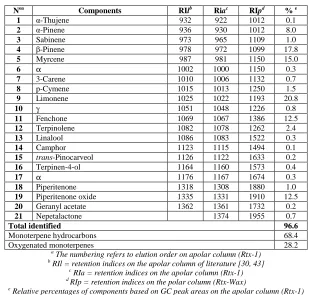
Analysis of the essential oil of F. vulgare from Morocco was carried out using gas chromatography (GC) and gas chromatography-mass spectral (GC-MS). The oil was dominated by monoterpene hydrocarbons (68.4%) followed by oxygenated monoterpenes (28.2%). 21 constituents were reported amounting to 96.6% of the total oil (Table 1). Among them, limonene (20.8%), β-pinene (17.8%), myrcene (15.0%) and fenchone (12.5%) were identified as major components. Essential oil of Fennel from Morocco was characterized by the lack of trans-anethol in comparison with those of other geographic origins previously reported. Indeed, F. vulgare oils from Serbia [37], India [38], China [39] Turkish [9, 15] exhibited high contents of trans-anethol and fenchone.
3.2. Total phenolic and flavonoid contents of solvent extracts
Table 1. GC and GC-MS analysis of essential oil composition from F. vulgare
Noa Components RIlb Riac RIpd % e
1 α-Thujene 932 922 1012 0.1
2 α-Pinene 936 930 1012 8.0
3 Sabinene 973 965 1109 1.0
4 β-Pinene 978 972 1099 17.8
5 Myrcene 987 981 1150 15.0
6 α 1002 1000 1150 0.3
7 3-Carene 1010 1006 1132 0.7
8 p-Cymene 1015 1013 1250 1.5
9 Limonene 1025 1022 1193 20.8
10 γ 1051 1048 1226 0.8
11 Fenchone 1069 1067 1386 12.5
12 Terpinolene 1082 1078 1262 2.4
13 Linalool 1086 1083 1522 0.3
14 Camphor 1123 1115 1494 0.1
15 trans-Pinocarveol 1126 1122 1633 0.2
16 Terpinen-4-ol 1164 1160 1573 0.4
17 α 1176 1167 1674 0.3
18 Piperitenone 1318 1308 1880 1.0
19 Piperitenone oxide 1335 1331 1910 12.5
20 Geranyl acetate 1362 1361 1732 0.2
21 Nepetalactone 1374 1955 0.7
Total identified 96.6
Monoterpene hydrocarbons 68.4
Oxygenated monoterpenes 28.2
a
The numbering refers to elution order on apolar column (Rtx-1) b RIl = retention indices on the apolar column of literature [30, 43]
c RIa = retention indices on the apolar column (Rtx-1) d RIp = retention indices on the polar column (Rtx-Wax)
e Relative percentages of components based on GC peak areas on the apolar column (Rtx-1)
Table 2. Total phenol and flavonoid contents of solvent extracts from F. vulgare
Solvent extracts Total polyphenol content (µg CA/mg extract)
Total flavonoid content (µg quercetin/mg extract)
Foeniculum vulgare Diethyl ether 70 ± 4.2 14 ± 2.1 Ethyle acetate 169 ± 5.0 23 ± 3.1
3.3. Antioxidant properties
Free radical-scavenging capacity of the essential oil and solvent extracts were measured by DPPH method (Table
3). The antiradical activity of essential oil was weak (IC50: 900 µg/ml) in comparison with ascorbic acid (IC50: 0.97
µg/ml). Conversely, both extracts of F. vulgare exhibited potential antioxidant activity; the ethyl acetate and the diethyl ether extract scavenged 50% DPPH free radical at the concentration of 1.5 and 6.2 µg/ml. Thus, the DPPH scavenging effect increased in the order of essential oil < diethyl ether extract < ethyl acetate extract < ascorbic acid.
Table 3. DPPH radical-scavenging of essential oils and solvent extracts (diethyl ether and ethyl acetate) from F. vulgare
Sample Antioxidant activities
Essential oil
Essential oil concentration (µg/ml) 150 300 600 900 1200 Scavenging effect on DPPH (%) 16±2.4 30±0.7 43±3.6 50±2.1 57±1.8
DPPH IC50 (µg/ml) 900
Diethyl ether
Extract concentration (µg/ml) 1.0 1.5 2.5 3.5 10 Scavenging effect on DPPH (%) 6±2 14±1.7 25±3.5 35±4.3 72±5.3
DPPH IC50 (µg/ml) 6.2
Ethyl acetate
Extract concentration (µg/ml) 0.7 1.0 1.5 2.0 4.0 Scavenging effect on DPPH (%) 33±3.4 40±3.6 50±2.8 59±1.2 83±4.9
DPPH IC50 (µg/ml) 1.5
Ascorbic acid
Concentrations (µg/ml) 0.2 0.35 0.5 1.0 2.0 Scavenging effect on DPPH (%) 21±0.7 26±0.4 34±2.5 54±3.5 82±4.1
DPPH IC50 (µg/ml) 0,97
Values expressed are means of three parallel measurements
[image:4.595.135.478.556.694.2]It could be inferred from our results that there was a positive correlation between polyphenolic content and antioxidant activity. Indeed, the greater antioxidant activity of the ethyl acetate extract in comparison with diethyl ether extract could be attributed to the higher content of phenolic and flavonoids compounds ((Table 2). These results may be due to hydroxyl groups existing in the chemical structure of phenolic compounds from F. vulgare extracts that can provide the necessary component as a radical scavenger [40-42].
CONCLUSION
From these results, it appeared that the ethyl acetate extracts of aerial parts of F. vulgare exhibited high antioxidant properties according to the amount of total polyphenolic compounds. Thus, F. vulgare extract can be used as easily accessible source of natural antioxidants for food applications as food supplement or preservative additives.
REFERENCES
[1] Sulekha Mandal, Satish Yadav, Sunita Yadav, Rajesh Kumar Nema, J. Chem. Pharm. Res, 2009, 1, 102-104. [2] PK Agraval, Carbon-13 NMR of flavonoids. Studies in Organic Chemistry, Elsevier Science, The Neterlands,
1989, 39, 564.
[3] BH Havsteen, The biochemistry and medicinal significance of the flavonoids. Pharmacol. Ther. 2002, 96, 67– 202.
[4] T B Shyma, A G Deviprasad, M P Raghavendra, J. Chem. Pharmac. Res., 2012, 4, 4501-4505.
[5] N Tamilselvi, P Krishnamoorthy, R Dhamotharan, P Arumugam, E Sagadevan, J. Chem. Pharm. Res, 2012, 4(6), 3259-3262.
[6] I Fecka, D Raj, M Krauze-Baranowska, Chromatographia, 2007, 66, 87–93.
[7] NY Zahid, NAA bbasi, IA Hafiz and Z Ahmad, Pak. J. Bot., 2009, 41(4), 1759-1767.
[8] M Blamey, & C Grey-Wilson, Flora of Britain and Northern Europe, 1989. ISBN 0-340-40170-2 [9] Jing Deng, Wen Li, Xi lin Peng and Xi Hai Hao, J. Chem. Pharm. Res, 2013, 5(12):443-446.
[10] DS Bhati, MS Shaktawat, LL Somani, and HR Agarwal, Transactions of Indian Society of Desert Technology,
1988, (2), 79-83.
[11] W He, B Huang, Journal of Medicinal Plants Research, 2011, 5(16), 3595-3600.
[12] DJ Charles, MR Morales, and JE Simon, J. and J. E. Simon (eds.), New crops. Wiley, New York., 1993, 570-573.
[13] N Arslan, A Bayrak, and A Akgul, Herbe Hung., 1989, 28 (3), 27-32.
[14] HA Lazouni, A Benmansour, SA Taleb-bendiab, D Chabane Sari, Sciences & Technologie C, 2007, (25), 7-12. [15] I Telci, I Demirtas, A Sahin, Ind. Crops Prod., 2009, 30, 126–130.
[16] M Gulfraz, S Mehmood, N Minhas, N Jabeen, R Kausar, K Jabeen and G Arshad. African Journal of
Biotechnology, 2008, 7 (24), 4364-4368.
[17] R Agarwal, SK Gupta, SS Agrawal, S Srivastava and R Saxena, Indian J Physiol Pharmacol, 2008, 52 (1) , 77– 83.
[18] JK Gurinder and SA Daljit, BMC Complementary and Alternative Medicine, 2009, 9, 30. [19] CMF Cavaleiro, OL Roque, DA Proenca, A Cunha , J Essential Oil. Res., 1993, 5, 223-225.
[20] B Muckensturm, D Foechterlen, JP Reduron, P Danton M Hildenbrand, Biochem. System. Ecol., 1997, 25, 353-358.
[21] M Tognolini, V Ballabeni, S Bertoni, R Bruni, M Impicciatore, E Barocelli, Pharmacological Research, 2007, 56, 254–260
[22] R Piccaglia, M Marotti, J Agric Food Chem 2001,49, 239–44. [23] H Kruger, K. Hammer, J Essential Oil Res, 1999, 11, 79–82.
[24] MC Diaz-Maroto, IJ Díaz-Maroto Hidalgo, E Sánchez-Palomo, MS Pérez-Coello, J. Agric. Food Chem., 2005, 53, 5385-5389.
[25] N Lahhit, A Bouyanzer, J-M Desjobert, B Hammouti, R Salghi, J Costa, C Jama, F Bentiss, L Majidi,
Portugaliae Electrochimica Acta , 2011, 29, 57-68.
[26] I Parejo, F Viladomat, J Bastida, G Schmeda-Hirschman, J Burillo, C Codina , J. Agric. Food Chem., 2004, 52, 1890-1897.
[27] Council of Europe, Pharmacopée Européenne, Maisonneuve S.A (Ed.), Sainte Ruffine, France, 1996. [28] J Paolini, J Costa, AF Bernardini, J. Chromatogr. A., 2005, 1076, 170-178.
[29] J Paolini, J Costa, AF Bernardini, Phytochem. Anal., 2007, 18, 235-244.
[30] WA Konig, DH Hochmuth, D Joulain , Library of Mass Finder 2.1, Institute of Organic Chemistry, Hamburg,
Germany, 2001.
[31] RP Adams, Identification of essential oils by Capillary Gas Chromatography/Mass Spectroscopy, Allured Publ.
Corp., Carol Stream, IL, 2001..
[33] Li HB, Wong CC, Cheng KW, Chen F, Food Sci. Technol., 2008, 41, 385-390. [34] A Arvouet-Grand, B Vennat, A Pourrat, P Legret, J. Pharma. Belg., 1994, 49, 462-468. [35] T Hatano, H Kagawa, T Yasuhara, T Okuda, Chem. Pharm. Bull., 1985, 36, 1090-1097. [36] W Brand-Williams, ME Cuvelier, C Berset, Lebensm.-Wiss. Technol., 1995, 28, 25-30. [37] B Damjanovic, Z Lepojevic, V Zivkovic, A Tolic, Food Chem., 2005, 92, 143–149. [38] G Singh, S Maurya, M.P Lampasona, C Catalan, Food Control, 2006, 17, 745–752. [39] F Fang , M Qi, T Li, Q Shao, R Fu, J. Pharm. Biomed. Anal., 2006, 41, 791–797. [40] TA Pereira, J. Am. Oil Chem. Soc., 1990, 67, 255-258.
[41] A Matkowski, Biotechnol. Adv., 2008, 26, 548-560.