Effects of Superplasticizing Admixtures on the
Compressive Strength of Concrete
Musbah Guma Musbah, Allam Musbah Al Allam*, Hosni Abdulruhman Saleh,
Ibrahim Mousbah Ateeg
College of Technical Sciences, Bani Walid, 00218, Libya
Copyright©2019 by authors, all rights reserved. Authors agree that this article remains permanently open access under the terms of the Creative Commons Attribution License 4.0 International License
Abstract
Nowadays, the most widely used construction materials in the market for both structural and non-structural applications are concrete-based. Concrete in general is made up of a combination of cement, aggregate, water and an additional material known as an admixture. The admixture is sometimes added to modify certain properties of concrete. Superplasticizer (SP) is one type of the admixtures, which was used for this study to modify the properties of concrete. Correct composition of admixture is important as usage of incorrect admixture, mix proportion and improper dosage of SP might cause high-slump concrete, bleeding, segregation and cracking due to shrinkage. Therefore, this project aimed to determine the optimum dosage of SP for normal strength concrete by studying the effects of three different dosages of SP, (500, 750 and 1000 ml/100kg) on properties of concrete in fresh and hardened state. Two series of concrete mix consisting of eight samples for both grades C25 and C30 were prepared for the experimental work. The control mix (without SP) was designed based on the DOE method. One type of specimen was used in different quantity. As a result, the optimum dosage of SP for the studied concrete properties was 750 ml/100kg of cement for both grades C25 and C30. Some comparative analyses were done to determine the relationships between the various parameters. It was found that the mechanical properties of the concrete mix with optimum SP, namely the compressive strength is higher than the control specimens. It was also found that the physical properties of the concrete mix with the optimum SP dosage improve workability.Keywords
Normal Concrete, Admixtures, Superplasticizer (SP), Optimum Dosage of (SP), DOE Method, Compressive Strength1. Introduction
The usage of admixtures such as superplasticizers in
it was used as dye (Naphthalene Sulfonate) and was also reported to increase the strength of concrete roads in one of the projects in America at that time [4]. In Japan, (Kikuwa Hitori, 1990) discovered a new admixture consisting of Bnapthalane that lowers the water/cement ratio but increases the concrete strength [5]. Meanwhile, in Germany, Isenberg (1974) also introduced an admixture type Melamine Sulfonate to improve the workability of concrete while maintaining the water/cement ratio without affecting its strength [6]. Also, the addition of plasticized admixture is able to reduce the water content of concrete to up to 25% whilst doubling the compressive strength compared to traditional concrete on day one. Besides that, it can achieve a third of 28 days strength [7]. Superplasticizer is a type of water reducers; however, the difference between superplasticizer and water reducer is that superplasticizer will significantly reduce the water required for concrete mixing [8]. There are two common categories of superplasticizers; sulfonated melamine formaldehyde condensates and sulfonated naphthalane- formaldehyde condensates. superplasticizers are water-soluble organic polymers which have to be synthesized to produce long molecules of high molecular mass [9].
2. Materials and Methods
Concrete is a composite of cement, aggregate (fine and coarse) and water. Sometimes, chemical or mineral admixtures are added in order to change the characteristics of concrete for certain applications. Since the materials are important in determining the quality of produced concrete, they should be properly selected and chosen before the beginning of the experiment.
2.1. Ordinary Portland Cement
The cement used in this project is a product from cement industries of Malaysia berhad (CIMA), with a brand name holcim top standard‟. This type-i cement conforms to MS 522: 2007, where it is high quality multi-purpose cement suitable for all buildings and construction purposes. When mixed with send and water to form mortar, it is ideal for brick laying and rendering, or with added coarse aggregate to form concrete for flooring. Also it is widely used in general construction, for example buildings, bridges and other precast concrete products. It is available in 50 kg bags. The chemical amount constituents in ordinary Portland cement
2.2. Aggregate
Aggregate is important because it occupies about three- quarters of the volume of concrete. Usually, there are two types of aggregate used in concrete, which are fine and coarse aggregates. Many parameters needed to be
considered in selection of aggregate, for instance, types of aggregate, size and shape of the particle, and the strength of the aggregate. All aggregate must be free from dust as the dust may affect the bonding between the aggregate and cement particles.
2.3. Mixing Water
Water is important to ensure continuous hydration process. Along the experiment, tap water is used for mixing and curing of concrete. The water must be free from reactive elements such as reactive ions and impurities to guarantee the quality of the concrete.
2.4. Chemical Admixtures
The type of admixtures used in this study, namely superplasticizer. Since the objective of this experiment is to observe the effects of these admixtures on the concrete characteristics, hence, both physical and chemical properties must be known to have a better understanding on the effect of admixtures.
2.5. Concrete Mixtures
The design mix in this study is based on the department of the environment (DOE) United Kingdom. Selecting the correct proportions of cement, fine, and coarse aggregate and water to produce concrete having the specified properties is a basic problem in designing a concrete mix. Hence the design mix is very important in achieving the design characteristic strength.
3. Method of Design
For this project there are two types of grades c25 and c30. The mixtures designed individually each mix with different steps based on (DOE) method. Basically, the problem of designing a concrete mix consists of selecting the concrete proportions of cement, fine and coarse aggregate, water and admixtures to produce concrete having the specified properties [10]. Tests were carried out in order to investigate the properties of the concrete. Basically, there are three types of testing, namely control testing, compliance testing and secondary testing. Control testing is used to ensure acceptable supplied materials are available, whereas, compliance testing is to judge compliance of the material with the given specifications. Lastly, secondary testing is used when there is doubt about the reliability of control and compliance results, [11].
3.1. Mix Proportions and Specimens
determined based on (doe) method. SP with the dosage of 500 ml/100kg of cement, 750 ml/100kg of cement and 1000 ml/100kg of cement was used as admixtures to prepare another six different mixtures. A size of (100 mm*100mm) cube with a number of 15 cubes was prepared to test the compressive strength for each mix.
3.2. Design Stages for (DOE) Method
In order to clarify the sequence of operation, and for ease of reference, the flow process is divided in to five stages. Each of these stages deals with a particular aspect of the design and ends with an important parameter or final unit proportions. The table below shoes the volume of concrete for each batch for both grade C25 and C30.
Table 1. The volume of concrete for each batch for both grade C25 and C30
Grade C25:
Quantities Cement (kg) Water (liter) Fine agg. (kg) Coarse agg. (kg)
Per 1m3 309 210 602 1279
Grade C30
Quantities
Cement (kg) Water (liter)
Fine agg. (kg)
Fine agg.
(kg) Coarse agg. (kg)
Per 1m3 323 21 597 1270
3. 3. Compressive Strength Test
Compressive strength is the most common test performed on concrete according to (Part 14 testing of hardened concrete). The several reasons for this are: 41 1)
It is assumed that the most important properties of concrete as directly related to compressive strength. 2) Concrete has little tensile strength and is used primarily in compression. 3) Structural design codes are based on compressive strength. After curing the samples of (100*100mm) cube, which were casted at the first day of the excremental work. Fifteen cubes for each mix (three for each period) were tested on the compressive strength test at 7, 14, 28, 56 and 90 days, respectively.
4. Results and Discussion
4.1. Compressive Strength of Concrete Specimens with Grade 25
Table2. Compressive Strength of Concrete Specimens with Grade 25
Mix ID Compressive Strength (MPa)
7 days 14 days 28 days 56 days 90 days
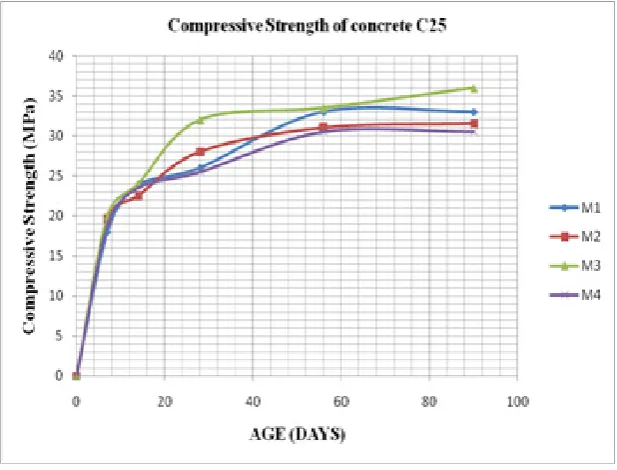
M1 18 23.8 26 33 33
M2 19.6 22.5 28 31 31.5
M3 20 24 32 33.5 36
M4 18.9 23.5 25.5 30.5 30.5
[image:3.595.60.290.282.403.2]Figure 1 represents the compression strength for the mixtures with grade C25. Which, indicate the relation between the age of samples in (day) and the maximum load effects the samples in (MPa). As shown above in figure 1 there is an increase for all samples with increase of age. Therefore, (M3) is the mix with dosage of (750ml/100kg of cement) contains the biggest value of compressive strength with (36 MPa) at 90 days.
[image:3.595.144.453.494.729.2]4.2. Compressive Strength of Concrete Specimens with Grade 30
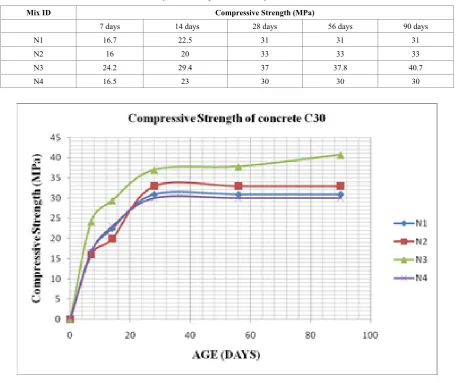
Figure 2 represents the compression strength for the mixtures with grade C30. Which, indicate the relation between the age of samples in (day) and the maximum load effects the samples in (MPa). As shown above in figure 2 there is an increase for all samples with increase of age. Therefore, (N3) is the mix with dosage of (750ml/100kg of cement) contains the biggest value of compressive strength with (40.7 MPa) at 90 days. On the other hand, (N4) the mix with dosage of (1000ml/100kg of cement) has the smallest compressive strength with (30 MPa) at the same day.
Table 3. Compressive Strength of Concrete Specimens with Grade 30
Mix ID Compressive Strength (MPa)
7 days 14 days 28 days 56 days 90 days
N1 16.7 22.5 31 31 31
N2 16 20 33 33 33
N3 24.2 29.4 37 37.8 40.7
N4 16.5 23 30 30 30
Figure 2. Compressive Strength of Concrete C30
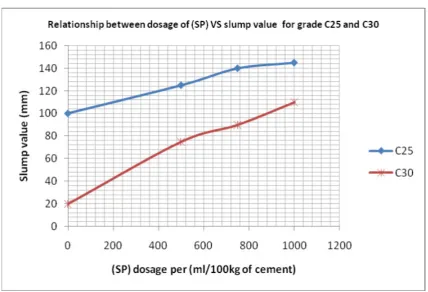
[image:4.595.70.527.177.560.2]Figure 3. The Relationship between the Slump value and (SP) Dosage for grade C25 and C30
Figure 3 above shows the relationship between slump value and (SP) dosage used for this project with both grades C25 and C30. As shown, that there is a gradual increase for the two curves. In additional, the increase of slump value describes the increase of the concrete workability. Therefore, both grades represent high workability with increase of (SP) dosage. For example, the blue curve represents the workability for C25 with a minimum value of slump of (100 mm) with dosage of (500 ml/100kg of cement) and maximum of (145 mm) with dosage of (1000 ml/100kg of cement). On the other hand, the red curve describes the workability for C30 with a minimum slump of (20 mm) with dosage of (500 ml/100kg of cement) and maximum of (110 mm) with dosage of (1000 ml/100kg of cement).
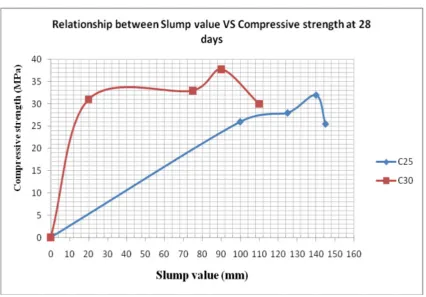
Figure 4. The Relationship between the Slump value and Compressive Strength at 28 days for grade C25 and C30
5. Conclusions
Taking into account the findings from this study, previously presented, the following conclusions can be drawn:
1. The study represented the effect of superplasticizer (SP) on the mechanical and physical properties of concrete with both grades C25 and C30.
2. The mechanical property tested was (Compressive, Strength) for grade C25 and C30. 2. The physical property tested for this study in both grades C25 and C30 was. Workability (on the fresh state).
3. The dosage of (SP) were used is (500, 750, and 1000 ml/100kg of cement) for both grades C25 and C30. 4. The optimum dosage of (SP) added was (750
ml/100kg of cement) for all of the findings in both grades C25 and C30.
5. From the relationships between the properties the obtaining was as follow:
a). The effect of (SP) on normal concrete improved the workability.
b). The maximum compressive strength met with the optimum dosage of (SP) at (750 ml/100kg of cement) for both grades C25 and C30.
c). The maximum increase in percentage when compared with the control mix at 28 days is 23% for compressive strength, for grade C25 at the optimum dosage.
d). The maximum increase in percentage when compared with the control mix at 28 days is 22%
for compressive strength, for grade C30 at the optimum dosage.
e). There was a decrease of water content with different dosage of (SP) which the maximum decrease in water content was 30.6% at 90 days for C25 and 26.7% at 90 days for C30.
f). All of the tested samples for this study met the (BS.1881: part 122: 1983) standers and have absorption rate below 10%.
Acknowledgements
Thanks to my supervisor Dr. Hj. Zainal Abidin Bin Akasah, for his help and guidance in me finishes this research successfully. Special thanks to my co. Supervisor Mr. Koh Heng Boon for his supervision, encouragement, contradictive ideas, patience, guidance and invaluable advice, enabling me to achieve the objective of this research
All so, I would like to acknowledge the contributions and the financial support by Collage of Technical Science-Bani Walied Libya.
REFERENCES
Hassan and Hamzah (2004). Concrete durability issues in the [1]
Concrete Durability, Assessment, Maintenance and Repair Techniques, Oct. 4- 6. _W. Zabierowski, A. Napieralski. Chords classification in tonal music, Journal of Environment Studies, Vol.10, No.5, 50-53.
Jackson, N. and Dhir, R. K (1996). Civil Engineering [2]
Materials. Hampshire, U.K.: Palgrave Publishers Ltd. _. Stillwell, J. A (1984). Current Practice Sheets – Volume 1.” [3]
The Concrete Society.: London, U. K
Dodson, V.H. (1990). Concrete Admixture, Structural [4]
Engineering Series,ed. Nostrand Rheinhold, New York, USA.
Kikuwa Hitori (1990), "Rheological studies on fresh [5]
concrete using admixtures" Proc. RILEM, Symp, Admixtures for concrete improvement properties.
Nagasaki, S. (1997). Present State of Superplasticizer in [6]
Japan, Conf. Paper on Plasticizers and Other Chemical Admixtures, Rome, Italy.
Jones T.P, (1982). Concrete Technology 4, Vol. 1 Properties [7]
and Materials.
Neville A.M (2005). Properties of concrete, Pearson. [8]
Prentice Hall, p 255- 262.
A.M. Neville (2002). Properties of Concrete [9]
Teychenne. D. C (1988). Design of normal concrete mix. [10]
Building Research Establishment, Watford.
Bungey, J. H. and Millard S. G., (1996). Testing of concrete [11]
in structures. Chapman & Hall.
Neville A. M. and J. J. Brooks (1987). Concrete technology. [12]
Longman. p. 83- 86, 89- 90.
T. Seshadri Sekhar and P. Srinivasa Rao (2008). [13]