International Journal of Emerging Technology and Advanced Engineering
Website: www.ijetae.com (ISSN 2250-2459, Volume 2, Issue 3, March 2012)449
Algorithms for Cost-Effective Video Compression
Angel DeCegama, Ph.D.
ACD2 Technologies, LLC
Abstract— The volumes and costs of video storage and
transmission are soaring. This situation can only be ameliorated by massive investments in infrastructure or by technological breakthroughs or both.
This paper presents one such technological breakthrough that can reduce the size of any video file compressed by any existing video codec, e.g., MPEG-4, H.264, DivX, VC-1, etc., to between 25% and 10% of such compressed size without loss of the video quality resulting from the decompression and display by the codec of its compressed file and without any changes to the codec.
The processing presented in this paper that achieves such results involves the preparation of the frames of the original video file before passing them on to a given codec. The codec then processes the received frames in its usual way to produce a much smaller compressed video file than without the initial pre-processing. The compressed video can then be stored and/or transmitted. For decompression and playback, the codec decompresses the compressed video frames in its usual way and then passes them onto the algorithm presented in this paper for final post-processing before display with a quality indistinguishable from that produced by the codec alone without using such pre- and post-processing.
I. MATHEMATICAL BASIS
The mathematical principles behind the algorithms presented here are those of the Wavelet Transform (WT). This is important because it has been demonstrated that human beings use the basic concepts of the WT to process in their brains all sensory information specially visual information that requires enormous amounts of compression. Such compresssion involves the discarding of all data that is irrelevant from the standpoint of human perception.
There have been many attempts to apply the WT to the problem of video compression (4,5,6). The results have been encouraging showing better results than other existing codecs but not good enough to motivate the people working in this area to change their already set up procedures because of he computational complexity of WT methods needed to achieve high quality video with WT-based codecs.
The approach presented in this paper is different. Do not change the codec. Pre-process and post-process the video.
II. DETAILED DESCRIPTION
In this approach, a crucial feature is the ability to recreate a given image or video frame from the low-frequency component of its WT which is ¼ the size of hte original image or video frame. This can be done precisely by applying the math of the direct WT and the IWT (inverse WT).
In order to minimize computational complexity, the Haar WT can be used. The direct Haar WT low-frequency coefficients are a2 = 0.5 and a1 - 0.5 and the high-frequency coefficients are b2 = 0.5 and b1 = -0.5. The IWT low-frequency coefficients are aa2 = 1.0 and aa1 = 1.0 and the IWT high-frequency coefficients are bb2 = -1.0 and bb1 = 1.0. The WT is applied to the individual pixel rows and columns of a given image or video frame. This is done separately for the luminance (Y) and chrominance (U,V) components of the different pixels of each row and column. It can also be done for the R, G and B planes.
Let’s define a set of yis to constitute the different values of one such component of a given row or column of an image or video frame. Let’s also define a set of xis to be the corresponding WT low-frequency values and a set of zis to be the corresponding WT high-frequency values.
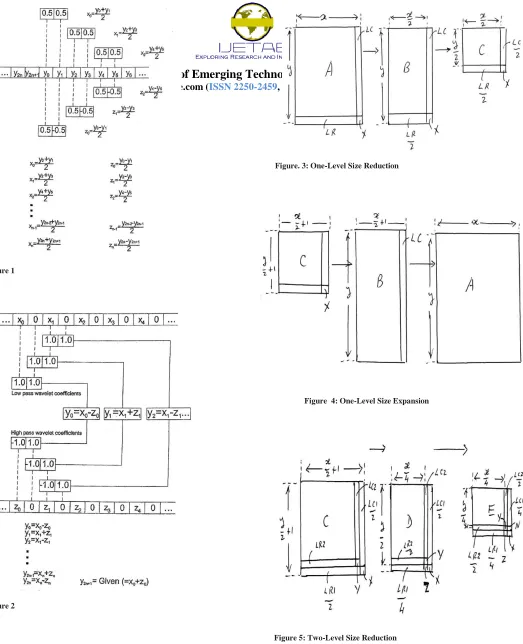
We can then write for the Haar WT (with decimation and now wraparound)
International Journal of Emerging Technology and Advanced Engineering
Website: www.ijetae.com (ISSN 2250-2459, Volume 2, Issue 3, March 2012)450
Knowing both the xis and zis we can reconstruct exactly the yis by calculating the corresponding IWT. [image:2.612.60.219.455.666.2]The above equations represent the IWT process shown in Figure 2.
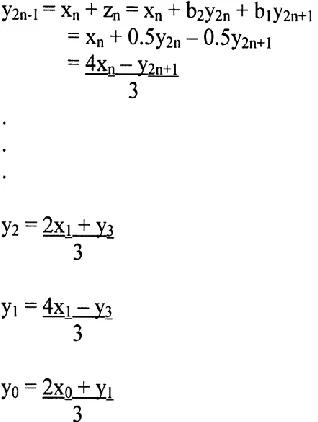
Assuming that y2n+1 is known, we can write
Similar equations can be obtained by moving from top to bottom and from left to right.
In other words, given the xis that are the low-frequency values of the decimated Haar WT of the yis, and given the very last value of the yis of a row or column of the original image or video frame, the yis values for the entire row or column can be found. Therefore, besides the xis values, one more value, the very last value of the yis, can also be stored to then be able to recreate precisely the entire original row or column. This is a negligible overhead when one considers that we are dealing with hundreds or even thousands of pixels for each row and column of images or video frames of typical applications.
By applying such a procedure to every row and column of an image or video frame, the size is reduced to approximately ¼ of the original that can be reproduced exactly from its reduced version. This process can be repeated on the reduced images or video frames for further size reductions of 1/16, 1/64, etc., of the original.
Of course, this cannot be done indefinitely because the precision of the calculations must be limited in order to avoid increasing the required number of bits instead of reducing it and information is being diluted at each ¼ reduction. However, extensive tests show that the quality of image reproduction is maintained up to 2 or 3 reduction levels with size reduction of up to 16 or 64 times before compression by the codec which is very significant in terms of video storage and transmission costs.
The reproduction by any standard codec of the reduced size frame is precise enough to be able to apply the above calculations for recovery of the original full size frames with similar quality to that of the frames recovered by the codec without the initial size reduction step.
In addition, the process can be further extended by using, after more than 2 or 3 reduction levels, any of the expansion filters disclosed in US Patent No. 7,317,840 [2] to enlarge very small images with high quality.
International Journal of Emerging Technology and Advanced Engineering
Website: www.ijetae.com (ISSN 2250-2459, Volume 2, Issue 3, March 2012)451
III. DESCRIPTION OF FRAME REDUCTION ANDEXPANSION TECHNIQUES
As above indicated, the application of the decimated Haar WT to a given video frame results in a frame that is ¼ the original size because only the low-frequency Haar wavelet filter is applied. It has been proven above that the high-frequency Haar wavelet filter need not be applied if just the last original value before wavelet transformation of a row or column pixel is saved. With this information, all the preceding original pixels of a row or column can be calculated exactly.
This process can be repeated again on the resulting reduced frame for additional sized reduction to 1/16 of the original and so on. This process is described in detail below.
IV. ONE-LEVEL FRAME SIZE REDUCTION AND
EXPANSION BACK TO THE ORIGINAL SIZE
Figure 3 shows the process of reducing the size of a frame to about ¼ of its original size.
“A” is the original frame with dimensions x and y. The decimated low-pass Haar WT is applied to A horizontally resulting in frame “B’ of dimension (x/2) +1 and y. The last column of A, i.e., “LC”, is copied to the last column of B.
Next, the decimated low-pass Haar WT is applied to the (x/2)+1 columns of B resulting in frame “C” of dimensions (x/2)+1 and (y/2)+1. Notice that pixel X (R, G, B, or Y, U, V component) is kept through this process. LR/2 is the decimated WT of LR and LC/2 is the decimated WT of LC.
The process of recovering the original frame from C of Figure 3 is shown in Figure 4. First the last row of C is used to precisely recover the columns of B using the reconstruction algorithmic calculations disclosed above in this patent application. Finally, the reconstruction algorithm is applied to B horizontally starting with the values of LC reconstructed from the value of X using the reconstruction algorithm from right to left to recover A exactly.
The procedure can be interfaced to any exiting codec, eg., MPEG-4, H.264, VC-1, DivX, etc, to improve its compression performance significantly (60% to 80% reduction in storage and transmission costs for all extensively tested video files) with no loss of video quality compared to that produced by the original codec after decompression.
First, the size reduction process is applied to the original frames of a given video file. Then the codec is applied to such smaller frames to produce a much smaller file than without the size reduction step. The resulting compressed video file can then be stored and/or transmitted at a greatly reduced cost.
For decompression and display, the codec is applied for decompression and then the above frame expansion procedure is used prior to displaying high-quality video in its original full-size
Because of the lossy compression of existing standard video codecs, there is some minor loss of video quality compared to the original before compression by the codec but the algorithm described here does not result in any perceived degradation of quality when compared to that produced by the codec on its own from a much larger file.
V. MULTIPLE-LEVEL FRAME SIZE REDUCTION AND
EXPANSION
The process described in Figures 3 and 4 can be continued one or more levels starting with the C frame instead of the A frame. There are additional right columns and bottom rows to be saved but they are one half the sizes of the previous level and, consequently, they don’t appreciably detract from the saving in storage and transmission bandwidth.
Figure 5 shows the process of reducing the frame size one more level.
Figure 6 shows the expansion by one-level of a two-level sized reduction. The original full size can then be recovered by the process of Figure 4
Figure 7 shows the process of going from 2-Level size reduction to 3-Level size reduction and Figure 8 shows the profess of expansion from 3-Level size reduction to 2-Level size reduction. Additional levels of reduction can be handled similarly.
VI. MODES OF OPERATION
The above ideas and algorithms can be implemented in a number of different ways.
For example,
1. Frame size reduction of only one level but codec compression at different levels of bit assignment per compressed frame.
International Journal of Emerging Technology and Advanced Engineering
Website: www.ijetae.com (ISSN 2250-2459, Volume 2, Issue 3, March 2012)452
VII. PERFORMANCESuch new algorithms (named ADC2 for Advanced Digital Compression Squared) for video data pre- and post-processing to be used with any given video codec without modifying the codec in any way are the basis for the extraordinary typical results shown in following table.
Note that the xi values are approximate because the actual original values have been processed by the codec being used to compress/decompress. Therefore, the yis calculated with the preceding algorithm are also approximations. The question is how good the approximations are. This can be determined by the perceived visual quality of the output video and by calculating the PSNR values for every output video frame for different bit rates and comparing such values for the codec alone and for the values obtained using the methods of this paper.
In terms of the PSNR values, the following table shows the comparison in PSNR values (in decibels (db)) between the codec alone and the codec with the ADC2 algorithms for different video examples.
This table clearly shows the high quality of the video reconstructed by the ADC2 algorithms even at very high levels of compression, whereas the quality of the video decompressed by any standard codec (H264 in this example) quickly decays with lower bit-rates which makes such standard codecs unsuitable for practical applications requiring good visual quality at very low bit-rate. These mathematical results confirm the visual perception evaluations of the results of the invention.
It can been seen from the preceding tables that the size reductions of video files compressed using the techniques of this invention are about 1/5 to 1/10 (depending on the level of size reduction) of the compressed files using the codecs alone. The perceived qualities of the decompressed videos for the different reduction levels are indistinguishable from that of the decompressed videos produced by the codec alone for all the codecs.
The implications of these results for the reduction of the current staggering costs of video storage and transmission are extremely significant.
VIII. SUMMARY
Embodiments of this technology use mathematical methods to develop software that uses wavelet transforms (WT) to process video frames that can then be compressed using a variety of codecs. Such compressed video frames can then be transmitted, decompressed, and displayed in their original size and quality, thereby producing real-time high-quality reproduction of video sequences.
Such performance can be verified by accessing the website at www.ADC2Video.com. By following the User Instructions, the ADC2 Video Player is downloaded and installed automatically first and then any of the examples in the menu can be downloaded, decompressed and played with unbeatable quality obtained from compressed video files of very small size that can be read out of the ADC2 Video Files Directory where the compressed files are automatically downloaded. The videos can be seen during streaming download and repeatedly after downloading by double clicking on the ADC2 Video icon to launch the player created by the ADC2 Video Player installation process and selecting the video from the ADC2VideoFiles directory.
International Journal of Emerging Technology and Advanced Engineering
Website: www.ijetae.com (ISSN 2250-2459, Volume 2, Issue 3, March 2012)453
References[1] Ten Lectures on Wavelets by Ingrid Daubechies, Society for Industrial and Applied Mathematics.
[2] Methods for Real-Time Software Video/Audio Compression, Transmission, Decompression, and Display, US Patent #7,317,840, January 8, 2008, Angel DeCegama
[3] Systems and Methods for Compression, Transmission and Decompression of Video Codecs, US Patent #8,031,782, October 4, 2011, Angel DeCegama
[4] A new Wavelet Transform Video Compression Algorithm, IEEE 3rd International Conference on Communication Software and Networks, 2011, Zhang Shu
[5] Three Dimensional Wavelet Transform Video Compression, 1999 IEEE International Conference on Multimedia Computing and Systems, July 1999, I.K. Levy
International Journal of Emerging Technology and Advanced Engineering
Website: www.ijetae.com (ISSN 2250-2459, Volume 2, Issue 3, March 2012)454
Figure. 3: One-Level Size Reduction
Figure 1
[image:6.612.50.573.38.682.2]Figure 4: One-Level Size Expansion
Figure 2
[image:6.612.332.574.481.654.2]International Journal of Emerging Technology and Advanced Engineering
Website: www.ijetae.com (ISSN 2250-2459, Volume 2, Issue 3, March 2012) [image:7.612.71.260.145.258.2] [image:7.612.75.288.307.418.2]455
Figure 6: One-Level Expansion of Two-Level ReductionFigure 7: Three Level Size Reduction
[image:7.612.73.277.466.582.2]