
Journal of Chemical and Pharmaceutical Research, 2014, 6(4):1047-1052
Research Article
CODEN(USA) : JCPRC5
ISSN : 0975-7384
Extraction and separation of Cu(II) in presence of Fe(II) and
Fe(III) from acidic solution using LIX 973NS-LV
Aparna Prava Devi
1, Nandita Swain
1and Nihar Bala Devi
2*1Department of Chemistry, College of Basic Science and Humanities, Orissa University of Agriculture and
Technology, Bhubaneswar, OR,India
2Department of Chemistry, Institute of Technical Education and Research, Siksha’O’Anusandhan University, Khandagiri Square, Bhubaneswar, OR, India
_____________________________________________________________________________________________
ABSTRACT
The extraction of copper(II) from chloride solution was investigated using 5-nonylsalicylaldoxime and 2-hydroxy-5-nonylacetophenone oxime (LIX®973 NS-LV) in kerosene. The parameters which could affect the extraction such as shaking time, hydrochloric acid concentration, extractant concentration, salt concentration were separately investigated. The extraction equilibrium was achieved within 2 minutes. Quantitative extraction of copper was obtained with 10%(v/v) LIX®973 NS-LV in kerosene. Presence of sodium acetate in the aqueous phase influences the extraction of copper. Separation of copper from a synthetic copper-iron solution containing 0.05M Cu(II) with 0.05M either Fe(II) or Fe(III) each and 0.05 M [Fe(II) + Fe(III)] has been carried out using 10%(v/v) LIX®973 NS-LV in kerosene. The extraction of Fe(II) was nil whilst highest separation factor (β = DCu/DFe) of 25.13 was obtained with Fe(III) from 0.005M HCl and the separation factor increased to 7325 in presence of 0.5M sodium sulfate.
Key words:Copper, Ferrous, Ferric, LIX®973 NS-LV, extraction
_____________________________________________________________________________________________
INTRODUCTION
In hydrometallurgical processes, solvent extraction is a well-established technique for the removal and separation of various metal ions after leaching and able to produce pure metal solutions which are used for electro winning purposes. In fact the technique can be applied for treatment of both concentrated and dilute solutions. The major source of copper is chalcopyrite, polymetallic manganese sea nodule, copper converter slag and now many e-wastes like printed circuit boards. Selective leaching by hydrochloric acid has been proven beneficial for the recovery of copper[1]. Devi et al [2] reported that copper can be quantitatively leached using manganese nodule as oxidant in 4 M Hydrochloric acid. Barik et al [3] reported that copper is leached from a waste heat boiler dust using sulphuric acid as a leachant. Other researchers also have reported quantitative leaching of copper from low grade ores[4-5]. Iron is associated with most of the ores and comes to the solution as Fe(II) or Fe(III) or in form of both during leaching. Hydroxyoximes are well known extractants which are broadly used for copper extraction from diluted acidic sulphate solutions [6-8]. The extraction–stripping reactions of copper with LIX 973N in Iberfluid has been studied by Alguacil [9]. He reported that copper extraction was not influenced by aqueous equilibrium pH, ammonium carbonate concentration or with temperature under the experimental conditions chosen for his study. Alguacil and Cobo [10] established the conditions for co-extraction of copper and nickel from a feed solution containing 3 g/L each of copper and nickel in presence of 60 g/L ammonium carbonate using LIX 973N. The separation of copper and iron from dump bioleaching solution of Dexing Copper Mine was studied using LIX®
amounts of other impurities using LIX®984N-C. Copper was effectively extracted and separated from other metals
in two stages at A:O ratio of 2 :1 corresponding equilibrium pH of 1.85 using 1.5% LIX®984N-C. Hariharan et al
[13] reported the extraction of iron using TOPO from various acid medium and found quantitative extraction of iron from sulphuric acid medium. As new extractants are being introduced to the market and LIX®973NS-LV is mainly
produced aiming at copper extraction on the other hand, no data are available on literature about its use in solvent extraction of copper in presence of other impurities. The purpose of this present work is to study the extraction of copper from chloride medium using LIX® 973NS-LV in kerosene. The effect of hydrochloric acid concentration, extractant concentration and various salts on the extraction of copper was investigated. Separation of Cu(II) from synthetic solutions containing ferrous / ferric ions alone and in presence of both was studied using LIX®973NS-LV
in kerosene.
EXPERIMENTAL SECTION
2.1Solutions and Reagents
The stock solutions of copper(II), Iron (II) and (III) (0.25M) were prepared by dissolving required amount of their chloride salts in double distilled water. Samples of LIX® 973NS-LV (a mixture of 5-nonylsalicylaldoxime and
2-hydroxy-5-nonylacetophenone oxime) was supplied by Cognis Inc. and were used without further purification. Commercial grade kerosene was used as diluent. Organic phase solution was prepared by diluting the desired amount of extractant in kerosene to the required concentration. All other reagents used were of analytical reagent grade.
2.2Experimental Methods
The metal bearing solution was equilibrated with an equal volume of LIX®973NS-LV for 5 minutes in a separating funnel as kinetics of copper extraction is very first with LIX reagents to reach the equilibrium. After phase disengagement the aqueous phase was collected and the metal content in the aqueous phase was determined by thiosulfate method using starch as the indicator. The ferrous concentration in the raffinate was determined by potassium dichromate method. When both copper and iron were present, the aqueous phase was analyzed with an ELICO type Atomic Absorption Spectrophotometer. The concentration of the metal ion in the organic phase was calculated by the difference of concentration before and after extraction. When required, the organic phase was determined after filtration through 1PS phase separating paper and stripping with 15% H2SO4followed by analysis
with AAS. All the extraction experiments were carried out at 30±1°C.
RESULTS AND DISCUSSION
3.1Extraction of Copper using LIX 973NS-LV 3.1.1Effect of equilibration time
Experiments were carried out at room temperature to study the effect of equilibration time on the extraction of 0.05M copper from 0.005M HCl in the range 30 sec – 10 minutes with 5% (v/v) LIX®973NS-LV in kerosene. The
[image:2.595.181.429.550.740.2]percentage extraction increased from 65% in 30 second to 77.7% in 2 minutes and further increase in time has no effect on percent extraction of copper[Figure 1]. Hence a five minute of shaking time was maintained in all experiments assuming achievement of complete equilibrium.
3.1.2. Effect of Hydrochloric acid concentration
To study the effect of hydrochloric acid concentration on extraction of 0.05M Cu(II), experiments were carried out at equal phase ratio in the decreasing acid concentration range 0.1M – 0.005M using 5%(v/v) LIX®973NS-LV in
[image:3.595.174.435.207.386.2]kerosene. The results of the experiments were presented in Figure 2 as percent copper extraction versus acid molarity. The percentage extraction increased with decrease in HCl concentration. When HCl concentration is 0.1M, no copper was extracted into the organic phase and it was increased to 73.8 with acid molarity of 0.02M and further decrease in acid concentration did not affect the copper extraction much as it was 77.7% with 0.005M HCl. Similar type of behavior was also reported by Reddy et al [14] where they found the percentage extraction of copper decreased with decrease in initial pH (1.2-3.2) with LIX 973N. In this work the maximum extraction of copper was 77.7% with 5%(v/v) LIX®973NS-LV at 0.005M HCl concentration.
Figure 2: Effect of acid concentration on copper extraction. Aq: 0.05M Cu(II); Org:5%(v/v) LIX 973NS-LV in kerosene
3.1.3Effect of Extractant concentration
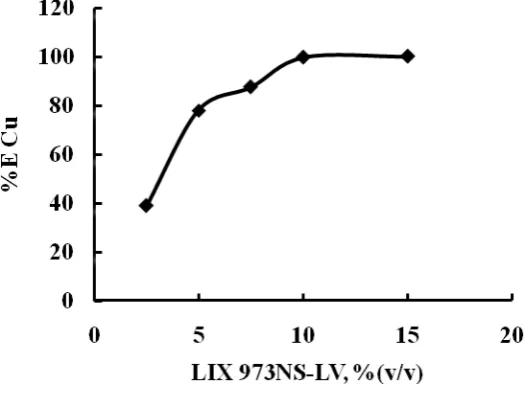
Different concentration of LIX®973NS-LV (2.5–15%)(v/v) were used to study the effect of extractant concentration
[image:3.595.177.442.489.691.2]on extraction of copper(II) (0.05M) from 0.005 M HCl. The percent copper extraction was increased from 39 to 99.7 with increase in extractant concentration from 2.5% to 10%(v/v) LIX® 973NS-LV, respectively shown in
Figure 3.
Figure 3: Effect of extractant concentration on copper extraction. Aq: 0.05M Cu(II) and 0.005M HCl ; Org: LIX 973NS-LV in kerosene
3.1.4Effect of various salts
recovery of iron(III), copper(II) and zinc(II) from mixed sulfate and chloride media whereas El-Hefny et al used the sulfate/thiocyanate media for zinc and cobalt separation[16]. The extraction of 0.05M Cu(II) which also contained the same amount of chloride ion was carried out in the presence of different salts like sodium sulfate, sodium chloride, sodium nitrate and sodium acetate (each of 0.5 M) with 5% (v/v) LIX® 973NS-LV in kerosene. The
[image:4.595.239.373.190.243.2]results showed that the distribution coefficient of copper was increased for sodium acetate and sodium sulfate, whilst it decreased with sodium nitrate and sodium chloride (Table 1). This may be due to the larger size of acetate and sulfate ions, which facilitates copper extraction due to salting out effect.
Table 1: Effect of various salts on the percent extraction of copper. Aq: 0.05 M Cu(II), 0.005 M HCl ; Org: 5% (v/v)LIX 973NS-LV in kerosene
[Salt], 0.5M DCu % Extraction CH3COONa 11.87 92.2 Na2SO4 4.15 80.6 NaNO3 2.43 70.8 NaCl 2.22 68.9
3.2Solvent extraction behavior of copper in presence of Iron(II) and Iron(III)
From the literature, it is evident that most of copper leaching was carried out using mineral acids, with some oxidants directly from ores or from secondary sources. As a result there is a possibility of presence of iron in its +2 or +3 oxidation state along with copper. Therefore, extraction behavior of copper in presence of either ferrous or ferric ion from an aqueous solution containing 0.05M Cu(II) and 0.05M Fe(II) / Fe(III) and both Fe(II) and Fe(III) (0.025M each) was studied using 10% (v/v) LIX®973NS-LV in kerosene.
3.2.1Extraction of Cu(II) in presence of Iron(II)
To know the co-extraction of Fe(II) along with Cu(II), extractions were carried out from a feed solution containing 0.05 M each of cupric chloride and ferrous chloride varying the HCl concentrations in the range 0.005M-0.05M with 10% (v/v) LIX®973NS-LV in kerosene. The data were plotted in Figure 4, which clearly showed that the extraction
[image:4.595.182.403.396.602.2]Fe(II) was nil over the entire concentration of acid studied which indicates effective separation of Cu(II) from Fe(II).
Figure 4: Plot of % E versus [HCl], M. Aq: 0.05M Cu(II), 0.05M Fe(II); Org:10%(v/v) LIX 973NS-LV in kerosene
3.2.2Extraction of Cu(II) in presence of Iron (III)
The extraction of 0.05M CuCl2in presence of 0.05M FeCl3was investigated using 10% (v/v) LIX® 973NS-LV in
kerosene from same hydrochloric acid concentration of 0.005M. The analysis of the results indicated that co-extraction of Fe(III) occurred along with Cu(II) and the co-extraction of both metals decreased with increase in acid molarity (Figure 5). The extraction of copper was decreased from 93.7% to 72.2 % and the extraction of iron was
decreased from 37.1% to 18.2% when HCl concentration increased from 0.005M to 0.05M. The separation factor (β
= DCu/ DFe) was calculated and tabulated in Table 2. Highest separation factor of 25.13 was achieved from 0.005M
HCl using10% (v/v) LIX®973NS-LV in kerosene.
of the respective salts with 0.05M each of CuCl2 and FeCl3with 0.005M HCl and the extractions were carried out at
equal phase ratios with 10% (v/v) LIX® 973NS-LV in kerosene. Highest separation factor of 7325 was obtained
with Na2SO4. Though the extraction of copper was highest from sodium acetate media, but the co-extraction of
Fe(III) was also increased to 44.6%. [Table 3]. The separation factor(β) followed the order: Na2SO4 > NaNO3 >
[image:5.595.172.405.136.338.2]CH3COONa > NaCl.
[image:5.595.226.387.400.451.2]Figure 5: Plot of % E versus [HCl], M. Aq: 0.05M Cu(II), 0.05M Fe(III); Org:10%(v/v) LIX973NS-LV in kerosene
Table 2: Effect of HCl concentration on the separation factor of Cu(II) and Fe(III). Aq: 0.05 M Cu(II), 0.05 M Fe(III) ; Org: 10% (v/v)LIX 973NS-LV in kerosene
[HCl], M DCu DFe S.F(β) = DCu/DFe 0.005 14.85 0.59 25.13
0.01 3.06 0.30 10.12 0.02 2.96 0.29 9.99 0.05 2.6 0.22 11.67
3.2.3Extraction of Cu(II) in presence of Iron(II) and Iron(III)
Aqueous solutions containing of 0.05M Cu(II) and equal amounts of Fe(II) and Fe(III) (0.025M each) were equilibrated with equal volume of 10% (v/v) LIX®973NS-LV in kerosene varying the HCl concentration over the
range 0.005-0.05M. The percent extraction of copper increased from 86 to 89.7% with increase in acid concentration from 0.005M to 0.05M in presence of both ferrous and ferric ions. Simultaneously the percent extraction of iron also increased from 8 to 17% [Figure 6]. To know how much of ferrous ion was extracted, the raffinates were titrated
Table 3: Effect of various salts on the separation factor of Cu(II) and Fe(III). Aq: 0.05 M Cu(II), 0.05M Fe(III), 0.005 M HCl ; Org: 10 %(v/v)LIX 973NS-LV in kerosene
[Salt], 0.5M DCu DFe S.F(β) = DCu/DFe CH3COONa 50.2 0.8 62.75 Na2SO4 26.37 0.0036 7325 NaNO3 6.26 0.074 84.59 NaCl 5.129 0.124 41.36
Table 4: Effect of HCl concentration on the separation factor of Cu(II) in presence of both Fe(II) and Fe(III). Aq: 0.05 M Cu(II), 0.025 M each Fe(II) and Fe(III) ; Org: 10% (v/v)LIX 973NS-LV in kerosene
[HCl], M DCu DFe S.F(β) = DCu/DFe 0.005 6.155 0.106 58.07
Figure 6: Plot of % E versus [HCl], M. Aq: 0.05M Cu(II), 0.025M Fe(II), 0.025M Fe(III); Org:10%(v/v) LIX 973NS-LV in kerosene with K2Cr2O7solution to estimate the Fe(II) content and the result showed that ferrous ion was not extracted by LIX 973NS-LV. This
indicated that the Fe(III) was only extracted by LIX 973NS-LV along with copper. Highest separation factor of 58.07 was obtained from 0.005M HCl concentration [Table 4]
CONCLUSION
The extraction of 0.05M Cu(II) was carried out using 5%(v/v) LIX 973NS-LV in kerosene. Two minutes shaking time was enough to reach the equilibrium. The percentage extraction of copper decreased with increasing HCl concentration. Quantitative extraction of copper was achieved with 10%(v/v) LIX 973NS-LV in kerosene from 0.005M HCl. The extraction of copper from different salts follows the order CH3COONa > Na2SO4 > NaNO3 >
NaCl. Copper can be effectively separated from Fe(II) in the all acid concentration range studied. In presence of Fe(III), highest separation factor of 25.13 was obtained from 0.005M HCl using 10%(v/v) LIX 973NS-LV in kerosene, but it increased to 8325 when 0.5M Na2SO4 was present along with Cu and Fe(III). The separation factor
was 58.07 from the 0.005M HCl using 10%(v/v) LIX 973NS-LV in kerosene when both Fe(II) and Fe(III) are present.
Acknowledgements
The authors are thankful to Cognis, Ireland Mining Chemical Technology Ltd.(Part of BASF Chemicals) for providing sample of LIX®973NS-LV. The authors are grateful to authorities of Siksha’O’Anusandhan University
for the encouragement to carry out this research work.
REFERENCES
[1] AL Van Peteghem, US Patent 1977, 4, 026, 773.
[2] NB Devi; M Madhuchhanda; PC Rath; KS Rao; RK Paramguru, Met. Mat. Trans. B.,2001, 32B, 777–784. [3]G Barik; KC Nathsarma; K Sarangi, Solv. Extr. Ion Exch., 2013, 31, 198–209.
[4] Y Xie; Y Xu; L Yan; R Yang, Hydrometallurgy, 2005, 80, 54– 58. [5] KH Park; D Mohapatra; BR Reddy, Sep.Puri.Technol., 200651, 332–337. [6] J Szymanowski, Copper extraction with hydroxyoximes, 1990,PWN, Warsaw.
[7]J Szymanowski, Hydroxyoximes and Copper Hydrometallurgy,1993, CRC Press, Boca Raton. FL., 77.
[8] GM Ritcey, AW Ashbrook. Solvent Extraction, Principles and Practices, Part II. Elsevier, Amsterdam, 1979, 235-296.
[9] FJ Alguacil; Hydrometallurgy, 1999, 52, 55–61.
[10] FJ Alguacil; A Cobo, J. Chem. Technol. Biotechnol., 1999, 74(5), 467–471.
[11] L Qing-Ming; Y Run-Lan; Q Guan-Zhu; F Zheng; C Ali-Liang; Z Zhong-Wei, Trans. Nonferrous Met. Soc. China, 2008, 18, 1258-1261.
[12] S Panda; PK Parhi; P Pradhan; UB Mohapatra, LB Sukla; KH Park, Hydrometallurgy, 2012, 121-124, 116–119. [13] A. V. L. N. S. H. Hariharan; Ch. Sudhakar; A. Srinivasanaidu, J. Chem. Pharm. Res., 2011, 3(4), 945-950. [14] BR Reddy; KH Park; D Mohapatra, Hydrometallurgy, 2007, 87, 51–57.

![Figure 4: Plot of % E versus [HCl], M. Aq: 0.05M Cu(II), 0.05M Fe(II); Org:10%(v/v) LIX 973NS-LV in kerosene](https://thumb-us.123doks.com/thumbv2/123dok_us/8771893.899347/4.595.182.403.396.602/figure-plot-versus-hcl-fe-org-lix-kerosene.webp)
![Figure 5: Plot of % E versus [HCl], M. Aq: 0.05M Cu(II), 0.05M Fe(III); Org:10%(v/v) LIX973NS-LV in kerosene](https://thumb-us.123doks.com/thumbv2/123dok_us/8771893.899347/5.595.172.405.136.338/figure-plot-versus-hcl-iii-org-lix-kerosene.webp)
![Figure 6: Plot of % E versus [HCl], M. Aq: 0.05M Cu(II), 0.025M Fe(II), 0.025M Fe(III); Org:10%(v/v) LIX 973NS-LV in kerosene](https://thumb-us.123doks.com/thumbv2/123dok_us/8771893.899347/6.595.187.412.74.262/figure-plot-versus-hcl-iii-org-lix-kerosene.webp)
