ReKnowiT (Research Knowledge into
Teaching)
Amaratunga, RDG, Kagioglou, M, Baldry, D, Aouad, GF and Bowden, A
Title
ReKnowiT (Research Knowledge into Teaching)
Authors
Amaratunga, RDG, Kagioglou, M, Baldry, D, Aouad, GF and Bowden, A
Type
Monograph
URL
This version is available at: http://usir.salford.ac.uk/2023/
Published Date
2003
USIR is a digital collection of the research output of the University of Salford. Where copyright
permits, full text material held in the repository is made freely available online and can be read,
downloaded and copied for noncommercial private study or research purposes. Please check the
manuscript for any further copyright restrictions.
ReKnowiT
(Research Knowledge into Teaching)
FINAL REPORT
Research Institute for the Built and Human Environment
School of the Built Environment
(formerly School of Construction and Property Management)
Maxwell Building –4
thFloor
The University of Salford
Salford M5 4WT, UK
Table of contents
Introduction... 1
1 Background ... 2
2 Aims and Objectives... 3
3 Research Work Plan ... 4
3.1 Phase I Work Plan... 4
3.2 Phase II Work Plan... 5
4 Project activities and evaluation ... 6
4.1 Phase I Work Evaluation... 6
4.1.1 Introduction ... 6
4.1.2 Literature Review... 6
4.1.3 Case Study ... 9
4.1.4 Research Findings... 12
4.1.5 Dissemination ... 14
4.2 Phase II Work Evaluation... 15
4.2.1 Introduction ... 15
4.2.2 Literature Review... 15
4.2.3 Case Studies ... 19
4.2.4 Research Findings... 20
4.2.5 Model Validation ... 26
4.2.6 Generic model development... 26
4.2.7 Dissemination ... 28
5 Reflection and conclusion ... 30
6 Appendices... 32
Appendix A – References ... 33
Appendix B – Case study brief... 37
Appendix C – Interview guidelines ... 38
Appendix D – Example interview transcript ... 39
List of Figures
Introduction
This document represents the final report for the research project titled “Research Knowledge into Teaching (ReKnowiT)” which was led by the School of Construction and Property Management at the University of Salford. The project was funded by the Faculty of Business & Informatics through the Teaching and Learning Quality Improvement Scheme (TLQIS) and a match funding was received from the Research & Graduate College. The project was undertaken in two phases and was carried out within an eighteen months period.
First, the report presents the background of the project. Second, the project aims and objectives are outlined. Third, the research methodology together with the total plan of work is given. Fourth, the report describes the activities undertaken and evaluates the project outcome against the original work plan. Fifth, findings of the project are detailed and finally a reflection of the project is offered with the conclusions followed by the references and appendices.
This final report was put together collectively by the research team. Find below the contact details of the project’s research team.
Principal investigator: Dr. Dilanthi Amaratunga
Other Investigators: Mr. David Baldry, Dr Mike Kagioglou, Prof. Ghassan Aouad
Researcher: Dr Sepani Senaratne
Contact details:
Dr Dilanthi Amaratunga
Research Institute for the Built and Human Environment School of the Built Environment
Maxwell Building – 4th Floor
The University of Salford, Salford M5 4WT Tel: 0161 295 4471 (Ext. 54471)
Fax: 0161 295 5011 (Ext. 55011)
1 Background
The higher education system in the UK has significantly changed over the last few decades with the growing emphasis on student learning activities, quality assurance procedures, and research funding mechanisms. For example, the student learning activities have been stimulated by initiatives such as the Higher Education Academy; and, Learning Teaching Support Network (LTSN). On the other hand, the existence of separate quality assurance mechanisms to monitor teaching (Teaching Quality Assessment) and research (Research Assessment Exercise) have negative impacts on the Research and Teaching (R&T) link. Moreover, increasing funding opportunities for research have resulted in staff favouring research over teaching duties. Rowland (1996) reveals that staff tend to value research highly, as it is influential in leading to promotion while teaching has a lower status due to low financial incentives and rewards. Thus, recent trends in higher education system have resulted in mixed impacts on the research and teaching relationship.
According to the Department for Education and Skills (2003), “the (UK) Government is not seeking an artificial divide between teaching and research…Lecturers need to keep up to date with their field through engagement in some form of advanced scholarly activity.” Linking research and teaching in higher education has become an international issue. The research work in Monash University (2003) explores the R&T link in the Australian context; accordingly, the existence of traditional teaching–only and research-biased departments across the university have had adverse impacts on the R&T relationship. Brew (2003), looking further into R&T link in Australia, states that it is necessary to look at the relationship again due to a number of changes in higher education, which challenge the relationship. According to Brew (2003), in Australia as in the UK, the dual funding system for research and teaching has generated problems with respect to linking research and teaching. Woodhouse (1998) reveals that in New Zealand pressures on academics from professional bodies and government to do research; and, pressures on academics from students and society to do teaching have influenced on the research and teaching (R&T) link. Thus, similar problems are encountered with respect to research and teaching relationship in many countries. The next section discusses research issues relating to the research and teaching link.
Teaching (ReKnowiT) research project focused on this requirement and aimed to offer good practice guidelines on how to transfer research knowledge into teaching in higher education departments. Phase I of the project specifically focused on the Built Environment (BE) discipline. Through a literature review and a case study this project developed a draft model and draft guidelines for transfer of research knowledge into teaching in the Built Environment discipline. Phase II of the project built upon the previous work and validated the draft model and guidelines through several workshops; and, also, extended the scope beyond the Built Environment discipline through five more case studies in a range of disciplines. The next section of this report offers aims and objectives of each phase.
2 Aims and Objectives
Phase I of the project sought to outline some ways of transferring the intellectual capital of research knowledge into practice via a “learning transfer” loop through the Undergraduate and Postgraduate programmes of the School of Construction and Property Management (SCPM)’s undergraduate and Postgraduate programmes. Accordingly, this research aimed to demonstrate how good practice research could be disseminated in a way of teaching via the wider academic community with the subsequent result of achieving quality enhancements. It focused on the process rather than the outputs. In this context, the objectives were:
Review existing state of the art literature on transferring mechanisms of research knowledge into teaching
Identify the gap between the current practice and the future requirement Develop a generic model including guidelines to transfer research
knowledge into teaching for BE discipline
Accordingly, Phase 1 of ReKnowiT developed a model and draft guidelines for transfer of research knowledge into teaching in the Built Environment discipline, through a literature survey and an exploratory case study. The work remaining included the validation stage of this model and extending the work to other related disciplines by conducting further case studies. This represented the aim and objectives of this ReKnowiT phase II research, and could be summarised as follows:
Model testing and validation of draft of implementation guidelines (Built Environment perspective)
An in-depth literature review within a more generic setting beyond Built Environment
Exploring the applications of the model within other disciplines (e.g. Healthcare, IT etc.), through comparative examples with at least 4 case studies across schools and faculties within the university
3 Research Work Plan
The total project was undertaken in two phases based on the funding and resources available.
3.1 Phase I Work Plan
Phase I of the project was carried out in four work packages (WPs) as described below.
WP1 - Literature review:
A detailed literature survey was planned to capture current practices on transferring research output into teaching within and outside the UK setting. Network of contacts that applicants have were expected to be used as a resource in the survey.
WP2 – Exploratory case study:
WP2 focused on a mini case study by selecting a research-biased department within the built environment discipline by using data collection techniques such as interviews, workshops and document analysis. This was intended to be supplemented by further interviews to represent the UK scenario and also the international standpoint.
WP3 - Generic model development:
Upon analysis of above data, a draft framework with guidelines was to be developed illustrating a process to transfer research knowledge into teaching.
WP4 - Validation:
This framework was then planned to be evaluated and discussed in a workshop, which was organised with research and teaching staff representation within the school.
Figure 1 denotes the project’s work plan as per the work packages. Although it largely followed linear steps, sometimes, they overlapped and were iterative.
WP1
Literature Review
WP2
Exploratory Case Study
WP3
Generic model development
WP4
[image:8.595.90.502.650.697.2]Validation
In total, this phase spanned over 7 months (July 2003-December 2003) and, therefore, in Phase I, the research team could only validate the draft guidelines through an internal workshop. Therefore, Phase II of the process was expected to extend the validation stage. Further, the need to focus beyond the built environment discipline was considered in developing aim and objectives in Phase II.
3.2 Phase II Work Plan
Phase II of the project was carried out according to the following work packages.
WP1 – Model testing and development of implementation guidelines:
WP1 focused on validating the model and the draft guidelines developed during the Phase I of ReKnowiT within built environment.
WP2 – In-depth literature review and interviews beyond Built Environment perspective:
This package aimed at identifying research issues associated with transferring research knowledge into teaching beyond the more specific built environment setting to a broader context through a detailed literature review together with interviews with field experts.
WP3 – Development of a more generic model:
The focus of this WP was to explore the usability of the model updated during WP1 in other disciplines. Outcome of WP2 was to be fed into this activity. Five mini case studies were to be carried out within different schools across faculties within the university.
WP4 – Model implementation guidelines, validation and good practice principles:
This package included the development of good practice principles along with generic implementation guidelines to enable effective transfer of research into teaching practices across the faculties.
WP5 – Research Dissemination and Exploitation:
The dissemination activities were included in WP5 with the aim of informing the research findings to the teaching and research community, both internal and external to the university.
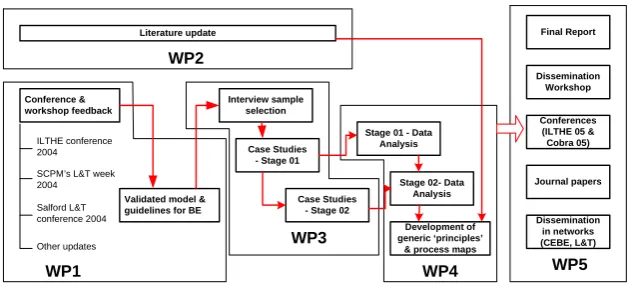
WP2
Literature update
WP4
Stage 01 - Data Analysis
Development of generic ‘principles’
& process maps Stage 02- Data
Analysis Interview sample
selection
WP3
Case Studies - Stage 01
Case Studies - Stage 02
WP1
Conference & workshop feedback
ILTHE conference 2004
SCPM’s L&T week 2004
Salford L&T conference 2004
Other updates
Validated model & guidelines for BE
WP5
Final Report
Dissemination Workshop
Conferences (ILTHE 05 & Cobra 05)
Journal papers
[image:10.595.140.456.70.213.2]Dissemination in networks (CEBE, L&T)
Figure 2 : Phase II Work plan
4 Project activities and evaluation
4.1 Phase I Work Evaluation
4.1.1 Introduction
Phase I of the project was successful and produced a draft model and guidelines as planned through a literature review and an exploratory case study. The findings were disseminated at several workshops and conferences. The key activities of this phase are described next.
4.1.2 Literature Review
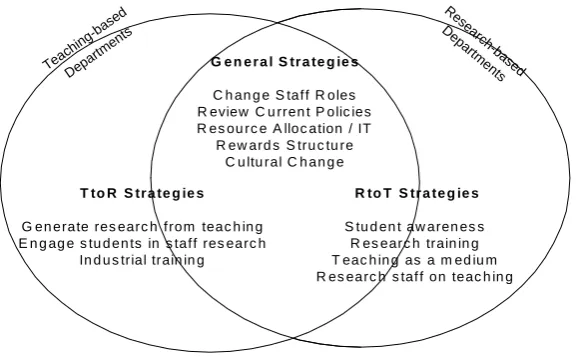
The literature survey mainly revealed that the Research and Teaching (R&T) link is not automatic and needs to be created. As Jenkin & Zetter (2003) argue, it is the academic departments who should develop this effective link. This is a two-way link (i.e. Research into Teaching [RtoT]; and, Teaching into Research [TtoR]) in which learning becomes the overlapping concept. Rowland (1996) describes this two-way link: research improves quality of university teaching while students’ understanding and work can contribute to a lecturer’s research. However, the transfer should be appropriately created depending on whether the department is teaching-biased or research-biased. For teaching-biased departments, which have limited research funds, the R&T link should focus towards developing a research profile by creating research activities through teaching (for example, see Gorden et al, 2003). That is, the knowledge should flow from teaching to research. On the other hand, research-biased departments can create the link to benefit teaching from their research activities. These departments can help students to appreciate the value of research within the department by creating this flow from research into teaching.
teaching-biased and research–biased departments. These include strategies such as changing staff roles (Jenkins & Zetter, 2003); reviewing current research and teaching policies (Rowland, 1996); allocating new resources (Badley, 2002); changing reward structures (Jenkins, 2000); and, creating a cultural change. For example, Rowland (1996) brings in the concept of ‘critical interdisciplinarity’ and suggests a cultural change through student-centred teaching. TtoR strategies were considered as more important for teaching-biased departments, which include strategies such as:
generating research from teaching activities (Rowley, 1996);
engaging students in staff research activities (Rowley, 1996; Jenkins & Zetter, 2003); and
generating research through industrial training (Healey, 2000).
RtoT strategies were identified as more appropriate for research-biased departments and include strategies such as:
student awareness of staff research (Zamorski, 2002);
providing students with research training (Healey, 2000), using teaching as a medium to transfer research (Healey, 2000); and
using research staff in teaching (Cech, 2003; Turrell, 2003).
However, as Rowland (1996) agrees, both TtoR and RtoT strategies should be in place in a particular department in an appropriate balance (for example, a research-biased department while focusing more on RtoT strategies should also implement TtoR strategies appropriately) in order to manage staff research with teaching commitments.
T to R S tr a te g ie s
G en erate res earc h f rom teac h in g E n g ag e s tu d en ts in s taf f res earc h
In d u s trial train in g
R to T S tr a te g ie s
S tu d en t aw aren es s R es earc h train in g T eac h in g as a m ed iu m R es earc h s taf f on teac h in g
G e n e r a l S tr a te g ie s
C h an g e S taf f R oles R eview C u rren t P olic ies R es ou rc e A lloc ation / IT
R ew ard s S tru c tu re C u ltu ral C h an g e
[image:11.595.155.444.486.666.2]Rese arc h-b ased D ep artm ents Teac hin g-base d Depa rtmen ts
Figure 3 : Strategies to link research and teaching
Activities associated with the transfer of research into teaching are comparatively difficult, and are a long-term process that also involve students’ motivation and commitment. Previous work shows that in research-biased departments, students are unaware of the high quality research discovered within these departments due to poor transfer mechanisms (for example, see Wood, 1999). Zamorski (2002) disclosing students views on staff research states, that students value being close to research and the idea of university as a research community in which they are included; but, they often feel that they are excluded from university research. On the other hand, Jenkins (2000) reveals that it is difficult for teaching to be valued by staff who generally prioritise discipline-based research over teaching duties. Therefore, transferring research into teaching in research-biased departments is an important task that needs prompt attention. By identifying this increased importance of RtoT transfer over TtoR transfer, the research study focused on how to implement RtoT transfer specifically in research-biased departments.
Research has also found that the R&T link is dependent on different disciplines (for example, see Healey, 2000). ‘Linking Research & Teaching’ (Online 1) is a national project that has broadly studied the R&T link in a variety of disciplines such as geography, biosciences, law, health science and hospitality disciplines. An associated project, namely LINK: Good Practice Resources Database (Online 2) explores the R&T link specifically in the built environment sector. In addition, the work of Fawcett et al (2003) on nursing; and, the work of Cech (2003) and Sears & Wood (2005) on bioscience provide useful insights into this link. Planet (2003) is a special issue that focuses on R&T link in geography, earth and environmental fields. However, Griffiths (2004) explains that the boundaries between disciplines are becoming less important with the growth of inter-disciplinarity; yet, at the broader level, there exist differences that affect the R&T link. Phase I of the research study focused on the BE discipline, which is a fertile area (Link, Online 2) to investigate the complex R&T relationship. BE falls under vocational and applied science disciplines as opposed to pure sciences discipline. Gann & Salter (1999) emphasise the need for improving interdisciplinary skills for BE students. Robertson & Bond (2001, p15) state “in disciplines where there is a large body of technical knowledge organised hierarchically and being taught in huge lecture theatres to students from a range of disciplines, a relationship is difficult to sustain or nurture.” Considering this from the BE point of view, factors such as collaborative studies and high technical subject content that are inherent in BE education, suggest that establishing the R&T link will be difficult. Link: Good Practice Resource Database’ (Online 2) offers significant contributions to create R&T link in BE higher education. However, extant literature on research and teaching relationship has failed to appreciate research into teaching as a knowledge transfer process and, therefore, has ignored useful insights that could be gained from the knowledge age. This research brought in knowledge management perspectives to this transfer process and developed a better understanding of the phenomenon.
absorptive capacity of the users. Accordingly, when students are considered as the potential users of such a transfer process, their learning process followed by such a transfer is an essential consideration. According to Elton (2001), the real teaching-research nexus lie in the curriculum process (all that contributes to the student learning process) rather than on merely the teachers or learners. As Griffiths (2004) emphasises, for an effective transfer and learning, providing students with learning opportunities is insufficient; therefore, it is equally important to evaluate student learning. In fact, learning is the key driving force that links research and teaching (Badley, 2002; Turrell, 2003; Hughes, 2004). As such, in transferring research knowledge into teaching, different student learning styles need to be addressed.
The literature on learning styles can be grouped into four theories (Smith, 2002; Vita 2001; Felder & Silverman, 1988). First, the ‘field dependency’ theory illustrates that learning can be influenced by the context within which the students learn. Second, ‘holistic versus sequential’ learning theory describes that some students prefer visual approaches whereas some prefer verbal approaches to learning. Third, experiential learning theory (Kolb, 1984 cited in Smith, 2002) explains an individual’s learning cycle in four aspects: activist, reflector, theorist and pragmatist. This role of experience in learning calls for activities such as project-based work that provide students with first-hand experience. Finally, based on ‘surface versus deep’ learning theory, it is the deep learning styles that should be encouraged in higher education institutions compared to surface learning. Active learning is learning by doing. Griffiths (2004) describes inquiry-based learning as a powerful active learning tool, especially in the form of problem-based learning. Schon (1983) describes that ‘reflection on action’ is also needed when students engage in active learning processes. On the whole, these theories on learning suggest that not everyone can be taught in the same way and the teaching approach needs to take these differences into account.
In summary, the pedagogical literature has established that R&T link is not automatic and needs to be created in each academic department based on the discipline. The knowledge transfer and learning literature values the importance of student perspectives and the maintenance of the R&T link following an immediate transmission process.
4.1.3 Case Study
The School of Construction & Property Management (SCPM) at University of Salford was selected as the exploratory case study to represent a research-based department in the built environment discipline. Semi-structured interviews, workshops and a documents survey were used as techniques of data collection. The interview sample comprised of academic staff, research staff and students. The issues and strategies identified through the literature survey were further explored and validated through this case study. The key findings are explained below:
The importance of creating an explicit R&T link within SCPM was affirmed by academic staff members at interview. The benefits that they identified from such a link were gaining academic rigour, creating market differentiation, raising ‘Royal Institution of Chartered Surveyors’ (RICS) standards, keeping ahead of change and complying with the mission statement. Research staff and postgraduates also made positive remarks towards linking research and teaching, in that they emphasised the opportunity to present their work to a different audience may trigger new insights into their research, especially in the case of applied research. When questioned whether they would like to teach on undergraduate programmes, they were supportive of the idea provided that they were financially rewarded. An interesting view that came out from staff interviews was the opportunity for financial gains by way of implementing academic enterprise and short programmes for undergraduates using research staff and postgraduates as teachers. Students on the other hand, were happy as they felt they were the immediate party which benefited from such a link. Their concerns over decreasing teaching commitments by staff due to research activities at present were apparent in these interviews, which further led to the justification of the importance of managing staff research and teaching activities to suit student requirements.
B). Key issues and concepts on R toT transfer
Regarding new insights raised by staff on the R&T link, the issue of ‘what research knowledge is more important to be transferred to students’ was a debating point. Some members said that it is the research learning process that is more important compared to research project findings. However, the majority view was that both types of knowledge were equally important to be fed into teaching. Another recurring issue was to address different learning styles. In achieving compatibility between curriculum and research activities, staff suggested using process mapping techniques to map the existing links within the school. In an industry which is still favouring old practices the staff view was that students should be exposed to research outputs that are suitable for the contemporary industry. This exposes the issue of how appropriate high quality research findings would be at undergraduate levels. A final point from the interviews with regard to the issues of the R&T link was the clear distinction between student groups. It was evident that the link is clearly different between postgraduate and undergraduate levels. At postgraduate level, the R&T link was already in place at a satisfactory level. Even within the undergraduate level, the part-time students viewed the R&T link differently to full-time students. For part-time students, who are closer to the industry, such a link should clearly relate to their work prospects, where as for full-time students the motivation can be created by the allocated credit value.
C). Best practices of R toT transfer
in the discipline, it is introduced at Level-3 in the programme. At the postgraduate level, knowledge of the research learning process is taught to students systematically, starting from basic research skills to conducting active research. In fact, certain research within SCPM has generated new Masters level programmes, showing the effective R&T link at postgraduate level. Other informal best practice examples within SCPM, as identified in the school review (2003), are certain workshops that present research outputs to undergraduates, active engagement of all members of professorial staff in teaching activities, and new academic staff recruited from research staff and PhD students.
D). Enablers and barriers on RtoT transfer
When queried on barriers to creating such a link, the conceptual barriers such as the inherent mismatch between R&T, mismatch between research and curriculum, and working in an industry that changes slowly, were raised by staff members. Common students’ side barriers were identified as lack of motivation; focus on passing examinations rather than gaining actual knowledge, expectation of delivery of the module through lecturers and handouts rather than self-learning; and superficial research such as use of internet searches when they are given research activities. With regard to implementation barriers, staff pointed out the fear and risk factor such as students’ ability to absorb research knowledge, wrongly designed programmes and key staff leaving amidst implementations. On the other hand, enablers found were the mission statement of SCPM, the research strength within SCPM, the positive attitude of all staff members, recognised staff who could enrich the student experience, and the external links with the Centre for Education in Built Environment (CEBE), Learning Teaching Support Network (LTSN), and other universities.
E). Suggestions to improve RtoT transfer
In terms of suggestions, the first consideration was how to overcome the existing barriers. Suggestions raised were engaging staff more in teaching & learning activities, structuring the programmes to highlight research, matching the module learning outcomes to suit this new direction, and improved interaction with the industry. With respect to students’ side barriers, creating a cultural change was suggested through activities such as:
encouraging student self-learning activities by project based work,
opportunities for student engagement in research on research forums,
student research skill development from inception,
engagement of students in various research activities within the school, and
informing students of the value of research.
4.1.4 Research Findings
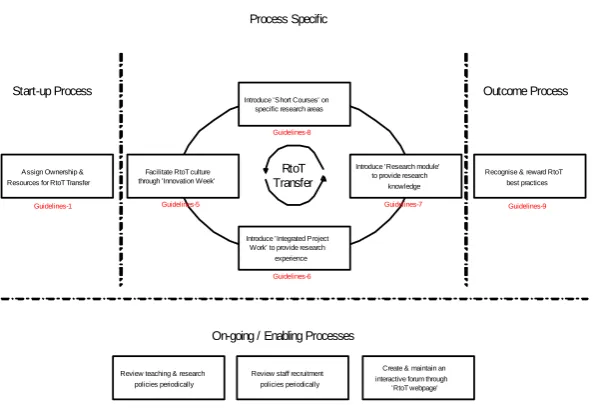
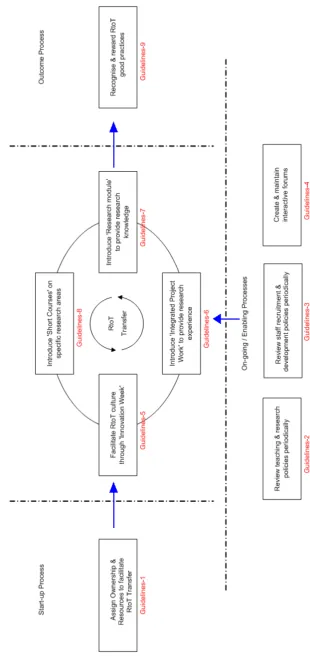
A draft model with guidelines was developed based on the case study findings as explained in this section. As explained in the literature review, previous studies have introduced various strategies to create the R&T link. However, they do not explain how to formalise these strategies. In formalising these strategies within a department, the questions as to ‘who should lead?’ and ‘who should maintain the link?’ arise. These questions led to the recommendation to identify a new staff position called ‘R&T co-ordinator’ within ‘R&T team.’ By allocating human resources in this way, not only can the link be initiated but it can also be maintained whilst creating a learning environment. Therefore, the first activity in the model will be the assignment of ownership and resources.
To enable ‘R to T’ transfer, three processes were identified as necessary. As the first step it is important to review current research and teaching policies in creating the R&T link. An interesting idea that emerged from the primary data was using the process mapping technique to perform this type of review. Hence, the proposal is to review the current policies in a department in initiating the ‘RtoT’ transfer. Having identified the importance of using research staff in teaching activities, the second activity considered under the enabling processes is a periodic review of research staff recruitment. Thirdly, to improve the learning environment and to make effective use of IT facilities the ‘R&T web page’ is proposed. The purpose is to link students, researchers and the academic staff in the department in order to strengthen relationships and create a shared space for interaction. This web-based collaboration will provide an opportunity to disseminate best practices and to initiate ‘a research showcase’ as mentioned in the primary survey.
Specific ‘RtoT’ transfer strategies were then considered. With the recurrent issues of ‘student motivation’ and ‘use and absorption’ that emerged from the literature on learning and from the primary survey, a cultural change was introduced within departments through an “innovation week” at each year of study. This ‘innovation week’ was introduced with various days for research-based activities. For example, in the first year of study, an ‘innovation week’ can be allocated for research awareness activities such as awareness of the research institute and staff research. In the second year, the ‘innovation week’ can be allocated to give students knowledge on research such as research process, important findings of research projects and PhD research. In the third year, ‘innovation week’ can be used to engage students in research activities by giving them to conduct project-based research tasks and to make presentations during the week. These progressive research activities from year to year enable the feed-forward of learning gained at each year. Therefore, this innovation week will not just provide a research environment among students by making research awareness and improving their research knowledge, but will also provide an enabling context for ‘PhD-undergraduates interaction’ and ‘industry-student interaction.’ Accordingly, both literature and primary survey results on ‘RtoT’ transfer strategies are integrated through this innovation week and all possible learning loops are suggested during and across different levels through the understanding received from the knowledge transfer and learning literature.
exercise that is proposed to be linked from one year to the next year to enable a learning cycle. This enables students to work collaboratively and gain active research experience. Further, drawing from the best practice examples from the selected case study, a separate module called ‘research module’ is proposed to provide not only new findings within the discipline but also to give students first hand research knowledge. For undergraduates this module can be introduced at the final level along with their dissertation project whereas for postgraduates this module can be introduced along with their research project. This module is aimed to specifically select current research themes and make students knowledgeable on these. Further the coursework tasks related to this module can specifically focus on giving students some research experience. Research data raised the importance of valuing teaching activities in research-based departments. Consequently, as an outcome activity of this ‘RtoT’ transfer process, recognising and rewarding best ‘RtoT’ practices are finally proposed.
Assign Ownership & Resources for RtoT Transfer
Introduce 'Integrated Project Work' to provide research
experience Introduce 'Short Courses' on
specific research areas
Introduce 'Research module' to provide research
knowledge Facilitate RtoT culture
through 'Innovation Week'
Recognise & reward RtoT best practices
Review teaching & research policies periodically
Review staff recruitment policies periodically
Create & maintain an interactive forum through 'RtoT webpage'
RtoT Transfer
On-going / Enabling Processes
Start-up Process Outcome Process
Process Specific
Guidelines-1 Guidelines-5 Guidelines-7
Guidelines-6 Guidelines-8
[image:17.595.90.389.288.497.2]Guidelines-9
Figure 4 : Framework for RtoT transfer process in Built Environment
4.1.5 Dissemination
The project findings were disseminated at various stages of the project. These are discussed in this section under publications and presentations.
Publications
Senaratne S., Kagioglou M., Amaratunga D., Baldry D., Aouad G. and Bowden A. , (2005), Research Knowledge Transfer into Teaching in the Built Environment, Journal of Engineering, Construction and Management, 12 (6), pp. 587-599
Senaratne, S., Amaratunga, D., Kagioglou, M., Baldry, D., Aouad, G. and Bowden, A., (2004), Transfer of Research Knowledge into Teaching in the UK Higher Education Institutions, In the proceedings of the 2nd Education in the Changing Environment Conference, University of Salford, Sep 2004.
Amaratunga, D., Senaratne, S., Kagioglou, M., Baldry, D. and Bowden, A. (2004). Good Practice Guidelines for Research Knowledge Transfer into Teaching within Built Environment, The Learning and Teaching Conference 2004, Hertfordshire, UK.
Senaratne, S., Amaratunga, D., Baldry, D., Kagioglou, M., Aouad, G. and Bowden, A. (2004). Good Practice Guidelines for Research Knowledge Transfer into Teaching within Built Environment. Project Interim Report. School of Construction and Property Management, The University of Salford, UK.
Senaratne, S., Amaratunga, D., Baldry, D., Kagioglou, M., Aouad, G. and Bowden, A. (2004). Generic Model and Guidelines. School of Construction and Property Management, The University of Salford, UK.
Senaratne, S., Amaratunga, D., Baldry, D., Kagioglou, M., Aouad, G. and Bowden, A., (2003), Research Knowledge Transfer into Teaching in the Built Environment, In the proceedings of the 1st Education in the Changing Environment Conference, University of Salford, Sep 2003.
Presentations
Presentation at the University of Salford 2nd Learning and Teaching Research conference titled 'Education in a Changing Environment’ 2004
A workshop at the Learning and Teaching week at the School of Construction & Property Management, The University of Salford, July 2004
Workshop and presentation at the Higher Education Academy annual conference on Enhancing the Student Experience. University of Hertfordshire, 2004.
A workshop at the Learning and Teaching week at the School of Construction & Property Management, The University of Salford, July 2003
4.2 Phase II Work Evaluation
4.2.1 Introduction
The model and guidelines in ReKnowiT Phase I first proposed to formalise the RtoT transfer by assigning ownership and resources for the process. Secondly the importance of reviewing current teaching, research and recruitment policies was emphasised. A key RtoT strategy introduced in ReKnowiT Phase I was the ‘Innovation Week’ in every academic year. This provides a research environment among students by developing research awareness through a series of presentations and also provides an enabling context for researcher-student interactions. Further interactions were enabled by proposing a separate RtoT web forum. The Phase I work revealed the importance of project-based learning in transferring research into teaching. By taking advantage of collaborative approaches in the Built Environment discipline, an integrated project task was introduced as another RtoT transfer strategy. Further, to provide not only new findings within the discipline, but also to give students first hand research knowledge, a separate module called ‘research module’ was proposed. In addition, separate short courses for specific research topics were introduced. The best practice examples from the selected case study shaped these proposals. Both literature and primary data raised the importance of valuing teaching activities in research-based departments. Consequently, as an outcome activity of this RtoT transfer process, recognising and rewarding best RtoT practices were finally proposed.
ReKnowiT Phase II took this initial research further and, in particular, aimed to validate the model in a broader context. As an attempt to replicate the findings and to extend the scope beyond Built Environment, the research further aimed at conducting additional case studies within different schools from different faculties at the University of Salford. Accordingly, phase II of the project achieved its planned work packages and finally produced a set of principles; and, modified the validated guidelines (developed in Phase I) to suit a more generic context. This was achieved through a wider literature review and five case studies that covered five disciplines beyond the built environment. The key activities as identified in Phase II work plan (see Figure 2) are explained next.
4.2.2 Literature Review
The literature review was extended from previous work to cover more generic issues on the research and teaching relationship (See Appendix A for the complete reference list). Following is a summary of the literature findings.
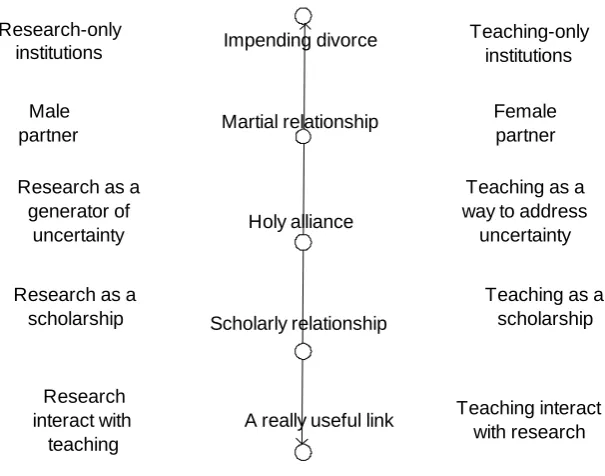
different interpretations: namely, ‘an impending divorce’; ‘a marital relationship’; ‘a holy alliance’; ‘a scholarly relationship’; and, ‘a really useful link’ (see Figure 5). In an impending divorce, separate institutions exist for research and teaching, for example, in USA existence of research institutions and teaching-only or all-teaching institutions; and, in UK identification of research-led and teaching-led departments. In a marital relationship, research is viewed as the male partner and teaching as the female partner. In a holy alliance view, research is seen as a generator of uncertainty; and, teaching needs to address this uncertainty. In a scholarly relationship, research and teaching are separate but overlapping scholarly activities. For example, Boyer (1990) includes research and teaching in his typology of scholarship: the scholarship of knowledge discovery and integration; and, the scholarship of knowledge application. Badley (2002) adds a ‘really useful link’ by seeing R&T as an interactive relationship. Thus, the R&T link is seen from different viewpoints based on the different interpretations of the terms research, teaching and scholarship. Martial relationship Male partner Female partner Impending divorce Research-only institutions Teaching-only institutions Scholarly relationship Research as a
scholarship
Teaching as a scholarship Holy alliance
Research as a generator of
uncertainty
Teaching as a way to address
uncertainty
A really useful link Research
interact with teaching
[image:20.595.145.448.301.539.2]Teaching interact with research
Figure 5 : Different interpretations of the R&T relationship
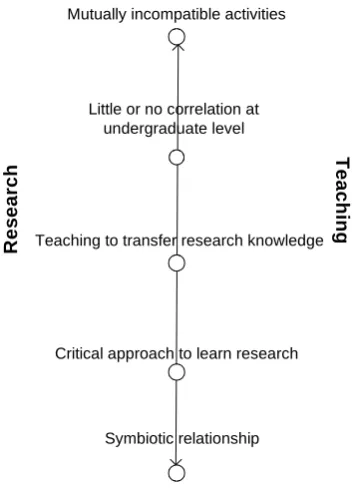
and, at the other extreme, R&T share a symbiotic relationship in a learning community. The three levels that exists in the middle are: little or no correlation exist between R & T at the undergraduate level; teaching is a means of transmitting research knowledge; and, teachers encourage a critical inquiry approach to learning. These levels correspond to Badley’s (2002) analysis of the R&T link, in particular at the two extremes.
Mutually incompatible activities
Symbiotic relationship Little or no correlation at undergraduate level
Teaching to transfer research knowledge
Critical approach to learn research
R
es
ear
ch
Te
achi
n
[image:21.595.209.388.191.438.2]g
Figure 6 : Different levels of the R&T relationship
To approach ‘a really useful link’ (Badley, 2002) or ‘a symbiotic relationship’ (Robertson & Bond, 2001) most academics believe in research-informed teaching, in particular that good research is necessary for good teaching (HEFCE, 2000). In fact, the Department for Education and Skills (2003) explains that the UK government is not seeking an artificial divide between teaching and research, and it expects lecturers to keep up to date with their field through engagement in some form of advanced scholarly activity. Clark (1997) states that, professors generally find their own teaching and research activities ‘merging in a seamless blend.’ According to Lindsay et al (2002), academics believe that research and teaching is one of ‘symbiotic’; ‘mutuality’; and, ‘synergy’, especially when lecturer research activity increases in quantity and quality. They reveal that a lecturer’s research activity enhances knowledge currency; credibility; competence in supervision; motivation; and, salience. According to Jenkins (2000), an effective way to link research and teaching is managing staff research to benefit student learning which will benefit both students and staff; and, also, will improve knowledge development and learning within universities.
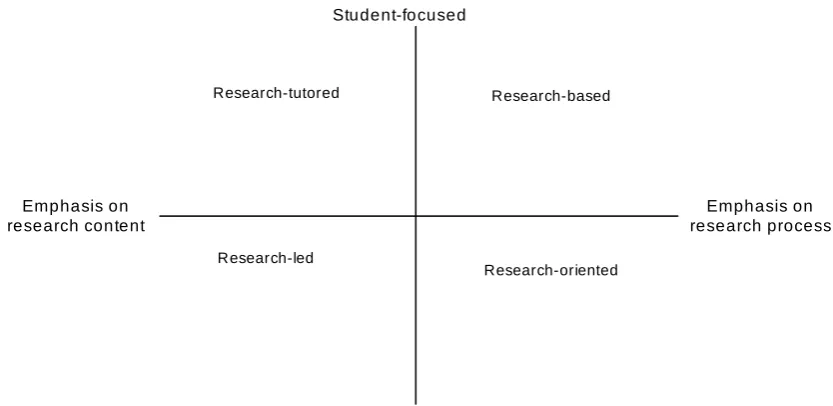
research-based; and, research-tutored. In research-led teaching, students learn about research findings. In research-oriented teaching, students learn about research processes. In research-based teaching, students learn as researchers. Finally, in research-tutored teaching, students write or discuss research work. Hughes (2004), too, emphasises the importance of delivering both research processes and content to students. Griffiths (2004) put forward these research-informed teaching methods in a nexus (Neumann, 1996) as depicted in Figure 7.
Research-tutored
Research-oriented Research-based
Research-led
Emphasis on research content
Emphasis on research process Student-focused
[image:22.595.88.505.222.425.2]Teacher-focused
Figure 7: Research and teaching nexus
As the R&T nexus suggests, the teaching approach can influence the R&T relationship depending on whether it is a deep approach (conceptual change/ student-focused) or a surface approach (information transmission/ teacher-focused) (Brew, 2003). Teacher-focused teaching is when teachers directly transmit research knowledge to a student audience; and, student-focused teaching is when students construct their own knowledge through active participation in class (Griffiths, 2004). Griffiths (2004) explains that in soft-applied disciplines, compared to hard-pure disciplines, student-focused teaching can be better employed. According to Elton (2001), the most influencing factors that contribute to a positive R&T link are student-centred teaching and learning. Therefore, while all teaching types can be used in a certain course the most effective transfer is research-based teaching where students learn about research process through participation.
According to him, more than research-informed teaching it is about dialogical and dialectical processes between teachers and students. As most studies confirm, research and teaching are loosely coupled activities, which may not have a necessary or an automatic link; and, therefore, it is necessary to create this link to achieve a productive relationship (Jenkins & Zetter, 2003). Recent studies address this issue and introduce different strategies to create a beneficial relationship rather than the problematic one that naturally exists. Elton (2001) describes that strategies to link R&T depend on various factors such as the unit of assessment (individual, departmental, institutional); level of competence (teaching or research); perspectives of stakeholders (academic staff, students, administrators, funding bodies); and, cultural factors (different countries, international dimension). Among these, the most influencing factors as identified in several studies are the type of department, discipline and level of study. Thus, this research moved beyond the initial scope to address the relationship in other disciplines and departments at different levels of study.
4.2.3 Case Studies
Departments that focus on disciplines such as information technology; sociology; nursing; geography; and, management were selected for detailed case studies. As such, five case studies across the four faculties within the university were selected as briefly identified below:
·
Faculty of Business & Informatics:
(1) School of Management : This department is engaged in delivering
courses in management education and development. It is more teaching-biased and has a low status for research activities.
(2) Information Systems Institute: This department is engaged in
delivering courses in information systems and technologies. The department had received 6* status in the UK 2001 research assessment exercise. Its vision includes the close connection between research and teaching.
Faculty of Health & Social Care:
(3) School of Nursing: This department is engaged in delivering
courses in nursing, health and social care. The department and its faculty as a whole are currently developing a combined research portfolio and multidisciplinary courses with an emphasis on the research and teaching link.
Faculty of Science, Engineering & Environment:
(4) School of Environment & Life Sciences: This department is
Faculty of Arts, Media & Social Sciences:
(5) School of English, Politics & Contemporary History: This
department is engaged in delivering courses in biosciences and geography studies. The department had won recognition for teaching in geography. However, the research activities within the department are limited.
The case studies were carried out in two stages. In the first stage, five interviews were done in each school by selecting a key contact. Following these initial interviews, a further interview sample was selected for the second stage of data collection. The interviewees were provided with the case study brief (see Appendix B) and the interview guidelines (see Appendix C) prior to the interview. The interviews took about 1 hour with each interviewee (see Appendix D for an example of an interview transcript). The case study data were then analysed and were presented in case study reports, which were prepared for each faculty.
4.2.4 Research Findings
The findings of the case studies were cross-analysed for emerging themes and patterns. Based on these findings the model and guidelines were modified to represent a wider context beyond the initial Built environment discipline. The revised model is presented in Figure 8 (The detailed guidelines document is attached separately to the report as Appendix E).
A). Summary of case study findings
Case study findings are discussed under six main sections: issues relating to R&T link; contextual factors that influence R&T link; enablers for RtoT transfer; barriers for RtoT transfer; current good practices; and, suggestions offered by interviewees to improve.
Key issues on R to T transfer
The interviews revealed several issues related to research into teaching transfer. Some findings were consistent with the extant literature while some were specific to disciplines and departments that were studied. The key issues are discussed below.
First, a key issue that the interviewees raised was the use of formal processes against informal processes. Some strongly favoured informal transfer of research into teaching against formal processes. A staff member explained, “the ideal situation is to transfer research indirectly to teaching. I believe that people who do research are
better at teaching. Academics need to be practitioners as well as teachers.” Other
members offered similar views, for example, a lecturer mentioned, “academics need
to be research-active, so that it informs teaching in a broad way” and another
confirmed, “transfer of research findings to teaching is natural when research-active
academics teach to students.” However, this is not always possible. For example, in
lecturers to be on the cutting edge of research on every subject that they lecture due
to the diversification of subjects.” On the other hand, due to workload limitations it is
difficult for every academic to be engaged actively in lectures while delivering good quality research. Therefore, many academics believed both formal and informal processes should be in place in an appropriate balance. Many interviewees noted that informal practices are in place and emphasised that strategies or workable processes to deal with this issue at a formal level are equally important.
Second, interviewees raised the importance of identifying what aspect of research need to be transferred to students. The common view was that all aspects of research need to be transferred be they research findings, research skills, research process or research methods. However, the majority said that more important than delivering research knowledge is, ‘enabling research’. An academic staff member echoed, “it is not necessarily about gaining research knowledge but more importantly gaining skills like critical thinking… If you give research knowledge it just give them a
list of answers. But, research skills will facilitate students’ thinking process.” Another
member expressed similar views, “what is more important is to teach students the research process i.e. how to do research. Research results could be used as a
vehicle.” A further point raised by an interviewee was the necessity of staff mastering
research skills in order to teach students.
Third, case study data revealed that staff are motivated to inform students of cutting-edge research when their teaching modules are closely related to their research activities. An academic in politics elaborated, “I have research expertise on Italian politics and my teaching modules are built around my research expertise. Last week I wrote a research article and I felt that I could transfer that knowledge to my teaching
modules.” However, curriculum limitations can make this difficult. According to an
interviewee, “it is often difficult to have an exact match between the actual real world
research and the teaching module objectives.” A lecturer in information technology
stated, “research what we are doing is not directly relevant to teaching programmes. Most of staff here are researching on social science aspects. The teaching programmes are aimed at technological subjects to produce IT professionals. So there is this difference of staff research and teaching subjects which creates the
problem of transferring staff research to teaching.” Some members suggested that
modules, which are difficult to be fed by research knowledge, could be delivered by academics who are no so research-active.
Fourth, research to teaching transfer at different levels was identified. Being consistent with the literature, case studies revealed that at undergraduate level the transfer is more difficult than at postgraduate level. Even at the undergraduate level, the transfer becomes easier at higher levels. In fact, one academic stated, “broadly,
research expertise should increase with the level of studies.” Case study data also
revealed how different student categories, for example, full-time students and part-time students in certain disciplines, can influence on such a transfer. A staff member in the management school expressed, “part-time students expect practical
knowledge more than research knowledge.” According to a staff member in
geography, “some students are struggling to find a strong link between their objective of getting a marketable degree and the introduction of cutting-edge research to the
curriculum.” However, as some interviewees revealed, in disciplines like Built
“post-registration students [people from practice] are better at understanding research as their practice is evidence-based.”
Fifth, the influence from quality assessment mechanisms was mentioned. An academic stated that the Teaching Quality Assessment (TQA) considers research-informed teaching. On the other hand, a respondent stated that the pressure to carry out research by the Research Assessment Exercise (RAE) facilitates the teaching process. In his words, “organising teaching around research is easier. RAE does not hinder this activity. It is much easier when you have done research. For example, materials are already there, reading lists are already there. So the process is easily
facilitated.” But, another member expressed strong views on RAE, “I think RAE, in
general, is problematic. RAE has made academics to mainly focus on research output, i.e publications. What is needed is staff to undertake good research and disseminate their knowledge to society in a broader sense. This has implications in
research to teaching transfer.” Also, another staff member confirmed this, thus
quality assurance mechanisms have mixed impacts on research to teaching transfer.
Barriers on R to T transfer
The interviewees were next questioned about common barriers and specific barriers related to their discipline and academic departments. Key barriers identified through the data analysis are discussed in this section.
Some of the departments that were case studied were teaching-biased and some were research-biased. In teaching-biased departments the common barrier was the absence of a research culture to initiate such a transfer process. Interviewees mentioned a division between research-active staff and teaching-only staff in such departments. Another barrier raised in these departments was the lesser funding and support given for individually motivated staff to undertake research. Some identified that learning outcomes in module specifications limit the flexibility of including new research knowledge into teaching.
In research-biased departments, staff noted common barriers such as high workload, time restrictions and resource limitations. A specific barrier in these departments was less motivation and financial incentives for staff, especially research-active academics and research staff, to do teaching. As a result, insufficient teaching is undertaken by research-active staff. For example, one said, “active researchers are
allocated less teaching workload while other teaching staff do a lot of teaching” and,
another said, “I strongly believe that experienced staff should be teaching on
undergraduate courses, especially in the 1st year.” Another barrier was the lesser
interaction between academics, researchers and students. One interviewee echoed,
“research staff do not have opportunities to work with others and discuss and
disseminate their research.”
Specific barriers identified in healthcare courses were the large student cohorts; substantial components delivered at the work place rather than at the classroom; and, ethics attached to the discipline. A staff member explained this problem,
“students cannot do research or project-based research work as they cannot interview or visit NHS staff, patients or facilities without passing ethical procedures.”
needs to focus on industry requirements rather than staff research expertise. For example, academics in built environment mentioned that since the construction industry changes slowly, students may not see direct benefits by including cutting-edge research in the curriculum.
Certain barriers were identified by students. For example, common student-side barriers identified by most of the case studied departments were the lack of motivation and participation of students in the programmes. According to one staff member, “student motivation is a barrier to a degree. It is difficult to get good
participation of students for certain subject modules.” Interviewees further expressed
that the aim of most students is to achieve a qualification and they rarely value further learning opportunities. Students generally expect lecturers to deliver all the lecture material and handouts rather than gaining a wider knowledge through self-learning. Therefore, some members doubt the success of any research knowledge transfer mechanisms. This was evident in one interviewees’ statement, “whatever
you suggest you need to attach a credit value to gain student participation.” Other
implementation barriers that were mentioned were the fear and risk factor such as a student’s ability to absorb research knowledge; wrongly designed programmes; and, key staff leaving amidst implementations.
Enablers of R to T transfer
The common enablers raised by case studied departments are discussed in this section.
Staff identified the significance of research in the mission statement as an enabler in many departments. A senior lecturer in a research-biased department emphasised,
“our school strategy is geared to enhance research-informed teaching. It is central in
our mission and a core part of what we do.” However, certain departmental staff
noted that in the mission statement the transfer of research to teaching is not explicitly mentioned. Some noted university level drivers and management structure as enablers for research to teaching transfer within their schools. For example, one participant expressed, “I think the management structure is an enabler; for example, even academics such as associate dean (research) and associate dean (teaching) teach on courses.”
Research strength in research-biased departments is another enabler. For example, an interviewee stated, “research strength in our school is probably an enabler.”
Further, the recognised staff and positive attitudes were seen as enablers within these departments. Other departments identified individual staff motivation and the existence of some research-active staff as enablers within their departments.
External links with professional bodies, such as Learning Teaching Support Network (LTSN) and links with other universities were identified as enablers by some respondents while others identified availability of modern and expensive equipment for research as an enabler. In essence, existence of research institutes, funding opportunities and resources were key enablers in staff engaging in research and transferring that knowledge to teaching.
and labour intensive. Thus, involvement of undergraduates in actual real world research is an effective way of transferring research knowledge into teaching as well as an effective way of fulfilling some of the resource requirements of real world
research projects.” In disciplines such as built environment and healthcare a specific
enabler was an inter-disciplinary working culture. For example, staff in healthcare stated, “move towards interdisciplinary working is, in general, an enabler for
research, teaching, working and learning.” In information technology, research is
seen as the work itself; for example, an interviewee said that system analysis involves research tasks. As a whole, interviewees stated that, in applied disciplines, research is more relevant and there is more opportunity to use research in teaching.
Good practices in R to T transfer
Among the good practices observed within case studied departments the following key strategies were identified.
First, project-based working, problem-based learning and active learning were seen as good practices where students get the opportunity to understand and experience disciplinary research.
Second, special modules such as research-based modules and a dissertation module that aim at delivering research knowledge and awareness were recognised as good practices within some undergraduate and post-graduate programmes. For example, a member explained details about such a module conducted in their department, “final year module, which is a series of seminars conducted by industry people and researchers, aims at making students knowledgeable about current
research and industry practices.” Some programmes were enriched with additional
workshops, seminars and guest lectures that give opportunity for researchers to disseminate research knowledge.
Third, some staff members noted engaging in research through academic enterprises as good practice that also links to the research to teaching transfer. Some of the case studied departments had a strong academic enterprise culture.
Fourth, new academic staff recruited from research staff and PhD students, and initiation of new schemes such as Graduate Teaching Assistants (GTA) were positives practices observed to this effect. Further, students’ placement-based scheme in vocational disciplines was a good practice that facilitates this process. For example, a respondent described this practice within his department: “work placement is a good practice here where students get an opportunity to work sometimes as research assistants in the industry; e.g. in parliamentary placements
as RAs.”
Suggestions to improve R to T transfer
Interviewees offered several suggestions, both general and specific, to their departments to improve inclusion of research in their teaching. These are discussed in this section.
strategies or policies.” However, many academics in case study departments favoured formal mechanisms to boost informal research-based teaching. In fact, some stated that there should be a fundamental change at the university level to create a driver to be research-led and make changes with respect to criteria for promotions.
Creating a research culture within each department is a common suggestion discovered in case studies. Many emphasised that awareness of research among students and access to institute’s research activities is important. An academic explained this; “I do not think that RtoT transfer should always take place by
researchers going into students’ classroom to teach. Students should be provided
with access and awareness of current research through effective dissemination.”
Some further suggested enhancing innovative teaching through student-centred, problem-based learning mechanisms. An interesting suggestion was to practice ‘team teaching’ as part of this process. A person explained this team teaching concept, “research-active staff members and research-inactive staff members team
together to deliver undergraduate and postgraduate modules.” All in all, increasing
interaction among all members (be they academics, researchers, students or in some cases industry) is vital to create this cultural change. As part of this, interviewees mentioned engaging students in various research activities to create opportunities for students to disseminate their work at various forums, for example, a research conference.
Another key suggestion was using research staff effectively in teaching activities by encouraging them to have a research profile with teaching duties. In fact, one respondent described indirect benefits of this; “using research-active staff members in teaching is a selling point when it comes to undergraduate and postgraduate
recruitment.” For this to happen, some noted the importance of training such staff to
teach. Not only research staff, for every academic there is a need to create a balance between teaching and research. Hence, departmental support, in terms of resources allocation, changing policies, valuing teaching and changing recruitment policies, were also proposed.
In addition to the above suggestions, there were suggestions to overcome present barriers within departments. For example, to overcome the mismatch between staff research and curriculum, academics suggested collaborating with other departments who have research expertise on certain teaching modules. However, academics expressed their concerns, “this is really difficult across faculties. In our case we can collaborate with … department. But, since it is in another faculty this has become
difficult.” To overcome the problems with rigid module specifications, staff suggested
explicitly including research to teaching in the learning outcomes of module specifications. To overcome resource limitations, staff suggested introducing an equipment pooling mechanism so that resources can be effectively shared. To overcome research funding problems, there were suggestions to create business through new programmes based on cutting-edge research. Moreover, staff pointed out that financial gains can be increased through academic enterprise and short programmes for undergraduates using research staff and postgraduates as teachers.
4.2.5 Model Validation
The model (see Section 4.1.4) was updated using the feedback received from the ILTHE 2004 conference, 1st Education in a Changing Environment conference, SCPM’s Learning and Teaching week workshop, and comments received through field experts. Further, case studies conducted in this phase were also used to test and validate the model. The comments received are discussed below.
In the initial validation stage, comments were received as to on-going activities. Some mentioned reviewing staff development policies along with staff recruitment policies. Also, in terms of the web page, some said it is equally important to create face-to-face interactive sessions as well. Accordingly, the guideline 3 in the model was revised to include staff development policies and the guideline 4 was revised to represent all interactive sessions.
In validating the framework within case study departments, significant comments were received which were incorporated into this final framework. Most departments agreed that this is a comprehensive framework that covers most R to T aspects. However, one case study department which had strong informal research-based teaching practices stated that it is important to evaluate the value of such a formal transfer mechanism where natural transfers exist. With respect to separate ownership, academics raised mixed views. Some stated that it will create bureaucracy while some indicated that people will start thinking that it is someone else job. Thus, it is important to emphasise that separate ownership is assigned purely to facilitate the process and all academics need to effectively take part in R to T transfer. However, many saw the importance of assigning an ownership, in particular, to manage administrative work in connection. The ‘innovation week’ received many positive comments; for example, in healthcare courses academics expressed that this week would work well with their large student cohorts. Some mentioned that this week would effectively align with their induction programme in level one. Some academics pointed out that this kind of activity needs to be assessed to achieve good student participation. In recognising and valuing good practices, academics emphasised valuing innovative teaching methods and staff personal development. The final validated generic framework is given in section 4.2.4 under Phase II research findings.
4.2.6 Generic model development
The initial framework that was developed through the exploratory study was validated in the detailed case study phase. This section describes the final generic framework that was validated by case study participants.
As case study findings identified, many academics favoured introducing formal strategies to facilitate the R toT transfer process. In formalising these strategies within a department, the questions as to ‘who should lead?’ and ‘who should be allocated to maintain the link?’ arise. These questions led to recommend assigning a new staff position called ‘R&T co-ordinator’ with ‘R&T team’. By allocating human resources in this way, not only the link can be initiated but also it can be maintained. Therefore, the start-up activity of the framework is assignment of ownership and resources.