A knowledge based system for valuing
variations in civil engineering works: a
user centred approach
Sutrisna, M, Proverbs, D, Potts, K and Buckley, K
Title
A knowledge based system for valuing variations in civil engineering
works: a user centred approach
Authors
Sutrisna, M, Proverbs, D, Potts, K and Buckley, K
Type
Article
URL
This version is available at: http://usir.salford.ac.uk/487/
Published Date
2004
USIR is a digital collection of the research output of the University of Salford. Where copyright
permits, full text material held in the repository is made freely available online and can be read,
downloaded and copied for noncommercial private study or research purposes. Please check the
manuscript for any further copyright restrictions.
1 Introduction
In construction project management research, the subject of variations has attracted considerable attention and further study [3; 9; 12]. Variations have become an almost inevitable part of the construction process particularly within the traditional approach, which is still widely used in the UK and overseas [33].
The valuation of variations has long been recognised as one of the commonest sources of disputes in the construction industry [19]. Several methods exist to value variations, and different circumstances require the application of appropriate valuation methods. Problems normally occur when there are different
perceptions between the project stakeholders regarding the circumstances. Hibberd [13] has warned that the valuation of variations, in many cases, depends upon a high degree of personal opinion or judgment.
In order to respond to these problems, the ICE 7th Measurement Version, 1999 [35] has provided three mechanisms, namely the quotation mechanism, the negotiation mechanism, and the engineer-determination mechanism [32]. However, the quotation can be rejected, the negotiation may fail to reach a mutual agreement, and the contractor may be dissatisfi ed with the engineer’s determination then proceed through claims or even disputes. Thus, a need to have a structured and robust mechanism for valuing variations has been articulated [40].
There has been much evidence that valuing variations in construction
projects can lead to confl icts and disputes leading to loss of time, effi ciency,
and productivity. One of the reasons for these confl icts and disputes concerns
the subjectivity of the project stakeholders involved in the process. One way
to minimise this is to capture and collate the knowledge and perceptions of
the different parties involved in order to develop a robust mechanism for
valuing variations. Focusing on the development of such a mechanism, the
development of a Knowledge Based System (KBS) for valuing variations
in civil engineering work is described. Evaluation of the KBS involved
demonstration to practitioners in the construction industry to support the
contents of the knowledge base and perceived usability and acceptance of
the system. Results support the novelty, contents, usability, and acceptance
of the system, and also identify further potential developments of the
KBS.
civil engineering, knowledge based system, user interface, valuation of
variations
Valuing Variations in Civil Engineering
Works: a User Centred Approach
M. Sutrisna
1, D. Proverbs
1, K. Potts
2and K. Buckley
3ABSTRACT |
KEYWORDS |
In light of this, the research aims to develop such mechanism to minimise confl icts and disputes from the valuation of variations. The selected methodology for the main data collection was the questionnaire survey. Findings of the questionnaire survey has been reported in various publications [33; 34] Based on the fi ndings, a Knowledge Based System (KBS) has been developed to incorporate the three mechanisms using the Java Server Pages (JSP) technology involving a database system as the main knowledge repository system. The main objectives of developing such a system is to preserve and disseminate the captured knowledge to the UK construction industry, particularly in quantity surveying of civil engineering sector. Although it has been generally accepted that a standard manual on the best way to incorporate human factors does not exist [23], the main success measures of the developed system were defi ned as the users participation in the entire life cycle of the system, adequacy of the knowledge base contents, and perceived usability and acceptance. Interviews with practitioners from the construction industry were carried out to evaluate the KBS.
This paper aims to discuss the development and evaluation phases of the KBS, namely the Dynamic Expert-system for Valuing-variations in Civil Engineering (DEViCE), which was developed to preserve and disseminate the captured knowledge on valuing variations and intended to assist practitioners in the UK construction industry to minimise confl icts and disputes from the valuation of variations. At this prototyping phase, the DEViCE is focused on civil engineering works, particularly excavation works, and hence the ICE 7th [35] was used as the platform.
2 Valuing
Variations
Variations may be required in the case of mistakes in the tender documents, or waivers by owners and the promise to pay [39], by a contractor’s proposal in the case of emergency works regarding safety and/or compliance with statutory regulations [38] or simply
for the benefi t of the project i.e. in terms of savings or improvements in constructability [13]. Whether a particular work item can be treated as a variation or should be included in the original scope of works would depend on the clauses contained in the contract documents. Standard forms of contracts have been designed to standardise the duties of contractors, employers and engineers and to distribute the risks fairly [1].
Many of the problems associated with the valuation of variations [16; 19; 22; 40] have been attributed to the failure of the traditional cost model, i.e. the bill of quantities [5]. The bill of quantities (BoQ) have been acknowledged as the main fi nancial control system between the client and the contractor [25]. Under the traditional rules for variations, the rate and price quoted in the BoQ is normally used to determine the value of each variation. From the contractors’ point of view, these individual rates and prices may not necessarily provide an accurate fi gure for individual work items, i.e. quoted in the tender only for the specifi ed amount of works and/or calculated to maintain their competitiveness in the tender.
In respond to this problem, two frameworks for valuing variations were developed for excavation works and concrete works respectively [27; 30] at the earlier stages of this research. The platform for the excavation works framework was determined to be the ICE 7th [35]. According to this standardised form of contract, after a variation has been authorised by the Engineer [Clause 51], the Contractor may be requested to prepare a quotation [Clause 52(1)]. The formulation of this quotation is left to the discretion of the Contractor. In the event that the Engineer rejects the quotation or in the absence of such a request, the Contractor is required to prepare a quotation based on the prices and rates in the Contract [Clause 52(2)].
provided by Clause [52(2)(b)(ii)] calling for a mutual agreement between the Engineer and the Contractor. If the negotiation fails, the classical scheme (i.e. the Engineer determines the valuation of the variations) applies. The extent of changes in the work characteristics and/or conditions determines whether the rates/prices in the BoQ can be applied directly [Clause 52(3)(a)], applied with adjustments [Clause 52(3)(b)] or a new rate/price is required [Clause 52(3)(b)]. There remains a high degree of subjectivity involved in determining which of these is appropriate. The determination of the valuation by the Engineer is prone to confl ict whilst the system provides an opportunity for an unsatisfi ed Contractor to proceed into further claims [Clause 53(1) and (2)] or even dispute [Clause 66]. For the purposes of this paper, this engineers’ determination scheme is also known as the decision-making mechanism since it involves a decision-making process.
3 Research
Methodology
Prior to the development of the Knowledge Based System (KBS), a feasibility study was conducted in order to investigate the potential of developing a KBS to tackle the particular problem in this specifi c area [29]. The overall research methodology leading to the development of the KBS has previously been reported [28]. It was decided to focus on the excavation work due to its relative higher degree of uncertainties, hence using the ICE 7th [35] as the platform for the system.
In order to evaluate the current application of the mechanisms for valuing variations provided by the ICE 7th [35] in the UK construction industry, particularly civil engineering sector, and to acquire the practitioners’ knowledge and subjectivity in valuing variations, a semi-structured questionnaire survey of relevant practitioners was conducted in the UK. The results of the survey were used to develop best practice in crafting a quotation to pre-price the variations encompassing perceptions and interpretations of contractors, engineers/consultants and employers [33]. Such best practice should help to increase the likelihood of the quotation being accepted
and help to avoid unnecessary subsequent stages that may be time consuming and costly. Data obtained from the survey was also utilised to develop the decision-making model on the extent of changes in the work characteristics and/or conditions for valuing variations [34]. Results from the analyses were used to develop the intended KBS.
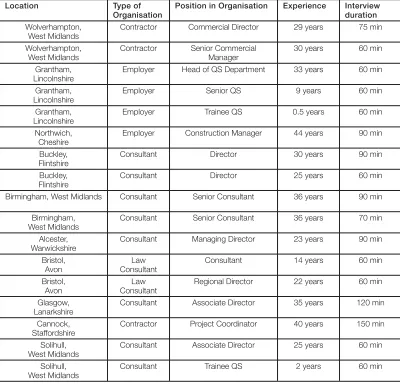
Subsequent to the development of the KBS, an evaluation of the KBS was carried out with a relatively smaller population of practitioners. The evaluation consists of verifi cation and validation whilst validation is subdivided into internal and external validation. The detail for verifi cation and internal validation are explained in subsection 5.1. The external validation involved a demonstration of DEViCE and an interview. The result of the evaluation is presented in subsection 5.2. The demonstration and interviews were conducted throughout Britain (i.e. England, Scotland, and Wales). Each interview lasted for around 60 to 150 minutes (mean 80 minutes), including around 30 minutes to demonstrate the DEViCE. Seventeen practitioners were interviewed, comprising ten practitioners who originally contributed to the knowledge base through the questionnaire and had agreed to provide further assistance to this research project (intended to test and validate the content of the knowledge base), two novices (i.e. trainees) in order to explore the potential of the DEViCE as a learning and training tool particularly in valuing variations, and fi ve other considered experienced practitioners/experts in the fi eld who had not contributed to the questionnaire survey (recommended by some the original ten practitioners/experts) and involved in order to obtain more-neutral and unbiased opinions
4 Development of the KBS
DEViCE was developed using JSP technology with Tomcat version 4.1.27 from Apache’s Jakarta Project as the web container (JSP server) allowing an embedment of Java programming language J2SDK 1.4.1_04 from Sun directly on the JSP pages. The Tomcat server works as a JSP Engine by translating the JSP fi les into JSP Servlets, works as Servlet-Engine by compiling the JSP Servlets into responses, and works as the Web Server by sending the responses to Client Browsers as requested. The JSP technology has enabled a
clear separation between the presentation part of the page (user interface) and its application logic (the algorithms and calculations) through the use of special JSP tags [37]. The main knowledge repository system (knowledge base) was developed with MySQL version 5.0 from MySQL AB. Minor parts of the knowledge base, i.e. the explanation and information texts were developed with HTML 4.0 and hence reside in the JSP server. The Java Database Connectivity (JDBC) driver used was MySQL Connector/J 3.0.8 from MySQL AB.
Cover page
Main Page
Main Option Page modify Knowledge BaseUser id & Password to User id & Passwordverification
Explanation on modifying Knowledge Base
Form to modifying Knowledge Base
Knowledge Base Modification
List of References
LEGEND
HTML Page, residing in the JSP Server
A group of HTML/JSP Pages, residing in the JSP Server
JSP Page, residing in the JSP Server
SQL Table, residing in the MySQL Server Check List
Recommendation 1 (for Quotation)
Negotiation Page Decision Making Input Page
Recommendation 2
(for Decision-Making) Experts/Decision-Makers Profile List of Experts + Decisions
Advices for Negotiators + Model explanation
Quotation Mechanism Negotiation Mechanism Decision-Making Mechanism
Explanation on Valuing Variations
Explanation on the items on the checklist
Explanation on the Recommendation 1
Explanation on the Decision-Making
Explanation on the Recommendation 2
Explanation on the principles of fuzzy logic
Project Information Decision Result
Data Decision Making Experts Model
Decision Summary
Tables in MySQL server
1 1 2 2 3 Knowledge Base Experts’ Profile 4 5 4 5
Explanation on the Negotiation Mechanism 6 6 7 8 7 8 9 3 9 A A Checklist B B C C D D A B F E D C A F E Deleting Experts Adding Experts H G F H G 3
Data flow/connection/new page
Explanation on experts’ profile
10 10
Figure 1: Breakdown
Figure 2: The cover and main pages in the DEViCE
The distributed architecture of DEViCE was intended to optimally exploit the supremacy of the Internet for dissemination and to deliver an easy to use Graphical User Interface (GUI) [31]. From the user perspective, the experience of using the DEViCE was intended to be similar to browsing web pages on the Internet whilst actually exploring a system that contains complicated mathematical operations and logical algorithms. Thus, the users’ point of views was the main consideration in designing this system. A breakdown of the structure of DEViCE is provided in Figure 1.
The cover page commences the exploration of DEViCE with a brief defi nition and explanation of the system. The activation button prompts the user to the main menu page, which then requests certain information from the user, such as the choice of forms of contract to be used, types of activities, total value of the project, total duration and the names of the organisations involved. At this initial stage, only the ICE 7th [35] and excavation works are available. In a further development, other forms of contract and other types of work could be added. There are options to consult the references used in the explanation facilities of DEViCE. Another button enables the user to modify the knowledge base, which is discussed in a later section of the paper. The main_menu acquires general project information from users and transmit the information to the MySQL server for further use. Figure 2 provides the thumbnails of the cover page and the main menu page.
The selection of the forms of contract and type of works brings the user into the main option page. Consistent to the current available option, the main option page refers to the ICE 7th [35] and excavation works (refer to Figure 3). A fl owchart, showing the process fl ow of valuing variations under the ICE 7th [35], is displayed. Following Clause 52, the three mechanisms for valuing variations are provided and are discussed separately in the subsequent sections.
Figure 3: Thumbnail of the main option page
4. 1 Quotation Mechanism
[image:6.482.43.447.465.615.2]the quotation mechanism [33]. The survey fi ndings also prescribed essential factors to be considered for inclusion and identifi ed best practice for drafting a quotation. These fi ndings have been converged to formulate a best practice model for preparing quotations to pre-price variations in civil engineering projects, particularly in excavation works [33]. Four attributes, namely overheads inclusion, pricing level, profi ts level, and contingencies for risks, are presented for inclusion in the best practice model together with essential factors to be considered, exclusively for excavation work.
These essential factors are detailed in an extensive checklist comprising all possible changes that need to be included in pre-pricing a variation. Correct inclusion of these factors as guided by the best practice model could increase the likelihood of a quotation being accepted. The best practice model provides a common ground for both contractors (in drafting quotations) and for engineers/consultants and employers (in assessing quotations for variations). The application of this best practice model should help to achieve an objective and mutual agreement between the project stakeholders with regard to the varied works.
Based on this, the quotation mechanism in DEViCE was developed comprising the extensive checklist and also the inclusion of the attributes necessary to
provide the recommendation to the user in preparing quotations with a higher likelihood for acceptance. The checklist is dynamically generated from information kept in the repository system, i.e. the knowledge base. The recommendation page dynamically displays the choices for the inclusion of recommended attributes in the quotation based on the users’ input. Additionally, further information on the labelling of the choices of the attributes, and also on the best practice model for preparing a quotation is available. The snapshots of the quotation mechanism pages are provided in Figure 4.
4. 2 Negotiation Mechanism
Following the process of valuing variations according to the ICE 7th [35], and assuming the quotation is rejected, the next stage is the negotiation mechanism. Earlier stages of this research led to the development of a negotiation model based on various elements surround the negotiation process [32]. Relevant elements have been identifi ed as the human factor bringing subjectivity and referred to as the psychological dimension, the organisational dimension, the social dimension as one of the main counter-forces maintaining the negotiating parties hold on the value of fairness, the legal dimension, and the opening bid (i.e. the rejected quotation).
The aim of developing this model was to provide a micro level understanding and a macro level overview of the whole negotiation process for the negotiating parties. A list of factors to be considered by both of the negotiating parties, based on the negotiation model, is provided as general advice for both parties to increase the chance of having a successful negotiation. This model has been refi ned based on the practitioners’ feedbacks during the interview sessions subsequent to the development of DEViCE.
[image:7.482.37.234.449.597.2]The success of a negotiation depends on each party’s openness and willingness to reach a mutual agreement [32]. A mutual agreement, which is the objective of this negotiation scheme, is unlikely to be achieved when
Figure 4: The snapshot of the recommendation
the parties apply aggressive negotiating approaches in seeking to take advantage over the other party during a variation event [21]. Therefore, for the negotiation mechanism, DEViCE is positioned as an explanation system rather than a decision support system as in the other two mechanisms. DEViCE provides a negotiation model with extensive explanation and generic advice and does not provide any specifi c recommendations.
Figure 5: The snapshot of the negotiation mechanism page
4. 3 Decision-Making Mechanism
The next mechanism, if the negotiation fails, is known as the decision-making mechanism and was developed based on a making model. The decision-making model was constructed using the basic principles of fuzzy-logic as described in Sutrisna et al [34]. The intention of applying fuzzy-logic in this problem area is to accommodate the uncertainties resulting from the decision-makers subjective interpretation in the valuation of variations rules provided by the ICE 7th [35]; particularly in the interpretation of similar work characteristics and/or similar work conditions. It has also been demonstrated that the use of fuzzy-logic in this matter required less knowledge acquisition from the experts/decision-makers. Hence, the use of fuzzy logic here has been considered necessary and benefi cial. A brief explanation on the use of fuzzy-logic to model the decision-making process applied in the development of DEViCE now follows.
Let U be the universe of discourse. A fuzzy set F in U is characterised by a membership function as follows, µF: U Õ [0,1]. In the problem domain, valuation of variation, the universe of discourse U represents the collection of all possible value changes in the fi ve decision attributes (i.e. changes in Programme, Human Resource, Construction Equipment, Material, and Sundry Charges). Three fuzzy sets (LOW, MEDIUM, and HIGH), which are directly associated with the three alternatives for the decision-making, were defi ned for the valuation of variations.
LOW is associated with the fi rst decision alternative from the ICE 7th [35] which represent the application of the original rates/prices in the BoQ, i.e. the changes in the decision attributes are considered trivial. MEDIUM is associated with a certain degree of changes in the decision attributes that requires adjustments to be applied to the original rate/price from the BoQ. HIGH refers to a certain degree of changes in the decision attributes that necessitates a new rate/price to be derived from a fair valuation. The generic membership functions of the three fuzzy sets are graphically presented to the users (refer to Figure 7).
The membership function of the three fuzzy sets can also be represented:
Five decision attributes were identifi ed in the decision-making process in the valuation of variations. Therefore, fi ve membership functions were developed with three fuzzy sets on each. As the inference mechanism, the fuzzy aggregation operation proposed uses AND operator which is assumed as fuzzy intersection operation (I). In order to represent the AND operation, three aggregation operators were used and defi ned as:
Minimum operator: µLowTotal(u) = min {µLOW(u1), µLOW(u2), µLOW(u3), µLOW(u4), µLOW(u5)}
Arithmetic-sum operator: µLowTotal(u) = {µLOW(u1)+ µLOW(u2)+ µLOW(u3)+ µLOW(u4)+ µLOW(u5)}
Algebraic-product operator: µLowTotal(u) = {µLOW(u1)• µLOW(u2)• µLOW(u3)• µLOW(u4)• µLOW(u5)}
Where u1,…,u5 are the degrees of membership in LOW for all decision attributes. Applying similar procedures, the values of µMediumTotal(u) and µHighTotal(u) can be defi ned. The majority outcome is considered as a fi nal result of these aggregation operations. A failure to have a majority results in an inconclusive operation.
The mapping of these values to the output of the inference mechanism is performed by applying OR operator which is basically fuzzy union operation (U) and defi ned as:
Decision = LOW OR MEDIUM OR HIGH
= µLow Total(u) U µMedium Total(u) U µHigh Total(u)
= max {µLowTotal(u), µMediumTotal(u), µHighTotal(u)}
In this max-operator, the highest value is selected as the decision. The defuzzifi cation process of the result is not required as it already represents the decision.
In DEViCE, the user is requested to enter the value of the changes previously selected in the checklist. This information is then processed using the knowledge base and the decision-making algorithm written in the JSP. In order to improve the accuracy of the results; three operators were used to aggregate the membership values, namely the minimum operator, the arithmetic-sum operator, and the algebraic-product operator mentioned above. The majority outcome is considered as a fi nal result of these aggregation operations. A failure to have a majority results in an inconclusive operation. However, based on the analysis of the questionnaire, certain aggregation operators are more dominant in certain conditions. A decision table on the relative dominance of the aggregation operators in deriving the fi nal recommendation of DEViCE is presented in Table 1.
Result from Minimum operator
Result from Arithmetic-Sum operator
Result from Algebraic-Product operator
Recommended Decision
Low Low Low Low
Low Low Medium Low
Low Low High Low
Low Low Inconclusive Low
Low Medium Low Low
Low Medium Medium Medium
Low Medium High Inconclusive
Low Medium Inconclusive Low
Low High Low Low
Low High Medium Inconclusive
Low High High High
Low High Inconclusive Low
Low Inconclusive Low Low
Low Inconclusive Medium Low
Low Inconclusive High Low
Low Inconclusive Inconclusive Low
Medium Low Low Low
Medium Low Medium Medium
Medium Low High Inconclusive
Medium Low Inconclusive Medium
Medium Medium Low Medium
Medium Medium Medium Medium
Medium Medium High Medium
Medium Medium Inconclusive Medium
Medium High Low Inconclusive
Medium High Medium Medium
Medium High High High
Medium High Inconclusive Medium
Medium Inconclusive Low Medium
Medium Inconclusive Medium Medium
Medium Inconclusive High Medium
Medium Inconclusive Inconclusive Medium
High Low Low Low
High Low Medium Inconclusive
High Low High High
High Low Inconclusive High
High Medium Low Inconclusive
High Medium Medium Medium
High Medium High High
High Medium Inconclusive High
High High Low High
High High Medium High
High High High High
High High Inconclusive High
High Inconclusive Low High
High Inconclusive Medium High
High Inconclusive High High
High Inconclusive Inconclusive High
Inconclusive Low Low Low
Inconclusive Low Medium Inconclusive
Inconclusive Low High Inconclusive
Inconclusive Low Inconclusive Low
Inconclusive Medium Low Inconclusive
Inconclusive Medium Medium Medium
Inconclusive Medium High Inconclusive
Inconclusive Medium Inconclusive Medium
Inconclusive High Low Inconclusive
Inconclusive High Medium Inconclusive
Inconclusive High High High
Inconclusive High Inconclusive High
Inconclusive Inconclusive Low Low
Inconclusive Inconclusive Medium Medium
Inconclusive Inconclusive High High
Inconclusive Inconclusive Inconclusive Inconclusive
T
able 1:
A
decision table for DEV
iCE’
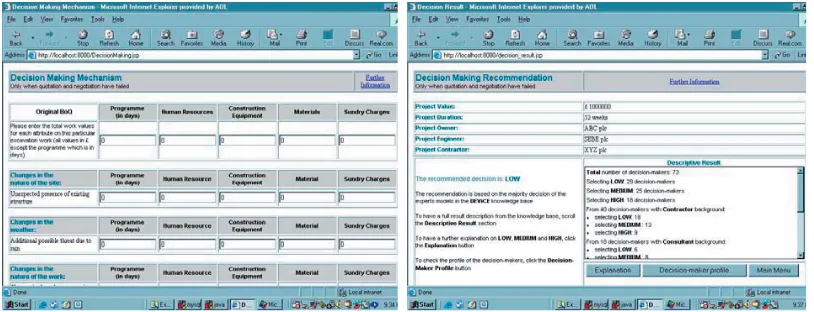
and employers). Thus, the users are informed of the distribution of the decision results among the different decision-makers to allow the users to better judge the fi nal recommendation. A snapshot of the decision-making mechanism in DEViCE is presented in Fig. 6.
4. 4 Supporting modules
Supplementary to the three main mechanisms, there are other modules that support DEViCE, namely the explanation facility, list of references, experts’ profi le, and modifi cation to the knowledge base. The explanation facility utilises the information from the knowledge base and inference engine to provide required explanations from the end user through the user interface. Thus, this explanation facility provides the user with a means of understanding that replicates a consultation session with human experts. Since decision-making in the valuation of variations often causes confl ict and disputes, an explanation facility was required for this system [29]. The links to the explanation pages are made available on all of the main mechanism pages, providing instant explanation of the labelling and terminology used in the current main mechanism page and also brief background information on various matters based mainly on many published articles.
A list of references provides the users with full range of sources for further exploration and study. The explanation pages and the list of references page are HTML text pages with several text section anchors for linking purposes. Activation of the explanation pages and the references page creates new separate windows to reinforce the effect of being supplemental pages to the main mechanism pages. Every time the user fi nishes with an explanation page, he/she is prompted to close the supplemental page and return to the main pages. This is deliberately designed to avoid any hindrance to the main pages.
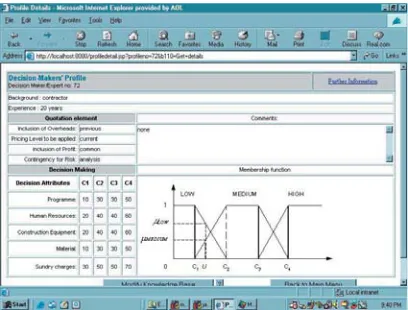
[image:11.482.36.443.56.212.2]The users are also able to investigate the decision made by each model representing the decision-makers/ experts currently held in the DEViCE knowledge base. The user can select any of the decision-makers/experts and obtain a profi le of the decision-maker/expert. The information provided in the profi le is the background experiences, choices of attributes for inclusion in preparing quotations, fuzzy-sets model of the decision-making, and advice on the selected decision-maker/ expert. Personal information is not disclosed in respect to the Data Protection Act 1998. A brief and practical explanation on how the fuzzy logic works in modelling the decision-making process and deriving a decision to contribute to the fi nal recommendation of the system is provided in order to satisfy the curiosity of the user.
Users who wish to fully understand the mechanics of a fuzzy logic calculation are recommended to consult the literature listed in the references as a starting point. A snapshot of an expert’s profi le is provided in Fig. 7.
The option to modify the knowledge base is also an important feature. Once being activated, DEViCE requests the user’s id and password. This is important to maintain the integrity of the KBS and changes to it may cause signifi cant differences to the results and recommendations provided. Therefore, only authorised users with suffi cient training are allowed to utilise this module to modify the content of the knowledge base. At this stage, access to modify the knowledge base is mechanised through the use of a request form. This form is then submitted and allocated to a temporary table within the knowledge base in the MySQL server and the implementation of the modifi cation to the knowledge base is actually performed by the designer of the system or the system administrator upon further confi rmation and validation.
5 Evaluation of the DEViCE
The purpose of evaluating a KBS is to ensure that the performance of the designed system is problem-free in terms of practical operation and/or technical structure.
The selected evaluation technique is verifi cation and validation. Verifi cation evaluation essentially addresses the intrinsic properties of the system and its components whilst validation checks the requirements of the system against certain standards to ensure the intended results and user satisfaction [4]. Verifi cation focuses on ensuring the system is developed correctly, that it accurately gives solutions or results, and does not contain technical errors [4; 10; 18].
In the development of DEViCE, the verifi cation evaluation was performed during the entire development process by the system developer, including iterated internal tests for micro level verifi cation. The micro level verifi cation encompasses criteria described in Awad [4], i.e. circular rule, completeness, confi dence, correctness, consistency/inconsistency, redundancy, reliability, and subsumption rule. For the macro level verifi cation, i.e. evaluating the entire system, the content of the knowledge based system was checked and approved by an expert in developing knowledge based systems and Java programming language, internal to the research project team.
Validation evaluation provides assurances that the solution or recommendation derived from the knowledge base suffi ciently represents those of the human experts. Therefore, the validation should be tested by a black box approach, ignoring the internal mechanism of the system [4; 10]. In light of this, the validation process for DEViCE involves actual human experts and/or intended users. Here, the validation process is subdivided into internal validity and external validity.
[image:12.482.40.244.54.209.2]Internal validity refers to whether the identifi ed inputs within their attributes actually produce the expected output [20]. The internal validity procedures involved the questionnaire responses. The identifi ed ‘best practice’ of preparing quotations for variations was validated by demonstrating the convergence among the literature search, analyses of the questionnaire survey and academic validity [33] whilst the model for
negotiation was validated by the convergence among the literature search, interviews with practitioners and academic validity [32]. For the developed decision-making mechanism, after the models had been developed, the decisions resulting from the models were statistically compared to the actual decisions of the practitioners to demonstrate the degree of accuracy of the developed models in deriving the decisions [34].
External validity refers to the extent to which any research fi ndings can be generalised or extrapolated beyond the immediate research sample or setting in which the research took place [20]. In order to test a KBS, there are major steps to be taken involving preparation of suffi cient variety of test cases, in-depth re-evaluation of the knowledge base and user interface mechanisms, and reduction of objectivity and gaining feedback from others [24]. However, unlike a conventional system, a KBS represents a process rather than a tool to implement the process with critical real-world consequences [7]. This nature of the problem solving provided by a KBS, through a certain interaction with the user, has created a different set of demands on the interface [11]. The main task of such an interface has been determined to match the interface to the user’s cognitive task [26]. Therefore, in this research, the external validity was achieved by demonstrating a high degree of the user orientation, user acceptance (consists of user-perceived usefulness and perceived ease of use), and involvement through the entire life cycle of the DEViCE. This high degree of users orientation, acceptance, and involvement is also known as a user-centred approach [36].
5. 1 User Orientation, Acceptance and Involvement
A KBS life cycle stages consists of feasibility study, knowledge engineering, design, implementation, testing, and maintenance [7]. During the feasibility study stage, the importance of the user orientation was recognised and established as a critical success factor for the KBS development [29]. During the knowledge
engineering phase, the background of the research project was communicated to the intended users during the questionnaire and their involvement with the knowledge acquisition process was inevitable due to the fact that the intended users are also the targeted practitioners for knowledge acquisition. In order to meet the objective of user acceptance during the design stage, the user interface was designed to be displayed through Internet browsers to support and encourage human-computer interaction [14]. In order to evaluate user acceptance, two criteria were used, namely user perceived usefulness and perceived ease of use [8]. User perceived usefulness is defi ned as the degree to which the user believes that using the system will enhance his/her performance, whereas user perceived ease of use is defi ned as the degree the user believes that using the system will be free from efforts.
Fifty-four of the ninety-fi ve respondents to the survey agreed to further contribute to the research project by further interview(s) for validation and evaluation purposes. During the evaluation stage, much feedback from the practitioners were incorporated and led to numerous improvements in DEViCE. Collaboration with one of the practitioners from a large contracting fi rm was established. This collaboration mainly involves in-depth discussions with the key person in the fi rm to fi nalise the algorithm of DEViCE. The particular contracting fi rm also agreed to undertake a trial of DEViCE for long-term evaluation purposes. Therefore, the development stage of the DEViCE has been performed with a close involvement of the users and experts in the fi eld. This is reinforced by a user involvement in the long-term maintenance stage of the prototype (DEViCE version 1.0).
5. 2 The Evaluation Results
The main objectives of the demonstrations and inter-views were to validate the contents of the knowledge base, to measure the satisfaction level of the potential user, and also to obtain useful feedback for improvement. A sensitivity analysis was performed during the interviews by requesting the practitioners to provide different inputs to DEViCE. The recommendations made by DEViCE were then compared to the actual decisions expected by the practitioners under those inputs. Whenever a signifi cant discrepancy occurred, further discussions leading to adjustment/fi ne-tuning
of the algorithm was conducted with the practitioners. These adjustments were continued until the detected discrepancies were eliminated.
Following the sensitivity analysis, a semi-structured interview was also conducted in order to record the practitioners’ acceptance, opinions, and suggestions for improvement. The practitioners were asked for their general opinion on the novelty, general opinion on the development, general impression, and potential of DEViCE. The second part of the interview, requested the
Location Type of
Organisation
Position in Organisation Experience Interview
duration
Wolverhampton, West Midlands
Contractor Commercial Director 29 years 75 min
Wolverhampton, West Midlands
Contractor Senior Commercial
Manager
30 years 60 min
Grantham, Lincolnshire
Employer Head of QS Department 33 years 60 min
Grantham, Lincolnshire
Employer Senior QS 9 years 60 min
Grantham, Lincolnshire
Employer Trainee QS 0.5 years 60 min
Northwich, Cheshire
Employer Construction Manager 44 years 90 min
Buckley, Flintshire
Consultant Director 30 years 90 min
Buckley, Flintshire
Consultant Director 25 years 60 min
Birmingham, West Midlands Consultant Senior Consultant 36 years 90 min
Birmingham, West Midlands
Consultant Senior Consultant 36 years 70 min
Alcester, Warwickshire
Consultant Managing Director 23 years 90 min
Bristol, Avon
Law Consultant
Consultant 14 years 60 min
Bristol, Avon
Law Consultant
Regional Director 22 years 60 min
Glasgow, Lanarkshire
Consultant Associate Director 35 years 120 min
Cannock, Staffordshire
Contractor Project Coordinator 40 years 150 min
Solihull, West Midlands
Consultant Associate Director 25 years 60 min
Solihull, West Midlands
[image:14.482.44.444.58.442.2]Consultant Trainee QS 2 years 60 min
practitioners to score each of the modules in DEViCE (i.e. quotation mechanism, negotiation mechanism, and decision-making mechanism) under certain criteria using a Likert scale of 1 to 5 (1 is assigned for poor and 5 is assigned for excellent). The threshold was established to be 3 (60%). If any of the modules were scored less than 3, a serious consideration and re-designing of the particular module would be required against the criteria. If the modules scored 3 or higher, only minor modifi cations might be required based on the practitioners’ suggestions within the scope of the research project.
Practitioners were asked whether they were familiar with similar existing systems to DEViCE and if so, how DEViCE compared. As expected, all practitioners perceived DEViCE to be a novel approach in tackling the problems in valuing variations. This confi rmed the claim that the problems in valuing variations have been informally articulated for long [2] and the need for a structured mechanism [28].
Most of the practitioners responded positively and opined that DEViCE was a good idea, considered both useful and helpful in this crucial area. It was mentioned that the outcome of this research might prevent or at least reduce confl ict and disputes in valuing variations and assist parties in reaching agreement by providing a sound and systematic knowledge base. Some of the practitioners agreed that DEViCE could also be used for training purposes. This response is consistent with the aim and objectives of the research project.
There were, however, some concerns regarding the basic assumption taken in this research that the parties are open, fair, and willing to cooperate to solve a confl ict or dispute. In reality, practitioners can be guided by many factors such as previous experience, objectives and goals of their organisations, the problem identifi ed and defi ned, the hypothetical solutions, the information gathered and analysed, and their pre-assumptions [6]. Defi ning an assumption was needed to focus this research; therefore, it was necessary to assume that all
parties are rational and willing to cooperate to resolve the confl ict and dispute by being fair and open to each other.
Another concern was on the future necessity to build an extensive database to cover all other activities in construction projects to deliver a comprehensive and complete solution to the construction industry, particularly in quantity surveying of civil engineering sector. That is, the KBS domain of expertise is usually narrow and only developed to solve specifi c problems with specifi c terms [15]. The development of such a database is however considered beyond the scope of this current research.
A majority of the practitioners (73%) were impressed by the system and confi rmed that DEViCE had fulfi lled, exceeded, or even far exceeded their expectations. Some (27%) said that DEViCE did not quite satisfy their expectations but this was found to be caused by a misunderstanding of the intended use of the tool by practitioners who are not originally involved in the development of DEViCE. Despite this mixed response, most agreed that in general DEViCE appeared professional, contained detailed information, and was relatively straightforward. It was also mentioned that DEViCE rationalised the process of valuing variations and reduced the dependencies on human elements of the process. Some suggested developing interfaces to link DEViCE with existing software packages, such as scheduling software, quantity surveying and estimating software, and even AuotCAD, again, to deliver a comprehensive and complete solution to the construction industry, particularly in quantity surveying of civil engineering sector. This again was considered beyond the scope of this research project.
other activities in construction projects, obtaining consent from all parties, and also the development of interfaces to enable DEViCE to link with existing software packages. These suggestions while useful were acknowledged and will be recommended for further research. Furthermore, one trainee opined that the DEViCE certainly had much potential as a training tool for students and graduates due to the extensive explanation facilities and useful insight into the mechanics of the valuation of variations.
Results on the second part of the interview revealed all of the modules scored higher than 3, and thus maintained their inclusion in DEViCE and only minor modifi cations were required. The lowest score was for the completeness/coverage of the negotiation mechanism. As the success of negotiations heavily depends on each party’s openness and willingness to reach a mutual agreement [32], the negotiation module in DEViCE was designed to be an informative tool to generally encourage the parties to seek a mutual attempt at successful negotiation and was not designed as an extensive repository of the knowledge body of negotiation science. The highest score was for the ease of use, including the navigation mechanism. This result was consistent with the intended user-centered approach, and confi rmed a high level of users acceptance, particularly on the ease of use, for potential users of DEViCE. The results of the second part of the interview are presented in Table 3.
Mean of the scores Quotation Mechanism Negotiation
Mechanism Decision-Making Mechanism
Usefulness 3.56 3.44 3.63
Completeness/Coverage 3.60 3.33 3.60
Ease of use (navigation, etc.) 4.38 4.31 4.38
Suffi ciency of the Explanation
Facilities 4.19 4.06 4.13
6 Conclusions
The valuation of variations has been acknowledged as one of the commonest causes of confl ict and disputes. Referring to the rules of valuing variations provided by the ICE 7th [35] that provides three different mechanism for valuing variations, potential problems were identifi ed as the subjective interpretation of the human experts/ decision-maker in interpreting the changes in the work condition and/or work character occurring as a result of a variation event. A framework for valuing variations in excavation works and in concrete works has been previously developed and reported, as has a negotiation model for valuing variations and also a feasibility study on the potential of eliciting the experts’ knowledge and using a KBS for the valuation of variations.
[image:16.482.44.445.546.625.2]In order to evaluate the current application of the mechanisms for valuing variations in the UK construction industry, particularly in quantity surveying of civil engineering sector, and to acquire practitioners’ knowledge and subjectivity in valuing variations, a semi-structured questionnaire survey was conducted with a group of relevant practitioners in the UK. The result of the survey identifi ed best practice in crafting a quotation to pre-price the variations that encompassed the perceptions and interpretations from contractors, engineers/consultants and employers. This should help to increase the likelihood of the quotation being accepted and help to avoid unnecessary further stages that may be time consuming and costly. Another essential section from the questionnaire was utilised to develop the decision-making model on the extent of changes in the work characteristics and/or conditions for valuing variations.
Based on the developed frameworks and the analysis of the questionnaire result, a KBS (i.e. named DEViCE) was developed using a user-centred approach. This approach required a high degree of the user orientation, satisfaction, and involvement through the entire life cycle of DEViCE. The evaluation was mainly conducted by demonstrating the system and interviewing seventeen practitioners from the construction industry, particularly in quantity surveying of civil engineering sector. The main objective of the demonstrations and interviews were to validate the contents of the knowledge base, to measure the acceptance level of potential users, and also to obtain useful feedback for improvement. Sensitivity analyses were performed during the interviews by requesting the practitioners to provide different inputs to check for any necessary adjustment/fi ne-tuning of the algorithm.
The interviews were divided into two sections. The fi rst section concerned general issues of the novelty of the approach, the practitioners’ opinions on the attempts made by the research project, the practitioners’ general impression on the system in terms of fulfi lling their initial expectation, and potential of the system as a practical problem-solver. Supportive responses were obtained from the practitioners and several suggestions for improvements and/or further research were also identifi ed. Some practitioners were concerned about the openness, fairness, and willingness of project stakeholders to mutually solve the confl ict or disputes. However, this was a basic assumption made in the earlier stages of the research and is congruent with the current ethos in the construction industry. The fact that the project stakeholders were willing to consult DEViCE was assumed as an attempt to be open, fair, and willing to solve confl ict or disputes. Many of the practitioners also suggested inclusion of construction project activities other than excavation work and for the development of interfaces to allow DEViCE to work with other existing software packages. Whilst providing useful future development ideas for DEViCE, these were considered beyond the scope of this research. All of the modules contained in DEViCE
were maintained to be included in the DEViCE. The ease of use scored the highest, thereby confi rming a high level of users acceptance, particularly on the ease of use, for potential users of DEViCE.
The development of a KBS, namely DEViCE and developed in order to minimise confl icts and disputes from the valuation of variations has been explained and discussed in detail. As the success of such a system depends on the interaction with its human-users, a user-centred approach was applied in building DEViCE. Supportive responses from the practitioners, were obtained to validate the knowledge base content, and to demonstrate the user acceptance. Following the user-centred approach, the intended users were involved in the stages of the system’s development starting from its earliest stage. Important collaboration was established, involving an in-depth assistance by one of the practitioners in refi ning the algorithm and also a long-term assistance to undertake a trial of DEViCE for evaluation purposes, thus laying a solid platform for further development of the system. As demonstrated by the results of the evaluation process, the methodology in developing DEViCE can be considered as an appropriate methodology to tackle similar problems in this area. Hence, DEViCE is considered an appropriate system to minimise confl ict and disputes from the valuation of variations and is recommended to assist practitioners in the UK construction industry, particularly in civil engineering sector, in valuing variations due to its robust algorithm, knowledge base content, and capabilities to incorporate a user-centred approach for its entire life cycle.
7 Acknowledgement
DEViCE was developed using tools freely downloaded from open source sites as follow: http://www.mysql.com
REFERENCES |
[1] Abrahamson, M. W. (1985), Engineering Law and the I.C.E. Contracts, Elsevier Applied Science Publisher, London.[2] Akenhead, R. (1999), Valuation of variations: the principles, UK Commercial Arbitration Law Development, www.legal500.com/devs/uk/ca/ukca_021.htm, viewed: 09/12/02. [3] Akinsola, A.O. (1997), An Intelligent Model of Variations’ Contingency on Constructions
Projects, Unpublished PhD thesis, University of Wolverhampton, Wolverhampton. [4] Awad, E. M. (1996), Building Expert Systems: Principles, Procedures, and Applications,
West Publishing Company, St. Paul.
[5] Barnes, N. M. L. (1971), Civil engineering bills of quantities, Report to CIRIA on Research Project No. 98, Department of Civil and Structural Engineering, UMIST, Manchester.
[6] Bridges, F. J., Olm, K. W. & Barnhill, J. A. (1971), Management Decisions and Organizational Policy: Text, Cases, and Incidents, Allyn & Bacon, Boston. [7] Darlington, A. (2000), The Essence of Expert System, Prentice-Hall, Essex.
[8] Davis, F. D. (1989), Perceived usefulness, perceive ease of use, and user acceptance of information technology, MIS Quarterly, 13, pp. 319-340.
[9] Dorter, J. (1990), ‘Variations’, Construction Law Journal, v7, n4, pp. 281-302.
[10] Geissman, J. R. & Schultz, A. D. (1988), Verifi cation and Validation of Expert System, AI Expert, February, pp. 26-33.
[11] Hendler, J. & Lewis, C. (1988) Designing interfaces for expert system, In: Hendler, J. (Ed.) Expert System: The User Interface, Ablex, Norwood.
[12] Hibberd, P.R. (1980), Building Contract-Variations, Unpublished MSc thesis, UMIST, Manchester.
[13] Hibberd, P. R. (1986), Variations in Construction Contracts, Collins, London.
[14] Kekkonen-Moeta, S. & Moneta, B. (2002) E-Learning in Hong Kong: comparing learning outcomes in online multimedia and lecture versions of an introductory computer course, British Journal of Educational Technology, 33(4), pp. 423-433.
[15] Mallach, E. G. (1994), Understanding Decision Support Systems and Expert Systems, Irwin/McGraw-Hill, Boston.
[16] McGowan, P. H., Malcolm, R., Horner, W., Jones, D. & Thompson, P. A. (1992), ‘Allocation and Evaluation of Risk in Construction Contracts’, CIOB Occasional Paper No. 52, The Chartered Institute of Building, Ascot.
[17] Newton, S. (1985), Expert Systems and the Quantity Surveyor, Royal Institute of Chartered Surveyor, Surveyors Publication, London.
[18] O’Keefe, R. M, Balci, O. & Smith, E. P. (1987), Validating expert system performance, IEEE Expert, Winter, pp. 81-90.
[19] Potts, K. F. (1995), Major Construction Works: Contractual and Financial Management, Longman Scientifi c & Technical, Essex.
[20] Robson, C. (2002), Real World Research: A Resource for Social Scientists and Practitioner-Researchers, 2ed., Blackwell Publishers, Oxford.
[21] Scott, B. & Billing, B. (1990), Negotiating skills in engineering and construction, Thomas Telford, London.
[22] Seeley, I. H. & Murray, G. P. (2001), Civil Engineering Quantities, 6th ed., Palgrave, New York.
[23] Shackel, B. (1984), Information technology-A challenge to ergonomics and design, Behaviour and Information Technology, 3, pp. 263-275.
[24] Siegel, P. (1986), Expert Systems: a non programmer’s guide to development and applications, TAB Books, Blue Ridge Summit.
[25] Skinner, W. H. (1982) ‘The contractor’s use of bills of quantities’, CIOB Occasional Paper No.24, The Chartered Institute of Building, Ascot.
[26] Stelzner, M. & Williams, M. D. (1988) The Evolution of interface requirements for expert system, In: Hendler, J. (Ed.) Expert System: The User Interface, Ablex, Norwood. [27] Sutrisna, M & Potts, K. (2003a), ‘Valuing Variations in Excavation Works: a Proposed
Framework’, In: Aouad, G. & Ruddock, L. (Eds.), 3rd International Postgraduate Research Conference, 3-4 April 2003, Lisbon, University of Salford, pp. 499-510. [28] Sutrisna, M. & Potts, K. (2003b), ‘A Proposed Research Methodology for Developing a
Systematic Approach on Valuing Variations’, In: Egbu, C & Tong, M. (Eds.), 1st Scottish Conference for Postgraduate Researchers in the Built & Natural Environment. Glasgow, 18-19 November 2003, Glasgow, Glasgow Caledonian University, pp. 467-478. [29] Sutrisna, M., Potts, K. & Buckley, K. (2003a), ‘An Expert System as a Potential
[30] Sutrisna, M., Potts, K. & Proverbs, D. (2003b), ‘Development of a framework for valuing variations in concrete works’, 2nd International Structural Engineering and Construction Conference, 23-26 September 2003, Rome, Balkema Publisher, Lisse, pp. 129-136. [31] Sutrisna, M. (2004), ’Developing a knowledge based system for the valuation of
variations’, Civil Engineering Surveyor, December/January 2004, pp. 12-13.
[32] Sutrisna, M. & Potts, K. (2004), ‘A Negotiation Model for the Valuation of Variations in Civil Engineering Works’, In: Ruddock, L., Amaratunga, D., Aouad, G., Kagioglou, M., and Sexton, M. (Eds.), 4th International Postgraduate Research Conference, 1-2 April 2004, Salford, University of Salford, pp. 53-63.
[33] Sutrisna, M., Potts, K. & Proverbs, D. (2004a), ‘Quotation mechanism for pre-pricing variations in civil engineering projects: a quest for best practice’, Journal of Financial Management of Property and Construction, 9(1), pp. 13-25.
[34] Sutrisna, M., Potts, K., Proverbs, D. & Buckley, K. (2004b), ‘A decision making model for the valuation of variations on civil engineering projects’, RICS Foundation Research Papers. (Accepted for forthcoming publication).
[35] The Institution of Civil Engineers, The Association of Consulting Engineers & The Civil Engineering Contractors Association (1999), ICE Conditions of Contract: Measurement Version, 7th ed., Thomas Telford, London.
[36] Torres, R. J. (2002), Practitioner’s Handbook for User Interface Design and Development, Prentice Hall, Upper Saddle River.
[37] Turner, J. (2002), MySQL and JSP Web Applications, Sams, Indianapolis.
[38] Twort, A. C. & Rees, J. G. (1995), Civil Engineering: Supervision and Management, 3rd ed., Arnold, London.
[39] Wallace, I. D. (1995), Hudson’s Building and Engineering Contracts: including the duties and liabilities, v1, 11th ed., Sweet & Maxwell, London.