© 2017, IRJET | Impact Factor value: 5.181 | ISO 9001:2008 Certified Journal
| Page 834
UTILIZATION OF PAPER INDUSTRY PROFLUENT AS WATER
REDUCING AGENT IN CONCRETE
DOREDLA NAGARAJU
Assistant Professor, Faculty of civil Engineering, Narasaraopeta engineering college [autonomous],
Narasaraopeta, Andhra Pradesh, India, pin:-522601
---***---
Abstract. The present paper portrays the use of paper industry profluent as water lessening specialist in concrete for its consequences for different properties like droop, setting time, compressive quality and so forth. The properties have been contrasted and industrially accessible water diminishing operators like Modified lignosulphonate (MLS) and Sulphonated Naphthalene Formaldehyde Condensate (SNF). It has been seen from examines that the profluent which is a wellspring of contamination on getting water body's sea-going biological system and nearby rural fields, cattle’s and so forth and can be utilized as an admixture in cement to show signs of improvement workability at same w/c proportion or by decreasing w/c proportion at a given workability.Key words: lignosulphonate, concrete, water reducing agent, effluent
1. INTRODUCTION
Paper industry, little and vast, has extended hugely over the most recent five decades in India. These ventures utilize wood and rural buildups in papermaking and releases tremendous volumes of exceedingly shaded and lethal waste water (profluent) in nature. The procedure breaks up the lignin introduce in the wood and releases the cellulose fiber. Lignin is changed over into thio and soluble base lignin in Kraft process and dialect sulphonate in Sulphite process. The strands still contain a piece of lignin and consequently are shaded dark colored and require blanching for making white paper. The spent alcohol from Kraft process or Salt process is either depleted out or gathered for recuperation of chemicals, wherever concoction recuperation is possible. The paper business expends around 300 m3 water for each ton of paper and release around 250 m3 of water for every ton of paper. The procedure of mash washing offers ascend to dim darker hued squander known as stock wash or advantageously called as dark alcohol. On standing, the emanating after some time has smell.
The dark colored shading on long standing is conferred mostly by the nearness of lignin and its subsidiaries.
Lignin subordinates account 20% of the organization of wood. The synthetic recuperation is done from the dark alcohol which contains 90% of aggregate lignin of the wood.
2. MATERIALS AND EXPERIMENTAL WORK
2.1
CHARACTERISTICS OF COMMERCIALLY AVAILABLE ADMIXTURES
Sl.No. PARAMETER MLS SNF
1. COLOUR DARK BROWN DARK BROWN
2. PHYSICAL STATE LIQUID LIQUID
© 2017, IRJET | Impact Factor value: 5.181 | ISO 9001:2008 Certified Journal
| Page 835
4. TOTAL SOLIDS (mg/l) 382760 140585
5. TOTAL SUSPENDED SOLIDS (mg/l) 100 105
6. TOTAL DISSOLVED SOLIDS (mg/l) 382660 140480
7. CHEMICAL OXYGEN DEMAND (mg/l) 366396 230769
8. BIOCHEMICAL OXYGEN DEMAND (mg/l) 138200 116384
9. CHLORIDE (mg/l) 867 578
10. SULPHATE (mg/l) 5050 5192
2.2 CHARACTERISTCS OF PAPER MILL EFFLUENT
Sl. No.
PARAMETER SPME (small
paper mill effluent)
LPME(large paper mill effluent)
1. COLOUR DARK BROWN LIGHT
BROWN
2. PHYSICAL STATE LIQUID LIQUID
3. PH 7.81 5.85
4. TOTAL SOLIDS (mg/l) 30228 34416
5. TOTAL SUSPENDED SOLIDS (mg/l) 215 195
6. TOTAL DISSOLVED SOLIDS (mg/l) 30013 34221
7. CHEMICAL OXYGEN DEMAND (mg/l) 102561 19658
8. BIOCHEMICAL OXYGEN DEMAND (mg/l) 3015 5890
9. CHLORIDE (mg/l) 459 545
10. SULPHATE (mg/l) 810 980
2.3. LABORATORY DETERMINATIONS
The following experiments were carried out on the effluent, MLS, SNF:
a) The effect of effluent, MLS, SNF on the setting time of cement at various dosages has been studied as per BIS 4031-1988.
© 2017, IRJET | Impact Factor value: 5.181 | ISO 9001:2008 Certified Journal
| Page 836
c) The effect of effluent, MLS, SNF on the compressive strength of concrete at 3, 7 and 28 days was determined at different w/c ratios and at different dose level.BIS 4031 –1988 REQUIREMENTS:
1. CONSISTENCY OF CEMENT: 29%
2. INITIAL SETTING TIME: NOT LESS THAN 30 MINUTES 3. FINAL SETTING TIME: NOT MORE THAN 600 MINUTES
3. RESULTS AND DISCUSSION
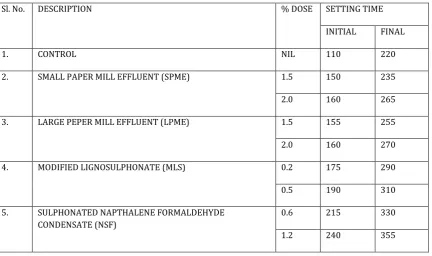
The tables 3.1-3.7 shows the effect of effluent dose and that of commercial admixtures on the setting behaviour of cement compared to control mix initial (110 mins) and final (220 mins) time, the addition of effluent dose (1.5 and 2.0) from small mill has delayed initial setting by 40 and 50 minutes, while 15 and 45 minutes delay in final setting time. In case of large paper mill effluent the delay in initial setting is 45 and 50 minutes and that of final is 35 and 50 minutes.
The addition of modified lignosulphonate (MLS) at 0.2% and 0.5% dose level, there is 65 and 80 minutes delay in initial setting time, while 70 and 90 minutes delay in the final setting time. In the case of SNF at 0.6% and 1.2% dose level, delay in initial setting time of cement (105 mins and 130 mins) and final setting (110 mins and 135 mins) has been observed.
[image:3.595.85.518.409.665.2]TABLES
Table 3.1EFFECT OF SPME, LPME, MLS AND SNF ON THE SETTING TIME OF CONCRETE
Sl. No. DESCRIPTION % DOSE SETTING TIME
INITIAL FINAL
1. CONTROL NIL 110 220
2. SMALL PAPER MILL EFFLUENT (SPME) 1.5 150 235
2.0 160 265
3. LARGE PEPER MILL EFFLUENT (LPME) 1.5 155 255
2.0 160 270
4. MODIFIED LIGNOSULPHONATE (MLS) 0.2 175 290
0.5 190 310
5. SULPHONATED NAPTHALENE FORMALDEHYDE
CONDENSATE (NSF)
0.6 215 330
© 2017, IRJET | Impact Factor value: 5.181 | ISO 9001:2008 Certified Journal
| Page 837
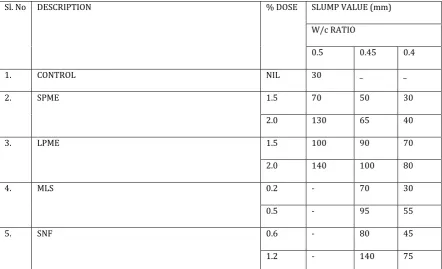
Table 3.2 WORKABILITY OF M30 CONCRETE IN TERMS OF SLUMP VALUE FOR VARIOUS W/C RATIO.Sl. No DESCRIPTION % DOSE SLUMP VALUE (mm)
W/c RATIO
0.5 0.45 0.4
1. CONTROL NIL 30 _ _
2. SPME 1.5 70 50 30
2.0 130 65 40
3. LPME 1.5 100 90 70
2.0 140 100 80
4. MLS 0.2 - 70 30
0.5 - 95 55
5. SNF 0.6 - 80 45
1.2 - 140 75
Table 3.3 LOSS OF WORKABILITY OF M30 CONCRETE AT 0.5 W/C RATIO MODIFIED WITH VARIOUS ADMIXTURES
Sl.
No. DESCRIPTION % DOSE SLUMP OF CONCRETE (mm)
TIME ELAPSED AFTER MIXING
5 MINS 15 MINS 30 MINS
1. CONTROL NIL 30 25 15
2. SPME 1.5 70 35 20
3. LPME 2.0 130 110 70
4. MLS 1.5 100 80 65
5. SNF 2.0 140 120 95
Table 3.4 LOSS OF WORKABILITY OF M30 CONCRETE AT 0.45 W/C RATIO MODIFIED WITH VARIOUS ADMIXTURE S
Sl.
No. DESCRIPTION DOSE % SLUMP OF CONCRETE (mm)
TIME ELAPSED AFTER MIXING
5 mins 15 mins 30 mins
1. SPME 1.5 50 30 15
2.0 65 40 20
2. LPME 1.5 90 60 35
2.0 100 65 35
3. MLS 0.2 70 40 20
0.5 95 70 45
4. SNF 0.6 80 50 25
[image:4.595.67.524.570.790.2]© 2017, IRJET | Impact Factor value: 5.181 | ISO 9001:2008 Certified Journal
| Page 838
Table 3.5 LOSS OF WORKABILITY OF M30 GRADE CONCRETE AT 0.4 W/C RATIO MODIFIED WITH VARIOUSADMIXTURES
Sl.
No. DESCRIPTION DOSE % SLUMP OF CONCRETE (mm)
TIME ELAPSED AFTER MIXING
5 mins 15 mins 30 mins
1. SPME 1.5 30 20 10
2.0 40 25 15
2. LPME 1.5 70 45 20
2.0 80 50 25
3. MLS 0.2 30 15 5
0.5 55 30 15
4. SNF 0.6 45 30 15
[image:5.595.79.517.381.483.2]1.2 75 55 25
Table 3.6 WORKABILITY OF M30 GRADE CEMENT CONCRETE AT REDUCED WATERCONTENT AT VARIOUS DOSE OF ADMIXTURES.
Sl.
No DESCRIPTION %DOSE W/C RATIO SLUMP
1. CONTROL 0 0.5 30
2. SMALL MILL 1.5 0.4 30
3. MLS 0.2 0.4 30
4. SNF 0.2 0.4 45
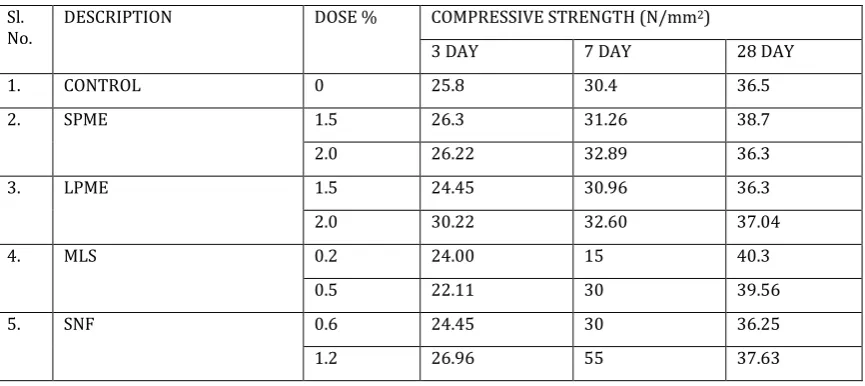
Table 3.7 COMPRESSIVE STRENGTH OF M30 GRADE CEMENT CONCRETE AT 0.45 W/C RATIO WITH THE ADDITION OF VARIOUS ADMIXTURES
Sl.
No. DESCRIPTION DOSE % COMPRESSIVE STRENGTH (N/mm
2)
3 DAY 7 DAY 28 DAY
1. CONTROL 0 25.8 30.4 36.5
2. SPME 1.5 26.3 31.26 38.7
2.0 26.22 32.89 36.3
3. LPME 1.5 24.45 30.96 36.3
2.0 30.22 32.60 37.04
4. MLS 0.2 24.00 15 40.3
0.5 22.11 30 39.56
5. SNF 0.6 24.45 30 36.25
[image:5.595.83.516.536.729.2]© 2017, IRJET | Impact Factor value: 5.181 | ISO 9001:2008 Certified Journal
| Page 839
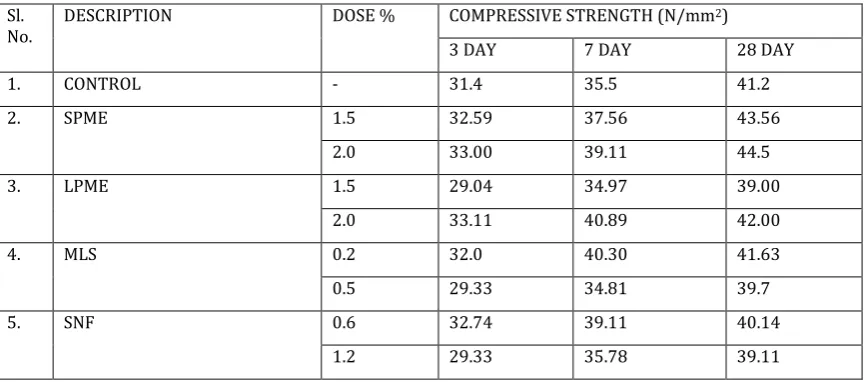
Table 3.8 COMPRESSIVE STRENGTH OF M30 GRADE CEMENT CONCRETE AT 0.4 W/C RATIO WITH THE ADDITIONOF VARIOUS ADMIXTURES
4.CONCLUSION
From the above tests and the outcomes got, it is seen that the paper industry profluent containing lignosulphonate can be adequately utilized as an admixture in solid which is generally a wellspring of contamination. The expansion of gushing has no noteworthy impact on the setting conduct of concrete and is well inside BIS limits. Studies have demonstrated that the expansion of paper process profluent enhances the workability by expanding droop estimation of cement and is tantamount to business super plasticizers. Studies uncover that the 28 days compressive quality increments by over 10% with the utilization of LPME than SPME as the lignin content is more. Thus the LPME and SPME attributes as an admixture in solid contrast well and industrially accessible super plasticizers like Modified Lignosulphonate (MLS) and Sulphonated Naphthalene Formaldehyde (SNF)Condensate used for the tests
REFERENCES
1. Agarwal .S.K and Kiran Patel.”Utilization of Paper Industry Effluent as Water Reducing Agent in Concrete”.NBM &CW April 2004: Pp 62-68
2. Baruah B.K and Das .M.” Study on Impact of Paper Mill Effluent on Germination Behaviour and Seedling Growth of Crop Plant, Oryza Satna.L.” Pollution Research 17(1):Pp 65-68(1998).
3. Shetty .M.S.” Concrete Technology ,Theory And Practice” S.Chand & Company.
4. Sidhu .D.S.” Effect Of Superplasticizers On Properties Of Cement And Concrete.” NBM & CW May 2001 :Pp 38-43
Sl.
No. DESCRIPTION DOSE % COMPRESSIVE STRENGTH (N/mm
2)
3 DAY 7 DAY 28 DAY
1. CONTROL - 31.4 35.5 41.2
2. SPME 1.5 32.59 37.56 43.56
2.0 33.00 39.11 44.5
3. LPME 1.5 29.04 34.97 39.00
2.0 33.11 40.89 42.00
4. MLS 0.2 32.0 40.30 41.63
0.5 29.33 34.81 39.7
5. SNF 0.6 32.74 39.11 40.14