© 2018, IRJET | Impact Factor value: 6.171 | ISO 9001:2008 Certified Journal | Page 1562
A REVIEW: BLOOM BOX – A SOLID OXIDE FUEL CELL
P.Deepika
1, M.Naren Kumar
2, P.Sivasankar
31, 2, 3
U.G student, Dept.of.Mechanical Engineering, Angel College of Engineering and Technology, Tamil Nadu, India.
---***---Abstract –
The World has been repetitively fighting the energy problems. Scientists are in the search of new, economic, clean, renewable and efficient energy sources. Mr. K. R. Sridhar, an Indian – American scientist and co-founder of Bloom Energy has introduced the world a fuel cell that claims to revolutionize the energy economy as well as to meet energy challenges like greenhouse emissions. Bloom Energy Server (generally called as Bloom Box) is a small size cubical fuel cell box which can provide sufficient energy to 100 average U.S. homes or 30,000 sq. feet. Bloom Energy Server with the size of refrigerator is able to produce 100 kW of energy using hydrocarbons such as gasoline, diesel, methane or biogas to produce electricity. The human demand for energy is giant and exponentially increasing. Today, the energy sector is one of the most potential and profitable sector. Bloom Box has been embraced by big names such as eBay, Google, Staples and FedEx etc.Keywords: Renewable Energy, Fuel Cell, Combustion,
Hydrocarbons, Electricity.
1. INTRODUCTION
The Bloom Energy Server (the Bloom Box) is a solid oxide fuel cell (SOFC) power generator made by Bloom Energy, of Sunnyvale, California, that takes a variety of input fuels, including liquid or gaseous hydrocarbons produced from biological sources, to produce electricity at or near the site where it will be used. This new class of distributed power generator produce clean, reliable, affordable electricity at the customer site. It can withstand temperatures of up to 1,800 °F (980 °C). According to the company, a single cell (one 100 mm × 100 mm plate consisting of three ceramic layers) generates 25 watts. Bloom stated in 2011 that two hundred servers had been deployed in California for corporations including eBay, Google, Yahoo, and Wal-Mart.
The human demand for energy is enormous and exponentially increasing. Today, the energy sector is one of the most potential and profitable sector. As 80 to 90 percent of the world’s total energy comes from combustion of fossil fuels which are limited and create pollution, the need to find other renewable, non-exhausting and clean energy resources is increasing. The traditional approach to energy production has many challenges such as emission of greenhouse gaseous, transmission losses, cost inefficiency and dependency on transmission lines etc. One of the major challenges is to reach world’s 1.5 billion population living in the remote
areas without electricity. All these challenges made many organizations to search more reliable, clean and efficient energy sources. Mr. K. R. Sridhar, an Indian-American rocket scientist and co-founder and CEO of Bloom Energy has now come up with a Bloom Box which is supposed to meet all these challenges.
Bloom Energy Server (generally called as Bloom Box) is a small size cubical fuel cell box which can provide sufficient energy to 100 average U.S. homes or 30,000 sq. feet K. R. Sridhar- Co-founder and CEO of Bloom Energy 5 office building. Bloom Energy Server with the size of refrigerator is able to produce 100 kW of energy. Bloom Energy server is basically a solid oxide fuel cell (SOFC) which can use any kind of gaseous or liquid hydrocarbons such as gasoline, diesel, methane or biogas to produce electricity. It has no moving parts and produces negligible noise. Company claims that the Bloom energy Server is built on a patented solid oxide fuel cell technology and is a new class of distributed power generator running on any type of hydrocarbon fuel and is responsible for producing clean, reliable, affordable electricity at customer site. It is one of special kind of battery which will always run and the expected life of one server is 10 years.
2. BLOOM ENERGY
Bloom Energy is the company that develops, builds, and installs Bloom Energy Servers. The company, started in 2002 by CEO K. R. Sridhar, is one of 26 named a 2010 Tech Pioneer by the World Economic Forum.
2.1 History
© 2018, IRJET | Impact Factor value: 6.171 | ISO 9001:2008 Certified Journal | Page 1563 customers. A few days later he allowed Lesley Stahl of the
[image:2.595.39.285.183.361.2]CBS News program 60 Minutes to see the factory. On February 24, 2010, the company held its first press conference. Bloom Energy's well-known customers include Walmart, Staples, AT&T, Adobe, Coca-Cola, EBay, Google, Bank of America, FedEx, Life Technologies, Safeway, Yahoo, Apple and Home Depot.
Fig-1: Profile
In July 2014, the company announced a "long-term strategic partnership" with Exelon Corporation to finance "fuel cell projects at 75 commercial facilities in California, Connecticut, New Jersey and New York." In October 2016, the electric utility Southern Company announced that its Power Secure subsidiary is buying 50 megawatts of fuel cells from Bloom Energy. Power Secure will package the fuel cells with Lithium-ion batteries with the intent of selling the technology, with related infrastructure, to corporate and industrial customers under long-term contracts. Powers cure’s technology helps businesses maintain operations through grid blackouts. The installations could qualify for a California subsidy for batteries that enable customers to reduce their use of electricity from the grid at peak times.[1]
3. TECHNOLOGY
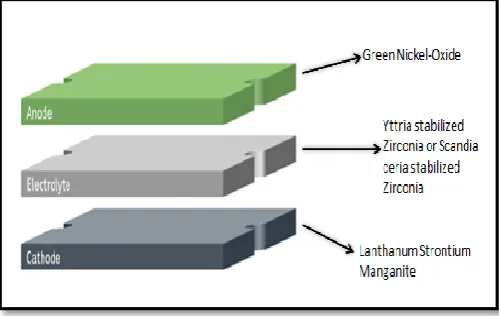
The Bloom Energy Server uses thin white ceramic plates (100 × 100 mm) that are made from components found in beach sand. Each plate is coated with a green nickel oxide-based ink on one side, forming the anode, and another black (probably Lanthanum strontium Manganite) ink on the cathode side. According to the San Jose Mercury News, "Bloom's secret technology apparently lies in the proprietary green ink that acts as the anode and the black ink that acts as the cathode..." but in fact these materials are widely known in the field of SOFCs. Wired reported that the secret ingredient may be Yttrium-stabilized Zirconia based upon US patent that was granted to Bloom
in 2009; but this material is also one of the most common electrolyte materials in the field. US patent application 20080261099, assigned to Bloom Energy Corporation, says that the "electrolyte includes Yttrium stabilized Zirconia and a Scandia-stabilized Zirconia, such as a Scandia ceria stabilized Zirconia". ScSZ has a higher conductivity than YSZ at lower temperatures, which provides greater efficiency and higher reliability when used as an electrolyte. Scandia is scandium oxide (Sc2O) which is a transition metal oxide that costs between US$1,400 and US$2,000 per kilogram in 99.9% pure form. Current annual worldwide production of scandium is less than 2,000 kilograms. Most of the 5,000 kilograms used annually is sourced from Soviet era stockpiles. To save money, the Bloom Energy Server uses inexpensive metal alloy plates for electric conductance between the two ceramic fast ion conductor plates. In competing lower temperature fuel cells, platinum is required at the cathode.
– Bloom cell is made up of thin white ceramic plates (100 × 100 mm)
– Made from components found in beach sand
– ANODE: Coated with Green Nickel-Oxide based ink
– CATHODE: Coated with Black Lanthanum Strontium Manganite
– ELECTROLYTE: Yttrium stabilized Zirconia or Scandia ceria stabilized Zirconia
– TEMPERATURE: It can withstand temperature up to 1,800 °F (980 °C)
– CAPACITY: One Bloom Cell can produce about 25 Watts
– FUEL USED: Any Hydrocarbons (Liquid or Gaseous Form)
[image:2.595.312.562.592.750.2]© 2018, IRJET | Impact Factor value: 6.171 | ISO 9001:2008 Certified Journal | Page 1564 4. WORKING
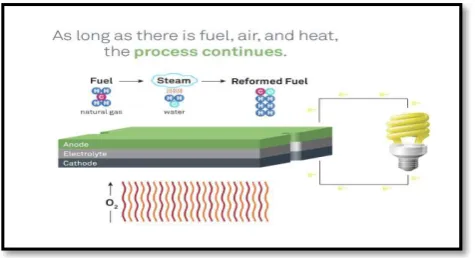
[image:3.595.43.281.140.269.2]The working procedure of a bloom cell is diagrammatically explained below.
Fig-3: Working of Bloom SOFC Cell.
STEP 1: The steam and the fossil fuel combine to create the reformed fuel which flows over the anode side.
STEP 2: Warm air flows across the cathode side.
STEP 3: Electrolyte only allows the oxygen ions from the cathode to pass to the anode.
STEP 4: The chemical reaction between the oxygen ions and the reformed fuel produce electricity, water, heat and small amount of carbon dioxide. The water and heat are reused to repeat the process.
5. COST
5.1 Installations
The current cost of each hand-made 100 kW Bloom Energy Server is $700,000–800,000. In 2010, the company announced plans for a smaller, home sized Bloom server priced under $3,000. Bloom estimated the size of a home-sized server at 1 kW, although others recommended 5 kW. The capital cost is $7–8 per watt. According to the New York Times (Green Blog), in early 2011 "... Bloom Energy ... unveiled a service to allow customers to buy the electricity generated by its fuel cells without incurring the capital costs of purchasing the six-figure devices.... Under the Bloom Electrons service, customers sign 10-year contracts to purchase the electricity generated by Bloom Energy Servers while the company retains ownership of the fuel cells and responsibility for their maintenance.... 'We’re able to tell customers, ‘You don’t have to put any money up front, you pay only for the electrons you use and it’s good for your pocketbook and good for planet,’ ' [CEO K.R. Sridhar] said." [6]
5.2 Usage
On 24 February 2010, Sridhar claimed that his devices were making electricity for $0.08–.10/kWh using natural gas, cheaper than today's electricity prices in some parts of the United States, such as California. Twenty percent of the cost savings depend upon avoiding transfer losses that result from energy grid use.
Bloom Energy claimed to be developing power purchase agreements to sell electricity produced by the boxes, rather than selling the boxes themselves, in order to address customers' fears about box maintenance, reliability, and servicing costs.
As of 2010, 15% of the power consumed by eBay was generated via the use of Bloom Energy Servers. At the time, after factoring in tax incentives which effectively halved the initial cost, eBay expected a three-year payback period based on the then $0.14/kWh cost of commercial electricity in California.[1]
6. INSTALLATIONS
The company says that its first 100-kW Bloom Energy Servers were shipped to Google in July 2008.Four such servers were installed at Google's headquarters, which became Bloom Energy's first customer. Another installation of five boxes produces up to 500 kW at eBay headquarters California. Bloom Energy stated that their customers include Staples (300 kW – December 2008),Walmart (800 kW – January 2010),FedEx (500 kW), The Coca-Cola Company (500 kW) and Bank of America (500 kW).Each of these installations were located in California. A 1-megawatt Bloom Box fuel cell system installed at Yahoo headquarters in Sunnyvale, California in 2014 is designed to "power one-third of the electricity to the buildings on Yahoo’s campus.[1]
7. PORTABLE UNITS
Sridhar announced plans to install Bloom Energy Servers in third world nations. Ex-Chairman of the Joint Chiefs of Staff, Colin Powell, now a Bloom Energy board member, said the Bloom Energy generators could be useful to the military because they are lighter, more efficient, and generate less heat than traditional generators.
8. FEASIBILITY
© 2018, IRJET | Impact Factor value: 6.171 | ISO 9001:2008 Certified Journal | Page 1565 Scott Samuelsen of the University of California, Irvine
National Fuel Cell Research Centre questioned the operational life of Bloom Servers. "At this point, Bloom has excellent potential, but they have yet to demonstrate that they've met the bars of reliability." Lawrence Berkeley National Laboratory expert Michael Tucker claimed, "Because they operate at high temperatures, they can accept other fuels like natural gas and methane, and that's an enormous advantage... The disadvantage is that they can shatter as they are heating or cooling. Venture capitalist John Doerr asserted that the Bloom Energy Server is cheaper and cleaner than the grid. An expert at Gerson Lehrman Group wrote that, given today's electricity transmission losses of about 7% and utility-size gas-fired power stations efficiency of 33–48%, the Bloom Energy Server is up to twice as efficient as a gas-fired power station. Fortune stated that "Bloom has still not released numbers about how much the Bloom Box costs to operate per kilowatt hour" and estimates that natural gas rather than bio-gas will be its primary fuel source. AP reporter Jonathan Fahey in Forbes wrote: "Are we really falling for this again? Every clean tech company on the planet says it can produce clean energy cheaply, yet not a single one can. Government subsidies or mandates keep the entire worldwide industry afloat. Hand it to Bloom, the company has managed to tap into the hype machine like no other clean tech company in memory."
8.1 Efficiency
Bloom claims a conversion efficiency of around 50%.A modern combined cycle gas turbine power plant (CCGT) can reach 60% overall efficiency, while cogeneration can achieve greater than 95% efficiency. Sridhar stated that Bloom's products convert chemical energy to electrical energy in one step, are more fuel efficient than current gas-fired power stations and reduce transmission/distribution losses by producing power where it is used. Each Bloom Energy Server ES5700 is said to provide 200 kW of power, similar to the base load needs of 160 average homes or one office building. The average monthly electricity consumption for a U.S. residential utility customer in 2012 was 903 kWh per month (or 1.24 kW mean load). Sridhar said the boxes have a 10-year life span, although that could include replacing the cells during that period. The CEO of eBay says Bloom Energy Servers have saved the company $100,000 in electricity bills since they were installed in mid-2009, Fortune Magazine contributor Paul Keegan calls that figure "meaningless without the details to see how he got there". The largest disadvantage is the high operating temperature which results in longer start-up times and mechanical and chemical compatibility issues.
8.2 Long term business case
[image:4.595.308.566.214.418.2]Assuming a 50% future cost reduction, one could argue that the best case scenario for the 200 kW unit would be a capital (installed) cost comparable to today's 100 kW units, i.e., around $800,000. Using average electricity ($0.10/kWh) and natural gas ($3/MMBtu) prices and assuming a 6% per year maintenance/operating cost apart from fuel, the break-even period for the device comes to over 8 years, based on published performance numbers.
Table – 1: Units pertaining to Bloom Box
9. BLOOM ENERGY SERVER
The following figure shows the energy server of Bloom Box.
Fig-4: Power of Bloom Box
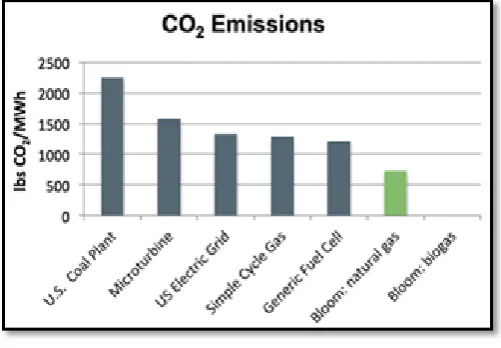
10. CO2 EMISSION
[image:4.595.310.557.509.662.2]© 2018, IRJET | Impact Factor value: 6.171 | ISO 9001:2008 Certified Journal | Page 1566 Fig-5: CO2 Emissions
11. WATER CONSUMPTIONS
[image:5.595.40.282.374.493.2]Similarly the amount of water consumed is also very low compared to other resources of energy. The following table compares the water consumption of Bloom Box with other resources of energy.
Table-2: Water Usage Comparison
12. MERITS
12.1 Bloom has a Broader Vision
Historically, businesses have been required to install many different energy technologies to address all their energy needs. To ensure power reliability, they purchased costly backup solutions. For increased power quality, they purchased power conditioning equipment. If they simply wanted clean power, they installed solar panels or purchased Renewable Energy Credits. All individual solutions that solve individual problems. Bloom is Different Bloom Energy's versatile fuel cell technology is essentially a flexible energy platform, providing multiple benefits simultaneously for a wide range of applications. In addition to clean, reliable, affordable electricity, Bloom customers can realize a multitude of other advantages: such as carbon sequestration, reverse backup, time to power, DC power supply, and hydrogen production.
12.2 Carbon Sequestration
The electrochemical reaction occurring within Bloom Energy systems generates electricity, heat, some H2O, and pure CO2. Traditionally, the most costly aspect of carbon sequestration is separating the CO2 from the other effluents. The pure CO2 emission allows for easy and cost-effective carbon sequestration from the Bloom systems.[6]
12.3 Reverse Backup
Businesses often purchase generators, uninterruptible power supplies and other expensive backup applications that sit idle 99% of the time, while they purchase their electricity from the grid as their primary source. The Bloom solution allows customers to flip that paradigm, by using the Energy Server as their primary power, and only purchasing electricity from the grid to supplement the output when necessary. Increased asset utilization leads to dramatically improved ROI for Bloom Energy's customers.
12.4 Time to Power
The ease of placing Bloom Energy Servers across a broad variety of geographies and customer segments allows systems to be installed quickly, on demand, without the added complexity of cumbersome combined heat and power applications or large space requirements of solar. These systems' environmental footprint enables them to be exempt from local air permitting requirements, thus streamlining the approval process. Fast installation simply requires a concrete pad, a fuel source, and an internet connection.
12.5 DC Power Supply
Bloom systems natively produce DC power, which supplies an elegant solution to efficiently power DC data centres and/or be the plug-and-play provider for DC charging stations for electric vehicles.
12.6 Hydrogen Production
Bloom's technology, with its NASA roots, can be used to generate electricity and hydrogen. Coupled with intermittent renewable resources like solar or wind, Bloom’s future systems will produce and store hydrogen to enable a 24 hour renewable solution and provide a distributed hydrogen fuelling infrastructure for hydrogen powered vehicles.
© 2018, IRJET | Impact Factor value: 6.171 | ISO 9001:2008 Certified Journal | Page 1567 13. DEMERITS
Though it has many advantages there are some disadvantages that may be resolved to make it even more efficient. The following are the list of disadvantages that Bloom Box possess.
• Cost of power production is high.
o WIND - $ 2,000 / Kw
o SOLAR - $ 5,000 / Kw
o BLOOM BOX - $ 9,000 to $ 10,000 / Kw
• Capital & installation costs are high.
• Operates at high temperatures.
14. SUMMARY
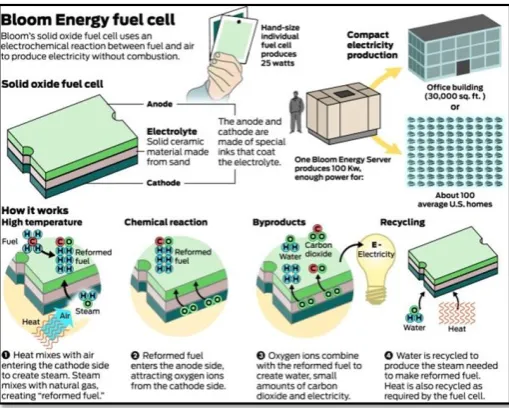
[image:6.595.362.519.85.200.2]A brief summary Bloom Box is depicted in this figure.
Fig-6: Bloom Box
[image:6.595.38.293.357.561.2]The photographs shown below are the list of customers who have installed Bloom Energy Servers in their campuses.
Fig-7: Bloom Energy Servers Installations
15. CONCLUSION
Thus BLOOM ENERGY proves to be a new and developing technology that produces clean & reliable energy with very meagre or no CO2 emissions.
16. REFERENCES
[1].https://en.wikipedia.org/wiki/Bloom_Energy_Server# Technology
[2].https://www.forbes.com/2010/02/24/fuel-cell-utc-technology-ecotech-bloom-energy.html
[3].http://www.mercurynews.com/2010/02/24/bloom-energy-unveils-its-bloom-box-fuel-cell/
[4].“Bloom Box Energy: The Future of Energy” by Rakesh Gakare Praxis Business School
[5].http://www.bloomenergy.com/clean-energy/