© 2018, IRJET | Impact Factor value: 6.171 | ISO 9001:2008 Certified Journal | Page 3970
NUMERICAL ANALYSIS OF EFFECT OF INJECTION PRESSURES ON
EMISSIONS OF DIRECT INJECTION DIESEL ENGINE FUELLED WITH
DIESEL AND HEPTANE
Maneesh Krishna T
1, Biju Cherian Abraham
2, Arjun Baby
3, Jibin Alex
41,3,4
M-Tech Student, Dept. of Mechanical Engineering, M A College of Engineering, Kerala, India
2Associate Professor, Dept. of Mechanical Engineering, M A College of Engineering, Kerala, India
---***---Abstract -
Internal combustion engines, now a days is thebest available reliable source of power for all domestic, large scale industrial and transportation applications. The major issue arises at the efficiency of these engines. The major pollutants are Un Burned Hydro Carbons (UBHC), and Oxides of Nitrogen (Nox) .These are formed due to incomplete combustion of the fuel in combustion chamber of diesel engine. One of the important factors which influence the performance and emission of diesel engine is fuel injection pressure. A numerical study was performed on a light duty direct injection diesel engine at 150 bar, 180 bar, 210 bar, 250bar and 300bar injection pressure to study its effect on performance and emission for both fuels that is diesel and heptane The performance and emission characteristics were presented graphically and concluded that they were found better at the fuel injection pressure 210 bar for the light duty engine.
Keywords: CO, Diesel Engine, Fuel, Injection Pressure,
N-Dodecane, N-Heptane, NO, Soot
1. INTRODUCTION
The diesel engine is a type of internal combustion engine more specifically, it is a compression ignition engine, in which the fuel ignited solely by the high temperature created by compression of the air-fuel mixture. The engine operates using the diesel cycle. The diesel engine is more efficient than the petrol engine, since the spark-ignition engine consumes more fuel than the compression-ignition engine. In present diesel engines, fuel injection systems have designed to obtain higher injection pressure.A study on light duty Kirloskar engine parameters were performed by varying its injection pressure. STAR-CD is used as the software tool for this analysis. So, it is aimed to decrease the exhaust emissions by increasing efficiency of diesel engines. When fuel injection pressure is low, fuel particle diameters will enlarge and ignition delay period during the combustion will increase. When injection pressure increased of fuel particle diameters will become small. Since formation of mixing of fuel to air becomes better during ignition period, engine performance will be increase. If injection pressure is too higher, ignition delay period becomes shorter. Possibilities of homogeneous mixing decrease and combustion efficiency falls down the fuel injection system in a direct injection diesel engine is to achieve a high
© 2018, IRJET | Impact Factor value: 6.171 | ISO 9001:2008 Certified Journal | Page 3971 loads and increases at high engine speeds for biodiesel
and biodiesel/diesel blends.
Keshav et al. [5] they examined the characteristics of high pressure spray and exhaust emissions in a single cylinder diesel engine using common rail type diesel fuel injector at different injector operating conditions. The injection system utilizes an intensifier to generate injection pressures as high as 160 MPa. Daisha et al. [6] they conducted an experimental study in DI diesel engine with different Injection pressures 60, 100, and 160 MPa and reported that, increase in the injection pressure increases the relative speed between the ambient air spray increases and atomization is promoted, Results indicate the reduction of soot by the higher injection pressure.
S.Premnath et al.[7] In this work, re-entrant combustion chamber with three different fuel injection pressures(200,220and240bars) has been used in the place of the conventional hemispherical combustion chamber for diesel and J20.From the experimental results, it is found that there-entrant chamber improves the brake thermal efficiency of diesel and J20 in all the tested conditions. It is also found that the 20% blend of Jatropha methyl ester showed 4% improvement in the brake thermal efficiency in the re-entrant chamber at the maximum injection pressure. H.Hanafi et al. [8] Performance and emission characteristics of n-heptane were investigated at constant engine speed of 1000 rpm in a HCCI engine model. The effects of inlet air temperature were also examined. The test results showed that brake power, brake mean effective pressure and brake specific fuel consumption decreased when increased AFR and inlet air temperature.Nik Rosli Abdullah et al. [9]the injection pressure was varied from 300 bar up to 800 bar with two different dMI. A short dMI 5 CAD before the main injection (main injection at 2.5 CAD after top dead Centre (ATDC) for 1500 rpm and 0.7 CAD ATDC for 2250 rpm) and a long dMI 40 CAD before the main injection which was investigated. Engine speeds 1500 rpm and 2250 rpm with loads of 35.1 Nm were selected to study the effect at low load. 25% for heat transfer coefficient compared to water.
Yong Qian et al. [10]an experimental study was conducted on the combustion and emissions characteristics of RCCI in a single-cylinder engine, There in applying the in-cylinder direct injection of n-heptane combined with the port injection of ethanol, n-butanol and n-amyl alcohol. With the port injection of ethanol and n-butane, at a certain premixed ratio and overall LHVs, low emissions of NOx and soot can be simultaneously realized. C.Syed Aalam et al.[11] they concluded Increasing the injector pressure i.e. 220 bar to 1000 bar using electronically controlled injection system resulted in a considerable enhancement in performance and emissions with due to better spray formation. Brake thermal efficiency increases from 23.8% to 29.2%, Hydrocarbon emission reduced from 90 to 65ppm, NOx emission increases with
increasing of injection pressure due to faster combustion and higher temperatures reached in the cycle. Smoke emission reduced from 64HSU to 46HSU.
2. NUMERICAL MODEL
2.1 Physical Geometry [image:2.595.322.542.277.400.2]Modelling of hemi spherical piston bowl geometry was done using SolidWorks. Surface mesh generation done by Prosurf. Then a 120-degree sector mesh was generated in es-ICE (Expert Systems in IC Engine). After this, the sector grid is used as a part of STAR-CONTROL for applying initial conditions, boundary conditions like beginning temperature, initial pressure and cylinder crown temperature and so on
Fig -1: Geometry of the model
Fig -2: prosurf geometry
[image:2.595.313.554.430.562.2]© 2018, IRJET | Impact Factor value: 6.171 | ISO 9001:2008 Certified Journal | Page 3972
2.2 Governing Equations
The three dimensional in-cylinder, transient, non-reacting flow physics in a direct injection diesel engine is simulated by solving the following governing equations: i. Conservation of mass, ii. Conservation of momentum The equations are provided in tensor notations
The flow being assumed to be Newtonian, the following constitutive relation is specified connecting the components of the stress tensor τij to the velocity gradients,
Where µ - molecular fluid dynamic viscosity,
The in-cylinder flow is turbulent in nature at all speeds and dimensions of the engine. It is necessary to model the turbulence to capture the properties of in-cylinder fluid dynamics. The ‘Standard’ k − ε model is which the turbulent Reynolds number forms of the k and ε equations are used in conjunction with the algebraic ‘law of the wall’ representation of flow, heat and mass transfer for the near wall region
Standard k − ε Model: The particular high Reynolds number form of the k − ε model used is appropriate to fully turbulent, compressible or incompressible flows. The transport equations are as follows:
Conservation equations for heat transfer
Where ‘h’ is static enthalpy, defined by
(11)
Conservation Equations for Species or Mass Transfer: Each Constituent, k of a fluid mixture, whose local concentration is expressed as a mass fraction is assumed to be governed by a species conservation equation of the form:
2.3 ENGINE PARAMETERS & DETAILS
Table -1: Engine Specifications
KIRLOSKAR ENGINE
ITEM SPECIFICATION
© 2018, IRJET | Impact Factor value: 6.171 | ISO 9001:2008 Certified Journal | Page 3973
EQUATIONS
ṁ =Cd×An×√ (2×ρf×Δp) × ((Δθ)/360N)
Cd = Coefficient of discharge of injector = 0.7
An = Area of one injector hole= (π×.000172/4)
=0.226×10⁻⁷ Kg/s
ρf =Density of fuel = 832 kg/m3 Δp =Pressure difference
=Injection pressure - In cylinder pressure =210 – 7 = 203 bar
Δθ = Injection duration = 270
N = Engine RPM = 1500
ṁ = 0.7×0.226×10-7×√ (2×832×203×105) × [27/
(360×1600)] = 1.99×10⁻⁵ kg/s
3 RESULTS AND DISCUSSIONS
3.1 VALIDATION
Crank angle vs. pressure
A comparison between experiments and simulation is presented, in order to assess the accuracy of the subsequent predictions.The trend predicted by the model is reasonably close to experimental results. By the numerical results shows 82 bar and experimental results having 69 bar. The peak pressure discrepancies between experimental and computation are 15.7%
3.2 Cylinder pressure
As the Injection pressure increased we can see that the cylinder pressure also increases because of better atomization the combustion rate is high following graph represents diesel fuel at various injection pressure the
[image:4.595.43.270.446.591.2]peak pressure is 86 bar for injection pressure 300 bar. As the injection pressure increases from 150 bar to 300 bar the cylinder pressure increases nearly 10 bar.
Fig -4- cylinder pressure variation of n-dodecane
Fig -5- cylinder pressure variation of n-heptane
In the case of heptane the injection pressure increases the cylinder pressure also increases. As we comparing with diesel fuel by using heptane the cylinder pressure is higher than the diesel.
[image:4.595.309.561.585.745.2]3.3 Cylinder Temperature
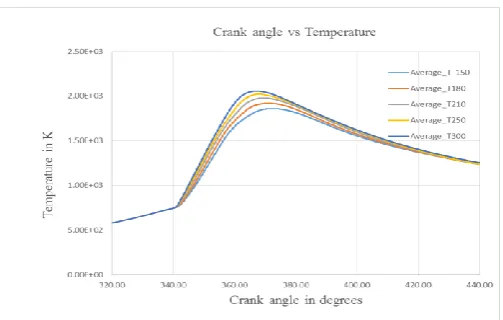
© 2018, IRJET | Impact Factor value: 6.171 | ISO 9001:2008 Certified Journal | Page 3974 As the Injection pressure increased we can see that the
[image:5.595.311.559.71.254.2]cylinder temperature also increases because of better atomization the combustion rate is high following graph represents diesel fuel at various injection pressure the peak pressure is 2100 K for injection pressure 300 bar. As the injection pressure increases from 150 bar to 300 bar the cylinder temperature increases nearly 300 K.
Fig -7- cylinder Temperature variation of n-Heptane
The injection pressure is increases from 150 bar to 300 bar the cylinder Temperature increases in to 18 bar. The peak pressure found on the the result is 300 bar. The peak cylinder Temperature in the result is 2600 K.
[image:5.595.37.287.170.342.2]3.4 NOx EMISSION
Fig -8- NOx emission variation of n-dodecane
[image:5.595.307.588.347.626.2]As we can see that the NOx emission depends up on the cylinder temperature and availability of oxygen and we can see that temperature is higher in diesel engine combustion here so the injection pressure increases NOx emission increased
Fig -9- NOx emission variation of n-heptane
In the case of heptane the NOx emission increase by increasing injection pressure. Comparing with diesel engine the NOx emission is very high because of high cylinder temperature.
Fig.10.-NOx contour at 370 degree crank angle at different pressure
150 bar 180 bar
[image:5.595.38.284.440.609.2]© 2018, IRJET | Impact Factor value: 6.171 | ISO 9001:2008 Certified Journal | Page 3975
3.5 CO EMISSION
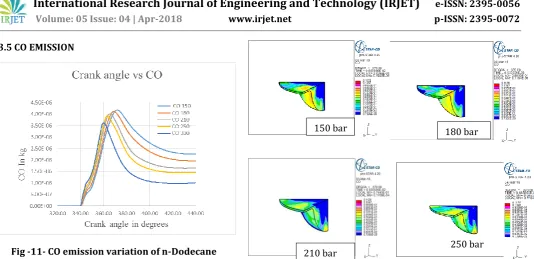
Fig -11- CO emission variation of n-Dodecane
Carbon monoxide results from the incomplete combustion where the oxidation process does not occur completely. As High injection pressure generates better atomization the surface area of fuel particles increases, and hence better oxidation of carbon occurs.
Fig -12- CO emission variation of n-Heptane
[image:6.595.38.573.38.297.2]In the case of heptane, the co emission decreasing when increasing injection pressure compared with diesel because ofheptane have high cetane number so, for high cetane number having less ignition delay period so combustion rate is increase while increase in injection pressure. Cetane number related to ignition property of diesel fuel. The heptane having high cetane number so it is good fuel for diesel engine.
Fig.13.-CO contour at 370 degree crank angle at different pressure
[image:6.595.40.570.368.550.2]3.6 SOOT EMISSION
Fig -14- Soot emission variation of n-dodecane
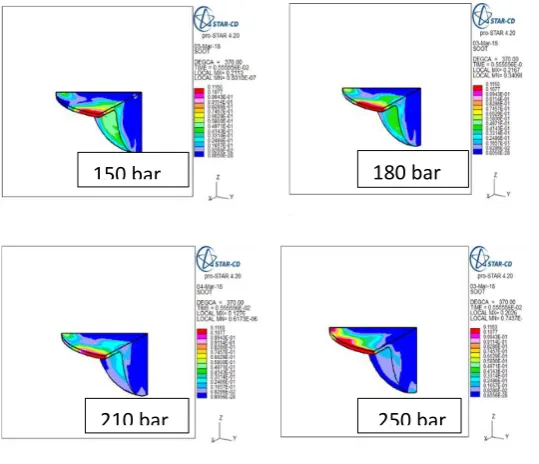
The soot emission is decreased by increasing injection pressure. Soot is originated from the agglomeration of very small particles of partly burned fuel, partly burned lube oil, ash content of fuel oil and cylinder lube oil and water. As injection pressure increases size of fuel particle decreases due to better atomization and better combustion occurs hence the soot emission decreases.
250 bar
150 bar 180 bar
© 2018, IRJET | Impact Factor value: 6.171 | ISO 9001:2008 Certified Journal | Page 3976 Fig -15- Soot emission variation of n-heptane
[image:7.595.34.303.62.243.2]Comparing with diesel and heptane the soot emission is less in heptane based fuel because of combustion rate is higher in heptane so chance of occurring partly burned fuel is very low so soot emission is increased.
Fig.16.-soot contour at 370 degree crank angle at different pressure
4. CONCLUSIONS
• Analysis at compression ratio 17.5 for different injection pressure was completed using STAR-CD and results were obtained.
• Higher fuel injection pressure is better for smaller droplet size and leads to better combustion.
• The better fuel injection pressure is found on using both fuels were 210 bar. The emission are comparatively better in this injection pressure.
• The Nox emission is increased by increasing injection pressure the comparatively Nox emission higher in heptane fuel due to high cylinder temperature
• Using diesel fuel the the injection pressure is increasing the CO emission decreased. In heptane the CO emission is also decreasing with increasing injection pressure because of heptane have high cetane number so, for high cetane number having less ignition delay period so combustion rate is increase that’s why CO emission decreased
• The soot emissions is decreased by increasing injection pressure because of better combustion rate on both fuels. In the case of heptane soot emissions is less than diesel fuel because of the particles of partly burned fuels is less by the properties of fuel the boiling point of the heptane is less than that of diesel and zero point in octane rating scale.
5. REFERENCES
[1] Rosalie Abu Bakar ‘’Fuel Injection Pressure Effect on
Performance of Direct Injection Diesel Engines Based on Experiment” march 2015.
[2] K. Kannan, M. Udayakumar.
‘’
Experimental Study OfThe Effect Of Fuel Injection Pressure On Diesel Engine Performance And Emission” ARPN Journal of Engineering and Applied Sciences Vol. 5, No. 5, May 2010
[3] C.Anuradha, T. Anand Kumar, Dr. M .Lakshmi Kantha
Reddy, Dr.G.prashanthi.
‘’
Effect of Injection Pressures on Emissions of Direct Injection Diesel Engine By Using CFD Simulation”IOSR Journal of Mechanical and Civil Engineering Volume 13, Issue 5 Ver. V (Sep. - Oct. 2016).[4] Huang “Performance and emissions of a
turbocharged, high-pressure common rail diesel engine operating on biodiesel/diesel blends”, June 2015
[5] Keshav “Characteristics of High Pressure Spray and
Exhaust Emissions in a Single Cylinder DI Diesel engine “march 2016.
[6] Daisho “experimental study on a direct- injection
single-cylinder diesel engine with different injection pressure,” July 2016
[7] S. Premnath, G.Devaradjanean “Improving the
performance and emission characteristics of a single cylinder diesel engine having reentrant combustion chamber using diesel and Jatropha methyl esters”
150 bar
180 bar
[image:7.595.36.306.331.563.2]© 2018, IRJET | Impact Factor value: 6.171 | ISO 9001:2008 Certified Journal | Page 3977 Ecotoxicology and Environmental Safety Accepted27
July2015
[8] H.Hanafi, M.M.Noor, M.M.Rahman , K.Kadirgama
“Numerical Study Of N-Heptane Fuelled Hcci Under Different Air Fuel Ratio And Inlet Air Temperature”, Automotive Engineering Centre, University Malaysia Pahang,
[9] Nik Rosli Abdullah, Rizalman Mamat, P. Rounce “The
Effect Of Injection Pressure And Strategy in A Jaguar V6 Diesel Engine”, Journal of KONES Powertrain and Transport, Vol. 16, No. 2 2009
[10] Yong Qian, Linqi Ouyang, Xiaole Wang, Lifeng Zhu
“Experimental studies on combustion and emissions of RCCI fuelled with n-heptane/alcohols fuels”, Fuel, 162 (2015) 239–250, 2015
[11] C. Syed Aalam, C.G. Saravanan “Effects of Fuel Injection