http://dx.doi.org/10.4236/ajac.2015.64034
How to cite this paper: Kudo, Y. and Katsuta, S. (2015) On an Expression of Extraction Constants without the Interfacial Equilibrium-Potential Differences for the Extraction of Univalent and Divalent Metal Picrates by Crown Ethers into 1,2-Dichloroethane and Nitrobenzene. American Journal of Analytical Chemistry, 6, 350-363.
http://dx.doi.org/10.4236/ajac.2015.64034
On an Expression of Extraction Constants
without the Interfacial
Equilibrium-Potential Differences
for the Extraction of Univalent and Divalent
Metal Picrates by Crown Ethers into
1,2-Dichloroethane and Nitrobenzene
Yoshihiro Kudo
*, Shoichi Katsuta
Graduate School of Science, Chiba University, Chiba, Japan Email: *[email protected]
Received 17 February 2015; accepted 25 March 2015; published 27 March 2015
Copyright © 2015 by authors and Scientific Research Publishing Inc.
This work is licensed under the Creative Commons Attribution International License (CC BY). http://creativecommons.org/licenses/by/4.0/
Abstract
An idea on interfacial equilibrium-potential differences (∆φeq) which are generated for the
extrac-tion of univalent metal picrate (MPic) and divalent ones (MPic2) by crown ethers (L) into high-po-
lar diluents was improved. These potentials were clarified with some experimental extraction- data reported before on the M = Ag(I), Ca(II), Sr(II) and Ba(II) extraction with 18-crown-6 ether (18C6) and benzo-18C6 into 1,2-dichloroethane (DCE) and nitrobenzene (NB). Consequently, it
was demonstrated that the ∆φeq values from the extraction-experimentally obtained logKD,Pic ones
are in agreement with or close to those calculated from charge balance equations in many cases,
where the symbol, KD,Pic, denotes an individual distribution constant of Pic− into the DCE or NB
phase. Also, it was experimentally shown that extraction constants based on the overall extraction
equilibria do not virtually contain the ∆φeq terms in their functional expressions.
Keywords
Extraction Constants, Distribution Constant of a Single Ion, Interfacial Equilibrium-Potential Differences, 1,2-Dichloroethane, Nitrobenzene, Metal Picrates, Crown Ethers
*
1. Introduction
Univalent and divalent metal picrates
(
MPic ,z z=1& 2)
, such as alkali and alkaline-earth metal ones, havebeen extracted by crown compounds (L) into the high-polar diluents, such as 1,2-dichloethane (DCE), dichlo-romethane and nitrobenzene (NB) [1]-[5]. In such high-polar diluents, an extracted ion-pair complex, MLPicz,
dissociates MLz+ and zPic−[1]-[3] [6]. In introducing these component equilibria in an extraction model, an in-dividual distribution constant (KD,A) of Pic− (=A−) into the diluents has been determined extraction-experimen-
tally [1]-[3] [7]. However, in spite of the limitation of the same KD,A definition and the same diluents, the
thus-determined KD,Pic values have differed from each other. For example, the logKD,Pic values were −0.94 [2] for
the PbPic2 extraction with 18-crown-6 ether (18C6), −1.34 [7] for the SrPic2 one with benzo-18C6 (B18C6) into
NB, −2.46[3] for the AgPic one with benzo-15-crown-5 ether, −1.89 [2] for the PbPic2 one with 18C6 and −4.35 [6] for the CdPic2 one with 18C6 into DCE. Thus, their values have changed over experimental errors with
combinations of MPicz and L.
To clarify a reason for such differences, the authors have applied the idea [8] of an interfacial potential dif-
ference (∆φeq) at extraction equilibrium to an expression of log KD,A, namely −f
(
Δφeq−ΔφA0′)
2.303 [3][6][7], where the negative sign being in the front of f, which denotes F/RT, comes from the electrical charge of A−. In addition to this, extraction constants, Kex± and Kex2±, have been electrochemically expressed as
(
0)
eq
Δ Δ k 2.303
zf φ − φ′ at k=ex± and z=1 and at ex±, ex2± and 2 [3] [7]. Here, 0 A
Δφ ′ and Δ 0
k
φ ′ refer to standard formal potentials for the single distribution of A− into the diluent or organic (o or org) phase and the formal potentials for the overall equilibrium, respectively. Also, Kex± and Kex2± have been defined experimentally
by extraction as
(
2[ ]
2)
o
o o
MLA+ A− M + L A−
[2][7] or
(
[ ]
)
o
o o
ML+ A− M+ L A−
[1]-[3]
and 2 2
(
2[ ]
2)
o
o o
ML+ A− M + L A−
[7], respectively.
On the other hand, from the thermodynamic points of view, these extraction constants are resolved into
(
)
2(
)
D,M D,A ML,org 1,org ex
K
K
K
K
=
K
± for z=2 [7], KD,MKD,AKML,orgfor 1 [3] and(
)
2(
)
D,M D,A ML,org ex 2
K
K
K
=
K
± for z=2 [7]. Here, the component equilibrium constants, KML,org (complexformation in the o phase) and K1,org (1st-step ion-pair formation in the o one), do not contain the ∆φeq terms in
their expressions, because the constants are of homogeneous systems that all species relevant to the reaction are present in the single o phase [3] [7]; namely no interface is involved in these processes. Similarly, the distribu-tion constant of Mz+ has been expressed with KD,M (see Equation (3) at z=1 in the Section 2.1) [3]. Therefore,
since KD,M and KD,A are present in the
(
)
2 D,M D,AK
K
or KD,MKD,A term, the both terms must cancel out mu-tually the ∆φeq ones. Thereby, the extraction constants virtually lose the ∆φeq terms on their functional expres-
sions. Thus, the above expression, such as
(
0)
ex eq ex
logK ±=zf Δφ −Δφ ±′ 2.303, has caused contradictions on the thermodynamic cycles [3] [7]. Furthermore, such contradictions can cause discrepancies in Δ 0
k
φ ′ between experimentally-evaluated values and theoretically-reproduced ones [7].
In the present paper, in order to solve the above two contradictions, namely the differences of KD,A caused by
experimental conditions of extraction and the contradiction based on the thermodynamic cycles [3] [7], we pro-posed another expression without ∆φeq of the extraction constants, Kex± and Kex2±. In course of clarifying this
ex-pression, some experimentally-determined constants [3] [7], such as Kex±, an individual distribution constant (KD,ML) of the complex ion ML2+ into the NB phase and that of AgL+ into DCE, were also reproduced by
calcu-lation. Here, the AgPic and MPic2 (M = Ca, Sr & Ba) extraction with L = 18C6 and/or B18C6 [3] [7] were
em-ployed as model systems. Also, a meaning of the ∆φeq values [3] [7] & [8] which were calculated from the
logKD,A ones determined by the extraction experiments was discussed based on an electroneutrality-point of
2. Theory
2.1.
∆
φ
eqValues Derived from Charge Balance Equations for the o Phase
(i) Case of the M(I) extraction with L. For the extraction equilibrium,(
)
o o o o
M++L +A− MLA ML+ +A−, we can obtain from the extraction model (see Appendix I for more details) reported before the following charge-balance equation
o o o
M+ ML+ A−
+ = (1)
for the o phase. The concentrations of M+ and A− in the o phase were modified as
(
)
{
0}
{
(
0)
}
eq M o eq A
M+ exp f Δφ Δφ ML+ A− exp f Δφ Δφ
− + = − −
′ ′ (2)
by using electrochemical equations [6][8] such as
(
)
0 1
eq M o
Δφ =Δφ ′+ f− ln M+ M+ (3)
and
(
)
0 1
eq A o
Δφ =Δφ ′−f− ln A− A− ; (4) see Appendix B in ref [6] for a detailed derivation from electrochemical potentials to this equation. Here, Δ 0
j
φ ′
and [j]o/[j] denote a standard formal potential of species j {=M(I), A(−I) & ML(I); see the introduction and
sec-tion 3.3} and the individual distribusec-tion constant (KD,j) of j between the two phases, respectively. At least, the 0
Δφ ′j values are available from references for M = Ag(I) [9], Ca(II) [10], Sr(II) [10] and Ba(II) [10] and A = Pic(−I) [11] into the DCE and NB phases. Additionally, the
(
)
(
)
{
1}
D,A
o o
logK =log A− A− =2.303 ln− A− A− values have been determined extraction-experi-
mentally [1]-[3] [6] [7]; see Appendix II for the KD,A determination. Defining as exp
(
fΔφeq)
=x and thenrearranging Equation (2), we can easily obtain
(
2)
( )
4 2 0
x= b − ac−b a > (5) with
(
0)
M
M exp Δ ,
a= + −f φ ′ (5a)
o
ML
b= + (5b)
and
(
0)
A
A exp Δ .
c= − − f φ ′ (5c) Accordingly, the following equation is derived.
(
)
1 eq
Δφ = f− lnx=0.05916 logx V unit at 298 K (6) Hence, if the [M+], [ML+]o and [A−] values are determined experimentally, then we can obtain the ∆φeq values
from Equation (6) immediately; the [ML+]o values were calculated here from the relation
(
mix)
[ ]
( )
ex ex o
o
ML+ K K M+ L A− 0
= − >
with
( )
{
}
(
[ ]
)
mix
ex total concentration of analyzed M I in the o phase M Lo A
K = + − (see Appendix II for more detail)
and ex
[
]
(
[ ]
)
o o
MLA M L A
K = + − . The data of [ML+]o≤ 0 were neglected in a further computation.
for a basic extraction model and Appendix II for the KD,A determination). Therefore, the charge balance
equa-tion for the o phase becomes
2 2
o o o o
2 M + +2 ML + + MLA+ = A− . (7) As described above, this equation was modified to [8]
(
)
{
}
{
(
)
}
(
)
{
}
2 0 2 0
eq M eq ML o
0 eq A
2 M exp 2 Δ Δ 2 ML exp 2 Δ Δ MLA
A exp Δ Δ .
f f
f
φ φ φ φ
φ φ
+ + +
−
− ′ − ′ +
= − −
+
′
(8)
Defining as exp
(
fΔφeq)
=x and then rearranging Equation (8), we easily obtain the cubic equation3
0
a x′ +b x′ + =c′ (9) with
(
)
(
)
2 0 2 0
M ML
2 M exp 2 2 ML exp 2 Δ ,
a′ = + − f∆φ ′ + + − f φ ′ (9a)
o
MLA
b′ = + (9b)
and
(
0)
A
A exp Δ
c′ = − − f φ ′ (9c) We can exactly solve this equation for x based on the mathematical formula [13]. Its real solution is
(
)
(
) (
)
{
2 2 4 3 27}
1 3{
(
2)
(
2 4) (
3 27)
}
1 3,x= − q + q + p + − q − q + p (10)
where p=b a′ ′ and q=c a′ ′. Therefore, we can similarly obtain the ∆φeq value from the combination of
Equations (6) and (10).
The b′ values were evaluated from the relation, (2 )
o
MLAN N
r+
∑
− + with N =1 and 2, where[
]
(
2 o)
o o
MLA MLA MLA
r+ = + + +
(
(
2[ ]
)
1 2{
(
2[ ]
)
1 2 2[ ]
2}
ex M Lo A ex M Lo A ex M Lo A
K ± + − K ± + − K + −
≈ + under the condition of
o o
MLA+ ≈A−
[7]). The (2 )
o
MLAN−N+
∑
values were directly determined by AAS measurements in theextraction experiments [2][7] and also we were able to calculate the other values in r+ from the experimental
data [7].
2.2. On Expressions of the Extraction Constants without
∆
φ
eqAccording to previous papers, the two of the three extraction constants have been defined as
(
0)
(
S)
ex eq ex eq ex
logK ±= f Δφ −Δφ ±′ 2.303= fΔφ 2.303 log+ K ± for the MIA-L extraction system [3] and
(
0)
ex eq ex
logK ± = f Δφ −Δφ ±′ 2.303 and
(
0)
(
S)
ex 2 eq ex2 eq ex2
logK ± =2f Δφ −Δφ ±′ 2.303= 2fΔφ 2.303 log+ K ±
for the MIIA2-L extraction one [7]. Here, logKex± (or logKex2±) equals S ex
log
K
± (orlog
K
ex2S ±) at Δφ =eq 0 V.These two kinds of extraction constants contain the ∆φeq terms as parameters in their functional expressions[3]
[7]. On the other hand, logKex has been expressed as
0 ex
Δ 2.303
f φ ′
− or −2fΔφex0′ 2.303 without ∆φeq and
spontaneously became an expression electrochemically-standardized at Δφ =eq 0 V [3] [7].
[
]
(
)
{
}
ex ex 2,org 2 o o o
logK −logK ± =logK =log MLA MLA+ A− , must give a function without ∆φeq, because
the resulting component equilibrium-constant K2,org does not relate with ∆φeq [7]; namely K2,org and Kex are the
constants at Δφ =eq 0 V. However, using the above definition [3] [7], the same term, logKex−logKex±, be-
comes logKexS −logKexS±= − fΔφeq 2.303 and then the ∆φeq term does not disappear, where
(
)
S 0
ex ex ex
logK =logK =−2fΔφ ′ 2.303 and logKexS±= −2fΔφex0±′ 2.303. The same is also true of the result of
(
S S)
ex ex 2 ex ex 2 eq 1,org
logK ±−logK ± = logK ±−logK ±− fΔφ 2.303 =logK which is defined as
(
2)
o o o
log MLA+ ML+ A− . These two facts obviously have the contradiction with respect to ∆φeq.
In order to cancel such contradictions, we assume here that the two extraction constants are functions without
∆φeq, as well as that of Kex[3] [7]. Accordingly, the constants are defined as
S 0
ex ex ex
logK ± =logK ±=−fΔφ ±′ 2.303 (11) and
S 0
ex2 ex2 ex2 .
logK ± =logK ± =−2fΔφ ±′ 2.303 (12) That is, by our traditional sense, it is proposed here that complicated equilibrium constants, such as Kex, Kex±
and Kex2±, do not contain the ∆φeq terms in their functions. This means that these constants are ordinarily defined
without ∆φeqor under the condition of Δφ =eq 0 V and thereby are electrochemically-standardized as
S ex
K
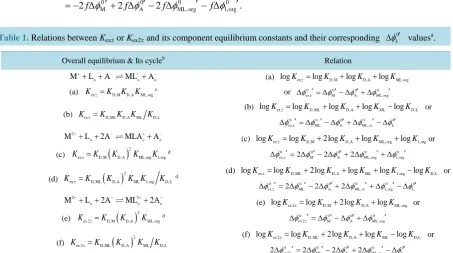
±and Kex 2S ± [3] [7].Table 1 lists new (or traditional) expressions of such extraction constants composed of some
component equilibrium constants based on thermodynamic cycles.
The relations in Table 1 shows that the individual distribution process of A−[12] cancels out that of a cation
[14], such as M+, R4N+, M2+ and ML2+, in ∆φeq. As an example, the thermodynamic relation for M(II)
ex D,M D,A ML,org 1,org
logK ± =logK +2 logK +logK +logK (13)
can be rearranged into
(
) (
)
0 0 0 0 0
ex eq M eq A ML,org 1,org
0 0 0 0
M A ML,org 1,org
Δ 2 Δ Δ 2 Δ Δ 2 Δ Δ
Δ Δ Δ Δ .
2 2 2
f f f f f
f f f f
φ φ φ φ φ φ φ
φ φ φ φ
±
− = − − − − −
= − + −
′ ′ ′ ′ ′
[image:5.595.87.541.442.695.2]′ ′ ′− ′ (14)
Table 1.Relations between Kex± or Kex2± and its component equilibrium constants and their corresponding ∆φ ′k0 values
a
.
Overall equilibrium & Its cycleb Relation
o o o
M++L +A−ML++A− (a) Kex±=KD,MKD,AKML,orgc
(a) logKex±=logKD,M+logKD,A+logKML,org
or 0 0 0 0
ex M A ML,org
Δφ ±′=Δφ′−Δφ′ +Δφ ′
(b) Kex±=KD,MLKD,AKML KD,L
(b) logKex±=logKD,ML+logKD,A+logKML−logKD,L or
0 0 0 0 0
ex ML A ML, w L
Δφ ±′=Δφ ′−Δφ′+Δφ ′−Δφ′
2
o o o
M++L +2A−MLA++A−
(c) Kex±=KD,M
( )
KD,A 2KML,orgK1,orgd
(c) logKex±=logKD,M+2 logKD,A+logKML,org+logK1,orgor
0 0 0 0 0
ex M A ML,org 1,org
Δφ ±′=2Δφ ′−2Δφ′+2Δφ ′+Δφ ′
(d) Kex±=KD,ML
( )
KD,A 2K KML 1,org KD,Ld(d) logKex±=logKD,ML+2 logKD,A+logKML+logK1,org−logKD,L or
0 0 0 0 0 0
ex ML A ML, w 1,org L
Δφ ±′=2Δφ ′−2Δφ′+2Δφ ′+Δφ ′−Δφ′
2 2
o o o
M++L +2A−ML++2A−
(e) Kex 2±=KD,M
( )
KD,A 2KML,orgd(e) logKex 2±=logKD,M+2 logKD,A+logKML,org or
0 0 0 0
ex 2 M A ML,org
Δφ ±′=Δφ′−Δφ′+Δφ ′
(f)
( )
2 ex 2 D,ML D,A ML D,L
K ±=K K K K
(f) logKex 2±=logKD,ML+2 logKD,A+logKML−logKD,L or
0 0 0 0 0
ex 2 ML A ML, w L
2Δφ ±′=2Δφ ′−2Δφ′+2Δφ ′−Δφ′
a
Therefore, the relation (c) in Table 1 is immediately obtained. From Equations (2) and (8), one should ob-viously see that ∆φeq of KD,M equals that of KD,A in the extraction system of Equation (13). Also, we can rewrite
Equation (13) to
S S S
ex D,M D,A ML,org 1,org ex
logK ±=logK +2 logK +logK +logK =logK ± (13a)
Consequently, Equation (14) or (13) does not contain the ∆φeq term and is virtually expressed with only the
standard formal potentials (at Δφ =eq 0 V) as Equation (13a). The thermodynamic relations are also satisfied with the expressions such as Equations (11) and (12). The same is true of the other relations in Table 1.
3. Results and Discussion
3.1. On a Meaning of
∆
φ
eqEstimated from log
K
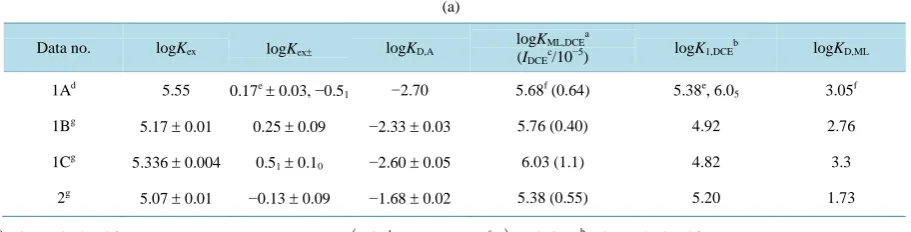
D,ATable 2(a) lists fundamental data [3] for the extraction of AgPic by B18C6 into DCE. The ∆φeq values were
calculated from Equation (4) and the experimental log KD,Pic values in Table 2(a).
Here, fΔφPic0′ 2.303
(
=ΔφPic0 0.05916=logKD,PicS)
= −1.011 [11] at 298 K was employed in the calculation.Table 2. (a)Fundamental data for the extraction of AgPic by B18C6 into DCE at 298 K; (b) Evaluated ∆φeq values; (c)
Re-produced logKex± values; (d) Evaluated logKSD,AgL and reproduced logKD,AgL values.
(a)
Data no. logKex logKex± logKD,A logKML,DCE
a
(IDCEc/10−5)
logK1,DCEb logKD,ML
1Ad 5.55
0.17e± 0.03, −0.51 −2.70 5.68f (0.64) 5.38e, 6.05 3.05f
1Bg
5.17 ± 0.01 0.25 ± 0.09 −2.33 ± 0.03 5.76 (0.40) 4.92 2.76
1Cg 5.336 ± 0.004 0.5
1± 0.10 −2.60 ± 0.05 6.03 (1.1) 4.82 3.3
2g 5.07 ± 0.01 −0.13 ± 0.09 −1.68 ± 0.02 5.38 (0.55) 5.20 1.73
a
Values calculated from
(
S)
ML,DCE ex D ,A eq D ,M
logK =logK ±−logK − Δφ 0.05916+logK at 298 K;
b
Values calculated from
1,DCE ex ex
logK =logK −logK ±; cUnit: mol dm−3; dRef. [3]; eValues re-calculated from the same data as that reported before. See ref. [3]; f Addition-ally determined values which were calculated from the same data as that reported before. See ref. [3]; gData obtained from additional extraction
expe-riments. Experimental conditions and data analyses are essentially the same as those reported on ref. [3]. For only the data no. 2, the w phases were prepared with about 0.1 mol dm−3 HNO3.
(b)
Data no. 1A 1B 1C 2
( )P1 eq
Δφ /V 0.10 0.078 0.094 0.040
( ) eq ,
P2 av
Δφ /V 0.093± 0.013 0.074± 0.012 0.089± 0.012 0.040 ± 0.005
(c)
Data no. 1A 1B 1C 2
( )K5 ex
logK ±
* 0.17 0.25 0.52 −
0.13
* ( )K 5 S S (Table 2 a( ))
ex D,Ag D,Pic AgL,DCE
logK± =logK +logK +logK .
(d)
Data no. 1A 1B 1C 2
( ) S K6 D,AgL
logK * 1.36 1.44 1.7 1.06
( )K7 D,AgL
logK § 2.94 2.70 3.2 1.74
* S K 6( ) ( )K 5 S [ ] [ ]
D,AgL ex D,Pic AgL D,L
logK =logK± −logK −logK 15+logK 16 .
§ ( )K 7 ( )P 2 S K 6( )
D,AgL eq ,av D,AgL
[image:6.595.86.542.320.436.2]Also, we estimated ∆φeq,av from Equation (6) with Equation (5), where ∆φeq,av denotes an average value for each
run.
The both values, expressed as Δφeq( )P1 & Δφeq,( )P2av in Table 2(b), agreed well within experimental errors. Average I values of the extraction systems in Table 2(a) were 0.0036 mol⋅dm−3 for the no. 1A [3], 0.0028 for 1B, 0.0027 for 1C and 0.097 for 2; I denotes the ionic strength of the water phase in the extraction. Except for the data no. 2, we can handle other three data on the average, because experimental conditions [3] of the data are essentially the same (see the footnote g in Table 2(a) for no. 2). So the following values were obtained at 298 K and L = B18C6: logKex± = 0.31± 0.14 and logKD,Pic = −2.54 ± 0.07;
[ ]
(
)
{
}
AgL,DCE DCE DCE DCE 1 3
logK =log AgL+ Ag+ L =5.7 ±0.2 in the IDCE range of (0.40 - 1.1) × 10 −5
mol⋅dm−3 (see the data in Table 2(a)) and 1,DCE
{
(
[
]
)
}
DCE DCE DCE 8 2
logK =log AgLPic AgL+ Pic− =5.0 ±0.2
in the same IDCE range. The symbol, IDCE, refers to the average ionic strength of the DCE phase; the same is true
of INB (see Table 3).
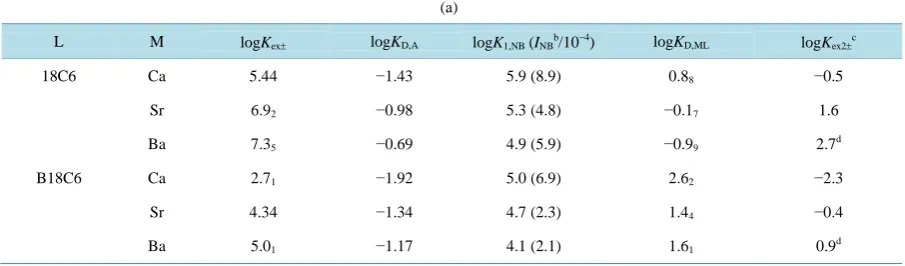
Table 3(a) summarizes the fundamental data [7] for the extraction of MPic2 (M = Ca, Sr & Ba) by 18C6 and
B18C6 into NB.
The ∆φeq values were calculated from Equation (4) with the logKD,Pic values in Table 3(a) and the
(
)
0 S
Pic D,Pic
Δφ ′ 0.05916 =logK =0.05 [11] ones reported previously. From Equation (6) with Equation (10), the
∆φeq,av values were estimated in the same manner. The above findings are listed inTable 3(b).
For the 18C6 extraction systems, the Δφeq( )P3 values obtained from Equation (4) are close to the Δφeq,( )P4av ones from Equation (6) with Equation (10). On the other hand, the former values are larger than the latter ones for the B18C6 extraction systems.
Except for the Δφeq( )P3 and Δφeq,( )P4av values of the B18C6 systems, the above results indicate that the interfa- cial equilibrium-potential differences, ∆φeq, based on Equation (4) are essentially the same as those based on
Equation (6). The differences between Δφeq( )P3 and Δφeq,( )P4av for the B18C6 systems can be due to those in the charge balance equation between extraction experiments (see Appendix II) and electrochemical (or theoretical)
treatments, namely
NB NB
MLPic+ ≈ Pic−
[7] and Equation (7) or (8). In other words, the condition of
2 2
NB NB NB
2 M + +2 ML + MLPic+ cannot be satisfied in the B18C6 systems. For example, an average
value of 2
NB NB
2 BaL + BaLPic+ was 0.12 for L = B18C6, while that was 0.029 for 18C6; these values
were the maximum of the B18C6- and 18C6-M(II) extraction systems. Practically, the Δφeq,( )P4av values based on Equation (7) or (8) must be more accurate than the Δφeq( )P3 ones.
On the basis of the above facts, Δφeq( )P1 =Δφeq,av( )P2 and Δφeq( )P3 ≥Δφeq,av( )P4 , we see that the ∆φeq value obtained
from the distribution process of A−Ao− is essentially equivalent to that from the combined process of
o
M+M+ and ML+ML+o [8] {see Equations (1) & (2)} or 2 2 o
M +M +, MLA+MLAo+ and
2 2
o
ML+ML+ {see Equations (7) & (8)} into o = DCE and NB.
3.2. Experimental Proof of
K
ex±and
K
ex2±without
∆
φ
eqWe obtained the log Kex± values of the AgPic extraction with B18C6 into DCE from the relation (a) in Table 1
with logKD,AgS = −4.502 [9] (= −Δφ ′Ag0 0.05916 [3]), logKD,PicS = −1.011 [11] (into DCE) and the corres ponding logKML,DCE value in Table 2(a). These values, expressed as ( )
K5 ex
logK ± below, are in good agreement with those listed in Table 2(a).
The KD,AgL calculation can be an indirect proof of Kex± without ∆φeq. First, the log KD,AgL values (namely S
D,AgL
logK ones) standardized at Δφeq =0 V for L = B18C6 were calculated from the modified form,
S S
D,AgL ex D,Pic AgL D,L
shown as KD,AgLS K6( ) in Table 2(d). In this calculation, we employed S
D,Pic 1
logK = −1.01 [11] (into DCE),
[ ]
(
)
{
}
AgL
logK =log AgL+ Ag+ L =1.83 [15] (in water), D,B18C6
{
(
[
]
[
]
)
}
DCE
logK =log B18C6 B18C6 =2.009
[16] at 298 K.
Next, the logKD,AgL values were reproduced by using the equation,
(
)
{
}
SD,AgL o eq D,AgL
logK =log AgL+ AgL+ =Δφ 0.05916+logK at 298 K (see Appendix in ref. [3] for its detailed derivation), with the calculated logKS K6D,AgL( ) values and the Δφeq,( )P2av ones. These logKD,AgL( )K7 values in Table 2(d) are in good accordance with the values listed in Table 2(a). Thus the log KD,AgL values can be well
reproduced. From the results of Kex( )K5± & KD,AgL( )K7 at least, we can see that Equation (11) is valid for the Ag Pic-B18C6 extraction system.
Moreover, an average S
D,AgL
logK value for all the logKD,AgLS K6( ) ones was 1.39± 0.23. From this value and the ( )P1
eq
Δφ ones, we calculated the logKD,AgL values again, using the above relation [3]. The value obtained from ( )P1
eq
Δφ of no. 1C was under-estimated by0.3 and that of no. 2 was over-estimated by the same, compared to those in Table 2(a) or of logKD,AgL( )K7 . On the other hand, the logKD,AgL values (= 3.1 & 2.7, respectively) of nos.
1A and 1B were close to those in Table 2(a).
The logKex± values for the M(II)-B18C6 extraction into NB were calculated from the relation (c) in Table 1.
These logKex( )K8± values are in accordance with the values in Table 3(a); the logKex± values in Table 3(a) have
been determined by the procedure [2][7] described inAppendix II. This accordance indicates that Equation (11)
without ∆φeq is satisfied. In this calculation, S D,Ca
logK = −11.80, logKD,SrS = −11.56, logKD,BaS = −10.82
[10], logKCaL,NB = 11.2, logKSrL,NB = 13.1, logKBaL,NB = 13.4 for L = 18C6 [17], logKCaL,NB = 9.43, logKSrL,NB =
11.1 and logKBaL,NB = 11.6 for L = B18C6 [17] were employed. Also, the logKD,M values were calculated from
the modified form of Equation (3), S
D,M eq D,M
logK =2Δφ 0.05916 log+ K , with the Δφeq( )P3 values, where the
( )
{
P3}
D,Pic eq
logK =Δφ 0.05916+0 0. 5 values in Table 3(a) corresponding to them were employed accordingly. The following discussion is similar to that from KD,AgLS to KD,AgL at L = B18C6 (Table 2(d)). The
S D,ML logK
values at M(II) were calculated from a modified form, logKD,MLS =logKex 2±−2 logKD,AS −logKML+logKD,L,
of the relation (f) in Table 1. Here, the adopted logKML
{
=log(
ML2+ M2+[ ]
L)
}
, in water at 298 K} val- ues were 0.48 for the Ca-18C6 [18] and -B18C6 [19] systems, 2.72 [20] for Sr-18C6, 3.87 [20] for Ba-18C6, 2.41 [15] for Sr-B18C6 and 2.90 [13] for Ba-B18C6. Also, logKD,PicS =0.05 [11] (into NB), logKD,18C6 = −1.00 [21] and logKD,B18C6 = 1.57 [17] (into NB) at 298 K were used for calculation. Furthermore, from the assumptionin the section 2.2, we employed the logKex2± values [12] which have been reported before and their values
vir-tually correspond to the ones standardized at Δφeq =0 V (see Table 3(a)).
The calculated logKD,S( )K9ML values are listed inTable 3(d). These values agreed well with those [17] pre-viously-reported by the ion-transfer polarographic measurements, except for the Ba-18C6 and -B18C6 systems. This fact indirectly indicates that Equation (12) is satisfied. For the Ba-18C6 and -B18C6 systems, −2.6 for the former and −0.8 for the latter have been reported [17].
As similar to logKD,A( )K7gL in Table 2(d), the calculation of logKD,ML becomes the indirect proof of logKex2±
without ∆φeq. Then, the logKD,ML values at 298 K were estimated from the ( )
S D,
K9 ML
logK ones and the equation,
(
)
{
0}
SD,ML eq ML eq D,ML
logK =2f Δφ −Δφ 2.303 =2Δφ 0.05916 log+ K [7]; the Δφeq( )P3 values were used here. The thus-calculated logKD,M(K 01L) values were close to the values listed in Table 3(a); the experimental logKD,ML values in Table 3(a) have been calculated from the relation (d) in Table 1[7]. This fact indicates that
Table 3.(a) Fundamental data for the extraction of MPic2 (M = Ca, Sr& Ba) by L into NB at 298 K.a; (b) Evaluated ∆φeq values; (c) Reproduced logKex± values; (d) Evaluated D ML
S ,
logK and reproduced log KD,ML values.
(a)
L M logKex± logKD,A logK1,NB (INBb/10−4) logKD,ML logKex2±c
18C6 Ca 5.44 −1.43 5.9 (8.9) 0.88 −0.5
Sr 6.92 −0.98 5.3 (4.8) −0.17 1.6
Ba 7.35 −0.69 4.9 (5.9) −0.99 2.7d
B18C6 Ca 2.71 −1.92 5.0 (6.9) 2.62 −2.3
Sr 4.34 −1.34 4.7 (2.3) 1.44 −0.4
Ba 5.01 −1.17 4.1 (2.1) 1.61 0.9d
a
Ref. [7]; bUnit: mol dm−3; c S ex2
logK ± values: see ref [12]; d
Values re-calculated from the data in ref [12].
(b)
18C6 extraction system B18C6 extraction system
M = Ca Sr Ba M = Ca Sr Ba
( )P3 eq
Δφ /V 0.088 0.061 0.044 0.12 0.082 0.072
( ) eq ,
P4 av
Δφ /V 0.080 ± 0.008 0.051 ± 0.008 0.036 ± 0.006 0.097± 0.008 0.059 ± 0.008 0.042± 0.010
(c)
18C6 extraction system B18C6 extraction system
M = Ca Sr Ba M = Ca Sr Ba
( )K8 ex
logK ± * 5.4 7.0 7.6 2.7 4.4 5.3
* ( )K 8
{
( )P 3 S [ ]}
(Table3 a( )) [ ] (Table3 a( ))ex eq D ,M D ,A ML ,org 1,org
logK ± = 2Δφ 0.05916+logK 10 +2 logK −logK 17 +logK . (d)
L = 18C6 B18C6
M = Ca Sr Ba M = Ca Sr Ba
( ) D,M S 9
L K
logK * −
2.1 −2.2 −2.3 −1.3 −1.3 −0.5
( ) D,M
K 0 L 1
logK § 0.9 −
0.1 −0.8 2.7 1.5 1.9
* S K 9( ) S [ ] S [ ][ ] [ ] [ ] [ ][ ]
D,ML ex 2 D,A ML D,L
logK =logK ±12−2 logK −logK 13 15 & 18 - 20+logK 17 21 .
§ (K10) ( )P 3 S K 9( )
D,ML eq D,ML
logK =2Δφ 0.05916 log+ K .
The above calculation results for the AgPic and MPic2 extraction with L indicate that the assumption of
Equa-tions (11) and (12) without ∆φeq is essentially valid. In other words, the overall extraction constants, Kex± and Kex2±, must be expressed rationally as functions without ∆φeq.
3.3. For Applications to Other Extraction Systems
The above handling based on Table 1 can be also applied to the practical extraction equilibria of
o o
M++A−M++A− into o = NB [14], (E11)
4 4 o
R N++A−R NA into DCE [22] and CH2Cl2 [23], (E12)
IL IL
o 4 4,o
H++L +AuCl−HLAuCl into DCE [26], (E14)
(
)
2
o 2,o
Pb++L +2SCN−PbL SCN into NB [27] (E15)
and
[
]
4
o 6 o
Pu ++L +2H++6Cl−HL HPuCl into NB [28]. (E16)
As examples, thermodynamic points of view suggest the following cycles for the above equilibria:
ex D,M D,A,
K =K K (E11c)
ex D,C D,A CA,DCE atC R N4 ,
K =K K K + = + (E12c)
ex,IE D,T D,A,
K ′ =K K (E13c)
ex D,H D,AuCl4 HL,DCE 1,DCE
K =K K K K (E14c)
with HL,DCE
(
[ ]
)
DCE
DCE DCE
HL H L
K = + + and 1,DCE
[
4]
(
4)
DCE DCE DCE
HLAuCl HL AuCl
K = + − ,
(
)
2ex D,Pb D,SCN PbL, NB 1, NB 2, NB
K =K K K K K (E15c)
and
(
)
2(
)
6ex D,H D,Pu D,Cl HL, NB 6, NB HPuCl6, NB 1, NB
K = K K K K β K K (E16c)
with
{
(
)
}
6
2 4
6, NB 6
NB NB NB
PuCl Pu Cl
β − + −
= ,
(
2)
HPuCl6, NB 6 6
NB NB NB
HPuCl H PuCl
K = − + − and
(
)
1, NB HL HPuCl6 NB HL NB HPuCl6 NB
K = + − + − , respectively. Similarly, only the KD,j values are expressed as
functions with the ∆φeq ones.
The relation, logKex =logKD,M+logKD,A, for the process (E11) can be arranged into
(
)
(
)
{
0 0}
S SD,M D,A eq M eq A D,M D,A
logK +logK = f Δφ −Δφ ′ 2.303−f Δφ −Δφ ′ 2.303 =logK +logK . This does not
con-tradict the fact [14] that the determination of ex
(
)
NB NB
M A M A
K = + − + − by solvent extraction
ex-periments gives KSD,M and KD,AS , when either KD,M or KD,A was standardized at Δφ =eq 0V which is based on
the Ph4As+BPh4− assumption [14] [29] & [30]. Also, KD,C cancels out KD,A in (E12c):
(
)
(
)
{
0 0}
S SD,C D,A eq C eq A D,C D,A
logK +logK = f Δφ −Δφ ′ 2.303−f Δφ −Δφ ′ 2.303 =logK +logK . For C+=
(
C H4 9 4)
N+and A− =Pic−, the
(
S S)
D,C+ D,A
logK logK value becomes 2.66 (=logKex−logKCA,DCE [22]) and accordingly
we have obtained the D,C S
logK value at 298 K from the experimental D,A S
logK one [11].
Similarly, KD,T cancels out KD,A in (E13c), where T− denotes another anion. That is,
(
)
(
)
{
0 0}
S SD,T D,A eq T eq A D,T D,A
logK −logK = −f Δφ −Δφ′ 2.303+f Δφ −Δφ′ 2.303 =logK −logK . F o r t h e o v e r a l l equilibria, (E14) & (E15), one can handle them in the same manner as that described above for the AgPic and MPic2 extraction with L, respectively.
We can easily see that the KD,H and KD,Pu values cancel out the KD,Cl one in (E16c). That is,
D,H D,Pu D,Cl
2 logK +logK +6 logK equals
(
0)
(
0)
(
0)
eq H eq Pu eq Cl
2⋅f Δφ −Δφ ′ 2.303 4+ f Δφ −Δφ ′ 2.303 6− ⋅f Δφ −Δφ ′ 2.303 and then becomes
S S S
D,H D,Pu D,Cl
2 logK +logK +6 logK . We found the
2
0 PuO
Δφ ′ value {
(
)
(
2 2)
2 NB 2
0.05916 2 log PuO + PuO +
= 0.035 V [29] at 298 K}, but were not able to find the 0 Pu
Δφ ′ value in references.
4. Conclusion
It was demonstrated that the ∆φeq values calculated from the experimental logKD,Pic ones are in agreement with
or close to those more-accurately done from the charge balance equations for the species with M(I) in the DCE phase and with M(II) in the NB one, except for some cases. This demonstration indicates that the plots of
mix ex
logK versus
(
[ ]
1)
o log M+ L A−z−
− , described inAppendix II with z=1 & 2, yield the practical KD,A
values and then the first-approximated ∆φeq ones. These results will give an answer to how one explain the
dif-ferences in KD,A among extraction experiments of various MA or MA2 by various L. Also, we clarified that the
assumption of Equations (11) and (12) is valid for the AgPic and MPic2 extraction with 18C6 and/or B18C6.
This eliminated the contradictions [3] [7] due to ∆φeq from the thermodynamic cycles. Moreover, the present
work indicates a possibility that the proposed handling can be applied to various extraction systems with neutral ligands at least.
Acknowledgements
The authors thank Mr. Tomohiro Amano, Mr. Satoshi Ikeda and Mr. Yuki Ohsawa for their experimental assis-tances.
References
[1] Kudo, Y., Harashima, K., Katsuta, S. and Takeda, Y. (2011) Solvent Extraction of Sodium Permanganate by Mono- benzo-3m-Crown-m Ethers (m = 5, 6) into 1,2-Dichloroethane and Nitrobenzene: A Method which Analyzes the Ex-traction System with the Polar Diluents. International Journal of Chemistry, 3, 99-107.
http://dx.doi.org/10.5539/ijc.v3n1p99
[2] Kudo, Y., Takahashi, Y., Numako, C. and Katsuta, S. (2014) Extraction of Lead Picrate by 18-crown-6 Ether into Various Diluents: Examples of Sub-Analysis of Overall Extraction Equilibrium Based on Component Equilibria.
Journal of Molecular Liquids, 194, 121-129. http://dx.doi.org/10.1016/j.molliq.2014.01.017
[3] Kudo, Y., Ogihara, M., Katsuta, S. and Takeda, Y. (2014) An Electrochemical Understanding of Extraction of Silver Picrate by Benzo-3m-Crown-m Ethers (m = 5, 6) into 1,2-Dichloroethane and Dichloromethane. American Journal of Analytical Chemistry, 5, 433-444. http://dx.doi.org/10.4236/ajac.2014.57052
[4] Valente, M., Sousa, S.F., Magalhães, A.L. and Freire, C. (2010) Crown-Ether Type Podands as Alkali Metal Cation Extractants: Interface of the Number of Oxygens in the Chain. Journal of Solution Chemistry, 39, 1230-1242.
http://dx.doi.org/10.1007/s10953-010-9579-9
[5] Valente, M., Sousa, S.F., Magalhães, A.L. and Freire, C. (2011) Complexation of Alkali Metal Cations by Crown- Ether Type Podands with Applications in Solvent Extraction: Insights from Quantum Chemical Calculations. Journal of Molecular Model, 17, 3275-3288. http://dx.doi.org/10.1007/s00894-011-1004-9
[6] Kudo, Y., Horiuchi, N., Katsuta, S. and Takeda, Y. (2013) Extraction of Cadmium Bromide and Picrate by 18-crown-6 Ether into Various Less-Polar Diluents: Analysis of Overall Extraction Equilibria Based on Their Component Equili-bria with Formation of Their Ion Pairs in Water. Journal of Molecular Liquids, 177, 257-266.
http://dx.doi.org/10.1016/j.molliq.2012.10.015
[7] Kudo, Y. and Takeuchi, T. (2014) On the Interfacial Potential Differences for the Extraction of Alkaline-Earth Metal Picrates by 18-Crown-6 Ether Derivatives into Nitrobenzene. Journal of Thermodynamics & Catalysis, 5, 6 pp.
http://dx.doi.org/10.4172/2157-7544.1000133
[8] Takeda, Y., Ezaki, T., Kudo, Y. and Matsuda, H. (1995) Distribution Study on Electroneutral ans Protonated Amino Acids between Water and Nitrobenzene. Determination of the Standard Ion-Transfer Potentials of Protonated Amino Acids. Bulletin of the Chemical Society of Japan, 68, 787-790. http://dx.doi.org/10.1246//bcsj.68.787
[9] Marcus, Y. (1983) Thermodynamic Functions of Transfer of Single Ions from Water to Nonaqueous and Mixed Sol-vents: Part 1-Gibbs Free Energies of Transfer to Nonaqueous Solvents. Pure & Applied Chemistry, 55, 977-1021. [10] Pivoňková, M. and Kyrš, M. (1969) The Distribution of Alkaline Earth Dipicrylaminates and Tetraphenylborates
Be-tween Water and Nitrobenzene Phases. Journal of Inorganic and Nuclear Chemistry, 31, 175-185.
http://dx.doi.org/10.1016/0022-1902(69)80066-7
Salts into 1,2-Dichloroethane and Nitrobenzene: Analysis of Overall Extraction Equilibrium Based on Elucidating Ion-Pair Formation and Evaluation of Standard Potentials for Ion Transfers at the Interfaces between Their Diluents and Water. Analytical Sciences, 27, 913-919. http://dx.doi.org/10.2116/analsci.27.913
[12] Kudo, Y., Katsuta, S. and Takeda, Y. (2012) Evaluation of Overall Extraction Constants for the Crown Ether-Complex Ions of Alkali and Alkaline-Earth Metal with Counter Picrate Ions from Water into Nitrobenzene Based on Their Component Equilibrium Constants. Journal of Molecular Liquids, 173, 66-70.
http://dx.doi.org/10.1016/j.molliq.2012.06.003
[13] Umegaki, T. (1983) Su-gakuYo-koKo-shiki-syu (Handbook of Mathematical Formula, 4th Edition). Komatsu, Y., Ed., Hirokawa Publishing Co., Tokyo, Chap. 3, 78-79. (In Japanese)
[14] Rais, J. (1976) Individual Extraction Constants of Univalent Ions in the System Water-Nitrobenzene. Collection of Czechoslovak Chemical Communications, 36, 3253-3262. http://dx.doi.org/10.1135/cccc19713253
[15] Takeda, Y., Kohno, R., Kudo, Y. and Fukada, N. (1989) Stabilities in Water and Transfer Activity Coefficients from Water to Nonaqueous Solvents of Benzo-18-crown-6-Metal Ion Complexes. Bulletin of the Chemical Society of Japan,
62, 999-1003. http://dx.doi.org/10.1246/bcsj.62.999
[16] Takeda, Y. (2002) Extraction of Alkali Metal Picrates with 18-crown-6, benzo-18-crown-6, and Dibenzo-18-crown-6 into Various Organic Solvents. Elucidation of Fundamental Equilibria Governing Extraction-Ability and -Selectivity.
Bunseki Kagaku (Analytical Chemistry), 51, 515-525. (In Japanese)
[17] Kudo, Y., Miyakawa, T., Takeda, Y., Matsuda, H. and Yajima, S. (1996) Ion-Transfer Polarographic Study of the Dis-tribution of Alkali and Alkaline-Earth Metal Complexes with 3m-crown-m Ether Derivatives (m = 6, 8) between Water and Nitrobenzne Phases. Journal of Inclusion Phenomena and Molecular Recognition in Chemistry, 26, 331-341.
http://dx.doi.org/10.1007/BF01053550
[18] Høiland, H., Ringseth, J.A. and Brun, T.S. (1979) Cation-Crown Ether Complex Formation in Water. II. Alkali and Alkaline Earth Cations and 12-crown-4, 15-crown-5, and 18-crown-6. Journal of Solution Chemistry, 8, 779-792.
http://dx.doi.org/10.1007/BF00648577
[19] Takeda, Y. and Nishida, M. (1989) Solvent Extraction of Various Metal Picrates with Benzo-18-crown-6 into CHCl3.
Bulletin of the Chemical Society of Japan, 62, 1468-1471. http://dx.doi.org/10.1246/bcsj.62.1468
[20] Izatt, R.M., Terry, R.E., Haymore, B.L., Hansen, L.D., Dalley, N.K., Avondet, A.G. and Christensen, J.J. (1976) Calo- rimetric Titration Study of the Interaction of Several Uni- and Bivalent Cations with 15-crown-5, 18-crown-6, and Two Isomers of Dicyclohexo-18-crown-6 in Aqueous Solution at 25˚C and μ= 0.1. Journal of the American Chemical So-ciety, 98, 7620-7626. http://dx.doi.org/10.1021/ja00440a028
[21] Iwachido, T., Minami, M., Sadakane, A. and Tôei, K. (1977) The Coextraction of Water into Nitrobenzene with Alka-line Earth Metal 2,2′,4,4′,6,6′-Hexanitrodiphenylaminats in the Presence of the Crown Ethers. Chemistry Letters, 6, 1511-1514. http://dx.doi.org/10.1246/cl.1977.1511
[22] Kusakabe, S. and Arai, M. (1996) Solvent Extraction of Several Anions with Tetrabutylammonium Ion into 1,2-Dichlo- roethane and Hydration of Anions in the Organic Phase. Bulletin of the Chemical Society of Japan, 69, 581-588.
http://dx.doi.org/10.1246/bcsj.69.581
[23] Katsuta, S., Wakabayashi, H., Tamaru, M., Kudo, Y. and Takeda, Y. (2007) Tetraalkylammonium Picrates in the Dichloromethane-Water System: Ion-Pair Formation and Liquid-Liquid Distribution of Free Ions and Ion Pairs. Jour-nal of Solution Chemistry, 36, 531-547. http://dx.doi.org/10.1007/s10953-007-9121-x
[24] Katsuta, S. (2013) Distribution Behavior of Neutral and Anionic Compounds in Ionic Liquid/Water Biphase Systems.
Bunseki Kagaku (Analytical Chemistry), 62, 297-315. (In Japanese)
[25] Katsuta, S., Nakamura, K., Kudo, Y. and Takeda, Y. (2012) Mechanisms of Rules of Anion Partition into Ionic Liquids: Phenolate Ions in Ionic Liquid/Water Biphasic Systems. Journal of Physical Chemistry B, 116, 852-859.
http://dx.doi.org/10.1021/jp210444n
[26] Camagong, C.T. and Honjo, T. (2001) Separation of Gold (III) as Its Ion-Pair Complex with 18-Crown-6 from Hydro- chloric Acid Media by Means of Solvent Extraction. Analytical Sciences, 17, i725-i728. [Proceedings of IUPAC Inter-national Congress on Analytical Sciences 2001 (ICAS 2001)]
[27] Dernini, S., Scrugli, A., Palmas, S. and Polcaro, A.M. (1996) Competitive Extraction of Pb2+ by Dicyclohexano-18- crown-6 from Heavy Metal Aqueous Solutions. Journal of Chemical & Engineering Data, 41, 1388-1391.
http://dx.doi.org/10.1021/je9601523
[28] Mohapatra, P.K. and Manchanda, V.K. (1996) Ion-Pair Extraction of Tetravalent Plutonium from Hydrochloric Acid Medium Using Crown Ethers. Journal of Inclusion Phenomena and Molecular Recognition in Chemistry, 25, 257-265.
http://dx.doi.org/10.1007/BF01044996
Pair Extraction. Analytica Chimica Acta, 452, 149-161. http://dx.doi.org/10.1016/S0003-2670(01)01436-2
[30] Markin, V.S. and Volkov, A.G. (1989) The Gibbs Free Energy of Ion Transfer between Two Immiscible Liquids.
Electrochimica Acta, 34, 93-107. http://dx.doi.org/10.1016/0013-4686(89)87072-0
[31] Kudo, Y., Usami, J., Katsuta, S. and Takeda, Y. (2004) Solvent Extraction of Silver Picrate by 3m-crown-m Ethers (m = 5, 6) and Its Mono-Benzo-Derivative from Water into Benzene or Chloroform: Elucidation of an Extraction Equi- librium Using Component Equilibrium Constants. Talanta, 62, 701-706.
http://dx.doi.org/10.1016/j.talanta.2003.09.022
Appendix I
The basic extraction model [1] [3] [31] for the case (i) is as follows.
M++LML+ (corresponding equilibrium constant is KML), (A1) ML++A−MLA (K1), (A2)
o
MLAMLA (KD,MLA), (A3)
o o o
MLA ML+ +A−
(
K1,org1)
−
, (A4)
o o o
ML+ M++L
(
KML,org1)
−
(A5)
and
M++A−MA (KMA). (A6)
Consequently, these component equilibria yield those of M+Mo+ (KD,M), ML MLo + + (K
D,ML),
o
LL (KD,L) and A Ao − − (K
D,A). An extraction of HPic, H Pic HPico
++ − (K
ex,HPic), was added in the
[Pic−] calculation. The distribution [31] of AgPic
(
=MA)
into the DCE phase was neglected in this study; its constant was not available from references.The case (ii) [2][6][7] was
2 2
M ++LML+ (KML), (A7) 2
ML++A−MLA+ (K1), (A8) 2
MLA++A−MLA (K2), (A9)
2 2,o
MLA MLA (KD,MLA2), (A10)
2,o o o
MLA MLA++A−
(
1)
2,orgK− , (A11)
2
o o o
MLA+ML++A−
(
1)
1,orgK− , (A12)
2 2
o o o
ML+M ++L
(
KML,org1)
− (A13)
and
2
M ++A−MA+ (KMA+), (A14)
where the distribution of MPic+
(
=MA+)
into the NB phase was neglected; their constants were not available from references. Similarly, some equilibria, such as M2+M2o+ (KD,M), ML2 ML2o+ +
(KD,ML) and
o
LL , can be given from the above component equilibria and the Kex,HPic value was included in the
calcula-tion.
Appendix II
The KD,A values have been determined extraction-experimentally using the following equations [1]-[3][6][7].
( )
[ ]
(
)
mix
ex o o
logK =log
∑
MLANz N− + Mz+ L A−z (A15)[ ]
(
)
{
1}
ex D,A o
log K K Mz+ L A−z−
≈ + (A16)
for N =0,1 at z=1 (the case of M+) or for N=1, 2 at z=2 (that of M2+). Hence, the plots of mix ex logK
versus
(
[ ]
)
o log M+ L
− [1] [3] and versus
(
2[ ]
)
o log M + L A−− [2] [6] [7] based on Equation (A16)
give the KD,A value with the Kex ones for the MA- and MA2-L extraction systems, respectively. Here, the ( )
o
MLANz N− +
∑
values are determined by AAS measurements and then the [Mz+], [L]o and [A−] values arecalculated by a successive approximation [1]-[3] [6] [7]. The following mass-balance equations have been employed for the approximation:
o o
ML+ ≈ A−
[1] [3] against Equation (1) and
o o
MLA+ ≈ A−
[2]
[6][7] against Equation (7) (see the Section 3.1).
Similarly, the Kex± values have been evaluated from the other arranged form of Equation (A15),
[ ]
(
)
1 2mix
ex ex ex o
logK ≈logK + K ± Mz+ L A−z
(A17)