© 2017, IRJET | Impact Factor value: 5.181 | ISO 9001:2008 Certified Journal
| Page 633
STUDY OF USING SOLAR ENERGY SYSTEM TO SUPPLY A DATA CENTER
Mohammad Yousefi
1, Pedram Ghalebani
11
Semnan University, Department of Electrical and Computer Engineering, Semnan, Iran.
---***---Abstract -
Supplying the electrical energy of a data center isan important issue that plays a major role in design, reliability and operation of the data center. IT and data center industries will make very significant improvements over the next few years which indicates an ever growing demand of energy for data centers which can contribute to more consumption of resources and more generation of carbon. More and more, data centers are being asked not only to pay greater attention to their energy consumption, but also to consider and understand their relationship to the greater environment such as exploiting renewable energy. It implies that it is no longer just about how energy is used, but also about how it is produced. In order to use renewable energy as a power supply, its conformation to requirements of a data center should be considered, which are desired reliability and power quality. In this paper solar energy is investigated if it can meet the requirements of data center power supply.
Key Words: Solar Cell, Data Center Power Supply, Renewable Energy, Energy Demand, Solar Energy
1. INTRODUCTION
Providing the electrical energy needed for operation of the data center is an ingenious and important approach. Electrical system of the data center includes transformer, generator, panel board, UPS and etc., and it can have different layouts and configurations. It plays an important role in determination of reliability of the data center and also affects the total cost of operation. If the harmonics ignored properly, the grid connection can affect the power market price [1]. They also can behave differently in islanding detection in case of using synchronous generators is the grid connected system [2].
Nowadays the growing developments of data centers along with other recent technologies such as plug-in electric vehicles are imposing constantly increasing in demand of energy to power plants [3]-[8], considering the limitations of fossil fuels such as the terminable sources used to generate the electricity and the pollution caused by generation of electricity from fossil fuels, the necessity of finding alternative source of energy gains a great importance and IT industries are more convinced to exploit other sources of energy, called renewable energy. In order to achieve this goal different sources of energy, other than fossil fuel exist. Solar energy, in the form of radiant light and heat from the sun, has been harnessed and utilized by humans in different
ways using a range of ever-evolving technologies. Solar radiation is considered as an available renewable energy on earth. To harvest the solar energy, the most common way is to use solar panels. The tilt angle of the solar panels plays an essential rule in capturing maximum solar radiation. Akhlaghi et al. [9] studied the sufficient number of optimal tilt angle adjustment to maximize residential solar panels yield. Every day earth receives a great and considerable amount of energy, the amount of solar energy reaching the surface of the planet is so vast that in one year it is about twice as much as will ever be obtained from all of the Earth's nonrenewable resources but only small portion of this energy can be utilized. Developing accurate models can effectively predict the availability of solar energy based on weather forecasting [10]. In [11], a linear parameter varying model is developed that is capable of the taking uncertainties into account especially in climate related data. No need to mention that, solar cells are subjected to severe weather conditions and impact by foreign objects. Khalili et al. [12-13] introduced a wave propagation based health monitoring method using WSFE-based UEL which has a great potential to be employed in order to detect and localize any possible damage in solar cells and panels. Meshless methods such as peridynamics [14-15] can also be used in health monitoring of solar systems.
Solar power is obtained when the sunlight is converted into electricity. It can be done, either directly using photovoltaics (PV), or indirectly using concentrated solar power (CSP). Solar energy is not available at night, and energy storage is an important issue in order to provide the continuous availability of energy. Because modern energy systems usually assume continuous availability of energy, especially for a data center, solar energy must be stored in different forms. Gharghabi et al. [16-18] investigated the effect of the various contingencies to happen on the structure of a data center.
© 2017, IRJET | Impact Factor value: 5.181 | ISO 9001:2008 Certified Journal
| Page 634
systems efficiency and reliability while these systems are getting widespread applications in both industrial and residential scales. One of the most important energy consumers in industrial sector are refrigeration systems. S. Aghniaey [19] in her paper analysed a solar-powered, ammonia-water refrigeration cycle that is able to provide temperatures as low as -40° C while using solar energy as the power source. In another paper [20] she compared this novel system with a conventional refrigeration system and a 12% increase in efficiency and 6% increase in COP was reported for the novel solar-powered refrigeration system. Solar systems are promising tools in cutting carbon footprint and reducing electricity demand and consumption in the near future.
The objective of this paper is to study the combination of the solar energy alongside the power grid to supply a data center. In this paper, the considerations of the power supply of a data center such as reliability and power continuity are investigated. The radiation graph of sun in Tehran is taken into account in simulations and the intermittent behaviour of the solar energy is examined. The load model of the data center is also implemented to present the variation of the energy it needs. By modelling and implementing the power supply system of the data center in MATLAB Simulink, the variation of battery state of charge and output power of each power provider are shown and investigated. The simulation shows the operations of the system for a week, when the solar cells are starting to charge the batteries. In order to increase the reliability of the system two batteries are used. Finally it is investigated that solar energy alongside the power grid can supply the data center.
[image:2.595.48.279.526.613.2]2. BASIC WORKING PRINCIPLE
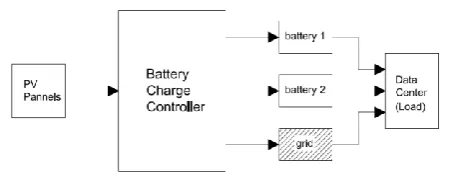
Figure 1 shows a schematic of the system with solar panel.
Fig. 1: Block diagram of the system
In this paper modeling of a grid connected solar cell system is used to present power supply stability. The model in Eq.1 is presented in [21] describes electrical characteristics of a solar cell.
(1)
In which Ir is irradiance; T is junction temperature; I_O is
saturation current; q is elementary charge of an electron; n is an ideality factor; k is Boltzmann’s constant; Np is the number
of cells in parallel and Ns is the number of cells in series. By increase of irradiance the output power will increase. But as it is presented higher temperature results lower output power and vice versa. So as a result a place with good irradiance and low temperature will boost the efficiency.
There are different methods used for controlling the solar panels. Maximum Power Point Tracker (MPPT) is a method that holds the output power of the PV panels, rather constant. Low cost MPPTs are designed to control the PV panels to operate off-grid. For example MPPT model presented in [22] does not need any external control signal to determine the working point. In [23] a robust three phase model for MPPT in PV panels connected to the grid is presented which by using MPPT and a current controller regulates the current. This model prevents the current overshoot. But in this paper in order to control the PV panels the controller or MPPT is not used, so that the effect of the variation of the sunlight in day on the constant load can be illustrated and also power continuity in a data center during the day can be demonstrated.
Charge controller manages the charging and discharging process of batteries. In fact it determines when a battery must be charging or discharging over the load in order to provide the power. For example in [24] a charge controller for lead acid batteries by using PWM in PI algorithm for standalone system is proposed. An improper algorithm of charge controller can harm the lead acid batteries. Scrutinizing the charge controller and analyzing it, is not the objective of this paper.
In [25] by developing an intelligent charge controller manufactured by Thompson microcontroller, the efficiency is increased by using a Microcontroller. The charge controller used in this paper is an intelligent charge controller which is capable of programming and sending controlling signals to start and stop, charging and discharging of batteries and power grid. The logic statements used for charge controller are as follows:
(2 )
A data center needs a huge amount of energy for IT devices and cooling requirements. For example using Combined Cooling, Heating and Power (CHP) causes a great heat generation. A discussion has been made in [23] about the application of the cooling system and IT devices together. It must be taken into account that a data center consumes a fairly constant energy and only during the night due to the
( ) 1 ( 1 99). 1
( ) 2 ( 2 99). 1. 2
( ) 1. 2.
( ) 1 ( 1 35). 1 ( 1 35).( 2 35).( 0)
( ) 2 ( 2 35). 2. 1
( ) 1. 2
a Chg Bat Dis
b Chg Bat Chg Dis
c ChGd Chg Chg DsGd
d Dis Bat Chg Bat Bat PV Cnt
e Dis Bat Chg Dis
f DsGd Dis Dis
exp 1
100
PV r
PV P SC P o
S qV I
I N I N I
nkTN
© 2017, IRJET | Impact Factor value: 5.181 | ISO 9001:2008 Certified Journal
| Page 635
decrease of temperature, power consumption of the cooling system reduces.
3. SIMULATION RESULTS
The data center used for simulations needs 2 MW electric power. The power demand of a data center is rather constant, but %20 decrease of power demand is taken into account at nights within 12 AM and 5 AM due to reduction of cooling system power demand and fewer operation of computational operation of data center. The electric power needed by data center is provided by solar panels and power grid simultaneously.
The system considered for simulation consists of two chargeable batteries, 10000 and 8000 Ah, and also a huge battery with %50 statement of charge which represents the power grid and all of them can be charged by solar panels. Voltage of batteries is 48V and voltage of power grid is 220V. Single phase model of the system is implemented and the simulations are based on the power produced and consumed. Battery Charge Controller controls the process charging and discharging of the batteries based on logical directives. In order to convert DC to AC or vice versa, inverter or converter with efficiency of 0.95 is used.
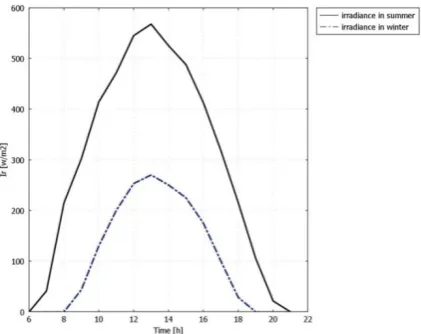
The irradiance graph of the sun in Tehran is shown in Fig. 2. Since Iran is located in a proper position that absorbs ample amount of sunlight, and the solar power in some areas exceeds 1000 w/m^2, this country has the great potential of using solar power.
Fig. 2: Irradiance of the sun in Tehran in summer and winter
Fig. 2 shows the solar power of the sun in the Tehran in a day, in summer and winter. As it can be seen these two figures are different, that affects the output power of the PV panels. The data center is located in Tehran, whose geographical coordination is shown in Table 1:
Table 1: Geographical coordination of Tehran
N E
51°25'23.00" 35°41'46.00"
The amount of sunlight that PV panels absorb, determines the output power of the PV panels. Based on simulations results and also Eq. 1 output power of the PV panels which consist of 10000 panels with 72 cells in series, reaches 1.2 MW at maximum in midday. Anyway it is lower than the power needed by data center most of the time. This fact is illustrated in Fig. 3.
Fig. 3: Power generated by PV panels
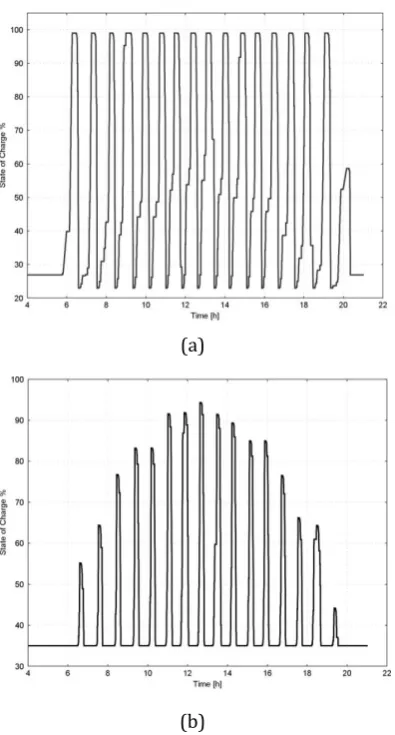
During operation of PV panels, the batteries are charging or discharging. The first battery works as the primary battery, and the second battery is known as backup to enhance the reliability of the system. This battery provides a portion of the load, when the primary battery cannot supply the load. State of charge (SOC) of two batteries is shown in Fig. 4.
As it can be seen in Fig. 4 based on the algorithm of the charge controller, the SOC of the batteries vary between 33% and %99. And also while the primary is charging the backup battery is discharging and supplying the power. In other words it can be said that the backup battery works as the complement of the primary battery.
[image:3.595.326.539.216.387.2] [image:3.595.58.269.447.614.2]© 2017, IRJET | Impact Factor value: 5.181 | ISO 9001:2008 Certified Journal
| Page 636
(a)
(b)
Fig. 4: Variation of the SOC of (a) primary battery (b) backup battery
In the configuration of the power system considered in this paper the power grid is capable of providing the 2 MW load of the data center and it undertakes the load whenever the sun is not available or batteries are charging and cannot provide the needed power to run the data center. Thus during the intervals which the batteries are charging, the power grid supplies the total load. Figure 5 depicts the power provided by the power grid.
Fig. 5: Power provided by grid
4. CONCLUSION
Based on simulations carried out following results can be concluded:
1) In order to enhance the reliability of the power supply, two or more batteries are needed. But they can be in smaller size. Thus in case of failure of one of the batteries continuous operation of the solar energy supply is guaranteed. It also gives more flexibility to have control over operation of the power supply.
2) It is shown that in the simulated configuration over a week solar energy provides %18 of the total energy needed by operation of the data center. This fact leads to reduction of the cost of the operation. Consequently, it can justify the high amount of capital the solar energy system needs to be installed.
3) Using solar power in a data center in addition to providing power and reducing the air pollution, can increase the sustainability of power system. If the power is supposed to be generated locally for a limited period, for example when power grid is not available, solar power increases the reliability of power system alongside the UPS and generators.
REFERENCES
[1] H. Norouzi, S. Abedi, R. Jamalzadeh, M. Ghiasi Rad, S.H. Hosseinian, “Modeling and investigation of harmonic losses in optimal power flow and power system locational marginal pricing.” ENERGY Journal, Science Direct, P-68, 2014. 140e147.
[2] H. Jouybari Moghaddam, S.H. Hosseinian, B. Vahidi, M. Ghiasi Rad, “Smart Control mode selection for proper operation of synchronous distributed generators”, 2nd Iranian Conference on Smart Grids , Iran (Islamic Republic of) , 2012.
[3] Babaei, Mehdi, Maziar Babaei, and Mohsen Niasati. "Parametric analysis of overvoltages caused by back-flashover in “Siah-bishe” 400kV GIS substation." Electric Power and Energy Conversion Systems (EPECS), 2013 3rd International Conference on. IEEE, 2013.
[4] S Jafarishiadeh, M Ardebili, A Nazari Marashi, “Investigation of pole and slot numbers in axial-flux pm bldc motors with single-layer windings for electric vehicles,” 24th Iranian Conference on Electrical Engineering (ICEE), pp. 1444-1448, 2016.
[5] Babaei, Maziar, Mehdi Babaei, and Ghasem Nourirad. "Analysis of influential factors in determining Very Fast Transient Overvoltages of GIS substations." Power Engineering and Optimization Conference (PEOCO), 2014 IEEE 8th International. IEEE, 2014.
[image:4.595.72.270.94.462.2]© 2017, IRJET | Impact Factor value: 5.181 | ISO 9001:2008 Certified Journal
| Page 637
[7] R. Jalilzadeh Hamidi and H. Livani, “Myopic real-time decentralized charging management of plug-in hybrid electric vehicles,” Electric Power System Research, Vol. 143, pp. 522-543, 2017.
[8] Seyyedmahdi Jafari Shiadeh, Mohammad Ardebili, and Parvin Moamaei, “Three-dimensional finite-element-model investigation of axial-flux PM BLDC machines with similar pole and slot combination for electric vehicles”, In: Proceedings of Power and Energy Conference, Illinois, pp. 1– 4, 2015.
[9] S. Akhlaghi, M. Sarailoo, M. Rezaeiahari, H. A. Sangrody, “Study of Sufficient Number of Optimal Tilt Angle Adjustment to Maximize Residential Solar Panels Yield” IEEE Power and Energy Conference at Illinois (PECI), 2017. Illinois, USA, Feb, 2017.
[10] Farshid Abbasi, Javad Mohammadpour, Roland Tóth, and Nader Meskin. "A support vector machine-based method for LPV-ARX identification with noisy scheduling parameters," In Proceeding of European Control Conference (ECC), pp. 370-375. 2014.
[11] Farshid Abbasi, Javad Mohammadpour, Roland Tóth, and Nader Meskin. "A Bayesian approach for model identification of LPV systems with uncertain scheduling variables," In 54th Annual IEEE Conference on Decision and Control (CDC), pp. 789-794, 2015.
[12] Khalili A., Jha R., Samaratunga D. “Spectrally Formulated User-Defined Element in Conventional Finite Element Environment for Wave Motion Analysis in 2-D Composite Structures” European Journal of Computational Mechanics, November 11, 2016, DOI: 10.1080/17797179.2016.1253364 [13] Khalili A., Samaratunga D., Jha R., Lacy T. E., Gopalakrishnan S. “WSFE-based User-Defined Elements in ABAQUS for Modeling 2D Laminated Composites with Complex Features” 30th ASC Technical Conference, Michigan State University, East Lansing, MI, US, 28-30 September 2015. [14] Yaghoobi, Amin, and Mi G. Chorzepa. "Meshless modeling framework for fiber reinforced concrete structures." Computers & Structures 161 (2015): 43-54.
[15] Yaghoobi, Amin, and Mi G. Chorzepa. "Fracture analysis of fiber reinforced concrete structures in the micropolar peridynamic analysis framework." Engineering Fracture Mechanics 169 (2017): 238-250.
[16] P. Gharghabi, J. Lee, M. S. Mazzola, and T. E. Lacy Jr., “Development of an Experimental Setup to Analyze Carbon/Epoxy Composite Subjected to Current Impulses,” Am. Soc. Compos. Thirty-First Tech. Conf., 2016.
[17] P. Gharghabi, P. Dordizadeh B., and K. Niayesh, “Impact of Metal Thickness and Field-Shaper on the Time-Variant Processes during Impulse Electromagnetic Forming in Tubular Geometries,” Journal of the Korean Physical Society, vol. 59, no. 61, 2011, p. 3560-3566.
[18] P. Dordizadeh-Basirabad, P. Gharghabi, and K. Niayesh, “Dynamic Analysis of a Fast-acting Circuit Breaker (Thompswon) Drive Mechanism,” J. Korean Phys. Soc., vol. 59, no. 61, p. 3547, 2011.
[19] Aghniaey, Sama, and Seyed Mohammad Seyed Mahmoudi. "Exergy analysis of a novel absorption
refrigeration cycle with expander and compressor." Indian Journal of Scientific Research (2014).
[20] Aghniaey, Sama, S. Mohammad S. Mahmoudi, and Vahid Khalilzad-Sharghi. "A comparison between the novel absorption refrigeration cycle and the conventional ammonia-water absorption refrigeration cycle." International Conference on Heat Transfer, Fluid Mechanics and Thermodynamics, 2014.
[21] Affordable Solar Group, LLC, “SMA Sunny Boy SB 2500 Inverter with ESS Switch,” May 2008, http://www.affordable-solar.com/sunny-boy-2500-inverter-export.htm
[22] Zhongyi He et al., "Low cost MPPT controller for off grid solar Applications", IEEE ICMS, 2010.
[23] Il-Song Kim, "System dynamic model and charging control of lead-acid battery for stand-alone solar PV system," Elsevier, Solar Energy 81, 2007, pp. 405–414.
[24] B.J. Huang, et al., "System dynamic model and charging control of lead-acid battery for stand-alone solar PV system", Elsevier, Solar Energy 84, 2010, pp. 822–830.
[25] H. Mashelini and X. F. CARELSE, "Microcontroller-Based Charge Controller for Stand-Alone Photovoltaic Systems," Elsevier, Solar Energy Vol. 61, No. 4, 1997, pp. 225–230. [26] M. Ghiasi Rad, M. Rahmani, P. Gharghabi, A. Zoghi and S. H. Hosseinian, "Scheduling a Wind Hydro-Pumped-Storage Unit Considering the Economical Optimization," American Journal of Electrical and Electronic Engineering, vol. 5, no. 1, pp. 16-22, 2017.