http://dx.doi.org/10.4236/jpee.2015.34008
How to cite this paper: Wang, X., Shi, Y.X., Cai, N.S., Lv, X.C. and Yao, W. (2015) Low Pressure Catalytic Combustion of Hy-drogen on Palladium. Journal of Power and Energy Engineering, 3, 49-55. http://dx.doi.org/10.4236/jpee.2015.34008
Low Pressure Catalytic Combustion of
Hydrogen on Palladium
Xi Wang
1, Yixiang Shi
1*, Ningsheng Cai
1, Xiaocheng Lv
2, Wei Yao
21Key laboratory for Thermal Science and Power Engineering of Ministry of Education, Department of Thermal
Engineering, Tsinghua University, Beijing, China
2China Academy of Space Technology, Zhongguancun Nandajie, Beijing, China
Email: *[email protected]
Received December 2014
Abstract
Exhausts of airship fabric bag in the stratosphere such as hydrogen which can be used for fuels by using catalytic combustion method. This can save the extra fuels used in the power system. Pd/γ- Al2O3 catalyst was prepared in this work by impregnation method and the H2 catalytic combustion
reaction kinetic was investigated between the pressure of 3.6 kPa and 101.3 kPa. The effects of temperature, pressure and gas composition ratio were studied in the paper. According to the ex-periment results, the increase of temperature increases the H2 conversion. The parameter
pres-sure has a positive effect on H2 reaction kinetics and low concentration of H2 in mixtures shows
better performance. The dependence of temperature on H2 reaction rate becomes more sensitive
in high pressure.
Keywords
Airship, Hydrogen, Catalytic Combustion, Impregnation, Reaction Kinetic
1. Introduction
The airship fabric bag emissions of dilute hydrogen can be used in the power generation system by low temper-ature catalytic combustion technology. Due to the low pressure in the stratosphere, the application of catalytic combustion in stratospheric airship power generation system provides the advantages of low ignition tempera-ture at lean combustion conditions, low pollution emissions, high combustion efficiency and stability [1]-[6] when compared with conventional combustion technology. Exothermic energy obtained from hydrogen catalytic combustion reaction can be provided to the power generation system as heat source which avoids carrying addi-tional fuels into the stratosphere.
For the catalysts of the low temperature catalytic combustion of hydrogen, noble metal catalysts such as pal-ladium and platinum have attracted large attention because of their high catalytic combustion activity and rela-tive simple preparation method [7] [8]. Depending on the catalysts, different wash coats are adopted such as Al2O3, CeO2et al. The wash coats should have large specific surface area and high thermal stability [9] [10] to
improve the dispersity of the active component and activity of the reactants.
While in the stratosphere the pressure is between 5.5 kPa and 1.2 kPa [11], the H2 reaction kinetics in low pressure and atmospheric pressure are differed from each other. Consequently, it is important to find out the dif-ference between each other. This study focused on experiment studies of low pressure hydrogen catalytic com-bustion on Pd/γ-Al2O3 catalyst with the tested pressure varying from 3.6 kPa to 101.3 kPa. In the experimental part, a fixed bed reactor experiment set-up was used, in which different pressures were tested between the reac-tion temperature of 100˚C and 150˚C. Additionally, different ratios of the fuel to oxidizer were applied to inves-tigate the effect of H2 concentration on the reaction kinetics.
2. Experiment
2.1. Experiment Set up
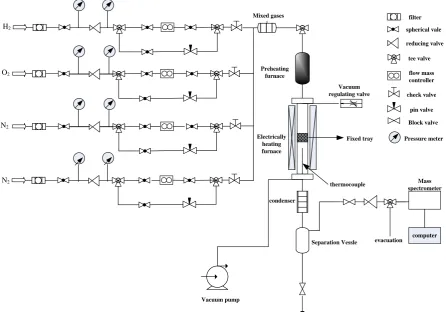
In the present work, the sketch of the fixed bed quartz reactor set-up is shown in Figure 1. The reactor is made up of quartz glass tube that has a diameter of 1.1 cm. Catalysts are filled into the fixed tray in the middle of the reactor and thermocouple is attached to it to test the temperature. The furnace is used for ignition of the reaction if needed. All relevant products in the outlet are detected by mass spectroscopy (MS) measurement device. When the experiments are operated below the atmospheric pressure, the vacuum pump is used to make sure a low pressure atmosphere in the reactor. And the vacuum regulating valve is used to adjust the pressure to the testing pressure in the reactor.
2.2. Catalyst Preparation and Characterization
The γ-Al2O3 supported Pd catalyst was prepared by impregnation method. The substrate is alumina spherical grain that has a diameter of about 1 mm. Pd was incorporated in the substrate by impregnation from Pd(NO3)2
[image:2.595.91.538.385.697.2]Mixed gases evacuation Preheating furnace Electrically heating furnace condenser Mass spectrometer H2 O2 N2 N2 Vacuum pump Vacuum regulating valve thermocouple Fixed tray filter spherical vale reducing valve tee valve flow mass controller check valve Pressure meter pin valve computer Block valve Separation Vessle
aqueous solution. The catalyst was heated by oil bath at 120˚C for 2 h and dried at 120˚C for 30 min. Subse-quently it was calcined at 500˚C for 10 h. The mass percent of Pd is 3.9wt%.
Specific surface area of the substrate was measured by the adsorption of N2using the Micromeritics ASAP- 2000 specific surface area analyzer. According to the result, the specific surface area was 280.5 m2∙g−1 and it is large enough to be the catalyst supporter.
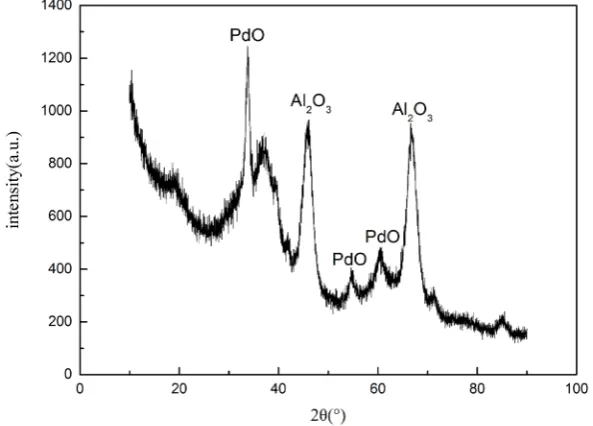
[image:3.595.150.447.233.446.2] [image:3.595.156.449.465.703.2]The prepared catalyst was characterized by powder X-ray diffraction (XRD), scans were performed over a 2θ range from 10˚ to 90˚. The materials are shown in Figure 2, indicating that the active catalyst phase is PdO. In the characterization, the diffraction peak of PdO exists in the diffraction angle of 35˚, 55˚, 60˚. According to the microstructure characterization shown in Figure 3, the small PdO particles are distributed well on the surface of Al2O3 support and the aggregation of the PdO particles is not obvious. The EDS analysis in point 1 is shown in Table 1 and the weight ratio of Al to Pd is close to 1.
Figure 2. XRD of catalyst before testing.
1
60μm
2.3. Measurement Conditions
To investigate the catalytic activity of H2 on Pd/Al2O3 in atmospheric pressure and the vacuum pressure, a series of experiments were carried out at different operation conditions such as total reaction pressure, H2/O2 equiva-lence ratio, temperature. The hydrogen and oxygen mixtures were diluted by nitrogen at total flow rate of 0.056 standard liter per minute (slpm). The furnace was used to ignite the reaction by heating up the reactor until light off occurs. The mass of the catalyst was 0.02 g. In addition, more Al2O3 sphere particles without impregnating active component Pd were filled in the reactor.
3. Results and Discussion
3.1. Effect of Total Reaction Pressure on the Catalytic Combustion Performance
[image:4.595.189.410.378.547.2]Reaction pressure is an important parameter of H2 catalytic combustion reaction kinetics. In this paper three dif-ferent pressures were adopted to study the influence of pressure on catalytic activity. Experiment operating con-ditions are listed in Table 2. The molar ratio of H2 to O2 is 0.6 which means equivalence ratio is 0.3. As can be observed in Figure 4, results show that the conversion of H2 increases with increasing pressure. The slow de-crease of conversion is seen from atmospheric pressure of 101.3 kPa to low pressure 3.6 kPa indicating that pressure has a gentle influence on H2 conversion performance. At 125˚C, the conversions are 0.58 and 0.56 re-spectively. Though pressure decreases by 1/28 of atmospheric pressure, the conversion has decreased by 2% displayed by experiment results. This phenomena is similar to the experimental results conducted by Michael [12]. In the experiments, the reaction rate of methane catalytic combustion on Pt/Al2O3 catalyst increases with increasing pressure above atmospheric pressure. The study of the effect of pressure on H2 conversion perfor-mance indicates that H2 catalytic combustion in low pressure environment conditions is available and can achieve good performance as in atmospheric pressure.
[image:4.595.88.536.592.651.2]Figure 4. H2conversion in different pressures at 125˚C.
Table 1. The element contents in point 1.
Element Weight ratio (%) Atom ratio (%)
O 23.63 45.36
Al 38.38 43.68
Pd 37.99 10.96
Table 2. Main parameters of experiment study.
Reactants molar ratio H2:O2:N2 = 0.6:1:4
Temperature (˚C) 125
[image:4.595.87.538.679.724.2]3.2. Effect of Temperature on the Catalytic Activity
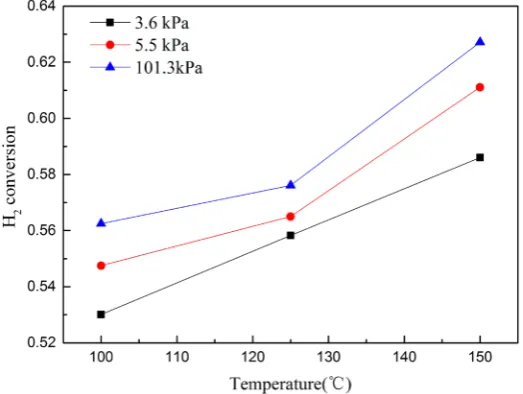
The effect of temperature on the lean burn hydrogen catalytic combustion at the equivalence ratio of 0.3(H2/O2 = 0.6) are shown in Figure 5. It is observed that at the pressure of 3.6 kPa, hydrogen conversion increases by 5.6% from 100˚C to 150˚C, while at 5.5 kPa and 101.3 kPa the conversions increase by 6.4% and 6.5% respectively. The parameter temperature has a gentle positive influence on H2 conversion. Theoretically, high temperature is beneficial for the improvement of H2 reaction kinetics. Comparing the effects of pressure with temperature, the influence of temperature in improving reaction kinetics is a little larger than pressure.
3.3. Effect of Equivalence Ratio on the Catalytic Activity
The different inlet reactants ratios of H2 to O2 were investigated at different pressures on the H2 catalytic activity. As shown in Figure 6, it is found that hydrogen conversion increases with decreasing equivalence ratio which indicates that the increase in the concentration of H2 lead to the decrease of hydrogen conversion. This may be due to the reason that the diffusion of H2 on the catalyst surface is inhibited in high H2 concentration conditions. More active reaction sites are occupied by H2 molecules through adsorption process. This in turn increases the reaction pathway between H2 and O2 molecules that leads to the decrease of H2 conversion. Therefore, the equi-valence ratio of 0.3(H2/O2 = 0.6) is the optimal choice in whatever low pressure or atmospheric pressure.
3.4. The Dependence of Temperature on H
2Reaction Rate at Different Pressures
Figure 7 gives the dependence of temperature on H2 reaction rate with pressure varying from 3.6 kPa to 101.3 kPa with H2/O2 = 0.6. The reaction rate r represents the H2 reaction moles per second. It can be seen that the reaction rate can be enhanced with increasing pressures. The increase of temperature also increases the reaction rate. With the increase of pressure, the improvement of temperature on reaction rate becomes more significant. Table 3 gives the expressions of H2 reaction rates in different pressures. Obviously, when the pressure gets higher, the dependence of temperature on H2 reaction rate becomes larger. In the low pressure region, the reac-tion rate increases with temperature linearly.
4. Conclusion
[image:5.595.168.430.495.692.2]The airship fabric bag emissions of dilute hydrogen can be used for fuels in the stratosphere. The Pd/γ-Al2O3 catalyst was prepared by impregnation method. The reaction kinetics of H2in atmospheric pressure and low pressure (of 5.5 kPa) were investigated. The parameter of pressure has a little positive effect on H2 conversion performance with the pressure varying from 3.6 kPa to 101.3 kPa. The increase of temperature leads to the
Figure 6. Hydrogen conversion of different H2 to O2 ratios at 100˚C
and 150˚C.
Figure 7. Reaction rates of H2 between 100˚C and 150˚C at different
[image:6.595.173.425.508.694.2]Table 3. Reaction rates of H2 in different pressures.
p (kPa) r (mol/s)
3.6 r exp 316.4 12.053
T
= − −
5.5 r exp 343.2 11.957
T
= − −
101.3 r exp 338.8 11.944
T
= − −
increase of H2 conversion. And low concentration of H2 is beneficial for H2 conversion performance due to the inhibited surface diffusion processes. The reaction rates of H2 on the dependence of temperature at three pres-sures are given. Results suggest that the effect of temperature becomes more sensitive at high pressure. The reaction rate of H2 is also higher in high pressure conditions.
Acknowledgements
This work is supported by China Academy of the Space Technology (The Fifth Research Institute) and Tsinghua University.
References
[1] Pfefferle, L.D. and Pfefferle, W.C. (1987) Catalysis in Combustion. Catalysis Reviews: Science and Engineering, 29, 219-267. http://dx.doi.org/10.1080/01614948708078071
[2] Hardiyanto, W., Koshi, S., Koichi, E. and Hiromichi, A. (1999) Oxidation of Methane over Pd/Mixed Oxides for Cat-alytic Combustion. Catalysis Today, 47, 95-101. http://dx.doi.org/10.1016/S0920-5861(98)00286-7
[3] Kikuchi, R., Maeda, S., Sasaki, K., et al. (2003) Catalytic Activity of Oxide-Supported Pd Catalysts on a Honeycomb-for Low-Temperature Methane Oxidation. Applied Catalysis A, 239, 169-179.
http://dx.doi.org/10.1016/S0926-860X(02)00387-3
[4] Soraia, T.B., Emerson, A.S., Luca, L., et al. (2006) Methane Combustion over PdO-Alumina Catalysts: The Effect of Palladium Precursors. Applied Catalysis B, 63, 9-14. http://dx.doi.org/10.1016/j.apcatb.2005.08.009
[5] Deutschmann, O., Behrendt, F. and Wamatz, J. (1994) Modelling and Simulation of Heterogeneous Oxidation of Me-thane on a Platinum Foil. Catalysis Today, 21, 461-470. http://dx.doi.org/10.1016/0920-5861(94)80168-1
[6] Marco, S. and John, M. (2013) Hetero-/Homogeneous Combustion of Hydrogen/Air Mixtures over Platinum: Fuel-Lean versus Fuel-Rich Combustion Modes. International Journal of Hydrogen Energy, 38, 10654-10670.
http://dx.doi.org/10.1016/j.ijhydene.2013.06.069
[7] Thevenin, P. (2002) Catalytic Combustion of Methane. Ph.D. Thesis, KTH-Kungliga Tekniska Högskolan.
[8] Kramer, J.F., Reihani, S.-A.S. and Jackson, G.S. (2002) Low-Temperature Combustion of Hydrogen on Supported Pd Catalysts. Proceedings of the Combustion Institute, 29, 989-996. http://dx.doi.org/10.1016/S1540-7489(02)80125-0
[9] Jin, L.Y., He, M., Lu, J.Q., et al. (2008) Palladium Catalysts Supported on Novel CexY1-xO Washcoats for Toluene Catalytic Combustion. Journal of Rare Earths, 26, 614-618. http://dx.doi.org/10.1016/S1002-0721(08)60148-9
[10] Kikuchi, R., Maeda, S., Sasaki, K., Wennerström, S., Ozawa, Y. and Eguchi, K. (2003) Catalytic Activity of Oxide- Supported Pd Catalysts on a Honeycomb for Low-Temperature Methane Oxidation. Applied Catalysis A: General, 239, 169-179. http://dx.doi.org/10.1016/S0926-860X(02)00387-3
[11] Zhang, J.M. and Lu, Y.P. (2007) Research on Equilibrium Point Estimation of Stratospheric Balloon Trajectory Con-trol System. Aerospace ConCon-trol, 25, 4-9.
[12] Reinke, M., Mantzaras, J., Schaeren, R., et al. (2004) High Pressure Catalytic Combustion of Methane over Platinum: In Situ Experiments and Detailed Numerical Predictions. Combustion and Flame, 136, 217-240.