© 2017, IRJET | Impact Factor value: 5.181 | ISO 9001:2008 Certified Journal
| Page 2120
Recent Advancement in Shape Memory Alloy
Prof Mr.Aniket Kolekar
1, Mr.Akshay Natak
2, Mr.kiran Navratne
3Prof.Mr.Amol Mali
414
Assistant Professor ,Mechanical Department , DYPIEMR Akurdi,Pune
2Under Graduate Student , Mechanical Department, DYPIEMR Akurdi,Pune
3Under Graduate Student ,Mechanical Department, DYPIEMR Akurdi,Pune
ABSTRACT
Shape memory alloys (SMAs) belong to a class of shape memory materials (SMMs), which have the ability to ‘memorise’ or retain their previous form when subjected to certain stimulus such as thermo mechanical or magnetic variations. SMAs have drawn significant attention and interest in recent years in a broad range of commercial applications, due to their unique and superior properties; this commercial development has been supported by fundamental and applied research studies. This work describes the attributes of SMAs that make them ideally suited to actuators in various applications, and addresses their associated limitations to clarify the design challenges faced by SMA developers. This work provides a timely review of recent SMA research and commercial applications, with over 100 state-of-the-art patents; which are categorized against relevant commercial domains and rated according to design objectives of relevance to these domains (particularly automotive, aerospace, robotic and biomedical). Although this work presents an extensive review of SMAs, other categories of SMMs are also discussed; including a historical overview, summary of recent advances and new application opportunities.
Keywords
:
Shape memory alloy, Shape memory materials, Biomedical applications.1. SHAPE MEMORY ALLOY
A shape-memory alloy (SMA, smart metal, memory
metal, memory alloy, muscle wire, smart alloy) is an alloy that "remembers" its original shape and that when deformed returns to its pre-deformed shape when heated. This material is a lightweight, solid-state alternative to
conventional actuators such as hydraulic, pneumatic,
and motor-based systems in robotics and automotive, aerospace and biomedical indu stries.[3]
The two main types of shape-memory alloys are
copper-aluminium-nickel, and nickel-titanium (NiTi) alloys but
SMAs can also be created by
alloying zinc, copper, gold and iron. Although iron-based
and copper-based SMAs, such as Fe-Mn-Si, Cu-Zn-Al and Cu-Al-Ni, are commercially available and cheaper than NiTi, NiTi based SMAs are preferable for most applications
due to their stability, practicabilityand superior
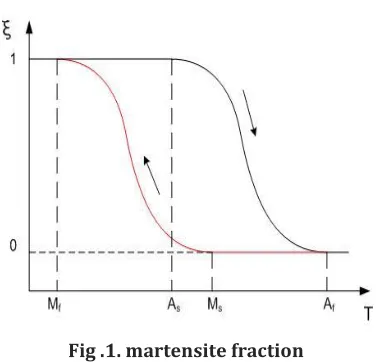
thermo-mechanic performance. SMAs can exist in two different phases, with three different crystal structures (i.e. twinned martensite, detwinned martensite and austenite) and six possible transformations[2]
NiTi alloys change
from austenite to martensite upon cooling; Mf is the
temperature at which the transition to martensite
completes upon cooling. Accordingly, during
heating Asand Af are the temperatures at which the
transformation from martensite to austenite starts and finishes. Repeated use of the shape-memory effect may lead to a shift of the characteristic transformation temperatures (this effect is known as functional fatigue, as it is closely related with a change of microstructural and functional properties of the material). The maximum temperature at which SMAs can no longer be stress
induced is called Md, where the SMAs are permanently
deformed.[2]
The transition from the martensite phase to the austenite phase is only dependent on temperature and stress, not time, as most phase changes are, as there is no diffusion involved. Similarly, the austenite structure receives its name from steel alloys of a similar structure. It is the reversible diffusionless transition between these two phases that results in special properties. While martensite
can be formed from austenite by rapidly cooling
carbon-steel, this process is not reversible, so steel does not have shape-memory properties.[2]
1.1
ONE-WAY MEMORY EFFECT
© 2017, IRJET | Impact Factor value: 5.181 | ISO 9001:2008 Certified Journal
| Page 2121
heating, the shape changes to its original. When the metal cools again it will remain in the hot shape, until deformed again.[1]
With the one-way effect, cooling from high temperatures does not cause a macroscopic shape change. A deformation is necessary to create the low-temperature
shape. On heating, transformation starts at As and is
completed at Af (typically 2 to 20 °C or hotter, depending
on the alloy or the loading conditions). As is determined by
the alloy type and composition and can vary between −150 °C and 200 °C.[1]
1.2 TWO-WAY MEMORY EFFECT
The two-way shape-memory effect is the effect that the material remembers two different shapes: one at low temperatures, and one at the high-temperature shape. A material that shows a shape-memory effect during both heating and cooling is said to have two-way shape memory. This can also be obtained without the application of an external force (intrinsic two-way effect). The reason the material behaves so differently in these situations lies in training. Training implies that a shape memory can "learn" to behave in a certain way. Under normal circumstances, a shape-memory alloy "remembers" its low-temperature shape, but upon heating to recover the high-temperature shape, immediately "forgets" the low-temperature shape. However, it can be "trained" to "remember" to leave some reminders of the deformed low-temperature condition in the high-low-temperature phases. There are several ways of doing this. A shaped, trained object heated beyond a certain point will lose the two-way memory effect.[1]
2. SUPERELASTICITY(SE)
[image:2.612.357.546.92.273.2]SMAs also display superelasticity, which is characterized by recovery of unusually large strains. Instead of transforming between the martensite and austenite phases in response to temperature, this phase transformation can be induced in response to mechanical stress. When SMAs are loaded in the austenite phase, the material will transform to the martensite phase above a critical stress, proportional to the transformation temperatures. Upon continued loading, the twinned martensite will begin to detwin, allowing the material to undergo large deformations. Once the stress is released, the martensite transforms back to austenite, and the material recovers its original shape. As a result, these materials can reversibly deform to very high strains – up to 8 percent.[1]
Fig .1. martensite fraction
In this figure, ξ(T) represents the martensite fraction. The difference between the heating transition and the cooling
transition gives rise to hysteresis where some of the
mechanical energy is lost in the process. The shape of the curve depends on the material properties of the
shape-memory alloy, such as the alloying.and work hardening.[1]
3. RECENT DEVELOPMENT
In the 1990’s, the term shape memory technology
(SMT) was introduced into the SMM community. SMA application design has changed in many ways since then and has found commercial application in a broad range of industries including automotive, aerospace, robotics and biomedical. Currently, SMA actuators have been successfully applied in low frequency vibration and actuation applications. Therefore, much systematic and intensive research work is still needed to enhance the performance of SMAs, especially to increase their bandwidth, fatigue life and stability.[2]Recently, many researchers have taken an experimental approach to enhance the attributes of SMAs, by improving the material compositions (quantifying the SMA phase transition temperature) to achieve a wider operating temperature range, and better material stability, as well as to improve the material response and stroke with better mechanical design (or approach), controller systems and fabrication processes. Research into alternative SMMs, forms or shapes, such as MSMA, HTSMA, SMP, shape memory ceramic, SMM thin film or a combination of them (i.e. hybrid or composite SMMs), are also intensively being conducted, and the number of commercial applications is growing each year More details of recent applications and development of SMA are described in the subsequent sections.[2]
© 2017, IRJET | Impact Factor value: 5.181 | ISO 9001:2008 Certified Journal
| Page 2122
areas are presented in. BCC research reported that the global market for smart materials was about USD19.6 billion in 2010, estimated to approach USD22 billion in 2011 and forecasted to reach over USD40 billion by 2016 with a compound annual growth rate (CAGR) of 12.8% between 2011 and 2016. The largest application segment of the market is actuators and motors, with sales of nearly USD10.8 billion (55% of the total market) in 2010 and forecasted to reach USD25.4 billion (approximately 64% of the market) by 2016 with CAGR of 15.4% between 2011 and 2016.[3]
Inventor year Remark Description
TROX (2013) Aircondition jet nozzle automatically SMAto adjust the jet nozzle of an air-condition system Khan et
al. (2013) Multiple Shapes SMA Multiple shapes of SMA at various temperatures could be achieved by using a new process, namely Multiple Memory Material
Technology (MMMT).
CRDF
Global (2013) FSMA NiMn FSMA can be used for actuation, sensing, magnetic
refrigeration, active tissue scaffolding and energy harvesting
Table-1: recent development
4. TYPES OF SHAPE MEMORY MATERIALS
4.1 HIGH TEMPERATURE SHAPE MEMORY
ALLOYS
Extensive research for HTSMAs with other ternary additions to the NiTi SMA (e.g. Au, Hf, Pd, Pt and Zr) has been undertaken, due to the increasing demands for high-temperature applications. Practically, HTSMAs are defined as SMAs that are operating at temperatures above 100 _C, and can be categorized into three groups based on their martensitic transformation ranges .[2]
4.2 MAGNETIC SHAPE MEMORY ALLOYS
Magnetic shape memory alloys (MSMAs), which are also known as ferromagnetic shape memory alloys (FSMAs) can actuate at higher frequencies (up to 1 kHz) because the actuation energy is transmitted via magnetic fields and is not hindered by the relatively slow heat transfer mechanism . FSMA strain rate is quite comparable to magnetostrictive and piezoelectrics active elements, but at strains as large as SMAs. FSMA can also provide the same specific power as SMAs, but deliver it at higher frequencies.[2]
4.3 SHAPE MEMORY MATERIAL THIN FILMS
SMM thin films evolved from the advancement of fabrication technology, where SMMs are deposited directly onto micromachined materials or as stand-alone thin films to become micro- actuators. Moreover, in the rapidly growing field of micro-electro-mechanical systems (MEMSs), NiTi thin films have become the actuator of choice at the micro-scale level, due to the attributes as described earlier (i.e. higher actuation force and displacement), but at relatively low frequency (up to 100 Hz) and efficiency as well as the non-linear behaviour The versatility of NiTi thin film with multiple degrees of freedom and compact structure, expand the potential of NiTi in biomedical, aerospace, automotive, and consumer products applications.[2]
4.4 SHAPE MEMORY POLYMERS
dual-© 2017, IRJET | Impact Factor value: 5.181 | ISO 9001:2008 Certified Journal
| Page 2123
component mechanism (DCM) and partial-transition mechanism (PTM). The recovery precision of more than 99% makes SMPs suitable for highly demanding applications. Similar to SMAs, the SME of SMPs varies depending on the composition of the material used, i.e. weight fraction of the switching segments and the molecular weight of the polymer-chain employed. The biodegradable nature of certain SMPs provide advantages over metal implants, where the removal of the implant after regeneration can be avoided, thus gentler, more effective and more economical treatments can be offered. However, despite the advantages described above, SMAs are still preferred for applications that require higher actuation forces and faster response [2].
5.
BIOMEDICAL APPLICATIONS
After the discovery of the SME in nitinol by Buehler et al. in 1962, they proposed to use this material for implants in dentistry, and a few years later, the first superelastic braces made from a NiTi alloy were introduced by Andreasen in 1971. SMA made a significant breakthrough into biomedical domain after its introduction in minimally invasive surgery (MIS), and more biomedical applications are developed and introduced into the market after the approval of the Mitek surgical product (i.e. Mitek Anchor) for orthopaedic surgery by US Food and Drug Administration (FDA) in September 1989. Although NiTi alloys are significantly more expensive than stainless steels, SMAs have exhibited excellent behaviour for biomedical applications such as high corrosion resistance, bio-compatible, non-magnetic, the unique physical properties, which replicate those of human tissues and bones, and can be manufactured to respond and change at the temperature of the human body.[2]
Fig.2. The stress versus strain relationship for superelastic nitinol, stainless steel, bone and tendon
tissues.[2]
The need for precise and reliable miniature instruments to achieve accurate positioning and functioning for complex medical treatments and surgical procedures provides SMAs with substantial advantages
and great opportunities for further commercial success in this area. SMAs are used in medical equipment and devices in many fields including orthopaedics, neurology, cardiology and interventional radiology; and other medical applications include: endodontics , stents , medical tweezers, sutures, anchors for attaching tendon to bone, implants , aneurism treatments , eyeglass frames and guide wires [2]
The superelastic behaviour of SMA, which fits the stress–strain behaviour of human bone and tendons, makes it an excellent material to meet some of the challenges presented by stenting operations.[2]
SMA stents are much more compliant to bends in the vessels and contours in the lumen, whereas stainless steel stents tend to force blood vessel straight. In addition, the superelastic hysteresis behaviour of SMA can resist crushing during the normal physiological process (provide radial resistive force) and exert a small outward force on the vessel during recovery, which is ideal for stenting applications. The first SMA stent was made by Dotter’s group in 1983, and since then it has evolved remarkably (from simple coiled wire form to the complex laser cut structures), growing in the global market (nearly half of stent products are fabricated from SMA and was forecast to reach USD6.3 billion by 2010), and has expanded the usage to other parts of the human body[2].
Fig.3. (a) Model of stent laser cut from nitinol tubing. (b) The radial resistance force and chronic outward force as a function of superelastic hysteresis loop.[2]
6.
FUTURE TRENDS IN SHAPE MEMORY ALLOY
The future trends in SMAs can be expected at three differentlevels:
© 2017, IRJET | Impact Factor value: 5.181 | ISO 9001:2008 Certified Journal
| Page 2124
(2) combination of the functional properties of SMAs with the structural properties of other materials (e.g. hybrid or composite SMMs)
(3) search for new markets.
The developments of new or improved SMAs have significantly enhanced SMAs attributes and performances. Many researchers are recently interested in ‘programming’ the SMMs by locally embedding multiple shape memories into SMMs with various techniques to set the temporary shapes without permanently changing the material properties, instead of utilising the traditional ‘training’ method. [1]
For example, a new process known as multiple memory material technology (MMMT) developed by researchers at University of Waterloo, Canada has transformed SMAs into multiple shapes at various temperatures.[1]
A new single-crystal SMA (SCSMA) made of copper– aluminium– nickel (CuAlNi) developed by TiNi Aerospace has exhibited better performance over NiTi SMA, i.e. higher operation temperature (>200 _C), fully resettable (repeatable with 100% recovery), up to one million of cycles operation, greater strain recovery (9%), wider tranformation temperature range (_270 _C to +250 _C) and very narrow loading hysteresis (<25 _C).
Recently, the performances and functionality of SMAs has been augmented by integrating SMAs with other materials to form memory hybrids (SMHs) or shape memory composites (SMCs). Various combinations of SMAs and other materials have improved the material performance such as higher damping capacity and toughness, active stiffening, triple-state changing and self-healing capability. An advanced composite structure constructed from CFRP composites with embedded SMA wires has also been employed as a structural health monitoring (SHM) system (i.e. for sensing and damage detection) with structural ice protection capacity.[1]
Fig.4. Artificial heart support devices with SMA fibre[2]
7. CONCLUSION
In general, the important designing factors to be considered for
SMA applications are as listed below:
Operating temperature range for the actuator: Selection of SMA material and heat transfer technique to be considered.
Force required for deforming the actuator: Selection of SMA shape, size, loading configuration and design technique to be considered.
The required speed of the actuator: Selection of SMA material, shape, size and cooling technique.
The stroke required: Selection of SMA material, shape, size, loading configuration and design technique to be considered.
Type of sensors and controller to incorporate with the actuator (e.g. position, temperature, force or resistance) to ensure long life and stability.
Durability and reliability of the actuator: Selection of SMA material, size, loading configuration and number of cycles to be considered.
Proposed actions to be taken to increase the commercialization of SMA applications:
Good collaboration within the SMM community (i.e. between material scientists, engineering designers and marketing personnel) and utilisation of information platform or database to share the knowledge of SMAs and designing SMA applications.
© 2017, IRJET | Impact Factor value: 5.181 | ISO 9001:2008 Certified Journal
| Page 2125
Exploration of new markets for SMA applications.
Incorporation of modern computer design and analysis tools such as CAD and FEA into the design and development process.
REFERENCES
[1]https://en.wikipedia.org/wiki/Shape-memory_alloy
[2]. J. Mohd Jani et al. / Materials and Design 56 (2014) 1078–1113
[3].D. Xue et al. / Acta Materialia 125 (2017) 532e541
[4].Ma J, Karaman I, Noebe RD. High temperature shape memory alloys. Int Mater Rev 2010;55:257–315.
[5]Furuya Y. Design and material evaluation of shape memory composites. Intell Mater Syst Struct 1996;7:321– 330.
[6]. Bil C, Massey K, Abdullah EJ. Wing morphing control with shape memory alloy actuators. J Intell Mater Syst Struct 2013;24:879–98.
[7].http://www.sciencedirect.com/science/article/pii/S02 61306913011345