http://dx.doi.org/10.4236/jqis.2014.44019
Tailoring Quantum Correlations of a
Coupled Central Two Qubits Soaked in a
Finite Temperature Antiferromagnetic
Environment with Frequency Gap
Lukong Cornelius Fai1, Ngwa Engelbert Afuoti1,2, Georges Collince Fouokeng1,
Jules Casimir Ngana Kuetche1,3, Martin Tchoffo1
1Mesoscopic and Multilayer Structures Laboratory, Department of Physics, University of Dschang, Dschang, Cameroon
2Department of Thermal Engineering and Energy, Douala University Institute of Technology, Douala, Cameroon 3Department of Physics, University of Buea, Buea, Cameroon
Email: [email protected]
Received 27 October 2014; revised 24 November 2014; accepted 5 December 2014 Copyright © 2014 by authors and Scientific Research Publishing Inc.
This work is licensed under the Creative Commons Attribution International License (CC BY). http://creativecommons.org/licenses/by/4.0/
Abstract
We revisit the quantum features of an anti-ferromagnetic (AF) spin environment at finite temper-ature with gap in its frequency spectrum, on the dynamics quantum correlations of a coupled cen-tral two qubits system with Dzyaloshinskii-Moriya (DM) interaction, prepared in two entangled Bell states. Using entanglement and quantum discord as quantum meters of decoherence, the prepared entangled states are classified as robust or fragile relative to the degree of information leakage to the AF environment. By tailoring the size of the frequency gap, anisotropy field strength and induced field, due to system AF spin environment coupling, size of the AF environment and DM interaction parameter, a decoherence-free sub-space can be accessed for efficient execution of quantum protocols encoded in the entangled states.
Keywords
Anti-Ferromagnetic Lattice, Anisotropy Field, Magnetic Field, Quantum Correlations, Central Two Qubits
1. Introduction
coun-terpart. Due to their notable features in the speed-up of quantum protocols in quantum computers and other quantum information devices, much attention has been devoted over the past recent years to uncover the intri-cate quantum features [1] [2]. The engineering of these quantum features in order to have control over quantum protocols remains till date a disputable issue due to decoherence and has been a subject of intense investigation
[3] [4]. Quantum entanglement being a resource on its own, once quantified becomes a suitable tool of quantum
meter of decoherence and various schemes have been theoretically and experimentally proposed to show how the quantum information encoded in the entangled states could be shaded from irreversible leakages into the en-vironment [5] [6]. Amongst others, quantum computing in a decoherence-free sub-space has gained substantial interest involving less computational resources [7]-[9]. In Ref. [9], the formalism for quantum computing in de-coherence-free sub-spaces that are partial triangulated to an index related to environment is constructed. The quantum states in the sub-spaces are reported to be the projected states and can be used to perform ideal quan-tum logical operations with minimal decoherence.
The resurgence in quantum computing in decoherence-free sub-spaces has also revitalized research for con-structing different environments as the later produces different decoherence features [10]. The developing inter-est in the study of spin environment with different geometrical structures especially the role of the latter on quantum correlations, has stimulated us to revisit the dynamics of quantum correlations of two central qubits embedded in an anti-ferromagnetic (AF) environment. The spin structure of the environment is taken to be di-vided into two interpenetrating sub-lattices a and b with gap in its frequency spectrum. This investigation is an extension of our recent works where the dynamics of a single qubit was considered [11]-[13].
The concept of thermal entanglement is one of the important concepts in quantum correlation because it shows the effect of thermal fluctuations on entanglement [14]. The maximization scheme for thermal entangle-ment for two interacting qubits has been proposed in Ref. [15] by turning a Hamiltonian under a given interac-tion, showing that the optimized entanglement does not vanish at any temperature and decays slowly according to 1
(
Tlog T)
at high temperatures (where T is the temperature). In Ref [16], the authors observed that the thermal effects can enhance disentanglement, and wash out critical phenomenon of quantum phase transitions as reflected in the disentanglement evolution of bipartite spin-1/2 system coupled to a common surrounding XY chain in transverse fields at non-zero temperature. By engineering the properties of the finite temperature anti- ferromagnetic environment through parameters of the composite system, the dynamics of the central two qubits system can be modulated. To take mechanism for spin-orbit coupled bands, the spin-flip hopping processes, bond distortion for a pair of adjacent magnetic orbitals into consideration, the DM interaction is considered [17] and some authors have investigated its influence on quantum correlations in spin system [18]. Indeed, a setup to couple two central electron spin to an AF environment, considering also the DM interaction has been recently investigated [19]. The authors consider the influence of the DM interaction on the time evolution of the concur-rence for different initial pure entangled states at zero temperature showing that in the absence of decoheconcur-rence, entanglement evolves periodically with frequency and amplitude that increases with the increase in DZ (z- component of DM interaction). In this work, referring to the setup of Ref. [19] the DM is seen to show a kind of trade-off with the anisotropy field (intrinsic field) as depicted in the entanglement dynamics.The paper is organized as follows. In Section 2 we call for the model Hamiltonian of the central two qubits spin coupled via XXZ Heisenberg chain soaked in a common AF environment. The spin-wave approximation is applied to map the spin operators of the AF environment to bosonic operators after which, exact tracing of the environmental modes is done to obtain the reduced density matrix of the central system as a function of lattice discrete momentum. This then prepares in Section 3 the ground for the evaluation of the functions characterizing the manipulation of information in the system such as concurrence and discord. Interpretations of results are given in Section 4 and finally the conclusion in Section 5.
2. Model
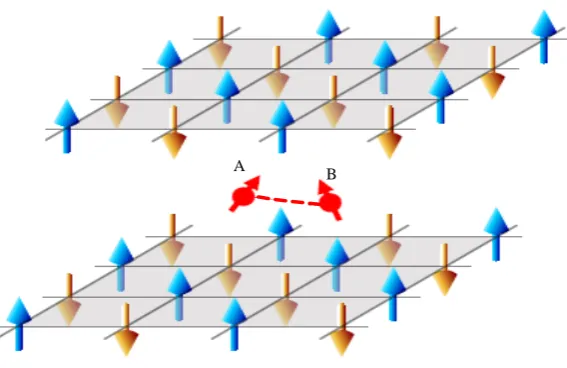
The model consists of a central two qubits spin system interacting via a Heisenberg XXZ chain with DM inte-raction soaked in an anti-ferromagnetic environment, driven by an anisotropic and magnetic field. Adiagram-matic picture of the composite system is represented in Figure 1.
The total Hamiltonian for a central two qubits spin longitudinally coupled to the AF spin field environment is given by
S SE E
B A
Figure 1. (Color online) Schematic of the two-qubit systems interacting with common anti-ferromagnetic environment.
where HS and HE are the Hamiltonians of the central two qubits and of the environment respectively; HSE is the non-demolition coupling of the central two qubit system to the AF environment, they can be written as:
(
)
1(
)
2(
1 2 1 2)
(
1 2 1 2)
1 22
s s s s s s s s s s s s
z z z z
S B A B A Z z
H = −gµ B+B S −gµ B−B S +Ω S S+ − +S S− + +iD S S+ − −S S− + +J S S , (2)
(
)
(
)
(
)
(
)
, , , , , , , ,
,
, , , , , ,
1 2
1
.
2
z z z z
E B A a i B A b j a i b i a i b i a i b i
i j i
z z
b j a j a j b j a j b j
j
H g B B S g B B S J S S S S S S
J S S S S S S
δ δ δ
δ
δ δ δ
δ
µ µ + − − +
+ + +
+ − − +
+ + +
+
= − + − − + + +
+ + +
∑
∑
∑
∑
(3)(
1s 2s)
(
, ,)
,z z z z
O
SE a i b i
i J
H S S S S
N
= − +
∑
+ (4)For definiteness, the subscript
s
refers to the system, g is the gyromagnetic factor, µB is the Bohr mag-neton, Ω is the isotropic central two qubits coupling strength along the xy plane and DZ the DM interac-tion that models the spin-orbit interacinterac-tion, JZ the coupling strength along the z axis; considered positive for AF coupling and negative for ferromagnetic coupling. JO is the coupling constant between system and spin environment, J is the isotropic predominantly nearest neighbor exchange interaction and is positive for AF environment. We consider the model of the AF environment where the spin structure of the environment may be divided into two interpenetrating sub-lattices a and b with the property that all nearest neighbors of an atom of a lie on b, and vice versa, Sa i,( )
Sb j, represents the spin operator of theth
i
( )
jth atom on sub-latticea
( )
b . Each sub-lattice contains N atoms. The vectors δ is a 3 dimensional vector that connects atom i or j with its nearest neighbor. The parameter B characterizes the intensity of the uniform external magnetic field applied along the z-axis. The anisotropy field BA is assumed to be positive, which approximates the effect of the crystal anisotropy energy, with the property of tending for positive magnetic moment µB to align the spins on sub-lattice a in the positive z-direction and the spins on sub-lattice b in the negative z-direction.By using the collective angular momentum operators , 1 ,
N a j i j
J± =
∑
=S± and the Holstein-Primakoff transfor-mation as J+ =a+ N−a a+ and J− =
(
N−a a a+)
with a a, + = 1, the Hamiltonians of the bath spin HE and interaction HSE can be rewritten as(
z z) (
)
O
SE A B k k k k
k J
H S S b b a a
N
+ +
[image:3.595.169.453.82.266.2](
)
(
)
(
(
)
)
(
)
0 2MSJ 2MSJ
2MSJ ,
E B z A k k B A z k k
k j
k k k k k
k
H E g B B a a g B B b b
a b a b
µ µ γ + + + + = + + + + + − + + +
∑
∑
∑
(6)With γk M 1 cos
(
)
−
=
∑
⋅δ
k δ . The coefficient M represents the number of nearest neighbors of an atom. The
constant E0= −2S NJ2 −2NSgµBBA may be neglected in subsequent evaluation, k is the lattice wave vector with discreet values (k=2πm N, m∈a b, ). By performing the Bogoliubov transformation,
( )
( )
( )
( )
cosh sinh
.
sinh cosh
k k k k k
k k k k k
a
b
θ α θ β
θ α θ β
+
+
= −
= − + (7),
The Hamiltonian HSE and HE can then be diagonalized as
(
1 2) (
)
,z z
O
SE s s k k k k
k J
H S S
N β β α α
+ +
= − +
∑
− (8)(
)
(
)
0 1 2 1 2
E k k k k k k
k k
H =E +
∑
ω α α+ + + +∑
ω β β− + + , (9)where α αk+
( )
k and β βk+( )
k are the creation (annihilation) operators of the two different magnons with wave vector k and frequency ω ωk( )
k+ −
. While deriving Equations (8) and (9), the function θk in the Bogoliubov transformation is chosen such that the coefficient of α βk k and α βk k
+ +
is zero. We find that, the bath spin is reduced into a bosonic mode thermal field with non-Markovian effect on the dynamics of the two-qubits system. Since this thermal field will not remain in a thermal equilibrium state as usually assumed for an environment with very large degrees of freedom, therefore, the master equation approach cannot be useful. In order to catch the exact non-Markovian dynamics of reduced density matrix for the system at arbitrarily finite temperatures, the time evolving density matrix of the composed system can be written as
( )
( )
( ) ( )
tot t U t tot 0 U t
ρ = ρ +
, (10) where
( )
e iHtot( )tU t = − . (11)
Assuming that the initial density matrix for the total system is separable, i.e. the initial state of the central spin system is completely irrelevant to the AF environment then, ρ
( )
0 =ρAB( )
0 ⊗ρE( )
0 . Where ρE( )
0 refers to the density matrix describing the initial state of the environment which at thermal equilibrium is represented bythe Boltzmann distribution as ρE
( )
0 , E( )
0 1exp(
HE)
Zρ = β , with Z the partition function given as:
(
)
0 0
1 1
exp
1 e k 1 e k
E T T
k k
Z Tr H T ω− ω+
− − = − = − −
∏
∏
(12)where kB is Boltzmanns constant which we henceforth set equal to one, T is the temperature.
( )
0( )
0( )
0 ABρ = Φ Φ is the density matrix of the central spins in the initial state, Φ
( )
0 is assumed tobe an initially prepared entangled state. By adopting the approach used in [20] and extending it to multilevel system, the time evolving reduced density matrix of the two-qubits is obtained by tracing out the environmental degrees of freedom
( )
4 , 1AB t c c Fυ µ µυ µ υ
µ υ
ρ ∗ φ φ
=
=
∑
(13)where
( )
( )( )
( )( )
( )
E E E E
and
(
)
exp , 1 2 3 4
μ μ μ
c = −iε t φ Φ μ= , , , (15) With φµ and εµ the µth eigen function and eigen value respectively of the system Hamiltonian HS.
( )
( )
e iHEt
E
U λυ t = − λµ is the projected time evolution operator.
In order to evaluate quantum correlations, the decoherence factors Fµυ is computed as follows
(
)
( )
(
)
0
e E k k k k k 0 e E k k k k k
i H i H
k E
k
F Tr
λµ ξµ β β α α λυ ξυ β β α α
µυ ρ + + + + − + − + − ∑ ∑ =
∏
(16) where(
)
(
)
, ,E k k k k k k
k k
Hλµ =
∑
ω+λµ α α+ +∑
ω−λµ β β+ , (17) represents the effective AF environment-dressed Hamiltonian resulting from the fact that the coupling HSE between the qubits and spin environment exerts an extra magnetic field ξµ on the spin environment HE, re-sulting to the effective intrinsic magnetic field λµ =BA+ξµ, where1,4 , 2,3 0
O B J N g ξ ξ µ
= ± = (18)
In this consideration, the decohorence factors yield
(
)
(
)
(
(
)
)
0 0
1
1 exp k 1 exp k
k k
F T it T it
Z
µυ =
∏
− −ω+ + Θ+µν∏
− −ω− + Θµν−
. (19)
where k k
µ
ν λ
λ
µν ω ω ξµ ξν +
+ +
Θ = − + − , k k
µ
ν λ
λ
µν ω ω ξν ξµ −
− −
Θ = − + − .
Between the elements of the decoherence factors the following relations exist: F12=F13, F23=1,F24 =F34, and Fµυ =1 for µ υ= . The absolute value of the decoherence factor F14 is evaluated in the thermodynamics limit as in Ref. [21]
( )
(
(
)
)
(
( )
)
( )
(
)
(
)
2
2 0 2
14 2
0
exp 2
exp ; d
π B 1 exp
x T J
F t t x x
g x T
ω
τ τ τ
µ ω ± ∞ + − ± ± − = − + =
∫
− − (20)3. Information Transfer in the Couple Spin System
There exist many parameters that characterize the information transfer between system and environment. In this work, we intend to investigate the degree of the information that can be leaked out when the two central qubits spin system in the presence of the DM interaction is coupled to the AF spin chain. We then focus on the evalua-tion of the concurrence whose numerical result is compared with that of classical correlaevalua-tion and quantum dis-cord.
Using Wootters concurrence [22], the entanglement dynamics is evaluated for the different initially prepared entangled states, Φ =
(
cosϑ 00 +sinϑ 11)
and Φ =(
cosϑ 01 +sinϑ10)
for the reduced density matrix( )
AB t
ρ in the standard basis spanned by
{
00 , 01 , 10 , 11}
as( )
(
AB)
max 0,{
1 2 3 4}
C ρ t = ϖ − ϖ − ϖ − ϖ , (21)
where the quantities ϖi are roots of the eigenvalues in decreasing order of the auxiliary matrix
( )
(
)
( )
(
)
AB t y y AB t y y
ς ρ= σ ⊗σ ρ∗ σ ⊗σ
. ρAB
( )
t∗
denotes the complex conjugate of ρAB
( )
t in the standard bases and σ the Pauli matrix. For the initially prepared entangled states taken respectively as(
)
is obtained as:
( )
11 14 22 23 32 33 14 44 0 0 0 0 0 0 0 0 AB t ρ ρ ρ ρ ρ ρ ρρ∗ ρ
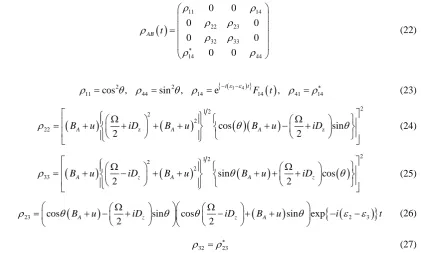
= (22) where ( )
{ 1 4 }
( )
2 2
11 cos , 44 sin , 14 e 14 , 41 14
i t
F t
ε ε
ρ = θ ρ = θ ρ = − − ρ =ρ∗
(23)
(
)
(
)
( )(
)
2 1 2 2 222 z cos z sin
2 2
A A A
B u iD B u B u iD
ρ = + Ω+ + + θ + −Ω+ θ
(24)
(
)
(
)
(
)
( )
2 1 2 2 233 sin cos
2 2
A z A A z
B u iD B u B u iD
ρ = + Ω− + + θ + +Ω+ θ
(25)
(
)
(
)
{
(
)
}
23 cos sin cos sin exp 2 3
2 2
A z z A
B u iD iD B u i t
ρ = θ + −Ω+ θ θΩ− + + θ − ε −ε
(26)
32 23
ρ =ρ∗
(27)
To quantify the quantumness of a system more broadly, quantum discord becomes a figure of merit as it quantifies non-classical correlations of more general type than concurrence. Quantum discord is introduced as the difference between the total correlations and the classical correlation and has been evaluated in many works
[23]-[27]. In order to discuss the time variation of quantum correlations other than entanglement of the coupled
two qubits system bathed in the model of the antiferromagnetic environment, we will only provide results with-out further derivations since we are concerned with two-qubit X state that has been explicitly derived in [24].
4. Results and Discussions
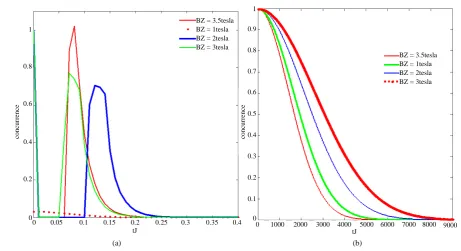
The time evolution of entanglement as a function of applied global external magnetic field for finite lattice size and the thermodynamic limit are presented in Figure 2(a) and Figure 2(b) respectively for the initial maximal entangled Bell state Φ =
( )
1 2(
cosϑ 00 +sinϑ 11)
. For the case of finite lattice sizeFigure 2(a) we ob-served entanglement killing for small values of the magnetic field and for increasingly large values of the field, entanglement becomes enhanced with sudden death and revival during the early stage dynamics of the system before hitting zero during the latter stages. The time for the revival is short and with enhancement in the revival peak as the magnetic field increases. We attribute this observation to the fact that, the frequency splitting in the presence of the magnetic field gives birth to two modes which enters the dynamics of entanglement. For a given magnetic field, we distinguish two frequency modes; the high frequency modes ωk+
whose frequency and par-ticle excitation number increases with magnetic field and low frequency modes ωk
−
whose frequency and par-ticle excitation number decreases with magnetic field. This shows that the high frequency modes ωk
+
enhances memory effect as these modes readily copy and store the information about the state of the system with little leakage to the rest of the environment due to their stability as the field increases. These modes may be save as a decoherence free channel for initializing and carrying out gate operations in quantum computation.
[image:6.595.121.543.100.353.2]0 0.05 0.1 0.15 0.2 0.25 0.3 0.35 0.4 tJ
0 0.2 0.4 0.6 0.8 1
c
onc
ur
re
nc
e
0 1000 2000 3000 4000 5000 6000 7000 8000 9000 tJ
0 0.1 0.2 0.3 0.4 0.5 0.6 0.7 0.8 0.9 1
c
onc
ur
re
nc
e
BZ = 3.5tesla BZ = 1tesla BZ = 2tesla BZ = 3tesla
BZ = 3.5tesla BZ = 1tesla BZ = 2tesla BZ = 3tesla
[image:7.595.75.537.80.331.2](a) (b)
Figure 2. (Color online) The time
( )
tJ evolution of entanglement for the initial two-qubit state( )
1 2 cos(
ϑ00 sinϑ11)
Φ = + for different global static external magnetic field (a) finite size of the AF spin
environ-ment N=100; bg=JO N gµB=1 tesla is induced magnetic field due to system-environment coupling (b) thermody-namic limit, others parameters are set to JZ=1, BA=1 tesla, MSJ gµ =B 100 tesla, ϑ =π 4, T gµ =B 3.5 tesla.
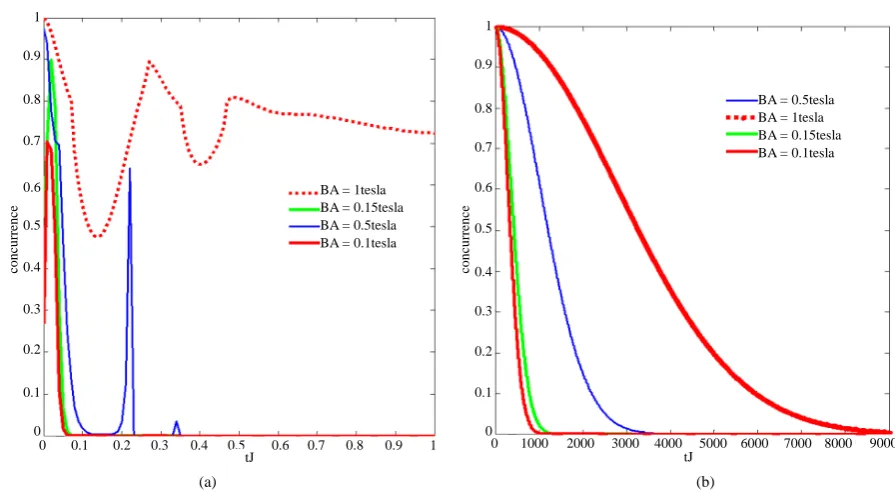
Entanglement enhancement is seen for a weakly coupled AF spin bath as the anisotropy field increases for the case of the finite size of the system, Figure 3(a) and the thermodynamic limitFigure 3(b). In this light, correla-tions in the anti-ferromagnetic environment are strengthen with increasing value of the anisotropy field; a situa-tion similar to increasing the exchange interacsitua-tion amongst the environmental spin.
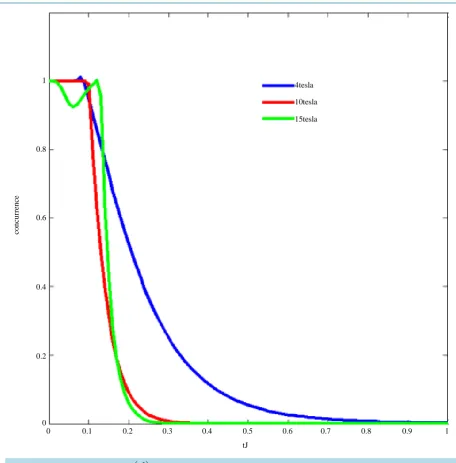
From Figure 4(a), we see that for small values of the induced field strength, memory effects are enhanced as seen from the periodic collapse and revival phenomenon in the entanglement dynamics (see insert for short time dynamics) and only hit zero after a long time interval. Increasing the induced field strength, memory effects are observed only for a short time interval. Figure 4(b)show that Entanglement trapping could be achieve for small number of atoms and killing as number of atoms increases. Fluctuations in the entanglement dynamics stems from the strong quantum effects as system size decreases. Figure 5 shows that increasing the temperature, the sudden death of entanglement is accelerated. As temperature increases, thermally excited fluctuating magnon modes increases and got entangled with the system leading to irreversible flow of information to the AF spin environment.
0 0.1 0.2 0.3 0.4 0 1000 2000 3000 4000 5000 6000 7000 8000 9000 tJ 0 0.1 0.2 0.3 0.4 0.5 0.6 0.7 0.8 0.9 1 conc ur re nc e
BA = 1tesla BA = 0.15tesla BA = 0.5tesla BA = 0.1tesla
0.5 0.6 0.7 0.8 0.9 1 tJ
BA = 0.5tesla BA = 1tesla BA = 0.15tesla BA = 0.1tesla
0 0.1 0.2 0.3 0.4 0.5 0.6 0.7 0.8 0.9 1 conc ur re nc e
[image:8.595.84.532.80.329.2](a) (b)
Figure 3.(Color online) The time
( )
tJ evolution of entanglement for the initial two-qubits state( )
1 2(
cosϑ00 sinϑ11)
Φ = + for different anisotropy field; (a) finite size of the AF spin environment N=100; 1 tesla
bg= , MSJ gµ =B 1 tesla; (b) thermodynamic limit, MSJ gµ =B 100 tesla, others parameters are set to JZ =1,
0.5 tesla
Z
B = , T gµ =B 3.5 tesla, ϑ =π 4.
0
bg = 0.01 bg = 0.1 bg = 0.3
0 conc ur re nc e
10 20 30 40 50 60
tJ 0.2 0.4 0.6 0.8 1 1.2 1.4 0
N = 10 N = 20 N = 30
0 conc ur re nc e
10 20 30 40 50 60 tJ 0.2 0.4 0.6 0.8 1 1.2 1.4
70 80 90 100
0 1 2 3 4 5 6 7 8 9 10
tJ 0 0.2 1.2 1.4 c onc urre n c e 0.4 0.6 0.8 1
[image:8.595.91.538.397.656.2](a) (b)
Figure 4. (Color online) The time
( )
tJ evolution of entanglement for the initial two-qubit state( )
1 2(
cosϑ00 sinϑ11)
0 0.1 0.2 0.3 0.4
4tesla
10tesla
15tesla
0.5 0.6 0.7 0.8 1
tJ 0
0.2 0.4 0.6 0.8 1
co
n
cu
rr
en
ce
[image:9.595.80.537.75.539.2]0.9
Figure 5.(Color online) The time
( )
tJ evolution of entanglement for the initial two-qubit state( )
1 2 cos(
ϑ00 sinϑ11)
Φ = + ; for different temperatures scaled as T gµB; T gµ =B 4 tesla (blue curve), 10 tesla
B
T gµ = (red curve), T gµ =B 15 tesla (green curve), others parameters are set to JZ=1, BA=0.15 tesla, MSJ gµ =B 100 tesla, BZ=1 tesla, bg=1 tesla, ϑ =π 4.
field) as depicted in the Hamiltonian Equation (2), as this initial state does not coupled to the AF environment since the total z-magnetization equal to zero. We may then say here that there is entanglement amplification when the DM interaction drives it to fall to stable entanglement once the initial state is in contact with the AF environment with appropriate anisotropy field. Since this initial state preparation is insensitive to system-envi- ronment coupling parameter, the appellation robust is used.
0
Dz = 0.1 Dz = 0.4 Dz = 1 Dz = 0.7
tJ 0
c
onc
ur
re
nc
e
2 4 6 8 10 12 14 16 18 20
0.05 0.1 0.15 0.25 0.3
0.2
0
tJ 0
c
onc
ur
re
nc
e
2 4 6 8 10 12 14 16 18 20
0.2 0.4 0.6 0.8 1 1.2
BA = 0.1tesla BA = 0.5tesla BA = 0.7tesla BA = 1tesla
[image:10.595.84.538.80.329.2](a) (b)
Figure 6.(Color online) The time
( )
tJ evolution of entanglement for the initial two-qubit entangled state(
1 2)
(
cosϑ01 sinϑ10)
Φ = + ; (a) for different values of DZ, setting: BZ =BA=0 tesla, (b) for different values of the anisotropy field BA, setting DZ=1, other parameters are set to JZ= = Ω =1 1, BZ =1 tesla, ϑ =π 4.
0 0.1 0.2 0.3 0.4
discord
classical correlation concurrence
0.5 0.6 0.7 0.8 0.9 1 tJ
0 0.1 0.2 0.3 0.4 0.5 0.6 0.7
0 0.1 0.2 0.3 0.4 0.5 0.6 0.7 0.8 0.9 1
0 0.1 0.2 0.3 0.4 0.5 0.6 0.7 0.8 0.9 1 tJ
co
rrl
a
ti
o
n
s
co
rrl
a
ti
o
n
s
concurrence classical correlations discord
(a) (b)
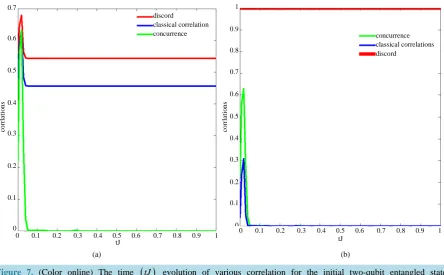
Figure 7. (Color online) The time
( )
tJ evolution of various correlation for the initial two-qubit entangled state(
cosϑ 00 sinϑ11)
Φ = + ; (a) for minimization parameters l=1 8, k=7 8; (b) for minimization parametersl= =k 1 2, others parameters are set to JZ=1, BA=0.1 tesla, bg=1 tesla, MSJ gµ =B 1 tesla, T gµ =B 3.5 tesla, BZ =2 tesla,
π 4
[image:10.595.91.536.391.666.2]this time limit. This is from the fact that, during the dissipative time evolution even without quantum entangle-ment, the correlations introduced by the environment are transferred to the two central qubits, producing a finite quantum discord. We equally notice fromFigure 7 that discord is larger than classical correlation, a scenario similarly observed in [27]. This results provide the description of the behavior of the classical and quantum cor-relations and their robustness under the decoherence process. In fact, the quantum discord behavior between the two-qubit depends on the minimization of the classical correlations during the time evolution. We have notice that for all arbitrary system parameters, quantum discord has a steady maximum value “1” once the minimiza-tion parameter are set to l= =k 1 2 (Figure 7(a)) as compared to values outside this setting (Figure 7(b)).
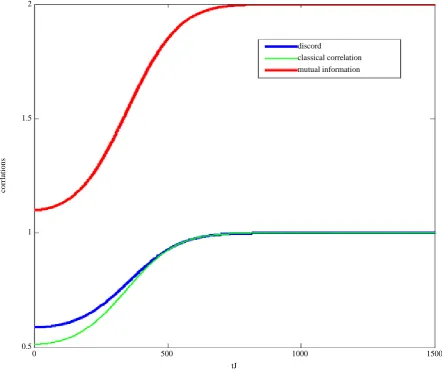
Figure 8 finally shows the evolutions of the various correlations in the thermodynamic limit and most impor-tantly is the fact that the correlations approach their maximum values asymptotically.
5. Conclusion
This work investigates the influence of finite temperature AF spin environment, with gap in its energy spectrum, on the dynamics quantum correlations of a central two qubits system interacting via a Heisenberg XXZ chain with Dzyaloshinski-Moriya interaction, prepared in two entangled Bell states; commonly identified as fragile
0
discord
classical correlation mutual information
tJ 0.5
co
rr
la
ti
o
n
s
500 1000 1500
1 1.5 2
Figure 8.(Color online) The time
( )
tJ evolution of quantum correlations in the thermodynamic limit : discord (blue curve),classical correlation (green curve), mutual information (red curve) for the initial two-qubit state Φ =
(
cosϑ00 +sinϑ11)
; system parameters are set to JZ =1, BA=0.1 tesla, MSJ gµ =B 100 tesla, T gµ =B 3.5 tesla, BZ =2 tesla, ϑ =π 4,1 8
and robust. For the fragile Bell state, two opposite scenes are seen to influence the entanglement dynamics as the frequency gap increases via increasing the magnetic field for the finite lattice size and the thermodynamic limit, and are explained in terms of the stability, excitation number difference and fluctuations of the two magnon modes that enter the dynamics of quantum correlations. Scenarios where entanglement trapping could be achieved by tailoring the anisotropy field and size of the AF spin environment are discussed. Endurance of feed-back effects is seen when the induced magnetic field is tune to small values and a general killing for large values. For the robust initial Bell state, while entanglement amplification is witnessed as the DM interaction pa-rameter increases, regime exists where further increment in this papa-rameter drives entanglement to fall to stable state, and can be restored by an appropriate anisotropy field. The robustness of quantum discord is manifested as it never hit zero irrespective of the composite system parameter and attends it maximum value for a rightly cho-sen minimization parameter. We have also conducted a comparative study of the various correlations in the thermodynamic limit. Our theoretical investigation provides insight on how quantum state initialization and gate operations for quantum computing and information technology using this type of AF spin environment as host, could be tailored by engineering the properties of the environment. We look forward to investigate the influence of the lattice vibration on the dynamics of quantum correlations central two qubits system considering both fi-nite and zero temperature of the environment.
Acknowledgements
Authors would like to thank Sigmund Kohler at the Institute of material science Madrid Spain (CSIC) for his in-sightful suggestions after going through the manuscript of this work. We would like also to thank the editor of the Journal of quantum information science for the support with a grant when publishing this paper.
References
[1] Nielsen, M.A. and Chuang, I.L. (2000) Quantum Computation and Quantum Information. Cambridge University Press, Cambridge.
[2] Datta, A., Shaji, A. and Caves, C.M. (2008) Quantum Discord and the Power of One Qubit. Physical Review Letters, 100, Article ID: 050502.
[3] Fouokeng, G.C., Tchoffo, M., Tendong, E. and Fai, L.C. (2014) Dzyaloshinskii-Moriya Interactions Effects on the En-tanglement Dynamics of a Two Qubitxxz Spin System in Non-Markovian Environment.arXiv:1405.7009v1 [quant-ph]
[4] Benedetti, C., Buscemi, F., Bordone, P. and Paris, M.G.A. (2012) Effects of Classical Environmental Noise on Entan-glement and Quantum Discord Dynamics. International Journal of Quantum Information, 10, Article ID: 1241005. http://dx.doi.org/10.1142/S0219749912410055
[5] Cai, J.M., et al. (2012) Robust Dynamical Decoupling with Concatenated Continuous Driving. New Journal of Physics, 14, 16. http://dx.doi.org/10.1088/1367-2630/14/11/113023
[6] Klinovaja, J., Stepanenko, D. and Halperin, B.I. (2012) Exchange-Based CNOT Gates for Singlet-Triplet Qubits with Spin Orbit Interaction. Physical Review B, 86, Article ID: 085423.
[7] Feng, Z.-B., Zhang, C.-L. and Zhou, Y.-Q. (2014) Robust Quantum Computing in Decoherence-Free Subspaces with Double-Dot Spin Qubits. Communications in Theoretical Physics, 61, 181.
[8] Campagnano, G., Hamma, A. and Weiss, U. (2010) Entanglement Dynamics of Coupled Qubits and a Semi-Decohe- rence Free Subspace. Physical Letters A, 374, 416-423.http://dx.doi.org/10.1016/j.physleta.2009.10.081
[9] Bi, Q., Guo, L. and Ruda, H.E. (2010) Quantum Computing in Decoherence Free Subspace Constructed by Triangula-tion. Advances in Mathematical Physics, 2010, Article ID: 365653.
[10] Brouard, S. and Plata, J., (2004) Decoherence of Trapped-Ion Internal and Vibrational Modes: The Effect of Fluctuat-ing Magnetic Fields. Physical Review A, 70, Article ID: 013413.
[11] Tchoffo, M., Fouokeng, G.C., Massou, S., Afuoti, N.E., Nsangou, I., Fai, L.C., Tchouadeu, A.G. and Kenné, J.P. (2012) Effect of the Variable B-Field on the Dynamic of a Central Electron Spin Coupled to an Anti-Ferromagnetic Qubit Bath. World Journal of Condensed Matter Physics, 2, 246-256. http://dx.doi.org/10.4236/wjcmp.2012.24042
[12] Fouokeng, G.C., Tchoffo, M., Moussiliou, S., Ngana Kuetche, J.C., Fai, L.C. and Siaka, M. (2014) Effect of Noise on the Decoherence of a Central Electron Spin Coupled to an Antiferromagnetic Spin Bath. Advances in Condensed Mat-ter Physics, 2014, Article ID: 526205.
3, 10-15.
[14] Wu, L.A., Yu, C.X. and Segal, D. (2013) Exact Dynamics of Interacting Qubits in a Thermal Environment Results beyond the Weak Coupling Limit. New Journal of Physics, 15, Article ID: 023044.
[15] Tomotaka, K. and Naomichi, H. (2011) Maximization of Thermal Entanglement of Arbitrarily Interacting Two Qubits. Physical Review A, 83, Article ID: 062311.
[16] Jing, N., Cheng, W.L. and Xi, Y.X. (2009) Disentanglement of Two Qubits Coupled to an XY Spin Chain at Finite Temperature. Communications in Theoretical Physics, 51, 815.
[17] Dzyaloshinsky, I. (1958) A Thermodynamic Theory of Weak Ferromagnetism of Antiferromagnetics. Journal of Physics and Chemistry of Solids, 4, 241-255. http://dx.doi.org/10.1016/0022-3697(58)90076-3
[18] You, W.L. and Dong, Y.L. (2010) The Entanglement Dynamics of Interacting Qubits Embedded in a Spin Environ-ment with Dzyaloshinsky Moriya Term. The European Physical Journal D, 57, 439-445.
http://dx.doi.org/10.1140/epjd/e2010-00056-1
[19] Tao, C., Xia, H.Y.S., Jia, C., Xing, L.J., Bing, L.J. and Kun, LT. (2010) Entanglement Evolution in an Anisotropic Two-Qubits Heisenberg XYZ Model with Dzyaloshinskii Moriya Interaction. Chinese Physics B, 19, Article ID: 050302.
[20] Mozyrsky, D. and Privman, V. (1998) Adiabatic Decoherence. Journal of Statistical Physics, 91, 787-799. http://dx.doi.org/10.1023/A:1023042014131
[21] Yuan, X.Z., Goan, H.S. and Zhu, K.-D. (2007) Influence of an External Magnetic Field on the Decoherence of a Cen-tral Spin Coupled to an Antiferromagnetic Environment. New Journal of Physics, 9, 219.
[22] Wootters, W.K. (1998) Entanglement of Formation of an Arbitrary State of Two Qubits. Physical Review Letters, 80, 2245-2228. http://dx.doi.org/10.1103/PhysRevLett.80.2245
[23] Ollivier, H. and Zurek, W.H. (2002) A Measure of the Quantumness of Correlations. Physical Review Letters, 88, Ar-ticle ID: 017901.
[24] Ali, M., Rau, A.R.P. and Alber, G. (2010) Quantum Discord for Two-Qubit X States. Physical Review A, 81, Article ID: 042105.
[25] Luo, S. (2008) Quantum Discord for Two-Qubit Systems. Physical Review A, 77, Article ID: 042303.
[26] Luo, S. and Fu, S. (2010) Geometric Measure of Quantum Discord. Physical Review A, 82, Article ID: 034302.