How to cite this paper: Belousov, A. and Voyda, Y. (2015) Study of the Reactions of Microorganisms in Response to the Magnetite Nanoparticles. OpenAccessLibraryJournal, 2: e1488. http://dx.doi.org/10.4236/oalib.1101488
Study of the Reactions of Microorganisms in
Response to the Magnetite Nanoparticles
Andrey Belousov
1, Yulia Voyda
21Laboratory of Applied Nanotechnology of Belousova, Engineering Invest IF GmbH, Vienna, Austria 2Kharkov Medical Academy of Postgraduate Education, Kharkov, Ukraine
Email: [email protected], [email protected] Received 1 April 2015; accepted 17 April 2015; published 22 April 2015
Copyright © 2015 by authors and OALib.
This work is licensed under the Creative Commons Attribution International License (CC BY).
http://creativecommons.org/licenses/by/4.0/
Abstract
The influence of basic physical factors caused by magnetite nanoparticles (constant magnetic field and sorption) on microorganisms by examining the reactions of the intensity of free radical lipid peroxidation (FRLP) and bacteriostatic action was studied. It was well established that the magne-tite nanoparticles caused unequal reaction in intensity of FRLP on different groups of microor-ganisms. It was determined that the most significant factor that influenced on the ultimate indica-tor of the intensity of luminescence on C. albicans, E. coli and P. aeruginosa was constant magnetic field which induced by nanoparticles. On the contrary, sorption was the most significant factor on S. aureus. It was found that the rate of consumption of free radicals lipid reduced reliably on all microorganisms after their processing by magnetite nanoparticles. The results of microbiological studies of E. coli, K. pneumoniae and S. aureus showed that bacteriostatic effect was detected after exposure by magnetite nanoparticles. Visually, it was detected by decreasing the number of colo-nies on the nutritious medium in comparison with the control. It was revealed an interesting fact that saline NaCl, which had previously been processed by magnetite nanoparticles also signifi-cantly had a marked bacteriostatic effect on the studied microorganisms. This effect could be ex-plained by mechanism of change the polarization structure water of microorganisms by magnetite nanoparticles. It was discovered that degree of expression of bacteriostatic action which induced by magnetite nanoparticles had correlation with marks of reactions intensity of FRLP. Maximum bacteriostatic effect on S. aureus was expressed in second variant application of magnetite nano-particles where mechanism of sorption was more significant than action of the magnetic field. On the contrary, maximum bacteriostatic effect on E. coli and K. pneumoniae was revealed in third va-riant, where time exposition of contact with microorganisms nanoparticles and, consequently, ac-tion of a constant magnetic field was determinative.
Keywords
OALibJ | DOI:10.4236/oalib.1101488 2 April 2015 | Volume 2 | e1488
Subject Areas: Microbiology, Pharmacology
1. Introduction
Today the world’s attention is locked on the problem of bacterial resistant to antibiotics—one of the most se-rious threats to humanity. Chief Medical Officer, Dame Sally Davies, warned that if this problem didn’t solved than in 20 years’ time even minor surgery might lead to death through untreatable infection. In Britain, in spite of greatly reducing hospital infections from bugs such as MRSA (Methicillin Resistant Staphylococcus aureus) and C. difficile to the levels of 10 years ago—falling by 80 percent—they were being replaced by opportunistic bacteria such as E. coli and K. pneumoniae, which became one of the most frequent agents of nosocomial infec-tions [1]. About 5000 patients a year in the UK died from bloodstream infections; half of them caused by drug- resistant organisms. Antimicrobial resistance is a ticking time-bomb not only for the UK but also for the whole world. Many experts believe that in the future all antibiotics would become useless and humanity would have to refuse of taking those [2]. Even now, the number of new antibiotics has been reduced dramatically. Antibiotic resistance leads to cases when people get sick for a long time, and increases vital infections. Resistant microor-ganisms also lead to increasing spends of medical aid because of prolongated stay in the clinics and this situa-tion requires treatment that is more intensive. The development of new antibacterial medicines based on nano-particles is one of the real ways to solve this problem. The first scientific publications on the investigation in-fluence of magnetite nanoparticles on microorganisms appeared in 1998. Reliable information about the bacte-riostatic effect of magnetite nanoparticles to certain pathogens was represented. Also, it was discovered that magnetite nanoparticles significantly increased the sensitivity of pathogens to antibacterial medications [3]. Fur- thermore, an example of studying human erythrocytes showed that the magnetite nanoparticles altered reliably the polarizable structure of the water sector of cell microenvironment and as a result their permeability [4]. Thus, analysis of above-mentioned dates could give us the opportunity of highly optimistic talking about the future development of a new direction—elaboration of antibacterial medications based on magnetite nanoparticles. The mechanism of their action will be associated with changes of physical factors of the cell existence. But today mechanisms of physical influence of magnetite nanoparticles on microorganisms are still poorly understood, and the main purpose of our investigations was to find out them.
The main goal was to investigate the influence of basic physical factors of magnetite nanoparticles on differ-ent groups of microorganisms.
In order to perform this goal next tasks were set:
to investigate the effect of magnetite nanoparticle on the intensity of free radical peroxidation lipids (FRPL) in various bacterial cultures;
to explore direct bacteriostatic action of magnetite nanoparticle on microorganisms;
to study bacteriostatic effect of saline NaCl that had previously been processed by magnetite nanoparticles; to establish a causal link between research results and main physical factors of magnetite nanoparticles.
2. Materials and Methods
Materials: colloidal solution of magnet-controlled sorbent (MCS-B). The basis of MCS-B is magnetite nanopar-ticles (Fe3O4). The size of nanoparticles is from 6 to 12 nm; the total sorption surface of NPs is from 800 to 1200
m2/g; magnetization of saturation Is = 2.15 kA/m; volume concentration q = 0.00448; viscosity ƞ = 1.0112 cSt; ζ-
potential = −19 mV; saline NaCl that had previously been processed by magnetite nanoparticles. Object of research: C. albicans, E. coli, S. aureus, P. aeruginosa, K. pneumoniae.
OALibJ | DOI:10.4236/oalib.1101488 3 April 2015 | Volume 2 | e1488
0.1% solution of magnetite nanoparticles. Induction was carried out by means 0.05 ml 3% Н2О2. Intensity of
FRPL was determined at three stages: I stage—I max determined, II stage—I final, III stage—the sum of light ∑. Preparation of bacterial cultures. After 24 h bacterial cultures growth on Mueller-Hinton agar was made mi-crobial suspension in saline NaCl with scale McFarland appropriate 0.5. Then the initial concentration of work-ing culture was titrated to concentration correspondwork-ing to 104. Sowing S. aureus was carried out on Mueller- Hinton medium; E. coli and K. pneumoniae—on Endo medium.
Bacteriostatic effect has been studied in the following variants: variant 1—control; variant 2—the study of bacteriostatic action of magnetite nanoparticles (MCS-B) after their short-term contact with microorganisms; variant 3—after 24 hours contact of microorganisms with MCS-B; variant 4—after 24 hours contact of micro-organisms with saline of NaCl, that had previously been processed by MCS-B. Estimate was carried out in comparison with the control.
Statistically processing the obtained results was performed by parametrical method of variation statistics by Student criterion.
3. Results and Discussion
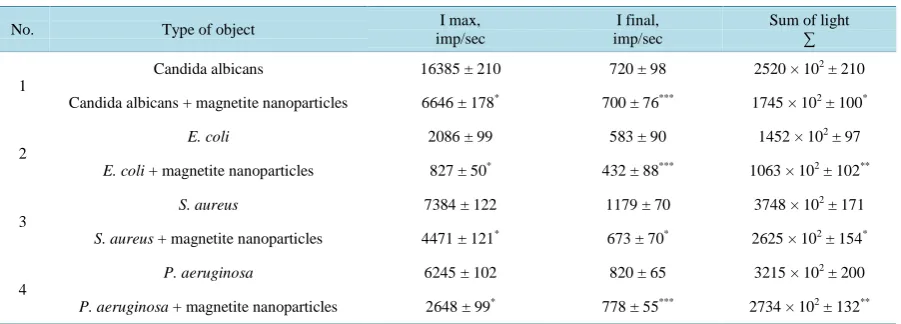
The results of the research intensity of FRPL in various bacterial mediums are presented inTable 1.
I max—intensity first flash luminescence (imp/sec) after the introduction of Н2О2 in the first minute. The
maximum value of the first flash gives an indication of the total number of peroxidation products in the substrate. I final—ultimate intensity of luminescence (imp/sec) after 4 minutes. This index corresponds to the amount of the remaining unreacted peroxidation products or antioxidants. ∑—sum of light in 4 minutes measurement. This index indicates to rate of consumption of the lipid nature free radicals in consequence their interaction with an-tioxidants.
The dates inTable 1 showed that intensity of the first flash of luminescence after the introduction of H2O2 (I
max) for all studied microorganisms after processed by magnetite nanoparticles was (p < 0.001) reduced reliably by 2 - 2.5 times in comparison with the control. This happened due to a decrease in the total amount of lipid pe-roxidation products as a result of adsorption by magnetite nanoparticles [6].
However, it was not determined reliable differences at stage II of the I final index in compared with control on microorganisms such as C. albicans, E. coli and P. aeruginosa (p > 0.05). On the contrary, I final index dif-fered reliably (p < 0.001) from the control on S. aureus. This fact indicated that the sorption activity of magne-tite nanoparticles in the bacterial culture of S. aureus was more important factor in the physical action than the effect of a constant magnetic field.
[image:3.595.90.541.546.708.2]Stage III study (determine ∑—sum light in 4 minutes) demonstrated that after processed of bacterial medium by magnetite nanoparticles the consumption speed of free radical lipid was reduced reliably on all microorganisms. This fact was connected with sorption effect that supplemented by the action of the magnetic field of the nano-particles. The constant magnetic field that induced (power of 300 - 400 kA/m) deprotonated (transfer in active
Table 1. Indicators of the intensity of free radical peroxidation in variants bacterial cultures at stages of the study (M ± m; n = 10).
No. Type of object I max,
imp/sec
I final, imp/sec
Sum of light ∑
1
Candida albicans 16385 ± 210 720 ± 98 2520 × 102 ± 210
Candida albicans + magnetite nanoparticles 6646 ± 178* 700 ± 76*** 1745 × 102 ± 100*
2
E. coli 2086 ± 99 583 ± 90 1452 × 102 ± 97
E. coli + magnetite nanoparticles 827 ± 50* 432 ± 88*** 1063 × 102 ± 102**
3
S. aureus 7384 ± 122 1179 ± 70 3748 × 102 ± 171
S. aureus + magnetite nanoparticles 4471 ± 121* 673 ± 70* 2625 × 102 ± 154*
4
P. aeruginosa 6245 ± 102 820 ± 65 3215 × 102 ± 200
P. aeruginosa + magnetite nanoparticles 2648 ± 99* 778 ± 55*** 2734 × 102 ± 132**
OALibJ | DOI:10.4236/oalib.1101488 4 April 2015 | Volume 2 | e1488
status) enzymes of antiradical defend. As a result the synthesis of lipid peroxides and secondary radical reactions were blocked, inhibited lipid peroxidation [7].
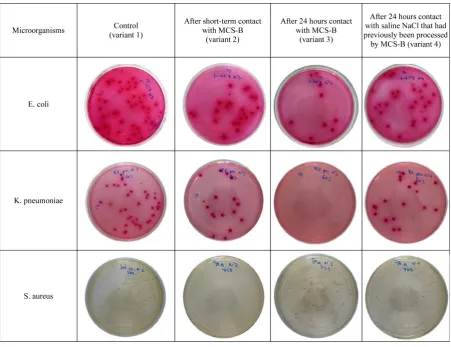
[image:4.595.89.541.350.697.2]Indicators the decline in the intensity of free radical peroxidation in bacterial cultures were supplemented with data from research of bacteriostatic action of magnetite nanoparticles (Figure 1).
Figure 1could demonstrate that bacteriostatic effect on bacterial cultures such as E. coli and K. pneumonia was determined after 24 hours exposition of magnetite nanoparticles with microorganisms. As a result there was significant decline in the number of colonies on the nutritious medium.
Maximum bacteriostatic action on S. aureus was found in the variant of short-term contact with nanoparticles of microorganisms (variant 2).
If mechanism of bacteriostatic effect in the second and third variants could be explained from position of the sorption activity of nanoparticles, in the fourth variant, where microorganisms contacted only with saline NaCl, which had previously been processed by nanoparticles, the sorption action was excluded. The mechanism for this effect was explained by increased mobility of the hydrogen protons and changing their spatial orientation after processed by magnetite nanoparticles. As a result, the polarizable structure of the cell water was modified and changed its permeability [8]. After analyzing all received data of research, we made a conclusion that degree of expression of bacteriostatic action had correlation with marks of reactions intensity of FRLP.
So, maximum bacteriostatic effect on S. aureus was expressed in second variant application of magnetite nano- particles where mechanism of sorption was more significant than action of the magnetic field. On the contrary, maximum bacteriostatic effect on E. coli and K. pneumoniae was revealed in third variant, where time exposition of contact with microorganisms nanoparticles and, consequently, action of a constant magnetic field was deter-minative. Received data confirmed the strength of influence of magnetic field caused by the nanoparticles on the
OALibJ | DOI:10.4236/oalib.1101488 5 April 2015 | Volume 2 | e1488
structure of water by the fact of bacteriostatic action of saline NaCl, which had previously been processed by magnetite nanoparticles.
Thus, it was found effects of the basic physical factors of magnetite nanoparticles (constant magnetic field and sorption) on different groups of microorganisms and fact that both factors had an impact on microorganisms, but determined influence of different factors would depend reliably on the individual properties of studied mi-croorganisms.
4. Conclusions
1) It was expanded the range of studying the mechanisms of the influence of physical factors of magnetite nanoparticles on microorganisms by examining the reactions intensity FRPL and bacteriostatic action.
2) It was established reliably that magnetite nanoparticles on different groups of microorganisms caused un-equal intensity FRPL reaction.
3) It was determined that more significant factor that influenced on the ultimate indicator of the intensity of luminescence on C. albicans, E. coli and P. aeruginosa was constant magnetic field which induced by nanopar-ticles. On the contrary, sorption was the most significant factor on S. aureus.
4) It was found that the rate of consumption of free radicals lipid reduced reliably in all microorganisms after their processing by magnetite nanoparticles.
5) The results of microbiological studies of E. coli, K. pneumoniae and S. aureus showed that bacteriostatic effect was detected after exposure by magnetite nanoparticles. Visually, it was detected by decreasing the num-ber of colonies on the nutritious medium in comparison with the control.
6) It was revealed an interesting fact that saline NaCl, which had previously been processed by magnetite na-noparticles also significantly, had a marked bacteriostatic effect on the studied microorganisms. This effect could be explained by mechanism of change the polarizable structure water of microorganisms by magnetite nanoparticles.
7) It was discovered that degree of expression of bacteriostatic action which induced by magnetite nanopar-ticles had correlation with marks of reactions intensity of FRLP. Maximum bacteriostatic effect on S. aureus was expressed in second variant application of magnetite nanoparticles where mechanism of sorption was more significant than action of the magnetic field. On the contrary, maximum bacteriostatic effect on E. coli and K. pneumoniae was revealed in third variant, where time exposition of contact with microorganisms nanoparticles and, consequently, action of a constant magnetic field was determinative.
References
[1] http://www.independent.co.uk/news/science/chief-medical-officer-dame-sally-davies-resistance-to-antibiotics-risks-he alth-catastrophe-to-rank-with-terrorism-and-climate-change-8528442.html
[2] http://www.bbc.com/news/health-21737844
[3] Belousov, A.N., Osolodchenko, T.P. and Belousova, Ye.Yu. (1998) Effects of Magtietic Fluid Preparations on Micro-organisms. 8th International Conference on Magnetic Fluids, Timisoara, 486-487.
[4] Belousov, A. (2014) The Role of Magnetite Nanoparticles (ICNB) in Discovery New Factor Which Influence on Permeability of Erythrocytes and Eryptosis. Open Access Library Journal, 1, e1055.
http://www.oalib.com/articles/3126453#.VGSZf8n-s0s http://dx.doi.org/10.4236/oalib.1101055
[5] Gerasimov, A.M., Kornev, E.N. and Amelin, D.Sh. (1978) Modeling the Relationship of Peroxide Generating and NADPH—Dependent Processes. Oxidative Enzymes of Animal Cells and the Regulation of Their Activity. Sympo-sium of Russia, Gorkiy, 23-24.
[6] Belousov, A. (2001) Effect of Extracorporeal Hemocorrection with Using Magnet-Controlled Sorbent on the Intensity of Lipid Peroxidation. Experimental and Clinical Medicine. Kharkov State Medical University, No. 1, 113-115.
[7] Belousov, A. (2004) The Extracorporal Hemocorrection with Application of Magnet-Controlled Sorbent in Intensive Therapy of Syndrome Intoxication in the Patients with a Pathology Hepatopancreatoduodenum Zones: The Abstract Dissertation of Doctor Medicine: 14.01.30. The Dnepropetrovsk State of Medical Academy, 40 p.