Published Online May 2015 in SciRes. http://www.scirp.org/journal/jilsa http://dx.doi.org/10.4236/jilsa.2015.72004
Iterated Function System-Based Crossover
Operation for Real-Coded Genetic Algorithm
S. H. Ling
Centre for Health Technologies, University of Technology, Sydney, Australia Email: [email protected]
Received 3 March 2015; accepted 13 April 2015; published 15 April 2015
Copyright © 2015 by author and Scientific Research Publishing Inc.
This work is licensed under the Creative Commons Attribution International License (CC BY).
http://creativecommons.org/licenses/by/4.0/
Abstract
An iterated function system crossover (IFSX) operation for real-coded genetic algorithms (RCGAs) is presented in this paper. Iterated function system (IFS) is one type of fractals that maintains a similarity characteristic. By introducing the IFS into the crossover operation, the RCGA performs better searching solution with a faster convergence in a set of benchmark test functions.
Keywords
Genetic Algorithm, Iterated Function System, Crossover Operation
1. Introduction
Genetic algorithm (GA) [1] is a stochastic search algorithm for solving optimization problems. It can help find
out the globally optimal solution over a domain. In general, three genetic operations affect the performance of the GA: selection, crossover and mutation. Selection operation selects the parents from the population with re-spect to some probability distribution and the fitness values. The crossover operation combines the information of the selected parents and generates the offspring. The mutation operation introduces changes to the offspring variables. Recently, different crossover operations for real-coded GA have been proposed to improve the
effi-ciency. The unimodal normal distribution crossover (UNDX) was proposed [2] for multi-modal and highly
epi-static functions. The blend crossover (BLX-α) [3] was reported showing good search ability for separable fitness
functions. Average-bound crossover [4] was introduced to enhance the solution quality and solution stability. In
this paper, a new crossover operation is presented.
Iterated function system (IFS) theory was proposed by Barnsley [5], which involved a specific fractal that
and provide a faster convergence in a suite of benchmark test functions.
2. Iterated Functions System Crossover
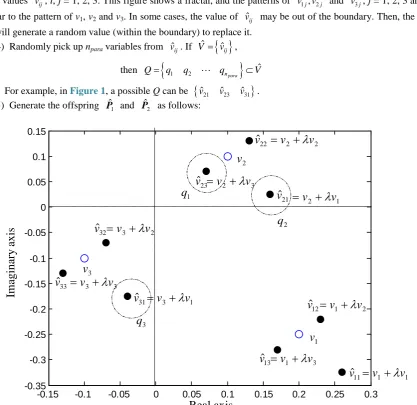
The idea of using IFSX to reproduce offspring is shown in Figure 1. The procedure is as follows:
1) Select 2 parents 1 11 12 1
para
n
p p p
=
p and 2 21 22 2
para
n
p p p
=
p from the population, where
para
n is the number of parameters.
2) Combine the information (genes) of p1 and p2 to form a vector v of complex elements given by
1 2 npara 11 21 12 22 1npara 2npara
v v v p jp p jp p jp
= = + + +
v (1)
3) Based on the IFS theory [4], let
ˆij i j
v = +v λv (2)
where ,i j=1, 2,,npara, λ ∈
(
0,1]
is a scaling factor. ˆvij are the possible values generated by the IFS thatexhibits a self-similarity property. For instance, in Figure 1, there are 3 values, v1, v2 and v3. From (2), we have
9 values ˆvij, i, j = 1, 2, 3. This figure shows a fractal, and the patterns of vˆ1j,vˆ2j and vˆ3j, j = 1, 2, 3 are
simi-lar to the pattern of v1, v2 and v3. In some cases, the value of ˆvij may be out of the boundary. Then, the system
will generate a random value (within the boundary) to replace it.
4) Randomly pick up npara variables from ˆvij. If Vˆ=
{ }
vˆij ,then
{
1 2}
ˆpara
n
Q= q q q ⊂V (3)
For example, in Figure 1, a possible Q can be
{
vˆ21 vˆ23 vˆ31}
. [image:2.595.92.510.294.699.2]5) Generate the offspring Pˆ1 and Pˆ2 as follows:
Figure 1. Idea of the proposed IFSX.
-0.15 -0.1 -0.05 0 0.05 0.1 0.15 0.2 0.25 0.3
-0.35 -0.3 -0.25 -0.2 -0.15 -0.1 -0.05 0 0.05 0.1 0.15 P1 (Re) P 2 (I m ) 1
v
2v
3v
12ˆ
v
11ˆ
v
13ˆ
v
21ˆ
v
22ˆ
v
23ˆ
v
33ˆ
v
32ˆ
v
31ˆ
v
2 3v
v
+
λ
=
3
3
v
v
+
λ
=
1
3
v
v
+
λ
=
3
2
v
v
+
λ
=
1
2
v
v
+
λ
=
2
2
v
v
+
λ
=
3
1
v
v
+
λ
=
2
1
v
v
+
λ
=
1
1
v
v
+
λ
( )
1ˆ =Re Q
P (4)
( )
2ˆ =Im Q
P (5)
where Re(Q) and Im(Q) generate vectors formed by the real part and imaginary part of the elements of Q
re-spectively.
Crossover operation is mainly for exchanging information from the two selected parents. In traditional
cros-sover operations (e.g. UNDX and BLX-α), the information is exchanging gene by gene. In the proposed IFSX,
each offspring gene is affected by all other genes of the parents, which is a more “complete” crossover operation for information exchange. The IFSX crossover makes the GA operation performs better in terms of fitness value and convergence rate.
3. Simulation Results
The GA with the proposed IFSX goes through six test functions. The results are compared to those from GAs
with UNDX and BLX-α. For each test function, the population size is 50 and all the simulation results are
aver-aged ones out of 50 runs. The selection algorithm and the mutation operation are the roulette wheel selection [1]
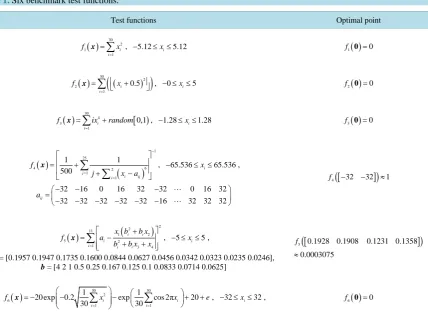
and the non-uniform mutation [1] respectively. The six test functions are listed in Table 1. f1 is a sphere model
which is smooth and symmetric. f2 is a step function, which is a representative of flat surfaces. f3 is a quartic
function which is a simple unimodal function padded with noise. f4 is a Shekel’s foxholes function and f5 is a
Kowalik’s function, which are multimodel functions with only a few local minima. f6 is an Ackley’s function
which is a multimodel function with many local minima. The parameter λ of the IFSX are set at 0.005, 0.001,
0.001, 0.01, 0.005, 0.005 for f1 to f6 respectively, and the parameter of the BLX-α is set at 0.336 [3]. The
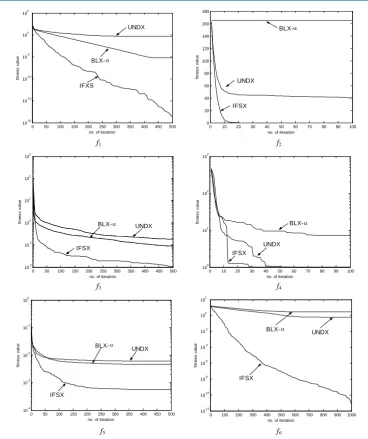
simula-tion results obtained by the GA with the proposed IFSX, UNDX and BLX-α are shown in Figure 2 andTable 2.
[image:3.595.108.537.401.717.2]It can be seen that the searching performance of the proposed IFSX is improved with faster convergence rate.
Table 1. Six benchmark test functions.
Test functions Optimal point
( ) 30 2 1
1
i i
f x
=
=
∑
x , −5.12≤ ≤xi 5.12 f1( )0 =0
( ) 30
(
( ))
2 2
1
0.5
i i
f x
=
=
∑
+ x , − ≤ ≤0 xi 5 f2( )0 =0
( ) 30
[
)4 3
1
0,1
i i
f ix random
=
=
∑
+x , −1.28≤ ≤xi 1.28 f3( )0 =0
( )
(
)
1 25
4 2 6
1 1
1 1
500 j
i ij
i
f
j x a
−
= =
= +
+ −
∑
∑
x , −65.536≤ ≤xi 65.536,
32 16 0 16 32 32 0 16 32
32 32 32 32 32 16 32 32 32
ij
a = − − −
− − − − − −
[
]
(
)
4 32 32 1
f − − ≈
( )
(
)
2 2 11
1 2
5 2
1 3 4
i i i
i i i
x b b x
f a
b b x x
=
+
= − + +
∑
x , − ≤ ≤5 xi 5,
a = [0.1957 0.1947 0.1735 0.1600 0.0844 0.0627 0.0456 0.0342 0.0323 0.0235 0.0246],
b = [4 2 1 0.5 0.25 0.167 0.125 0.1 0.0833 0.0714 0.0625]
[
]
(
)
5 0.1928 0.1908 0.1231 0.1358
0.0003075 f
≈
( ) 30 30
2 6
1 1
1 1
20 exp 0.2 exp cos 2π 20
30 i 30 i
i i
f x x e
= =
= − − − + +
∑
∑
f1 f2
f3 f4
[image:4.595.112.481.77.517.2]
f5 f6
Figure 2. Simulation results for f1 to f6 based on the proposed IFSX (solid line), UNDX (dashed line)
and BLX-α (dotted line).
Table 2. Statistical results for f1 to f6.
IFSX UNDX BLX-α
f1
Ave. 2.6783e−19 4.9364e−1 6.0905e−6
S.D. 9.8771e−19 7.6386e−1 5.2821e−6
f2
Ave. 0 8.5 164.82
S.D. 0 5.6973 16.241
f3
Ave. 9.9721e−3 1.8537e−1 8.9198e−2
S.D. 2.1561e−2 1.7033e−1 4.1623e−2
f4
Ave. 0.99942 1.0023 7.2684
S.D. 0.00688 0.02393 43.494
f5
Ave. 5.6569e−4 6.1026e−3 4.6089e−3
S.D. 7.9694e−4 1.0703e−2 6.8570e−3
f6
Ave. 7.444e−12 2.8856 6.0939e−1
S.D. 2.0494e−11 2.4163 6.6202e−1
0 50 100 150 200 250 300 350 400 450 500 10-20
10-15 10-10 10-5 100 105
no. of iteration
fi
tnes
s
v
al
ue
IFXS BLX- α
UNDX
0 10 20 30 40 50 60 70 80 90 100 0
20 40 60 80 100 120 140 160 180
no. of iteration
fi
tnes
s
v
al
ue
UNDX
IFSX
BLX- α
0 50 100 150 200 250 300 350 400 450 500 10-2
10-1 100 101 102 103
no. of iteration
fi
tnes
s
v
al
ue
IFSX
BLX- α UNDX
0 10 20 30 40 50 60 70 80 90 100 100
101 102 103
no. of iteration
fi
tnes
s
v
al
ue
UNDX IFSX
BLX- α
0 50 100 150 200 250 300 350 400 450 500 10-4
10-3 10-2 10-1 100
no. of iteration
fi
tnes
s
v
al
ue
IFSX
UNDX BLX- α
0 100 200 300 400 500 600 700 800 900 1000 10-12
10-10 10-8 10-6 10-4 10-2 100 102
no. of iteration
fi
tnes
s
v
al
ue
UNDX
[image:4.595.87.536.565.722.2]4. Conclusion
In this paper, a new crossover of IFSX for real-coded GA has been proposed. Take the advantage of the iterated function system theory and integrate into crossover operation of real-code genetic algorithm, the solution quality of the searching is enhanced. A suite of benchmark test functions has been used to illustrate the merits of the IFSX.
References
[1] Michalewicz, Z. (1994) Genetic Algorithm + Data Structures = Evolution Programs. 2nd Edition, Springer, Berlin Heidelberg, New York. http://dx.doi.org/10.1007/978-3-662-07418-3
[2] Ono, I. and Kobayashi, S. (1997) A Real-Coded Genetic Algorithm for Function Optimization Using Unimodal Nor-mal Distribution Crossover. Proceedings of the Seventh International Conference on Genetic Algorithms, USA, 19-23 July 1997, 246-253.
[3] Eshelman, L.J. and Schaffer, J.D. (1993) Real-Coded Genetic Algorithms and Interval-Schemata. Foundations of Ge-netic Algorithms, 2, 187-202. http://dx.doi.org/10.1016/B978-0-08-094832-4.50018-0
[4] Ling, S.H. and Leung, F.H.F. (2007) An Improved Genetic Algorithm with Average-Bound Crossover and Wavelet Mutation Operations. Soft Computing, 11, 7-31. http://dx.doi.org/10.1007/s00500-006-0049-7