IDENTIFICATION OF LOCATION USING ROUTING BASED PROTOCOLS
V. Dhanakoti and P. Nirmala Deve
Department of Computer Science and Engineering, Valliammai Engineering College, Chennai, India
ABSTRACT
Many problems in Ad-Hoc network is divided as an optimization problem such as consumption in energy, localization, routing, use of nodes in effective way. To solve these problems set of routing algorithm have been developed based on swarm intelligence. Ant colony algorithm is based on the behavior of ants in swarm intelligence. To enhance the communication we use different protocols and also location of the nodes in the cluster is also identified using location based routing protocols.
Keywords: Ad-Hoc network, WSN, swarm intelligence, MANET, ant colony optimization, protocols.
1. INTRODUCTION
WSN is existing technology which consists of various applications like surveillance, healthcare, habitat monitoring and disaster management, etc.WSN comprises of sensors, processors and radio module with restricted battery, restricted memory, restricted bandwidth which put restriction on WSN. The ultimate goal is to take information from sender to receiver without failure. In ad-hoc network, routing is not easy than customized communication network because of its restriction which is mentioned above. In ad- hoc network basic protocol does not perform well due to its properties like unstable node, uneven link. In WSN and MANETs most of the protocols are application dependent. Based on the demand application they are designed. So, the adaptive protocol is developed. Based on swarm intelligence a new set of algorithms are related to biological, natural self-organizing system. The Ant Colony Optimization (ACO) is based on Swarm Intelligence (SI). Travelling Salesman Problem [TSP] was used to solve [1]. This algorithm comes under the behavior of ants to find shortest route in communication network. Food searching mechanism is used and it was further executed for ad-Hoc network.
2. ACO BASED ROUTING ALGORITHM
The Ant Colony Optimization can be obtained from behavior of ants based on food searching. In early nineties, original ant colony optimization algorithm in ant system was proposed [1].For communication network was proposed for ACO based routing algorithm [2].
Basic Ant Colony Algorithm
The ultimate aim of ant colony is obtained from the behavior of ants by searching their food. Ants deposit the pheromone on the way when they are in search of their food which makes route for them. Pheromone is a liquid which evaporates as time goes. Hence, the pheromone indicates the probability of path usage.
Figure-1. Flowchart for Ant Colony mechanism.
In Figure-1, three routes from source to destination are provided. On interaction ant selects the path randomly, because path A is shortest one, so path A is taken to reach the food first. The path depends on the concentration of pheromone by ants and shortest path is obtained from it will be higher when compared with others. By this all the ants takes the shortest path only. This behavior is obtained in communication networks for finding shortest path. Due to its unstable and various natures, this algorithm is used for mobile ad-hoc network where a frequent change in topology takes place. In [3] simple ACO meta-heuristics algorithm shows why these types of algorithm perform well in mobile ad-Hoc network.
Static protocols there are no need to refresh these tables
because they have static routing tables.
Proactive protocols periodically refresh the routing
Reactive protocols, on demand paths are discovered for
messages and also called as on-demand protocols. Hybrid
protocols, uses both proactive and reactive
protocols.
By using these routing protocols, new routes are discovered between communicating nodes between FANETS, and also addition and subtraction in this network is allowed dynamically by UAV nodes.
STATIC ROUTING PROTOCOLS
In static routing protocols, before a new mission a routing table is computed, since it is a static no update can be taken place.UAV have a constant topology [4] in this type of network. Each node with few UAVs or ground station can be communicated and that store their information .It has to wait till the end of the mission in case of any failure. So, correct dynamic environment and no fault tolerance.
Load Carry and Deliver Routing (LCAD)
In [5, 6] is the FANETs first routing model. In this, data is loaded from the ground by UAV; and carries data to destination when flying; and lastly delivers to ground station i.e.) destination. As in Figure 3, in practice single source and destination node is considered and multiple source and destination can also be implemented. In networking system, LCAD is interference free of communicating nodes because of its distance location and also throughput of the system is also increased by this. For huge data transfer and for the delay -tolerant with limited number of hops this method will obtain the possible solution [7]. While transmission the delay becomes more and cannot be tolerated as there is increased in parts for communicating. This shows how the UAV can fly fast in this distance as the mission time is depended on it.UAV can also obtain the data when it with them from the places.
When UAV is producing the data, it is not feasible to obtain data in a particular area from the source node or to load the data if there is single UAV. On same path more UAV can also be used due to decrement in the transmission time, increment in the speed can also be done and Smaller LCAD sub-networks also divided.
Figure-2. Load carry and deliver routing model.
Multi-level hierarchical routing
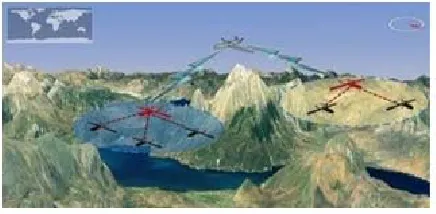
Because of the VANET environment, in two dimension space the protocols in routing are arranged as a flat routing. In 3D UAV is designed based on sensor types, height of the flight, size of UAV, capabilities in usage of energy, etc. Classical routing in large scale VANET network will lead to degradation in particular performance .To overcome this network scalability is upgraded, one possible solution is hierarchical routing protocols to be used [8,9] that divides the FANET into groups of UAV.
In order to operate in different area UAV networks are grouped in a hierarchical fashion .To initialize functions to the group in a different manner, each group will have the cluster head in which it is connected to upper or lower layers(communication through satellites, Base stations, UAVs etc.). CH should have direct transmission to other UAVs which is in cluster to broadcast and control information to other UAVs which is clustered. This model is used in swarms, in large mission areas and in UAV networks.
Data centric routing
Due to wireless communication in UAVs, one-to-one data transmission is preferred than one-to-many data transmission [10, 11].When many number of nodes is requesting for the data and also distribution is taking place on the on-demand algorithm. Data centric routing is a promising paradigm of routing mechanism and can be adapted for FANET, rather using IDs of sender or receiver node ,the request and collection of data based on data distribute. This model is used in clusters and publish- subscribe, efficiency on distributed computing can be obtained [12].
In this model, as subscription message is broadcasted by consumer node in form of queries to get the required data from required area. Now the producer node will decide the data's which are needed to be published and initialize the broadcast. When data reaches the UAV which is published, then it will check for the messages which subscribed and then forwarded based on it. Routing is based on data content, data needs; data aggregation algorithm is also used for efficiency in energy for data broadcasting. Network load will be more when collection and broadcasting of messages is added more, because of elimination of redundancy during transmission of data .By using this model, efficiency is increased .Three dimension of coupling is performed in this type of routing;
Space coupling is that Id's of each other parties is not
known during communication between them.
Time decoupling the parties those who are
Flow decoupling the process of sending messages
[image:3.612.77.295.148.255.2]cannot be blocked by third parties, which is in the form of asynchronous in structure of communication.
[image:3.612.76.295.286.394.2]Figure-3. Hierarchical routing model.
Figure-4. Data centric routing model.
PROACTIVE ROUTING PROTOCOLS
All the routing information are stored in the routing for each node in the network only to the particular region. Based on topological changes many table driven protocols are used in FANET and there is difference in updating. Advantage in this routing is all the new data's in the routing is obtained, hence it is easy to obtain path from source to destination and waiting is not needed. Disadvantages are between the nodes more information is exchanged and cannot use the bandwidth efficiently, only limited communication is provided which is not compatible for larger networks. If any failure or topological changes are occurred slow reaction is shown. Two protocols are used in VANETs: Optimized Link State Routing (OLSR) and Destination Sequenced Vector (DSDV).
Optimized Link State Routing (OLSR)
It uses hello and topology control messages are the two types of messages to discover neighbor nodes [13].During direct communication neighboring nodes are detected by using hello messages and it contains known neighbor list and broadcast them. Topology information of the system is maintained in topology control messages. It will periodically refresh and recalculates the routes for all nodes in the system so it results in overhead. To decrease the overhead Multi Point Relay (MPR) is used. MPRS selects each node from
its neighbor and only those nodes will forward the routing messages.
Destination Sequenced Distance Vector (DSDV)
It maintains routing table for all nodes, not only for neighboring nodes .This is called as table-driven proactive routing protocol. As the topology change occurs, the updates are broadcasted. DSDV will use the sequence number which is assigned by destination. A sequence number for the higher one is needed the lower one. The advantage in DSDV is simple algorithm and sequence number is used which make loop-free to the protocol. To make routing table to be updated, periodically nodes broadcast the updates in routing table and this will make overhead in network.
REACTIVE ROUTING PROTOCOLS
Reactive routing protocols is called as on-demand routing protocol, no communication and no storage between them .This will overcome the problems in PRP. Here, the communication of nodes route is obtained based on demand from source node. RouteRequest messages and RouteReply messages are two routing models. RouteRequest messages are produced and by network send to the source node and destination node will reply with a RouteReply message. Nodes will maintain the routes which are currently in use. No periodic message so bandwidth is efficient in RRP. For finding routes it takes longer time and high latency.
Dynamic Source Routing (DSR)
It is designed for multi-hops for wireless mesh networks.DSR, will disseminate request message to its neighbor node in wireless communication which contains more route request message. Request-id number which is added to the produced message is unique. Source node will store the entire route by hop-by-hop of the destination node. The route maintenance mechanism is achieved if source node cannot use current node because of changes in the network. In that situation, another route to destination is to be used; a new recovery phase is initiated. In [28] with the help of DSR obtaining new routes is difficult.
AD-hoc On-demand Distance Vector (AODV)
It is reactive protocol, which have the same on-demand characteristics with DSR with different maintaining mechanism of routing table. AODV contains single record for destination and each node will store the routing table. In DSR, data packets are taken
routing table is updated in intermediate nodes. Through route-id packets are transmitted. Some failures can occur, and for connection loss it will produce repairing process to maintain routes.
HYBRID ROUTING PROTOCOLS
Hybrid routing protocols (HRP) is combination of previous protocols, in reactive routing protocols the latency in initial routes can be reduced and in proactive routing control messages can be decreased. It is mainly suited for large networks, in which networks are divided into intra-zone by proactive approach and inner-zone by reactive approach.
Zone Routing Protocol (ZRP)
It is based on the concept of zones[30] .Each node will contain different zone, which is defined as set of nodes in which minimum distance is not greater than already defined radius ρ. So there is overlapping in neighboring nodes. In MANET whole traffic will be send to nearby nodes. The transmission of data can be from source node if they are in same zone. The inter-zone is for sending outside nodes. By broadcasting route discovery can be reduced. Traditional broadcasting is used by nodes of a zone.
Temporarily Ordered Routing Algorithm (TORA)
It is a routing process for networks in multi-hop, information about adjacent routers is maintained [31].Control message propagation is limited in unstable mobile computing environment, by reducing reaction based on topological changes. It is maintained based on Directed Acyclic Graph (DAG) from source to destination and contains multiple routes .It is mainly used for broken
links to find out the new routes and adaptation can be incremented. TORA Won't use shortest path solution, network overhead is decreased for long routes. Two nodes cannot have the same height. Data flow is from higher nodes to lower. With new routes and heights all the intermediate routes is updated in their routing table.
3. POSITION BASED ROUTING USING GPS
Position is calculated based on their mobile nodes, GPS system is used. The position of (X,Y) is calculated based on the formula Using inverse tangent function angle is calculated, The next way is based on arrival of direction and strength of signal for using the directional antenna. Now focus is about GPs systems due to their existing and increased usage [13]. Position Based routing protocols have the following advantages. They provide even more scalability and performance to improve the decision and efficiency in routing using geographical positions. Low packets and reduced signaling packets are used in current protocols [14].
Advantages in GPS technologies are owned and maintained by the government. And also provides reliable information in all the weather conditions, it is global satellite. It is better one for tracking and identification of nodes. In 2004 it was available in mobile phones.
Proposal of CGPSLAR
This proposal is to improve the Mobile Network Communication based on the use existing technology and infrastructure. Nowadays works involved does not address any existing device. Cellular technology is also a form of Ad-Hoc Network technology.
Table-1. Characteristics of examples.
Cellular Technology
Cellular Technology depends on hardware with digital which is rapidly improving and summing with its infrastructure. This helps to maintain demand and improvement of digital media or data. With backup power supply, towers have constant power supply. Cellular
towers will obtain the energy needed and will reduce the heavy load of energy on mobile devices and also produces landline connection as a backbone and adapters are used for connecting the computers to the network.
GPS has improved all types of technology and it is maintained by US Government and service to all the devices. Satellites are updated constantly GPS technology existing in automotive industry and cellular technology.
Mobility issues based on communication is caused mainly in automobile and it is a source. Current Scenario is to use Standard equipment as a GPS technology.
The proposed solution
In proposed solution infrastructure and Global Position location based routing is used in Mobile Ad-Hoc Network. In same way, servers are placed at cellular tower. The server maintains r o u t i n g t a b l e f o r its node location. Because strategic locations are used for cellular towers and based on area it is partitioned into four quadrants of four cellular towers in its server. Each server area will administer the mobile area anodes and provides the communication from source to destination nods. When node goes to the next area. The communication is happened in same way as in cellular communication. Advantage is power, capability in processing to obtain features in security for Mobile Ad-hoc Network.
A new method in Location Aided Routing protocol will provide communication with server. This protocol requires nodes in mobile to be capable of GPS. Suppose a failure occurs in base node a request for a new base node is broadcasted. For some reasons a central base station cannot be obtained, this protocol will provide communication with other nodes. From local nodes the server request for information and location information in a local table is stored. If any changes in the location can be updated in the location table without obtaining nay request.
The server will provide the communication from source to destination nodes .If server identifies route which is efficient, requesting node contains all the routing instruction which is sent. In this proposal, forwarding of packets and flooding packet control can be reduced, the efficiency of MANET is optimized.
Simulation results
Simulation Parameters [15] is as follows:
Using NS-2 network simulator, it is performed with the MANET extensions.
MAC layer protocol is used in IEEE 802.11.
With a bit rate of nominal 2Mbps the radio model is simulated.
250 meters is the range for the nominal transmission.
Two way ground model is the radio propagation Model.
100 nodes are used for one experiment and other 100 nodes are used for other computers of 1000mX1000m.
CBR is the traffic pattern with load of 4 packets/sec and length is 512 bytes.
Random waypoint model is the mobility model used. Node mobility degree is independent of the time
pause mobility in node. Pause time is small then it is intense node mobility and large time pause is called slow node mobility and pause time 5 seconds. Simulation time is 300 seconds.
The performance in simulation is done by different seeds from 2 m/s to 10 m/s in successive stage having an interval of 2m/s for max 40 nodes. Simulations are performed by 20,40,60,80,100 nodes
in successive stages.
Figure-5. End to end delay comparison to speed with
limited computing power.
Figure-6. End to end delay comparison for changing
number of nodes and limited computing power.
4. CONCLUSIONS
done on various simulation platforms. The result shows the comparison when changing the number of nodes.
REFERENCES
[1] Dorigo M., Birattari M. and Stutzle T. 2006. “Ant colony optimization," Computational Intelligence Magazine, IEEE , Vol.1, No.4, pp.28-39, November.
[2] G Di Caro, Gianni and Marco Dorigo. 1998. "Ant colonies for adaptive routing in packet-switched communications networks." Parallel Problem Solving from Nature—PPSN V. Springer Berlin/Heidelberg.
[3] Mesut Gunes, Mesut, UdoSorges and Imed Bouazizi. 2002. "ARA-the ant-colony based routing algorithm for MANETs." Parallel Processing Workshops, 2002. Proceedings. International Conference on. IEEE.
[4] Franchi A., Secchi C., Ryll M., Bulthoff H. H. and Giordano P. R. 2012. Shared control: balancing autonomy and human assistance with a group of Quadrotor UAVs. IEEE Robot. Autom. Mag. Vol. 19, No. 3, pp. 57– 68.
[5] Cheng C.M., Hsiao P.H., Kung H.T. and Vlah D. 2007. Maximizing throughput of UAV-relaying networks with the load-carry-and-deliver paradigm. In: IEEE Wireless Communications and Networking Conference (WCNC2007).
[6] Le M., Park J.S. and Gerla M. 2006. UAV assisted disruption tolerant routing. In: Military Communications Conference, MILCOM 2006, pp. 1– 5.
[7] Jonson T., Pezeshki J., Chao V., Smith K. and Fazio J. 2008. Application of Delay Tolerant Networking (DTN) in airborne networks. In: IEEE Military Communications Conference-(MILCOM 2008), pp. 1–7.
[8]Lamont G.B., Slear J.N. and Melendez K. 2007. UAV swarm mission planning and routing using multi- objective evolutionary algorithms. In: IEEE
Symposium on Computational Intelligence in Multi criteria Decision Making, pp. 10–20.
[9] Sun Z., Wang P., Vuran M.C., Rodhaan M.A., Al-Dhelaan A.M. and Akyildiz I. F. 2011. Border Sense: border patrol through advanced wireless sensor networks. Ad Hoc Netw. Vol. 9, No. 3, pp. 468–477.
[10]Ko J., Mahajan A. and Sengupta R. 2002. A network- centric UAV organization for search and pursuit operations. In: IEEE Aerospace Conference, pp. 2697–2713.
[11]Lopez J., Royo P., Pastor E., Barrado C. and Santamaria E. 2007. A middleware architecture for unmanned aircraft avionics. In: ACM/IFIP/ USENIX International Conference on Middleware companion (MC ‘07).
[12]de Jong E. 2011. Flexible data-centric UAV platform eases mission adaptation. White paper, Available online. http:// www.rti.com/ whitepapers/RTI_Data- Driven_ Approach_ to_UAV. pdf (2011). Accessed 3 August.
[13]Sahingoz O.K. and Erdogan N. 2003. MAPSEC: mobile- agent based publish/subscribe platform for electronic commerce. Lect. Notes Comput. Sci. 2869/2003, pp. 348–355.
[14]Mohammad A. Mikki. 2009. “Energy Efficient Location Aided Routing Protocol for Wireless Manets”, International Journal of Computer Science and Information Security, Vol. 4, No 1 & 2.