www.hydrol-earth-syst-sci.net/18/3693/2014/ doi:10.5194/hess-18-3693-2014
© Author(s) 2014. CC Attribution 3.0 License.
A hydrogeologic framework for characterizing summer streamflow
sensitivity to climate warming in the Pacific Northwest, USA
M. Safeeq1, G. E. Grant2, S. L. Lewis1, M. G. Kramer3,*, and B. Staab3
1College of Earth, Ocean, and Atmospheric Sciences, Oregon State University, Corvallis, OR 97331, USA 2USDA Forest Service, PNW Research Station, Corvallis, OR 97331, USA
3USDA Forest Service, PNW Region, Portland, OR 97208, USA
*current address: Soil and Water Science Department, University of Florida, Gainesville, FL 32611, USA Correspondence to: M. Safeeq ([email protected])
Received: 11 February 2014 – Published in Hydrol. Earth Syst. Sci. Discuss.: 21 March 2014 Revised: 15 July 2014 – Accepted: 16 August 2014 – Published: 24 September 2014
Abstract. Summer streamflows in the Pacific Northwest are largely derived from melting snow and groundwater dis-charge. As the climate warms, diminishing snowpack and earlier snowmelt will cause reductions in summer stream-flow. Most regional-scale assessments of climate change im-pacts on streamflow use downscaled temperature and preci-pitation projections from general circulation models (GCMs) coupled with large-scale hydrologic models. Here we de-velop and apply an analytical hydrogeologic framework for characterizing summer streamflow sensitivity to a change in the timing and magnitude of recharge in a spatially ex-plicit fashion. In particular, we incorporate the role of deep groundwater, which large-scale hydrologic models generally fail to capture, into streamflow sensitivity assessments. We validate our analytical streamflow sensitivities against two empirical measures of sensitivity derived using historical ob-servations of temperature, precipitation, and streamflow from 217 watersheds. In general, empirically and analytically de-rived streamflow sensitivity values correspond. Although the selected watersheds cover a range of hydrologic regimes (e.g., rain-dominated, mixture of rain and snow, and snow-dominated), sensitivity validation was primarily driven by the snow-dominated watersheds, which are subjected to a wider range of change in recharge timing and magnitude as a result of increased temperature. Overall, two patterns emerge from this analysis: first, areas with high streamflow sensitiv-ity also have higher summer streamflows as compared to low-sensitivity areas. Second, the level of low-sensitivity and spatial extent of highly sensitive areas diminishes over time as the summer progresses. Results of this analysis point to a robust,
practical, and scalable approach that can help assess risk at the landscape scale, complement the downscaling approach, be applied to any climate scenario of interest, and provide a framework to assist land and water managers in adapting to an uncertain and potentially challenging future.
1 Introduction
A fundamental challenge facing scientists and resource man-agers alike is grounding predictions of climate change and its consequences in specific landscapes and at scales useful for resource planning. This challenge is particularly acute for predictions of water abundance and scarcity, as both the cli-matic and landscape controls on water availability are typi-cally at a finer scale than representations in the current class of climate and hydrologic models. Resource managers are tasked to plan for an uncertain future by assessing vulner-abilities and sensitivities of different landscapes to change. What strategy should they follow?
But there are also limitations. GCMs coarsely parameter-ize terrain and fail to incorporate important climatic pro-cesses, such as the El Niño–Southern Oscillation and Pa-cific Decadal Oscillation, in predictions. Higher-resolution regional circulation models (RCMs) that include better to-pographic representation are improving this situation (Leung and Qian, 2003; Maraun et al., 2010), but accurate forecasts of future climate by this method are still several years off. Moreover, large-scale hydrologic models commonly used in the Pacific Northwest (PNW) for hydrologic forecast-ing (e.g., variable infiltration capacity – VIC; Liang et al., 1994), do not explicitly simulate streamflow contributions from deep aquifers (Wenger et al., 2010). However, the is-sue of deep-groundwater representation is not limited to VIC alone. Explicit representation of deep groundwater is approx-imated by extended soil profiles in many large-scale land sur-face models (Vano et al., 2012).
Several recent studies have demonstrated the important role of geologically controlled deep groundwater in medi-ating streamflow response to climatic variability and warm-ing in the PNW (Jefferson et al., 2008; Tague et al., 2008, 2013; Tague and Grant, 2009; Mayer and Naman, 2011; Waibel et al., 2013). Historical streamflow analysis across the western US underscores the importance of both climatic and geologic controls on streamflow response to climate change (Safeeq et al., 2013). Accordingly, approaches that capture both climatic and geologic controls are needed to identify landscape-level streamflow vulnerability to chang-ing climate. This is particularly critical in the PNW, where local climate, topography and geology combine to dictate hy-drologic regimes.
In the PNW, seasonal asynchrony between winter and spring precipitation and runoff and summer water demand makes summer water supplies scarce and vulnerable (Jaeger et al., 2013). Climate change will intensify this water scarcity by reducing summer streamflows (Safeeq et al., 2013). De-clines have the potential to be acute, due to a combina-tion of observed and predicted shifts in precipitacombina-tion phases from snow to rain, earlier onset and faster rates of snowmelt, and increased summer evapotranspiration (Mote et al., 2005; Stewart et al., 2005; Nolin and Daly, 2006; Das et al., 2011). Increasing interannual variability and changes in extreme flows compound seasonal changes. Luce and Holden (2009), for example, documented widespread declines in the lowest annual flows occurring from 1948 to 2009; these flows are critical for consumptive water use, hydropower, and aquatic biota, including the region’s prized and declining salmon populations.
We present a complementary “bottom-up” approach, fo-cusing on the PNW. Our methodology rests on the analytical framework of Tague and Grant (2009) that characterizes rel-ative summer streamflow sensitivity. Using a rigorous defini-tion of summer streamflow sensitivity as funcdefini-tion of the first derivatives of the relationship between discharge and either the timing or magnitude of recharge, we develop a spatial
analysis that characterizes summer streamflow sensitivity at a landscape scale. Relationships between observed climate and streamflows at specific gaged locations in diverse hydrogeo-logic areas are used to extend the sensitivity relationships to ungaged areas and map sensitivity for the entire study region. The uniqueness and strength of this approach is that it is in-dependent of climate change scenarios. Sensitivity is mapped as an intrinsic property of the landscape as interpreted using the average historical climate and other landscape properties, rather than as a response to future climate change alone.
This sensitivity assessment can then be integrated with cli-mate scenario data to produce regional-scale summer stream-flow vulnerability maps. We present an example of how this type of spatial analysis might be applied to National Forest lands in the Pacific Northwest. Land and water managers can tune this type of assessment to their specific needs in order to identify and prioritize actions to adapt to uncertain and potentially challenging future conditions.
2 Study location
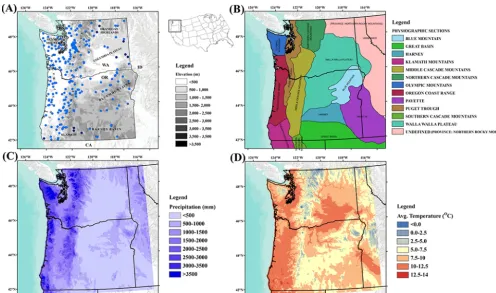
This analysis encompasses Oregon (OR) and Washington (WA) in the northwestern United States (US) with a pop-ulation of nearly 10.5 million (US Census Bureau, 2010). The elevation varies from sea level to over 4300 m at Mount Rainier, with the north–south trending mountains of the Cas-cade Range dividing the western and eastern portions of the states (Fig. 1a). The study region is divided into 13 phys-iographic sections (Fig. 1b) based on common topography, rock type, structure, and geomorphic history (Fenneman and Johnson, 1946). The maritime climate is highly influenced by the Pacific Ocean and varies with elevation and distance from the coast (Fig. 1b and c). Long-term average precipita-tion ranges from 150 mm in the Columbia Valley on the east side of the Cascades to∼7000 mm in the Olympic Moun-tains (Daly et al., 2008, Fig. 1c). Both OR and WA have extreme wet (winter) and dry (summer) seasons, but the sea-sonal distribution of precipitation varies between the region’s eastern and western halves. While most of the annual preci-pitation occurs during fall and winter, more frequent summer thunderstorms in the eastern half result in a slightly higher summer precipitation (Mass, 2008). An altitudinal tempera-ture gradient, varying by latitude (Fig. 1c), controls the phase of precipitation with winter rain (R) in lower elevations, sea-sonal snow at higher elevations (SSZ), and transient snow at intermediate elevations (TSZ) (Jefferson, 2011). The ma-jority of the winter precipitation occurs as rain in the Coast Range and as snow along the Cascades and other ranges (e.g., Wallowa and Blue Mountains).
Figure 1. (a) Study domain and selected stream gages (n=227; all circles) in Oregon and Washington used to calculatek. Stream gages (n=217; light blue circles) with at least 20 years of daily streamflow between 1950 and 2010 were used in the sensitivity validation and other time series comparisons of rain, snowmelt, and streamflow; (b) physiographic regions based on common topography, rock type, structure, and geomorphic history; (c) average (1981–2010) annual precipitation; (d) average (1981–2010) temperature.
and minimal groundwater storage (e.g., the OR Coast Range and western side of the Middle Cascade Mountains known as the Western Cascades) resulting in higher winter peaks and prolonged summer low flows. In contrast, streams in groundwater-dominated regions such as the volcanic-dominated central and eastern portion of the Middle Cas-cade Mountains (High CasCas-cades) show a much more uniform flow regime, with higher summer baseflows, slower recession rates, and significantly lower winter peak flows (Grant, 1997; Tague and Grant, 2004).
3 Conceptual model of streamflow sensitivity
Our conceptual model is built around the assumption that the discharge from a watershed depends solely on the amount of aquifer storage. Based on conservation of mass, the water balance within the watershed is given by
dS
dt =IR+IM+GWin−ET−Q−GWout, (1) where S is water stored in watershed (mm),IR is rainfall (mm day−1), IM is snowmelt (mm day−1), ET is evapo-transpiration (mm day−1),Qis discharge (mm day−1), and GWin and GWout are the groundwater (mm day−1) inflow
and outflow, respectively. Change in storage (dS/dt) is positive when IR+IM+GWin−GWout−ET> Q and negative whenever Q > IR+IM+GWin−GWout−ET. Maximum aquifer storage (dS/dt=0) occurs when Q=IR+IM+GWin−GWout−ET, which should coincide with peak discharge (dQ/dt=0) based on the storage–discharge relationship. In reality, since peak discharge always lags the peak recharge (Kirchner, 2009), the peak of the hydrograph will oc-cur when IR+IM+GWin−GWout−ET< Q and thus dS/dt <0. However, we simplify and assume that at the peak of the hydrograph dS/dt≈0 and hence Q≈IR+IM+GWin−GWout−ET, and Eq. (1) can be simplified to
Qo=IR+IM+GWin−ET−GWout, (2) whereQois peak discharge (mm).
The recession curve of the hydrograph, or decay of Qo over time, can be expressed by
Q(t )=Qoe−kt, (3)
[image:3.612.49.545.65.358.2]andk is a recession constant (Tallaksen, 1995). As the cli-mate warms, any change in the timing and magnitude ofQo will affectQ(t ). Additionally, the recession timet depends on the day of the peak dischargetpand the daytdon which Qis quantified. Hence a more general form of Eq. (3) can be written as
Q (1Qo, ts)=(Qo+1Qo) e−k(td−tp−ts), (4) where 1Qo andts are change in peak discharge rate and shift in time driven by climate change, respectively. An ear-lier shift in peak discharge will result in a negative ts and hence an overall longer recession period betweentpand the daytd. Following Tague and Grant (2009), streamflow sensi-tivities to a shift in magnitude (1Qo) and timing (ts) can be described using a first-order derivative of Eq. (4) with respect to peak dischargeQoand timet:
dQ(t ) dQo
=εQo=e
−kt (5)
dQ(t )
dt = −εt= −kQoe
−kt, (6)
where terms εQo and εt represent the metrics used in this study to describe the sensitivity of discharge to changes in magnitude of peak discharge and timing, respectively. The negative sign in Eq. (6) indicates that Q(t ) decreases with increasingt.
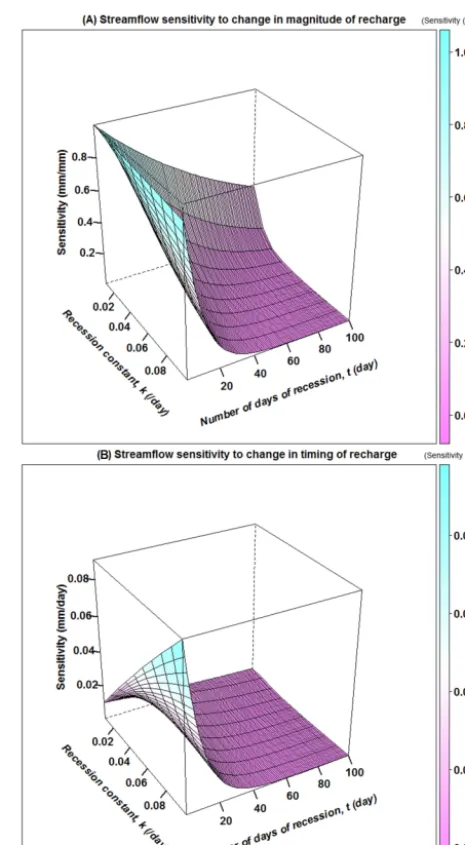
The response surfaces of εQo and εt (Fig. 2) illustrate the interaction betweent andk and how the two sensitivi-ties are expressed over the course of the streamflow reces-sion. In groundwater-dominated systems with low values of k(e.g., High Cascades),εQo starts higher at the beginning of the recession and shows a very subtle decline with increas-ingt (Fig. 2a). In contrast, in the runoff-dominated systems with highk(e.g., Western Cascades),εQo is very compara-ble to low k systems but diminishes very rapidly with in-creasing t. In the context of climate change, this suggests that while changes in summer streamflow in groundwater-and runoff-dominated systems with similar tp andQo may be comparable in the beginning of recession, they vary dras-tically as the recession progresses. The interaction betweent andkforεt is more complex as compared toεQo (Fig. 2b). In groundwater-dominated systems with lowk,εt starts low and shows a very subtle decline with increasingt. In runoff-dominated systems with highk,εtstarts high but diminishes very quickly with increasing t. The very subtle and rapid decline of sensitivities (εQo andεt) between groundwater-and runoff-dominated systems expressed by the conceptual model are consistent with those expressed in streamflow trends in the empirical record. In groundwater-dominated systems streamflow response to decreasing snowpack is me-diated and streamflow continues to decline throughout the summer (Mayer and Naman, 2011; Safeeq et al., 2013).
[image:4.612.309.542.63.486.2]Although our conceptual model of streamflow sensitiv-ity is consistent with trends shown in the empirical stream-flow record, we recognize that the complexity of the real
Figure 2. Theoretical response surface from conceptual model
(af-ter Tague and Grant, 2009) for representativekvalues for the study region. Sensitivity of summer streamflow to (a) a change in the magnitude of recharge (mm mm−1) and (b) an earlier shift in the timing of recharge (mm day−1), assuming an initial recharge vol-ume of 1 mm.
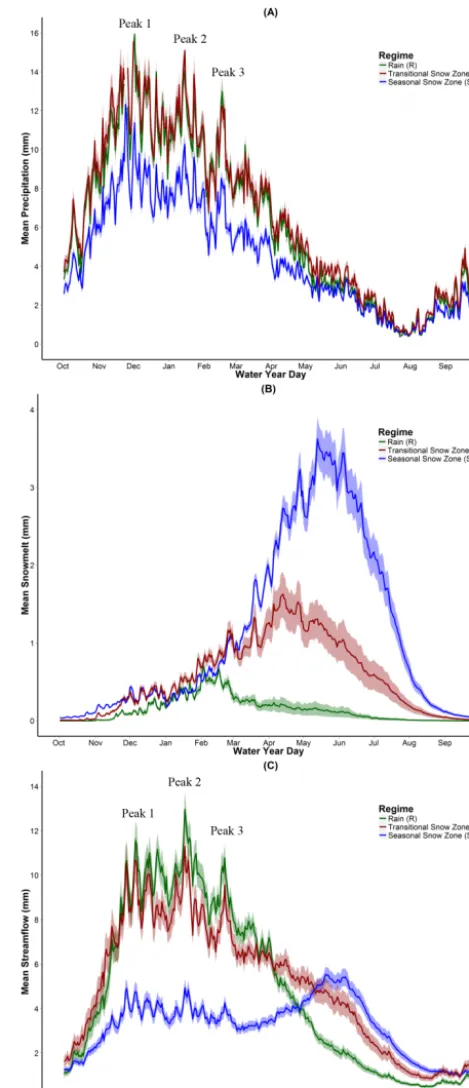
This exchange has been excluded from our approach be-cause physically accounting for groundwater gain and loss in this conceptual sensitivity framework with little or no data would undermine its simplicity. This introduces some error in some landscapes, notably those with large groundwater systems in young volcanic terranes. Additionally, this sen-sitivity approach assumes thatQoandtare independent and any change inQowill not affectt. This assumption may hold true in rain-dominated systems but could be problematic in snowmelt-driven environments. However, this is much less of an issue in our study domain, where most of the snowmelt occurs during spring and summer recession characteristics depend primarily on peak initial recharge (Qo). Additionally, approximating theIRorIMforQoandtRortMfortp, even when ET≈0 and GWin=GWout(Eq. 2) could result in bi-ased estimates of sensitivity described in Eqs. (5) and (6). In places where the reservoir is large, Qo gets delayed fol-lowing rechargeIRorIM, andtRortMmay not representtp. For example, in watersheds within the seasonal snow zone (see Sect. 4.2 for the definition), tp is on average delayed by 6 days from tM (Fig. 3). In rain-dominated watersheds, the time lag between tRandtp is on average 9 days for the first peak as streamflow recovers from the long summer re-cession. This time lag between rainfall and streamflow de-creases to 1 or 2 days for the subsequent peaks (Fig. 3a, c). Although the time lag between peak recharge and stream-flow may vary significantly depending on data (e.g., observed vs. simulated IM andtM) and method (e.g., isotopic tech-niques vs. simple recharge–runoff relationship) used to char-acterize the relationship, our goal here is to highlight the is-sue and how it might affect the sensitivity expressed using the conceptual model. Finally, the watershed recession con-stant,k, may vary year-to-year depending on evapotranspira-tion losses and other forms of water withdrawals (Thomas et al., 2013), which are not explicitly considered in the model. Given these limitations, our intent is not to precisely predict the change in actual flow regimes, but to assess the compar-ative sensitivity of those flow regimes across the landscape.
4 Parameterizing the model 4.1 Recession constant (k)
Daily average streamflow data for a set of 227 (111 in OR and 116 in WA) unregulated watersheds were obtained from the United States Geologic Survey (USGS) (http:// waterdata.usgs.gov/or/nwis/sw; data accessed on October 31, 2011) and the Oregon Department of Water Resources (http: //apps2.wrd.state.or.us/apps/sw/hydroreport/; data accessed on 1 November 2011) (Fig. 1a). Watershed drainage areas range from 4 to ∼21 000 km2, with an average of approxi-mately 950 km2. These watersheds were classified as part of the USGS Hydroclimatic Climatic Data Network (HCDN) (Slack et al., 1993), or were part of the reference gage
net-Figure 3. Time series of daily rainfall (a), snowmelt (b), and
streamflow (c) averaged over the available lengths of record andn
watersheds in rain (R,n=44; green), transitional snow zone (TSZ,
[image:5.612.309.544.80.625.2]work developed by Falcone et al. (2010) based on Geospatial Attributes of Gages for Evaluating Streamflow (GAGES). Both the HCDN and GAGES data sets have been screened to ensure that they are minimally affected by upstream an-thropogenic activities such as irrigation diversions, road net-works, and reservoir operations. To minimize the effect of climate bias (i.e., wet vs. dry years) on estimates of k, all selected watersheds were further screened to have a mini-mum of 20 years of complete daily streamflow data within the water years 1950–2010. Since the majority of the stream-flow gages were located in the western half of the study area (Fig. 1a), we added 12 additional non-reference, non-HCDN gages to the eastern side to ensure a more uniform population of basins. These 12 gages were selected after visual examina-tion of the historic streamflow data records for homogeneity, and review of site information, including a hydrologic dis-turbance index (Falcone et al., 2010) to ensure there were no major diversions or impoundments. The selected 227 water-sheds were delineated using a 30 m resolution digital eleva-tion model (DEM).
4.1.1 Recession analysis
Following Vogel and Kroll (1992), an automated recession algorithm was employed to search the historical record of daily streamflows for all recession segments lasting 10 days or longer. Peak and end of recession segments were defined as the point when the 3-day moving average streamflow be-gan to recede and rise, respectively. The beginning of the re-cession (inflection point) was identified following the method of Arnold et al. (1995). To minimize the effect of snowmelt on k, and thereby derive estimates of k that were intrin-sic to the geology of the watershed, we excluded recession segments that fell between the onset of snowmelt-derived streamflow pulse and 15 August. We used 15 August as a cutoff for melt-out date determined based on snowpack data from snowpack telemetry (SNOTEL) sites in OR and WA. The date of snowmelt pulse onset was determined following the method of Cayan et al. (2001) and mean flow for cal-endar days 9–248 after Stewart et al. (2005). Similar to Vo-gel and Kroll (1992), spurious observations were avoided by only accepting pairs of receding streamflow (Qt,Qt−1) when Qt>0.7Qt−1. The recession constantkwas calculated as k=exp
" 1 m
m X
t=1
ln(Qt−1−Qt)−ln0.5(Qt+Qt+1) #
,(7) where mis the total number of pairs of consecutive daily streamflow,Qt andQt−1, at each site. Among the 227 wa-tersheds, the values of m varied between 24 and ∼8000 (average∼3000). The importance ofkin characterizing the low-flow behavior of streams has long been recognized but there is a considerable debate on appropriate techniques for recession analysis (Tallaksen, 1995; Vogel and Kroll, 1996; Smakhtin, 2001; Sujono et al., 2004). Estimates ofkare com-parable using some techniques (Sujono et al., 2004) but not
others (Vogel and Kroll, 1996). To ensure that ourkestimates for the candidate sites were robust and not influenced by our choice of the technique for recession analysis, we recalcu-latedk from the master recession curve generated for each site using the matching strip method (Posavec et al., 2006). We also calculated averagekfrom semi-logarithmic plots of individual recession segments lasting 10 days or longer dur-ing non-snowmelt periods as described earlier. The recession constant derived from the three methods showed a strong cor-relation (R >0.77, p <0.001). We used the recession con-stantkfrom Eq. (7) in the sensitivity analysis.
4.1.2 Regression model development
We established a regression model for transferringkto the ungaged landscape. Average watershed relief and slope were estimated from a 30 m DEM using the ArcGIS spatial an-alyst. Soil permeability (Ksoil, cm h−1) values for the top 10 cm soil depth were obtained from the STATSGO database (Miller and White, 1998; available online: http://www.cei. psu.edu). A digital 1 : 500 000 scale ArcGIS coverage of aquifer permeability (Kaqu, m day−1) derived from existing aquifer unit maps for eastern OR (Gonthier, 1984) and west-ern OR (McFarland, 1983) was obtained from Wigington et al. (2013). Because thisKaqu data set was not available for WA, we developed a geologic index (ranging from 1 to 9, with higher values corresponding to higher permeability) for OR and WA based on a 1 : 500 000 scale aquifer poros-ity and rock unit map (Huntting et al., 1961; Walker et al., 2003). A regression between drainage densities estimated us-ing the National Hydrography Dataset (NHD) flowlines and the area-weighted geologic index was used to assign theKaqu values to each geologic index in WA. Area-weighted values of average relief, slope,Ksoil, andKaquwere determined and log-transformed prior to the regression analysis.
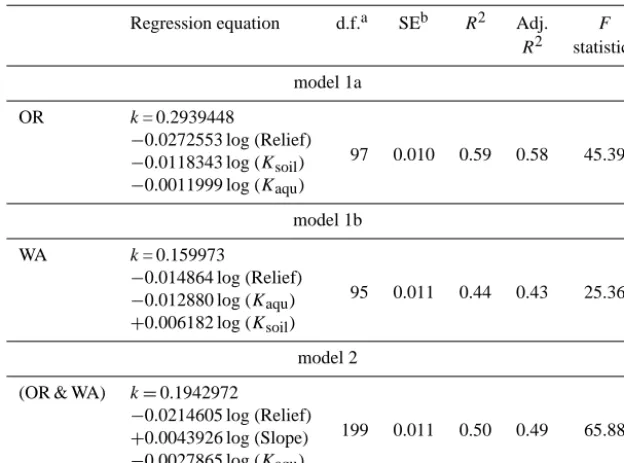
Table 1. Regression analysis for prediction ofkin Oregon (model 1a) and Washington (model 1b) and the entire domain (model 2), using relief, soil permeability (Ksoil), aquifer permeability (Kaqu) and slope.
Regression equation d.f.a SEb R2 Adj. F R2 statistics
model 1a
OR k= 0.2939448
97 0.010 0.59 0.58 45.39 −0.0272553 log (Relief)
−0.0118343 log (Ksoil) −0.0011999 log (Kaqu)
model 1b
WA k= 0.159973
95 0.011 0.44 0.43 25.36 −0.014864 log (Relief)
−0.012880 log (Kaqu) +0.006182 log (Ksoil)
model 2
(OR & WA) k=0.1942972
199 0.011 0.50 0.49 65.88 −0.0214605 log (Relief)
+0.0043926 log (Slope) −0.0027865 log (Kaqu)
ad.f. is degree of freedom;bSE is standard error.
watershed parameters used for predicting k showed strong cross-correlation (as high as 0.72), particularly amongKaqu, Slope, andKsoil in OR. However, since these variables are used to predict k and not to characterize their relationship with each other, the cross-correlation and sign of the regres-sion coefficients can be ignored.
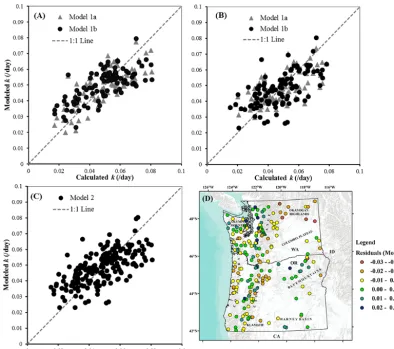
The regression coefficients (R2) for the three geographic domains (OR: model 1a, WA: model 1b, or OR and WA combined: model 2) ranges between 0.44 for WA and 0.59 for OR (Table 1), which are within the range of values re-ported elsewhere with a different set of independent vari-ables (e.g., Thomas et al., 2013). The overall standard error of the estimate is low for the fitted regressions, and modeled kis only slightly biased, overpredicting small values and un-derpredicting higher values ofk (Fig. 4). There is no clear spatial pattern of systematic bias based on residuals, how-ever (Fig. 4d). The predicted k map using model 2 at the fifth field HUC scale broadly distinguishes among different hydrologic regions with different drainage characteristics, in-cluding fast-draining regions such as the OR Coast Range, parts of the Columbia River basin in OR and WA and the Owyhee uplands and much of the Ochoco Mountains in OR. Slower-draining regions include the eastern (High) Cascades in OR and WA and the Okanogan highlands in WA (Fig. 5a), but the Okanogank values are at the high end of the range for this bin (0.02–0.04).
Figure 4. Calculated and modeled flow recession constant (k) for watersheds in (a) OR, (b) WA, and (c) entire domain based on the regression equations developed individually for OR (model 1a), WA (model 1b) and for the entire domain (model 2). (d) Spatial distribution ofkresiduals (calculated-modeled) using model 2.
A lack of spatially distributed precipitation gauge and snowpack telemetry sites, particularly at higher altitudes, precluded using empirical data to calculate recharge mag-nitude and timing. Instead, we calculated the peak recharge magnitude (IRandIM) and timing (tRandtM) using spatially distributed gridded (1/16th degree resolution) daily precipi-tation and VIC-simulated daily snowmelt data from Hamlet et al. (2013). The simulated snowmelt data from Hamlet et al. (2013) were limited to the Columbia River basin and coastal river basins of OR and WA and did not include the OR portions of the Klamath and Great basins. VIC-simulated daily snowmelt data for the Klamath and Great Basins at 1/8◦ spatial resolution were obtained from the US Bureau of Reclamation (Reclamation, 2011). VIC uses a two-layer energy and mass balance approach to model the process of snow accumulation and melt; descriptions of snow accumu-lation and melt processes within the VIC model are well de-scribed elsewhere (Liang et al., 1994; Ni-Meister and Gao, 2011).
The daily (1–365) average (1916–2006) maximum 1-day recharge,IRandIMwere calculated on the water year basis as
IR=max
N P
i=1 Ri,1
N ,
N P
i=1 Ri,2
N , . . . , N P
i=1 Ri,365
N
(8)
IM=max
N
P
i=1
Mi,1
N ,
N
P
i=1
Mi,2
N , . . . ,
N
P
i=1
Mi,365
N
, (9)
Figure 5. (a) Spatial distribution of recession constant k us-ing model 2 for the entire domain of Oregon and Washus-ing- Washing-ton. Lower k values represent deep-groundwater-dominated sys-tems; higher k values represent surface-flow-dominated systems.
(b) Study domain discretized between rain (R; green), transitional
snow zone (TSZ; blue), and seasonal snow zone (SSZ; gray) based on November–January average wet day air temperature. Areas in the TSZ with a snow to precipitation ratio (Sf)>10 % are shaded with light blue.
The spatial distribution of recharge magnitude (IRandIM) and timing (tR and tM) show distinct geographic contrasts between the eastern and western study domains (Fig. 6). The average peak daily recharge from precipitation (IR) varies from less than 5 mm day−1in the Walla Walla Plateau and much of eastern OR to as high as 44 mm day−1 in the Olympic Mountains to the west. Similarly, the average daily peak snowmelt (IM) varies between 0 in coastal southeast-ern OR to as much 40 mm day−1in northern WA. Although the magnitudes of IRandIM are small in northeastern WA and much of eastern OR as compared to those in the Coast Range, northern WA, and Cascades, they occur later during the water year. In northern WA, the timing ofIMoccurs quite late during the water year (Fig. 6). Timing ofIRis also quite variable across the region and occurs as early as October to as
late as mid-September (Fig. 6). For the sensitivity analysis, in systems with rain as dominant recharge we substitutedQo withIRandtpwithtR. Similarly, in systems with snowmelt as dominant recharge we substitutedQowithIMandtpwith tM.
4.3 Future recharge magnitude and timing (Qo,tp) Changes in actual streamflow in the future will not only de-pend on the intrinsic sensitivity of the landscape but also the magnitude and direction of climate change in terms of mag-nitude (IRorIM) and timing (tRortM) of recharge to which a landscape is exposed. The actual exposure or magnitude of change inIRorIMandtRortMwill depend on future emis-sion scenarios, which are highly uncertain. However, to il-lustrate this concept of intrinsic sensitivity and exposure, we present a climate change scenario consistent with regional-scale climate projections for the PNW of decreasing snow-packs (Mote, 2003; Elsner et al., 2010) as a proxy for expo-sure. An integrated daily snow product based on the 1 km res-olution Snow Data Assimilation System (Carroll et al., 2001) was selected andIMandtMwere calculated as described ear-lier. We used the differences betweenIM andtM values for the wet year 2004 (an El Niño year) and the dry year 2011 (a La Niña year), which correspond to a∼50 % regional snow-pack decline, as a potential climate change scenario. Changes in precipitation magnitude and timing are unclear for this re-gion (Salathe et al., 2007; Mote and Salathe, 2010), and were excluded from this analysis.
5 Model validation
We validated our derived streamflow sensitivities (εQoandεt) against empirical measures of climate sensitivity extracted from historical records of 217 (Fig. 1a) watersheds for the months of July, August, and September. Our approach was to use streamflow response to historical climate extremes as a proxy for streamflow sensitivity. Measures used included the (1) change in streamflow with respect to a change in annual precipitation between wet and dry periods; and (2) change in streamflow with respect to a change in spring air temper-ature between cool and warm periods. These two empirical measures of sensitivity were calculated as
εp=
Qwet−Qdry Pwet−Pdry
(10)
εT =
Qcool−Qwarm Tcool−Twarm
. (11)
[image:9.612.48.286.64.403.2]Table 2. Watershed average (n=217) values of peak recharge magnitude and timing between wet/dry and cool/warm periods with corre-sponding empirical and analytically derived streamflow sensitivity values.
Scenario Average parameter value Empirical validation Derived sensitivity
IR IM tR tM εp(mm mm−1), Eq. (10) εQo(mm mm
−1), Eq. (5)
(mm) (mm) (day) (day) Jul Aug Sep Jul Aug Sep
Wet 35.95 6.95 86 167
0.046 0.016 0.013 0.046 0.017 0.0066
Dry 21.56 4.32 106 151
IR IM tR tM εT (mm◦C−1), Eq. (11) εt (mm day−1), Eq. (6)
(mm) (mm) (day) (day) Jul Aug Sep Jul Aug Sep
Cool 28.03 7.33 89 180
−22.17 −7.89 −2.89 0.014 0.004 0.0016
Warm 28.13 4.56 87 154
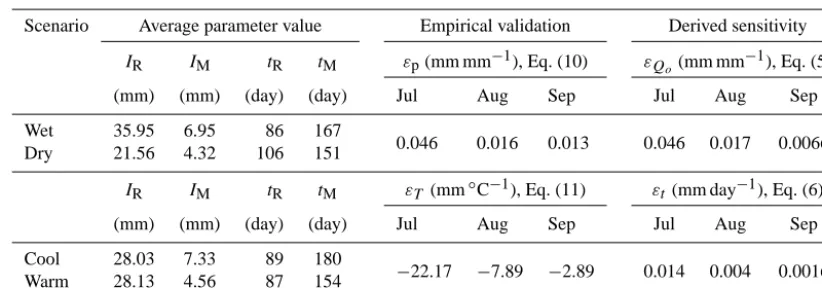
sensitivity proposed by Schaake (1990) and Sankarasubra-manian et al. (2001). The empirical measures εp and εT were calculated as an indicator of streamflow sensitivity to a change in magnitude and timing of recharge, respectively. However, magnitude (IRandIM) and timing (tRandtM) are each affected by wet and dry periods and cool and warm springs (Table 2). Also, the effect of wet and dry climate on peak recharge magnitude and timing differs for rain- and snowmelt-dominated systems. For example, during a wet as compared to a dry period, tM shifts 16 days later, whereas tRshifts 20 days earlier. Hence, the empirical measures εp andεT are representative of the streamflow sensitivities as a convolution of timing and magnitude. We used the non-parametric Spearman rank correlation (ρ) coefficient to eval-uate the correspondence between empirical (εpandεT) and conceptual (εQoandεt) measures of streamflow sensitivities. Spearman rank correlation is less sensitive to outliers and considered a robust alternative to the Pearson product mo-ment correlation.
6 Results and discussion 6.1 Sensitivity validation
Summer streamflow sensitivities derived from the concep-tual framework are in agreement with the climate sensitivity estimators calculated from historical data (Table 2). The ab-solute magnitudes of both empirical (εp andεT) and con-ceptual (εQo and εt) measures of streamflow sensitivities decrease from July to September. Also, both precipitation-and temperature-based estimators of streamflow sensitivity εp andεT are significantly (p <0.001) correlated withεQo andεt. The Spearman rank correlation coefficient forεpand εQodecreases from 0.73 in July to 0.50 in September, and for εpandεt decreases from 0.77 in July to 0.54 in September. The Spearman rank correlations betweenεpandεQoorεtare weaker and ranged between−0.66 (εpvs.εQo) and−0.71 (εp vs. εt) in July and−0.5 in September. The overall slightly
lower values of Spearman rank correlations between empir-ical and conceptual measures of streamflow sensitivities are not surprising given the fact that changes inIM andtM tween wet and dry periods were very small. Similarly, be-tween cool and warm periodsIRandtRwere relatively con-stant. So although we used a total of 217 watersheds for val-idation, not all of them were subjected to a change in magni-tude and timing of recharge between wet and dry or cool and warm periods. In fact, all of the rain-dominated watersheds had similarIRandtRbetween cool and warm periods. This smaller change inIRandtRlimits the range of our validation for rain-dominated watersheds.
6.2 Sensitivity analysis and distribution
Streamflow sensitivities to a change in magnitude,εQo, are very similar during the first weeks after peak recharge for all HUC units across the range of k values (Fig. 7a). In groundwater-dominated HUCs, the εQo are mediated and show very sharp contrasts from runoff-dominated HUCs, even after 110 days of recession. Since peak rechargeIM oc-curs late during the year in most of the lowkHUCs (Fig. 6), these mediated sensitivities will be expressed throughout the summer. In contrast, the sensitivities to a change in tim-ing,εt, are very different during the first weeks after peak recharge across all HUC units (Fig. 7b). Most of the HUCs with higherεt (>0.5 mm day−1) are in the rain-dominated Coast Range (Fig. 1), where recharge magnitude (IR) is higher overall when compared to the snow-dominated Cas-cades, Olympics, and other western parts of OR and WA. However, in most of these coastal HUCs the peak recharge occurs early in the year (Fig. 6), resulting in a long recession with lower sensitivities in the summer months.
Figure 6. Spatial distribution of peak recharge magnitude (mm day−1) for precipitationIR(a), snowmeltIM(b) and recharge timing (day of water year – DOWY) for precipitationtR(c) and snowmelttM(d) across the study domain.
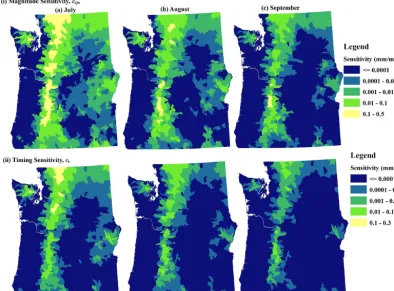
orientation of the topography, with the Cascade Range in both OR and WA clearly showing up as most sensitive to both types of changes. Snow-dominated regions with late melt, such as the mountains along the WA–Canada border and the Wallowa Mountains in OR also show a high, though diminished, sensitivity. Second, the maps show that fifth field HUCs sensitive to a change in magnitude (IRandIM) are also sensitive to a change in timing (tRandtM). Third, the level of sensitivity and its spatial extent diminish as the day of inter-est (td) moves from early to late summer. The highest magni-tudes of sensitivity to changes inIRandIM, were 0.47, 0.25, and 0.14 mm mm−1at the start of July, August, and Septem-ber, respectively; The highest magnitudes of sensitivity to changes in tRandtM were 0.28, 0.10, and 0.03 mm day−1, at the start of July, August, and September, respectively. The highest sensitivity for July streamflow is primarily located in the northern WA and along the Cascades, but portions of OR Cascades continue to show high sensitivity through-out the summer. This contrasting pattern is attributed to rela-tively highkvalues in the OR Cascades compared to northern
WA. By the end of August, OR Cascade streams are mainly sourced from deep groundwater, as most of the aboveground storage in the form of snow has melted out (Tague and Grant, 2004).
Figure 7. Decline of streamflow sensitivities for the range of k
across all HUC units to a change in (a) magnitude,εQoand (b)
tim-ing,εtduring the first 110 days of recession from the peak recharge, tp. White shading indicates no data.
Over the entire study area, streamflow at the start of July is at least moderately sensitive (εQoandεt>0.001) to a change in peak recharge magnitude and timing in 49 and 27 % of the area, respectively. As the day of interest moves towards the start of September, the spatial extent of at least moderately sensitive areas diminishes to 25 and 11 % of the region for εQoandεt, respectively. Within the individual states, stream-flow at the start of July in OR is at least moderately sensi-tive in 38 and 16 % of the area, as compared to 64 and 44 % of the area in WA, to a change in peak recharge magnitude and timing, respectively. Similarly, streamflow at the start of September in OR is at least moderately sensitive in 15 and 6 % of the area as compared to 39 and 18 % of the area in WA, to a change in peak recharge magnitude and timing, re-spectively.
6.3 Summer streamflow vulnerability
This analysis yields a spatially explicit prediction of the sen-sitivity of late summer streamflow to climate change based on the convolution of geology, as represented by k, and recharge dynamics, as represented by IR, IM, tR and tM (Fig. 8). To better understand this sensitivity, we consider how the processes driving it vary across the landscape. For
example, the OR High Cascades and much of WA show similar levels of sensitivity, but for different reasons. The OR High Cascades are sensitive because of low k and, as a result, abundant deep, and slow-draining groundwater that recharges streams over many months. Peak snowmelt recharge,IMin much of the OR Cascades, is not only small compared to northern WA, but also melts earlier (Fig. 6), leaving deep groundwater as the only source of late season streamflow. These groundwater-dominated landscapes in ef-fect “remember” changes in climate as reflected in either the magnitude or timing of recharge in the winter or spring, re-sulting in higher sensitivity of late-season streamflow.
In contrast, much of northern WA is sensitive not because of lowkbut because of higherIRorIMand latetRandtM. TheIMis higher in much of this region and melts later dur-ing the year (Fig. 6), contributdur-ing a substantial portion of the late season streamflow. If the climate changes so that less snow accumulates and snowmelt occurs earlier in spring, the corresponding changes in recharge timing and magnitude are reflected in late summer streamflow, which relies almost ex-clusively on snowmelt in this region.
Figure 8. Spatial distribution of (a) July, (b) August and (c) September streamflow sensitivities to a change in (i) magnitudeεQo(mm mm
−1)
and (ii) timingεt(mm day−1) of recharge.
streamflow changes in July were larger than in August and September under both theIM(Fig. 9a) andtM(Fig. 9b) sce-narios. Relative changes (%) in streamflow were calculated after normalizing the absolute change by the peak snowmelt recharge (IM) as a proxy forQo. In the absence of spatially distributed observed streamflow data, we utilized the peak recharge as a proxy for available water in the streams at the start of the recession. In general, areas showing greater ab-solute change also showed greater relative change (Fig. 9a and b).
This disparity between absolute and relative change across the landscape illustrates a key aspect of interpreting sen-sitivity: our prediction of future streamflows reflects both the intrinsic sensitivity of the landscape (as reflected in k and average historic climate) as well as changes in snow-pack between cooler and warmer years. Both factors affect the timing or magnitude of recharge. Specifically, under our assumed scenario, the changes in IM andtM are greater in places with “warmer” snowpacks (Nolin and Daly, 2006), such as the Cascades and other mountain ranges that are closer to marine influence (e.g., Olympics, Fig. 1b). In these areas, small temperature changes directly affect the total pro-portion of snow to precipitation. In contrast, colder snow-pack areas such as the Harney and Great Basins, Payette, and Walla Walla Plateau (Fig. 1b) are less sensitive to
tem-perature changes. The net effect to streamflow is that some regions (e.g., Northern Cascades, Fig. 1b) experience both more vulnerable snowpack and more sensitive landscapes (i.e., lowerkvalues). This is reflected in both a greater abso-lute and relative change (Fig. 9). The drier eastern portions of the study region, in contrast, have lower absolute change be-cause their snowpacks are relatively insensitive to warming, andkvalues are higher.
7 Management applications
A central goal in developing this spatially explicit, ana-lytical framework was to help resource managers, such as the US Forest Service (USFS), evaluate vulnerabilities of key resources to changing summer streamflows, and develop and implement adaption strategies to reduce potential im-pacts. While such strategies may introduce some new activ-ities (e.g., facilitated migration of species, mulching forests) (Grant et al., 2013), we expect that most will involve adjust-ments in the location, timing, and scope of current actions or modification of their site-specific designs.
Figure 9. (a) Predicted decline in streamflow in absolute (i) and relative (ii) terms, based on (1) the intrinsic sensitivities to changes in
[image:14.612.99.499.66.659.2]large fraction of the region (nearly 27 % of OR and WA) and support diverse, valuable, and climate-sensitive resources. The largest changes in summer streamflows are expected to occur on these forest lands, which may affect and alter nu-merous forest management activities. Such activities include timber harvest and fuels management, watershed restoration, resource assessment and monitoring, and construction and operation of dams, water diversions, roads, and recreational facilities.
Watershed restoration is currently a major focus for the USFS (Potyondy and Geier, 2011). Much of this work in the Pacific Northwest is directed towards maintaining or improv-ing water quality and aquatic habitats for salmon and other cold water biota, as directed by the Northwest Forest Plan and other forest plans in the region. Common restoration ac-tions include removal of physical barriers in streams (e.g., poorly designed culverts), road improvements and decom-missioning, improved livestock management, reconstruction of stream channels and floodplains, restoration of riparian vegetation and streamflows, decommissioning or alteration of dams and water diversions, and enhancement of instream habitats via additions of wood, boulders, and nutrients (Roni et al., 2002).
Implementing these restoration projects in a “climate-informed” way is critical, as changes in summer stream-flows and other habitat components (e.g., stream thermal regimes) may significantly influence their effectiveness (Bat-tin et al., 2007). This can be accomplished by integra(Bat-ting assessment products like the one presented here into exist-ing strategic plannexist-ing and project design processes. For ex-ample, to maximize the effectiveness of its restoration pro-gram, the USFS is currently focusing investments in “prior-ity watersheds” based on assessments of non-climatic stres-sors and other factors (Watershed Condition Framework at http://www.fs.fed.us/publications/watershed/). In the PNW, those watersheds where the greatest ecological gains can be achieved with the least funding have typically been selected as priorities. In general, such areas have high ecological val-ues (e.g., high biodiversity, rare or legally protected species), mild to modest levels of non-climatic impacts (e.g., water diversions, water quality problems, altered stream habitats), high sensitivities to those impacts (e.g., cold water biota with narrow thermal tolerances), and significant opportunities for restoration (e.g., important and technically solvable prob-lems, sufficient financial resources and workforce capacity, community support, few legal barriers).
This sensitivity assessment provides an opportunity to consider an additional factor in the priority-setting: climate-induced changes in summer streamflow. In many cases, such changes may not alter priority areas selected for restora-tion. For example, current priority watersheds may remain priorities after consideration of climate change information (Fig. 10). In others, however, likely climate impacts may shift emphasis away from some watersheds and towards oth-ers. For example, watersheds with large projected changes in
summer streamflows and water resources highly sensitive to those changes may be considered a lower restoration priority if restoration treatments are unlikely to address the cumula-tive effects of both climatic and non-climatic impacts or if the cost of those treatments greatly exceed available fund-ing (i.e., adaptive capacity is limited). Conversely, the rela-tive priority of other watersheds may increase in cases where significant climate impacts are expected, but managing both climatic and non-climatic impacts is deemed technically, so-cially, and financially achievable (Fig. 10).
Moreover, this analysis could influence the type, intensity, location, or timing of restoration actions considered neces-sary to sustain critical resources in priority watersheds, both at a watershed- and project scale. The prospect of late-season streamflow change in some portions of the watershed could lead to redesign of water diversions, proactive efforts to re-duce stream temperatures, rethinking low-flow channel di-mensions for fish passage and stream channel reconstruc-tion projects, and reconsiderareconstruc-tion of what riparian species are likely to survive into the future.
8 Conclusions
Our results provide a hydrogeologic framework to identify watersheds most and least vulnerable to summer streamflow changes. This method reveals landscape – level patterns and their relationship to topographic, geologic and climatic con-trols, and can be applied to interpret the effects of any climate change scenario of interest. As such, we believe the sensitiv-ity maps represent a robust, scalable tool that can be used in climate change assessment and adaptation in both gaged and ungauged basins.
Figure 10. Examples of hypothetical watershed prioritization based on USDA Forest Service Watershed Condition Classification, an
as-sessment of non-climatic impacts, sensitivities to those impacts, and opportunities to address them. Priority watersheds (red stars) differ for classifications without (a) and with (c) streamflow sensitivity analysis (b).
More broadly, we recognize that this approach does not yield the specific streamflow values or future hydrographs of the current generation of hydrologic models. There are many applications where having a spatio-temporal prediction of how much water is present would be quite useful. Beyond the uncertainty in both our approach and streamflow modeling, each method has strengths and limitations. The spatial map of sensitivity reveals broad landscape patterns and is applicable where data, time, or cost limit applying a more sophisticated hydrologic model. Hydrologic models give detailed predic-tions, but may not always illuminate underlying mechanisms or provide sound future predictions. Both approaches have their place. Although our results are independent of GCM predictions, the two approaches are not necessarily mutu-ally exclusive. New CMIP5 high-resolution, terrain-sensitive model predictions could be incorporated into this framework. Predicting future streamflows is an uncertain task at best, but is essential to address a rapidly changing environment. The “bottom-up” approach described here is intended to complement other “top-down” approaches involving sophis-ticated and coupled climate and hydrologic models. These spatial maps, based on simple theory and supported by em-pirical data, represent spatially explicit hypotheses about how streamflow is expected to respond to climate changes in the future. Other, more complex approaches also yield
spatially explicit hypotheses in the form of future hydro-graphs. We can now compare these two approaches, high-light their strengths and limitations, and integrate knowledge from each to guide managers and communities in facing the uncertain future of water resources in the Pacific Northwest and beyond.
Acknowledgements. The authors gratefully thank three anonymous reviewers for their helpful comments. They acknowledge funding support from the Oregon Watershed Enhancement Board, the Bureau of Land Management (Oregon) and the USDA Forest Service Region 6 and Pacific Northwest Research Station.
Edited by: M. Mikos
References
Arnold, J. G., Allen, P. M., Muttiah, R., and Bernhardt, G.: Au-tomated base flow separation and recession analysis techniques, Ground Water, 33, 1010–1018, 1995.
Carroll, T., Cline, D., Fall, G., Nilsson, A., Li, L., and Rost, A.: NOHRSC operations and the simulation of snow cover proper-ties for the coterminous US, in: Proceedings of the 69th Western Snow Conference, Sun Valley, Idaho, 16–19 April 2001. Cayan, D. R., Kammerdiener, S. A., Dettinger, M. D., Caprio, J. M.,
and Peterson, D. H.: Changes in the onset of spring in the western United States, B. Am. Meteorol. Soc., 82, 399–415, 2001. Christensen, N. S., Wood, A. W., Voisin, N., Lettenmaier, D. P.,
and Palmer, R. N.: The effects of climate change on the hydrol-ogy and water resources of the Colorado River basin, Climatic change, 62, 337–363, 2004.
Cook, R. D.: Detection of influential observation in linear regres-sion, Technometrics, 42, 65–68, 2000.
Dai, A.: Temperature and pressure dependence of the rain-snow phase transition over land and ocean, Geophys. Res. Lett., 35, L12802, doi:10.1029/2008GL033295, 2008.
Daly, C., Halbleib, M., Smith, J. I., Gibson, W. P., Doggett, M. K., Taylor, G. H., Curtis, J., and Pasteris, P. P.: Physiographically sensitive mapping of climatological temperature and precipita-tion across the conterminous United States, Int. J. Climatol., 28, 2031–2064, 2008.
Das, T., Pierce, D. W., Cayan, D. R., Vano, J. A., and Letten-maier, D. P.: The importance of warm season warming to west-ern U.S.streamflow changes, Geophys. Res. Lett., 38, L23403, doi:10.1029/2011GL049660, 2011.
Elsner, M. M., Cuo, L., Voisin, N., Deems, J. S., Hamlet, A. F., Vano, J. A., Mickelson, K. E. B., Lee, S.-Y., and Lettenmaier, D. P.: Implications of 21st century climate change for the hydrology of Washington State, Climatic Change, 102, 225–260, 2010. Falcone, J. A., Carlisle, D. M., Wolock, D. M., and Meador, M.
R.: GAGES: A stream gage database for evaluating natural and altered flow conditions in the conterminous United States, Ecol-ogy, 91, 621–621, 2010.
Fenneman, N. M. and Johnson, D. W.: Physiographic Divisions of the United States, US Geological Survey – USGS, Wash-ington, D.C., avilable online: http://water.usgs.gov/GIS/dsdl/ physio_shp.zip (last access: 7 July 2014), 1946.
Gonthier, J. B.: A description of aquifer units in eastern Oregon, Water Resources Investigations Report 84-4095, US Geological Survey, Portland, Oregon, 1984.
Grant, G. E.: Dynamics and geomorphology of mountain rivers [Book Review], J. N. Am. Benthol. Soc., 16, 719–720, 1997. Grant, G. E., Tague, C. L., and Allen, C. D.: Watering the forest
for the trees: an emerging priority for managing water in forest landscapes. Front. Ecol. Environ., 11, 314–321, 2013.
Hamlet, A. F. and Lettenmaier, D. P.: Effects of climate change on hydrology and water resources in the Columbia River Basin, J. Am. Water Resour. Assoc., 35, 1597–1623, 1999.
Hamlet, A. F., Elsner, M. M., Mauger, G., Lee, S.-Y., Tohver, I., and Norheim, R. A.: An overview of the Columbia Basin Climate Change Scenarios Project: Approach, methods, and summary of key results, Atmos. Ocean., 51, 392–415, 2013.
Huntting, M. T., Bennett, W. A. G., Livingston, V. E. J., and Moen, W. S.: Geologic Map of Washington: Washington Division of Mines and Geology, scale 1 : 500,000, online at: http://mrdata. usgs.gov/sgmc/wa.html, last access: 12 September 2014, 1961. Jaeger, W. K., Plantinga, A. J., Chang, H., Dello, K., Grant, G.
E., Hulse, D., McDonnell, J. J., Lancaster, S., Moradkhani, H., Morzillo, A. T., Mote, P., Nolin, A., Santelmann, M., and Wu,
J.: Toward a formal definition of water scarcity in natural human systems, Water Resour. Res., 49, 4506–4517, 2013.
Jefferson, A. J.: Seasonal versus transient snow and the elevation de-pendence of climate sensitivity in maritime mountainous regions, J. Geophys. Res., 38, L16402, doi:10.1029/2011gl048346, 2011. Jefferson, A. J., Grant, G. E., and Rose, T.: Influence of vol-canic history on groundwater patterns on the west slope of the Oregon High Cascades, Water Resour. Res., 42, W12411, doi:10.1029/2005WR004812, 2006.
Jefferson, A. J., Nolin, A. W., Lewis, S. L., and Tague, C. L.: Hydro-geologic controls on streamflow sensitivity to climate variation, Hydrol. Process., 22, 4371–4385, 2008.
Jha, M., Pan, Z., Takle, E. S., and Gu, R.: Impacts of climate change on streamflow in the Upper Mississippi River Basin: A regional climate model perspective, J. Geophys. Res.-Atmos., 109, D09105, doi:10.1029/2003JD003686, 2004.
Jha, M., Arnold, J. G., Gassman, P. W., Giorgi, F., and Gu, R. R.: Climate chhange sensitivity assessment on upper mississippi river basin streamflows using SWAT, J. Am. Water Resour. As-soc., 42, 997–1015, 2006.
Kirchner, J. W.: Catchments as simple dynamical systems: Catchmentcharacterization, rainfall-runoff modeling, and do-ing hydrology backward, Water Resour. Res., 45, W02429, doi:10.1029/2008WR006912, 2009.
Knowles, N., Dettinger, M. D., and Cayan, D. R.: Trends in snowfall versus rainfall in the Western United States, J. Climate, 19, 4545– 4559, 2006.
Leung, L. R. and Qian, Y.: The sensitivity of precipitation and snow-pack simulations to model resolution via nesting in regions of complex terrain, J. Hydrometeorol., 4, 1025–1043, 2003. Liang, X., Lettenmaier, D. P., Wood, E. F., and Burges, S. J.: A
sim-ple hydrologically based model of land surface water and energy fluxes for general circulation models, J. Geophys. Res.-Atmos., 99, 14415–14428, 1994.
Luce, C. H., and Holden, Z. A.: Declining annual streamflow distri-butions in the Pacific Northwest United States, 1948–2006, Geo-phys. Res. Lett., 36, L16401, doi:doi:10.1029/2009GL039407, 2009.
Maraun, D., Wetterhall, F., Ireson, A. M., Chandler, R. E., Kendon, E. J., Widmann, M., Brienen, S., Rust, H. W., Sauter, T., The-meßl, M., Venema, V. K. C., Chun, K. P., Goodess, C. M., Jones, R. G., Onof, C., Vrac, M., and Thiele-Eich, I.: Precipita-tion downscaling under climate change: Recent developments to bridge the gap between dynamical models and the end user, Rev. Geophys., 48, RG3003, doi:10.1029/2009RG000314, 2010. Mass, C.: The weather of the Pacific Northwest, University of
Washington Press Seattle, Washington, 2008.
Mayer, T. D. and Naman, S. W.: Streamflow response to climate as influenced by geology and elevation, J. Am. Water Resour. Assoc., 47, 724–738, 2011.
McFarland, W. D.: A description of aquifer units in western Ore-gon, Open-File Report 82-165, US Geological Survey, Portland, Oregon, 1983.
Miller, D. A. and White, R. A.: A conterminous United States multi-layer soil characteristics dataset for regional climate and hydrol-ogy modeling, Earth Interact., 2, 1–26, 1998.
Mote, P. W.: Trends in snow water equivalent in the Pacific North-west and their climatic causes, Geophys. Res. Lett., 30, 1601, doi:10.1029/2003GL017258, 2003.
Mote, P. W. and Salathe, E. P.: Future climate in the Pacific North-west, Climatic Change, 102, 29–50, 2010.
Mote, P. W., Hamlet, A. F., Clark, M. P., and Lettenmaier, D. P.: De-clining mountain snowpack in western North America, B. Am. Meteorol. Soc., 86, 39–49, 2005.
Nash, L. L. and Gleick, P. H.: Sensitivity of streamflow in the Col-orado basin to climatic changes, J. Hydrol., 125, 221–241, 1991. Nijssen, B., O’Donnell, G. M., Hamlet, A. F., and Lettenmaier, D. P.: Hydrologic sensitivity of global rivers to climate change, Cli-matic Change, 50, 143–175, 2001.
Ni-Meister, W. and Gao, H.: Assessing the impacts of vegetation heterogeneity on energy fluxes and snowmelt in boreal forests, J. Plant Ecol., 4, 37–47, 2011.
Nolin, A. W. and Daly, C.: Mapping “at Risk” snow in the Pacific Northwest, J. Hydrometeorol., 7, 1164–1171, 2006.
Patil, S. D., Wigington, P. J., Leibowitz, S. G., and Comeleo, R. L.: Use of hydrologic landscape classification to diagnose stream-flow predictability in Oregon, J. Am. Water Resour. Assoc., 50, 762–773, doi:10.1111/jawr.12143, 2014.
Posavec, K., Baˇcani, A., and Naki´c, Z.: A visual basic spreadsheet macro for recession curve analysis, Ground Water, 44, 764–767, 2006.
Potyondy, J. P. and Geier, T. W.: Watershed condition classification technical guide, FS-978, United States Department of Agricul-ture, Forest Service, Washington, D.C., 2011.
Reclamation: SECURE Water Act Section 9503(c) – Reclamation Climate Change and Water, Report to Congress, U.S. Department of the Interior Bureau of Reclamation Denver, Colorado, 206 pp., 2011.
Roni, P., Beechie, T. J., Bilby, R. E., Leonetti, F. E., Pollock, M. M., and Pess, G. R.: A review of stream restoration techniques and a hierarchical strategy for prioritizing restoration in Pacific Northwest watersheds, N. Am. J. Fish. Manage., 22, 1–20, 2002. Safeeq, M., Grant, G. E., Lewis, S. L., and Tague, C. L.: Cou-pling snowpack and groundwater dynamics to interpret historical streamflow trends in the western United States, Hydrol. Process., 27, 655–668, 2013.
Salathe, E. P., Mote, P. W., and Wiley, M. W.: Review of scenario selection and downscaling methods for the assessment of climate change impacts on hydrology in the United States Pacific North-west, Int. J. Climatol., 27, 1611–1621, 2007.
Sankarasubramanian, A., Vogel, R. M., and Limbrunner, J. F.: Cli-mate elasticity of streamflow in the United States, Water Resour. Res., 37, 1771–1781, 2001.
Schaake, J. C.: From climate to flow, Climate change and US water resources, edited by: Waggoner, P. E., John Wiley & Sons, New York, 177–206, 1990.
Slack, J., Lumb, A., and Landwehr, J.: Hydro-Climatic Data Net-work (HCDN): Streamflow Data Set, 1874–1988, USGS Water-Resources Investigations Report 93-4076, 1993.
Smakhtin, V. U.: Low flow hydrology: a review, J. Hydrol., 240, 147–186, 2001.
Stewart, I., Cayan, D. R., and Dettinger, M.: Changes toward earlier streamflow timing across western North America, J. Climate, 18, 1136–1155, 2005.
Sujono, J., Shikasho, S., and Hiramatsu, K.: A comparison of tech-niques for hydrograph recession analysis, Hydrol. Process., 18, 403–413, 2004.
Tague, C. L. and Grant, G. E.: A geological framework for inter-preting the low-flow regimes of Cascade streams, Willamette River Basin, Oregon, Water Resour. Res., 40, W04303, doi:10.1029/2003WR002629, 2004.
Tague, C. L. and Grant, G. E.: Groundwater dynamics mediate low-flow response to global warming in snow-dominated alpine regions, Water Resour. Res., 45, W07421, doi:10.1029/2008WR007179, 2009.
Tague, C. L., Grant, G. E., Farrell, M., Choate, J., and Jefferson, A.: Deep groundwater mediates streamflow response to climate warming in the Oregon Cascades, Climatic Change, 86, 189– 210, 2008.
Tague, C. L., Choate, J. S., and Grant, G.: Parameterizing sub-surface drainage with geology to improve modeling streamflow responses to climate in data limited environments, Hydrol. Earth Syst. Sci., 17, 341–354, doi:10.5194/hess-17-341-2013, 2013. Tallaksen, L.: A review of baseflow recession analysis, J. Hydrol.,
165, 349–370, 1995.
Thomas, B. F., Vogel, R. M., Kroll, C. N., and Famiglietti, J. S.: Estimation of the base flow recession constant under human in-terference. Water Resour. Res., 49, 7366–7379, 2013.
Tohver, I. M., Hamlet, A. F., and Lee, S. Y.: Impacts of 21st-Century Climate Change on Hydrologic Extreme in the Pacific North-west Region of North America, J. Am. Water Resour. Assoc., doi:10.1111/jawr.12199, in press, 2014.
USACE: Snow hydrology summary report of the snow investiga-tions of the North Pacific Division, Portland, OR, 1956. US Census Bureau: Population Division, also available online:
http://www.census.gov/popest/estimates.html (retrieved: 10 Oc-tober 2011), 2010.
Vano, J. A., Das, T., and Lettenmaier, D. P.: Hydrologic sensitivities of Colorado river runoff to changes in precipitation and temper-ature, J. Hydrometeorol., 13, 932–949, 2012.
Vogel, R. M. and Kroll, C. N.: Regional geohydrologic-geomorphic relationships for the estimation of low-flow statistics, Water Re-sour. Res., 28, 2451–2458, 1992.
Vogel, R. M. and Kroll, C. N.: Estimation of baseflow recession constants, Water Resour. Manage., 10, 303–320, 1996.
Waibel, M. S., Gannett, M. W., Chang, H., and Hulbe, C. L.: Spatial variability of the response to climate change in regional ground-water systems – Examples from simulations in the Deschutes Basin, Oregon, J. Hydrol., 486, 187–201, 2013.
Walker, G. W., MacLeod, N. S., Miller, R. J., Raines, G. L., and Conners, K. A.: Spatial digital database for the geologic map of Oregon, US Geological Survey, Menlo Park, California, 2003. Wenger, S. J., Luce, C. H., Hamlet, A. F., Isaak, D. J., and
Neville, H. M.: Macroscale hydrologic modeling of ecologi-cally relevant flow metrics. Water Resour. Res., 46, W09513, doi:10.1029/2009WR008839, 2010.