Georgia State University
ScholarWorks @ Georgia State University
Respiratory Therapy Theses Department of Respiratory Therapy
Fall 10-26-2015
Respiratory Therapy Administrators’ Perceptions of
Effective Teaching Characteristics of Clinical
Preceptors in Metro-Atlanta Hospitals
Abdulelah Aldhahir
Follow this and additional works at:https://scholarworks.gsu.edu/rt_theses
This Thesis is brought to you for free and open access by the Department of Respiratory Therapy at ScholarWorks @ Georgia State University. It has been accepted for inclusion in Respiratory Therapy Theses by an authorized administrator of ScholarWorks @ Georgia State University. For more information, please [email protected].
Recommended Citation
Aldhahir, Abdulelah, "Respiratory Therapy Administrators’ Perceptions of Effective Teaching Characteristics of Clinical Preceptors in Metro-Atlanta Hospitals." Thesis, Georgia State University, 2015.
ACCEPTANCE
This thesis, RESPIRATORY THERAPY ADMINISTRATORS’ PERCEPTIONS OF EFFECTIVE TEACHING CHARACTERISTICS OF CLINICAL PRECEPTORS IN METRO-ATLANTA
HOSPITALS, by Abdulelah Aldhahir, was prepared under the direction of the Master’s Thesis Advisory Committee of the Respiratory Therapy department at Georgia State University. It is accepted by the committee in partial fulfillment of requirements for the Master’s of Science degree in Respiratory Therapy at Byrdine F. Lewis School of Nursing and Health Professions, Georgia State University.
The Master’s Thesis Advisory Committee, as representatives of the faculty, certifies that this thesis has met all standards of excellence and scholarship as determined by the faculty.
______________________________Date_________ Douglas S. Gardenhire, Ed.D, RRT-NPS, FAARC Committee Chair
______________________________ Date_________ Robert B. Murray, MS, RRT
Committee Member
______________________________ Date_________ Ralph D. Zimmerman, MSM, RRT-NPS
AUTHOR’S STATEMENT
In presenting this thesis as partial fulfillment of the requirements for the advanced degree from Georgia
State University, I agree that the library of Georgia State University shall make it available for inspection
and circulation in accordance with its regulations governing materials of this type. I agree that permission
to quote, to copy from, or to publish this thesis may be granted by the professor under whose direction it
was written, by the Byrdine F. Lewis School of Nursing & Health Professions director of graduate studies
and research, or by me. Such quoting, copying, or publishing must be solely for scholarly purposes and
will not involve potential financial gain. It is understood that any copying from or publication of this
thesis, which involves potential financial gain, will not be allowed without my written permission.
Author
NOTICE TO BORROWERS
All these deposited in the Georgia State University Library must be used in accordance with stipulations
prescribed by the author in the preceding statement. The author of this thesis is:
Abdulelah Aldhahir, RRT-NPS
1303 Peachtree creek circle
Atlanta, GA 30341
The director of this thesis is:
Douglas S. Gardenhire, Ed.D, RRT-NPS, FAARC
Governor’s Teaching Fellow
Clinical Associate Professor and Interim Chairman
Byrdine F. Lewis School of Nursing and Health Professions
Department of Respiratory Therapy
Georgia State University
P.O. Box 4019
Atlanta, GA 30302-4019
Users of this thesis not regularly enrolled as students of Georgia State University are required to attest
acceptance of the preceding stipulation by signing below. Libraries borrowing this thesis for use of their
patrons are required to see that each user records here the information requested:
DEDICATION
First of all, I would like to thank Allah, our God, for all the great things He has given me
throughout my existence. My prayers and faith has helped motivate me to complete this thesis. In
addition, I also would like to thank my parents whose continuous support, love, and words of
encouragement have enlightened me and pushed me to work harder. If it weren’t for them, I would have
given up a long time ago. Although I find it difficult to fully express in words how much they have
influenced and contributed in my life, I wish to celebrate my accomplishments with them. I also would
like to extend my gratitude to my siblings who have helped take care of my parents while I am away.
Lastly, I would like to thank all of my friends and the people whose faith, encouragement, and kindness
ACKNOWLEDGEMENTS
Overall, I would like to thank Dr. Doug Gardenhire, my ever-patient and supportive thesis adviser,
whose wisdom he willingly shared to help me accomplish my goals. Likewise, his guidance, advice, and
support have been crucial to the success of this thesis. Working with him was an insightful experience.
Additionally, I would also like to thank Professor Ralph Zimmerman and Professor Robert Murray, as
members of the thesis committee, for their valuable expert opinion, patience, and sharing their time to
help me throughout the process of completing this thesis.
Abdulelah Aldhahir
RESPIRATORY THERAPY ADMINISTRATORS’ PERCEPTIONS OF EFFECTIVE TEACHING
CHARACTERISTICS OF CLINICAL PRECEPTORS IN METRO-ATLANTA HOSPITALS
A thesis submitted by
Abdulelah Aldhahir, BSRT, RRT-NPS
in partial fulfillment of requirements for the degree of
Masters of Science
in
Health Sciences
in
The Department of Respiratory Therapy
Under the supervision of Dr. Douglas S. Gardenhire
in
the Byrdine F. Lewis School of Nursing and Health Professions
Georgia State University, Atlanta, Georgia
RESPIRATORY THERAPY ADMINISTRATORS’ PERCEPTIONS OF EFFECTIVE TEACHING CHARACTERISTICS OF CLINICAL PRECEPTORS IN METRO-ATLANTA HOSPITALS
By
Abdulelah Aldhahir, BSRT, RRT-NPS
(Under the Advisement of Dr. Douglas S. Gardenhire)
ABSTRACT
Clinical preceptors in respiratory therapy (RT) face a great deal of expectations from schools, students, and colleagues. They are expected to possess effective teaching skills and qualities that signify their knowledge, expertise, and professionalism. Thus, it is important to identify and distinguish effective teaching
characteristics of present RT clinical preceptors, which will influence the clinical success of RT students and reflect the efficiency of RT administrators. PURPOSE: The goal of this study is to determine the effective teaching characteristics of clinical preceptors that are perceived to be most and least important according to RT administrators in select Metro-Atlanta hospitals. METHODS: A descriptive survey was utilized to gather data. The survey was an adaptation of previous RT studies and was emailed to all RT administrators of a
convenience sample. The survey was composed of three general domains, professional competence,
relationship with the students, and personal attributes. Moreover, thirty-five behavioral teaching characteristics were provided based on a five-point Likert scale. It was ranked according to each characteristic’s importance. RESULTS: A survey response rate of 55.4% was achieved. Female participants accounted for 47.22% of all participants, while male participants account for 52.78%. Managers were the largest position group of administrators (25%), followed by directors (19.4%), assistant managers (16.7%), educational coordinators (16.7), supervisors (16.7) and others (5.5%) represented as a clinical preceptor and a clinical specialist. The teaching characteristics found to be the most important, “showing genuine interest in patients and their care” and “demonstrates skills, attitudes and values that are developed by students in the clinical area (Role modeling)” obtained the highest ranking from all participants with overall mean scores and S.D of (M 4.83, S.D ±0.37). Other important teaching characteristics include responding promptly, demonstrating good communication skills, and facilitate critical thinking during clinical practice were ranked highest by the managers. Meanwhile, supervisors perceived that being approachable, supportive and helpful, facilitates critical thinking in clinical practice, as well as showing competence in clinical skills were most important. On the other hand, educational coordinators perceive demonstration of skills, attitudes, and values that are developed by students in the clinical area (role modeling) are seen as most significant. Lastly, assistant managers perceive role modeling, the ability to communicate knowledge and skills to the students for safe practice, and facilitating students’ awareness of their professional responsibility as the most important characteristics. CONCLUSION: RT administrators in Metro-Atlanta hospitals agree that (role modeling) and showing genuine interest in patients and their care are the most effective teaching characteristics of clinical preceptors. RT administration differs by title in their ranking of clinical preceptors’ effective clinical characteristics.
TABLE OF CONTENTS
LIST OF TABLES ... viiv
CHAPTER I: INTRODUCTION Introduction ... 1
Purpose ... 3
Research Questions ... 3
Significance ... 4
Definitions of Words and Terms ... 5
CoARC ... 5
RT ... 5
ECICI ... 5
Preceptor ... 5
AARC ... 5
Preceptorship ... 5
Chapter II: REVIEW OF THE LITERATURE Introduction ... 6
Preceptorship in Health Care ... 6
Preceptorship in Nursing Education ... 8
Preceptorship in Physical Therapy ... 10
Preceptorship in Respiratory Care ... 12
Summary ... 14
CHAPTER III: METHODOLOGY Introduction ... 16
Research Questions ... 16
Instrumentation ... 17
Study Design ... 18
Data Collection and Analysis ... 19
Sample ... 19
Development of Cover Letter ... 20
CHAPTER IV: RESULTS ... 21
CHAPTER V: DISCUSSION ... 31
Implications and Recommendations for Future Research ... 37
Limitations of the Study ... 38
Conclusion ... 38
Appendix A ... 40
Appendix B ... 45
Appendix C ... 48
Appendix D ... 50
References ... 52
LIST OF TABLES
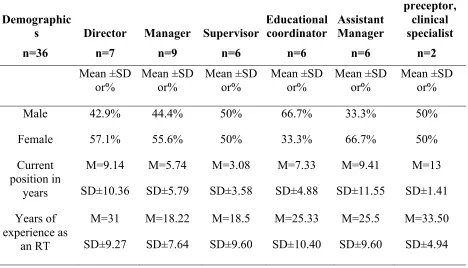
Table1. Demographic Information of the Sample.
Table 2. 5 Most Effective Clinical Teaching Characteristics Ranked by Respiratory Therapy Department
Directors.
Table 3. 5 Most Effective Clinical Teaching Characteristics Ranked by Respiratory Therapy Department
Managers.
Table 4. 5 Most Effective Clinical Teaching Characteristics Ranked by Respiratory Therapy Department
Supervisors
Table 5. 5 Most Effective Clinical Teaching Characteristics Ranked by Respiratory Therapy Department
Educational Coordinators
Table 6. 5 Most Effective Clinical Teaching Characteristics Ranked by Respiratory Therapy Department
Assistant Managers
Table 7. 5 Most Effective Clinical Teaching Characteristics Ranked by Other Respiratory Therapy
Department Administrators
Table 8. 10 Most Effective Clinical Teaching Characteristics Ranked by All Participants
1 CHAPTER I
INTRODUCTION
The profession of respiratory care began in 1946 when multidisciplinary groups of medical
staff met at the University of Chicago and decided to inaugurate an organization known as the
Inhalation Therapy Association (American Association of Respiratory Care, 2014). In the past,
qualifications and duties for respiratory therapists (RT) were different from the present. RT’s
used to cart oxygen cylinders and set up oxygen tents, masks, and nasal catheters only
(Kacmarek, Stoller & Heuer, 2013). Between 1950 and 1960, mechanical ventilators and aerosol
medications became commonplace, which allowed for further expansion of the profession, and
made RT’s responsible for arterial blood gas and pulmonary function laboratories (Kacmarek,
Stoller, & Heuer, 2013). At that time, educational programs began emerging, and RT was
recognized as a standard allied health profession. Since then, qualifications required to be an RT
have changed. Today, one of the many areas that an RT is required to master is teaching students
in the healthcare setting (Kacmarek, Stoller, & Heuer, 2013).
According to the Commission on Accreditation for Respiratory Care (CoARC) (2015), as
of 2014, there are 438 academic programs of respiratory care in the United States that are being
offered by different institutions: 374 Associate, 61 Baccalaureate, and 3 Masters degree
programs (CoARC, 2015). In 2013, there were 9,297students enrolled in 438 programs with a
mean number of 21 students per program (CoARC, 2015).
All undergraduate healthcare education programs have changed markedly within the last
decade by focusing more on student learning in clinical settings (Mccarthy & Murphy, 2010).
2
from other allied healthcare programs (Barnes, Kacmarek, & Durbin, 2010). By participating in
multiple clinical rotations, students acquire essential skills such as attitudes, knowledge, clinical
experience, and clinical skills, which prepare them for the modern clinical environment (Rye &
Boone, 2009). Students need clinical experience because it allows them to practice accurate
patient care and implement theory and knowledge from the classroom (Rye & Boone, 2009).
In respiratory care education, there has been a noted faculty shortage in recent years, which
includes faculty members teaching inside the classroom and clinical instructors that specialize in
the clinical setting. Providing an adequate number of clinical instructors is difficult to
accomplish due to the present manpower shortage in RT education (Barnes, Kacmarek, Kageler,
Morris, & Durbin, 2011). Due to this shortage, hospital-based staff are being used to precept
students in clinical rotations (Ownby, Schumann, Dune, Kohne, 2012). Hospital-based
preceptors can link the theoretical education with clinical experience for students who are
seeking to work in hospitals (Raines, 2012). The benefits of using the preceptorship method
include providing a larger pool of instructors and an increased number of clinical sites (Ownby,
Schumann, Dune, & Kohne, 2012).
Preceptorship is a modern method that is preferred by allied health professions for teaching
students in most healthcare settings. This method of clinical teaching among students in different
allied healthcare programs began in the mid-1970s (Burns & Northcutt, 2011). The process of
preceptorship involves the pairing of an experienced clinician with a novice learner where the
passage of clinical skills occur under close supervision (Rye & Boone, 2009). Preceptorship
involves a relationship between a skillful healthcare professional and a student that takes place in
clinical settings. The goal is to prepare the learner to achieve objectives to become a qualified
3
involved with patient interaction and exposure to other healthcare providers that occur each day
(Barker& Pittman, 2008).
Using a qualified respiratory therapist as a preceptor is essential for the process to be
successful (Rye & Boone, 2009). However, selecting preceptors in the healthcare environment is
often based on their free time or willingness to work with students (Burns& Northcutt, 2011).
There is a need to set a standard criteria for selecting RT’s as preceptors. Other healthcare
professions have identified qualifications for effective clinical preceptors. These qualifications
include providing the best environment for learning, stimulating students to ask questions,
explaining topics related to the profession, and stimulating critical thinking skills (Young,
Cantrell &Shaw, 2014). These as well as additional preceptor qualifications will be discussed in
the next chapter.
Purpose
The purpose of this study is to discover the most important behavioral characteristics of RT
preceptors as deemed by the respiratory therapy department directors, managers, supervisors,
educational coordinators, assistant directors, and assistant managers who are mainly responsible
for assigning their roles, ensuring professionalism and ethics, and maintaining proper conduct at
all times.
Research Questions
This study answered the following questions:
1.What are the behavioral teaching characteristics among preceptors that respiratory
4
2.What are the behavioral teaching characteristics among preceptors that respiratory
therapy department managers consider the most important?
3. What are the behavioral teaching characteristics among preceptors that respiratory
therapy department supervisors consider the most important?
4.What are the behavioral teaching characteristics among preceptors that respiratory
therapy department educational coordinators consider the most important?
5.What are the behavioral teaching characteristics among preceptors that respiratory
therapy assistant directors consider the most important?
6.What are the behavioral teaching characteristics among preceptors that respiratory
therapy assistant managers consider the most important?
7.What are the behavioral teaching characteristics among preceptors that other
respiratory therapy administrators consider the most important?
8. What are the behavioral teaching characteristics among all participants consider the
most important?
Significance
The significance of this study lies in its purpose of contributing to the advancement of the
profession and the research and studies in the field of respiratory care. By studying the hospital
department directors’, managers’, supervisors’, educational coordinators’, assistant directors’,
and assistant managers’ perception of effective behavioral characteristics of clinical preceptors,
further effective behavioral characteristics among clinical preceptors will be determined,
enhanced, and developed to support respiratory therapist training in the future. Moreover, it is
hoped that the findings of the study will create a standard among clinical preceptors and will see
5
Definitions of Words and Terms
CoARC: Commission on Accreditation for Respiratory Care
RT: Respiratory Therapy
ECICI: Effective Clinical Instructor Characteristics Inventory
Preceptor: An expert, such as a respiratory therapist, which offers students practical, relevant
experiences and training
AARC: American Association for Respiratory Care
Preceptorship: A relationship between a novice student (as a trainee) and a preceptor that
happens in the clinical environment (i.e. hospital) (Burns, Beauchesne, Ryan-Krause, & Sawin,
6 Chapter II
REVIEW OF THE LITERATURE
Introduction
Preceptorship is an important aspect of learning. While formal knowledge is the
foundation of academic learning, it must be complemented by real-world skills and knowledge
that can only be emanated from professionals and experts that have had years of training and
work experience. In the field of healthcare, preceptorship is a professional relationship between a
student, as a trainee, and an experienced registered staff member, as the preceptor or clinical
instructor. The preceptor helps the students acquire an individualized clinical experience and
education, relate classroom knowledge with real patient management issues, and emanate a role
model that will enable them to hone standards and strategies for their practice (Burns,
Beauchesne, Ryan-Krause, & Sawin, 2006; Aljasser, 2012; Alspach, 2008; Burns et al., 2006; De
Cicco, 2008; Dunlevy, Varekojis, & Sergakis, 2013; Rye & Boone, 2009; Smedley, 2008;
Mountain Area Health Education Center [MAHEC], 2015). This paper discusses documented
literature in preceptorship in healthcare, with specific emphasis on nursing education, physical
therapy, and respiratory therapy programs.
Preceptorship in Health Care
Smedley (2000) states that preceptors, through role modeling, help students develop
knowledge, clinical skills, and professional attitudes in nursing through guidance, supervision
and personal development. It is a time-consuming practice, but it is something from which
practitioners in the health field gain the most learning. According to the Office of Regional
Primary Care Education of the Mountain Area Health Education Center (MAHEC) (2015), the
7
national supply and retention and quality of health professionals. There are four principles
required of a clinician to provide effective teaching to a learner. These include communication,
careful analysis, skill in teaching and practice, and motivation of the learner (MAHEC, 2015).
First of all, communication is very important. This is the very first skill that an effective
preceptor must have. All the skills and education in the world will amount to nothing if it cannot
be conveyed or passed on to another person through effective communication. To be effective in
communication, one must first be knowledgeable in the given field because one cannot
communicate what one does not know. In fact, if one has poor understanding of concepts and
ideas, one is not able to transmit the knowledge to another person (MAHEC, 2015).
Secondly, with careful analysis, learning is further enhanced when the preceptor makes
learning fun. It is also important for a preceptor to be open to questions and answer these
questions as a matter-of-fact. By critically analyzing clinical situations, the learner becomes
motivated and later adopts a specific learning style. In this event, the preceptor must know how
to approach students with varied learning styles. Thirdly, skills in teaching and practice are
crucial to the learning success of the students. Various teaching methods and aids can be used to
assist the preceptor in teaching the students. For instance, financial matters are better taught with
graphs and numbers. Another example, in the field of medicine, one will better learn when one is
in an actual medical setting than when one is just discussing information inside a classroom.
Thus, it has been observed that preceptorship in classrooms for students is quite different from
precepting in a clinical setting (MAHEC, 2015). Likewise, it is important for department
directors, managers, supervisors, educational coordinators, assistant directors, and assistant
8
as encouraging clinical preceptors to analyze carefully and improve their skills in teaching and
practice.
Lastly, the fourth principle is the motivation of a learner. Teaching not only involves
relaying concepts and knowledge but is also about role modeling. By becoming role models,
clinical preceptors motivate the learners to learn practical clinical skills and knowledge. Clinical
students will appreciate it more if they are given increasing responsibility while at the same time
maintaining oversight and guidance (MAHEC, 2015). There are times when something must be
directly taught, through words and instruction, and at other times teaching is more effective when
the action is modeled, and the learner is allowed to execute the action as well. Therefore, to
motivate the learner, preceptors must guide the students make good decisions and serve as
reliable role models. These principles will allow the students gain valuable lessons and clinical
experiences that can be applicable in various clinical areas, such as the critical care unit,
emergency rooms, operating rooms, and so on (MAHEC, 2015).
Preceptorship in Nursing Education
Preceptorship programs are used in nursing education to educate nurses, enhance
leadership skills, and improve quality of work life (De Cicco, 2008). Although nurses go to work
already equipped with knowledge gained from formal schooling, there is still a need to link
classroom knowledge to real patient management problems (Burns, Beauchesne, Ryan-Krause,
& Sawin, 2006). Not everyone can become a preceptor; clinical teaching and supervision is a
skill that must be studied and learned (Horton, De Paoli, Hertach, & Bower, 2015).
In many organizations, precepting is a required skill that is normally added to a job
9
came on board, those new in a specialty area, those who have been away from nursing for years,
and those who are new to the United States (Alspach, 2015).
For most preceptors, there is a lack of resources available for information, educational
strategies, educational materials on how to handle different types of learners, and guidelines on
handling instructional scenarios (Alspach, 2015). But in rare instances, training programs are
sometimes provided by organizations who hire nurses. In Kansas, the Nurse Preceptor Academy
was established by the U.S. Department of Labor through the Workforce Innovation in Regional
Economic Development (WIRED) grant (Horton, DePaoli, Hertach, & Bower, 2015). This is
important, especially since Alspach (2015) stresses that serving as a preceptor to a nurse
orienteer is different from serving as a preceptor to those who are nursing students (regardless if
they are just starting in nursing education or on an advanced level of study). Despite some
training programs provided available resources for preceptors in the nursing field are still not
enough to equip nurse preceptors.
The reason for the lack of adequate preceptors in the nursing field is not just due to lack
of training. In a study conducted by Madhavanpraphakaran, Sjukri, and Balachandran (2014),
specific factors may interfere with preceptorship: lack of protected time, heavy workload of
preceptors, poor correlation between theory and practice, and lack of interest in direct patient
care by students. In another study, Madhavanpraphakandaran, Shukri, and Balachandran (2013)
found that the behaviour of clinical preceptors affects the learning process of the students. These
behaviors include their commitment to assisting directly with patient care and being consistent in
shift duty with the assigned preceptor during the entire clinical rotation
10
Many registered nurses believe they do not have the skills needed to become a preceptor.
They would have to undergo additional formal training on preceptorship. Preceptorship is
important in the field of nursing because it offers practical knowledge that the student conveys
and can apply through skilled communication, patient-nurse interaction and actual rendition of
patient care.
Preceptorship in Physical Therapy
The concerns of preceptors and academic instructors in the field of physical therapy are
evidenced in the professional behavior of the physical therapists. According to Gleeson (2007),
there may be differences in how physical therapists or students define or display professional
behavior (Anderson, Taylor, Gahimer, 2014). This is difficult to verify because there are
different meanings attached to the term “professionalism.” These differences in meaning also
result in manifestations of different behavior by physical therapists at work.
Collaboration with different individuals in different fields of specialization is important
for physical therapists for a variety of reasons. For instance, those who need physical therapists
first consult a doctor who may come from a variety of fields of specialization. Orthopaedics, for
instance, has different fields of specialization. Those who specialize in the hand, only focus on
the hand. Those who specialize in the spine are focused on that area. By collaborating with
different fields of specialization, or having people from other related fields as a preceptor, a
person can learn how to work with people and collaborate well. What one person can do depends
on one’s training and background. If one does not know how to interact with a health practitioner
from another field of specialization, the risk of misunderstandings and unproductive relationships
11
Hammer (2006) explains that socialization is the manner in which students learn and
adopt the values, attitudes, and practice behaviors of a profession. Part of preceptorship is
socializing or partnering with someone who has been in the profession one has chosen, so that
one’s experiences and insights may be passed on. As in preceptorship, learning does not stop
inside the classroom. Often, questions occur outside formal confines of the classroom, or outside
of formal sessions of preceptorship (Anderson, Taylor, Gahimer, 2014). On the other hand,
Wolff-Burke (2005) reported that physical therapist preceptors expect their students to
acknowledge responsibility for learning, exhibit empathy, emanate professionalism, and show
appropriate communication skills. Meanwhile, the behaviors that were identified as inappropriate
include the demonstration of an attitude of disengagement or lack of interest, poor
communication, and unprofessional behavior. However, as pointed out earlier, there are
differences in what may be considered unprofessional (Anderson, Taylor, Gahimer, 2014).
These points are important in identifying the effective teaching characteristics of clinical
preceptors.
For example, Anderson, Taylor, and Gahimer (2014) examined graduate students in
physical therapy and offered the opportunity to participate in a service learning experience
involving students and faculty from several health profession programs across the state. This
service learning experience was helpful for graduate students in physical therapy before
attending the internship. It has been pointed out in the section for preceptors in nursing education
that precepting students is quite different from precepting those who are practicing in the medical
field (Anderson, Taylor, Gahimer, 2014).
Furthermore, Solomon (2010) believes now is the time for interprofessional education.
12
field of specialization, but others who may be able to contribute to one’s specialty (Solomon,
2010, 3). This is similar to Hammer’s (2006) explanation of socialization. The students get to
learn and adopt the values, attitudes, as well practice the behaviors of a profession when one
engages in interprofessional education and socializes with people from different healthcare fields
(Anderson, Taylor, Gahimer, 2014). It is in such a setting that collaborative skills are enhanced,
as it forces people from different fields to learn while at the same time helping each other in
achieving their common goals.
Although interprofessional education is being discussed, Solomon (2010) acknowledges
that “it is through ongoing innovation and evaluation of collaborative educational initiatives that
physical therapists will ensure that the interprofessional education is an integral part” of their
future education (Solomon, 2010, 3). Therefore, the health care field and clinical education
programs should recognize the importance of interprofessional education in increasing the
capacity and capability of people to share knowledge and skills.
Preceptorship in Respiratory Care
Similar to the case of nurses, many respiratory therapists have no training for
preceptorship. This is documented by Rye and Boone (2009) in their survey, which revealed that
32% of the respondents claimed the preceptors didn’t receive preceptor training and were unpaid.
Fortunate preceptors who received training trained by the clinical education director ranging
from 1 hour to 6 weeks. Another problem were the presences of hindrances or limitations to
preceptor training that 72% of respondents have reportedly experienced. Thus, there is a need to
standardize the current preceptor training programs in order to enhance the quality of
preceptorship and ensure today’s RT program graduates are fully equipped with the necessary
13
In addition, there is an inadequate ratio of preceptors and students because of a shortage in
faculty staff members in most respiratory care departments (Aljasser, 2012). On the other hand,
for those who do experience preceptorship, some of their preceptors are not formally trained to
perform in this role. As highlighted in this paper, some form of training is needed before one
becomes a preceptor because of basic difference between precepting in a classroom and
precepting in a clinical setting.
Respiratory care is an important field that is expected to increase its staffing requirement
by 28% by 2020 (Aljasser, 2012). This is similar to what the U.S. Department of Labor’s Bureau
of Labor Statistics (2014) predicts. Respiratory therapist employment is expected to increase by
19 percent from 2012 until 2022, which is faster than the average for other occupations (Bureau
of Labor Statistics, 2014). The transition from student to professional may be eased if there are
enough respiratory care practitioners who are trained as preceptors. This will help them assuage
the panic and worry of new graduates who are entering the respiratory care department of
hospitals. In fact, preceptorship was the only mode of transferring and delivering the respiratory
care education five decades ago, with respiratory therapists being trained by experienced
respiratory therapists while on duty (Aljasser, 2012).
The lack of clinical instructors has left students to be precepted by preceptors that are
neither necessarily competent nor trained to transmit practical knowledge to the students. This
lack of standardized training may result in inconsistent and substandard education of respiratory
therapy students in the clinical setting (Dunlevy, Varekojis, & Sergakis, 2013). This presents a
serious situation to the medical field, as the practice for respiratory therapy may suffer in such a
situation. One cannot expect that the academic education that one received is enough to respond
14
To solve this serious problem, it has been recommended that respiratory care
practitioners have formal preceptor training in the same manner of nurses with their standardized
training and focus on critical thinking skills (Dunlevy, Varekojis, & Sergakis, 2013). A study
conducted by Gross-Forneris and Peden-McAlphine (2009) reveal that preceptors who had
received preceptor training have the ability to enhance the students' critical thinking skills. It is
highlighted, however, that there must not just be preceptor training made available for
respiratory therapists, but that it must be training that is standardized for all would-be preceptors.
This ensures that the standard that could be expected for the medical field is one and the same
(Dunlevy, Varekojis, & Sergakis, 2013). As seen from the effectiveness in the nursing education
preceptor program, standardized training allows for established criteria in all medical facilities in
the United States.
Summary
Preceptorship in the healthcare field is a very important program that must be
established, enhanced, and part of every clinical practitioner’s training. Health professionals deal
with lives and have to be accurate in the practice of their profession. However, this accuracy is
not readily seen in new graduates, as learning from the classroom is quite different from actual
practice in the medical field.
What is learned in classrooms is important as it forms the foundation of knowledge in
respiratory care education. However, there is still a need to complement classroom knowledge
with the practical knowledge that can be gained effectively through a preceptorship program.
Such a program facilitates the development of knowledge, clinical skills, and professional
attitudes through the guidance, supervision, and role modeling of more experienced
15
One of the main concerns regarding preceptorship is that it is time-consuming. Cost
cutting measures often get in the way of having enough staff to effectively engage clinical
students. Despite the shortage of staff and clinical preceptors, the emphasis on preceptorship and
formal training will help encourage the development of a credible and professional preceptorship
in the field of respiratory care. Additionally, it will promote effective teaching characteristics
16 CHAPTER III
METHODOLOGY
In this study, the researcher investigated the behavioral teaching characteristics of
effective clinical preceptors that have contributed to the learning outcomes of students in their
respective clinical settings. This study was accomplished through the use of convenience sample
and an online survey that was emailed to all hospital directors, managers, supervisors,
educational coordinators, assistant directors, and assistant managers participating in this
research. Furthermore, members of the committee have met and inspected each element of the
instrument to complete the final survey. The researcher has also utilized the online survey
software, Survey Monkey to administer the survey. Finally, this chapter describes the methods
and procedures to be used in conducting this study.
Research Questions
This study answered the following questions:
1.What are the behavioral teaching characteristics among preceptors that respiratory
therapy department directors consider the most important?
2.What are the behavioral teaching characteristics among preceptors that respiratory
therapy department managers consider the most important?
3. What are the behavioral teaching characteristics among preceptors that respiratory
therapy department supervisors consider the most important?
4.What are the behavioral teaching characteristics among preceptors that respiratory
therapy department educational coordinators consider the most important?
5.What are the behavioral teaching characteristics among preceptors that respiratory
17
6.What are the behavioral teaching characteristics among preceptors that respiratory
therapy assistant managers consider the most important?
7.What are the behavioral teaching characteristics among preceptors that other
respiratory therapy administrators consider the most important?
8. What are the behavioral teaching characteristics among all participants consider the
most important?
Instrumentation
This study used a modified version of the Effective Clinical Instructor Characteristics
Inventory (ECICI) survey by Alasmari and Gardenhire (2015). In addition, the same instrument
had followed Siraj’s (2015) instrument in his unpublished thesis. In this regard,
Madhavanpraphakandaran et al. permission was originally obtained by Alasmari and Gardenhire
(2015) in order to use the survey as the instrument. Upon the approval of the permission request,
the survey aimed to determine respiratory care directors, managers, supervisors, educational
coordinators, assistant directors, and assistant managers perceptions of effective behavioral
teaching characteristics of clinical preceptors was altered with the use of a Q-sort method.
Based on Madhavanpraphakandaran et al. (2013) the alpha reliability coefficient devised
by Cronbach that developed the ECICI instrument was used to measure the validity and
reliability of the used instrument. As recommended by advisors and results of the original study,
five items from the survey were removed while three items were paraphrased to enhance their
clarity. Thus, the concluding modified survey was composed of 40 items. According to the alpha
reliability coefficient of Cronbach, the tool scored 0.87, which showed the reliability and validity
18
To test the tool’s content validity, a group of respiratory therapy education specialists
composed of the director of clinical education, one assistant clinical professor, and one clinical
associate professor tested the validity to ensure the degree the instrument was able to measure
what it purported to measure. Likewise, the researcher cautiously evaluated the study’s
instrument and recommended any need for modifications regarding the words, format, and
content used. Meanwhile, the committee members also evaluated and discussed all survey
questions.
Study Design
According to Brown (2009), a survey is defined as a research process that is concerned with
answering questions, and is the most popular type of tool in descriptive research. In this regard, a
survey suitable for a descriptive research method was utilized in this study. The survey design
aimed to gather information from department directors, managers, supervisors, educational
coordinators, assistant directors, and assistant managers. The purpose was to identify how
department directors, managers, supervisors, educational coordinators, assistant directors, and
assistant managers viewed effective behavioral teaching characteristics of clinical preceptors, as
well as how they perceived its impact on overall respiratory care education and the clinical
setting. A benefit of using this survey design was having the capacity to gather large amounts of
data from numerous participants through the use of a single instrument (Portney & Watkins,
2008). Furthermore, the study’s design was advantageous in terms of lessening costs because it
19
Data Collection and Analysis
In conducting and completing this study, the approval of the Institutional Review Board
(IRB) at Georgia State University was sought. An anonymous questionnaire was used to gather
data and to serve as this study’s research instrument. It was then disseminated to convenience
sample of respiratory care directors, managers, supervisors, educational coordinators, assistant
directors, and assistant managers. While the characteristics were categorized into three areas,
including professional competence, educator-student relationship, and personal attributes, a
ranking scale was labeled from 5 to 1 to indicate the most and the least important behavioral
characteristic.
In addition, the latest version of Statistical Package for the Social Sciences (SPSS) was
used to analyze descriptive statistics of the collected data. The frequency, percentage, means and
standard deviation were analyzed to help determine the differences of the ranking perceptions of
directors, managers, supervisors, educational coordinators, assistant directors, and assistant
managers. Each behavior’s mean scores were calculated; higher scores indicated the
characteristics that were deemed important while lower scores indicated the behavioral
characteristics that participants thought were least important.
Sample
A convenience sample of Georgia State University, Department of Respiratory Therapy
External Advisory Committee members served as the sample population for this study. All
directors, managers, supervisors, educational coordinators, assistant directors, and assistant
managers based in the metropolitan Atlanta area were included. Subjects were selected based on
20
them about the specifics and purpose of the present study, as well as ensured their
confidentiality.
Development of Cover Letter
The researcher developed the cover letter after examining different styles and examples
of similar surveys published previously (Portney & Watkins, 2008). After creating the cover
letter, it was sent to the thesis advisor for further examination. The final cover letter, a follow-up
21 CHAPTER IV
FINDINGS
The goal of this study was to discover the most important behavioral teaching
characteristics of RT preceptors as deemed by respiratory therapy department directors,
managers, supervisors, educational coordinators, assistant directors, and assistant managers in
metropolitan Atlanta. The results are presented in the chapter as well as the demographic
information of the sample. To conduct the statistical analysis for this study, Statistical Package
for the Social Sciences 22 (SPSS 22) was used. In this section, each research question will be
addressed separately.
Research Questions
1.What are the behavioral teaching characteristics among preceptors that respiratory
therapy department directors consider the most important?
2.What are the behavioral teaching characteristics among preceptors that respiratory
therapy department managers consider the most important?
3. What are the behavioral teaching characteristics among preceptors that respiratory
therapy department supervisors consider the most important?
4.What are the behavioral teaching characteristics among preceptors that respiratory
therapy department educational coordinators consider the most important?
5.What are the behavioral teaching characteristics among preceptors that respiratory
therapy assistant directors consider the most important?
6.What are the behavioral teaching characteristics among preceptors that respiratory
therapy assistant managers consider the most important?
7.What are the behavioral teaching characteristics among preceptors that other
22
8. What are the behavioral teaching characteristics among all participants consider the
most important?
Demographic Findings
The study included a convenience sample of respiratory therapy administrators from
different hospitals in metropolitan Atlanta. Thirty-six responses were received out of 65 emailed
surveys with a response rate of 55.4%. Meanwhile, 47.22% (n=17) of participants were female
and male participants accounted for 52.78 (n=19). In addition, the director, the manager, the
supervisor, the educational coordinator, the assistant director, and the assistant manager
accounted for 19.44% (n=7) , 25% (n=9), 16.67% (n=6), 16.67% (n=6), 0% (n=zero), and
16.67% (n=6) respectively. Furthermore, 5.56% (n=2) represented other positions not listed on
the survey. They include a clinical preceptor and clinical specialist. All demographic information
23
Table 1. Demographic Information of the Sample
Findings Related to Research Question 1
The first research question asked, “What are the behavioral teaching characteristics among
preceptors that respiratory therapy department directors consider the most important?” Table 2
shows mean scores (M) and standard deviations (SD) of the top 5 most important effective
clinical teaching behavioral characteristics ranked by respiratory therapy department directors.
Data results were tabulated and presented in Table 2, which includes the item number on the
survey, a description of the teaching behavior, and the corresponding category for each teaching
behavior. Respiratory therapy department directors ranked the behavioral teaching characteristic
“Shows genuine interest in patients and their care” as the most effective with a mean score value
M = 4.85 and standard deviation (SD ± .37). Demographic s n=36 Director n=7 Manager n=9 Supervisor n=6 Educational coordinator n=6 Assistant Manager n=6 Other; clinical preceptor, clinical specialist n=2 Mean ±SD
or% Mean ±SD or% Mean ±SD or% Mean ±SD or% Mean ±SD or% Mean ±SD or%
24
Table 2. 5 Most Effective Clinical Teaching Characteristics Ranked by Respiratory Therapy Department Directors (n=7)
Item
No. Behavior Description Category Mean
Std. Deviation PC2 Shows genuine interest in
patients and their care Professional competence 4.85 .37 PA3 Demonstrates self-control &
patience
Personal Attributes 4.71 .48
PC13 Evaluates students objectively and fairly
Professional competence
4.71 .48
PC10 Demonstrates skills, attitudes & values that are developed
by students in clinical area(Role modeling)
Professional competence
4.71 .48
PA11 Exhibits responsibility Personal Attributes 4.57 .53
Findings Related to Research Question 2
The second research question asked, “What are the behavioral teaching characteristics
among preceptors that respiratory therapy department managers consider the most important?”
Table 3 shows mean scores (M) and standard deviations (SD) of the top 5 most important
effective clinical teaching behavioral characteristics ranked by respiratory therapy department
managers. Data results were tabulated and presented in Table 3, which includes the item number
on the survey, a description of the teaching behavior, and the corresponding category for each
teaching behavior. Respiratory therapy department managers ranked the behavioral teaching
characteristics "responds promptly," "demonstrates good communication skills," "facilitates
critical thinking in clinical practice" as the most effective with a mean score value M = 5.0 and
25
Table 3. 5 Most Effective Clinical Teaching Characteristics Ranked by Respiratory Therapy Department Managers (n=9)
Item
No. Behavior Description Category Mean
Std. Deviation
PA10 Responds confidently Personal Attributes 5.0 .00
PA1 Demonstrates good communication skills
Personal Attributes 5.0 .00
PC11 Facilitates critical thinking
in clinical practice Professional competence 5.0 .00 PA11 Exhibits responsibility Personal Attributes 4.88 .33
PA9 Responds promptly Personal Attributes 4.88 .33
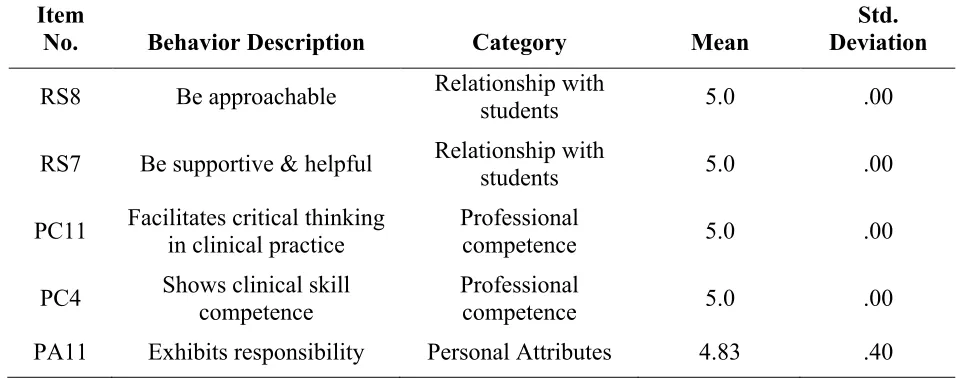
Findings Related to Research Question 3
The third research question asked, “What are the behavioral teaching characteristics
among preceptors that respiratory therapy department supervisors consider the most important?”
Table 4 shows mean scores (M) and standard deviations (SD) of the top 5 most important
effective clinical teaching behavioral characteristics ranked by respiratory therapy department
supervisors. Data results were tabulated and presented in Table 4, which includes the item
number on the survey, a description of the teaching behavior, and the corresponding category for
each teaching behavior. Respiratory therapy department supervisors ranked the behavioral
teaching characteristics "Be approachable," "Be supportive & helpful," "Facilitates critical
thinking in clinical practice," "Shows clinical skill competence" as the most effective with a
26
Table 4. 5 Most Effective Clinical Teaching Characteristics Ranked by Respiratory Therapy Department Supervisors (n=6)
Item
No. Behavior Description Category Mean Deviation Std.
RS8 Be approachable Relationship with
students 5.0 .00
RS7 Be supportive & helpful Relationship with
students 5.0 .00
PC11 Facilitates critical thinking in clinical practice Professional competence 5.0 .00
PC4 Shows clinical skill competence
Professional
competence 5.0 .00
PA11 Exhibits responsibility Personal Attributes 4.83 .40
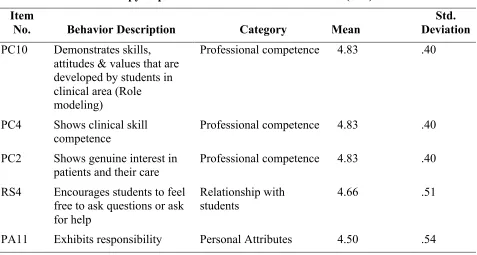
Findings Related to Research Question 4
The fourth research question asked, “What are the behavioral teaching characteristics
among preceptors that respiratory therapy department’s educational coordinators consider the
most important?” Table 5 shows mean scores (M) and standard deviations (SD) of the top 5 most
important effective clinical teaching behavioral characteristics ranked by respiratory therapy
department educational coordinators. Data results were tabulated and presented in Table 5, which
includes the item number on the survey, a description of the teaching behavior, and the
corresponding category for each teaching behavior. Respiratory therapy department educational
coordinators ranked the behavioral teaching characteristics "Demonstrates skills, attitudes &
values that are developed by students in clinical area (Role modeling)," "Shows clinical skill
competence," "Shows genuine interest in patients and their care" as the most effective with a
27
Table 5. 5 Most Effective Clinical Teaching Characteristics Ranked by Respiratory Therapy Department Educational Coordinators (n=6)
Item
No. Behavior Description Category Mean
Std. Deviation PC10 Demonstrates skills,
attitudes & values that are developed by students in clinical area (Role modeling)
Professional competence 4.83 .40
PC4 Shows clinical skill
competence Professional competence 4.83 .40
PC2 Shows genuine interest in patients and their care
Professional competence 4.83 .40
RS4 Encourages students to feel free to ask questions or ask for help
Relationship with
students 4.66 .51
PA11 Exhibits responsibility Personal Attributes 4.50 .54
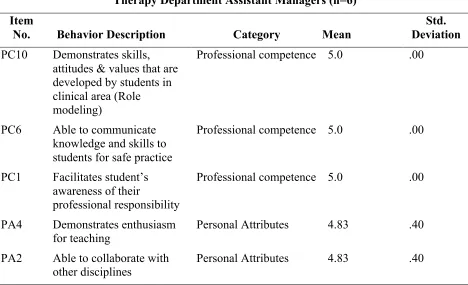
Findings Related to Research Question 6
The sixth research question asked, “What are the behavioral teaching characteristics among
preceptors that respiratory therapy assistant managers consider the most important?” Table 6
shows mean scores (M) and standard deviations (SD) of the top 5 most important effective
clinical teaching behavioral characteristics ranked by respiratory therapy assistant managers.
Data results were tabulated and presented in Table 6, which includes the item number on the
survey, a description of the teaching behavior, and the corresponding category for each teaching
behavior. Respiratory therapy assistant managers ranked the behavioral teaching characteristics
"Demonstrates skills, attitudes & values that are developed by students in clinical area (Role
modeling)," "Able to communicate knowledge and skills to students for safe practice,"
"Facilitates student’s awareness of their professional responsibility" as the most effective with a
28
Table 6. 5 Most Effective Clinical Teaching Characteristics Ranked by Respiratory Therapy Department Assistant Managers (n=6)
Item
No. Behavior Description Category Mean
Std. Deviation PC10 Demonstrates skills,
attitudes & values that are developed by students in clinical area (Role modeling)
Professional competence 5.0 .00
PC6 Able to communicate knowledge and skills to students for safe practice
Professional competence 5.0 .00
PC1 Facilitates student’s awareness of their
professional responsibility
Professional competence 5.0 .00
PA4 Demonstrates enthusiasm for teaching
Personal Attributes 4.83 .40
PA2 Able to collaborate with other disciplines
Personal Attributes 4.83 .40
Findings Related to Research Question 7
The seventh research question asked, “What are the behavioral teaching characteristics
among preceptors that other respiratory therapy department administrators consider the most
important? ” Table 7 shows mean scores (M) and standard deviations (SD) of the top 5 most
important effective clinical teaching behavioral characteristics ranked by other respiratory
therapy department administrators. Data results were tabulated and presented in Table 7, which
includes the item number on the survey, a description of the teaching behavior, and the
29
Table 7. 5 Most Effective Clinical Teaching Characteristics Ranked by Other Respiratory Therapy Department Administrators (n=2)
Item
No. Behavior Description Category Mean
Std. Deviation PA11 Exhibits responsibility Personal Attributes 5.0 .00
PA10 Responds confidently Personal Attributes 5.0 .00 PA3 Demonstrates self-control
& patience Personal Attributes 5.0 .00
PA1 Demonstrates good communication skills
Personal Attributes 5.0 .00
RS5 Allows freedom for discussion
Personal Attributes 5.0 .00
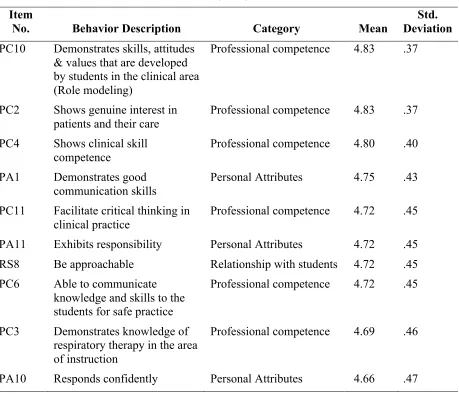
Findings Related to Research Question 8
The eighth research question asked, “What are the behavioral teaching characteristics
among all participants consider the most important?” Table 8 shows mean scores (M) and
standard deviations (SD) of the top 10 most important effective clinical teaching behavioral
characteristics ranked by all participants. Data results were tabulated and presented in Table 8,
which includes the item number on the survey, a description of the teaching behavior, and the
corresponding category for each teaching behavior. All the participants ranked the behavioral
teaching characteristic "Demonstrates skills, attitudes & values that are developed by students in
clinical area (Role modeling)" and "Shows genuine interest in patients and their care "as the most
30
Table 8. 10 Most Effective Clinical Teaching Characteristics Ranked by All Participants (n=36)
Item
No. Behavior Description Category Mean
Std. Deviation PC10 Demonstrates skills, attitudes
& values that are developed by students in the clinical area (Role modeling)
Professional competence 4.83 .37
PC2 Shows genuine interest in patients and their care
Professional competence 4.83 .37
PC4 Shows clinical skill competence
Professional competence 4.80 .40
PA1 Demonstrates good communication skills
Personal Attributes 4.75 .43
PC11 Facilitate critical thinking in clinical practice
Professional competence 4.72 .45
PA11 Exhibits responsibility Personal Attributes 4.72 .45 RS8 Be approachable Relationship with students 4.72 .45 PC6 Able to communicate
knowledge and skills to the students for safe practice
Professional competence 4.72 .45
PC3 Demonstrates knowledge of respiratory therapy in the area of instruction
Professional competence 4.69 .46
31 CHAPTER V
INTERPRETATION OF FINDINGS
This chapter will discuss the interpretations of the findings revealed in Chapter IV.
This chapter is separated into five major sections, which includes an overview of the study,
discussion of the findings, implications and recommendations for future research and a
conclusion.
Overview of the Study
The goal of tis descriptive study was to determine the most important behavioral
characteristics of RT preceptors according to the RT department directors, managers,
supervisors, educational coordinators, assistant directors, and assistant managers that are
responsible for assigning the RT preceptors’ roles, ensuring professionalism and ethics, and
maintaining proper conduct at all times.
Research Questions
1. What are the behavioral teaching characteristics among preceptors that respiratory therapy
department directors consider the most important?
2. What are the behavioral teaching characteristics among preceptors that respiratory therapy
department managers consider the most important?
3. What are the behavioral teaching characteristics among preceptors that respiratory therapy
department supervisors consider the most important?
4. What are the behavioral teaching characteristics among preceptors that respiratory therapy
department educational coordinators consider the most important?
5. What are the behavioral teaching characteristics among preceptors that respiratory therapy
32
6. What are the behavioral teaching characteristics among preceptors that respiratory therapy
assistant managers consider the most important?
7. What are the behavioral teaching characteristics among preceptors that other respiratory
therapy administrators consider the most important?
8. What are the behavioral teaching characteristics among all participants consider the most
important?
Discussion of Findings
Findings Related to Research Question 1
The first research question asked, “What are the behavioral teaching characteristics among
preceptors that RT department directors consider the most important?” Seven out of the thirty-six
respondents (19.4%) in the study, which consists of RT department directors, ranked “shows
genuine interest in patients and their care” as the most important behavioral teaching
characteristics among RT preceptors. This is similar to Madhavanpraphakaran et al. (2013) study
wherein it is believed that the lack of protected time, heavy workload, poor theory-practice
correlation, and the lack of interest in direct patient care by the students reflect how some factors
interfere with preceptorship. In the same way, behaviors such as the preceptors’ commitment to
assist directly with patient care and consistency during shift are seen as very important
behavioral teaching characteristics as well (Madhavanpraphakandaran, Shukri, and
Balachandran, 2014).
Findings Related to Research Question 2
The second research question asked, “What are the behavioral teaching characteristics
33
thirty-six respondents (25%) composed of RT department managers ranked “responds
confidently,” “demonstrates good communication skills,” and “facilitates critical thinking in
clinical practice” as equally the most important behavioral teaching qualities among RT clinical
preceptors. These three were followed close by the qualities “exhibits responsibility” and
“responds confidently.” This is consistent with other studies, such as those revealed by MAHEC
(2015). According to the organization, communication is an important skill that efficient clinical
preceptors should possess. Similarly, it would require a comprehensive understanding of the
concepts and fundamental skills needed to be able to allow the students to acquire knowledge
from a skillful clinical preceptor (MAHEC, 2015).
Additionally, aside from communication, socialization is another important area where
preceptors are expected to be experts (Hammer, 2006). This involves the adoption and display of
the proper attitudes, values, and behavioral practice of a professional (Hammer, 2006). In
preceptorship, it is known that learning should not cease inside (or outside) the classroom. Thus,
through effective preceptorship, students are expected to exhibit responsibility for learning,
empathy, professionalism, and proper communication skills while recognizing the difference
between what is appropriate from what is not (Anderson, Taylor, & Gahimer, 2014;
Wolff-Burke, 2005).
Findings Related to Research Question 3
The third research question asked, “What are the behavioral teaching characteristics among
preceptors that RT department supervisors consider the most important?” Six supervisors
(16.66%) out of 36 total respondents claimed being approachable, as well as supportive and
helpful to be equally the most significant behavioral teaching characteristics in line with
34
professional competence, the supervisors ranked the behavioral teaching characteristics of
facilitating critical thinking during clinical practice and showing clinical skill competence as the
most important qualities for RT preceptors. This finding can be associated with the principles
that motivate the students to learn.
As MAHEC (2015) argues, teaching should build on the foundation of role modeling.
Clinical preceptors, as role models, become a source of motivation and inspiration for the
students, particularly where practical application of clinical skills and knowledge are concerned.
As a result, students are provided with the opportunity to appreciate their craft and clinical
training more because of the increased responsibility expected from them (MAHEC, 2015). For
example, some RT practitioners are required to complete formal preceptorship training in order
to become role models for standardized training and critical thinking skills (Dunlevy, Varekojis,
& Sergakis, 2013). In addition to being fair and objective, the findings are synonymous with the
results of Alasmari and Gardenhire (2015) that reveal the demonstration of knowledge, being
approachable, respecting students and colleagues, and establishing a good student-teacher
relationship are a must in any allied health profession because they represent vital characteristics
of clinical preceptors (Alasmari & Gardenhire, 2015).
Findings Related to Research Question 4
The fourth research question asked, “What are the behavioral teaching characteristics
among preceptors that RT department’s educational coordinators consider the most important?”
Six coordinators (16.66%) out of the thirty-six survey respondents ranked the most important
behavioral teaching characteristics, which are under professional competence, to be role
35
students in the clinical area, and showing of clinical skills competency as two of the equally most
important qualities of RT preceptors.
This finding is relatable to Smedley’s (2000) revelation that role modeling helps students
develop the necessary knowledge, clinical skills, and professional attitudes that are achieved
through guidance, supervision, and personal development (MAHEC, 2015). Likewise, the
findings coincide with the belief that careful analysis further enhances learning, especially when
the preceptor makes learning fun for the students. The key herein is the ability of the preceptor to
be open to the students and to answer any questions they may have that are related to varied
clinical situations. Thus, doing so breeds motivation and adoption of effective learning styles.
Also, the preceptors’ skills in teaching and practice remain significant to the learning success of
the students (MAHEC, 2015; Dunlevy, Varekojis, & Sergakis, 2013). In the end, educational
coordinators perceive role modeling as the key to the preceptors’ and the students’ success.
Findings Related to Research Question 5
There were no assistant directors that responded to the survey. Thus, the research question
that asked, “What are the behavioral teaching characteristics among preceptors that RT assistant
directors consider the most important?” was left unanswered.
Findings Related to Research Question 6
The sixth research question asked, “What are the behavioral teaching characteristics among
preceptors that RT assistant managers consider the most important?” Six out of thirty-six total
survey respondents (16%) composed of assistant managers ranked the qualities that represent
professional competence to be the most significant. These include role modeling, ability to