Georgia State University
ScholarWorks @ Georgia State University
Respiratory Therapy Theses Department of Respiratory Therapy
Spring 4-27-2015
Students’ Perceptions of Using Simulation In
Respiratory Therapy Program
Ahmad Alhaykan
Follow this and additional works at:https://scholarworks.gsu.edu/rt_theses
This Thesis is brought to you for free and open access by the Department of Respiratory Therapy at ScholarWorks @ Georgia State University. It has been accepted for inclusion in Respiratory Therapy Theses by an authorized administrator of ScholarWorks @ Georgia State University. For more information, please [email protected].
Recommended Citation
Alhaykan, Ahmad, "Students’ Perceptions of Using Simulation In Respiratory Therapy Program." Thesis, Georgia State University, 2015.
i
STUDENTS’ PERCEPTIONS OF USING SIMULATION IN RESPIRATORY THERAPY PROGRAM
By
Ahmad E. Alhaykan
(Under the Direction of Professor Chip Zimmerman)
ABSTRACT
Respiratory therapy graduate students are going to face a clinical environment that commands greater responsibility and culpability than in years past. Therefore, respiratory therapy educators must prepare graduates for the multidimensional demands of the workplace. PURPOSE: The purpose of this study was to explore the perception of the undergraduate respiratory therapy (BSRT) and integrated graduate respiratory therapy (MSRT) students in the implementation of simulation in the educational laboratory setting. METHODS: Data were collected through a descriptive survey. The survey was distributed to a convenience sample of first year BSRT and MSRT students attending an accredited respiratory therapy program at an urban public research university in the southeast United States. The survey consisted of 10 questions presented in a four-point Likert-type scale to obtain students’ perceptions regarding their simulation
ii
Dedication
I thank God, the one who is most deserving of thanks and praise for his guidance and support
during this research thesis as well as throughout my life.
I would like to dedicate this research thesis to my loving parents who praise my education since I
was kid. My father, thank you for all what you have done. Your words still linger in my mind. To the
loving memory of my mother who did not live to witness my graduation, may Allah grant mercy upon her
soul. To my beautiful wife, Jawaher, who has supported me in all my endeavors. To my son, Eyad who
makes life fun.
Acknowledgments
I would like to honestly thank my advisor, Prof. Chip Zimmerman for his support and guidance in
making this thesis come perfect. Special thanks to Dr. Lynda T. Goodfellow, your input and support were
amazing and invaluable. I also wish to express my deep thankfulness to Dr. Doug Gardenhire for his great
feedback, comments and advices in completing this thesis. Finally, I would like to thank my dearest and
iii CHAPTER I 1
Introduction ... Error! Bookmark not defined.
Problem Statement ... 2
Purpose of the Study ... 3
Significance of the study ... 3
Definitions of Words and Terms ... 4
CHAPTER II ... 6
Review of literature ... Error! Bookmark not defined. The Classification of Simulation... 6
Overview of Historical and Modern Simulation Modalities ... 7
Clinical Simulation Labs ... 8
Simulation and teaching skills ... 8
Simulation in Physical Therapy: ... 9
Simulation in Medicine: ... 11
Simulation in Nursing ... 12
Simulation in Respiratory Therapy: ... 19
CHAPTER III ... 23
Methodology ... 23
Instrumentation ... 23
Research Design... 24
Sample ... 25
Data Collection and Analysis ... 25
CHAPTER IV ... 27
Results ... Error! Bookmark not defined. CHAPTER V ... 33
Interpretation of findings ... 33
Overview of the Study ... 33
Discussion of Findings ... 34
Implications for Research ... 36
Recommendations for Future Study ... 37
Limitations ... 38
Conclusion ... 38
iv
LIST OF TABLES
Table1. Demographic data of Undergraduate Degree Respiratory Therapy (BSRT) and Graduate Degree Respiratory Therapy (MSRT) Students (n = 32).
Table 2. BSRT students’ overall perceptions of the simulation course. Table 3. MSRT students’ overall perceptions of the simulation course. Table 4. BSRT & MSRT perception of the simulation course.
v
LIST OF FIGURES
1
CHAPTER I INTRODUCTION
Respiratory therapy graduate are going to face a clinical environment that commands
greater responsibility and culpability than in years past. Therefore, respiratory therapy educators
must prepare graduates for the multidimensional demands of the workplace. Simulation is an
innovative teaching approach that has been widely used in health care education and training
over the last several years. It supports the efforts of educators to prepare students for practice
(Hotchkiss, Biddle & Fallacaro, 2002; Nehring, Lashley & Ellis, 2002; Bearnson & Wiker,
2005).
In the 1960s, cardiopulmonary resuscitation programs (CPR) incorporated Resusci-Anne
mannequin to provide hands-on resuscitation training for emergency situations such as cardiac
arrest. Since then, Anesthesiology, Nursing and Respiratory Therapy programs have found
mannequins useful in patient care education primarily because the possibility of human harm
was eliminated. Clinical simulation in health care education has developed exponentially in
recent years and is expected to continue to do so in the future (American Association of Medical
Colleges, 2000; American Association of Colleges of Nursing, 2005)
Moreover, there has been an increased emphasis on patient safety and optimal patient care.
This is typically achieved by the quality of a health care provider’s technical and non-technical
skills, both of which can be improved by utilizing simulation modules (Ohtake, Lazarus, Schillo,
& Rosen, 2013). There has been an extensive amount of research conducted on methods of
optimal learning that have shown that students grasp the understanding of scientific concepts
better when they construct them within practical or tangible models. Unlike the traditional
2
approach and the manipulation of apparatus allowing students the opportunity to apply their
critical thinking. In a simulation lab, students are presented with a situation to work out that is
similar to what they would encounter in a real clinical environment after which they receive
feedback on their performance (Issenberg, McGaghie, Petrusa, Gorden, & Scalese,
2005). Simulation imitates actual life while providing a foundation for teaching, understanding,
and practice.
In spite of the positive implications in respiratory therapy education, there is a lack of
evidence to support overall respiratory therapy best practices for simulation. The development of
an instrument to measure students’ perceptions of using simulation in Respiratory Therapy
program is a significant research challenge. The complexity of the health care system and the
necessity of evidence-based approaches in health care education demonstrate the need for an
evidence base describing and evaluating clinical simulations (Reed, et al., 2005).
There are many health professional schools currently using simulation in their programs.
As a result of this increased use of technology, the need for an evaluation program arises that
would ensure simulations are producing the expected outcomes. Simulation in respiratory
therapy education has not been described or tested empirically, and there are only few studies
that address this role (Tofil et al., 2011), (Rozansky, 2012), (Tuttle et al., 2007).
Problem Statement
The use of simulation in respiratory therapy laboratories has grown exponentially in
recent years. Despite that fact, no instrument exists to measure the students’ perceptions of using
simulation in respiratory therapy programs or how simulation affects their learning process
3
Purpose of the Study
Due to the lack of respiratory education methodology resources, a nurse education
simulation and an allied health program will be utilized to conduct this study. The purpose of this
study is to evaluate students’ perceptions of using simulation in respiratory therapy programs.
There is a need for an instrument for assessment, evaluation, and feedback for respiratory
educators who use simulations in their teaching. The conceptual framework for this study is
derived from the nurse education simulation framework (NESF), which guides the design,
implementation and evaluation of simulations (Jeffries, 2005). The following research questions
were addressed to help steer the study:
1. What are the undergraduate respiratory therapy students’ overall perceptions of the
simulation course that is included in the undergraduate curriculum?
2. What are the graduate (IMP) respiratory therapy students’ overall perceptions of the
simulation course that is included in the graduate curriculum?
3. How integral are simulation experiences to clinical practice in the field of respiratory
therapy?
4. Does the simulation debriefing experience support students’ understanding and
reasoning?
Significance the of study
The specific goal of this study is to advance respiratory therapy programs by
implementing simulation courses in the curriculum as a mandatory requirement prior to clinical
practice. The perception and feedback from students in using alternative learning methods are
essential to modifying the respiratory therapy programs that utilize clinical simulation in a
4
Definitions of Words and Terms
Standardized Patient: A standardized patient is defined as a person who has been carefully
recruited and trained to present an illness or scenario in a systematic, constant manner
affording the students an opportunity to learn in a simulated clinical environment
(Barrows, 1993).
Simulation: Simulations are highly realistic operating models that contain relevant
features of reality. Simulations are designed to symbolize, model, explain, predict
and/or communicate the features, influence, and intrinsic behavior of the modeled system
of interest. When persons participate, the task and task environment must be perceived as
sufficiently real to produce pertinent real-world equivalent behavior (Streufert, Satish &
Barach, 2001).
Human Patient Simulator: The human patient simulator can be defined as a life-like manikin
with advanced computer controls that can be adjusted to provide different physiological
parameter outputs of physical, electrical, or combinatorial nature. The parameters can be
controlled through either automated software or respond to the actions of an evaluator in
response to student actions. (Bradley, 2006).
Fidelity: Fidelity is the degree to which the simulations mimic the reality of the system used.
Simulations may be categorized as low, medium or high-fidelity (Seropian, 2004).
Advanced human patient simulators, which are designed to closely imitate reality, are
5
Summary
One of the main objectives in respiratory therapy programs is to prepare graduates for the
multidimensional demands of the workplace. Simulation supports the efforts of educators to
prepare students for practice. Using an alternative learning method is vital to student learning
outcomes. Students’ perceptions would provide an exploration of this teaching modality and
provide valuable information to respiratory therapy programs that utilize simulation in a
6
CHAPTER II
REVIEW OF THE LITERATURE
Literature regarding the use of simulation in respiratory therapy education as a teaching
modality is sparse. As a result, a literature review of nursing, medical, and other health care
professional training were utilized in this study. Many of these health professions incorporated
clinical simulation in their respective fields of education. The search keywords used to gather
studies for this review included the following: simulation, clinical simulation, nursing, medicine,
physical therapy, respiratory therapy, respiratory care, and education. These search terms were
utilized together to find articles in different databases such as Cochrane Reviews, the Cumulative
Index to Nursing and Allied Health Literature, Science Direct and MEDLINE.
The literature on simulation in different health care specialties presents publications
about: the classification of simulation, the history of simulation, clinical simulation labs, and
how patient safety and care can be enhanced by improving technical and nontechnical skills of
the health care provider. Some health care specialties have had more publications and in-depth
discussions of what particular theories they employ for their simulation framework than others.
The nursing profession provides the most abundant publication sources about simulation.
The Classification of Simulation
Simulation is defined as ‘‘a person, device, or set of conditions that tends to present
problems authentically’’ (Issenberg SB, et al., 2005). Simulation is often classified into four
categories: a standardized patient, a computer, a partial-task, or a high-fidelity simulator (Okuda
& Quinones, 2008). Standardized patients are trained persons acting as a real patient to give
7
interactive program that allows the students to give patient care and receive feedback on their
medical intervention. “Part-task” simulation is a tool or device used to teach a particular skill or
procedure, such as drawing an arterial blood gas sample or placing a chest tube. The high-fidelity
simulator is a dynamic, computerized, whole-body mannequin capable of a multitude of tasks
including: giving a history creating physical exam findings such as abnormal or normal lung and
heart sounds, and displaying physiological changes in blood pressure, respiratory rate, and heart
rate. Moreover, some high fidelity simulators are able to physiologically respond to medication
and oxygen administration, receive electrical cardioversion, and receive diagnostic procedures
such as peritoneal lavage and central lines (Sahu & Lata, 2010). These simulators provide
authentic, clinically relevant opportunities for practical learning. Clinical simulation encourages
students to become more engaged and actively participate in their learning. (Ohtake et al., 2013).
Overview of Historical and Modern Simulation Modalities
The root of modern day simulation lies within the aviation industry. As early as the
1920’s, pilots were learning to operate airplanes in hazardous situations without placing
themselves, their passengers, or their airplanes at risk (Grenvik & Schaefer, 2004). Later on, this
technology began to emerge in health care. In the early 1960’s, the Resusci-Anne mannequin
was created by Peter Safar, an originator of the resuscitation movement, in collaboration with
Laerdal, a doll-maker from Norway (Grenvik, & Schaefer, 2004). This mannequin still being
used today, created a revolution in CPR. Rapidly evolving computer technology and decreasing
costs of simulation development played an essential role in re-emerging interests in simulation-
based medical education, particularly the use of high-fidelity patient simulators in the early
8
popular commercialized simulators that are now being widely used in respiratory therapy
education today and other health professions.
Clinical Simulation Labs
Clinical simulation labs have become an essential modality in the health care education
for many reasons from the need to improve patient mortality rates to broadening health care
practitioner experience levels among an environment that is increasingly difficult to staff.
Respiratory therapists are health care professionals that must be adequately prepared to handle
various clinical situations. Simulation labs are aimed to create an environment that mimics real
world situations to enhance the student’s education and to train them so that they will be
well-equipped even under stressful circumstances. Simulation labs vary from the simple mannequin
head on which to practice intubation skills to a fully equipped room with sophisticated computer
equipment providing a controlled environment that mimic real situations. In the simulation lab,
students can practice the clinical skills without a fear of harming the patient. Furthermore,
simulation lab provides an unlimited number of trials and opportunities to challenge students in a
controlled environment where they are permitted to make errors and learn from them. (Frey, M.
V. 2012).
Simulation and teaching skills
Simulation training can be an effective modality for teaching technical skills. Much of the
literature comes from the surgical realm. In particular, simulator trained residents have acquired
laparoscopic surgical skills more rapidly than they have with traditional teaching methods.
(Aggarwal, Ward, Balasundaram, Sains, Athanasiou, Darzi 2007). In addition, they have
9
operations has a significant effect on decreasing the required time to complete the procedure,
reduces errors, lowers the likelihood of the attending surgeon taking over the procedure, and
increases the overall operative performance (Aggarwal et al., 2007). In respiratory and critical
care medicine there is an evidence suggesting that simulation training improves residents’
performance of endotracheal intubation (Mayo, Hackney, Mueck, Ribaudo, & Schneider, 2004),
and bronchoscopy (Davoudi & Colt, 2008) among other procedures. On the other hand,
simulations have shown to have a substantial impact on teaching non-technical skills. The
acquisition and refinement of nontechnical skills are critical to function effectively in the current
team-based health care environment. In addition to targeted simulation training and debriefing,
multi-disciplinary health care teams showed a significant improvement in their performance with
increased collaboration and teamwork skills among all members. Moreover, physicians and other
health professions have been shown to improve their critical thinking significantly by using
simulation designed to enhance their leadership, communication, and delegation skills.
(Holcomb, Dumire, Crommett, 2002; Ward, 2012).
Simulation in Physical Therapy:
High fidelity simulation is relatively new in physical therapy education. This modality
has the potential to be beneficial in educating physical therapist students in the evaluation and
treatment of patients in the complex acute care setting. Implementation of physical therapy
rehabilitation on patients in the critical care settings has a positive impact on patients’ outcomes.
It plays a significant role in decreasing the duration on mechanical ventilators, decreasing the
number of intensive care unit (ICU) days, and eventually shortening hospital length of stay
(Ohtake, Lazarus, Schillo, & Rosen, 2013). Despite the fact that physical therapy intervention is
10
Mealer, &Moss, 2009) and patients often remain immobile during their ICU stay (Winkelman,
Higgins, and Chen, 2005). Schweickert et al. (2009) support that the implementation of ICU
rehabilitation programs including early mobility. Many physical therapists often report being
uncomfortable and inexperienced for work in this high-risk setting. (Gorman et al., 2010). In the
physical therapy arena, there is a lack of a standardized system that would prepare physical
therapists for ICU practice. (Gorman et al., 2010) Despite this fact, simulation plays an important
role in enhancing a physical therapy student’s confidence in managing patients in ICU. Ohtake et
al. (2013) reported that incorporation of simulated critical care experiences into a physical
therapy clinical course enhanced the confidence of physical therapy students. This experience
improved the technical, behavioral, and cognitive skills of students, and resulted in a high
student satisfaction rate. Students were introduced to the critical care settings through the high
fidelity simulation model, which may possibly increase their interest in working in this practice
area. Moreover, the students had a positive perception of the overall experience with the majority
agreeing that the physical therapy curriculum would be enhanced through the incorporation of
simulation practices within the clinical courses.
Faculty members from the physical therapy and physician assistant programs at Chatham
University conducted a similar study (Bednarek, Downey, Williamson, & Ennulat, 2014). The
aim of this study was to discuss the incorporation of simulation training into the curriculum for
physical therapy and physician assistant students. Simulation experiences were integrated into
the physical therapy curriculum in the cardiovascular and pulmonary course. Content covered in
this experience includes examination and treatment of cardiovascular cases, pulmonary cases,
wounds, and lower extremity amputation. In addition, the course represented the unique aspects
11
reviewing medical charts in addition to identifying and managing different lines, tubes, and
drains. This simulation experience aimed to create a therapist who has the ability to identify
medical equipment, make appropriate clinical decisions and show self-confidence in a safe
environment.
Simulation in Medicine:
In medical education, simulation-based teaching methodologies have been extensively
used to teach technical, communication, and clinical skills. It provides a safe and efficient
platform for practice without real harm. (Nuzhat, Salem, Al Shehri, & Al Hamdan, 2014).
Exposure to simulation for medical students is a valuable tool to enhance knowledge and student
self-confidence at a key transition period prior to beginning of internship (Halm, Lee, & Franke,
2010).
Simulation use in various levels of medical school education
Basic science. Simulation in basic science education has been widely used by medical
educators (Kelsey, Botello, Millard, & Zimmerman, 2002). Via et al. (2008) conducted a study
on second-year medical students in a pharmacology course. This study aimed to evaluate the
students’ perception of using simulation by using a full-body simulator to show changes in
cardiac output, heart rate, and systemic vascular resistance in response to volatile anesthetics.
Students’ perceptions of using this method were considerably higher with as much as 95% of
students noting that it was a valuable use of their time and 83% of the students preferring this
method over traditional classroom lectures.
Physical examination. Simulation has been used to teach basic physical examination
skills, and dealing with systems such as the heart and lungs. In a 1968 multicenter study
12
teach different cardiac conditions for both normal and abnormal findings. This simulator
mimicked respiratory sounds, heart sounds, pulses, jugular venous pulsations, and precordial
pulsations. This part-task simulator was created to address the limitations of patient exposure and
to help teach abnormal cardiovascular examination findings to medical students (Okuda &
Quinones, 2008).
Skills training. Simulation in medical education is an effective method of teaching
procedural and surgical skills training. A study conducted by Van Sickle et al. (2006)
demonstrated that using a laparoscopic suturing part-task simulator improved the ability of
medical students to learn advanced technical skills compared to those of senior level residents
within a short period of time. For non-surgical skills such as central line insertion, chest tube and
cricothyrotomy, medical students with simulation training showed more confidence and were
more willing to do those procedures on their own in comparison to those trained without
simulation.
Simulation in Nursing
In nursing education, it is essential to improve the learning of theoretical concepts by
making theory appropriately relevant for clinical practice (Benner, 2010). In order to do so,
simulation has been used as an educational method to assist students in transferring theory to
specific patient situations in focus. Teachers play an essential role in facilitating and assisting
students in providing nursing care in complex patient conditions (Benner, 2010). However, in
clinical practice, such facilitation may be difficult due to time constraints and concerns for
patient safety (Morgan, 2006).
Nursing education is being altered by technological developments in simulation. These
13
educators. Today, students are expected to be qualified to acclimatize to the multifaceted
demands of the workplace upon graduation, which requires a learning environment that allows
for critical thinking, self-confidence and experiential learning (Blum, Borgland, & Parcells,
2010). Students must be given opportunities to make a connection between classroom theory and
the experiences of the clinical setting. Simulation is a vital link in this practice because it allows
faculty to create laboratory environments that replicate actual clinical scenarios. In the
simulation laboratory, students can practice nursing intervention procedures, prioritize patient
care and improve communication skills within a safety environment. The outcomes that may
result from integration of simulation in undergraduate nursing programs include reduced anxiety,
increased knowledge retention, and development of psychomotor skills before encountering the
reality of actual care settings (Billings & Halstead, 2012).
Based on the positive impact of using simulation in undergraduate education, many
schools recommend the application of simulation throughout the nursing curriculum. Because
this task is not easy to undertake, the foundational level of the nursing curriculum has become a
primary point to initiate this type of educational method (Kardong-Edgren, Starkweather, &
Ward, 2008). Students at this level are very concerned about treating patients clinically, lack of
critical thinking practice, and are beginners in their psychomotor skills. Using simulation at this
level has been proven to be beneficial in these three skills. (Dearmon et al., 2013).
Overview of the nursing education simulation framework
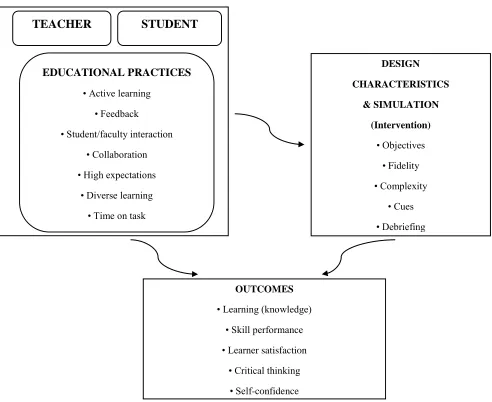
The Nursing Education Simulation Frame Work (NESF) derived from the theoretical and
experiential literature. It is intended for all types of simulation, regardless of the level of fidelity
designed for use in nursing education today. A group of professional organizations, staff
14
health care professions, worked together to proposed this framework. NESF guides the processes
of designing, implementing and evaluating simulations in nursing that aim to identify teaching
and learning practices with simulation that contribute to positive outcomes, the role of the
teacher in simulation, and the overall teaching and learning process (Jeffries, 2005).
Clinical simulation, in conjunction with clinical experience plus other teaching methods is
considered an excellent tool to prepare students for the complexities of the workplace. (Morton,
1997).The five major components that presented in this framework are best practices in
education, student factors, teacher factors, simulation design characteristics, and outcomes.
Effective teaching and learning using simulations mainly depend on teacher and student
interactions, expectations, and roles of each during these practices. Therefore, the two
components of the framework that must work harmoniously together are the teacher and the
15
Figure 1. Simulation Model (Jeffries, 2005).
Teacher Factors. Teachers play a significant role in the success of the simulation as an
alternative learning experience. During simulation exercises, the teacher acts as a facilitator in
the student learning process unlike the traditional classrooms setting where the teacher is the
main speaker. The role of the teacher varies depending on whether the simulation is conducted
for learning or evaluation purposes. (Jeffries, 2005)
TEACHER STUDENT
EDUCATIONAL PRACTICES
• Active learning
• Feedback
• Student/faculty interaction
• Collaboration
• High expectations
• Diverse learning
• Time on task
DESIGN CHARACTERISTICS & SIMULATION (Intervention) • Objectives • Fidelity • Complexity • Cues • Debriefing OUTCOMES
• Learning (knowledge)
• Skill performance
• Learner satisfaction
• Critical thinking
16
Teachers must be ready and feel comfortable with the simulation activities they are using.
They may need help in simulation design, setting up equipment and using technology. As Zerwic
& Theis (1999) demonstrated that a faculty development workshop allowed teachers to practice
feelings similar to those of students. Those feelings allow the teachers to identify the students’
anxiety and discomfort in dealing with a new experience.
Student Factors. Despite the variability of simulation activities, students must be
self-directed and motivated throughout the experience. In simulation lab, students may engage in a
role-play simulation. For instance, one student may play a nurse and another the patient. The
other students may act as observers or actively participate in other activities such as videotaping.
Next, the students can rotate through the roles to learn different experiences (Jeffries, 2005).
Cioffi (2001) discussed two roles of the student: response-based and process-based. In the
response-based role, the learner does not act as an active participant and has no control over the
material presented such as giving a participant the complete written case notes of a real patient.
However in the process- based role, the learner acts as an active participant, selecting the
information presented and its sequence over time (Cioffi, 2001).
Education Practices
According to Chickering and Gamson (1987), education practices can be classified into seven
principles; active learning, prompt feedback, student-faculty interaction, collaborative learning,
high expectations, allowing diverse styles for learning and time on task.
Active learning. Students are expected to learn more through activities that need their
immediate response. For instance, a case in which an intubated patient who developed restless,
agitated and coughing affecting his oxygenation status, the student is asked what are the best
17
Feedback. Simulations offer students the opportunity to learn and practice nursing
theories with immediate feedback regarding their performance, knowledge, and decision-making,
in order to achieve the desired learning outcomes (Byrne et al., 2002).
Student-Faculty interaction. Students and faculty should discuss course content and
learning processes, along with personal and professional aims. One of the simulation goals is to
facilitate discussions between faculty and students that helped promote the achievement of
course objectives. (Roberts, While, & Fitzpatrick, 1992)
Collaborative learning. Students work together as a team in collaborative learning to
solve problems and contribute in the decision making process. Using simulation promotes
collaborative learning and efforts among students, instructors, and other health care practitioners
imitating real-life situations (Gibbons et al., 2002)
High expectation. Students and faculty need to have high expectations for the simulation
process that will reflect ultimately in positive outcomes (Tomey, 2003).
Diverse learning. The increasing diversity of the student requires the faculty to develop
their teaching strategies, curricula, and program development. Implication of simulations can
accommodate a number of learning styles and teaching approaches that may be conducive to the
diversity of students who may have different cultural backgrounds. This modality would provide
an array of options for the students to benefit from the experience (Jeffries, 2005).
Time on task. It is essential to provide the students an initial time, during which the learners
operates the mannequin before simulation session started, will allow them to focus on the
objectives of the session without distraction. Shearer and Davidhizar (2003) suggested that
identifying learning objectives and providing a time frame has to be the first step in establishing
18
Simulation Design
Designing simulation must be suitable to course objectives, skill competencies, and learning
outcomes. There are five areas that should be considered in simulation design including
objectives, planning, fidelity, complexity, cues, and debriefing.
Objectives. Written objectives are essential when simulation activities are used to promote
the students’ learning and outcome achievements. Rauen (2001) suggested that objectives for the
experience and learner knowledge and experience should be matched each other.
Planning. Simulation is a new experience for students. In order to familiarize students with
these activities appropriate planning is necessary. They must be presented with information
about the activity process, amount of time required, role expectations, and outcome expectancies
prior to the simulation (Rauen, 2001).
Fidelity. Clinical simulations mimic health care reality. They must be authentic, convincing,
and inclusive to as many factors as possible (Cioffi, 2001).
Complexity. Clinical simulations range from simple to complex. Task complexity may be
presented as a patient with a complicated case with multiple problems such as confusion,
ineffective airway clearance, and depression. All of these problems are interrelated, but the
available clinical information is irrelevant (Hughes & Young, 1990).
Cues. In a simulation lab, faculty or other assigned persons may help the student in
progressing throughout the simulation activities by providing information about the step the
student is currently working on or may be approaching. (Jeffries, 2005)
Debriefing. It is a valuable tool in simulation activities. It reinforces the positive aspects of
the activities and encourages deep learning, which allows the participant to incorporate theory
into practice, think critically, and discuss how to intervene professionally in very complex
19
reviewing the relevant teaching points as well as discussing the process, outcome, and
application of the scenario (Rauen, 2001).
Outcomes
Knowledge. Fuszard (1995) demonstrated that didactic knowledge gained from simulations is
retained longer than knowledge gained through traditional classroom lectures.
Skill performance. Procedural skills require more attention because of their significance to
patient care. Fuszard (1995) found that this alternative method of education (simulation) will
sometimes result in quicker acquisition of the skill than conventional training methods.
Learner satisfaction. Simulation activities can be evaluated by using instruments to measure
students’ perception of the simulation experience. Overall studies showed that students were
very satisfied with this simulation experience (Engum, Jeffries, & Fisher, 2003).
Critical thinking. Many studies suggested that critical thinking skills are improved when
simulation experience has been used with a variation in measurement tools (Rauen, 2001).
Self-confidence. Simulation activities help the learner in transferring simulation skills into
the clinical settings resulting in increased self-confidence and improved clinical judgments
(Cioffi, 2001).
Simulation in Respiratory Therapy:
In respiratory therapy education, simulation programs, either computer based or
mannequin based, work hand in hand with the multi-faceted educational methods utilized today
in health care education. Education is designed to teach students academic knowledge more so
than practical application. This knowledge must then be utilized appropriately in patient care to:
perform procedures, recognize the effect interventions have on patient outcome, and participate
in continuous health education in order to maintain competence and learn about new
20
students to patient scenarios prior to applying their knowledge to the patient’s bedside and
provide them with the opportunity to demonstrate skills and knowledge without compromising
care or risking harm. In respiratory therapy, utilization of simulation programs provides an
advantageous educational modality that should be used widely in the future (Barnes, Kacmarek,
Kageler, Morris, & Durbin, 2011). According to the American Association of Respiratory Care
(AARC), utilizing simulation training is recommended for continuing education in order to
improve skills among current practitioners. In addition, this training technique will also be
imperative in the future to educate students both didactically and clinically (Shortliffe & Cimino,
2006). A survey conducted by the AARC (2005) in which they interviewed educators and
managers about respiratory care, determined that the use of simulation is an indispensable
method for therapists training for the practices of neonatal and pediatric respiratory care (Barnes,
Kacmarek, Kageler, Morris, & Durbin, 2011). Currently, the American Heart Association’s
program offers an electronic certificate of Advanced Cardiac Life Support (e-ACLS). In this
program, a case-based approach of simulation is provided to teach different health care
practitioners the advanced skills and knowledge they need to evaluate and manage
life-threatening cardiovascular and respiratory crises. This program is composed of two sessions:
computer-based simulations of patient scenarios and demonstration of ACLS skills on a
simulation mannequin. Furthermore, training with simulators and task trainers provide
respiratory therapists the opportunity to perform specific procedures such as endotracheal
intubations and bronchoscopy (Rozansky, 2012). Simulation patients can be adjusted to mimic a
variety of respiratory diseases, asthma or acute respiratory distress, and patients undergoing
21
Respiratory therapists either as college-based instructors or hospital department educators
need to be advocates of simulation teaching in order to enrich students’ skill development,
refinement, and competency for clinical practice (Walsh, Gentile, & Grenier, 2011). Tuttle et al.
(2007) demonstrated the implications of simulation technology in the teaching of mini
Broncho-alveolar lavage procedure, one of which was an enhanced competency of this procedure within
the respiratory therapy staff. Rozansky (2012) has suggested that the incorporation of simulation
training into respiratory therapy education curricula is essential. One of the respiratory therapy
programs that has done this is School of Respiratory Therapy in St Augustine, Fla at St Johns
River State College. Students there gained experience from clinical simulation lab that they
might otherwise not often find in the clinical setting. This training prepares students to be more
ready for the workforce as respiratory therapists. (Scalese, Obeso, & Isenberg, 2008).
Barnes et al. (2011) have argued that the use of simulation undoubtedly will need to
increase significantly in the future. There are numerous modalities, both in computer and human
simulation that have a substantial impact on respiratory therapy education. One of the challenges
in increasing the education requirement to the baccalaureate level might be in providing
additional training opportunities. Despite the fact that the experience of direct patient care cannot
be substituted, valuable knowledge, indirect patient care, and practice can be gained in the safety
of the simulation environment.
MacIntyre (2004) demonstrated that respiratory system simulations and modeling is
classified into three major types, beginning with simple mechanical devices to more complex
systems that include advanced computer systems. He categorized simulators and modeling as
patient signs and symptoms simulation, anatomic models of the respiratory system, and
22
simulator that includes ventilators, anatomical modeling of upper-airway and respiratory system
mechanics, breathing sounds, and gas exchange. Airway simulation systems include
bronchoscopy simulation with three-dimensional virtual bronchoscopy. These simulation
systems and models can improve the understanding of disease processes and guide therapies for
respiratory therapists and other health care provider.
Summary
Simulation continues to be an important part of respiratory therapy programs.
It has been equally important in other health professions that have implemented strategies
dedicated towards creating highly qualified health care practitioners. Physical therapy have been
involved in this type of education method through simulation experiences in enhancing students’,
confidence in managing critical care patients. In medical education, simulation-based teaching
methodologies have been broadly used to teach basic sciences, physical examinations and skills
training. Other specialties have designated resources framework that can be used to design,
implement, and evaluate simulations, such as in nursing. The clinical simulation in respiratory
therapy education is continuously growing. Currently, respiratory therapy programs vary in their
implementations of simulation prior to the clinical training. According to AARC, utilizing
simulation training is recommended for continuing education in order to improve skills among
23
CHAPTER III Methodology
In this study, the researcher evaluated using simulation in a respiratory therapy program
as a mandatory requirement prior to the clinical practice course. Perceptions and impact on
respiratory therapy students learning processes were examined. The study was completed using
a survey to identify the need to implement a simulation course prior to the clinical practice in the
hospitals. The survey was distributed to undergraduate respiratory therapy (BSRT) and
integrated graduate respiratory therapy (MSRT) students at the participating school. Moreover,
the committee members reviewed the instrument and discussed every element of the instrument
to finalize a survey of ten questions. This chapter describes the methods and procedures that
were used to develop this study.
Research Questions
This study was used to answer the following questions:
1. What are the undergraduate respiratory therapy students’ overall perceptions of the
simulation course that is included in the undergraduate curriculum?
2. What are the graduate (IMP) respiratory therapy students’ overall perceptions of the
simulation course that is included in the graduate curriculum?
3. How integral are simulation experiences to clinical practice in the field of
respiratory therapy?
4. Does the simulation debriefing experience support students’ understanding and
24
Instrumentation
The instrument developed in this study was a survey that was designed by Howard et al.
(2011). Their purpose was to implement and integrate the use of high-fidelity human simulation
as a teaching and active learning strategy throughout the undergraduate-nursing curriculum. This
survey was edited and modified to evaluate student perception of using simulation in respiratory
therapy as a mandatory requirement in the curriculum prior to a clinical practice course.
Permission was sought from the author to allow use of the survey instrument. After obtaining the
permission of use, the survey was modified using a Q-sort method to evaluate the respiratory
care students’ perception of using simulation as a mandatory requirement in the curriculum prior
to clinical practice course.
Validity and reliability refer to the consistency and accuracy of the used instrument
(Burns & Grove, 2005). In the original study, the internal consistency was reported as
Cronbach’s alpha = .87, suggesting that the instrument was reliable. A four-point Likert-type
scale was used to obtain the students’ perceptions regarding their perception of simulation. An
expert panel of respiratory therapy educators verified content validity.
Research Design
A survey of descriptive exploratory research design was used in this study.
A survey is a method of research that contains answering questions and/or interviews.
The purpose of a survey is using questionnaire interviews to collect data from a sample to report
the population in a research. The survey design used in this study was intended to collect data
from students on how they perceive using simulation in respiratory therapy program curriculum.
One of the benefits of survey research is using only one instrument to collect a large amount of
25
the use of online technologies and reaching large number of participants (Portney & Watkins,
2008).
Sample
The population of this study was a convenience sample of students attending
undergraduate and graduate respiratory therapy programs at an accredited respiratory therapy
program at a leading research university located in the southeastern part of the United States.
Since it was a convenient sampling, subjects were chosen on the basis of availability. The sample
was 32 respiratory therapy students in undergraduate and graduate respiratory therapy degree
programs. Inclusion criteria included students who were enrolled in the undergraduate or
graduate RT 3060/ 6050 course. Exclusion criteria included students from other levels of
respiratory therapy programs, such as associate, diploma, bridge, traditional graduate program,
and from alternate learning methods, such as distance or online. All participants are currently in
their first year of a professional program that requires them to be at a minimum juniors in
college, therefore none will be under the age of 18. A cover sheet was provided to the
participants to inform them of the nature and purpose of the study and assure them of
confidentiality.
Data Collection and Analysis
Georgia State University Institutional Review Board (IRB) permission was obtained prior
to conducting this study. Participants’ rights were protected at all times. Participation was
completely voluntary with implied consent assumed with return of the completed survey. No
names will be used for data collection. Also, there will be no risks associated with being included
in this study. A four-point Likert-type-type scale was used to obtain the students’ perceptions
26
The collected data was analyzed using the statistical program of Statistical Package for
the Social Sciences (SPSS) version 22. Descriptive statistics including frequency, percentage,
mean and standard deviation were performed to identify the differences in students’ perception
regarding their previous simulation experience. Mean scores were calculated for each question,
higher scores implied more agreement of using simulation and lower scores implied less
agreement of using simulation.
Development of Cover Letter
Development of a cover letter occurred by the researcher after examining different examples and
styles of previous similar surveys (Portney & Watkins, 2008). A cover letter sample was created,
it was sent to the thesis advisor for additional examination. The final version was confirmed and
27
CHAPTER IV RESULTS
The purpose of this study is to explore the perception of respiratory therapy students’ in
the implementation of simulation in the educational laboratory setting, as well as to compare
these perceptions in undergraduate degree respiratory therapy (BSRT) and integrated master’s
degree respiratory therapy (MSRT) students. Responses to the simulation evaluation survey are
presented through descriptive statistics using Statistical Package for the Social Sciences 22
(SPSS 22). Students used a Likert-type scale method to respond to the survey statements. The
scale ranged from 1 to 4 (1 strongly disagree, 2 disagree, 3 agree, and 4 strongly agree).
The results are presented in this chapter. Demographic information of the sample and results of
the descriptive statistical analyses are provided.
Research Questions
1. What are the respiratory therapy students’ overall perceptions of the simulation course
that is included in the curriculum by the undergraduate degree respiratory therapy
students?
2. What are the respiratory therapy students’ overall perceptions of the simulation course
that is included in the curriculum by the graduate respiratory therapy?
3. How integral to clinical practice in respiratory therapy are simulation experiences?
4. Does the simulation debriefing experience support students’ understanding and
reasoning?
Demographic Findings
Participant demographical information was collected to provide a description of the
28
(71.9%) participants from the baccalaureate degree program (BSRT) and 9 (28.1%) participants
from the integrated graduate degree program (MSRT) in an accredited respiratory therapy
program at a leading research university. The BSRT students’ age mean = 23.7 (SD ± 4.8) while
the MSRT students were (27.1, ± 3). A majority of the participants were females with 78.1% (n
= 25) from both programs, in BSRT program were 87% (n=20) while in MSRT were 55.6%
(n=5). Moreover, males totaled 29.1% (n = 7) of the sample for both programs, in BSRT
program were 13% (n=3) while in MSRT were 44.4% (n=4). The number of students that they
had any experience working in hospital varied based on curricular track. BSRT students
accounted for 17.4% (n=4) and MSRT students 77.8% (n=7). In addition, regarding to the
survey’s item asking students to indicate if they had any experience with clinical simulation prior
to entering the respiratory therapy program at GSU. Only 8.7% (n=2) of BSRT students reported
that they had clinical simulation experience whereas 55.6% (n=5) of MSRT students had
simulation experience.
Table1. Demographic data of Undergraduate Degree Respiratory Therapy (BSRT) and Graduate Degree Respiratory Therapy (MSRT) Students (n = 32)
Demographic BSRT MSRT (n=23) (n=9)
Mean ±SD/% Mean ±SD/%
Age (years) 23.7, SD ± 4.8 27.1, SD ± 3.0
Clinical Experience 17.4% 77.8%
Simulation Experience 8.7% 55.6%
Female 87% 55.6%
29
Findings Related to Research Question 1
The first research question asked, “What are the respiratory therapy students’ overall
perceptions of the simulation course that is included in the curriculum by undergraduate degree
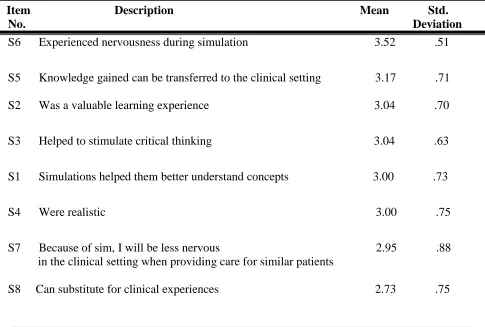
respiratory therapy students?” Table 2 shows mean scores and standard deviation of the
respiratory therapy students’ overall perceptions evaluated by BSRT students. Data results were
tabulated according to the number of survey’s items. BSRT students indicated high agreement
with the statement that they experienced nervousness during the simulation with a mean = 3.52,
[image:35.612.64.549.340.667.2](SD ± .51).
Table 2: BSRT students’ overall perceptions of the simulation course in rank order.
Item Description Mean Std. No. Deviation
S6 Experienced nervousness during simulation 3.52 .51
S5 Knowledge gained can be transferred to the clinical setting 3.17 .71
S2 Was a valuable learning experience 3.04 .70
S3 Helped to stimulate critical thinking 3.04 .63
S1 Simulations helped them better understand concepts 3.00 .73
S4 Were realistic 3.00 .75
S7 Because of sim, I will be less nervous 2.95 .88 in the clinical setting when providing care for similar patients
30
Findings Related to Research Question 2
The second question asked, “What are the graduate (IMP) respiratory therapy students’
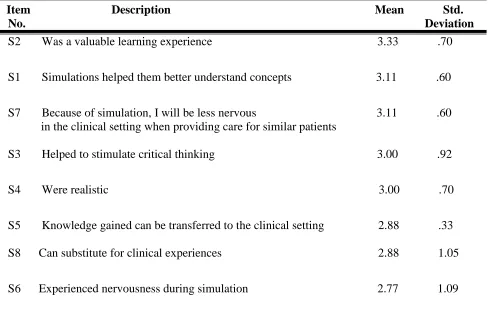
overall perceptions of the simulation course that is included in the graduate curriculum”? Table 3
shows mean scores and standard deviation of the respiratory therapy students’ overall
perceptions evaluated by BSRT students. Data results were tabulated according to the number of
survey’s items. MSRT students indicated high agreement with the statement that simulation was
[image:36.612.64.552.321.646.2]a valuable learning experience with a mean = 3.33(SD ± .70).
Table 3: MSRT students’ overall perceptions of the simulation course in rank order.
Item Description Mean Std. No. Deviation
S2 Was a valuable learning experience 3.33 .70
S1 Simulations helped them better understand concepts 3.11 .60
S7 Because of simulation, I will be less nervous 3.11 .60 in the clinical setting when providing care for similar patients
S3 Helped to stimulate critical thinking 3.00 .92
S4 Were realistic 3.00 .70
S5 Knowledge gained can be transferred to the clinical setting 2.88 .33
S8 Can substitute for clinical experiences 2.88 1.05
31
Findings Related to Research Question 3
The third question asked, “How integral to clinical practice in respiratory therapy are
simulation experiences”? The descriptive statistical results related to this question are
demonstrated in table 3. Both of BSRT & MSRT students responded positively that simulation
should continue to be an integral part of the clinical experience in respiratory therapy program.
MSRT students demonstrated higher agreement with a mean = 3.55 (SD ± .72) also BSRT
students agree with this statement with a mean = 3.47 (SD ± .73).
Table4: BSRT & MSRT perception of the simulation course
Survey Item BSRT MSRT
(n=23) (n=9)
Mean ±SD Mean ±SD
Simulation should continue to be 3.47, (SD ± .73) 3.55, (SD ± .72)
an integral part of the clinical
experience in respiratory therapy program.
Findings Related to Research Question 4
The fourth research question asked, “Does the simulation debriefing experience support
students’ understanding and reasoning”? The majority of the responses to this question agreed
that a debriefing session after a simulation experience supported the understanding and reasoning
32
Table5: BSRT & MSRT perception of debriefing session
Survey Item BSRT MSRT
(n=23) (n=9)
Mean ±SD Mean ±SD
Debriefing experience supported 3.39, (SD ± .65) 3.55, (SD ± .52)
my reasoning and ability to perform in
33
CHAPTER V
INTERPRETATION OF FINDINGS
This chapter will present interpretation of the findings discussed in Chapter IV. It is
divided into five major sections, including overview of the study, discussion of findings,
implications for research, recommendation for future research, study limitations, and conclusion.
Overview of the Study
The purpose of this descriptive quantitative study was to explore the perception of
respiratory therapy students’ in the implementation of simulation in the educational laboratory
setting. Data were collected from an accredited respiratory therapy program at a leading research
university and represents a sample from both baccalaureate and master degree programs. The
research questions leading this study were:
1. What are the undergraduate respiratory therapy students’ overall perceptions of the
simulation course that is included in the undergraduate curriculum?
2. What are the graduate (IMP) respiratory therapy students’ overall perceptions of the
simulation course that is included in the graduate curriculum?
3. How integral to clinical practice in respiratory therapy are simulation experiences?
4. Does the simulation debriefing experience support students’ understanding and
reasoning?
The survey instrument developed in this study was a survey that was designed by Howard
et al. (2011). Their purpose was to implement and integrate the use of high-fidelity human
simulation as a teaching and active learning strategy throughout the undergraduate-nursing
curriculum. The survey was reviewed and modified using a Q-sort method to evaluate the
34
curriculum prior to the clinical practice course. An expert panel of respiratory therapy educators
at Georgia State University completed the revisions and modifications. The committee members
met and discussed each item of the instrument and finalized a survey of ten questions (Appendix
A).
Participants in the study were selected based on a convenience sample of first year
undergraduate (BSRT) and graduate (MSRT) respiratory therapy students who were enrolled in
the undergraduate or graduate RT 3050/ 6050 course. The researcher distributed the survey
packets to thirty- two students of both BSRT and MSRT.
Discussion of Findings
Findings Related to Research Question 1
The first research question asked, “What are the undergraduate respiratory
therapy students’ overall perceptions of the simulation course that is included in the
undergraduate curriculum?” The overall results of this study revealed that both male and
female BSRT students rated (N =23) responded positively that the simulations helped
them better understand concepts (mean = 3.0), were a valuable learning experience (mean
= 3.04), helped to stimulate critical thinking (mean =3.04), and were realistic (mean
=3.0). The respondents also perceived that the knowledge gained from simulations can
be transferred to the clinical setting (mean = 3.17). Nevertheless, although the mean
scores indicate the highest agreement with the statement that students experienced
nervousness during the simulation (mean = 3.52) and that because of the simulation
experiences, they will be less nervous in the clinical setting when caring for similar
35
the lack of simulation experience and clinical experience for undergraduate respiratory
therapy students as reported in the demographic information. Finally, students did not
agree with the statement that simulations can substitute for actual clinical experiences
(mean = 2.73). These findings are similar to what academic programs have reported in
other literature (Howard et al., 2011). Nursing studies have reported that students felt
positively that simulation should be included in the curriculum, with disagreement that it
should be totally substituted for all clinical experiences. Similarly, in pharmacy
programs, participation in a high-fidelity simulation session improved pharmacy
students’ knowledge and understanding (Branch, 2013).
Findings Related to Research Question 2
The second question asked, “What are the graduate (IMP) respiratory therapy students’
overall perceptions of the simulation course that is included in the graduate curriculum”? MSRT
students indicated high agreement with the statement that simulation was a valuable learning
experience with a mean = 3.33 (SD ± .70). The sample for this study (n=32) consisted of BSRT
students (n= 23) and MSRT students (n= 9). Results of the simulation evaluation survey reported
by MSRT students revealed that, on average, students responded more positively on all items
than what BSRT students did with the exception of the item that they experienced nervousness
during the simulation and that because of the simulation experiences, they will be less nervous in
the clinical setting. These findings are expected from MSRT students due to their previous
clinical and simulation experience as indicated in the demographic data, and suggest that these
36
Findings Related to Research Question 3
The third question asked, “How integral to clinical practice in respiratory therapy are
simulation experiences”? Both of BSRT & MSRT students responded positively that simulation
should continue to be an integral part of the clinical experience in respiratory therapy program.
MSRT students demonstrated higher agreement with mean = 3.55 (SD ± .72). Similarly, BSRT
students agree with this statement with mean = 3.47 (SD ± .73). This supports the findings of
Nuzhat et al. (2014), and Medley & Horne (2005) in which a majority of students provided a
positive feedback regarding role of implication simulation as a mandatory course in the
curriculum.
Findings Related to Research Question 4
The fourth research question asked, “Does the simulation debriefing experience support
students’ understanding and reasoning”? The majority of responses to this question agreed that
debriefing session after simulation experience supported their understanding and reasoning from
both BSRT & MSRT. Nursing literature has reported similar findings in which nursing students
indicated that students considered that debriefing session provided adequate opportunity to
address their feelings after the simulation session as well as discussed and evaluated
nontechnical skills, such as communication, clinical reasoning, leadership, and teamwork (Kable,
Arthur, Levett-Jones, & Reid-Searl, 2012; Reese, 2009).
Implications for Research
Respiratory therapy educators are charged to develop and use evidence-based educational
practices to prepare graduates for the multidimensional demands of the workplace. The findings
of this study revealed that respiratory therapy programs recognize the requirement for
37
requirement prior to clinical practice. Another significant finding was the importance of the
debriefing session to support student development of clinical reasoning abilities. Students should
be encouraged to share and discuss what they have made during simulation experience.
Respiratory therapy educators need to thoughtfully design the debriefing as these results add
additional support to previous studies of the high quality learning that occurs during this time.
The study also brings to light the current evidence-based practices for assessment, evaluation,
and feedback for respiratory educators who use simulations in their teaching.
As a respiratory therapy program instructor is aware of students’ perception regarding
using of alternative methods of education that resulted in quicker acquisition of the skills than
conventional training methods. Respiratory therapy educators must strive to form positive
relationships with students to achieve positive learning outcomes. Finally, findings of this study
will add to the literature given the scarcity of studies examining effective clinical education in
the field of respiratory therapy.
Recommendations for Future Study
Due to the lack of studies in respiratory therapy training that address the subject of
student perceptions of using simulation, further research is recommended. Since the sample
chosen in this study represents respiratory therapy program in one university, generalization of
findings in this study might be limited. Therefore, replication of this study is strongly
recommended in order to generalize these findings with a larger sample size involving a number
of accredited undergraduate and graduate respiratory therapy programs. The inclusion of faculty
38
Limitations
This study was limited by a number of factors. The sample was selected from a single
institution comprising of BSRT & MSRT and the number of participants involved was limited to
first year students. The relatively small sample size must be taken into account with regard to the
comparison of different levels of students. The study also did not consider the effectiveness of
simulation as a teaching modality. Finally, this study did not take age, gender, and ethnicity into
account.
Conclusion
Respiratory Therapy educators continue to strive to enhance respiratory therapy students’
clinical reasoning, transference of theory to clinical practice, skills acquisition, and critical
thinking. Using of simulation is essential to achieve these objectives. The results of this study
support the implementation of simulation course in the curriculum as a mandatory requirement
prior to clinical practice as evidenced by positive responses from students through the simulation
evaluation survey. Although students felt positively that simulation should be continue in the
curriculum, they did not feel it should totally substitute for all clinical experiences.
39
40 PART 1: Demographics
1. In which curricular track are you currently enrolled?
A. Undergraduate respiratory therapy (BSRT)
B. Integrated graduate respiratory therapy (MSRT)
2. What is your gender?
A. Male
B. Female
3. Do you have any experience working in a hospital prior to entering the respiratory therapy
program at GSU?
A. Yes
B. No
4. Do you have any experience with clinical simulation prior to entering the respiratory therapy
program at GSU?
A. Yes
B. No
5. What is your age?
41
PART 2: Please circle the response that best describes how you feel about the simulation course.
(RT 3050/6050):
Thank you for completing this survey! Strongly Disagree
Disagree Agree Strongly Agree
1- The simulation course at GSU helped me to better understand respiratory therapy concepts in the clinical setting.
1 2 3 4
2-The simulation course provided a valuable learning experience.
1 2 3 4
3-The simulation course helped to stimulate critical thinking abilities.
1 2 3 4
4-The simulation course was realistic. 1 2 3 4
5-The knowledge gained through the simulation course can be transferred to the clinical setting.
1 2 3 4
6- I was nervous during the simulation experience. 1 2 3 4
7- Because of the simulation experience, I will be less nervous in the clinical setting when providing care for similar patients.
1 2 3 4
8- Simulation experiences can be a partial substitute for clinical experiences in the hospital.
1 2 3 4
9- Simulation should continue to be an integral part of the clinical experience in respiratory therapy program.
1 2 3 4
10- Debriefing after the simulation experience supported my reasoning and ability to perform in the clinical setting.
42