Middle and Secondary Education Dissertations Department of Middle and Secondary Education
5-11-2015
Filtered Identities: A Digitally Active
Mid-Adolescent’s Identity Construction in Social
Networking Spaces
Tara M. Campbell Georgia State University
Follow this and additional works at:https://scholarworks.gsu.edu/mse_diss
This Dissertation is brought to you for free and open access by the Department of Middle and Secondary Education at ScholarWorks @ Georgia State University. It has been accepted for inclusion in Middle and Secondary Education Dissertations by an authorized administrator of ScholarWorks @ Georgia State University. For more information, please [email protected].
Recommended Citation
Campbell, Tara M., "Filtered Identities: A Digitally Active Mid-Adolescent’s Identity Construction in Social Networking Spaces." Dissertation, Georgia State University, 2015.
ACCEPTANCE
This dissertation, FILTERED IDENTITIES: A DIGITALLY ACTIVE MID-ADOLESCENT‟S
IDENTITY CONSTRUCTION IN SOCIAL NETWORKING SPACES, by TARA
CAMPBELL, was prepared under the direction of the candidate‟s Dissertation Advisory
Committee. It is accepted by the committee members in partial fulfillment of the requirements
for the degree, Doctor of Philosophy, in the College of Education, Georgia State University.
The Dissertation Advisory Committee and the student‟s Department Chairperson, as
representatives of the faculty, certify that this dissertation has met all standards of excellence and
scholarship as determined by the faculty.
_________________________________ Ewa McGrail, Ph.D.
Committee Chair
_____________________________ _________________________________
Nadia Behizadeh, Ph.D. Amy Seely Flint, Ph.D.
Committee Member Committee Member
_________________________________ __________________________________
Ann Kruger, Ph.D. Michelle Zoss, Ph.D.
Committee Member Committee Member
_________________________________
Date
_________________________________________ Gertrude Tinker Sachs, Ph.D.
Chairperson, Department of Middle and Secondary Education
_________________________________
Paul A. Alberto, Ph.D. Dean
AUTHOR’S STATEMENT
By presenting this dissertation as a partial fulfillment of the requirements for the advanced degree
from Georgia State University, I agree that the library of Georgia State University shall make it
available for inspection and circulation in accordance with its regulations governing materials of
this type. I agree that permission to quote, to copy from, or to publish this dissertation may be
granted by the professor under whose direction it was written, by the College of Education‟s
Director of Graduate Studies, or by me. Such quoting, copying, or publishing must be solely for
scholarly purposes and will not involve potential financial gain. It is understood that any copying
from or publication of this dissertation, which involves potential financial gain, will not be
allowed without my written permission.
NOTICE TO BORROWERS
All dissertations deposited in the Georgia State University library must be used in accordance
with the stipulations prescribed by the author in the preceding statement. The author of this
dissertation is:
Tara Campbell
Department of Middle and Secondary Education College of Education
Georgia State University Atlanta, GA 30303
The director of this dissertation is:
Ewa McGrail, Ph.D.
Department of Middle and Secondary Education College of Education
CURRICULUM VITAE
Tara Campbell
Education
2015 Ph.D. Teaching and Learning/Language and Literacy, Georgia State University
2007 Ed.S. Curriculum and Instruction, Piedmont University
2001 M.A. Early Childhood Education, Piedmont University
1992 B.A. Middle Grades Education, Mercer University
Professional Experience
August 1992- August 2013 Teacher, Douglas County School System
June 2011-July 2011 Teaching Assistant (Content Literacy), Georgia State University
August 2013-Present K-12 English Language Arts Specialist, Douglas County School
System
August 2014-Present Reading Endorsement Instructor, Douglas County School System
Publications
Flint, A., Anderson, N., Allen, E., Campbell, T., Fraser, A., Hilaski, D… & Thornton, N. (2013). More than graphs and scripted programs: teachers navigating the educational policy terrain. In P.L. Thomas (Ed.), Becoming and being a teacher. (pp. 175-188). New York, NY: Peter Lang.
Campbell, T. (2012). Strategies to support students in world making. Language Arts, 90(1), 15.
Presentations
Campbell, T. and Sowerbrower, K. (2012, November) Integrating Common Core Standards into Middle and High School Classrooms Presentation at Annual Convention of the National Council of Teacher of English, Las Vegas, NV.
Campbell, T. (2012, March) Content Literacy Presentation to Dr. Michelle Ruble‟s Content Literacy Class, Mercer University, Douglasville, GA.
Campbell, T. and Sowerbrower, K. (2012, January) Prequals-3g, Webinar presented for Georgia State University at www.globalconversationsindoctoralpreparations.com
Flint, A., Anderson, N., Allen, E., Campbell, T., Fraser, A., Hilaski, D., James, L., Rodriguez, S., &Thornton, N. (2011, November) When Policies Collide with Conviction Paper presentation at Annual Convention of the National Council of Teachers of English, Chicago, IL.
Campbell, T. (2008, June) The 5 C’s of Gifted Instruction at Gifted Endorsement Series, Douglasville, GA.
Campbell, T. & Leatherman, J. (2007, June) Differentiation at Gifted Endorsement Series, Douglasville, GA.
Professional Service
Member: NCTE, IRA, ALAN, AUA
2013, Young Adult Literature Reviewer, ALAN Online
2013, Peer Reviewer, Language Arts Journal of Michigan
2013, Moderator, Global Conversations in Literacy Research webinar featuring Dr. Julia Davies
2010, Volunteer, National conference for National Association for Gifted Children National
Conference
Filtered Identities: A Digitally Active Mid-Adolescent‟s Identity Construction in Social Networking Spaces
By
TARA CAMPBELL
Under the Direction of Ewa McGrail, Ph.D.
ABSTRACT
Teens, including young teens, are using digital tools, including social networking sites at
a rapidly growing pace (Madden, Lenhart, & Duggan, 2013). However, few studies have
addressed the social networking practices of young teens. In this study, I attempted to address a
gap in the current literature by investigating the online identity construction of a 14 year-old
female who avidly participated on social networking sites. The purpose of this study was to
examine a mid-adolescent‟s use of social networking and what this use might reveal about her
identity construction. The following questions guided the research:
• What are a mid-adolescent‟s thoughts as she decides what to post on social networking
sites to represent herself?
• What do the tools and social practices she uses reveal about her online identity
construction?
This study was grounded in a sociocultural understanding of language, particularly that language
and thought are culturally derived (Vygotsky, 1986) constructs that shape and are shaped by
human activity (Cole, 2003; Wertsch, 1991). Through a sociocultural view of identity, I
recognized that identity is a social construct in which mid-adolescents often experience conflict
(Harter, 2012) as they try to integrate a fragmented, or “kaleidoscopic” (p. 94) sense of self into a
cohesive sense of self.
I used a qualitative single case study design (Merriam, 2009) to investigate the social
networking practices of the participant. Data collection included semi-structured interviews;
think-aloud verbal protocols while using social networking sites; informal phone or instant
messaging interactions between the participant and researcher; participant and researcher
journals; and participant‟s posts to social networking sites. Using a systematic recursive
qualitative method (LeCompte, 2000) informed by Saldaña‟s (2009) coding recommendations, I
found that the participant adhered to perceived online social conventions and used a variety of
digital literacy tools to present socially acceptable filtered identities across three Social
Networking Sites (SNS). Findings suggest that a mid-adolescent would benefit from
opportunities to use digital communication skills in school to present an academic identity in
school-related online spaces.
Keywords: Online Social Networking, Identity, Digital Communication, New Literacies,
Facebook, Instagram, Ask.fm, Sociocultural Research, Qualitative Research, Social Networking
FILTERED IDENTITIES: A DIGITALLY ACTIVE MID-ADOLESCENT‟S IDENTITY CONSTRUCTION IN SOCIAL NETWORKING SPACES
by
TARA CAMPBELL
A Dissertation
Presented in Partial Fulfillment of Requirements for the
Degree of
Doctor of Philosophy
in
Teaching and Learning
in
The Department of Middle and Secondary Education in
the College of Education
Georgia State University
Copyright by Tara M. Campbell
ii
ACKNOWLEDGMENTS
It is difficult to narrow the field of those who have made this project possible to one that can
be addressed in a few words. This difficulty lies partly in the fact that it is hard to determine just
when the work on this project began. Perhaps it started two years ago when I decided to study
this particular topic. Or perhaps it started five years ago when I applied to the doctoral program
in the field of Teaching and Learning at Georgia State University. In my view, it has no concrete
beginning. No deed is accomplished out of context from time and space. I acknowledge that
understanding here as I express my deep appreciation for those who have had the most recent
and, to me, most evident impact on my life and my ability to finish this study:
My committee members, Dr. Nadia Behizadeh, Dr. Amy Seely Flint, Dr. Ann Kruger,
and Dr. Michelle Zoss, who have all volunteered their time and intellectual capital to
assist me throughout the project and, upon whose work mine is built.
My senior advisor and dissertation committee chair, Dr. Ewa McGrail, who always had
great insight on how my work might be improved and who has propelled me to
accomplish more than I imagined I could.
My parents, Bobby and Arlene Hadden, who, even though they may not have understood
it, have always appreciated and encouraged me in my love of academia.
My friends and classmates at Georgia State University without whom this work and the
understandings contained within would not be possible - in particular, Linda James and
Kelli Sowerbrower.
My very willing and forthcoming participant who has tolerated my intrusion into her
iii
endless barrage of questions via text with near lightning speed and smiley face emoticons
peppered throughout
My son, Clint, who made the astounding transition from college boy to self-sufficient
man during the course of this project, despite having a mother who sent text messages
instead of care packages and who has known that he is loved and supported anyway.
My daughter, Avery, who has made a smooth and graceful transition from teenager to
young adult during the course of this project and who has been a willing and insightful
sounding board for my newfound academic understandings as they have unfolded.
Finally, my husband, who, over the last five years, has earned a degree himself, taken up
a martial art in which he will soon earn a black belt, and began learning the banjo. All
the while, he has not merely supported my efforts; he has encouraged them and has been
my most enthusiastic cheerleader even in times when I was not sure I could continue.
Without him, this work would not exist.
For all of those mentioned here and numerous others, I am grateful, openly recognizing that,
while I have the privilege of staking claim to this work, it is not solely mine, but a collective
iv
TABLE OF CONTENTS
LIST OF TABLES……….v
LIST OF FIGURES………..vi
1 INTRODUCTION……….1
Phenomenon to be Studied……….5
Theoretical Perspective………11
Overview of Study………..19
Definitions………...20
2 REVIEW OF LITERATURE……….22
Classic Views of Identity………22
Identity in Online Spaces………29
Summary……….53
3 METHODOLOGY………..55
Research Design……….55
Participant………...…57
Setting……….61
Data Collection………63
Data Analysis………..74
Ethical Concerns and Quality Control………94
4 FINDINGS……….111
Audience Matters……….112
Adherence to Self-Perceived Social Conventions and Participation in Trends…...151
v
TABLE OF CONTENTS, CONT’D
Socially Acceptable Filtered Identities Across SNS………173
Summary……….…...……….……….194
5 DISCUSSION AND IMPLICATIONS……….196
The Complex Cultural Environment of Online SN Tools……….….………..196
Perceived Audience Mediates a Filtered Identity Presentation…….………..207
Social Acceptable Filtered Identities Across SNS………..215
Implications for Practice………..221
Implications for Future Research……….226
Final Thoughts……….228
vi
LIST OF TABLES
Table Page
Data Used to Answer Research Questions………64
Application of Tenets of Theoretical Framework in Analysis………..75
Description of Categories………..85
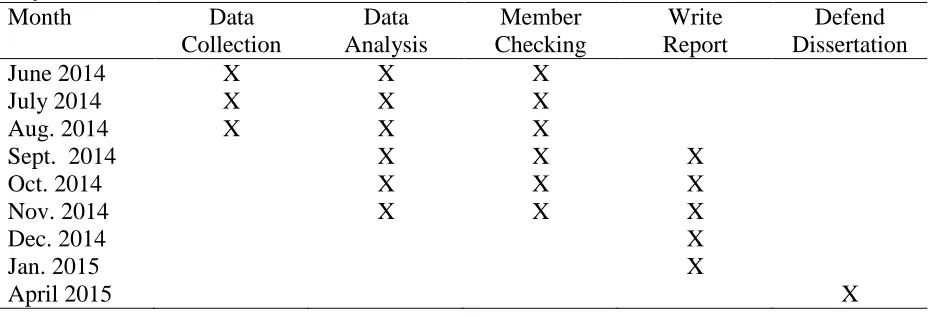
Application of Merriam‟s Suggestions for Quality……….108
Project Timeline………..………110
Types of Questions to Which Trinka Responded on Ask.fm June-August 2014……...131
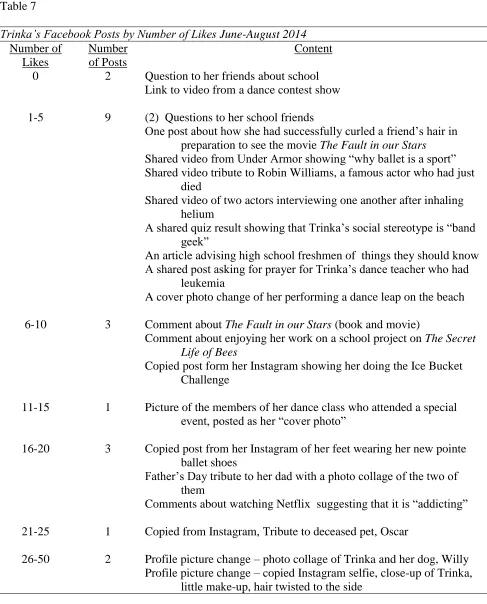
Trinka‟s Facebook Posts by Number of Likes June-August 2014………..135
Trinka‟s Instagram Posts by Number of Likes June-August 2014……….138
Trinka‟s Inspirational Quotes by Visual Content………148
Unwritten Rules of Social Networking………...152
Trinka‟s Facebook Audiences – all have offline connections………176
Trinka‟s Instagram Audiences………179
Trinka‟s Posts about High School across SNS………...192 1
2
3
4
5
6
7
8
9
10
11
12
vii
LIST OF FIGURES
Figure Page
1 Theoretical Framework: Language-Text-Self Connections……….11
2 Number of Posts Made to Instagram January-June 2014………62
3 The Logic of Data Analysis……….76
4 Early Coding Sample………...79
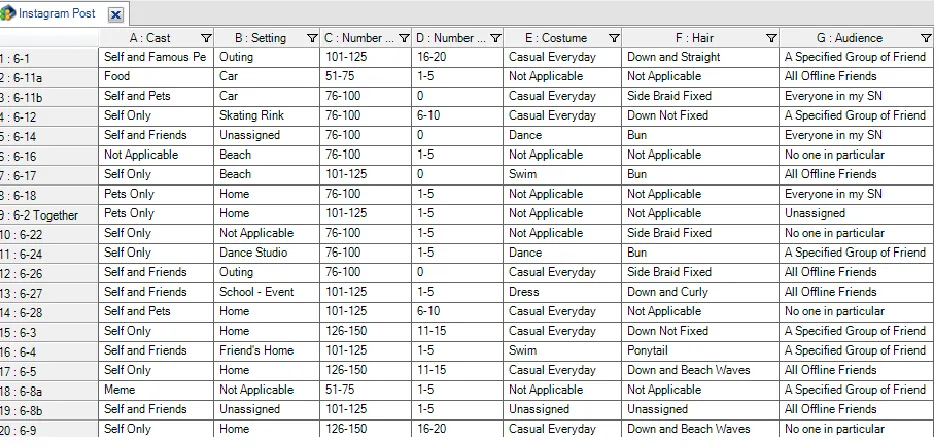
5 Instagram Attribute Table for June Posts………86
6 Creating Patterns………..88
7 Posts Sorted by Audience………89
8 Early Attempt at Thesis………...90
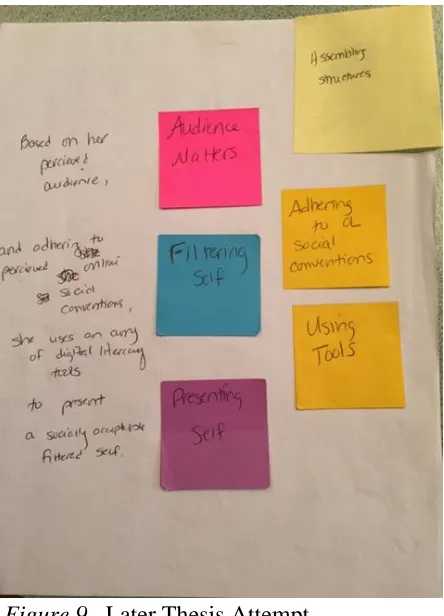
9 Later Thesis Attempt………...92
10 Data Analysis Process………..94
11 Trinka‟s Facebook Audiences………...116
12 Trinka‟s Instagram Audiences………...120
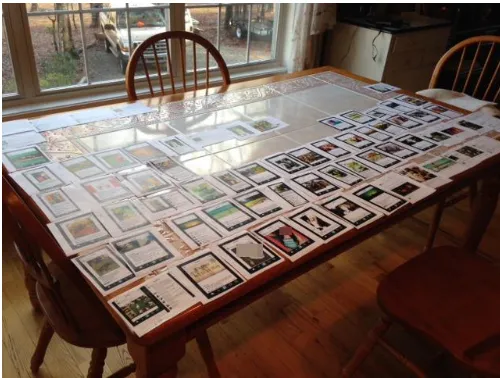
13 Skating Rink and Amusement Park Posts………..122
14 Selfies for Friends………..123
15 Selfie for Self……….125
16 Jam Skating Pose………...127
17 Leap on Beach………...133
18 Most Liked Post……….140
19 Trinka‟s Compliments………...…141
20 Dance Turn Video………..143
21 Be True to Who You Are Selfie………...149
viii
Figure
LIST OF FIGURES, CONT’D
Page
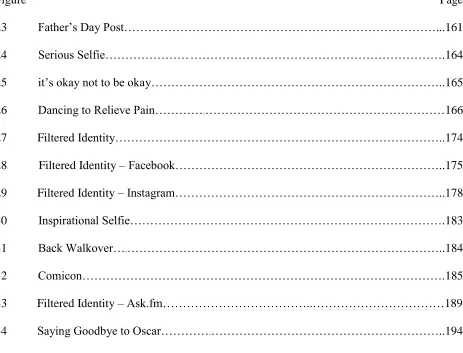
23 Father‟s Day Post………...161
24 Serious Selfie……….……….164
25 it‟s okay not to be okay………..165
26 Dancing to Relieve Pain………….………166
27 Filtered Identity………..174
28 Filtered Identity – Facebook………..175
29 Filtered Identity – Instagram………..178
30 Inspirational Selfie……….183
31 Back Walkover….………..184
32 Comicon……….185
Filtered Identity – Ask.fm………..………189
Saying Goodbye to Oscar………….………..194 33
34
CHAPTER ONE
INTRODUCTION
Today‟s teens have grown up in a dramatically different world than teens from just a
decade ago. As of 2011, 95 percent of US teens use the Internet, and 80 percent of these online
teens use social networking sites (Madden, Lenhart, Duggan, Cortesi, & Gasser, 2013). Digital
communication and social networking sites such as Facebook, Instagram, and Twitter have
revolutionized the way many people communicate, stay in touch with the world, and pass the
time. The use of such sites is nearly ubiquitous with teens, and has increased dramatically over
the past six years, especially among younger teens (Lenhart, Ling, Campbell, & Purcell, 2010).
With young teens constantly texting, posting and tweeting, many adults may assume that it is just
all in good fun or they may just think of it as wasting time without looking hard at what teens are
actually doing in social networking spaces (Barnett, 2009; Berson & Berson, 2006; Notley,
2009). However, the impact of this digital revolution cannot be underestimated; as people change
their environment, they also change themselves (Cole, 2003; Wertsch, 1991). Vygotsky (1986)
emphasized that human communication processes give rise to particular ways of thinking, and
Wertsch (1991) furthered this idea, explaining that human action, which arises in cultural
contexts, is tied to thought processes. The teens of 2014, the year of this study, were engaged in
communication practices and activities that were quite different from teens from any decade
prior, using text messaging and a myriad of social networking sites to communicate with friends
(Lenhart et al., 2010). Vygotsky‟s (1986) and Wertsch‟s (1991) assertions about the
interconnectedness of human action and thought suggest that teens‟ digital practices are shaping
teens themselves are different as they engage in new ways of communicating. To understand
how they are different, more research is needed.
Some researchers have expressed concerns about what these changes might mean
(Bauerlein, 2008; Turkle, 2011). Drawing upon a number of national surveys and standardized
test data from several instruments including the National Assessment of Educational Progress,
Baurlein (2008) claimed, “Instead of opening young American minds to the stores of civilization
and science and politics, technology has contracted their horizon to themselves, to the social
scene around them” (p. 10). Others are more optimistic about the changes; for example, Tapscott
(2009), who has studied media and social change since the 1970s, admitted that some concern
may be warranted, but stated that “overall the kids are alright” (p. 6) and suggested that other
generations can learn from the now under-40 population that he nicknamed the “net generation”
(p. 6). Similarly, Prensky (2011a, 2011b), suggests that today‟s teens, whom he calls “digital
natives (2011a, p. 4), think differently; their brains, he argues are physiologically different
(2011b), and rather than lament over the changes, those of us over 40, “digital immigrants”
(2011a, p. 4) need to accept them. Particularly, he calls for dramatic changes in how we educate
“digital natives”, pointing out that the institution of public education has resisted change,
stubbornly expecting children to conform to ways of thinking foreign to them.
In my experience as a public middle school teacher, I have witnessed how slow the
education community has been to react to the changes in the world and in the very students we
teach. This failure to adapt to an increasingly digital world and the cultural changes that have
ensued has been, in part because of a lack of resources; public schools have historically lagged
behind in regard to technology integration and this remains true today with schools often lacking
cannot blame our limitations solely on funding. Even when digital tools are available, teachers
express reluctance to bring young people‟s new literacies into their classrooms, dismissing them
with comments like, “that‟s just something that they do,” or “it doesn‟t count,” or “that‟s just
computer games” (Burke, 2009, p. 37).
When digital tools are used, their use is often limited to traditionally valued literacy skills
- new ways of doing old things; Burke (2009) noted that school use of digital tools is limited to
word processing, visual lectures through PowerPoint, and using the Internet as an encyclopedia
even though “through their many digital engagements, youth are developing very sophisticated
skills” that greatly exceed those required in the classroom (p. 35). Rowsell (2009) studied three
adults‟ use of Facebook and found that online social networking requires a host of sophisticated
literacy skills including mediating online identities. She argued that online social networking
deserves a place in classrooms and that students‟ evaluation of their own digital literacy practices
is a way to access their funds of knowledge (Moll, 2000), making school more relevant and
opening the door to further literacy learning. Yet, this is not typically happening. In my
experience and according to research, teachers do not often see the value in their students‟ digital
literacies. Sometimes, they are reluctant to use new technologies because they do not feel skilled
in digital tool use themselves (Burke, 2009); other times, teachers feel that the “old” ways are
superior and dismiss teens‟ digital lives as something to pursue in their spare time, or even as a
waste of time altogether (Chandler-Olcott & Lewis, 2010). I would argue, along with Prensky
(2011a, 2011b) and others (Burke, 2009; Rowsell, 2009) that schools must adapt and that to do
so means, in part, understanding the digital worlds of the young people we teach.
Researchers have been working to develop such an understanding; a growing body of
(boyd, 2007; Davis, 2012; Greenfield, 2004; Livingstone, 2008). boyd (2007) found that teens
from age 13-17 and young adults used MySpace to create digital bodies, essentially writing
themselves into being. Davis (2012) found that her 13-18 year old participants‟ Facebook use
promoted identity development processes but that the “unique features of computer-mediated
communication shape[d] adolescents‟ experiences of these processes in distinct ways” (p. 1527).
Livingstone‟s (2008) work with 13-16 year-old online social networkers showed that teens were
balancing the risks (though they did not usually consider them risks) and affordances of social
networking to represent themselves in ways that varied by age and gender. Greenfield (2004)
found that, while children and teens were creating their own cybercultures online, often adults
were largely unaware of them and that when adults were not involved, there were potentially
negative developmental effects: disinhibition in sexuality, aggression, and troubled race
relations; early sexual priming; and models for racism, negative attitudes towards women, and
homophobia.
While researchers (boyd, 2007; Davis, 2012; Greenfield, 2004; Livingstone, 2008;
Subrahmanyam, Greenfield, & Tynes, 2004) seem to agree that young people are shaping the
very nature of their own development processes, more research is needed to understand exactly
how. As my literature review will show, the current research base fails to investigate what
young people are actually thinking when they are participating in social networking.
Additionally, previous research has either focused on older teens and young adults or they have
combined young teens with older teens in their research. There is little research that investigates
the role of social networking in the identity work of young adolescents in particular. More
research is needed to fill this gap since young teens are taking up the use of these powerful
1959/1980; Harter, 2012; Kroger, 2006) and, according to Harter (2012), a fragmented
self-concept she calls the “kaleidoscopic self” (p. 96). Harter (2012), who takes a psychosocial
perspective, believes that the self is both cognitively and socially formed. Therefore, while she
believes that cognitive development tends to occur in a particular order, she also recognizes that
one‟s social and cultural worlds will shape development. Whereas no two people will develop in
the same way, around the age of 14, for many, the self becomes more differentiated, potentially
leading to inner conflict about who one‟s “real” self is; Harter calls this stage mid-adolescence.
This is a crucial time in a young person‟s life, yet little research has explored digital identity
construction of mid-adolescents.
With teen use of social networking steadily climbing (Lenhart et al., 2010), it is
incumbent upon educators, parents, and policy makers to educate ourselves regarding this use
and reach an understanding of its significance in the lives of mid-adolescents. While one study
cannot possibly fill the gap of information needed about mid-adolescents‟ online identity
construction, I hope that this study can be a starting place for more. The purpose of this study
was to examine a mid-adolescent‟s use of social networking and what this use might reveal about
her identity construction.
Phenomenon to be Studied
Social networking has increased to the point of ubiquity for teens in the United States.
According to the Pew Internet and American Life Project (2012), as of 2011, 95% of teens were
using the Internet with social networking the most popular activity (80%), followed by getting
information (62%); buying things (48%); sharing personally created content (38%); video chat
(37%); looking up fitness information (31%); recording/uploading videos (27%); remixing
personal blogging (14%); streaming content for others to watch (13%); and visiting virtual
worlds (8%). The 80% of teens using social networking represents a dramatic increase over the
55% of teens using online social networking just three years earlier in 2007 (Lenhart et al.,
2010). The extreme popularity of social networking sites (SNS) among teens warrants research
into what teens are doing on these sites as they construct identities in those spaces.
For many teens, online activities occur on mobile phones with 78% of U.S. teens owning
phones, 47% of those being smartphones (Madden, Lenhart, & Duggan, 2013). Teens with
mobile phones have their friends and family readily available, and they take advantage of it; 63%
of teens use text messaging daily. These digitally and textually active teens make up a diverse
group, demographically speaking. According to Lenhart (2010) and her colleagues, teens over
14 are more likely to use SNS than those under 14, in part because social networking sites (SNS)
require users to be at least 13. Usage gaps among various groups seem to be closing and/or
shifting. For example, teens from lower income families are more likely to use social
networking than teens from wealthier households, a change from earlier polls which showed no
difference in income of SNS users. The gender gap is closing; whereas in 2006, girls were more
likely to use SNS than boys, in the 2010 poll (Lenhart, Purcell, et al.), there was no difference.
Text messaging also increased for boys and black teens (by a median of 20 texts per day)
between 2009 and 2011, though older girls (14-17) remained the most prolific texters with a
median of 100 texts per day. One constant across demographics is that SNS usage among teens
is increasing.
Clearly, teens are using digital tools, particularly social networking sites and text
messaging quite frequently. What exactly are teens doing in these spaces? Research has shown
Davis, 2012; Lenhart & Madden, 2007; Lewis & Fabos, 2005; Pettigrew, 2009; Subrahmanyam
& Greenfield, 2008; Thurlow, 2003). Research suggests that text messages carry aspects of the
creator‟s social self; the characteristics of text messages reflect social identities (Lewis & Fabos,
2005), personality (Holtgraves, 2011), gender (Tossell et al., 2012), and share some features with
talk (Haas & Takayoshi, 2011; Thurlow, 2003) including the way that people construct
themselves in “diatext” with others (Cortini, Mininni, & Manuti, 2004). Additionally, researchers
(Turner, Abrams, Katic, & Jeta, 2014) found that “digitalk” (p. 157) across social networking
sites, instant messages and text messages is conventionalized according to communities of
practice and audience.
However, teens are not just performing offline activity in a digital forum. There are
complex relationships among offline and online practices. For example, some research suggests
that personality characteristics, like shyness or narcissism influence online activity (Chan, 2011;
Mehdizadeh, 2010; Ong et al., 2010). Other studies have considered how the features of
particular online environments, like ease of posting pictures or the stated purpose of the site,
impact the ways in which users interact and present themselves (Reich, 2010; Schwämmlein &
Wodzicki, 2012; Zhao, Grasmuck, & Martin, 2008). There is also evidence of teens constructing
identity on social networking sites (boyd, 2007; Davis, 2012; Greenfield, 2008; Greenfield,
2004; Livingstone, 1998, 2008; Subrahmanyam, Greenfield, & Tynes, 2004; Subrahmanyam,
Smahel, & Greenfield, 2006; Turkle, 1995; Turkle, 2011; Zhao, Grasmuck, & Martin, 2008). All
of this research has contributed to the conversation about identity construction, while still leaving
room for further exploration, particularly in terms of mid-adolescent SNS use. I will present
Not all researchers are comfortable with the implications of teens‟ digital practices;
some, (Berson & Berson, 2006; Greenfield, 2004) have expressed concern about the general
lack of understanding into issues of teen identity in cyberspace claiming that we must do more to
educate ourselves so that we might educate teens about the ramifications of online behavior.
Barnett (2009), for example, claimed that a new conception of real versus virtual is in order if we
are to grasp the concept of the adolescent self in a digital age:
This passing from spaces once defined by the real/virtual binary, but conceived more
precisely here as movement across the seamless fractal locations of self in late capitalist
culture, requires educational researchers and contemporary practitioners to
reconceptualize our ways of knowing and representing adolescent identity as it is created
concurrently in real and virtual spaces. (p. 201)
According to Barnett, because adolescents are being positioned and positioning themselves as
products in a consumer culture, our old understandings of real and fake are irrelevant in trying to
understand adolescents of today. He also stated that in the digital age, social networking makes
teen identity construction visible to us like never before, and that we must take advantage of the
opportunity to shed our old ways of understanding identity and learn about the teens we seek to
instruct and guide.
In Life on the Screen, Turkle (1995) noted that, when it comes to technology, “it is our
children who are leading the way, and adults who are anxiously trailing behind” (p. 10). She
expressed concern that the face of human identity is changing altogether. Though at the time she
wrote this, she still expressed optimism that we could figure it out and somehow channel our use
of technology, her concern grew throughout the years. More recently, in Alone Together: Why
insecure in our relationships and anxious about intimacy, we look to technology for ways to be in
relationships and protect ourselves from them at the same time” (loc. 150). Turkle found that
social media asks us to oversimplify ourselves and then, once we have done so, we feel the need
to conform to the oversimplified picture we have created. With their lives now organized on
digital display, adolescents may require a new kind of guidance and awareness as they navigate
their changing social roles and transition to adulthood. They may need new kinds of practical
advice as well.
Berson and Berson (2006) called for a better awareness of what teens are doing online so
that we might protect them from creating digital identities that could hinder their future success.
They referred to the collection of digital information about an individual as a “digital dossier”
that when collected by someone else results in an “unauthorized digital biography” of the person.
According to Berson and Berson (2006), teens are largely unaware that they are writing their
own unauthorized digital biographies and are not, because of their age, completely able to grasp
the possible ramifications of the identities they construct online. They suggested that people
exercise more control over their personal information on the Internet and that we need to provide
young people instruction in how they might manage their digital identities.
As an educator, I must argue that education can play a role in this phenomenon.
Unfortunately, as of now, most teens are not getting much, if any instruction on how to manage
their online lives (Berson & Berson, 2006; Greenfield, 2004), and teachers, parents, and
policy-makers are largely ignoring the wealth of literacy practices that teens are developing as they use
digital tools (Notley, 2009). While some teachers have incorporated digital literacies into their
classrooms (Buckingham & Willett, 2006; Hagood, 2012; Hagood, Alvermann, & Heron-Hruby,
“new” digital tools into the learning environment (Chandler-Olcott & Lewis, 2010; Reiser,
2012). Teachers‟ feelings about digital literacies are mixed and sometimes contradictory. A
recent poll of Advanced Placement and National Writing Project teachers (Purcell, Buchanan, &
Friedrich, 2013) showed that most (78%) of them felt that digital technologies foster creative
expression, but 68% of them expressed concern about digital tools, saying that they make
students more likely to take short cuts and not put effort into their writing. Teachers were quite
divided on digital tools‟ effects on grammar with 40% saying that digital tools make students
more likely to use poor spelling and grammar while 38% said that digital tools make students
less likely to do so (emphasis mine). Regardless of how educators feel about digital tools,
though, students are using them. Bringing such tools, including social networking, into the open
in school could benefit teachers and students (Notley, 2009). School would be more relevant to
students if it were to recognize and value teens‟ own literacy practices, including
digitally-mediated social ones (Notley, 2009).
Clearly, there are varying ideas about what adolescents are doing online and what
changes in human development, if any, are happening before our eyes. Research must continue
to evolve along with cultural practices, including digital ones. The teen social world is
drastically different from the worlds of their predecessors to whom they look for guidance. If we
are to understand how communication, friendship and identity building are playing out in the
lives of our teens, we must ask questions and develop rigorous studies to build new knowledge
for parents and educators. The purpose of this study was to examine such questions for a
Theoretical Perspective
Before we denigrate (Bauerlein, 2008; Berson & Berson, 2006; Turkle, 2011) or elevate
(boyd, 2007; Jacobs, 2008; Notley, 2009) youths‟ use of SNS, we must first understand how and
why they use it and how it is affecting who they become. With that in mind, I grounded my
work in what I believe to be true about the nature of human language, text, and self for a
theoretical base. In particular, my study was informed by a socio-cultural view of language, text,
and self; Figure 1 shows that both the creator of a SN message (self) and message itself (text) are
mediated by the tools and practices (language) humans take up. In this section, I describe what
is meant by language, text, and self through sociocultural lens and how these understandings
enabled me to learn about a mid-adolescent through her social networking practices.
Language
Language is at the top of Figure 1, representing that the tools of interaction mediate the
messages that are produced in language as well as the messengers themselves. Language and
thought interact, changing how people think, therefore changing them (Vygotsky, 1986). For an
understanding of how language and thought interact, I draw upon the work of Lev Vygotsky
(1986). While his research took place long before digital tools were invented, his understanding
of the interaction of human thought and language are still relevant. He understood that human
communication, arising through social action, influences how people think. Applied to this
study, this concept illuminates the reciprocal relationship between language and humans; as the
new ways of communication are shaped by humans, they are also shaping humans themselves
(Figure 1). Vygotsky (1986) argued that language plays a central role in human development,
but rather than occurring in rigid, linear stages, speech and thought develop socially, as
culturally-mediated action. According to Vygotsky (1986), all speech and thought has social
origins, and the types of activity in which people engage come to bear upon their thought
processes. It is not merely social interaction itself that influences development and ultimately
ways of understanding the world; the types of actions undertaken as the social interactions take
place are important as well. This understanding of the significance of means of interaction was
important to my study because it allowed me to see digitally mediated interaction as mediating,
not only a communicative act but also the development of its users. In other words, the tools and
practices used on SNS mediate the messages produced there and the people who create them.
A related concept that is central to a socio-cultural understanding of language is the
concept of mediated activity. Wertsch (1991) explained that human action “typically employs
action in essential ways” (p. 12) , pointing out that the action and mediational means are so
connected that when identifying who is performing an action, it would be appropriate to identify
both the individual and the mediational means. In other words, language development is not a
predetermined set of processes that will occur in the same way in every person. And the way
that one communicates (the meditational means) is highly interconnected with the one who
communicates and necessarily shapes the message. Therefore, digital means of communicating
shape and are shaped by those who employ them. In this study, I understood social networking
practices as meditational means that shaped and were shaped by acts of communication and the
identity development of mid-adolescent who participated in them. By studying the practices of a
mid-adolescent SNS user, I was able to learn about how those practices are shaping her identity.
Cole‟s (2003) notion of artifacts was also helpful in establishing the significance of a
teen‟s social networking practices. Cole defines artifacts as mediational tools that are used by
social groups and passed down and modified from one generation to the next giving them a
clearly historical orientation even as their use is grounded in present activity. According to
Cole‟s (2003) definition, artifacts do not merely include physical objects, as the common use of
the word might imply, but may also include the ideal (2003, p. 117); language, therefore, is an
artifact of human culture. Culture, according to Cole (2003), includes “the entire pool of
artifacts accumulated by the social group in the course of its historical experience” (p. 110) and
language is one of these artifacts. This understanding allowed me to see digitally mediated
messages produced by a mid-adolescent online social networker and the social practices they
revealed as artifacts that also revealed traces of her identity (Figure 1).
In a socio-cultural view, drawn from a host of philosophers and researchers (Cole, 2003;
Vygotsky, 1986; Wertsch, 1991), one cannot understate the influence of the mediational means
on human activity. When viewed through a socio-cultural lens, it becomes clear that as a
mediator of social activity, social networking shapes and is shaped by the young teens who are
using it.
Text
From a socio-cultural perspective, a text might be thought of as anything intended to
carry meaning (Cole, 2003; Smagorinsky, 2001; Wertsch, 1991) and as shown in Figure 1,
mediated by the tools used to create it. A socio-cultural view of text allowed me to view a teen‟s
online social networking practices as literacy practices worthy of educational research because
those practices resulted in texts. Smagorinsky (2001; Smagorinsky & O'Donnell-Allen, 1998)
embraces a broad view of what counts as language and represented thought. Smagorinsky
(2001) conceives of signs and tools as both the product and producer of culture, similar to Cole‟s
(2003) understanding of the historical collective of artifacts as culture itself. The signs that
people take up, what they mean and how people employ them are mediated by and mediate the
culture in which they are embedded. A sign is anything intended to mean something; a sign can
be an image, word, letter, gesture, facial expression, and so forth. Furthermore, for
Smagorinsky, a text is any configuration of signs, including all potential modalities like body
language, print, image, and digital creations. Viewed as such, the residual traces of teen social
networking practices and teens‟ articulated understandings of those practices are texts and can be
studied as artifacts that can help us understand them.
Self
From a socio-cultural perspective (Harter, 2012), the self is not a predestined inner
one‟s life as a result of interactions with the environment. As an early writer about identity
which he conceived as a social construction, Erikson (1959/1980) was dissatisfied with Freud‟s
overly negative and deterministic view of what society does to a person. Rather, Erikson
believed that identity and society influenced one another and that understanding the relationship
between the individual and his/her environment at various life stages could help us develop a
“healthy personality” (p. 53). He conceived of adolescence as a time during which young people
experience the crisis of “identity versus identity diffusion” (p. 94), postulating that older children
and teens are trying to reach a state in which one feels a certain continuity of self, an integration
of previous stages in which “meaningful identification led to a successful alignment of the
individual‟s basic drives with his endowment and his opportunities” (p. 94). One way that teens
piece together their own identities is in choosing friends and aligning with or positioning
themselves as different from others. Adolescents‟ social lives are crucial as they attempt to
define themselves. According to Erikson (1959/1980), the formation of cliques and
in-group/out-group mentality commonly associated with the teen years is a psychological defense
against identity diffusion. This notion was important to my study because, in a digitally
mediated world, teen use SNS to form these groups and to define themselves.
Whereas Erikson viewed adolescence as the stage occurring with the onset of puberty
through adulthood, other scholars have elaborated on his theories subdividing adolescence and
the conflicts experienced in the teen years (Harter, 2012; Kroger, 2006). Harter (2012) sees the
self as cognitively and socially formed, taking a psychosocial view. While believing that there
are certain continuous, cognitive stages that come to bear upon one another, like Erikson, Harter
does not see these stages as deterministic lock-step eras through which everyone will pass in the
others and cultural norms/values are as responsible for shaping development of the self as are the
cognitive factors. Harter (2012) builds on some of Erikson‟s (1959/1980) ideas and, as a result
of her observations, subdivides adolescence into three stages through which Western adolescents
are likely to pass.
Harter (2012) defines early adolescence (often occurring between the age 11-13) as a
stage in which the self becomes more differentiated; the ability to think abstractly allows the
early adolescent to integrate self traits into higher order concepts. For example, someone can
identify that he is smart because he can solve problems, does well on tests, and reads books
identified for older children. However, early adolescents compartmentalize these traits and are
not as able as mid- and late- adolescents to notice and therefore reflect on abstractions that are
seemingly conflicting (hard worker at school, but lazy at home). This inability may protect the
young adolescent from distress over such contradictions. Early adolescents are very preoccupied
with what other people think, including peers (Erikson, 1959/1980; Harter, 2012; Kroger, 2006).
Social comparison, which increases in school and other settings at this age, amplifies this
concern. Today, with much of this social comparison taking place online, young teens have
permanent representations of themselves and others to compare and contrast infinitum.
Middle adolescence (usually age 14-16), according to Harter (2012), brings with it the
ability to recognize conflicting abstractions about the self, and this causes a great deal of
uncertainty and stress. Differences in self-expression and feelings are common across different
contexts; middle adolescents are able to recognize them but are unable to resolve them so they
become very concerned with discerning which self is the true self. The result is what Harter calls
the “kaleidoscopic self” (p. 96). Youth in this stage may mirror what they believe others see in
what others‟ think often permeate their daily routines. All of these issues can cause self-esteem
to suffer during this time. This understanding allowed me to think through how a 14 year old
participant presented herself online and whether these digitally mediated constructions-of-self
reinforced or helped to resolve such conflicts.
In this study, I focused on a young girl in Harter‟s mid-adolescent stage. Harter‟s notion
of the mid-adolescent kaleidoscopic self provided a framework through which to view the
participant‟s constructions of self in social networking spaces. Investigating what an adolescent
was thinking about as she decided what to post online can gave me an inside view of some of the
pieces that make up a teen‟s kaleidoscopic self and helped me see how a kaleidoscopic self looks
in digital spaces.
Whereas his work did not apply specifically to adolescents, Goffman‟s (1959) theory of
identity as performance seems salient to some aspects of teen behavior and also provided a
helpful lens through which to view teen digital practices. For Goffman, social interactions
involve a series of presentations in which people attempt, either consciously or subconsciously to
influence the impression they are making on others. Any performance must necessarily take
place in a setting Goffman terms a “front” which is “the expressive equipment of a standard kind
intentionally or unwittingly employed by the individual during his performance” (p. 32).
Though Goffman must have assumed interactions would take place face-to-face, the notions of
performance and front is useful in modern disembodied settings as well. In Identity in
Cyberspace, Miller and Arnold (2009) used Goffman‟s (1959) construct of identity to consider
how it might play out in online spaces suggesting that time spent offline can be viewed as back
regions for the online enactment of self. For example, the time spent writing and revising a text
message). In doing so, they found that people were presenting their hoped-for possible selves
rather than their “real” selves.
Goffman also made the point that “a given social front tends to become institutionalized
in terms of the abstract stereotyped expectations to which it gives rise, and tends to take on a
meaning and stability apart from the specific tasks which happen at the time to be performed in
its name” becoming “a collective representation and a fact in its own right” (p. 37). Could this
be true of digital “fronts” as well? If so, what roles do adolescents adopt as they “perform”
identity in those fronts? Goffman‟s understanding of identity enactment helped me to think
about how an adolescent worked to present particular selves for particular audiences as she
constructed her identity online. Figure 1 shows how the self might be viewed as mediating and
being mediated by the digital tools (social practices and tools) used when creating messages
(texts) in social networking spaces.
From these socio-cultural perspectives, there were several key understandings that were
useful as I researched a teen‟s digital social worlds. They were:
Language and thought are culturally derived(Vygotsky, 1986) ; the tools that mediate
human activity shape and are shaped by the humans who employ them (Cole, 2003;
Wertsch, 1991).
Language is a complex system of signs that are not limited to words and configurations
of words; texts therefore are not limited to the printed word but include any configuration
of signs (Smagorinsky, 2001).
The conception of self is cognitively and culturally derived and is always in flux
self are detected, but not well-integrated, a kaleidoscopic sense of self often emerges
(Harter, 2012); and the self is often enacted through social performance (Goffman, 1959).
If one accepts that language, thought, and identity (sense of self) are all culturally derived and
are mediated by tools, including SNS (Figure 1), then to understand identify construction
requires a deep examination of the reciprocal relationships among thought, identity, tools, and
social practices. This understanding suggests a need to study the literacy practices of students as
a means to gain insight into how they think; they also inform the idea that the signs people
exchange and the tools with which they exchange them are meaningful and reveal something
about the users. Therefore, students‟ online practices are salient signifiers of their growing
thought processes and identity constructions.
Overview of Study
The purpose of this study was to examine a mid-adolescent‟s use of social networking
and what this use might reveal about her identity construction. The following questions guided
my study:
• What are a mid-adolescent‟s thoughts as she decides what to post on social networking
sites to represent herself?
• What do the tools and social practices she uses reveal about her online identity
construction?
• What kinds of identities does she present on social networking sites?
The participant, who is a member of my family, was a 14 year old girl who frequently
represented herself and communicated with others on social networking sites. This was both a
convenience and typical single-case study sample (Merriam, 2009). Whereas it was convenient
phenomenon I was studying. While one person may not be representative of a population, in the
statistical sense, because of my access to her and her avid use of social networking, I was able to
learn about her online self-representation through a process of in-depth data collection and
analysis. As Denzin and Lincoln (2005) point out, what can be learned from a certain case may
be more important than representativeness.
Data sources included semi-structured interviews conducted in person; verbal think-aloud
protocols; the participant‟s posts to social networking sites; text messaging and email interaction
between the participant and the researcher throughout the study; and a reflective journal kept by
the researcher. Throughout the data collection and analysis, I kept the participant informed about
my thinking to allow her to clarify my ideas and help co-construct meaning about her identity
construction in online spaces. I analyzed the data by combining LeCompte‟s (2000) suggestions
for data analysis with Johnny Saldaña‟s (2009) coding suggestions. To assist me with visual data
from the participant‟s online posts, I drew upon Albers‟ (2013) Visual Discourse Analysis
(VDA).
Definitions
Following is a list of terms I will use throughout this report and how I understand each one:
Identity - as informed by several thinkers, a construct of the self that can be formed in
various ways and develop in loose stages (Harter, 2012; Kroger, 2006), which will vary
depending on one‟s social environment and can change over time and be purposefully
presented (Goffman, 1959) to suit one‟s purposes
Kaleidoscopic self (Harter, 2012) – a fragmented sense of self that may occur during
mid-adolescence, possibly causing a great deal of uncertainty and stress as one tries to
Mid-adolescent – as understood by Harter (2012), a stage through which many Western
teens pass in which they recognize their own contrasting traits and struggle (perhaps) to
integrate these contrasting ideas (smart v. forgetful, for example) into a cohesive sense of
self. Youth in this stage will mirror what they believe others see in them and will also
project their own weaknesses and self-doubts onto other
Social Networking Site (SNS) – a broad-based term for any online site on which people
connect with, communicate with, and create content for others (for example, Facebook,
Instagram, Twitter)
As teens have shaped the very nature of their own development through their prolific use
of digital media, researchers have been asking questions about this relatively new phenomenon.
In the next chapter, I will review the research that speaks specifically to adolescent identity
CHAPTER TWO
REVIEW OF LITERATURE
I pointed out in the previous chapter that 80% of teens online use social networking sites
(SNS) daily; they use SNS more than any other online activity (Lenhart, 2012). Jenkins (2006)
describes today‟s world as a participatory culture, which he defines as “culture in which fans and
other consumers are invited to actively participate in the creation and circulation of new content”
(p. 331). Rather than passively receiving media messages as in past decades, in the digital world,
adolescents have the opportunity to take an active role in producing media. As young people
participate in their online worlds, they are not just producing media, but they are creating
themselves (boyd, 2007; Davies & Merchant, 2009; Livingstone, 2008). In this chapter, I will
present a growing body of literature that investigates how human identity plays out in online
spaces (e.g., Reich, 2010; Zhao, 2008; Alvermann et al., 2012; Clarke, 2009; Turkle, 2011); this
review will reveal that the mid-adolescent online social networker remains largely unaddressed
and that methodologies have not captured mid-adolescents‟ in-the-moment thinking as they
create and post content online.
First, I will summarize how seminal research has characterized identity construction
while noting the implications these studies may have for identity construction in online spaces as
well as the gaps these studies have when applied in those spaces. Then, I will review recent
research about the digital practices of teens while addressing what this growing body of literature
suggests about the nature of identity construction in online spaces and what it fails to address.
Classic Views of Identity
In the previous chapter, I explained that classic psychoanalytic and human development
some sense of a unified self develops as a person passes through various stages. He conceived
of these stages as inner conflicts that are, either resolved, resulting in a step toward a healthy
personality, or not resolved, resulting in any number of psychosocial problems. Adolescents,
according to Erikson (1959/1980) experience “identity versus identity diffusion” (p. 94), a stage
in which they struggle with wanting to know who they really are. Colloquially, we might say
that a young person is “finding him/herself”. Social forces come to bear upon this struggle as
adolescents can become very concerned with how members of the peer group view them
(Erikson, 1959/1980; Harter, 2012).
Contemporary psychology researcher Harter (2012), like Erikson, recognizes the social
forces at play in construction of the self. She takes a psychosocial view which sees the self as
being cognitively and socially formed; this view holds that there are certain continuous,
cognitive stages that come to bear upon one another, but rather than beings deterministic
lock-step eras through which everyone will pass in the same manner, they are stages in which
interactions with others and cultural norms/values are responsible for shaping the development of
the self and how one emerges from each stage. Both Erikson (1959/1980) and Harter (2012)
have argued that humans need the sense of an authentic self and suggest that failure to
accomplish certain tasks in each developmental stage can result in obstacles to that goal. For
example, adolescents recognize and become concerned with what Harter (2012) calls “false-self
behavior…[agonizing] over which [is] their true self, the real me” (p. 114). If adolescents are
not able to eventually reconcile their multiple selves into a perceived unified whole, they could
experience any number of pitfalls including low self-esteem; depression; inability to forge
Harter (2012) and Erikson (1950/1980) both claim that adult behavior is important to an
adolescent‟s development of a healthy self. Adults can create problems by giving unwarranted
praise (Erikson, 1959/1980) and by being overly concerned with inflating adolescents‟
self-esteem (Harter 2012). Additionally, the inability to live up to unrealistic goals of adults and
those perceived by society at large can be damaging to the teen‟s personality development.
Harter (2012) specifically points to the larger unrealistic goals people often set for themselves
based on media images, which is a bigger concern in the 21st century than it was when Erikson
(1959/1980) developed his theory (Dill, 2009). Dill‟s (2009) research about the impact of media
on children‟s development supports Harter‟s (2012) claims, showing how the proliferation of
media has resulted in a reduction of time spent socializing with others and is linked to a host of
developmental issues including increased self-consciousness and reduced feeling of self-worth. I
wondered how this developmental concern with what others think and the danger of unrealistic
goals is impacted by the digital revolution and the vast amount of time adolescents spend in
online social spaces. While Erikson could not have conceived of the future of identity
construction in online spaces, Harter (2012) has yet to address how her theories are impacted by
adolescents‟ immersion in digital spaces.
One way that Harter (2012) has expanded on Erikson‟s (1959/1980) theory has been to
develop a more detailed and nuanced explanation of how a construction of self occurs and the
various concerns associated with identity development. One such expansion is a subdivision of
the stages of identity construction; whereas Erikson‟s (1959/1980) “identity versus identity
diffusion” encompassed a time roughly associated with puberty to adulthood, Harter (2012)
describes three phases of adolescence: early, middle, and late. Early adolescence, roughly ages
him to apply abstract descriptions to himself. For example, someone can identify that he is smart
because he can solve problems, does well on tests, and reads books identified for older children.
However, early adolescents compartmentalize these traits and do not often notice and/or reflect
on abstractions that are seemingly conflicting (hard worker at school, but lazy at home). This
inability to recognize such contradictions may protect the young adolescent from distress
(Harter, 2012).
Middle adolescence (ages 14-16), which is the stage of interest in my study, brings with it
the ability to recognize conflicting abstractions about the self, and this may cause a great deal of
uncertainty and stress (Harter, 2012). Differences in self-expression and feelings are common
across different contexts; middle adolescents are able to recognize them but unable to resolve
them so they become very concerned with discerning which self is the true self. The result is
what Harter calls the “kaleidoscopic self” (p. 96) or what Erikson (1050/1980) would have called
“identity diffusion”. Youth in this stage will mirror what they believe others see in them and will
also project their own weaknesses and self-doubts onto others (Harter, 2012). Concerns about
what others think permeate their daily routines, and all of these issues can cause a
mid-adolescent‟s self-esteem to suffer as s/he attempts to develop a sense of a unified (Erikson,
1959/1080) or a true (Harter, 2012) self. Late adolescence (ages 17-19) is marked by
self-representations that “reflect personal beliefs, values, and moral standards that have become the
internalized standards of others…directly constructed from their own experiences…and a greater
sense of agency” (p. 119). Having internalized these representations, late adolescents do not
attribute their traits and values to parents or other socially forming factors from whence they
most likely originated. Teens in this stage, unlike those in mid-adolescence, are able to integrate
across different contexts. Self-esteem generally improves in late adolescence as young people are
better able to discount the importance of their weaknesses while noting their strengths instead.
Social factors that may help are greater levels of autonomy and choice typically afforded older
teens. The peer group is still important, but in this stage many young people find their niche and
become less concerned with what everyone else thinks. It is important to find out just how these
developmental issues contemporary teens‟ online practices are shaping one another; as such, this
study investigated if a mid-adolescent girl‟s online identity reflected a kaleidoscopic or diffused
sense of self and what that self was like.
The social nature of online digital practices was of particular importance to this study.
Adolescents are very concerned with what others think of them, particularly the peer group.
Harter (2012) claimed that adolescents‟ concern with what others think leads to “the first serious
effort at impression management” (p. 311). Impression management is a construct of identity
that Goffman (1959) wrote about in elaborate detail, arguing that humans perform identity, and
as such, must constantly monitor how others perceive them, adjusting their behavior to achieve
the desired impression. Whereas his work did not apply specifically to adolescents, Goffman‟s
(1959) theory of identity as performance is salient to some aspects of teen behavior. While
Harter (2012) did not conceive of self as being mainly enacted on a stage, as did Goffman
(1959), they both note that identity construction includes social interaction in which people
attempt, either consciously or subconsciously to influence the impression they are making on
others, and according to Harter (2012), this effort begins with adolescence.
As people align themselves with one group, they are also positioning themselves as
different from others; this can create a clique-type mentality that popular culture often associates
and the in-group/out-group mentality commonly associated with the teen years as a
psychological defense against identity diffusion. While not condoning the intolerance to those
who are not part of a particular in-group that so many adolescents display, Erikson called for
understanding on the part of adults, writing
… It is difficult to be tolerant if deep down you are not quite sure if you are a man
(or a woman), that you will ever grow together again and be attractive, that you will be
able to master your drives, that you really know who you are, that you know who you
want to be, that you know what you look like to others, and that you will know how to
make the right decisions without, once for all, committing yourself to the wrong friend,
sexual partner, leader, career (p. 98).
Now that such adolescent intolerances are so often quite public (Barnett, 2009; Berson & Berson,
2006), adult reaction to them may be even more important. While understanding of this
intolerance that young people can exhibit may be in order (to a degree) as Erikson (1959/1980)
suggested, concern for those who are the brunt of intolerance may be heightened in light of the
speed and reach that digital tools afford today‟s young people.
Were Goffman (1959) still alive, he might conceive of digital spaces as new kinds of
stages on which people perform, and though he could not have imagined it, his dramaturgical
theory was a useful lens through which to consider a mid-adolescent‟s digital practices.
Adolescents‟ social lives are crucial as they attempt to define themselves (Erikson, 1959/1980;
Harter, 2012), and contemporary adolescents‟ social lives are, at least partly, taking place online.
According to Goffman (1959), any performance (social interaction) must necessarily take place
in a setting which he terms a “front” or “the expressive equipment of a standard kind
suggested in the first chapter, Goffman‟s (1959) constructs of performance and front are useful
in modern disembodied settings, like social networking sites. In Miller and Aronold‟s (2009)
study of college students‟ Facebook posts, they found that the online social networking afforded
their participants time in the back regions (Goffman, 1959) to construct their performances and
allowed them to present polished versions of themselves that approximated what they believed
they could be. Goffman (1959) also suggested that social fronts take on meanings of their own,
giving rise to particular behaviors. In the current study, I attempted to discover some of the ways
digital practices among adolescents have become institutionalized and what roles a
mid-adolescent adopts as she prepared and presented her social networking posts and her resulting
presentations of self.
While Goffman‟s (1959) work provides an interesting frame for attempting to understand
identity enactment in digital spaces, a framework that takes into account the specific
developmental and social issues of the adolescent is also needed to construct knowledge more
salient to those interested in adolescent identity as it plays out in digital spaces.
Erikson‟s (1959/1980) view that teens are experiencing a crisis which necessitates their
establishing autonomy from parents as they work desperately for peer approval is a lens through
which social networking, text messaging, and other digital practices can be understood, but,
viewed in isolation from more contemporary theory, it lacks the complexity needed to
understand the nuanced developmental differences among young people.
It is also important to note that some researchers (Sarigianides, Lewis & Petrone, 2015)
have problematized the construct of adolescence arguing that dominant perspectives of youth not
only unfairly imply that young people will have troubled times as teens, but that these